What base 3 hides
Base 2 lives on the square lattice, and the constant buried in its arithmetic is pi: two random integers are coprime with density 6/pi^2 = 1/zeta(2). Ask the same question in base 3 and the answer is not pi. Base 3 brings 3-fold symmetry, and a lattice with 3-fold symmetry is forced to be hexagonal; its arithmetic is the ring of Eisenstein integers, and the constant that falls out is built from an L-value in the same family as Catalan's constant — a number with no known closed form in terms of pi. Base 2 hid something elementary; base 3 hides something genuinely deeper.
The trap: visibility is base-blind
There is a wrong way to look for the base-3 constant, and it is worth naming. A lattice point (a, b) is visible from the origin exactly when gcd(a, b) = 1 — a condition on the coordinates alone, indifferent to whether those coordinates draw a square grid or a hexagonal one. The density of visible points is 1/zeta(2) = 6/pi^2 = 0.607927... on any rank-2 lattice. Counting on a 3000 x 3000 grid gives 0.608042. So simply re-running a base-2 construction with base-3 tiles returns pi again: the grid lines have not moved. The base-3 difference has to come from the number theory that is native to base 3, not from repeating the base-2 experiment.
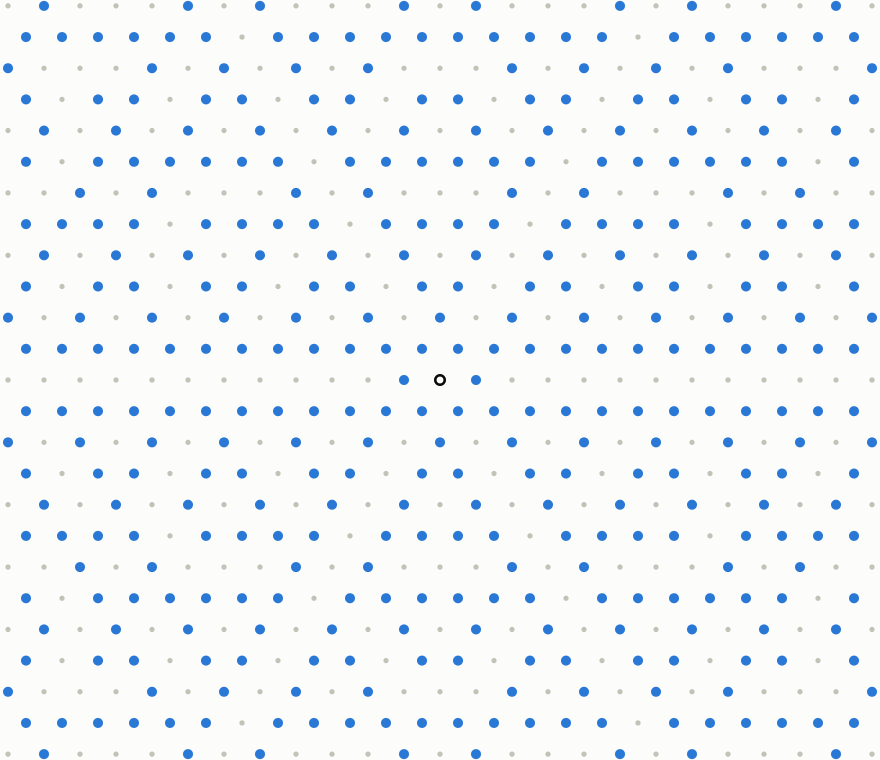
The hexagonal lattice with its visible points marked; the faint points are hidden behind a nearer one. The density of marked points tends to 6/pi^2 here just as on the square grid — the shape of the lattice does not enter. The figure is drawn by lab/base3/makefig.py.
Fresh structure per level
One thing base 3 does change is exact and easy. Refine the unit interval by a base b: level L places nodes at k/b^L. The nodes that are new at level L — not already present at level L - 1 — are those where b does not divide k, and there are b^L - b^(L-1) of them. The fraction of fresh structure per level is therefore (b-1)/b: base 2 refreshes 1/2, base 3 refreshes 2/3, base 5 refreshes 4/5. When b is prime this count is exactly Euler's totient phi(b^L) — the same function that makes primes the maximally novel scales. Higher base injects more new resonance per level, and that is a theorem, not a measurement.
The base-3 constant
A lattice with 3-fold symmetry is forced to be hexagonal — 6-fold in fact, since every lattice is centrally symmetric — and its arithmetic is the Eisenstein integers Z[omega], omega = e^(2 pi i / 3), with norm N(a + b omega) = a^2 - a b + b^2. This ring has unique factorization, so coprimality makes sense in it, and the density of coprime pairs of Eisenstein integers is 1/zeta_K(2), where zeta_K is the Dedekind zeta function of the field K = Q(sqrt(-3)). That zeta function splits into familiar pieces:
zeta_K(s) = zeta(s) * L(s, chi_-3)
chi_-3(n) = +1 if n = 1 mod 3, -1 if n = 2 mod 3, 0 if 3 divides n
Every number below is computed to 40 digits via the Hurwitz zeta (trigamma) form in lab/base3/precision.py and cross-checked by an independent route in lab/base3/sieves.py: the direct Dirichlet series for the L-value, and for zeta_K(2) the raw lattice sum (1/6) * sum 1/N(z)^2 over all nonzero Eisenstein integers, which reproduces the product zeta(2) * L(2, chi_-3) to ten digits.
| constant | value | role |
|---|---|---|
zeta(2) = pi^2/6 | 1.644934066848226 | the base-2 story: elementary, a pi-power |
L(2, chi_-3) | 0.781302412896486 | the base-3 L-value: no known closed form |
zeta_K(2), K = Q(sqrt(-3)) | 1.285190955484149 | product of the two rows above |
1/zeta_K(2) | 0.778094489175179 | density of coprime Eisenstein pairs |
Catalan G = L(2, chi_-4) | 0.915965594177219 | the square-lattice sibling |
1/(zeta(2) * G) | 0.663700804613853 | density of coprime Gaussian pairs |
The density claim is not left to analogy. Running the Euclidean algorithm in Z[omega] — nearest-integer division under the hexagonal norm — on 400,000 random pairs gives a coprime fraction of 0.77809, against the predicted 0.778094. The constant is really there in the lattice, sieved, not asserted.
Not a power of pi
Is L(2, chi_-3) secretly a pi-power, the way zeta(2) = pi^2/6 is? Everything points the other way. The natural candidate is a rational multiple of pi^2/sqrt(3), and an integer-relation search finds none: the continued fraction of L(2, chi_-3) * sqrt(3) / pi^2 runs on with ordinary partial quotients, ruling out every rational with denominator below 10^11. For comparison, the same test applied to zeta(2)/pi^2 terminates instantly at 1/6.
There is a structural reason to expect this. The character chi_-3 is odd (chi(-1) = -1), and for odd characters it is the even-argument L-values that resist closed forms — the same parity barrier behind zeta(3), which has no known pi^3 form. The exact sibling of our constant is Catalan's constant G = L(2, chi_-4) = 0.915965..., one of the famous unresolved constants of analysis: not known to be a pi-power, not even proven irrational. L(2, chi_-3) sits in the same class; its one known relative is Gieseking's constant, via L(2, chi_-3) = (4/(3*sqrt(3))) * Cl2(pi/3) with Cl2(pi/3) = 1.0149416064....
To be precise about the strength of the claim: no search can prove a closed form absent, and no impossibility proof is known. What is true is that none is known, none is expected, and any candidate relation now has to clear a very high bar.
Base picks the field
The two cases line up into one rule. The base selects a lattice symmetry, the symmetry selects an imaginary quadratic field, and the field's Dedekind zeta is the hidden constant.
| base | lattice | ring | field | hidden constant |
|---|---|---|---|---|
| 2 | square (4-fold) | Z[i] | Q(i) | pi via 6/pi^2; Catalan at s = 2 |
| 3 | hexagonal (6-fold) | Z[omega] | Q(sqrt(-3)) | L(2, chi_-3) — Catalan-class |
The arithmetic inside each row is proved; the pairing of base with lattice is the pattern, and it comes with a built-in boundary: beyond the 2-fold symmetry every lattice has, only 4-fold and 6-fold rotations are possible — no 5-fold lattice exists, so there is no lattice for base 5 to live on. Whatever base 5 hides, it is not found this way — which is its own kind of answer.
Base 2 hid pi. Base 3 hides a Catalan-class constant, with a
sqrt(3)riding along as the hexagonal signature. Raising the base does not give more of the same; it climbs from the elementary world of pi-powers into the genuinely unresolved arithmetic of odd L-values.