Cuts
A parity solid is built out of cubes, so you expect a planar cut through it to look like cubes. For one design it does not. Take mrly_126 — the 3D rule that keeps every corner of the parity cube except the two on the main diagonal — and cut it with the diagonal plane x + y + z = s. Every cut is a Sierpinski gasket, the binary digits of the height say which one, and the cut through the middle falls into six congruent gaskets tiling a hexagon.
Every claim below carries a tag. Proved means a proof is given or restated here; Verified means recomputed from scratch for this page; Conjecture means neither. The scripts are lab/cuts/cuts.py and lab/cuts/makefig.py, and nothing here rests on a stored image or an earlier run. Every source named in the literature section was opened and read while this page was written; sources that could not be checked that way were dropped rather than repeated.
The design, and what it already is
mrly_126 keeps the six corners of {0,1}^3 whose coordinates sum to 1 or 2, dropping only (0,0,0) and (1,1,1). Fill depends on the popcount alone, so it is an isotropic design in the sense of the core page, the level-set S = {1,2}, and it is the smallest code in its symmetry class. (Verified by orbit walk over the 48 signed permutations of the cube.) Its level-L solid has 6^L cubes in 8^L, dimension log(6)/log(2) = 2.584963.
That solid has a name already. Centre the six substitution maps at (1/2,1/2,1/2) and they become q -> (q + v)/2 with v running over three antipodal pairs; the linear map carrying those three vectors to e1, e2, e3 carries all six to +-e1, +-e2, +-e3. That is the standard six-map, ratio-one-half octahedron flake, also called the Sierpinski octahedron. The Wikipedia article on n-flakes defines it exactly that way — six octahedra scaled by one half, one at each corner — and gives it dimension log(6)/log(2), the number computed above. The same change of coordinates pulls the functional x + y + z back to the (1,1,1) direction in octahedron coordinates, which is a threefold axis of the octahedron. (Proved; Verified in exact rational arithmetic — the determinant of the centred basis is -1/2, so the conjugation is invertible and exact.)
So the object is not new and the page does not pretend otherwise. What follows is about the cut: an octahedron seen down a threefold axis is a hexagon, which is the whole reason the middle cut has six of anything.
Every diagonal slice is the same size
Each cube of mrly_126 contributes 1 or 2 to the coordinate sum at each scale, so a point of the level-L solid has
x + y + z = sum over k < L of 2^k * d_k, d_k in {1, 2}Subtract the minimum: t = (x + y + z) - (2^L - 1) = sum of 2^k * (d_k - 1), with every bracket in {0,1}. That is an ordinary binary expansion, so it is unique. Two things follow at once. The plane x + y + z = s meets the solid exactly when s = (2^L - 1) + t with 0 <= t < 2^L, and the digits of t fix the weight d_k at every scale. Each scale then offers exactly the 3 corners of that forced weight, so the slice has exactly 3^L points — the same count at every admissible height. (Proved; Verified at L = 1..8 by two enumerations that share no code path, a digit build upward through the 6^L survivors and a sweep of all 8^L positions testing bit-triples, and again to L = 14 by a height recursion that never builds a point set at all.)
Constant is the strong word. The slice count is 3^L against an ambient scaling of 2^L, so every slice has dimension log(3)/log(2) = 1.584963, which is exactly log(6)/log(2) - 1. No height is deficient; the cut never degenerates. (Proved.)
The binary digits of the height schedule the slice
The same argument says which three corners are available, not just how many. At scale k the slice may use the three corners of weight one, 100, 010, 001, when bit k of t is 0, and the three of weight two, 011, 101, 110, when it is 1. Substituting the matching triple scale by scale builds a set with three choices at every scale — a Sierpinski gasket whose per-scale orientation sequence is the binary expansion of the height offset. (Proved; Verified by exact set equality for every offset t at L = 1..6, all 126 slices, not a sample of special heights.)
This is a known mechanism, and the honest statement of the novelty is in its own section below.
Six gaskets in a hexagon
Now take the two central heights. They are t = 2^(L-1) - 1, whose expansion is a 0 followed by ones, and t = 2^(L-1), a 1 followed by zeros. Their top scales are opposite and their lower L - 1 scales are constant, so the schedule splits each slice into three translates of a constant-schedule gasket on 3^(L-1) points. Six pieces in all, pairwise disjoint, three of each orientation:
6 * 3^(L-1) = 2 * 3^Lwhich is the whole of both slices and nothing else. (Proved as a corollary of the schedule; Verified at L = 2..8 by rebuilding the six pieces from the level-L-1 constant-schedule sets and checking their union against the two slices, their pairwise disjointness, and the size of each piece: 18, 54, 162, 486, 1458, 4374, 13122 points.) The union is invariant under all six coordinate permutations and under complementing every coordinate against 2^L - 1, an order-12 symmetry group; the complement swaps the two heights. (Verified at L = 2..8.)
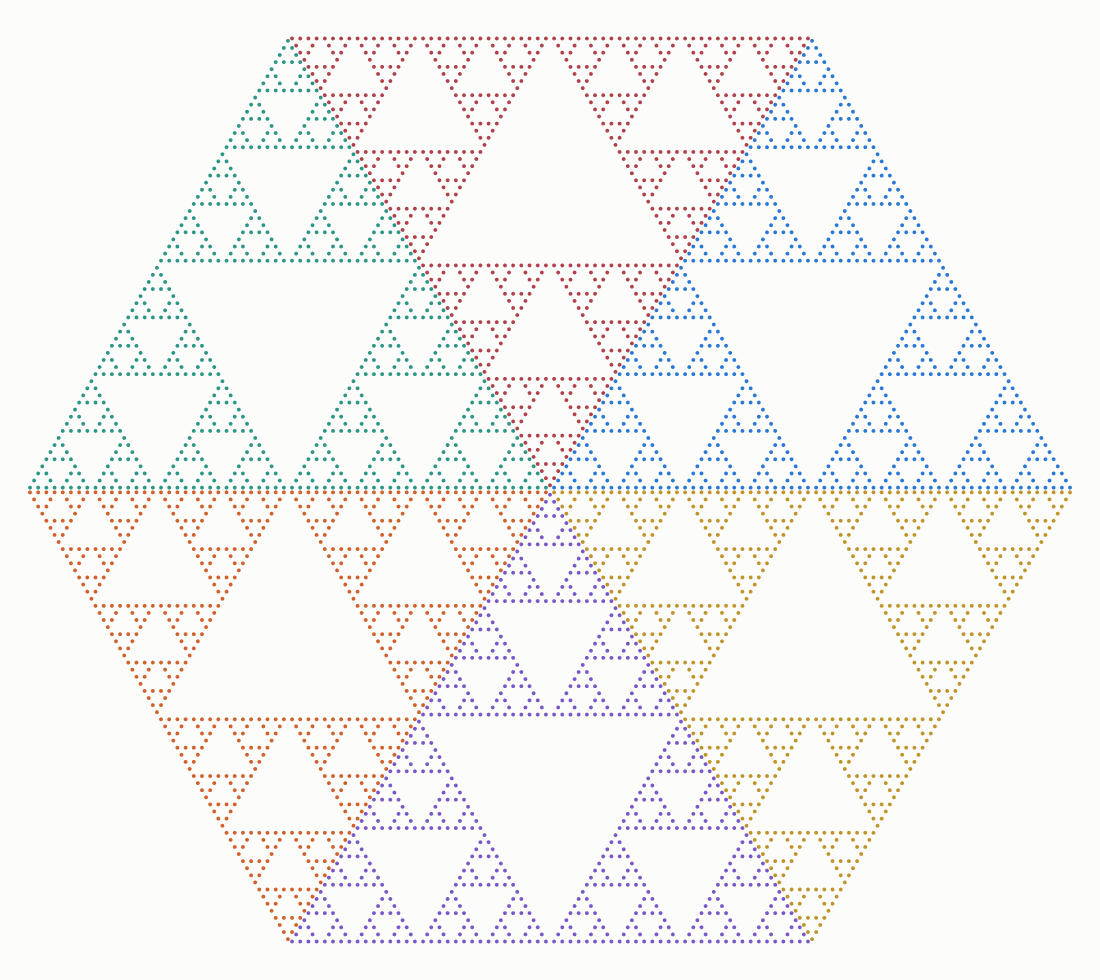
The two central cuts of mrly_126 at L = 7, projected together along the (1,1,1) axis: 4374 lattice points in six gaskets of 729, one colour per piece, three pointing each way. The projection is injective — no two points land on the same spot, checked in exact arithmetic — and the figure is drawn point by point by lab/cuts/makefig.py, which asserts the decomposition before it draws anything.
There is a second, coarser way to split the same set, and the research notes recorded it wrongly. Sort the union by which of the six orderings of x, y, z a point satisfies. The result is six classes of exactly 3^(L-1) - 1 points, plus exactly 6 points with two coordinates equal: the six permutations of (m, m, m+1) and (m, m+1, m+1) for m = 2^(L-1) - 1. The split is perfectly even at every level. (Verified at L = 2..8.) The uneven counts 244, 243, 243, 243, 243, 242 in the research notes were an artifact of how points on a sector boundary were assigned, not a property of the lattice, and they do not survive.
The flat slice is a page of Pascal's pyramid
Set t = 0. Every scale then uses a weight-one corner, so each bit of the height goes to exactly one of the three coordinates: x, y, z have pairwise disjoint binary supports and sum to 2^L - 1. By Kummer's theorem that is precisely the condition for the trinomial coefficient n! / (x! y! z!) to be odd. The lowest slice of mrly_126 is therefore the odd part of layer n = 2^L - 1 of Pascal's pyramid, which is the classical Sierpinski gasket. (Proved; Verified at L = 1..6 against the disjoint-support test, and at L = 1..5 against the parity of the coefficients themselves, computed as integers rather than inferred from Kummer — 3, 9, 27, 81, 243 points.)
That gives the right yardstick for the constant count. Run the same argument on mrly_023, the design that keeps the corners of weight 0 or 1: its digit triples have popcount at most one, so its whole level-L solid is the odd part of Pascal's pyramid, and its slice at height s has 3^wt(s) points, where wt is the binary digit sum. That is the classical layer count. (Proved; Verified at L = 1..6.)
Both halves of that are on record. A268240 is Pascal's tetrahedron of trinomial coefficients read mod 2, and its comments say it "might be called Sierpinski's tetrahedron" and that the number of ones in slice n is A048883(n) = 3^wt(n); A048883 in turn carries the comment that it counts the odd values in layer n of Pascal's tetrahedron. (Verified: both entries read live from OEIS, and A048883's terms 1, 3, 3, 9, 3, 9, 9, 27, ... reproduced by the recomputation above.) Eppstein's fractal-sponge page in the Geometry Junkyard lists "take Pascal's Pyramid of trinomial coefficients modulo two" as one of four equivalent constructions of the Sierpinski tetrahedron, stated as folklore with no proof and no slicing.
So the contrast is exact rather than rhetorical. The classical pyramid's layer count 3^wt(s) swings between 1 and 3^L as the height's digits change; mrly_126's is 3^L at every admissible height. mrly_023 is the same design that draws the Menger sponge at n = 3, listed under carpet and net on the core page — the base decides the shape, and at base 2 it is a tetrahedron flake, four maps at ratio one half on four affinely independent corners. (Verified: 4 of 8 cells at n = 2, 20 of 27 at n = 3.)
What is new here, and what is not
Four separate things are going on, with four different statuses, and the page claims priority for none of them.
The object is known. mrly_126 is the octahedron flake up to a linear change of coordinates, and the diagonal plane is perpendicular to one of its threefold axes; the flake and its dimension are standard, as the n-flake article records.
The hexagon is known as a genre. Cutting a cube-based digit fractal perpendicular to a space diagonal and finding a hexagon with unexpected sixfold structure is a well-travelled move: the Wikipedia article on the Menger sponge states that the cross-section through the centroid perpendicular to a space diagonal "is a regular hexagon punctured with hexagrams arranged in six-fold symmetry", and counts those hexagrams by the recurrence a_n = 9*a_(n-1) - 12*a_(n-2) with a_0 = 1, a_1 = 6, cross-referenced to OEIS A299916 — whose own comment describes six-pointed-star holes in the hexagonal cross-section of a Menger sponge. The n-flake article adds that the projection of the Cantor cube onto the plane orthogonal to its main diagonal is a hexaflake. (Verified: all three read live; A299916's listed terms 1, 6, 42, 306, 2250, ... satisfy the stated recurrence.) Nothing on this page is the first hexagonal diagonal cut of a cube fractal.
The mechanism of the schedule is published, and recently. Nakajima and Watanabe, Topology of slices through the Sierpiński tetrahedron, arXiv:2603.06004, submitted 6 March 2026, study the slice J_c of the Sierpinski tetrahedron at height c. Their Main Theorem A states that if c is a dyadic rational then J_c is a finite disjoint union of copies of the Sierpinski gasket, and they get there by realising each slice as the limit set of a non-autonomous iterated function system determined by the binary expansion of the height: their scale-j index set is {1} when digit j is 0 and {1,2,3} when it is 1. That a base-2 cube fractal cut at a dyadic height is gasket-shaped, with the per-scale map choice read off the digits of the height, is therefore literature. (Verified: abstract, Definition 1.2, Main Theorems A and B and the index-set definition read live.)
The arithmetic framing is classical, as the Pascal's pyramid section says.
What is left, and what this page actually asserts, is the shape the phenomenon takes for this design. Nakajima and Watanabe's digit changes the number of maps, so their slice count varies — their Main Theorem B gives 3^(n-l) components, l the number of zero digits — and at every non-dyadic height their slice is totally disconnected. Here the two options are the weight-one triple and the weight-two triple, both of size three, so the digit flips the orientation of the simplex and never the count: every admissible height gives a single gasket of exactly 3^L points, with no exceptional heights and no disjoint union. That constancy is what makes the six-gasket decomposition of the middle cut possible at all.
The literature pass that produced the sources above did not find that combination in anything it opened, and did not find the design itself under any name. That is a report on a search, not a theorem, and no search of this kind is exhaustive; the dimension theory of slices of self-similar sets with cubic patterns in particular is a mature literature this page has not read and deliberately makes no claim against. The mathematics above stands on its proofs and its recomputation. The question of priority is open and is left open.
The neighbours
The other four designs whose diagonal cuts were rendered, at L = 4. Support is the interval of heights the plane meets at all; the next column counts how many heights inside that interval are actually non-empty. (Verified; the level-L sets and profiles are rebuilt from the corner rules, and all five codes are already canonical.)
| design | rule | support | non-empty | min | max | constant |
|---|---|---|---|---|---|---|
mrly_063 | x and y = 0 | [0,30] | 31 of 31 | 1 | 81 | no |
mrly_105 | popcount even | [0,30] | 16 of 31 | 1 | 81 | no |
mrly_111 | drops (1,0,0) and (1,1,1) | [0,30] | 31 of 31 | 1 | 111 | no |
mrly_126 | popcount in {1,2} | [15,30] | 16 of 16 | 81 | 81 | yes |
mrly_127 | x and y and z = 0 | [0,30] | 31 of 31 | 1 | 162 | no |
mrly_126 is the only one of the five with a flat profile, and the only one whose support is a proper sub-interval reached at full strength. mrly_105, one of the six self-complementary 3D classes on the core page, is the opposite extreme: it meets only the even heights, so half its planes miss entirely.
One retraction belongs here. The research notes carry a closed form 4*(L+5)*3^(L-1) for mrly_127's diagonal cut. It gives 24, 84, 288, 972, 3240, 10692 at L = 1..6, while that design's actual slice maxima are 3, 12, 45, 162, 594, 2187, its minima are 1 at every level, and its totals are 7^L. The form matches the maximum, the minimum and the total at no level at all, and is not used anywhere on this page. (Verified at L = 1..6.)
Where the numbers live
lab/cuts/cuts.py recomputes every claim above — the two enumerations, the support and constant count, set equality for all 126 scheduled slices, the six-piece decomposition and its symmetry group to L = 8, the odd-trinomial identification against both the disjoint-support test and integer coefficient parity, the A048883 calibration, the neighbour profiles, the retraction, and the exact octahedron conjugation — in a couple of seconds, and lab/cuts/makefig.py redraws the figure with no dependency beyond the standard library. The prose account of both is in that directory's RUN.txt. Sequences that come out of this construction are held to the standard set in the sequence ledger.