
A Power Saving for the Digit Sum on Missing Digits
MrlyProd
First published 2026-10-05
Write the integers in a large base b and keep only those whose digits avoid a fixed set: they form a thin set S_F, F the fill digits kept, with A_F(x) = x^(log(fill)/log(b) + o(1)) members up to x and no multiplicative structure. How the sum of the digits of a prime is distributed in residue classes is a question of Gelfond, answered for all primes by Mauduit and Rivat (2010): equidistributed modulo every q coprime to b - 1. This paper proves the same for the primes of S_F at large base. The main theorem bounds the Mobius and von Mangoldt sums over S_F modulated by the digit sum s_b(n): if F keeps two consecutive digits and satisfies the one-step certificate (W) of An Unconditional Mertens Bound at Large Base, and (b - 1) alpha is not an integer, then sum_(n in S_F, n <= x) mu(n) e(alpha s_b(n)) and the same sum with Lambda are at most C A_F(x) x^(-delta), with delta explicit and C effective, both uniform in alpha once norm((b - 1) alpha) is bounded below; (W) holds at every one-missing-digit set from base 92317. Without the modulation that paper saves only exp(-c sqrt(log x)): near the fractions of small denominator it pays a contraction of the transform and, where the denominator divides a power of the base, mu in progressions through a zero-free region, both at root-log strength. The modulation removes that ceiling. A two-position lemma shows that on every pair of adjacent digits the modulated digit transform loses a fixed share of its mass at every frequency, exactly when (b - 1) alpha is not an integer, so every frequency near a fraction of small denominator is paid by the supremum of the transform times the number of such frequencies, and no L-function enters. The l^1 bounds are imported unchanged, once a peel shows that the one-step certificate does not see the modulation, and the minor-arc bounds are re-read with the ratio r = x/y in place of x^(o(1)). The power is tiny, delta_0 >= 4.678 * 10^-9 at base 92317 for every alpha with norm((b - 1) alpha) >= 0.2, and the size is not the point; the mechanism is, with its corollary for the primes. The mechanism is in print for the full digit set, in the survey of Maynard (2019), and the digit-sum classes of the integers of a missing-digit set are in Aloui (2015); what is written here is the mechanism carried onto the primes and mu of a missing-digit set.
Introduction
Write every integer in base b and throw away those that use a forbidden digit. What is left is sparse, with no multiplicative structure, yet its primes still behave: Maynard (2019) proved that there are infinitely many of them in base 10, and Maynard (2022) counted them at large base. Add up the digits of each such prime and sort the primes by that sum modulo some q. This paper proves that at large base every class gets its fair share, for every q coprime to b - 1. The tool is a sum that weighs each member n of the set by mu(n) or Lambda(n) and by the unit complex number e(alpha s_b(n)), the modulation, with e(t) = exp(2 pi i t) and s_b(n) the digit sum, which turns once around the circle each time the digit sum grows by 1/alpha. That sum cancels by a power of x unless (b - 1) alpha is an integer, and the reason fits in one picture.
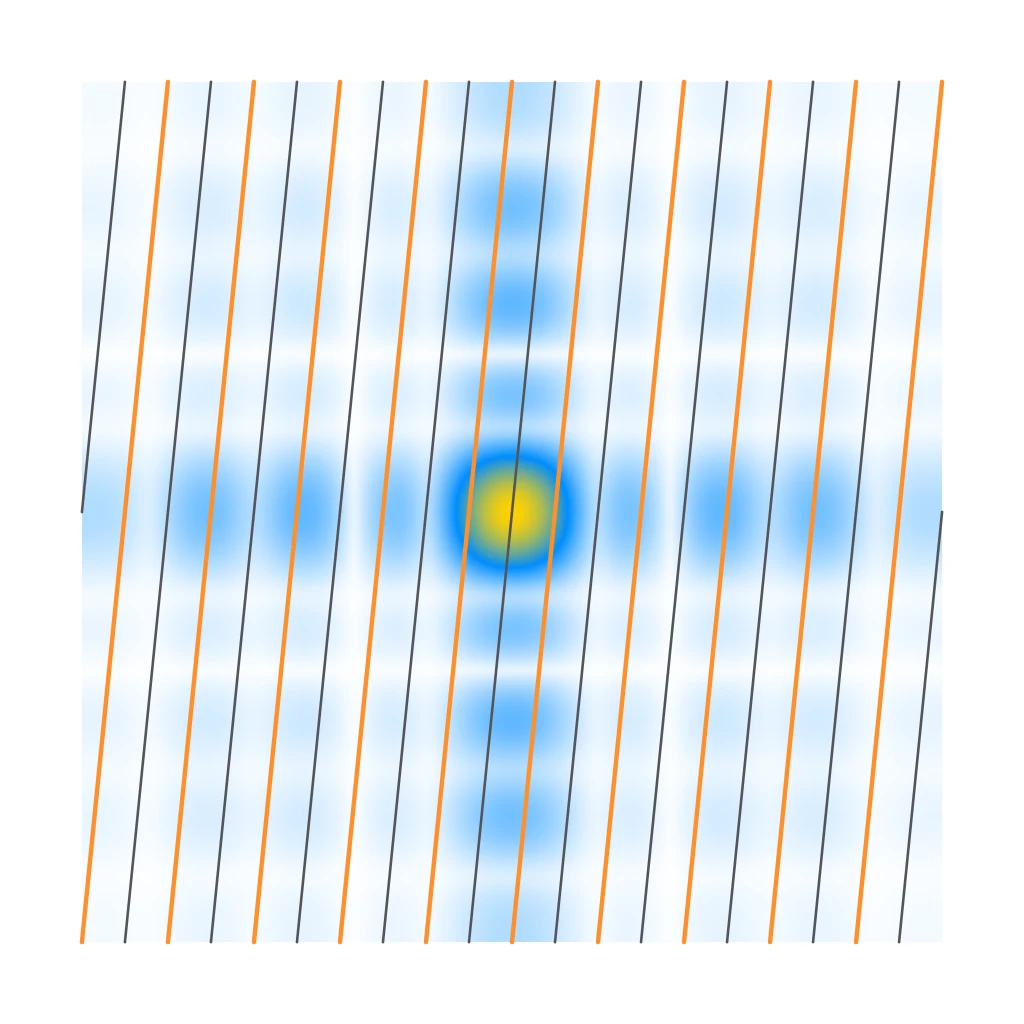
The figure is the two-position lemma at base 10 missing the digit 7. A frequency t meets two adjacent digit positions j and j + 1 through the phase pair (v_1, v_2) = (b^j t + alpha, b^(j+1) t + alpha). The square is the torus of all such pairs, each phase read in [-1/2, 1/2), painted by |g_F(v_1) g_F(v_2)|/fill^2, the share of the full mass that the two positions keep, with g_F(v) = sum_(d in F) e(d v) the digit transform: it is 1 only at the centre, where both phases are integers, and the cross through the centre holds the pairs where one of them is. As t runs, the pair runs along the line v_2 = b v_1 - (b - 1) alpha, ten segments of slope 10 on the torus. On the lattice, at alpha = 0, the dim segments pass through the centre, and the frequency t = 0 keeps the full mass at every pair of positions. At alpha = 1/2 the orange segments are moved by (b - 1) alpha = 9/2, half a turn, and pass beside the centre: at every point of them one phase is at least beta/(b + 1) = 1/22 from the integers, beta = norm((b - 1) alpha) = 1/2 the distance from (b - 1) alpha to the nearest integer, so the pair keeps at most 1 - c of the mass, c >= 0.1500 here (Fact 3.5). That fixed loss per pair of positions, at every frequency, is what pays the major arcs. Base 10 is far below the range of the theorem; the picture is the lemma, not the bound.
Fix a base b >= 3, a set E of m >= 1 digits and the rest F = {0, ..., b - 1} less E, with fill = b - m. S_F is the set of positive integers whose base-b digits all lie in F, A_F(x) its count up to x, s_b(n) the sum of the base-b digits of n, e(t) = exp(2 pi i t) and norm(t) the distance from t to the nearest integer. The certificate (W) reads two explicit one-step constants, P_b(m) and, at one missing digit e_0, P'_b(e_0), recalled in Definition 2.2 from Definition 2.4 of An Unconditional Mertens Bound at Large Base, the large-base paper below.
Theorem 1.1. Suppose
(P)   F contains two consecutive digits ,
(W)   P_b(m) < fill b^(-4/5) ,   or   m = 1, E = {e_0}, b >= 36 and P'_b(e_0) < (b - 1) b^(-4/5) ,
and let alpha_1 = log_b(b P_W/fill), P_W either constant (W) reads, so that alpha_1 < 1/5. Fix beta_0 with 0 < beta_0 <= 1/2, let c = c(b, F, beta_0) be the constant (1.1), gamma = log(1/(1 - c))/(2 log b), and put
sigma = gamma (1 - 4 alpha_1)/(5 - 4 alpha_1) , eta = min(1/5 - alpha_1, sigma) , delta_0 = (eta/4) log(fill)/log(b) .
Then for every delta < delta_0 there is C > 0, depending on b, F, beta_0 and delta alone and effectively computable, such that for every x >= 2 and every real alpha with norm((b - 1) alpha) >= beta_0
|sum_(n in S_F, n <= x) mu(n) e(alpha s_b(n))| <= C A_F(x) x^(-delta) ,
|sum_(n in S_F, n <= x) Lambda(n) e(alpha s_b(n))| <= C A_F(x) x^(-delta) .
The constant is explicit. With x_0 = beta_0/(b + 1), x_f = 1/(2(b - 1)), K_b(x) = max(sin(pi b x)/sin(pi x), 1/sin(pi/b)) and V_F = fill^(-1) sum_(d in F) (d - mean(F))^2 the variance of the digits of F,
c = 1 - min(G_1, G_2, G_3)/fill ,     G_1 = fill - 4 sin^2(pi x_0/2) ,     G_2 = m + K_b(x_0) ,
G_3 = max(fill sqrt(1 - 16 x_0^2 V_F), min(m + K_b(x_f), fill - 4 sin^2(pi x_f/2))) ,          (1.1)
the pair, kernel and variance forms of Lemma 3.1, and 0 < c <= 1 - 1/pi. The hypothesis norm((b - 1) alpha) >= beta_0 keeps alpha off the lattice (b - 1)^(-1) Z, where the method gives nothing: on the lattice the modulation is a character of n mod b - 1 and the modulated transform keeps its full mass at some frequency at every depth (Proposition 3.3). (W) forces (P) (Lemma 2.3), which is listed because the proof uses it in its own right.
Corollary 1.2 (where it holds). At one missing digit, (P) and (W) hold at every base b >= 92317 and every missing digit, so Theorem 1.1 holds on every one-missing-digit set from base 92317. At m >= 2 missing digits (W) forces m < b^(2/5), and at b = 10^7 it holds exactly for m <= 176.
Corollary 1.3 (the digit sums of primes). Let F satisfy (P) and (W), let q >= 2 be coprime to b - 1 and let delta be below the delta_0 of Theorem 1.1 at beta_0 = 1/q. Write psi_F(x) = sum_(n in S_F, n <= x) Lambda(n) and pi_F(x) for the number of primes of S_F up to x. Then for every residue a mod q
sum_(n in S_F, n <= x, s_b(n) = a mod q) Lambda(n) = psi_F(x)/q + O(A_F(x) x^(-delta)) ,
#{p in S_F : p <= x, s_b(p) = a mod q} = (1 + o(1)) pi_F(x)/q .
The saving is tiny. At base 92317 and beta_0 = 0.2 or 1/2 the exponent is delta_0 >= 4.678 * 10^-9, set by the margin 1/5 - alpha_1 >= 1.871 * 10^-8 by which (W) holds at its wall; it is 2.819 * 10^-4 at base 10^6, and it is always below log(fill)/(20 log b) (Fact 6.1, lab/py/digit-sum-twist, verb lemma). No computation at any reachable height can see such a power. What the theorem shows is the mechanism, that the major arcs need no L-function once the modulation is present, and its corollary for the primes.
The proof, after blocks carry x off the powers of the base, expands each block sum in additive characters modulo y = b^k and cuts the frequencies a/y by Dirichlet approximation, as the large-base paper does, but into three regions. Region A, the minor arcs, pays the whole l^1 mass of the modulated transform against the minor-arc bound x^(4/5 + eps) of Basak, Robles and Zaharescu (2023), or Lemma 4.2 of Maynard (2022) for Lambda. Region B, the middle denominators, pays a hybrid l^1 mass against the decay max(d, h)^(-1/2) of the same bounds. Region C holds the frequencies within Z/y of a fraction of denominator below Z, the major arcs. A and B read the transform only through the one-step constant B_b(F), a supremum over every shift, and the modulation only moves the shift (Lemma 4.1), so both are imported, the minor-arc bounds re-read with the ratio r = x/y. In the unmodulated dissection C splits into C1, where the denominator has a prime outside the base and the transform is small, and C2, where it divides a power of the base, the transform is full and the block sum is mu in progressions paid by a zero-free region; both are paid at root-log strength, and they cap the saving at exp(-c sqrt(log x)). With the modulation all of C is paid by the supremum of the transform, fill^k y^(-gamma) up to a constant (Corollary 3.2), times its 3 Z^2 frequencies times the trivial bound on the block sum; so Z can be a power of y, the blocks can be cut at a depth that is a power of x, and the saving is a power.
Mauduit and Rivat (2010) prove sum_(n <= x) Lambda(n) e(alpha s_q(n)) = O(x^(1 - sigma_q(alpha))) whenever (q - 1) alpha is not an integer, for unrestricted digits, by Type I and Type II sums with a carry truncation, and Martin, Mauduit and Rivat (2014) extend it to digital functions with real coefficients; neither restricts the digits. The survey of Maynard (2019) proves a weak form of the Mauduit-Rivat theorem at large base by the circle method, with the full-digit two-position bound and the major arcs paid by supremum times count, so the mechanism of this paper is in print for the full digit set (Section 9 says exactly how). What is written here is its object: the modulation carried onto a missing-digit set, for mu and Lambda, with an effective constant, from an explicit base, and with a two-position constant that does not decay with b. For the integers of a missing-digit set, Aloui (2015), read in its abstract only, carries the digit-sum classes with power-saving errors (Section 9). A search for a digit-sum theorem for the primes or mu of a missing-digit set found none; the search is stated in Section 9.
Section 2 fixes the objects and the imports. Section 3 proves the two-position lemma, its sharpness and the lattice dichotomy; Section 4 the modulated peel and the modulated hybrid bound; Section 5 the dissection, each changed step written out and each imported step stated with its pointer, and Theorem 1.1. Section 6 is the exponent and which term binds where, with Corollary 1.2; Section 7 is Corollary 1.3 and why it needs (W) itself; Section 8 the falsification; Section 9 the literature; Section 10 what is left open.
Definitions and imports
Definition 2.1 (the modulated transform). For k >= 0, D_k is the set of the fill^k integers 0 <= n < b^k whose k padded digits lie in F. The digit transform is g_F(v) = sum_(d in F) e(d v), written hat F in the large-base paper. For real alpha the modulated transform at depth k is
hat w_k(t) = sum_(n in D_k) e(alpha s_b(n) + n t) = prod_(j < k) g_F(b^j t + alpha) ,
since with n = sum_(j < k) d_j b^j the phase is sum_j d_j (b^j t + alpha) and the digits d_j run over F independently; it has period 1, and at alpha = 0 it is the level transform hat F_k of the large-base paper. Put beta = norm((b - 1) alpha); the lattice is (b - 1)^(-1) Z, where beta = 0. The modulated grid sums are Sigma_i(s) = sum_(a < b^i) |hat w_i(s + a/b^i)| at real s, Sigma_0 = 1. V_F, K_b and x_f are as in (1.1).
Definition 2.2 (the one-step constant and (W)). B_b(F) = sup_t sum_(r mod b) |g_F((t + r)/b)|, a supremum over every shift t. With H(n) = log n + gamma_E + 1/(2n), gamma_E Euler's constant,
Phi_b = (4/pi) b + (2b/pi) H(ceil((b - 2)/2)) + (1 - 2/pi)(b - 2) + 0.727 , P_b(m) = sqrt(m) + Phi_b/b ,
and at one missing digit e_0 and b >= 36, with u_0 = e_0 - (b - 1)/2 and p = floor(b/2), the chord constant of Definition 2.4 of the large-base paper is
Psi'_b = (b/pi)(2 H(p - 1) - 1 + 1/p) + (1 - 2/pi) b/2                       at even b ,
Psi'_b = (b/pi)(2 H(p - 1) - 1 + 2/p) + (1 - 2/pi)(b/2 + 1/(2b))              at odd b ,
P'_b(e_0) = ((4/pi) b + Psi'_b + b/2 - sec(pi u_0/b)/2)/b ,
below P_b(1) at every b >= 36 and every e_0, and smallest at the end digits. (W) is the condition displayed in Theorem 1.1, P_W either constant it reads and alpha_1 = log_b(b P_W/fill); (W) holds exactly when alpha_1 < 1/5.
Lemma 2.3 (imported). (i) B_b(F) >= b for every digit set. (ii) Under (W), B_b(F) <= b P_W = fill b^(alpha_1). (iii) (W) forces (P), and at m >= 2 it forces b^(1/5) > 2 and m < b^(2/5).
Proof. (i) is Lemma 2.3(iii) of the large-base paper: the digits of F are distinct modulo b, so Parseval on Z/b gives sum_(r mod b) |g_F((t + r)/b)|^2 = b fill, and each term is at most fill. (ii) is its Lemmas 2.5 and 2.6. (iii) is its Lemma 6.2: at m = 1 two consecutive digits remain; at m >= 2, P_b(m) >= sqrt(m) + 4/pi > 2 while (W) gives P_b(m) < b^(1/5), so b^(1/5) > 2 and m < b^(2/5) < (b - 1)/2, and a set with no two consecutive digits misses at least floor(b/2) digits. □
The two-position lemma
Lemma 3.1 (two positions). Let F contain two consecutive digits, let alpha be real with beta = norm((b - 1) alpha), put x_0 = beta/(b + 1) and let G_F(x_0) be the supremum of |g_F(v)| over norm(v) >= x_0. Then for every real u
|g_F(u + alpha) g_F(b u + alpha)| <= fill G_F(x_0) , G_F(x_0) <= min(G_1, G_2, G_3) ,
with G_1, G_2 and G_3 the forms of (1.1) at this x_0.
Proof. Locating. Put v_1 = u + alpha and v_2 = b u + alpha. Then b v_1 - v_2 = (b - 1) alpha, so beta = norm(b v_1 - v_2) <= b norm(v_1) + norm(v_2) <= (b + 1) max(norm(v_1), norm(v_2)), and one of the two phases has norm(v_i) >= x_0. Its factor is at most G_F(x_0) and the other at most fill.
The pair form. With d and d + 1 in F, |g_F(v)| <= fill - 2 + |e(d v) + e((d + 1) v)| = fill - 2 + 2 |cos(pi v)| = fill - 4 sin^2(pi norm(v)/2), which falls as norm(v) rises; so G_F(x_0) <= G_1.
The kernel form. g_F = D_b - g_E with D_b(v) = sum_(n < b) e(n v) and |g_E| <= m. |D_b| is even and has period 1, so put x = norm(v). On (0, 1/b], e(-(b - 1) x/2) D_b(x) = sum_(n < b) cos(2 pi (n - (b - 1)/2) x), the sines cancelling in the pairs n and b - 1 - n; each term falls in x because 2 pi |n - (b - 1)/2| x <= pi (b - 1)/b < pi, and the sum is sin(pi b x)/sin(pi x) >= 0, so |D_b(x)| = sin(pi b x)/sin(pi x) falls on (0, 1/b]. On [1/b, 1/2], |D_b(x)| <= 1/sin(pi x) <= 1/sin(pi/b). Since x_0 <= 1/(2(b + 1)) < 1/b, the supremum of |D_b| over x >= x_0 is at most K_b(x_0), and G_F(x_0) <= m + K_b(x_0) = G_2.
The variance form. |g_F(v)|^2 = sum_(d, d' in F) cos(2 pi (d - d') x) = fill^2 - 2 sum_(d, d') sin^2(pi (d - d') x). At x <= x_f every |d - d'| x is at most 1/2, where sin^2(pi y) >= 4 y^2 by the concavity of sin on [0, pi/2], and sum_(d, d') (d - d')^2 = 2 fill^2 V_F; so |g_F(v)| <= fill sqrt(1 - 16 x^2 V_F) on [0, x_f], the radicand nonnegative since V_F <= (b - 1)^2/4, and the bound falls in x. As x_0 < x_f, the supremum over x_0 <= x <= x_f is at most fill sqrt(1 - 16 x_0^2 V_F), and over x >= x_f the pair and kernel forms at x_f apply, since x_f <= 1/b. So G_F(x_0) <= G_3. □
Corollary 3.2 (the supremum). Under the hypotheses of Lemma 3.1 put c = 1 - min(G_1, G_2, G_3)/fill and gamma = log(1/(1 - c))/(2 log b). If beta > 0, then 0 < c <= 1 - 1/pi, gamma < 0.53, and at every k >= 0 and every real t
|hat w_k(t)| <= fill^k (1 - c)^(floor(k/2)) <= (1 - c)^(-1/2) fill^k b^(-gamma k) .
c does not fall as beta rises, so the bound at beta_0 holds at every alpha with norm((b - 1) alpha) >= beta_0.
Proof. G_1 < fill because x_0 > 0. Each form is at least min(fill - 1, m + b/pi): G_1 >= fill - 4 sin^2(pi/16) > fill - 1, G_2 >= m + 1/sin(pi/b) >= m + b/pi, and G_3 is at least its second entry. That minimum is at least fill/pi, since fill >= 2 and b >= fill; so 1 - c >= 1/pi and gamma <= log(pi)/(2 log 3) < 0.53. Pair the positions 2i and 2i + 1 of the product of Definition 2.1 with u = b^(2i) t, bound an odd last factor by fill, and use floor(k/2) >= (k - 1)/2. Each form is nonincreasing in x_0, G_2 because sin(pi b x)/sin(pi x) falls on (0, 1/b], so c is nondecreasing in beta. □
Proposition 3.3 (the lattice). If (b - 1) alpha is an integer, then e(alpha s_b(n)) = e(alpha n) for every n >= 0, |hat w_k(-alpha)| = fill^k at every k, and
sum_(n in S_F, n <= x) mu(n) e(alpha s_b(n)) = sum_(a mod b - 1) e(alpha a) M_F(x; b - 1, a) ,
with M_F(x; b - 1, a) the sum of mu(n) over the n <= x of S_F with n = a mod b - 1. So with two consecutive digits sup_t |hat w_k(t)|/fill^k is 1 at every depth when alpha is on the lattice, and at most (1 - c)^(floor(k/2)) with c > 0 when it is off.
Proof. n - s_b(n) = sum_j d_j (b^j - 1), and each b^j - 1 is a multiple of b - 1. At t = -alpha every phase b^j t + alpha = -(b^j - 1) alpha is an integer, where |g_F| = fill. The identity follows from the first statement, and the decay off the lattice is Corollary 3.2. □
The mechanism is the phase map. The phases v_j = b^j t + alpha obey v_(j+1) = b v_j - (b - 1) alpha. With two consecutive digits |g_F(v)| = fill exactly when v is an integer, so full mass at depth k needs v_0, ..., v_(k-1) all integral, and the affine map carries the integers into themselves exactly when (b - 1) alpha is one. At alpha = 0 the frequencies of full mass are the b-adic preimages l/b^j of 0: the region C2 of the large-base paper, the one place its zero-free region enters (its Lemma 6.5 and Proposition 6.6). Off the lattice no frequency keeps the mass. On the lattice the method returns nothing: the sum is a combination of mu in progressions modulo b - 1 over S_F, whose major arcs sit at -alpha + l/b^j and would need zero-free regions for the characters modulo (b - 1) b^j. That case is carried at exp(-c sqrt(log x)) in the section Progressions and every modulus of the digit-sum twist note.
Example 3.4 (the consecutive pair is needed). At b = 5, F = {0, 2} and alpha = 1/8, off the lattice with beta = 1/2, |hat w_k(3/8)| = fill^k at every k.
Proof. The phases are 5^j (3/8) + 1/8 = (3 * 5^j + 1)/8, and 5^j is 1 or 5 modulo 8, so 3 * 5^j + 1 is 4 or 0 modulo 8 and every phase lies in Z/2, where g_F(v) = 1 + e(2v) = 2 = fill. The generator reads |hat w_k(3/8)|/fill^k = 1 to twelve digits at k = 4, 8, 12 (lab/py/digit-sum-twist, verb lemma). □
Without the pair, |g_F| is full on a larger set than the integers, here Z/2, and the locating step finds one phase far from the integers without finding it far from that set. The pair form is the step that rules this out.
Fact 3.5 (the constants). At base 10 missing 7, c >= 0.1500 and gamma >= 0.0352 at alpha = 1/2, and c >= 0.0463 at 1/7, 0.0353 at 1/4, 0.0224 at 1/5, 0.0055 at 1/10 and 5.55 * 10^-5 at 1/900, where beta = 0.01, each from the variance form, which beats the pair form by a factor 66 at 1/2 and 61 at 1/900. At base 92317 missing its extreme digit, whose variance is the least, the kernel form gives c >= 0.3633 at beta = 1/2 and 0.06448 at 0.2, and the variance form c >= 6.666 * 10^-7 at beta = 10^-3. Generator: lab/py/digit-sum-twist, verb lemma.
To leading order the variance form gives c = 8 x_0^2 V_F; since V_F is about b^2/12 and x_0 about beta/b, that is c about (2/3) beta^2 at small beta and large base, independent of b, where the pair form alone decays like beta^2 b^(-3). The full-digit bound in print (Section 9) has the shape of the pair form.
The modulated peel
Lemma 4.1 (the modulated peel). For every real alpha and s and every i >= 1, Sigma_i(s) <= B_b(F) Sigma_(i-1)(b s), so Sigma_i(s) <= B_b(F)^i. The same grid sum with the factor of any one position replaced by 1 is at most b B_b(F)^(i-1), and int_0^1 |hat w_i| <= b^(-i) B_b(F)^i. Under (W), Sigma_i(s) <= fill^i b^(i alpha_1): the shifted-grid certificate of the large-base paper with C_F = 1, at every shift, for the modulated transform.
Proof. hat w_i(t) = g_F(t + alpha) hat w_(i-1)(b t), and hat w_(i-1) has period 1. Write a = a' + r b^(i-1) with a' < b^(i-1) and r < b. Then b (s + a/b^i) = b s + a'/b^(i-1) + r, so the second factor depends on a' alone, and s + a/b^i + alpha = (T + r)/b with T = b (s + alpha) + a'/b^(i-1). Summing over r first gives at most sum_(r mod b) |g_F((T + r)/b)| <= B_b(F) times |hat w_(i-1)(b s + a'/b^(i-1))|, and summing over a' gives B_b(F) Sigma_(i-1)(b s); induct from Sigma_0 = 1. If the factor at position 0 is replaced by 1, the sum over r is exactly b; if it sits at position j > 0, peel the j positions below it as above, then that one at the cost b, then the rest; this gives b B_b(F)^(i-1). The integral is int_0^(b^(-i)) Sigma_i(s) ds. Under (W) apply Lemma 2.3(ii). The modulation moves only the shift T, and B_b(F) is a supremum over every shift. □
Lemma 4.2 (the hybrid l^1 bound, modulated). Let y = b^k and give each residue a mod y a reduced fraction l/d with 1 <= d <= Q = y^(3/5) and |a/y - l/d| <= 1/(d Q), by Dirichlet's theorem, and its height h = |a d - l y| <= y^(2/5). Let D >= 1 and H >= 0 with 16 b^2 D (D + H) <= y, let R(D, H) be the residues with D <= d < 2D and h < 2H, or h = 0 when H = 0, and let V_1 = b^(i_1) be the least power of b at least 4 D^2 and V_2 = b^(i_2) the least at least 4H/D + 1. Then under (W), at every real alpha,
sum_(a in R(D, H)) |hat w_k(a/y)| <= (1 + pi b) fill^k (V_1 V_2)^(alpha_1) .
Proof. This is Lemma 5.1 of the large-base paper, whose proof reads the transform through three things only: a split into three products, the certificate at a shift, and a bound on the derivative of one digit factor. The split holds for the modulated transform: grouping the positions j < i_1, the middle ones and the top i_2 gives hat w_k(t) = hat w_(i_1)(t) hat w_(k - i_1 - i_2)(V_1 t) hat w_(i_2)(y t/V_2), since b^(k - i_2) = y/V_2, and the middle factor is at most fill^(k - i_1 - i_2). At t = a/y the top factor is hat w_(i_2)(a/V_2). The residues attached to one fraction are at most V_2 consecutive integers, distinct modulo V_2, so they pay at most Sigma_(i_2)(0) <= B_b(F)^(i_2) by Lemma 4.1. The bottom factor f = hat w_(i_1) at each residue of l/d is at most its supremum over J_(l,d) = [l/d - 1/(8 D^2), l/d + 1/(8 D^2)], and by |f(t)| <= |J|^(-1) int_J |f| + int_J |f'| on the disjoint intervals J_(l,d) the suprema sum to at most 4 D^2 ||f||_1 + ||f'||_1, norms on [0, 1]. Lemma 4.1 gives ||f||_1 <= V_1^(-1) B_b(F)^(i_1). Differentiating one factor at a time, |d/dt g_F(b^j t + alpha)| <= b^j 2 pi sum_(d in F) d <= b^j pi b (b - 1), and the integral over [0, 1] of the product with the factor at position j removed is int_0^(1/V_1) of its grid sum on V_1 points, at most V_1^(-1) b B_b(F)^(i_1 - 1) by Lemma 4.1; with sum_(j < i_1) b^j < V_1/(b - 1) that is ||f'||_1 <= pi b^2 B_b(F)^(i_1 - 1) <= pi b B_b(F)^(i_1), by Lemma 2.3(i). So the fractions pay at most (1 + pi b) B_b(F)^(i_1), since 4 D^2 <= V_1, and B_b(F)^(i_1 + i_2) <= fill^(i_1 + i_2) (V_1 V_2)^(alpha_1) by Lemma 2.3(ii). The count of the residues of one fraction, the containment of those residues in J_(l,d) and the disjointness of the intervals use 16 D H <= y and the fractions alone, and are as in Lemma 5.1 there. □
Remark 4.3 (what does not transfer). The large-base paper proves its certificate from base 584 by a digit-uniform chain (its Proposition 8.5), which telescopes a run of positions into one Dirichlet kernel, prod_(j < l) D_b(b^j u) = D_(b^l)(u); that needs consecutive arguments in ratio b, and the modulated arguments b^j t + alpha are not, since b (b^j t + alpha) = b^(j+1) t + b alpha differs from b^(j+1) t + alpha modulo 1 unless beta = 0. Its window certificates (Facts 8.6 and 8.7) bound grid sums of prod_j |g_F(b^j t)| over the one-parameter family of shifts, while a modulated grid sees the shift vector (b^j s + alpha)_j. Neither is refuted; neither is carried. Only the one-step bound of Lemma 4.1 survives the modulation, and so the base of Theorem 1.1 is the base of (W).
The dissection
The dissection is that of the large-base paper for mu and of Section 7 of An Unconditional Mertens Bound on the Half Interval, the half-interval paper below, for Lambda. Three things change: the blocks are cut at a depth that is a power of x, the major-arc parameter Z is a power of the block length, and the major arcs, one region C in place of C1 and C2, are paid by the two-position lemma. Imported by statement: the block split of Lemma 3.2 of the large-base paper, the bound of Basak, Robles and Zaharescu (its Lemma 4.2), the first display of Lemma 7.4 of the half-interval paper, and the classes of region B of Proposition 5.2 of the large-base paper. Imported by proof, with the ratio r in place of x^(o(1)): the two approximations of Lemma 4.3 there and the second display of Lemma 7.4 (Lemma 5.4). Not used: the contraction near a fraction with a prime outside the base (Lemma 6.1 there), mu and Lambda in progressions (Lemma 6.5 there, Lemma 7.5 of the half-interval paper), the main term of Lemma 7.2 of the half-interval paper, and every character, zero-free region and exceptional zero those lemmas carry.
Lemma 5.1 (the modulated blocks). Let f be mu or Lambda, with f(0) = 0. For k >= 0, y = b^k and an integer P >= 0 put S_P(theta) = sum_(P y <= n < (P+1) y) f(n) e(n theta). Then
sum_(t in D_k) e(alpha s_b(P y + t)) f(P y + t) = e(alpha s_b(P)) Sigma(P, k) , Sigma(P, k) = y^(-1) sum_(a mod y) hat w_k(a/y) S_P(-a/y) ,
so |Sigma(P, k)| <= y^(-1) sum_(a mod y) |hat w_k(a/y)| |S_P(a/y)|.
Proof. For 0 <= t < y the digits of P y + t are the k padded digits of t below those of P, so s_b(P y + t) = s_b(P) + s_b(t). Completeness of the additive characters modulo y, applied to t -> 1_(D_k)(t) e(alpha s_b(t)), whose transform at a/y is hat w_k(a/y), gives 1_(D_k)(t) e(alpha s_b(t)) = y^(-1) sum_(a mod y) hat w_k(a/y) e(-a t/y); put n = P y + t, so e(-a t/y) = e(-a n/y). f is real, so |S_P(-theta)| = |S_P(theta)|. □
Lemma 5.2 (the split at power depth). Let x >= b have L digits and 0 < tau < 1. By Lemma 3.2 of the large-base paper, S_F below x is the point x, when its digits lie in F, together with sets P b^k + D_k at scales k < L, the element 0 discarded, at most fill + 1 of them at each scale, and A_F(x) >= fill^(L-1) - 1. The sets at scales with b^k < x^(1 - tau) hold at most 2 (fill + 1) fill (A_F(x) + 1) x^(-tau log(fill)/log(b)) elements together, and every other set has y = b^k >= x^(1 - tau), that is r = x/y <= x^tau.
Proof. With k_0 the largest such scale, those sets hold at most (fill + 1) sum_(k <= k_0) fill^k <= 2 (fill + 1) fill^(k_0) elements, and fill^(k_0) = (b^(k_0))^(log(fill)/log(b)) < x^((1 - tau) log(fill)/log(b)). Since b^(L-1) > x/b, the mass floor gives A_F(x) + 1 >= fill^(L-1) > (x/b)^(log(fill)/log(b)) = x^(log(fill)/log(b))/fill. □
Definition 5.3 (three regions). On a set P y + D_k with y >= x^(1 - tau), give each residue a mod y the fraction l/d and height h of Lemma 4.2, at Q = y^(3/5), and put Z = y^zeta with zeta = 2 gamma/(5 - 4 alpha_1). Region A is d >= y^(2/5); region B is d < y^(2/5) with max(d, h) >= Z; region C is d < Z and h < Z. By Corollary 3.2, gamma < 0.53 and 5 - 4 alpha_1 > 4.2, so zeta < 0.26 < 2/5 and the three regions partition the residues. By the choice of zeta, gamma - 2 zeta = sigma and zeta (1/2 - 2 alpha_1) = sigma.
Lemma 5.4 (the minor arcs, with the ratio). On a set with r = x/y, for f = mu and every fixed eps > 0,
|S_P(a/y)| <<_eps x^(4/5 + eps) r^(1/5)                                   on region A ,
|S_P(a/y)| <<_eps x^(4/5 + eps) r^(1/5) + x (log x)^3 max(d, h)^(-1/2)      on region B ,
the implied constant effective and depending on eps alone, and for f = Lambda the same with (log x)^4 in place of both x^eps and (log x)^3 and an absolute constant.
Proof. For mu this is Lemma 4.3 of the large-base paper, whose proof applies the bound of Basak, Robles and Zaharescu (2023), Theorem 1.4, its Lemma 4.2, |sum_(n <= X) mu(n) e(n theta)| <<_eps X^(4/5 + eps) + X d^(-1/2) (log X)^3 + (X d)^(1/2) (log X)^3 at |theta - l/d| <= 1/d^2, (l, d) = 1, to S_P, a difference of two such sums with X <= 2x, at l/d and, on region B with h >= 1, at a second fraction l'/d' with y/(2h) <= d' <= 2y/h. There x/y was at most b^K = x^(o(1)); here it is r. On region A, X d^(-1/2) <= 2 x y^(-1/5) = 2 x^(4/5) r^(1/5) and (X d)^(1/2) <= (2 x y^(3/5))^(1/2) <= 2 x^(4/5). On region B, l/d leaves x (log x)^3 d^(-1/2) and (2 x y^(2/5))^(1/2) (log x)^3 << x^(7/10) (log x)^3, and l'/d' leaves 2 x h^(-1/2) and X d'^(-1/2) <= 2 x (2h/y)^(1/2) <= 3 x y^(-3/10) = 3 x^(7/10) r^(3/10), as h <= y^(2/5); and x^(7/10) r^(3/10) <= x^(4/5) r^(1/5) because r <= x. For Lambda this is Lemma 7.4 of the half-interval paper, Lemma 4.2 of Maynard (2022) read at a coarser fraction and at l/d, whose proof gives the terms X^(4/5), 3 x y^(-1/5), 2 x^(4/5), 2 x^(7/10), 3 x d^(-1/2), 2 x h^(-1/2) and 2 x y^(-3/10) times (log x)^4, with r in place of its b^K. □
Proposition 5.5 (region A). y^(-1) sum_(a in A) |hat w_k(a/y)| |S_P(a/y)| <<_eps fill^k r^(1 + eps) y^(alpha_1 - 1/5 + eps) for mu, and << fill^k r y^(alpha_1 - 1/5) (log x)^4 for Lambda.
Proof. By Lemma 4.1 at s = 0, sum_(a mod y) |hat w_k(a/y)| = Sigma_k(0) <= fill^k y^(alpha_1), and by Lemma 5.4 every residue of A carries |S_P| <<_eps (r y)^(4/5 + eps) r^(1/5). □
Proposition 5.6 (region B). Once y >= (32 b^2)^5, y^(-1) sum_(a in B) |hat w_k(a/y)| |S_P(a/y)| <<_eps fill^k (log y)^2 (r^(1 + eps) y^((4/5) alpha_1 - 1/5 + eps) + r (log x)^4 y^(-sigma)), and the same for Lambda with (log x)^4 in place of r^eps y^eps.
Proof. Group the residues of B into the classes of Proposition 5.2 of the large-base paper, D <= d < 2D over powers of two D < y^(2/5), and H <= h < 2H over powers of two H <= y^(2/5) or h = 0: at most (log_2 y + 2)^2 classes, each inside R(D, H), with 16 b^2 D (D + H) <= 32 b^2 y^(4/5) <= y, and on each max(d, h) >= max(D, H) > Z/2. By Lemma 4.2, with V_1 V_2 < 16 b^2 D (D + H) <= 32 b^2 max(D, H)^2, and Lemma 5.4, a class weighs <<_eps y^(-1) (x^(4/5 + eps) r^(1/5) + x (log x)^4 max(D, H)^(-1/2)) fill^k max(D, H)^(2 alpha_1). With max(D, H) <= y^(2/5) the first term is <<_eps fill^k r^(1 + eps) y^((4/5) alpha_1 - 1/5 + eps). With 2 alpha_1 - 1/2 < 0 and max(D, H) > Z/2 the second is << fill^k r (log x)^4 Z^(-(1/2 - 2 alpha_1)) = fill^k r (log x)^4 y^(-sigma). □
Proposition 5.7 (region C, with no L-function). For f = mu or Lambda and every alpha with norm((b - 1) alpha) >= beta_0,
y^(-1) sum_(a in C) |hat w_k(a/y)| |S_P(a/y)| <= 3 (1 - c)^(-1/2) fill^k y^(-sigma) log(2x) .
Proof. The residues attached to a fraction l/d, read modulo 1, have |a - l y/d| < Z/d, so region C holds at most sum_(d < Z) phi(d) (2Z/d + 1) <= 3 Z^2 residues. On each, |S_P(a/y)| <= y log(2x), the block holding y terms each at most log(2x), and |hat w_k(a/y)| <= (1 - c)^(-1/2) fill^k y^(-gamma) by Corollary 3.2. So region C is at most 3 (1 - c)^(-1/2) fill^k Z^2 y^(-gamma) log(2x) = 3 (1 - c)^(-1/2) fill^k y^(2 zeta - gamma) log(2x), and gamma - 2 zeta = sigma. □
No contraction lemma, no progression, no Perron integral and no exceptional zero enters region C: the regions C1 and C2 of the large-base paper are paid together by the supremum, and the modulated sums carry no main term.
Proof of Theorem 1.1. Fix beta_0, delta < delta_0 and alpha with norm((b - 1) alpha) >= beta_0; c and gamma are those of Corollary 3.2 at beta_0, which serve at alpha. Put tau = eta/4, take eps > 0 small in terms of delta_0 - delta, and let x >= b; below b the bound is trivial. By Lemmas 5.1 and 5.2 the modulated sum is at most log x, for the point x, plus the sum of |Sigma(P, k)| over the sets of the split. The sets at scales with b^k < x^(1 - tau) weigh << A_F(x) x^(-tau log(fill)/log(b)) log x = A_F(x) x^(-delta_0) log x, by Lemma 5.2 and f <= log x. Every other set has y >= x^(1 - tau), large once x is, and r <= x^tau, and by Propositions 5.5, 5.6 and 5.7, with alpha_1 - 1/5 <= -eta, (4/5) alpha_1 - 1/5 <= alpha_1 - 1/5, as alpha_1 > 0 by Lemma 2.3(i) and (ii), and sigma >= eta,
|Sigma(P, k)| <<_eps fill^k r^(1 + eps) y^(-eta + eps) (log x)^6 .
As r^(1 + eps) y^(-eta + eps) = x^(1 + eps) y^(-1 - eta) falls in y, it is at most x^(tau (1 + eps) - (1 - tau)(eta - eps)), whose exponent is at most -3 eta/4 + eta^2/4 + 2 eps <= -eta/2 + 2 eps because eta <= 1/5. At most fill + 1 sets sit at each scale, so these sets carry (fill + 1) sum_(k < L) fill^k <= (fill + 1) fill (A_F(x) + 1) times that bound. So the modulated sum is <<_eps A_F(x) (x^(-eta/2 + 2 eps) + x^(-delta_0)) (log x)^6, and delta_0 < eta/2 gives C A_F(x) x^(-delta) once eps is small. Below the effective point past which every step that asked y large holds, the trivial bound A_F(x) log x goes into C. Every constant is effective: the implied constants of the two minor-arc inputs at this eps, (1 - c)^(-1/2), 1 + pi b, (32 b^2)^(alpha_1) and the thresholds on x, each explicit in b, F, beta_0 and delta. □
Which region needs what:
| region | paid by | asks |
|---|---|---|
A: d >= y^(2/5) | the peel at s = 0 against the minor-arc exponent 4/5 | alpha_1 < 1/5, the wall |
B: d < y^(2/5), max(d, h) >= Z | the modulated hybrid bound against max(d, h)^(-1/2) | alpha_1 < 1/4 |
C: d < Z, h < Z | the two-position lemma times 3 Z^2 | two consecutive digits, beta > 0 |
| the blocks | depth tau log_b x, a power of x | nothing |
In the unmodulated dissection the blocks sit at depth kappa sqrt(log x) and Z = exp(C_0 sqrt(log x)), because regions C1 and C2 are paid at root-log strength and cap both. Here nothing caps Z below a power of y. The modulation trades the base for the shape: unmodulated, the bound is proved from base 584 at exp(-c sqrt(log x)); modulated, from base 92317 at x^(-delta), because only the one-step certificate survives the modulation (Remark 4.3).
The exponent
The exponent has three sources. Region A saves y^(alpha_1 - 1/5), as small as the margin by which (W) holds. Regions B and C save y^(-sigma) each, and zeta is chosen to balance them: B pays Z^(2 alpha_1 - 1/2), rising with Z, and C pays Z^2 y^(-gamma), falling, and they meet at Z = y^zeta. So the kept sets save eta = min(1/5 - alpha_1, sigma), less what the ratio r <= x^tau costs. The discarded scales save x^(-tau log(fill)/log(b)), and at tau = eta/4 that term sets delta_0 = (eta/4) log(fill)/log(b); the depth tau = eta/4 is a convenience and is not optimised. Since eta <= 1/5 - alpha_1 < 1/5, delta_0 < log(fill)/(20 log b) at every base.
Fact 6.1 (the exponent). Each entry is a lower bound, computed at 40 digits and floored at four; c and gamma are read at the extreme missing digit, whose variance is the least, so each row bounds every one-missing-digit set of its base, and the chord row reads the middle digit, where the chord constant is largest.
| base | constant in (W) | beta_0 | 1/5 - alpha_1 | c | gamma | sigma | delta_0 |
|---|---|---|---|---|---|---|---|
92317 | P_b(1) | 1/2 | 1.871 * 10^-8 | 0.3633 | 0.01974 | 9.403 * 10^-4 | 4.678 * 10^-9 |
92317 | P_b(1) | 0.2 | 1.871 * 10^-8 | 0.06448 | 0.002915 | 1.388 * 10^-4 | 4.678 * 10^-9 |
92317 | P_b(1) | 10^-3 | 1.871 * 10^-8 | 6.666 * 10^-7 | 2.915 * 10^-8 | 1.388 * 10^-9 | 3.47 * 10^-10 |
39363 | P'_b(e_0) | 1/2 | 2.696 * 10^-7 | 0.3633 | 0.02133 | 1.015 * 10^-3 | 6.741 * 10^-8 |
10^6 | P_b(1) | 1/2 | 0.02411 | 0.3633 | 0.01634 | 1.127 * 10^-3 | 2.819 * 10^-4 |
10^6 | P_b(1) | 0.2 | 0.02411 | 0.0645 | 0.002413 | 1.665 * 10^-4 | 4.163 * 10^-5 |
Region A binds just above the wall: by bisection between 92317 and 10^6, 1/5 - alpha_1 is the smaller term up to 100083 and sigma from 100084 at beta_0 = 1/2, and the switch falls at 93409 at beta_0 = 0.2; at beta_0 = 10^-3, sigma binds already at 92317, and at 10^6 it binds at all three. Generator: lab/py/digit-sum-twist, verb lemma, under a second.
So past about 10^5 the two-position constant limits delta_0, through regions B and C, and below that the margin of (W) does: past the switch delta_0 is sigma log(fill)/(4 log b), proportional to gamma = log(1/(1 - c))/(2 log b).
Proof of Corollary 1.2. At m = 1, (P) holds because one missing digit leaves two consecutive ones at b >= 3. (W) holds through P_b(1) at every b >= 92317: by Lemma 8.2 of the large-base paper the gap (b - 1) b^(-4/5) - P_b(1) increases at every b >= 11221, and it is positive at 92317 and negative at 92316, certified in interval arithmetic at 200 bits: 1/5 - alpha_1 >= 1.87123612 * 10^-8 at 92317 and <= -4.82092732 * 10^-8 at 92316 (lab/py/digit-sum-twist, verb lemma), where Fact 8.1 there reads the same gap as a float re-read at 40 digits; this is Fact 8.3 there, with its one numerical step certified. At m >= 2, Lemma 2.3(iii) gives (P) and m < b^(2/5), and Fact 8.4 of the large-base paper gives P_b(m) < (b - m) b^(-4/5) at b = 10^7 exactly for m <= 176 (lab/rs/mertens-numerology). □
Fact 6.2 (below the proved wall). On the float scan of Fact 8.1 of the large-base paper, the chord form of (W) holds at every base from 39363 at every missing digit, and from 28352 at the end digits e_0 in {0, b - 1}; no base of that scan is interval-certified, so on 39363 <= b < 92317 Theorem 1.1 holds on the scan and is Verified, never Proved, with delta_0 >= 6.741 * 10^-8 at 39363, beta_0 = 1/2 (Fact 6.1). Generators: lab/py/mobius-dissection, verb wall, and lab/py/digit-sum-twist, verb lemma.
Digit sums of primes
Proof of Corollary 1.3. Orthogonality modulo q writes the left side of the first display as q^(-1) sum_(r mod q) e(-r a/q) psi_F(x; r/q), with psi_F(x; alpha) = sum_(n in S_F, n <= x) Lambda(n) e(alpha s_b(n)). The term r = 0 is psi_F(x)/q. At r != 0, (b - 1) r/q is not an integer, because gcd(q, b - 1) = 1 and q does not divide r; it lies in q^(-1) Z, so norm((b - 1) r/q) >= 1/q, and Theorem 1.1 at beta_0 = 1/q bounds each of these q - 1 terms by C A_F(x) x^(-delta). That is the first display.
For the prime count, the prime powers p^j <= x with j >= 2 weigh at most x^(1/2) (log x)^2 in any class, so the sum of log p over the primes of the class is psi_F(x)/q + O(A_F(x) x^(-delta)) too, because A_F(x) x^(-delta) >> x^(log(fill)/log(b) - delta) and log(fill)/log(b) > 1/2 + delta: the dimension log(fill)/log(b) is at least 1 - alpha_1 > 4/5, since b <= B_b(F) <= fill b^(alpha_1) by Lemma 2.3(i) and (ii), and delta < delta_0 < 1/20. Partial summation then gives #{p in S_F : p <= x, s_b(p) = a mod q} - pi_F(x)/q << x^(log(fill)/log(b) - delta), since the error E(t) of the class sum is << A_F(t) t^(-delta) and A_F(t) <= fill t^(log(fill)/log(b)), so int_2^x |E(t)| dt/(t log^2 t) is of that order. It remains to see that pi_F(x) >> A_F(x)/log x. Theorem 7.1(ii) of the half-interval paper proves, for any digit set with two consecutive digits and a shifted-grid certificate below 1/5, which (W) supplies with C_F = 1 by Lemma 2.3(ii) and the peel at alpha = 0,
psi_F(x) = kappa_F A_F(x) + O(A_F(x) exp(-c' sqrt(log x))) , kappa_F = (b/phi(b)) #{f in F : gcd(f, b) = 1}/fill ,
with c' > 0 effective. And kappa_F > 0 under (W): at m = 1 the base has phi(b) >= 2 digits coprime to it and one missing digit leaves one; at m >= 2, (W) forces b > 32 and m < b^(2/5) (Lemma 2.3(iii)), while phi(b) >= sqrt(b/2) > b^(2/5) at b > 32, so some digit coprime to b stays in F. The bound phi(n) >= sqrt(n/2) holds because phi(n)/sqrt(n) is the product over p^j exactly dividing n of p^(j/2 - 1)(p - 1), each factor at least 1 except 1/sqrt 2 at p^j = 2. □
The proof needs (W) itself, the inequality on the per-digit constants P_b(m) and P'_b(e_0), and not only the one-step bound B_b(F) <= fill b^(alpha_1) that the proof of Theorem 1.1 reads, at one point: kappa_F > 0, which at m >= 2 comes from m < b^(2/5).
Example 7.1 (the bare one-step bound does not suffice). Let b = 6^15 and let F be the digits d < b with gcd(d, 6) > 1, so fill = b - phi(b) = 2b/3. Then F holds the consecutive digits 2 and 3 and B_b(F) < 90 fill < fill b^(1/5), so the proof of Theorem 1.1 runs and its conclusion holds; but no digit of F is coprime to b, every member of S_F shares a factor with b, the set holds no prime beyond 3, and Corollary 1.3 has no main term. (W) fails: F misses m = b/3 digits and P_b(m) >= sqrt(m).
Proof. 1_F(d) = 1_(2 | d) + 1_(3 | d) - 1_(6 | d), so g_F(v) = D_(b/2)(2v) + D_(b/3)(3v) - D_(b/6)(6v) with D_N(v) = sum_(n < N) e(n v). For e in {2, 3, 6} and N = b/e, D_N has period 1, so sum_(r mod b) |D_N(e (t + r)/b)| = e sum_(r mod N) |D_N((t + r)/N)| <= e Phi_N by the kernel bound in the proof of Lemma 2.5 of the large-base paper, and Phi_N <= N ((2/pi) log N + 2) at N >= 10, from H(n) <= log(N/2) + gamma_E + 1/(N - 2). So B_b(F) <= 3 b ((2/pi) log b + 2) and B_b(F)/fill <= (9/pi) log b + 9 < 3 log b + 9 < 90, since log b = 15 log 6 < 27, while b^(1/5) = 6^3 = 216. A member n of S_F is congruent modulo b to its last digit, which shares a factor with 6, so n does. □
Remark 7.2 (the other moduli). When g = gcd(q, b - 1) > 1, the class of s_b(p) modulo g is the class of p modulo g, by Proposition 3.3, so the count asks for the primes of S_F in progressions modulo g: the lattice case, where the modulated transform keeps its full mass. Mauduit and Rivat carry that case for all primes in their Theorem 3, with main term (gcd(m, q - 1)/m) pi(x; a, gcd(m, q - 1)) in their notation; on S_F the section Progressions and every modulus of the digit-sum twist note carries it at exp(-c sqrt(log x)).
The falsification
Every reading below sits at base 10 or 37, far below the wall of (W), so it tests the shape of the statements and not the theorem. Each check raises if it fails.
Fact 8.1 (the supremum, read). At base 10 missing 7 the supremum sup_t |hat w_k(t)|/fill^k is bracketed at k = 1..8 and sixteen classes of alpha, five on the lattice and eleven off it: above by a max-product pass over the windows of six base-10 digits of t, each window's factor bounded by its centre value plus the Lipschitz margin pi h sum(F) on a cell of width h, a float reading and not a certificate; below by the value attained at the best path refined on a local grid. At every off-lattice class and every k >= 2 the upper bracket sits below the proved (1 - c)^(floor(k/2)), and at k = 8:
alpha | beta | attained | upper | proved |
|---|---|---|---|---|
1/2 | 0.5 | 0.071152 | 0.071165 | 0.521973 |
1/7 | 0.2857 | 0.310870 | 0.310915 | 0.826973 |
1/4 | 0.25 | 0.411592 | 0.411649 | 0.866052 |
1/10 | 0.1 | 0.870069 | 0.870167 | 0.977921 |
1/90 | 0.1 | 0.870069 | 0.870172 | 0.977921 |
1/900 | 0.01 | 0.998609 | 0.998716 | 0.999778 |
At the lattice classes 0, 1/9, 1/3, 2/3 and 4/9 the value at t = -alpha is 1 to twelve digits at k = 8, as Proposition 3.3 demands; 1/3 is on the lattice at base 10, 9/3 = 3, and does not decay. The measured rate is far better than the proved one: the upper bracket's eighth root is 0.718676 at alpha = 1/2 against the proved (1 - c)^(1/2) = 0.921947, since the pairing books one deficit per two positions where the readings show about one per position. At base 37 missing 18, k = 1..4, the same holds at its nine off-lattice classes, and the classes 1/2 and 1/4, on the lattice there because 36 is divisible by 4, read 1. Generator: lab/py/digit-sum-twist, verb sup, 10 seconds.
Fact 8.2 (the peel). At base 10 missing 7 the grid maximum of sum_(r mod b) |g_F((T + r)/b)| over 2 * 10^5 shifts reads 24.702183, so B_10(F) <= 24.702781 with the Lipschitz margin, in floating point, against the floor 2(b - 1) = 18 and the step-3 bound b P_b(1) = 39.6623. Over 16 classes of alpha, 12 shifts and depths 1..5, 960 checks, the one-step identity of Lemma 4.1 holds to 1.40 * 10^-11, and Sigma_i(s)/B^i and Sigma_i(s)/(B Sigma_(i-1)(b s)) stay below 0.999914. The modulation raises the unshifted mass, Sigma_5(0)^(1/5) reading 21.7151 at alpha = 1/2 and 22.3176 at 1/7 against 19.5656 unmodulated: it moves mass toward the shifted supremum, which (W) already pays. Generator: lab/py/digit-sum-twist, verb peel, 9 seconds.
Fact 8.3 (the modulated meters below 10^7). On base 10 missing 7 and missing 0, |sum_(n in S_F, n <= x) mu(n) e(alpha s_b(n))|/A_F(x) is at most 0.0005 at x = 10^7 over all sixteen classes, and its running maximum at most 0.0006 of A_F(10^7), with no visible difference between the lattice and the rest: at this height mu cancels at every alpha, and a power x^(-delta) with delta near 10^-8 is invisible. The von Mangoldt meter separates them. On the lattice psi_F(10^7; alpha)/psi_F(10^7) sits within 0.0013 of the value the primes carry, -0.5000 at alpha = 1/3 and 2/3, where the modulation is e(p/3) and mu(3)/phi(3) = -1/2, and near 0 at 1/9 and 4/9, where mu(9) = 0. Off the lattice it sits within 0.0076 of the average of e(alpha s_b(n)) over the members of S_F coprime to b (b - 1) = 90, which is near 0 at most classes and still large at 1/27, 1/90 and 1/900, 0.17, 0.86 and 0.998 in modulus on missing 7: those classes carry a small frequency alpha, and at 10^7 the frequency-zero factor (|g_F(alpha)|/fill)^7 has barely begun to decay. Generator: lab/py/digit-sum-twist, verb meter.
Fact 8.4 (the digit sums of the primes below 10^7). The 266823 primes of base 10 missing 7 below 10^7 deviate from 1/q in their digit-sum classes by at most 0.00825, 0.00880 and 0.00503 of the class size at q = 2, 4, 5, and by 0.05348, 0.10263 and 0.24272 at q = 7, 8, 10. The slow moduli are the design's and not the primes': the members of S_F coprime to 90, which carry the structure of the primes modulo 3 because s_b(n) = n mod 3, deviate by 0.04846, 0.09911 and 0.23939 on the same moduli, and the primes sit within 0.02213 of that model at every q coprime to 9 tested. The 397866 primes of base 10 missing 0 read the same, 0.08164, 0.14497 and 0.29072 at q = 7, 8, 10 against the model's 0.07811, 0.13695 and 0.29155, within 0.02584 of the model. The slow class at q = 10 is r = 3, at alpha = 3/10 = 1/3 - 1/30: far from the lattice in beta = 0.3 but a small frequency -1/30 away from the lattice point 1/3, so it mixes only at the rate |g_F(1/30)|/fill per digit. At q = 3, which divides b - 1, the class 0 holds one prime, 3 itself, the lattice case of Remark 7.2. Generator: lab/py/digit-sum-twist, verb gelfond.
What is in print
Mauduit and Rivat (2010), read in the published text, prove in Theorem 1 that sum_(n <= x) Lambda(n) e(alpha s_q(n)) = O(x^(1 - sigma_q(alpha))) with sigma_q(alpha) > 0 whenever (q - 1) alpha is not an integer, and in Theorem 3 the count of primes with s_q(p) = a mod m, with main term (gcd(m, q - 1)/m) pi(x; a, gcd(m, q - 1)). The digits are unrestricted, mu is in none of their theorems, and their proof runs through Type I and Type II sums with a carry truncation, not through major arcs. Martin, Mauduit and Rivat (2014), read at source in the authors' copy, extend Theorem 1 to e(f(n) + beta n) for every digital function f(n) = sum_k alpha_k |n|_k with real alpha_k, with the explicit exponent c_q norm((q - 1) theta)^2 when the alpha_k form a progression, all in their notation, which they credit to Drmota, Mauduit and Rivat, and remark that mu follows by the same method. A real f makes e(f(n)) unimodular, so the indicator of a missing-digit set is outside that class.
The survey of Maynard (2019), read at source, proves a weak form of the Mauduit-Rivat theorem at large base by the circle method. Its Lemma 8.4 (2) is the two-position lemma for the full digit set, |hat g(theta)| << b^(k (1 - delta_(alpha, b))) with delta_(alpha, b) = norm((b - 1) alpha)^2/(4 b^4), by the same locating step norm(b^i theta + alpha) + norm(b^(i+1) theta + alpha) >= norm((b - 1) alpha)/b. Its Lemma 10.1, as printed, bounds by that supremum times their count the major arcs whose denominator has a prime outside b, while its proof of Theorem 2.4 applies the same supremum times count to every small denominator: the mechanism of region C here. It treats the missing-digit set and the digit sum as two separate theorems and never their product. So the shape of this paper's argument is in print. What is written here is its object, the modulation carried onto a missing-digit set, for mu and Lambda, with an effective constant, from an explicit base, and with a two-position constant that does not decay with b (Fact 3.5), where the survey's per-digit loss 1 - b^(-delta_(alpha, b)), about beta^2 log b/(4 b^4), does.
On the missing-digit side, Maynard (2019) and Maynard (2022) carry the primes of a missing-digit set and no digit-sum modulation; the dissection of the large-base paper came from them.
Aloui (2015), read at the publisher page in its abstract only; its definition of T_N(alpha, beta) and its Theorems 2.1, 2.5 and 2.6 are known here through a machine summary of that page and through the citation in Saavedra-Araya, the full text unread, carries Gelfond's theorem onto the integers of a missing-digit set, jointly with residue classes, and onto their z-free members, with power-saving error terms, through the sums sum_(n in S_F, n < N) e(n theta + alpha s_b(n)), a sum of the shape of the modulated transform of Definition 2.1; no prime and no Mobius sum enters. It is the integer neighbour of Corollary 1.3. Saavedra-Araya (2024), read at source in its abstract and Theorem A, gives the necessary and sufficient form for the integers: for a missing-digit set and gcd(g, a) = gcd(a, a') = 1, the classes of n mod a and s_g(n) mod a' are jointly uniform exactly when gcd(a a', d_2 - d_1, ..., d_t - d_1) = 1, by Markov chains, with no primes. Aloui, Mauduit and Mkaouar (2017), read in its abstract, carry the digit-sum classes onto palindromes with missing digits, which are not primes. A search of the literature on the digit sum of primes with missing, restricted or ellipsephic digits, of the publication lists of Martin and of Rivat, of the reference lists of Mauduit and Rivat (2010) and of the survey, and of the prior-work list of Saavedra-Araya (2024) found no theorem on the digit sum of primes, or of mu, restricted to a missing-digit set. As far as that search reaches, no digit-sum theorem for the primes of a missing-digit set is in print, and the shape of the argument is.
Open problems
Five things are left undone. The pairing sets the exponent past about 10^5: Lemma 3.1 books one deficit per two positions, while Fact 8.1 reads close to one per position, 0.718676 per digit at alpha = 1/2 against the proved 0.921947, and a deficit per position would raise sigma, which binds from 100084 at beta_0 = 1/2. The base is that of (W), 92317 by proof and 39363 on the scan, against 584 and 115 for the unmodulated bound; a modulated chain would need, in place of the Lebesgue sums of D_(b^l), the grid l^1 norms of the full-digit modulated kernel prod_(j < l) D_b(b^j t + alpha), the discrete transform Mauduit and Rivat estimate, and a modulated window would need a supremum over shift vectors, and neither is written. The lattice is carried only at exp(-c sqrt(log x)), in the section Progressions and every modulus of the digit-sum twist note: mu in progressions modulo (b - 1) b^j on the set gives that bound at every lattice alpha and Corollary 1.3 at every q, the missing-digit form of Mauduit-Rivat Theorem 3, and a power saving there would ask a zero-free strip for the characters modulo (b - 1) b^j. In the unmodulated dissection the region C1 also caps the saving at exp(-c sqrt(log x)), through the rate of its contraction against the 3 Z^2 residues of the region and with no L-function, so the root-log ceiling there has two sources, and whether C1 can be priced at a power is open. And the exponent stays below log(fill)/(20 log b) at every base, nothing here touches sets of bounded fill, and the true size of the modulated sums is not examined.
Reproducibility
One study prints every number of Sections 3, 6 and 8, run from the repository root with one verb and raising if any check fails: lab/py/digit-sum-twist. uv run python research/lab/py/digit-sum-twist/twist.py lemma, under a second, prints Fact 3.5, Example 3.4, Fact 6.1 with the bisection of the binding switch on 92317..10^6, the margin at 92316, and the interval enclosures of the wall used in Corollary 1.2; sup, in 10 seconds, prints Fact 8.1 over k = 1..8 at base 10 and k = 1..4 at base 37; peel, in 9 seconds, prints Fact 8.2; meter gelfond, in 7 seconds with a peak of 1.7 GB, prints Facts 8.3 and 8.4 by a sieve to 10^7. The large-base constants are computed in mpmath at 40 digits and floored at four significant digits, so every printed c, gamma, sigma, delta_0 and 1/5 - alpha_1 is a lower bound; the base-10 constants are floats; the upper bracket of Fact 8.1 is a float reading with an explicit Lipschitz margin and never a certificate. The chord walls of Fact 6.2 and the budget of Corollary 1.2 are printed by the studies the large-base paper names, lab/py/mobius-dissection, verb wall, and lab/rs/mertens-numerology. Theorem 1.1 and Corollary 1.3 compute no constant beyond these. The figure is figures/paper-digit-sum-twist-power-saving.ts, pressed by bun figures/press.ts paper-digit-sum-twist-power-saving in under a second a theme; it evaluates g_F in closed form and asserts the full mass at the centre, a lattice segment through it, the counts of 11 and 10 segments, and at 2 * 10^5 points of the line at alpha = 1/2 a phase at least 1/22 from the integers and a share at most 1 - c with c >= 0.15.
References
- Mauduit and Rivat 2010, Sur un probleme de Gelfond: la somme des chiffres des nombres premiers, Ann. of Math. 171(3), 1591-1646. doi.org/10.4007/annals.2010.171.1591
- Martin, Mauduit and Rivat 2014, Theoreme des nombres premiers pour les fonctions digitales, Acta Arith. 165(1), 11-45. doi.org/10.4064/aa165-1-2
- Maynard 2019 survey, Digits of primes, read at source. arxiv.org/abs/1910.13402
- Aloui 2015, Sur les entiers ellipsephiques: somme des chiffres et repartition dans les classes de congruence, Period. Math. Hungar. 70, 171-208, abstract read at the publisher page, full text unread. doi.org/10.1007/s10998-014-0066-8
- Saavedra-Araya 2024, Distribution of integers with digit restrictions via Markov chains. arxiv.org/abs/2411.07418
- Aloui, Mauduit and Mkaouar 2017, Somme des chiffres et repartition dans les classes de congruence pour les palindromes ellipsephiques, Acta Math. Hungar. 151, 409-455, read in its abstract. doi.org/10.1007/s10474-017-0688-4
- Basak, Robles and Zaharescu 2023, Exponential sums over Mobius convolutions with applications to partitions. arxiv.org/abs/2312.17435
- Maynard 2022, Primes and polynomials with restricted digits, Int. Math. Res. Not. 2022, 10626-10648, read in arXiv:1510.07711v1. doi.org/10.1093/imrn/rnab002
- Maynard 2019, Primes with restricted digits, Invent. Math. 217, 127-218. link.springer.com