Every page on mrly.net.
Wiki
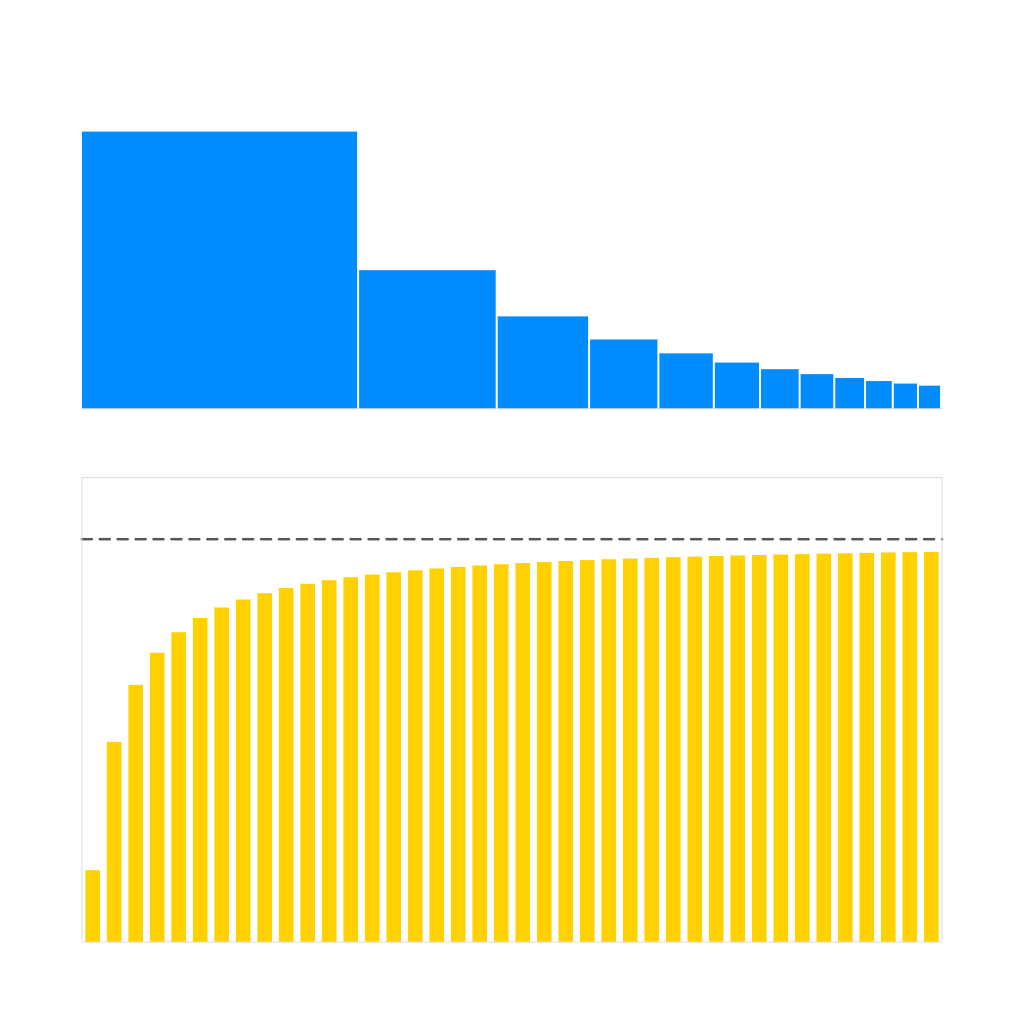
The Basel problem
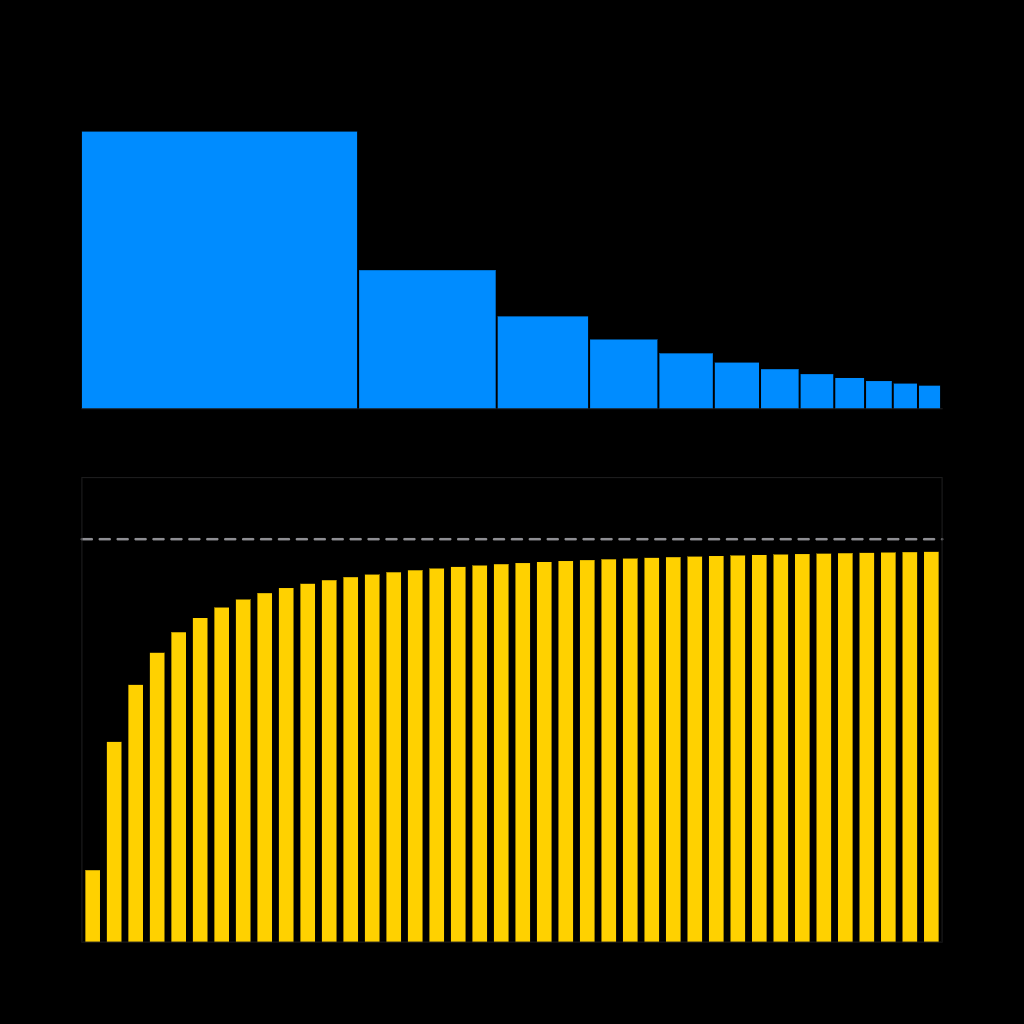
Add up the reciprocals of the squares and the total stops at pi squared over six, a circle appearing in a question that never mentioned one.
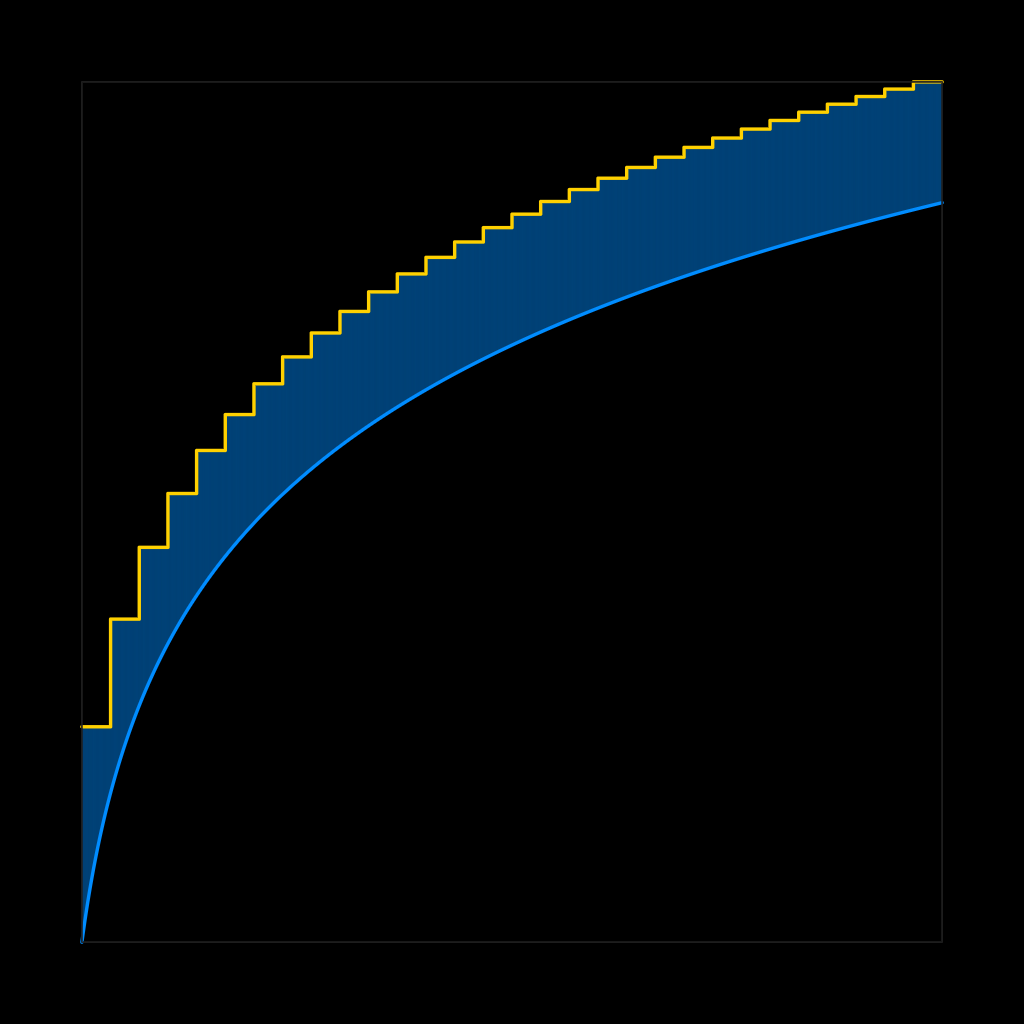
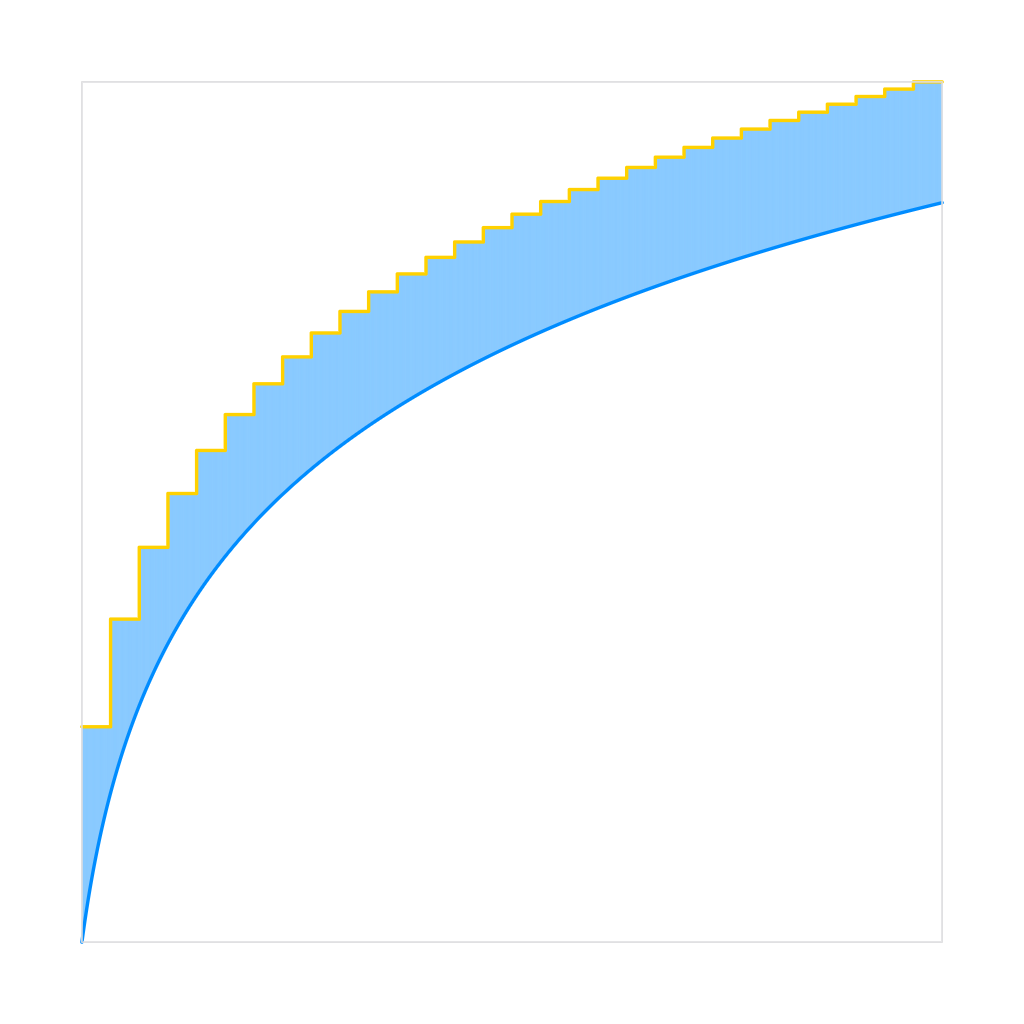
The Euler-Mascheroni constant
Add 1 and a half and a third and on to one over n, take away the logarithm of n, and the difference settles on 0.5772157, a number nobody has yet placed.
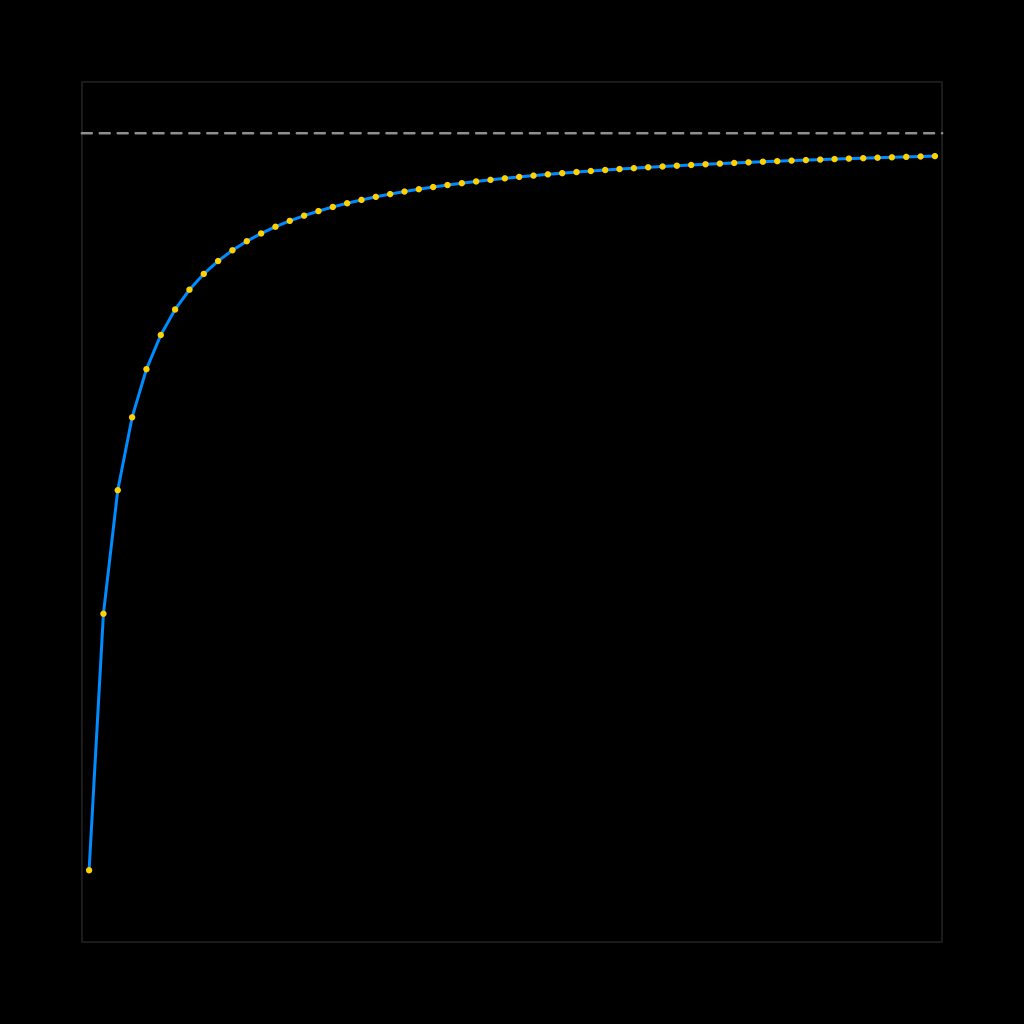
Euler's number
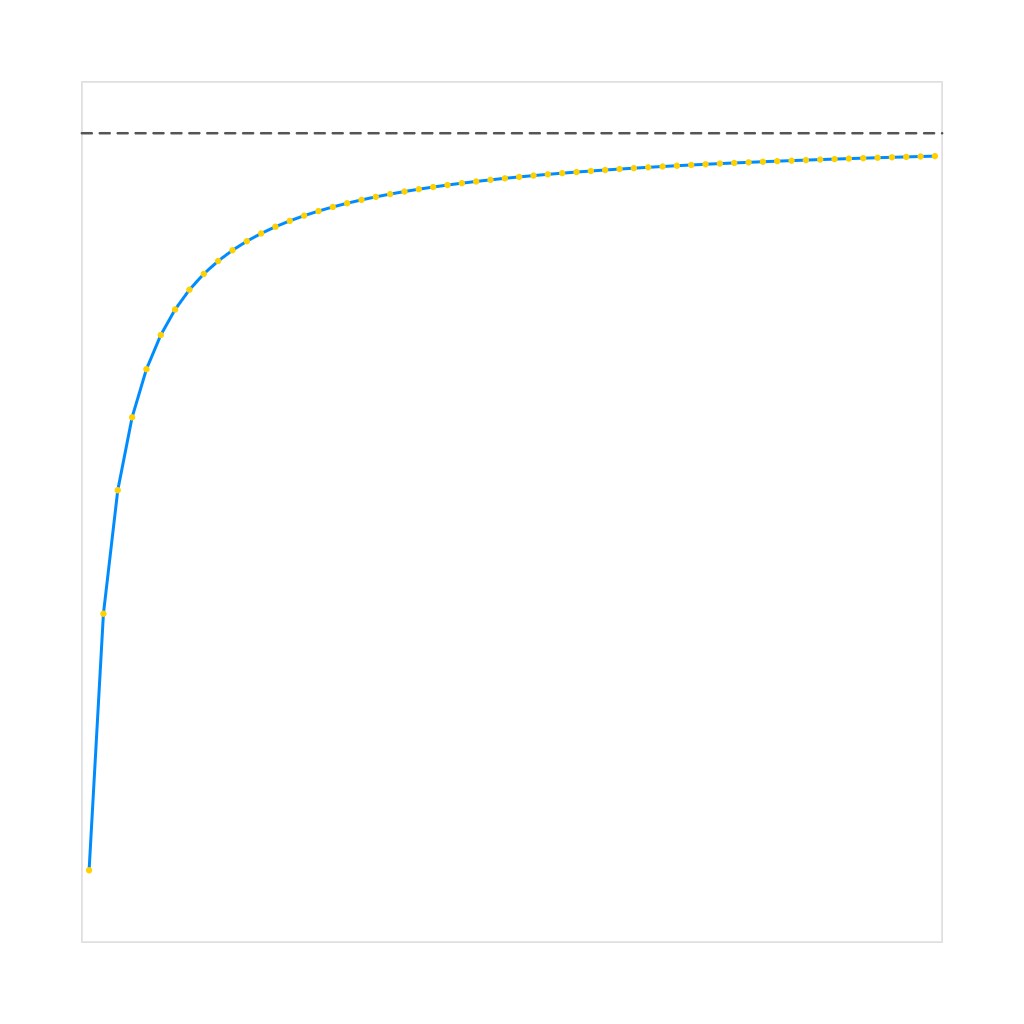
Split a year's interest into more and more payments and the yearly growth climbs, slows and stops at 2.718281828.
Famous formulas
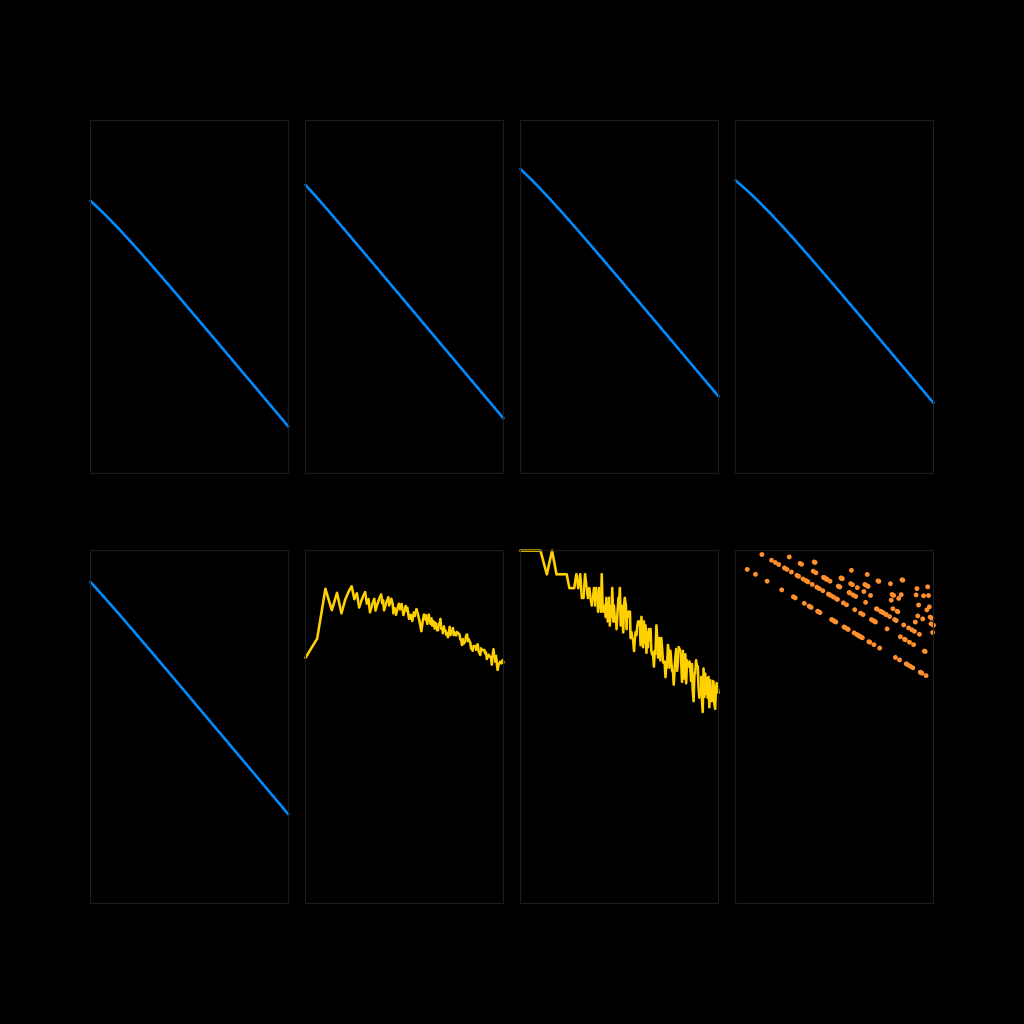
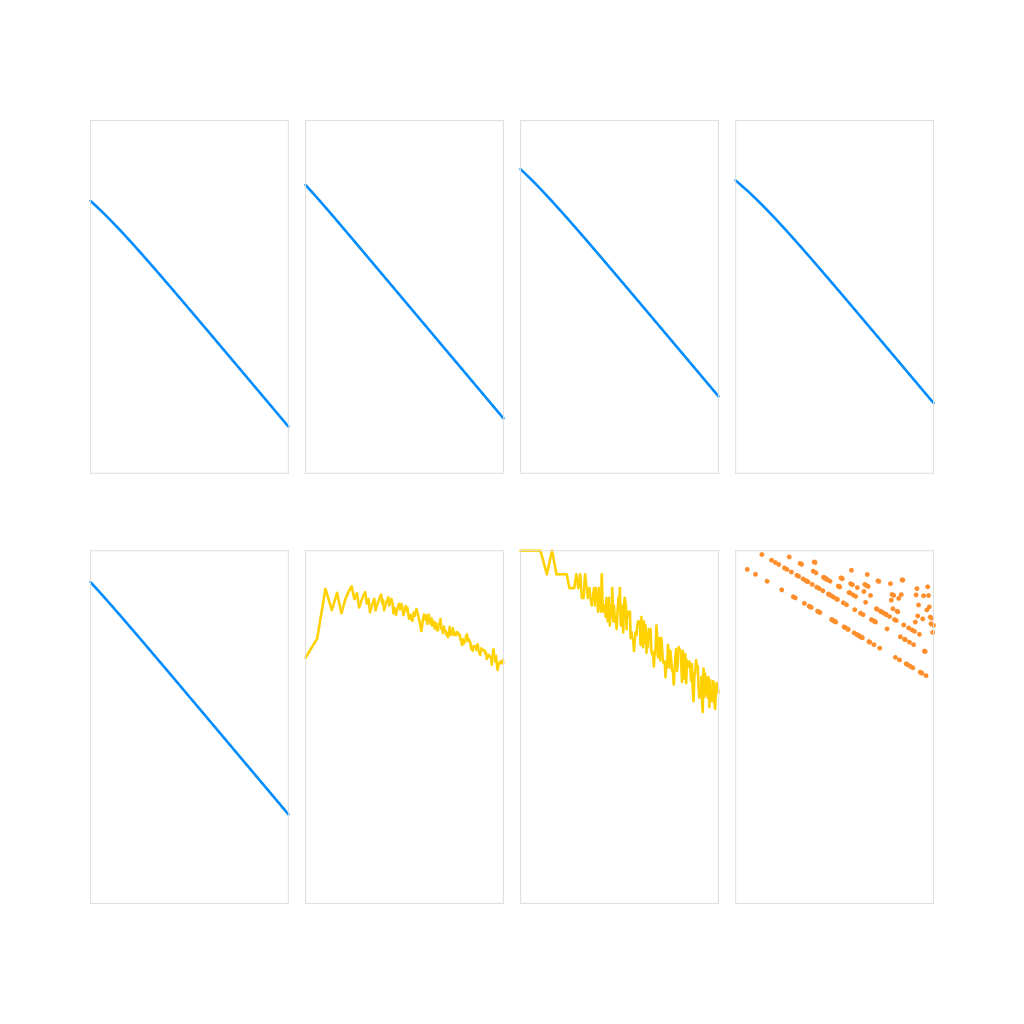
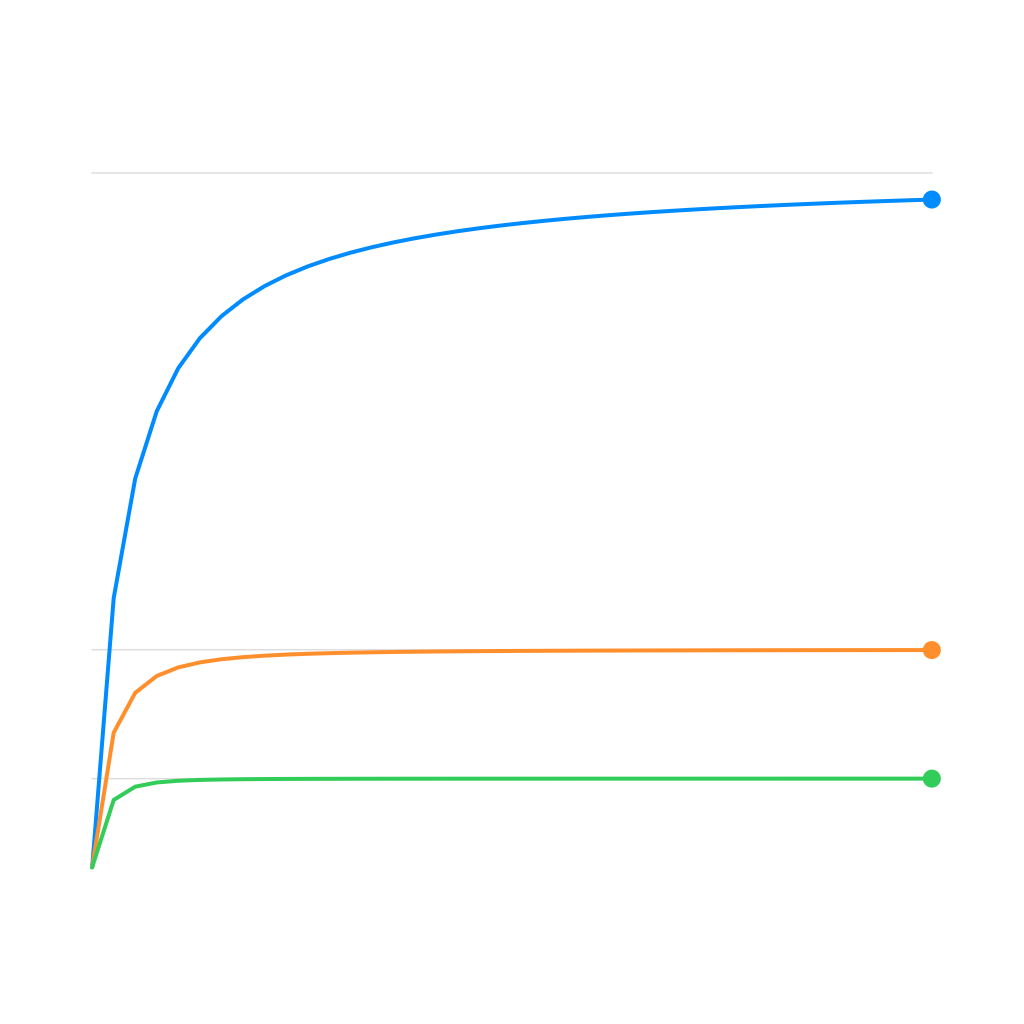
Eight elementary rules run out to infinity. Five close on a constant, one counts the primes, one refuses to reach zero and one refuses to settle down at all.
The Farey sequence
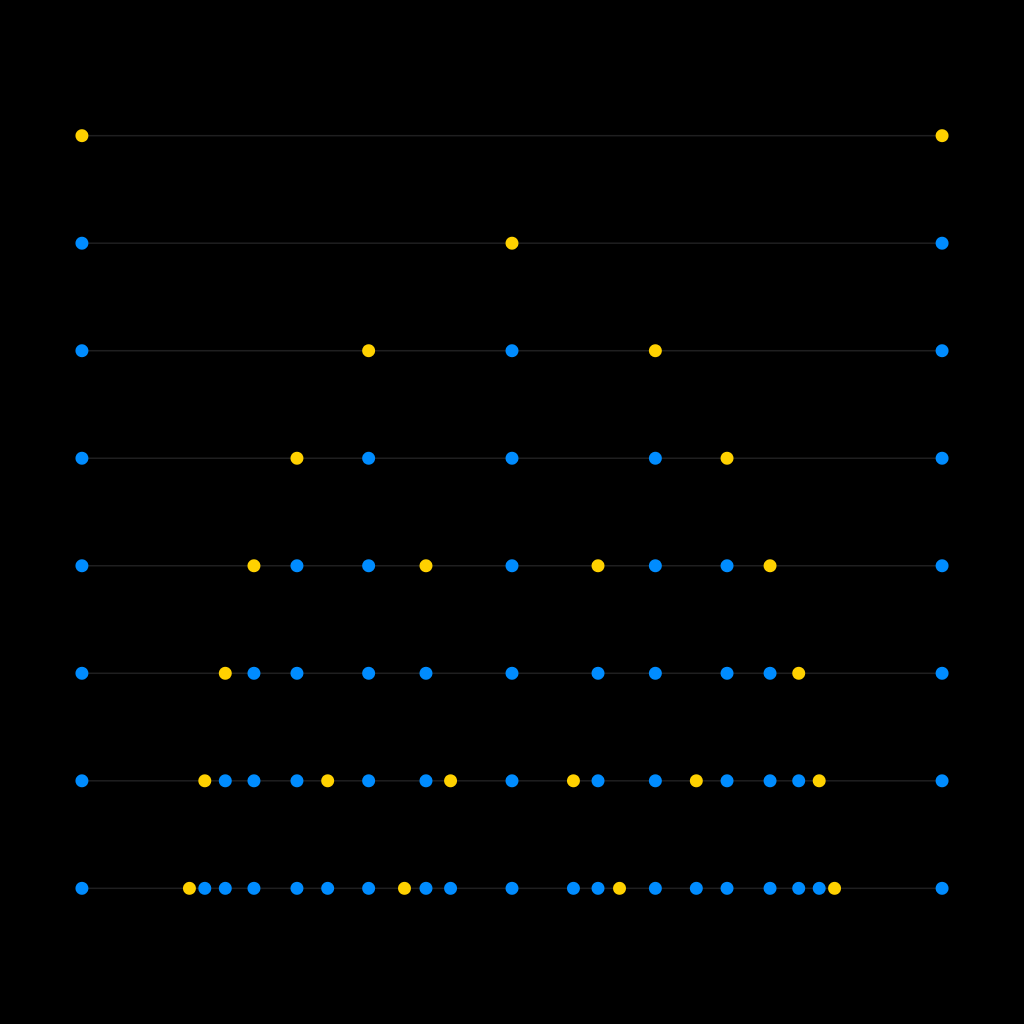
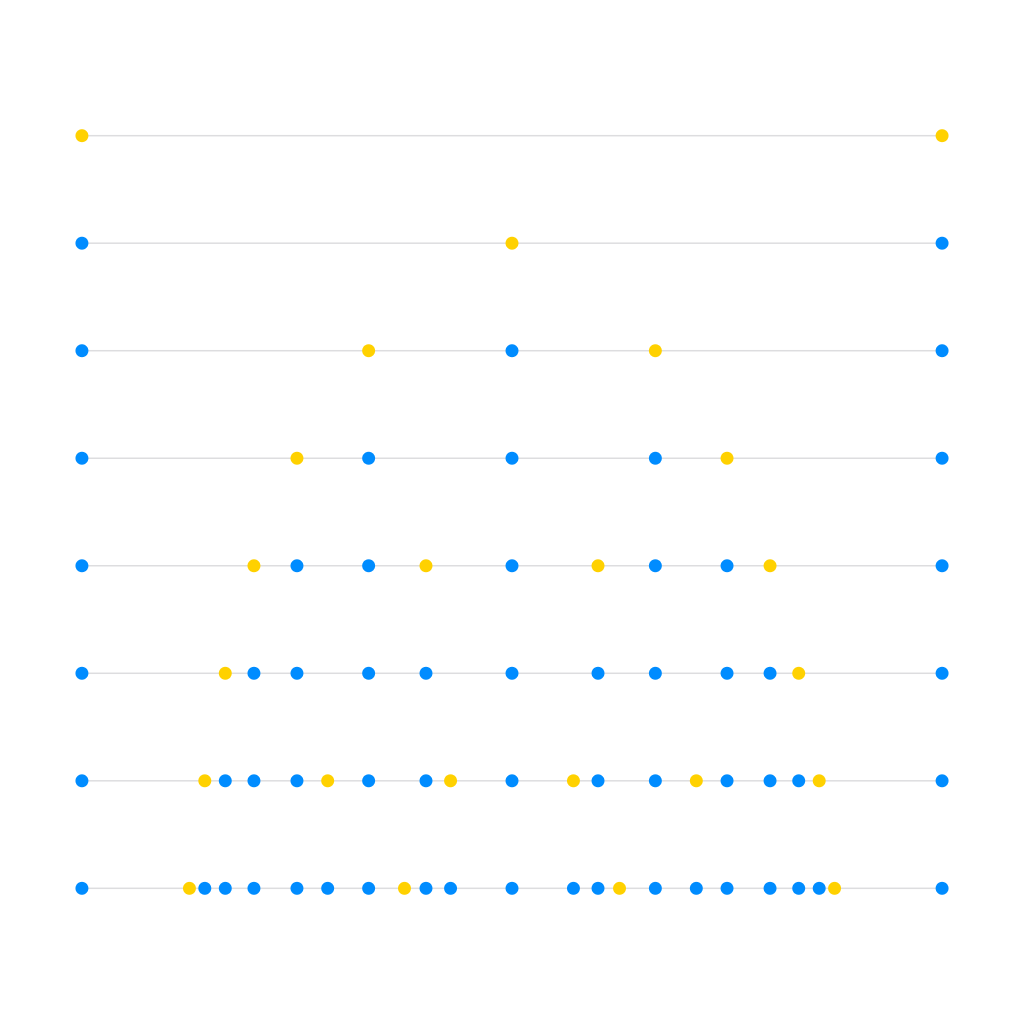
Every fraction between zero and one whose bottom number is at most Q, written in order; each new Q slips a few new fractions between the old ones and never moves one.
The greatest common divisor
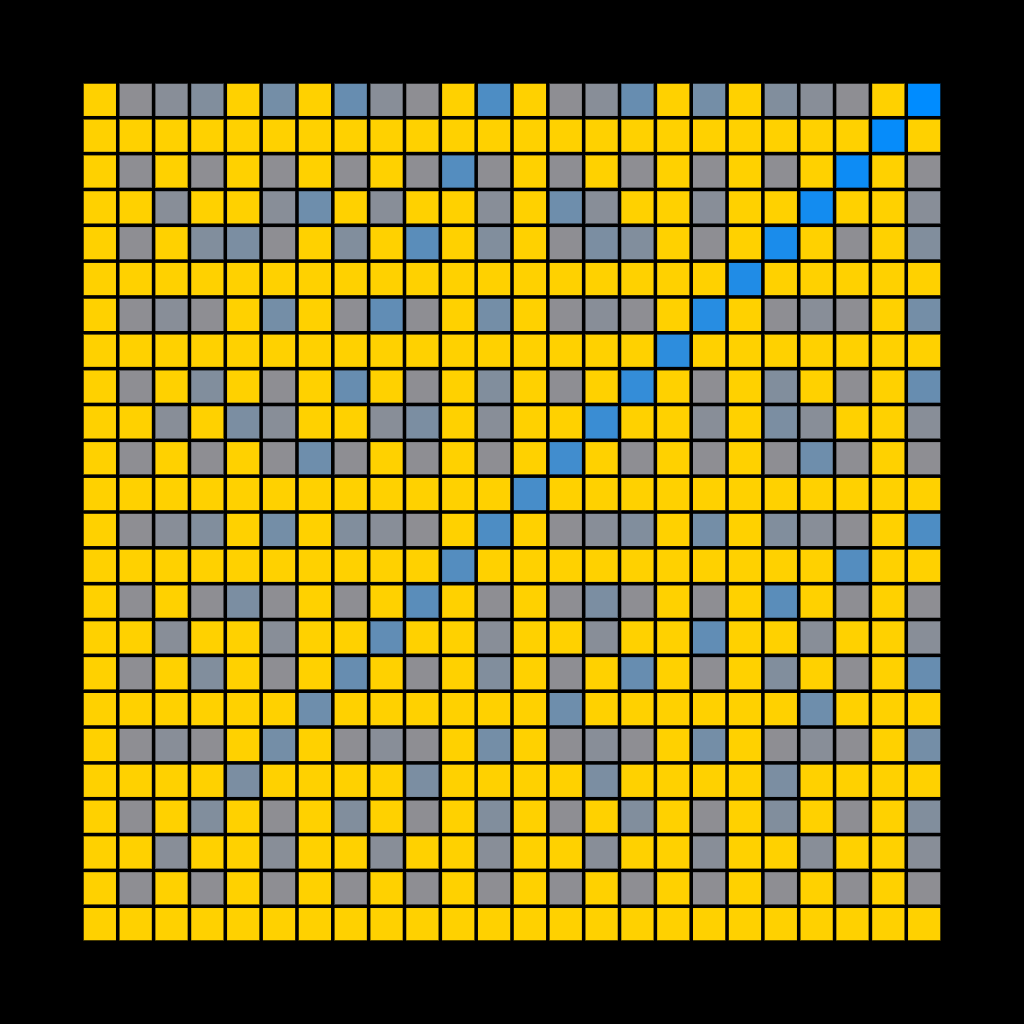
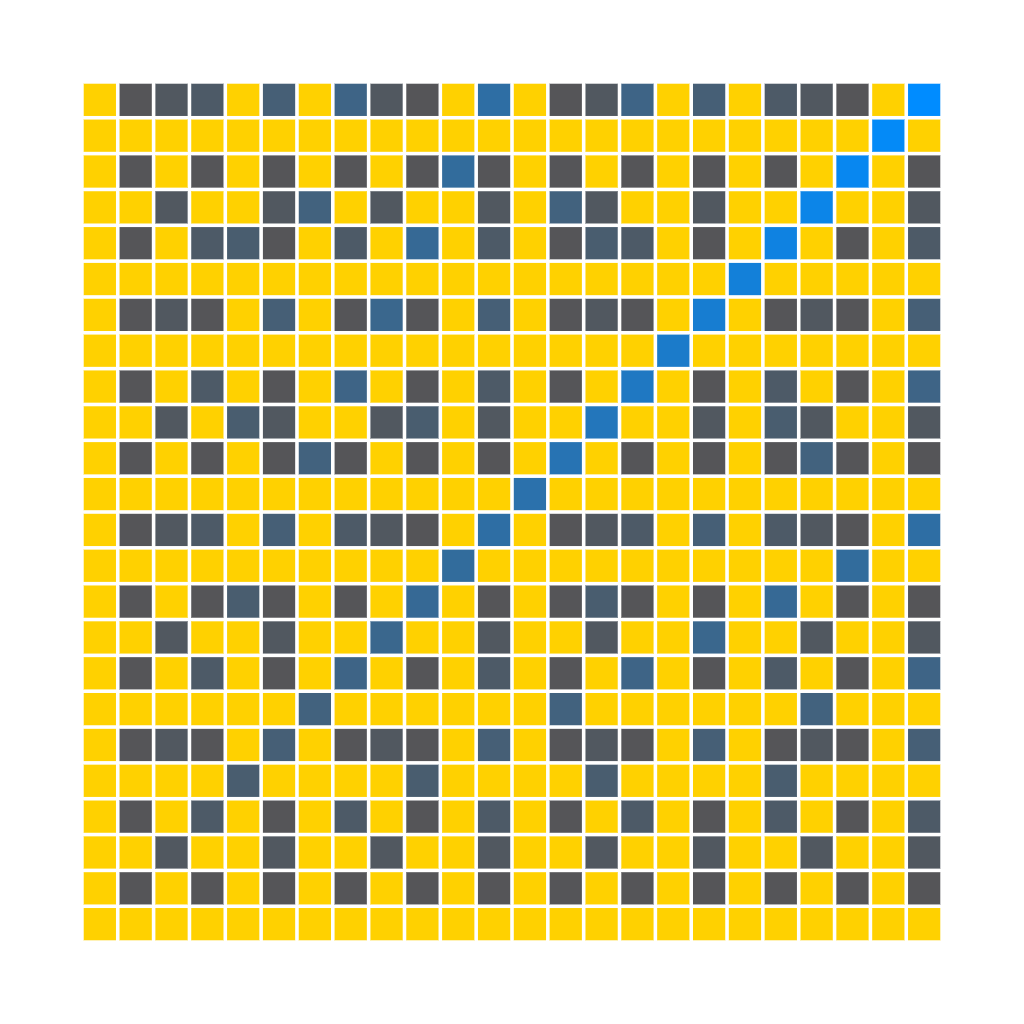
The largest number dividing two others at once; Euclid finds it by taking remainders, and when it comes out 1 the two numbers share nothing.
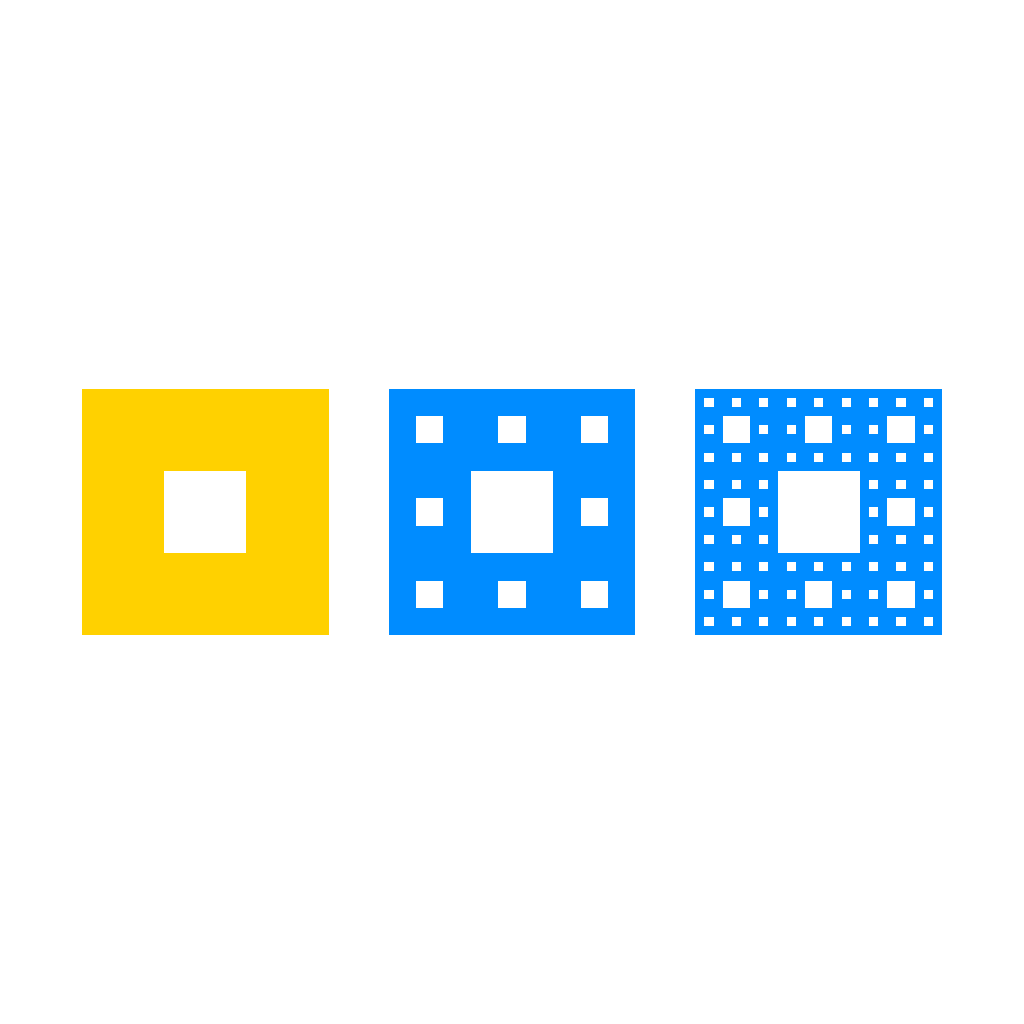
The Kronecker product
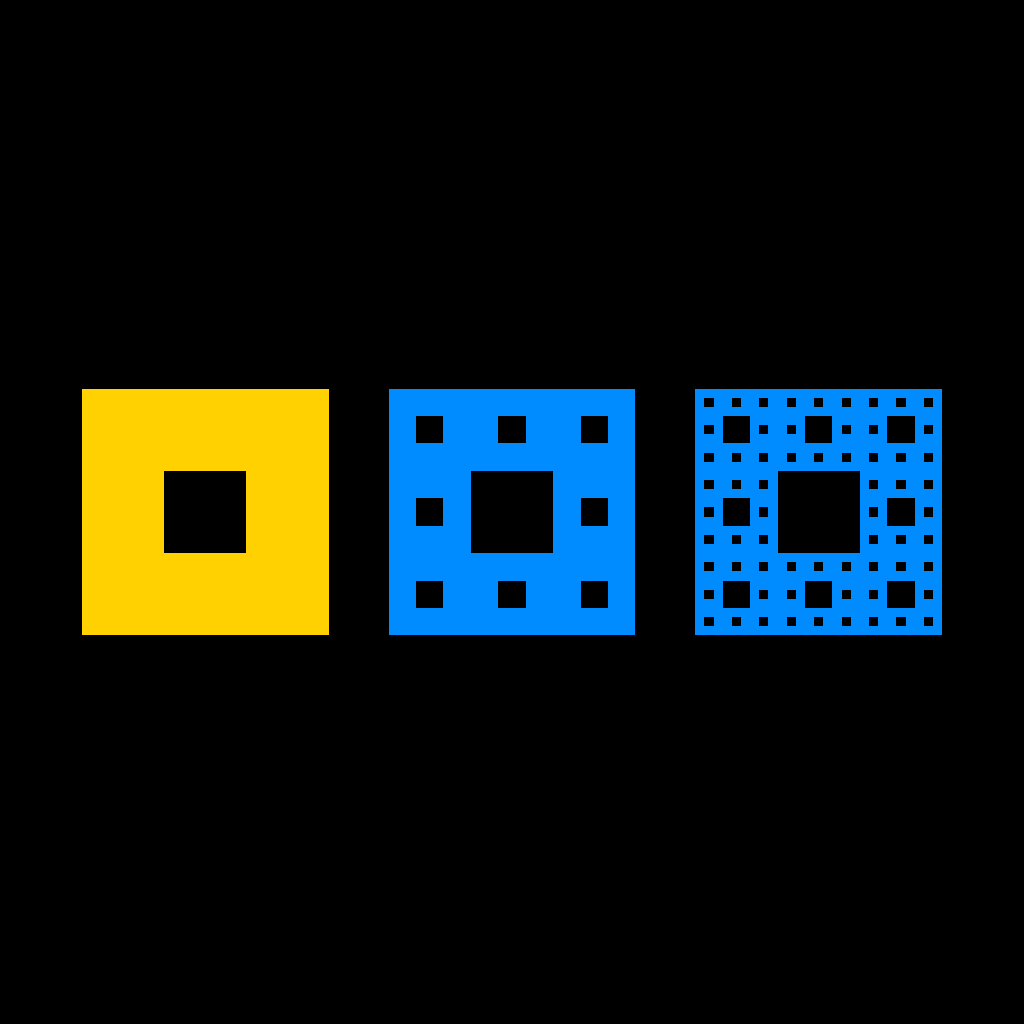
Stamp a small picture into every filled cell of itself and it grows a level; that one move builds every design on this site.
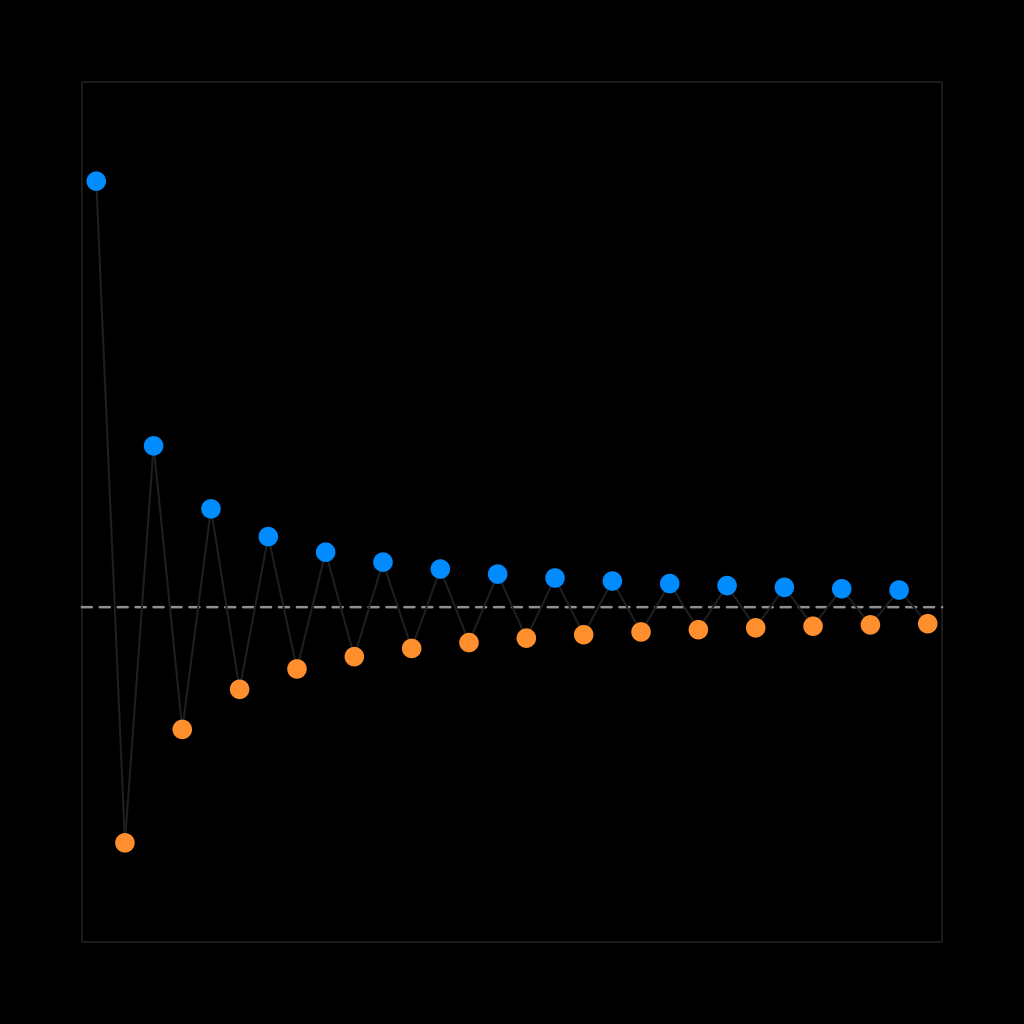
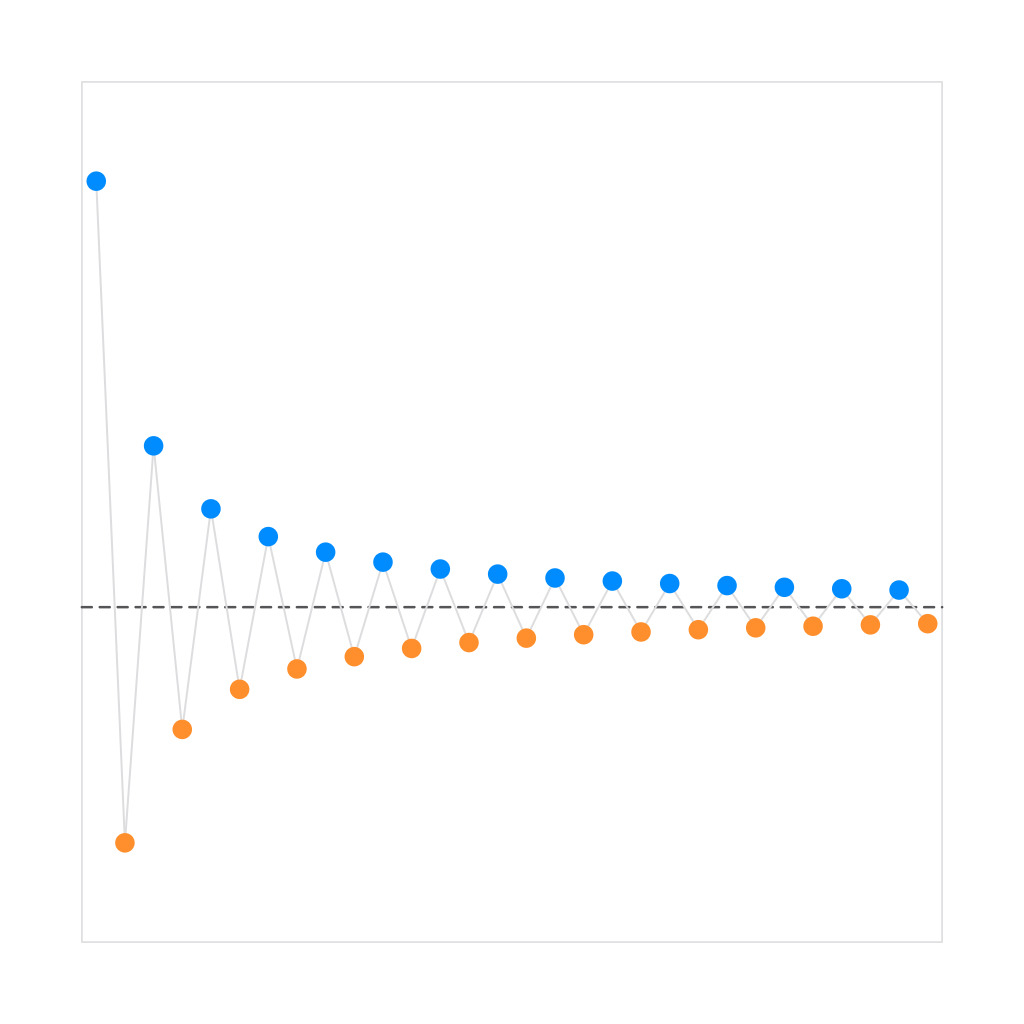
The Leibniz series
Add one, take away a third, add a fifth, and the running total swings over and under a quarter of pi, closing on it very slowly.
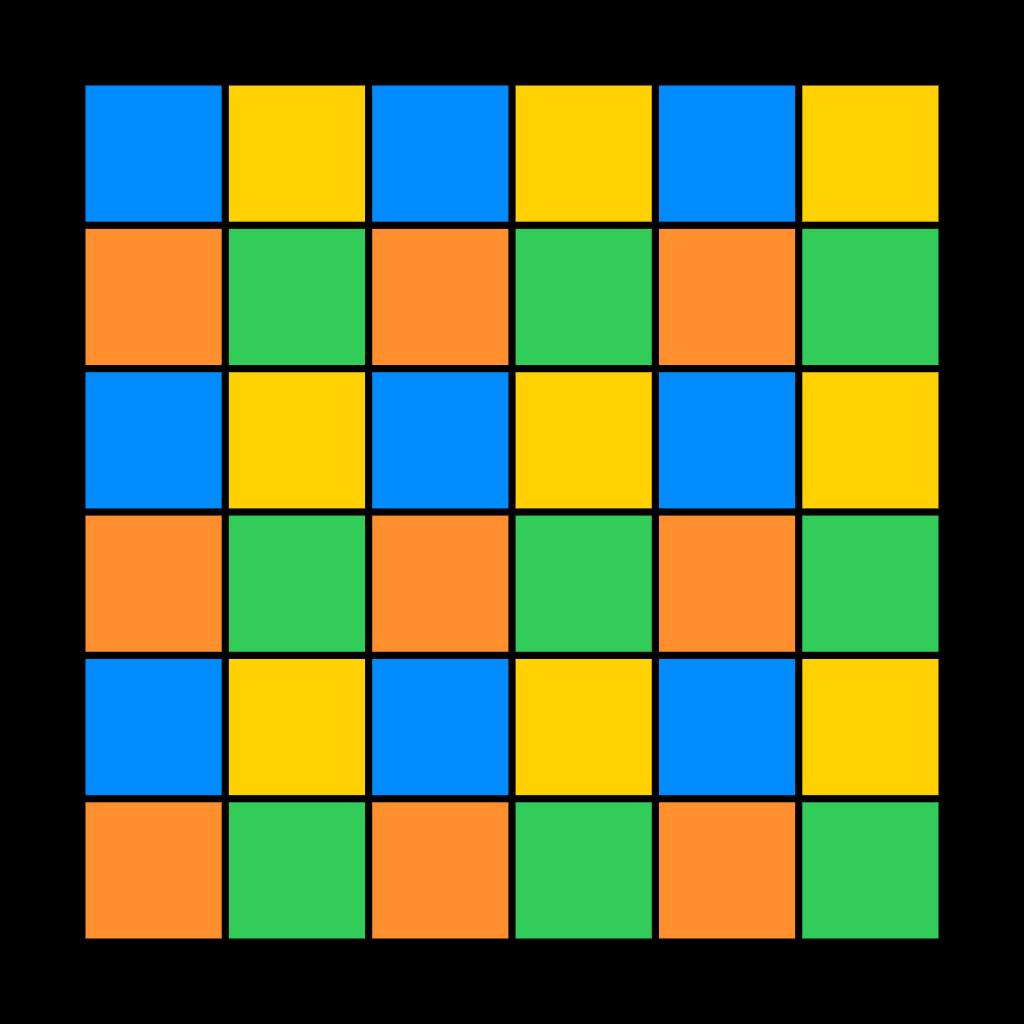
Parity
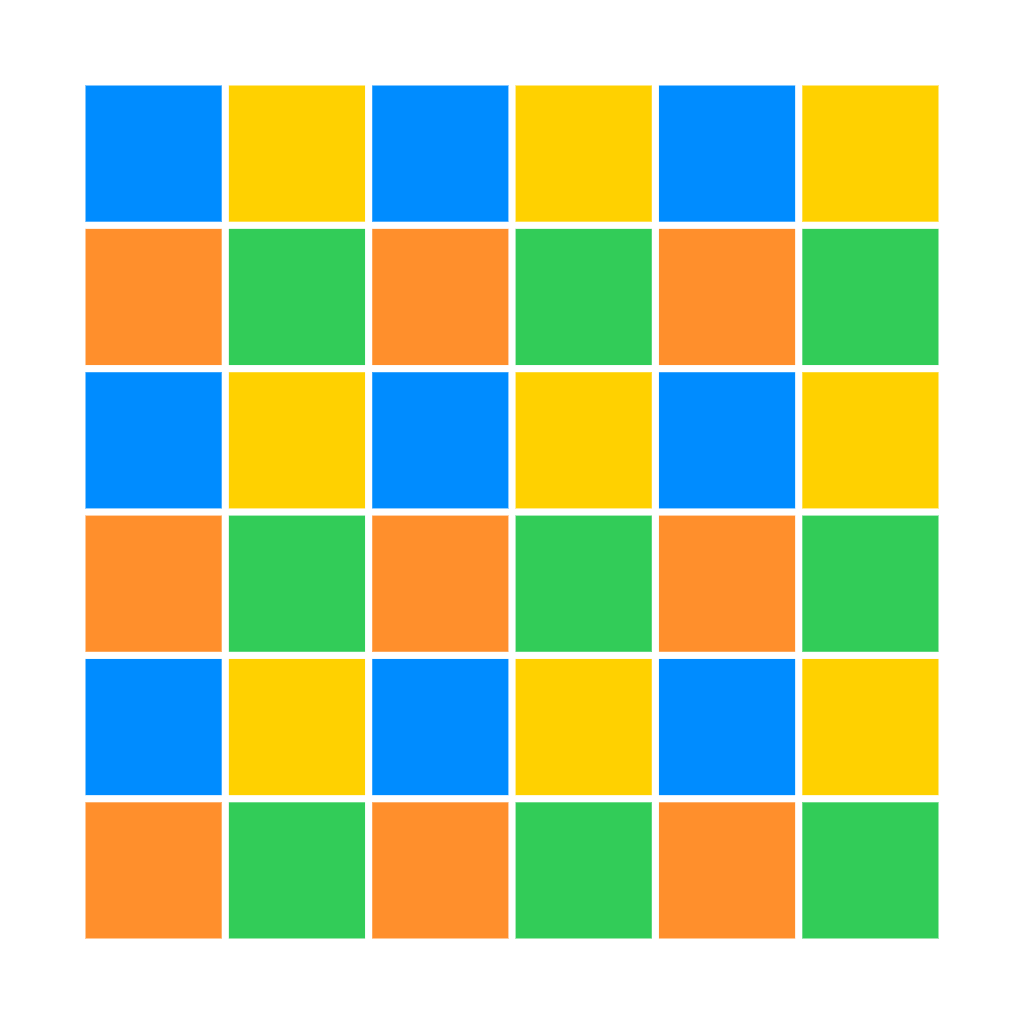
Every whole number is even or odd, and that single bit, read on each coordinate at once, is the whole of what a design uses to choose its cells.
Prime numbers
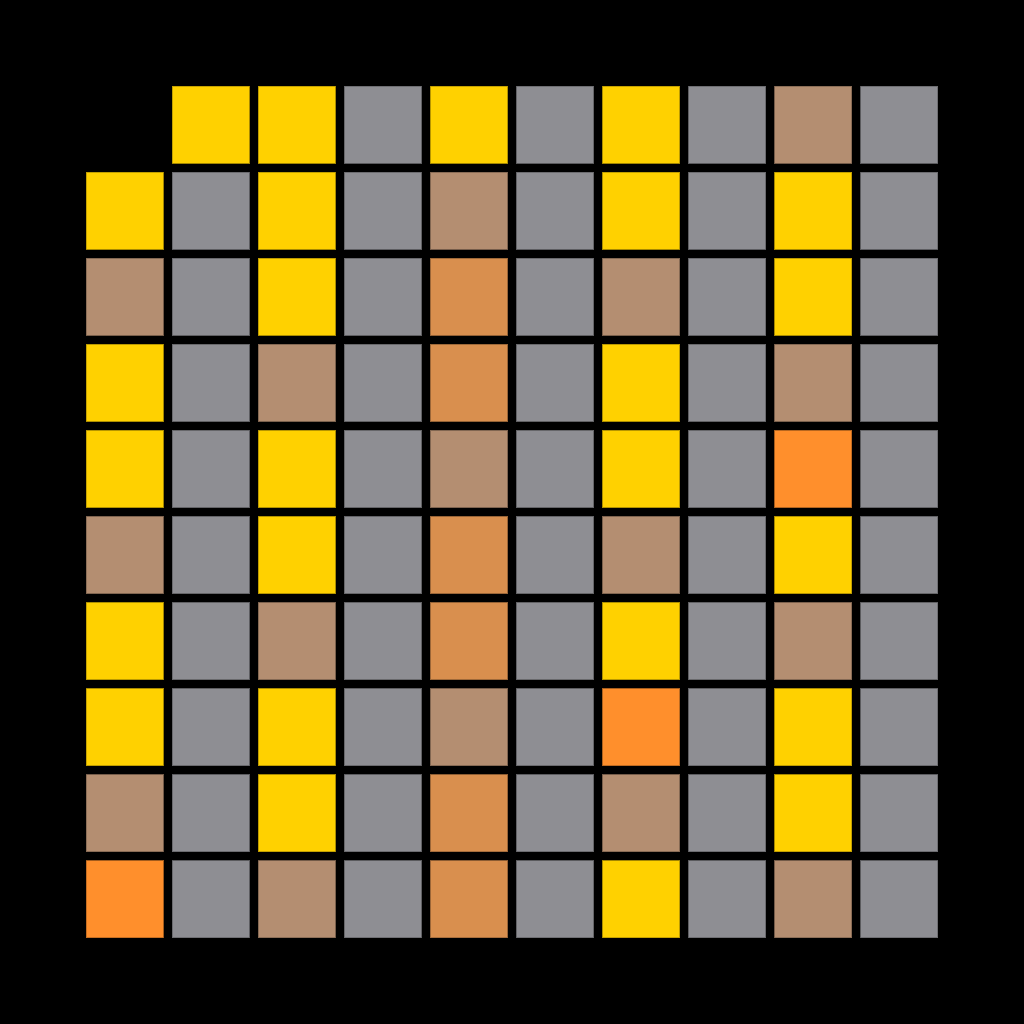
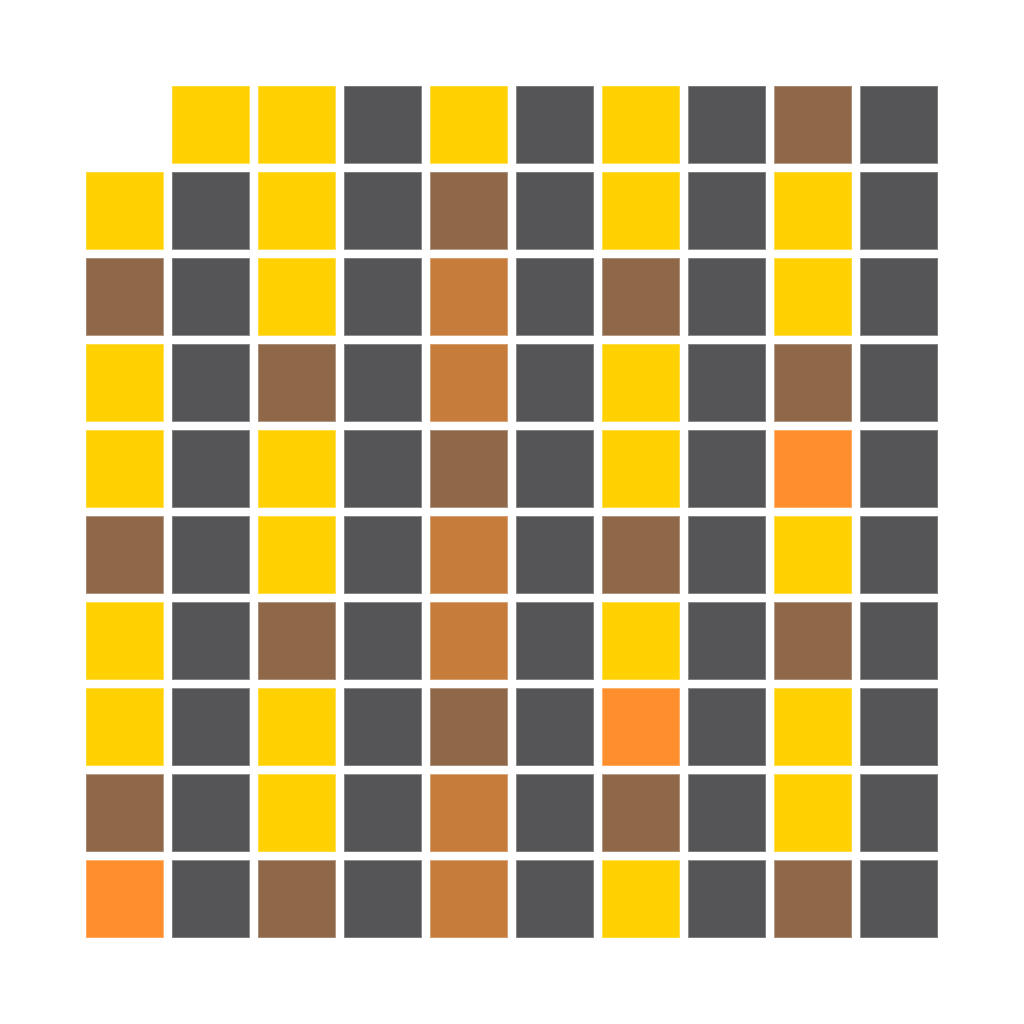
A prime is a number whose stones make only one rectangle; every other number is built from primes, and the supply never runs out.
Visible lattice points
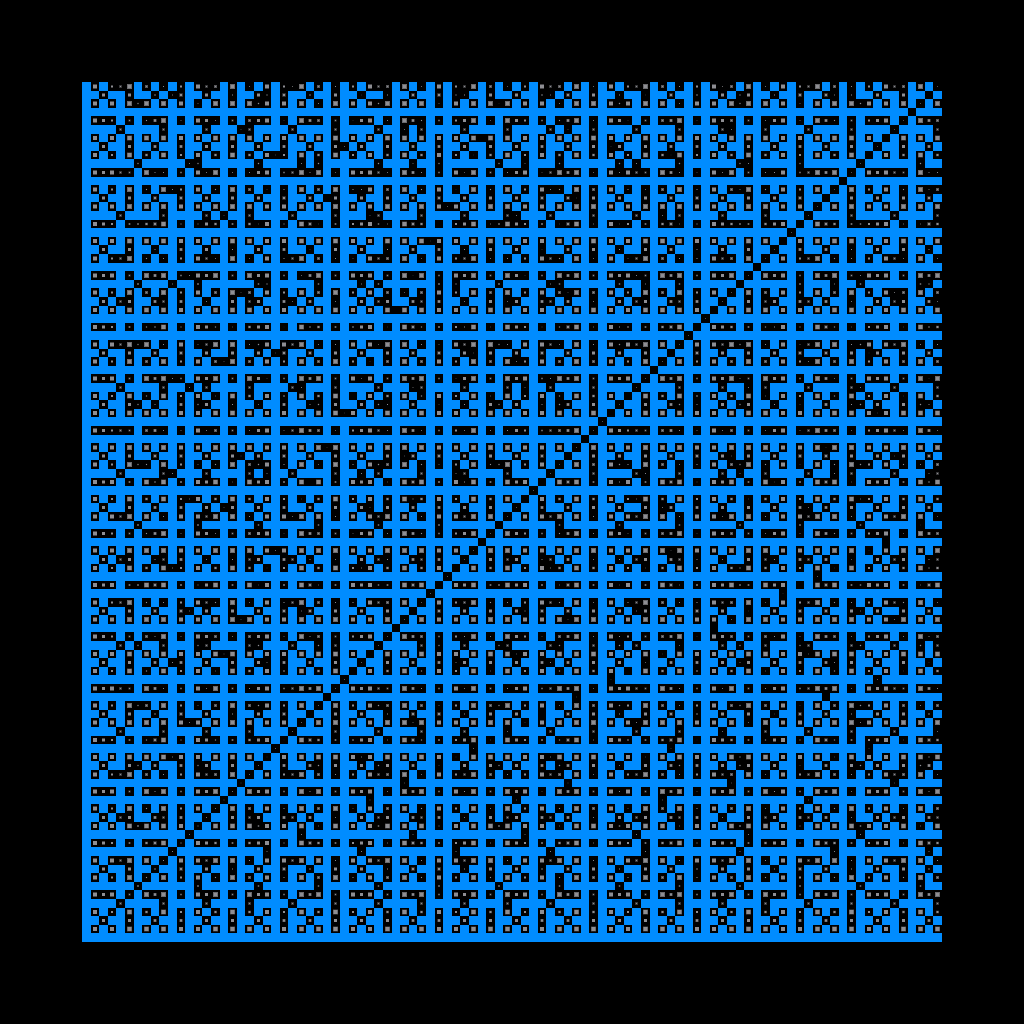
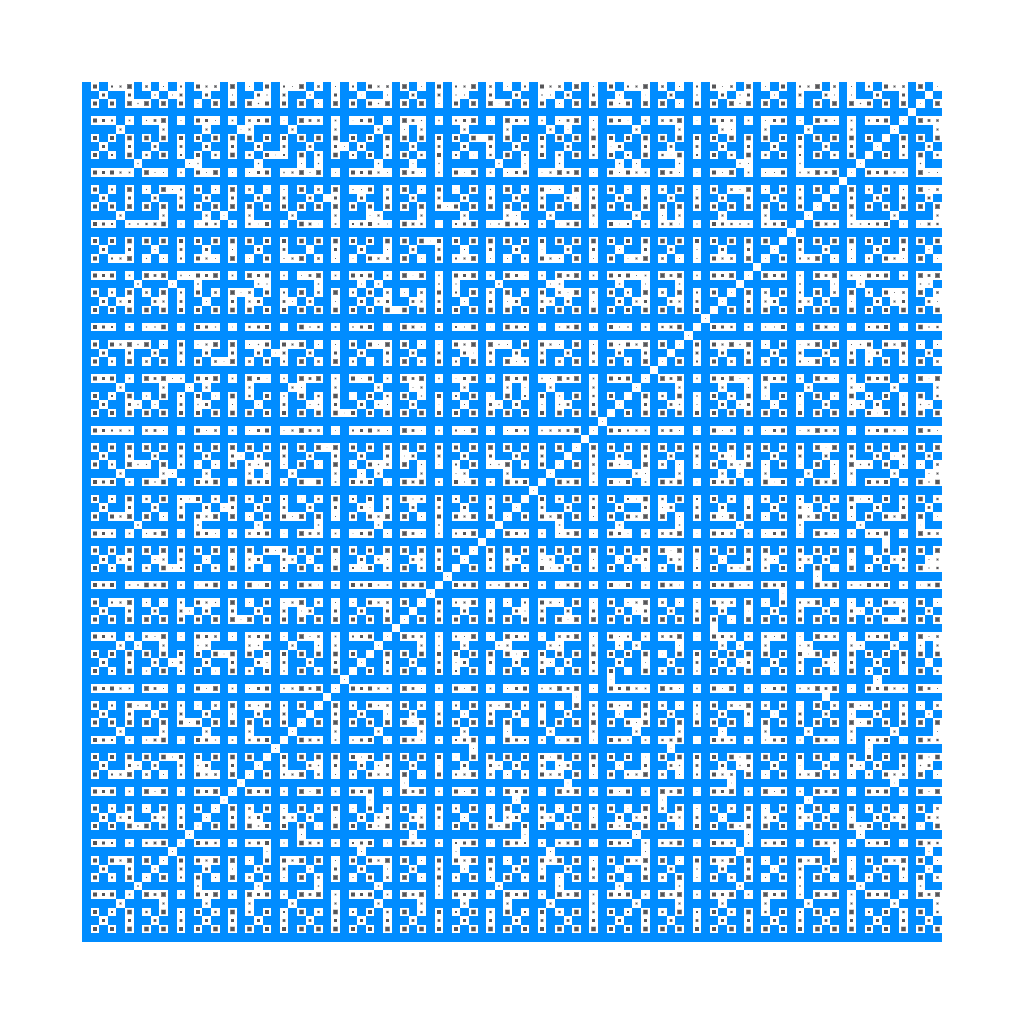
Stand at a corner of the grid and some points hide behind nearer ones; the ones you can see are the pairs sharing no divisor, and counting them hands back pi.
The Wallis product
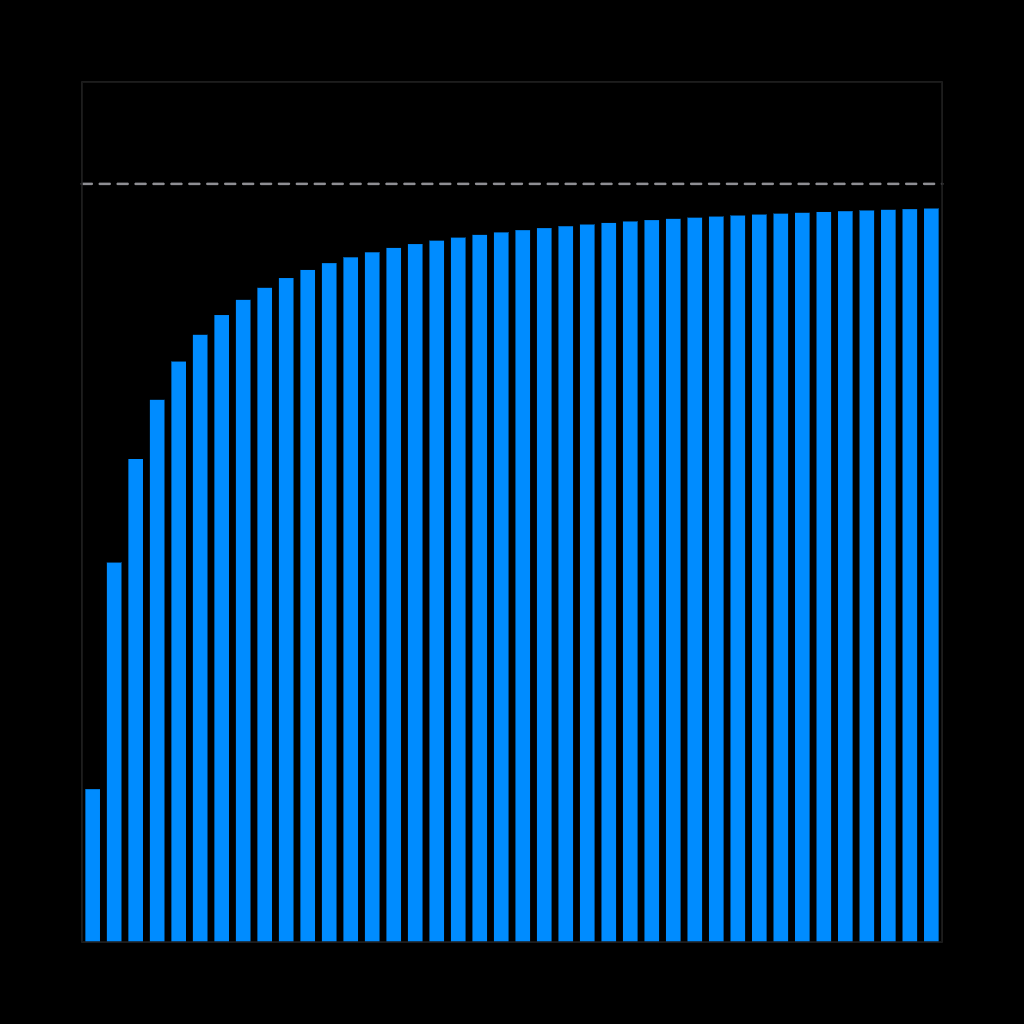
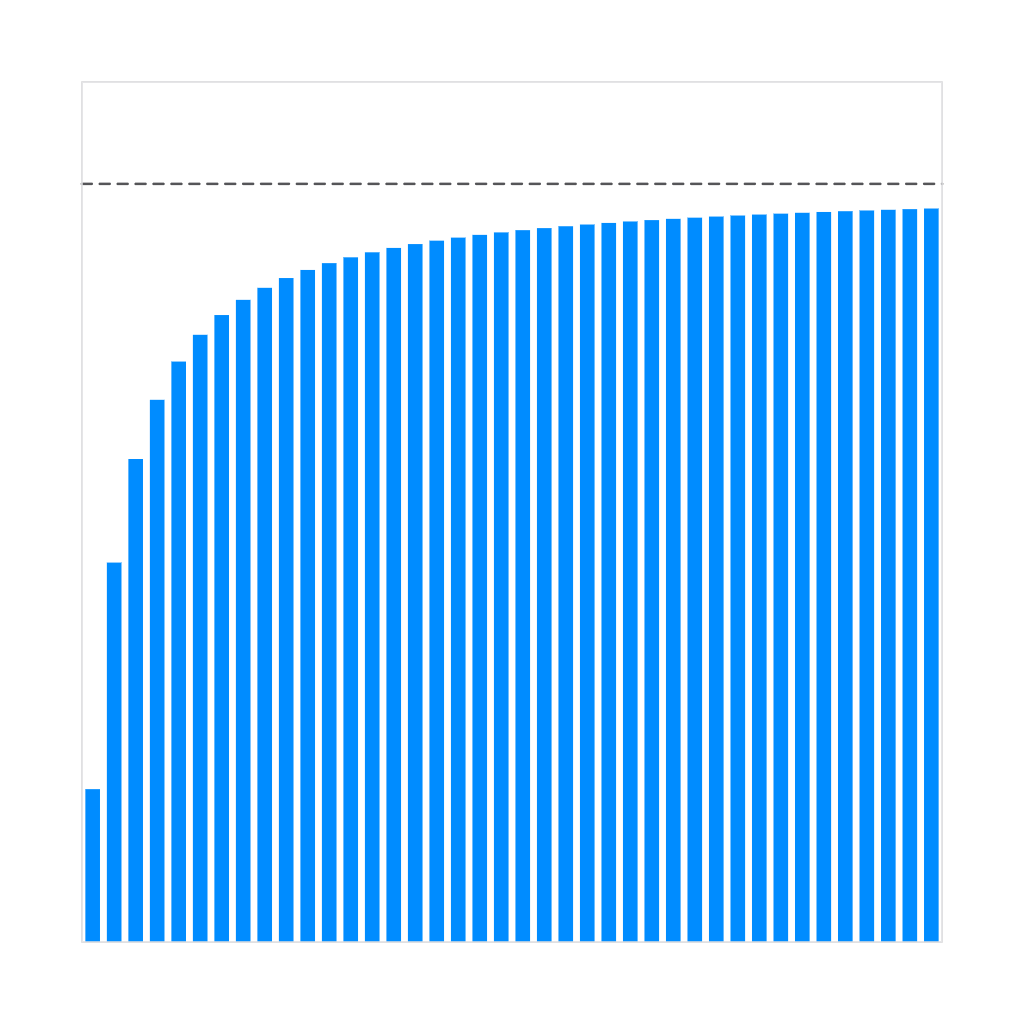
Multiply 4/3 by 16/15 by 36/35 and keep going, and the running product climbs forever without ever reaching half of pi.
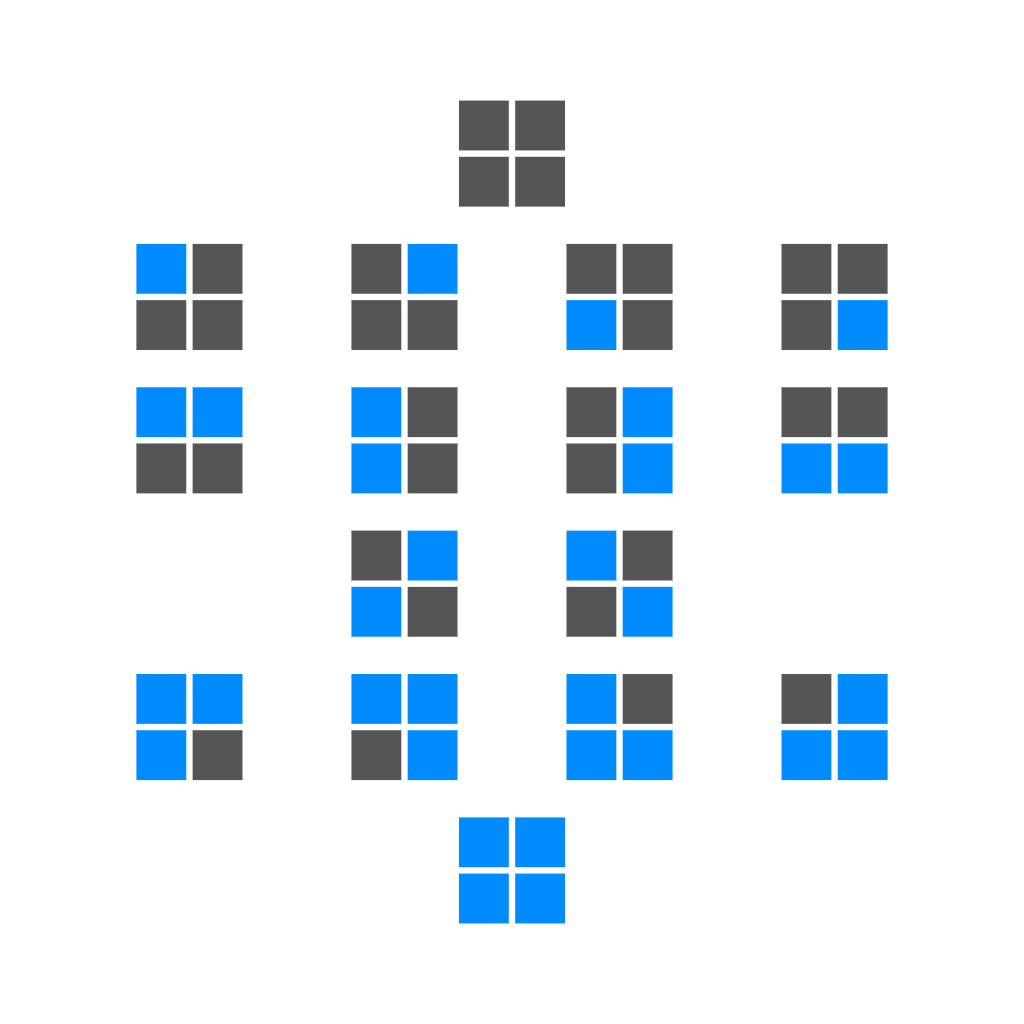
Burnside's lemma
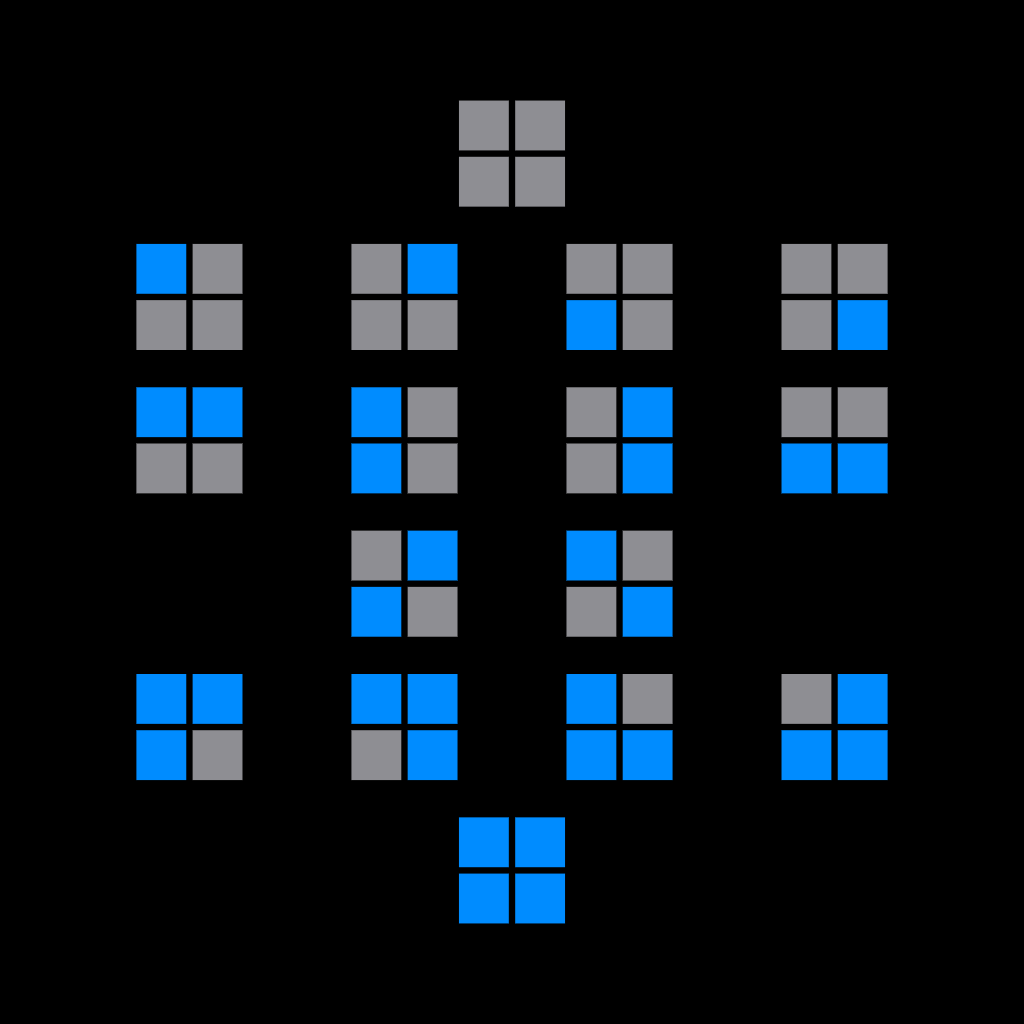
Counting arrangements that turning and flipping should not tell apart, by averaging how many each symmetry leaves untouched.
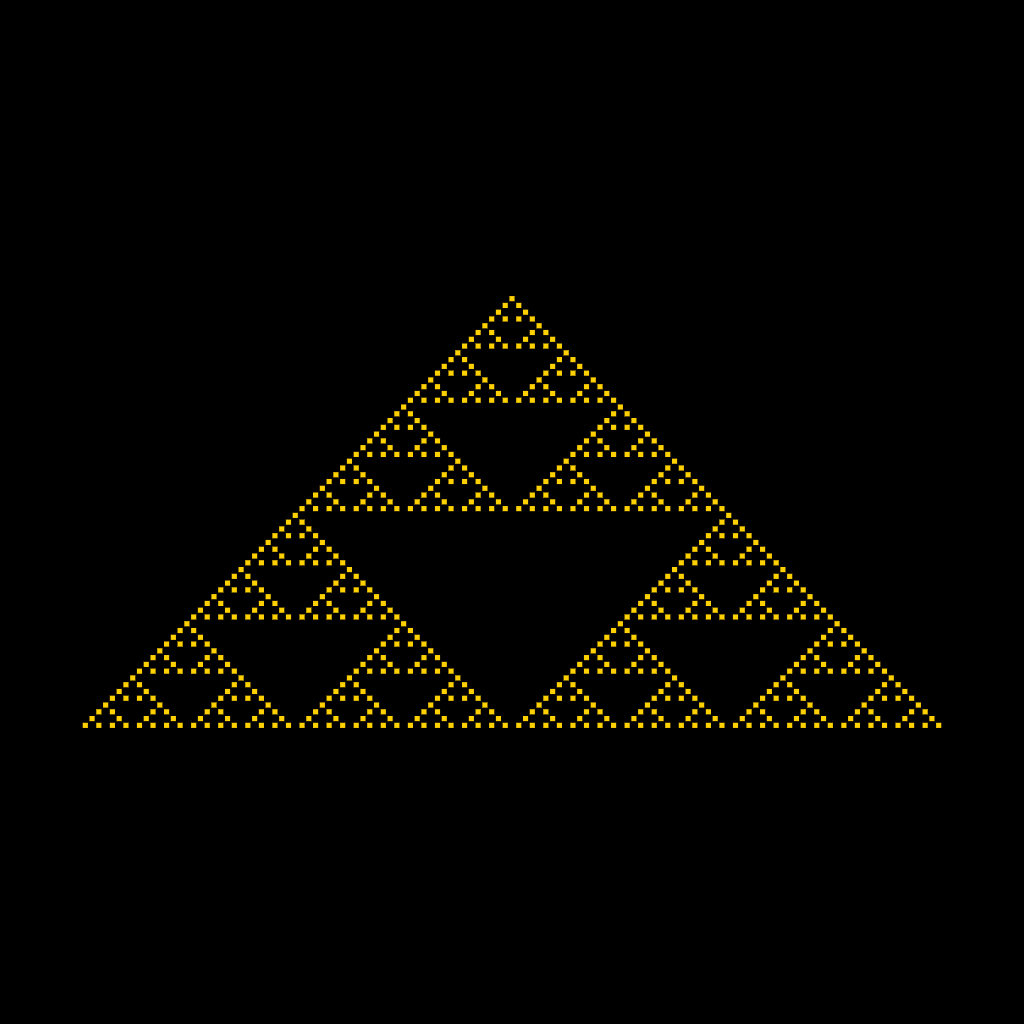
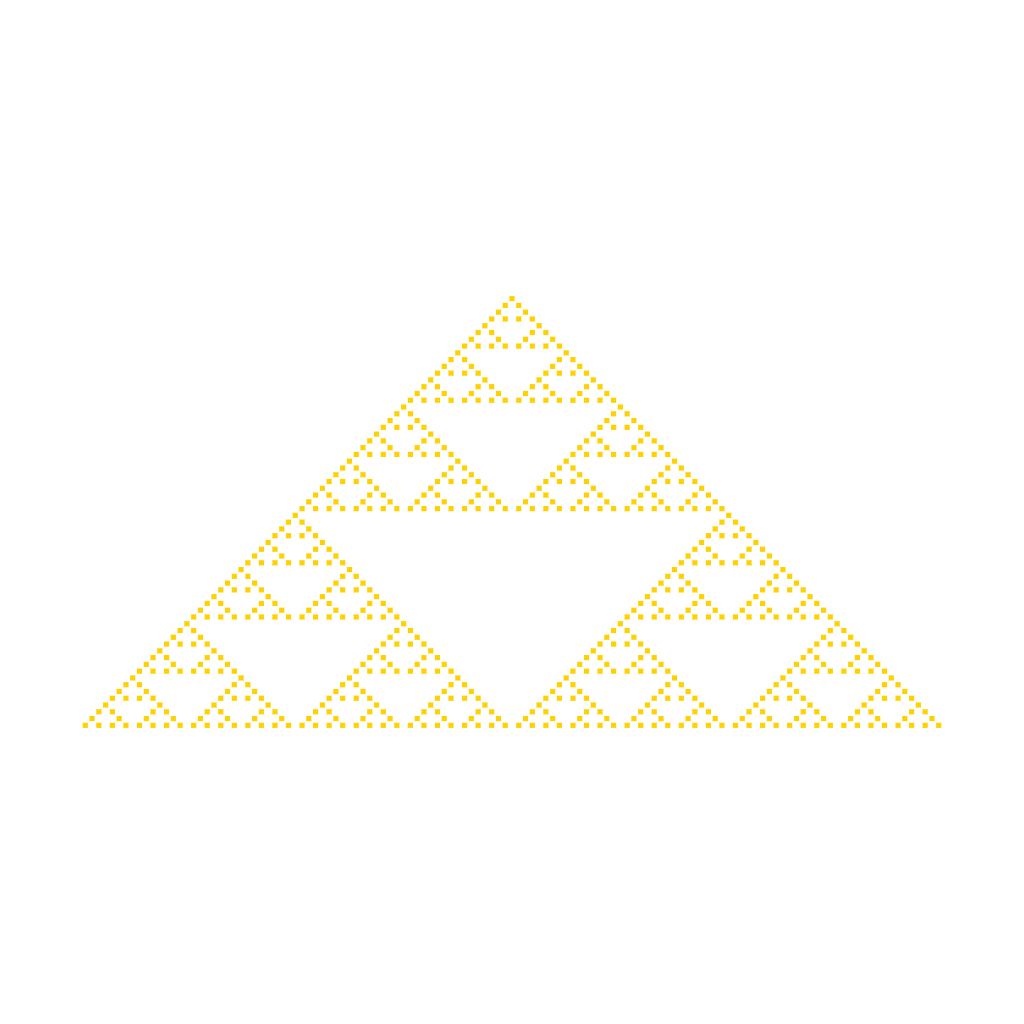
Cellular automata
A row of cells, a rule that reads each cell with its two neighbours, and a new row written underneath; run it and the rows draw a picture.
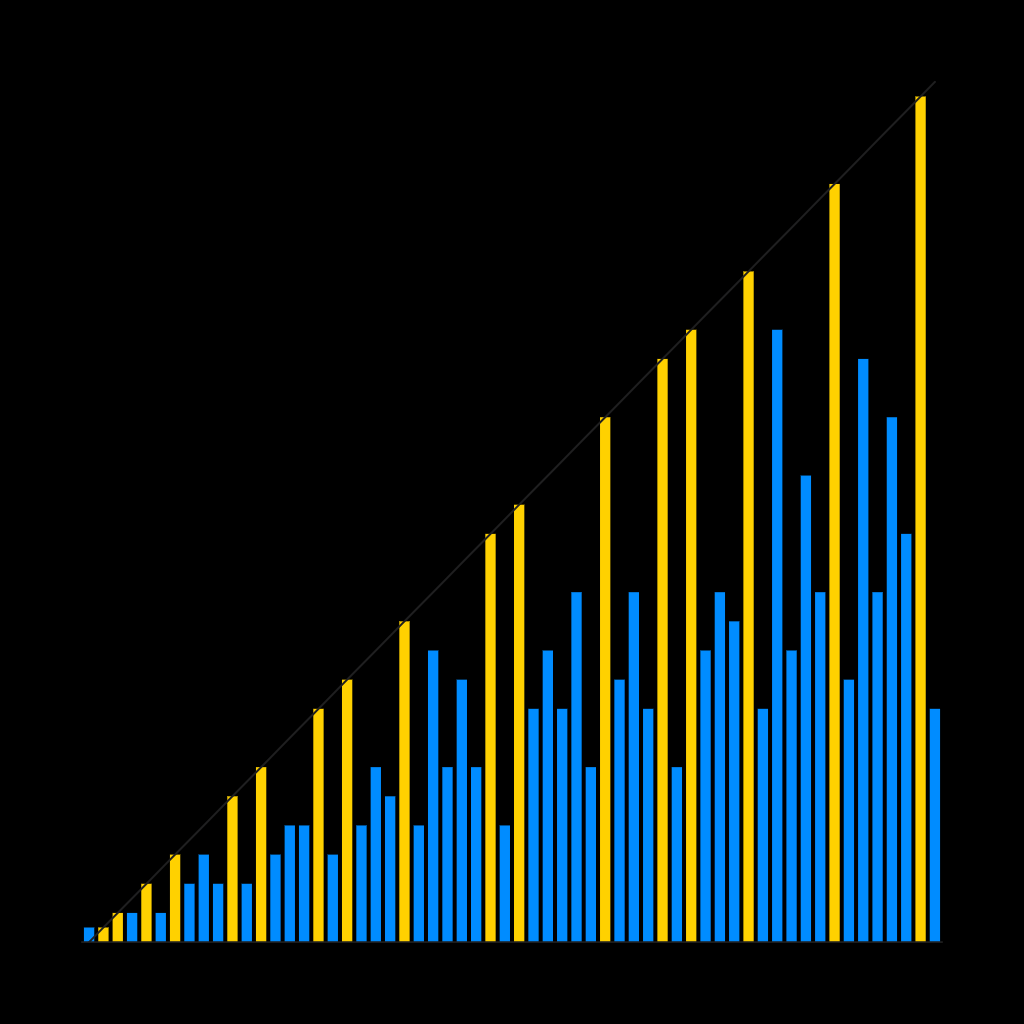
Euler's totient
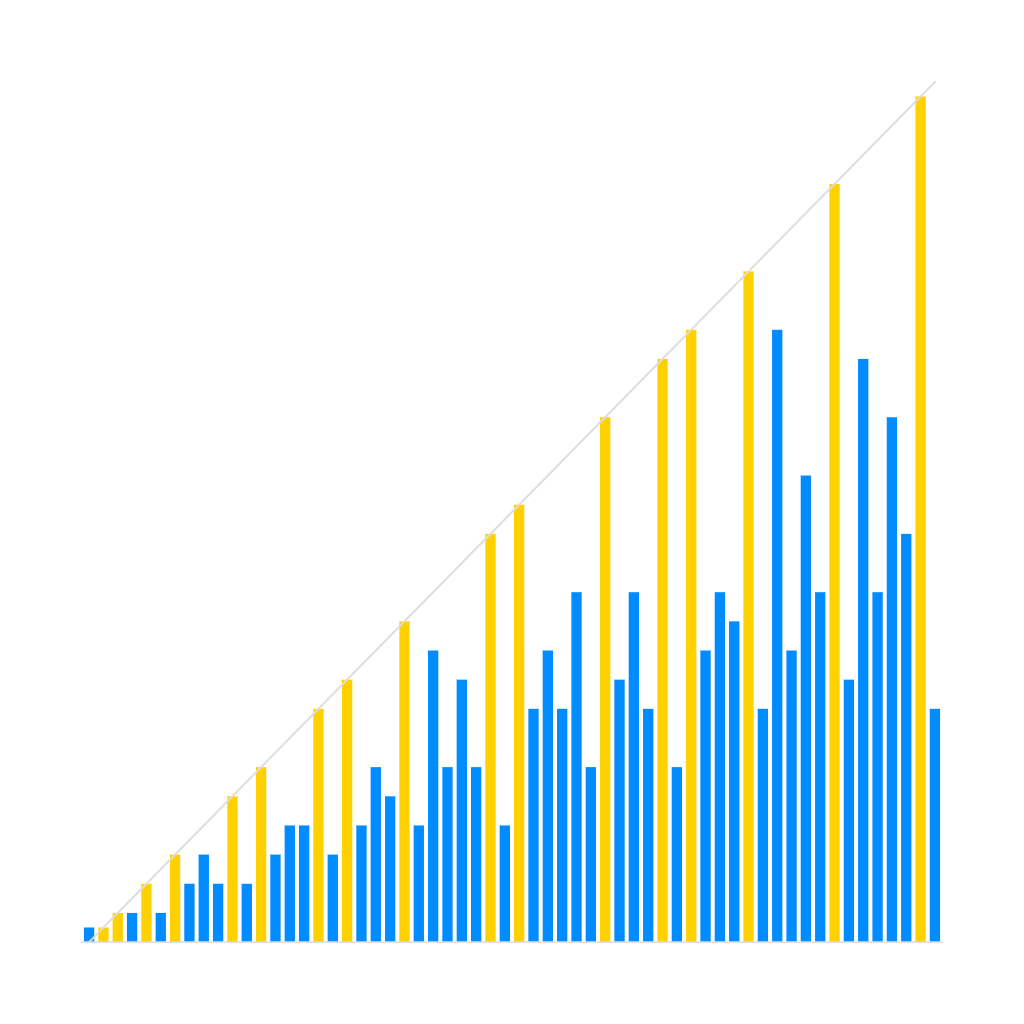
Phi of n counts how many of the numbers 1 to n share nothing with n; it sinks for numbers with many small factors and hits its ceiling at every prime.
Ford circles
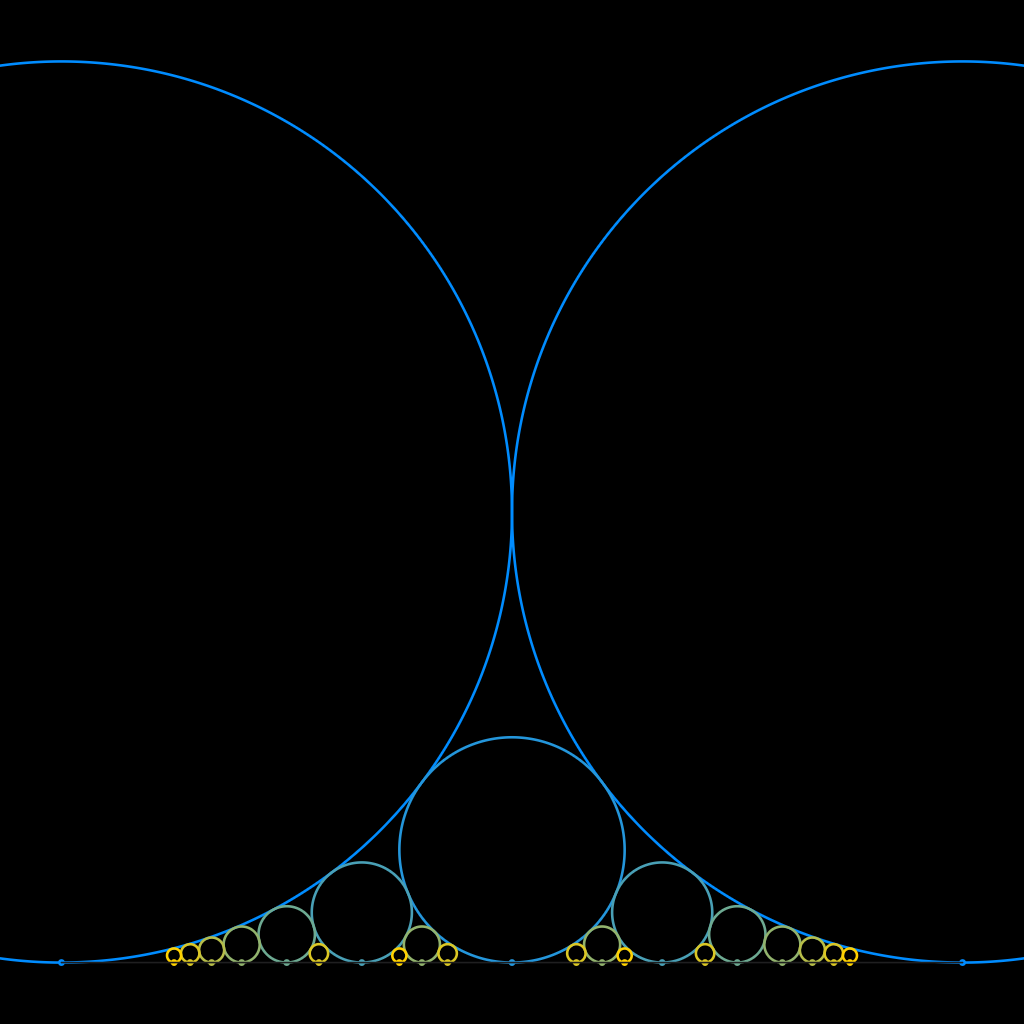
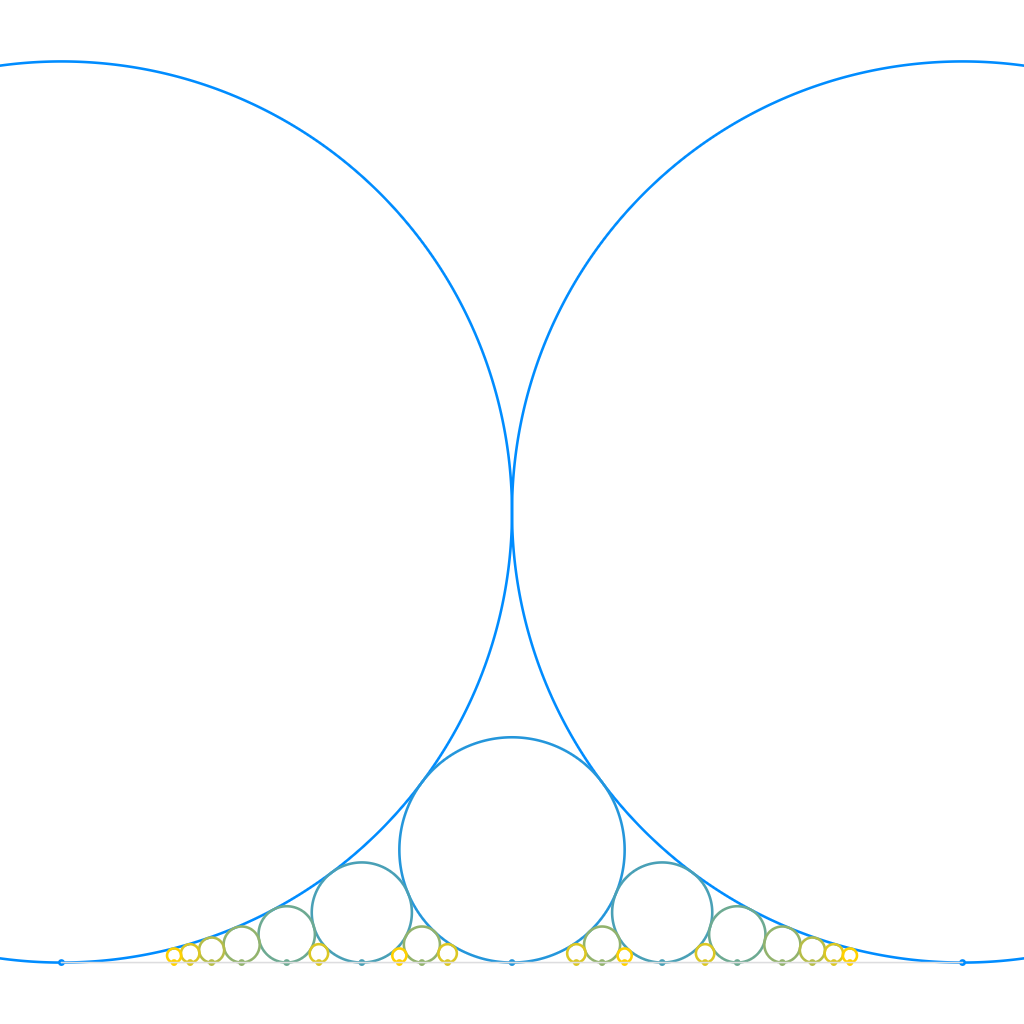
Above every fraction sits a circle resting on the number line, the simpler the fraction the bigger the circle, and no two of them ever overlap.
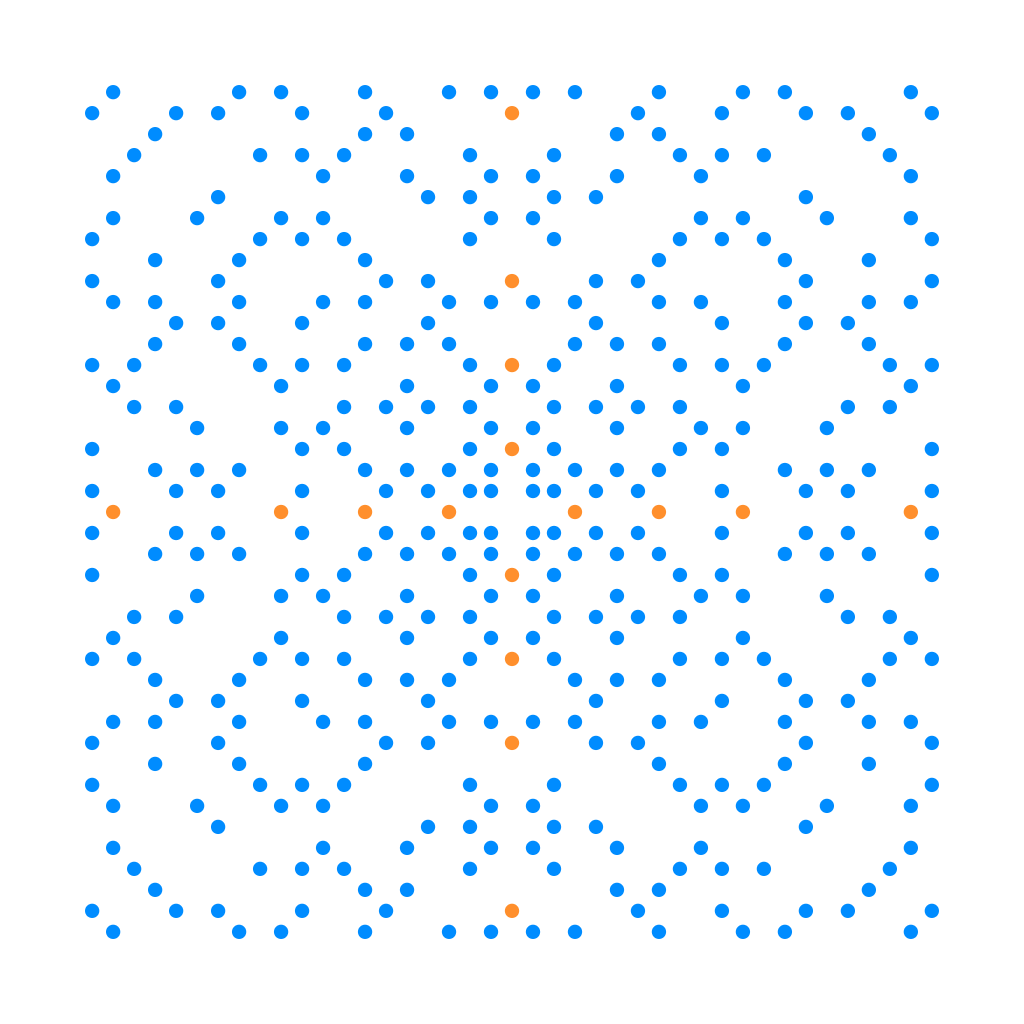
The Gaussian integers
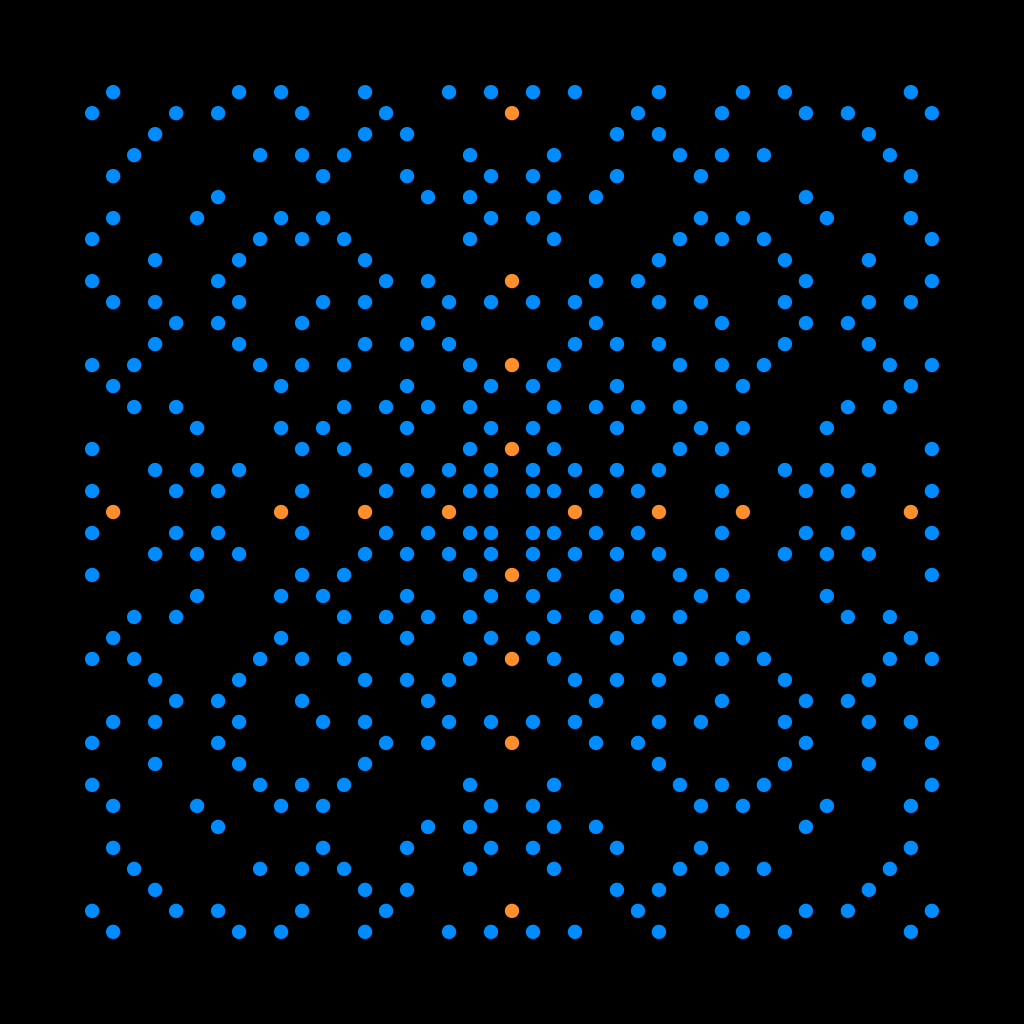
Numbers of the form a plus b times i, drawn as a square lattice, where each point has a size and some ordinary primes break in two while others stay whole.
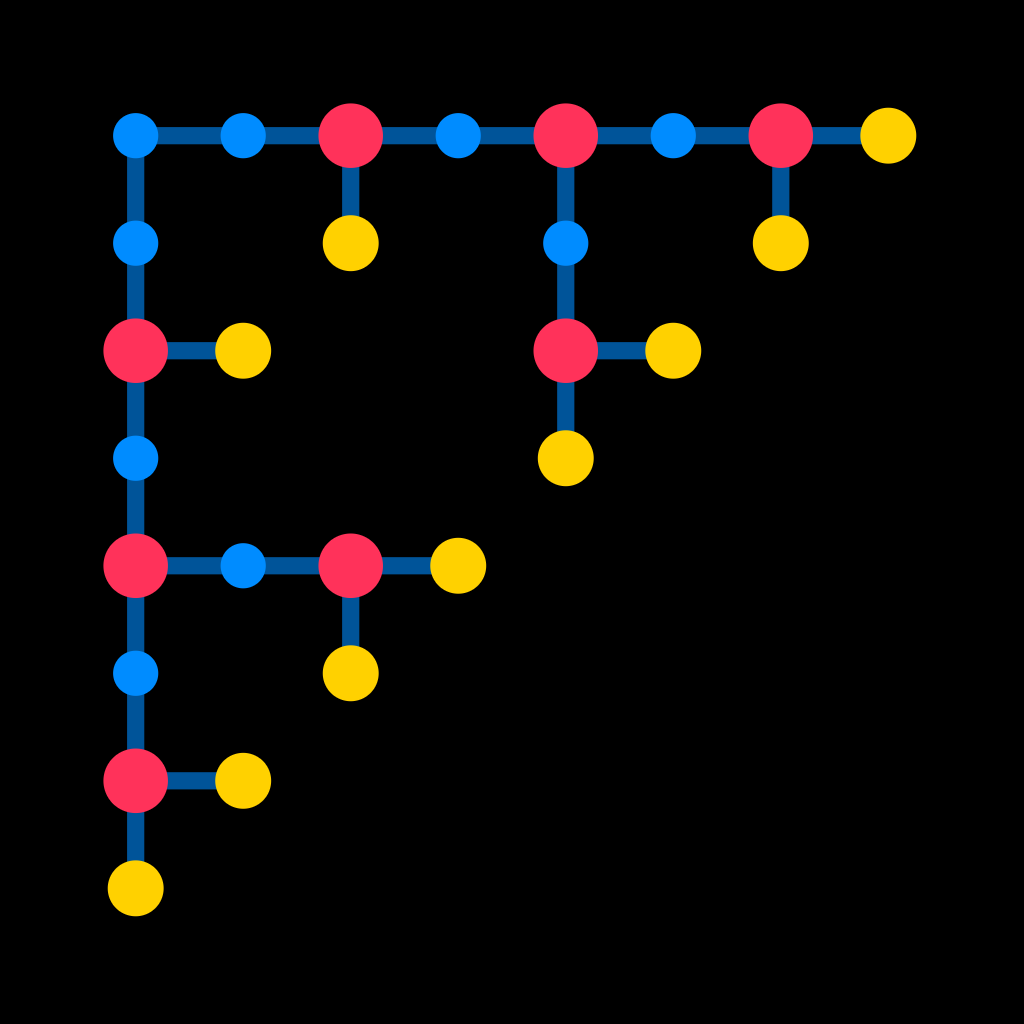
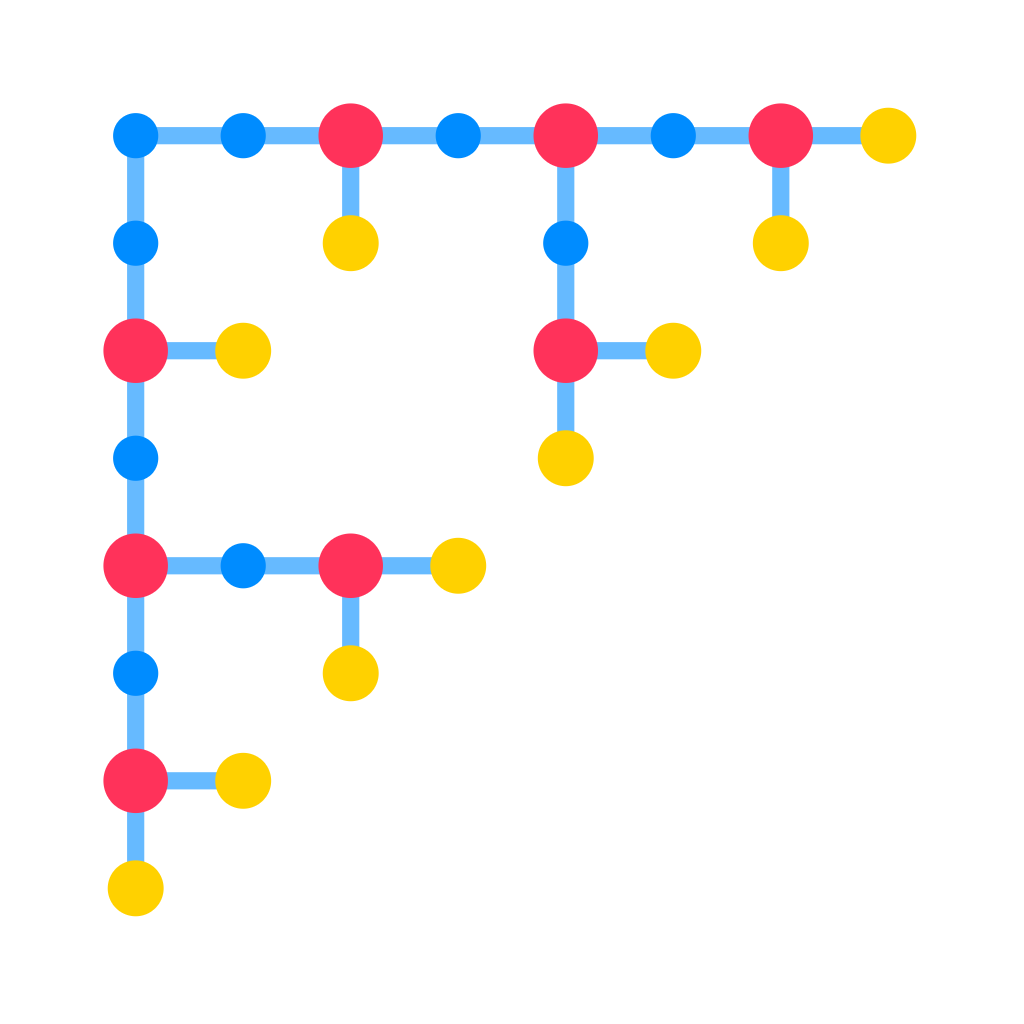
Graphs
Dots joined by lines and nothing else; count the lines at a dot for its degree, write the joins in a table of ones, and a design's filled cells become a network.
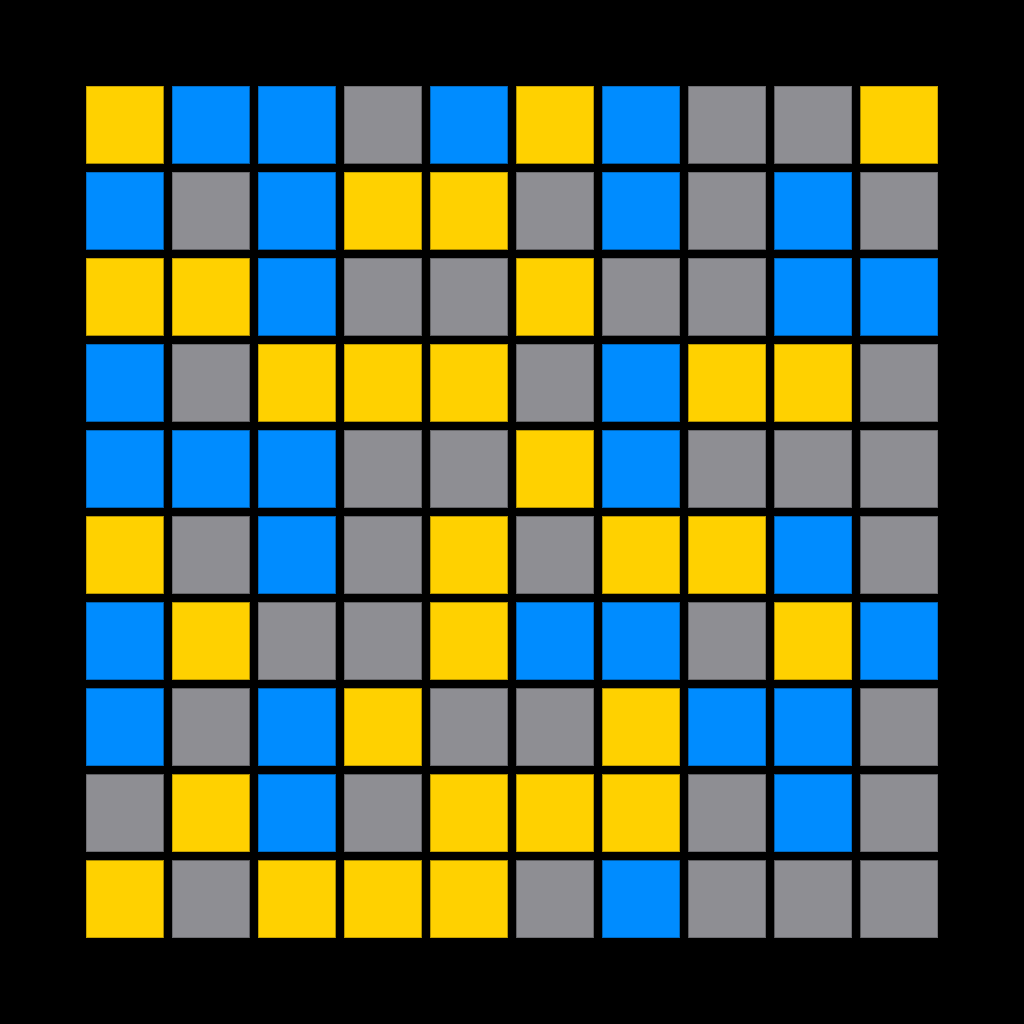
The Mobius function
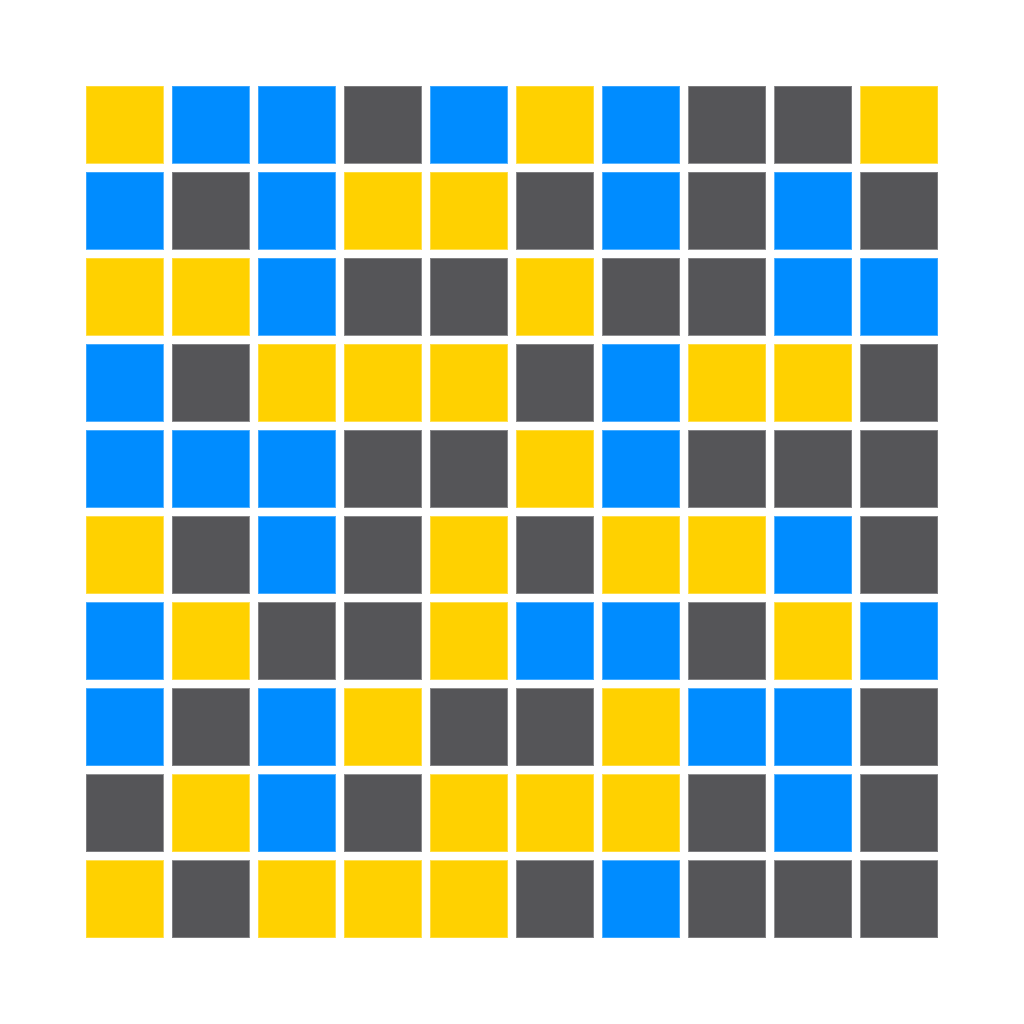
Mu of n is 0 when a square divides n, and otherwise plus or minus one depending on whether n has an even or an odd number of prime factors.
Moire
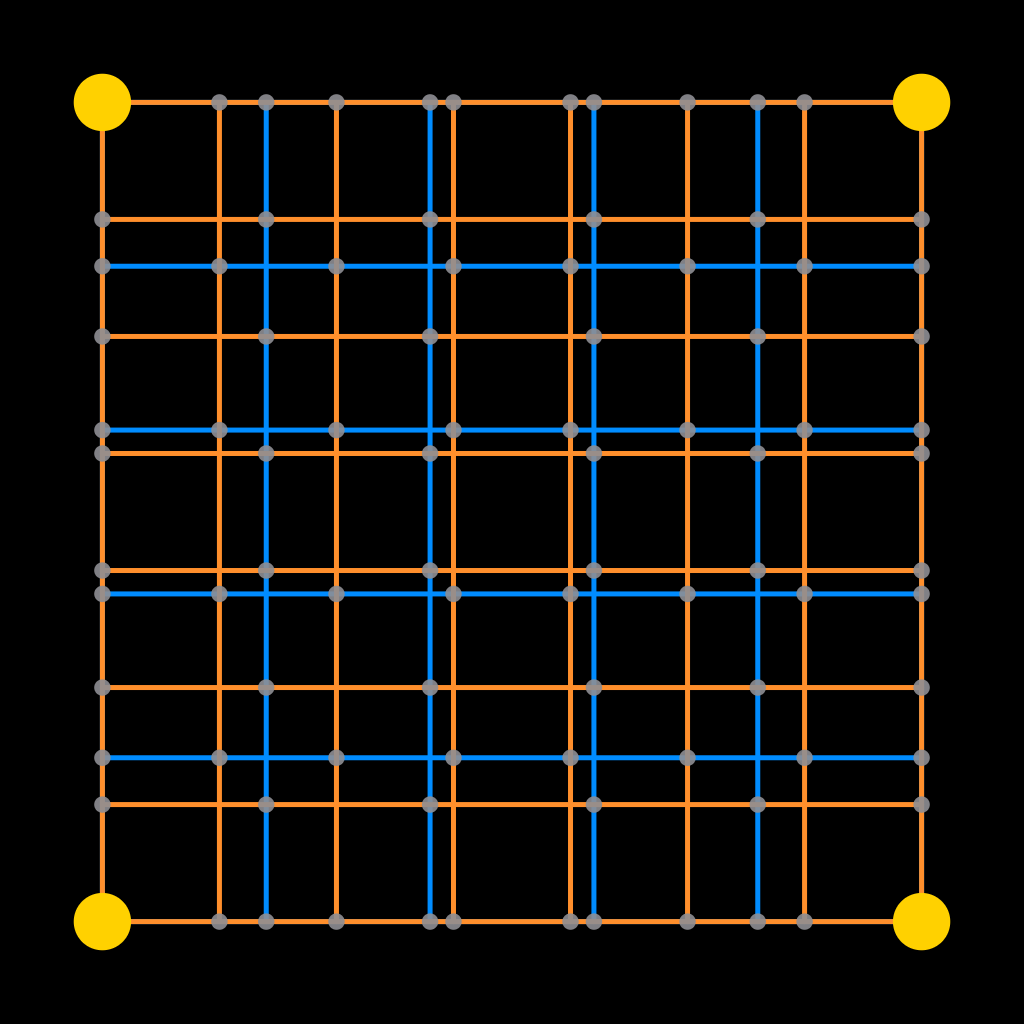
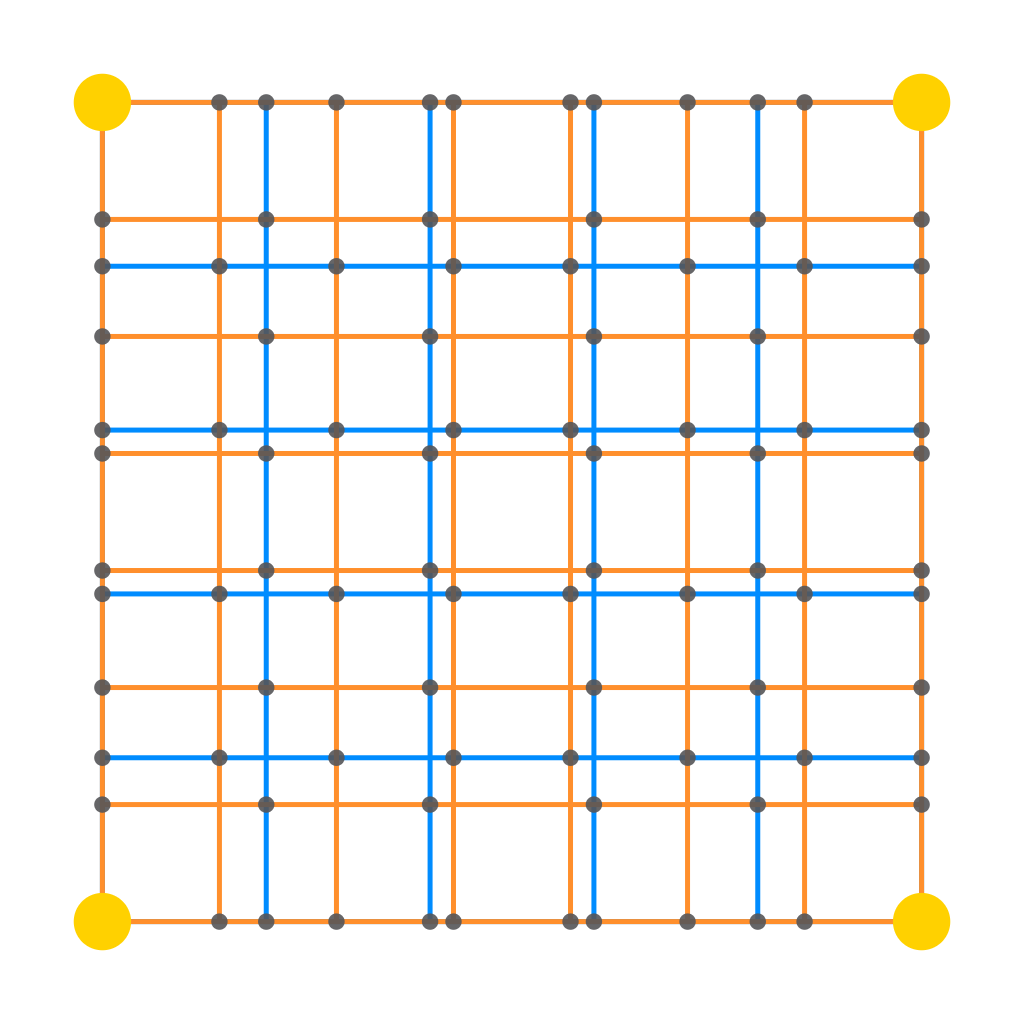
Lay two rulings over each other and they beat; the points both of them mark are the ones their scales agree on, and stacking many scales lights the points most scales share.
Pascal's triangle
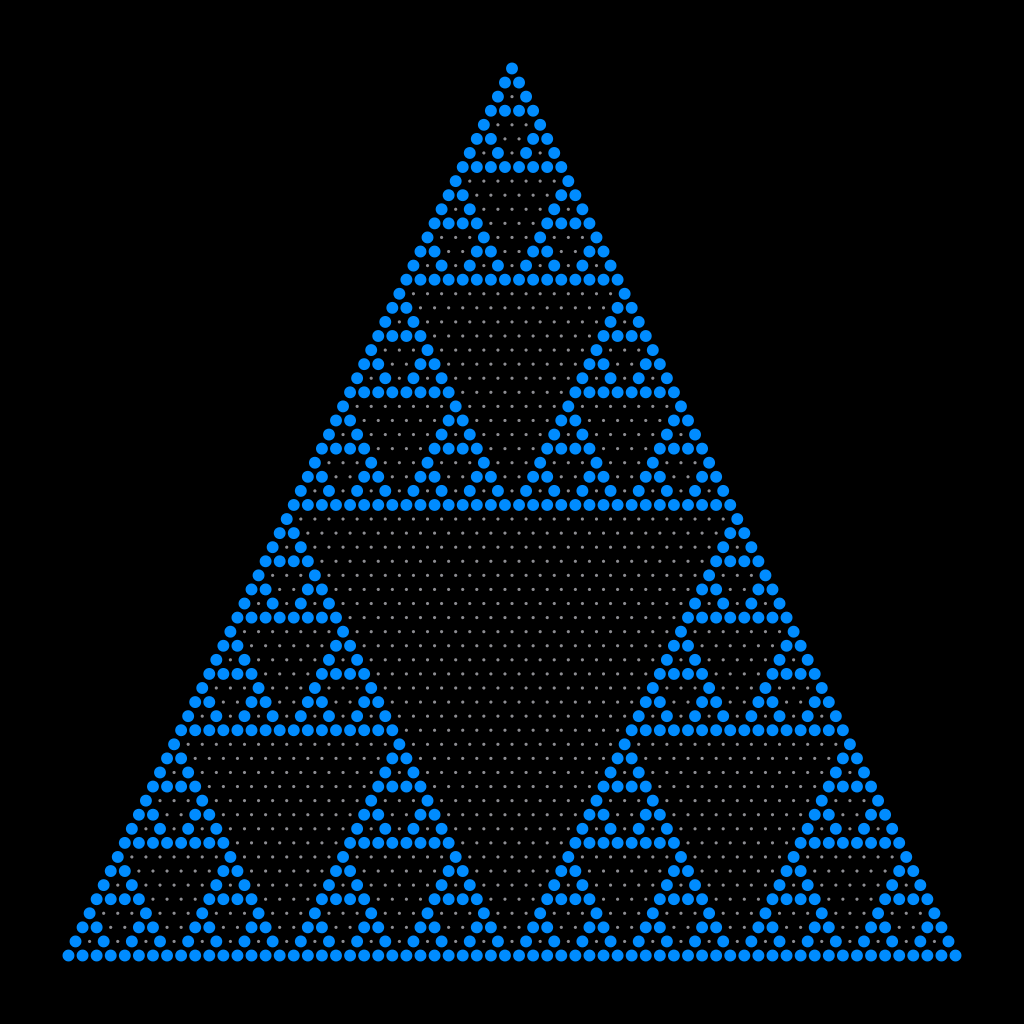
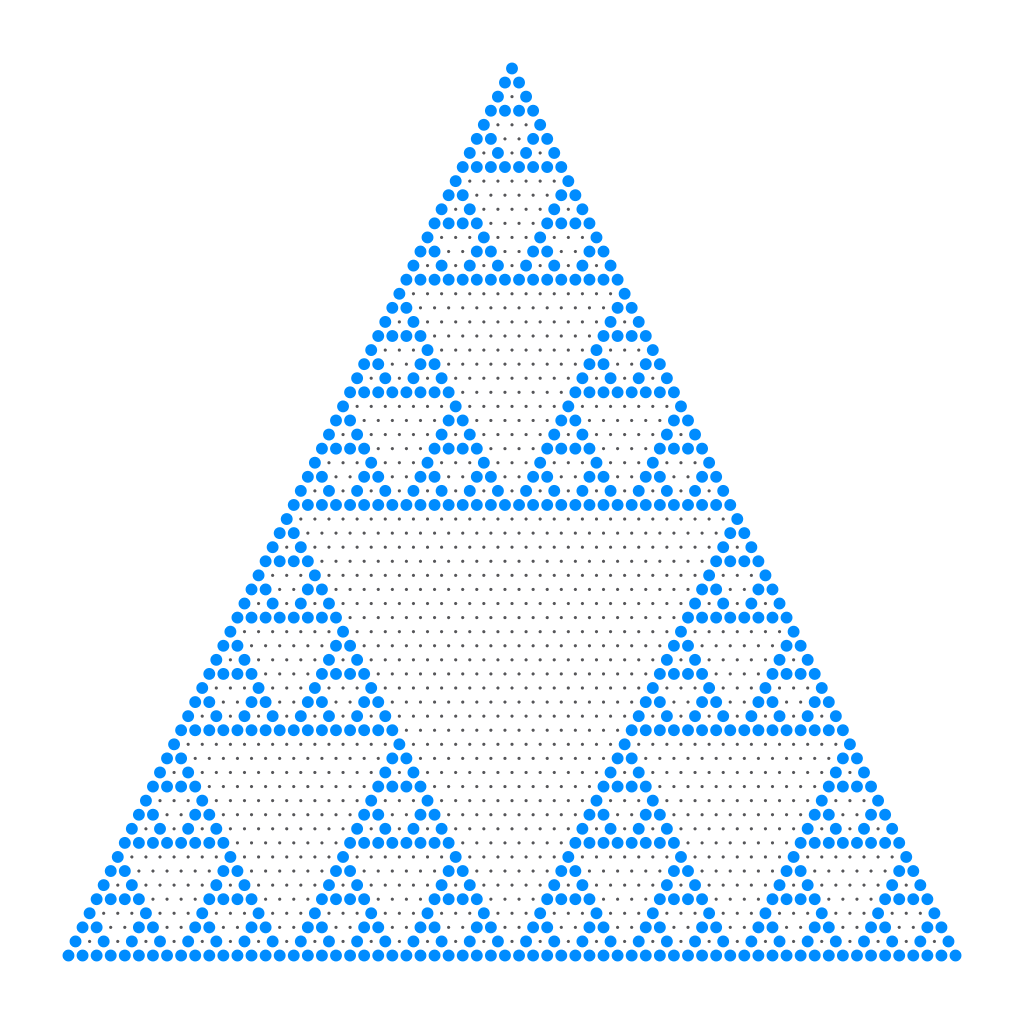
A triangle of numbers where every entry is the sum of the two directly above it, and colouring the odd ones draws a fractal.
The prime counting function
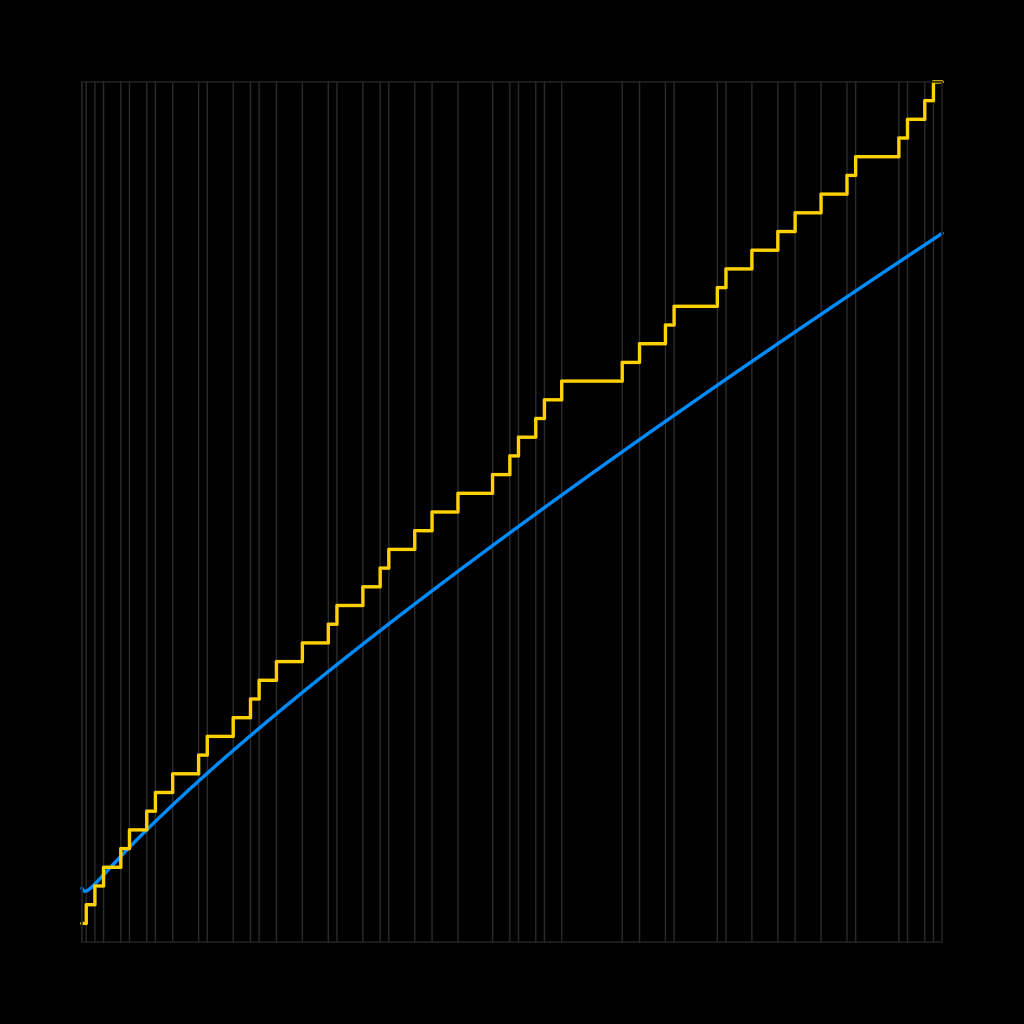
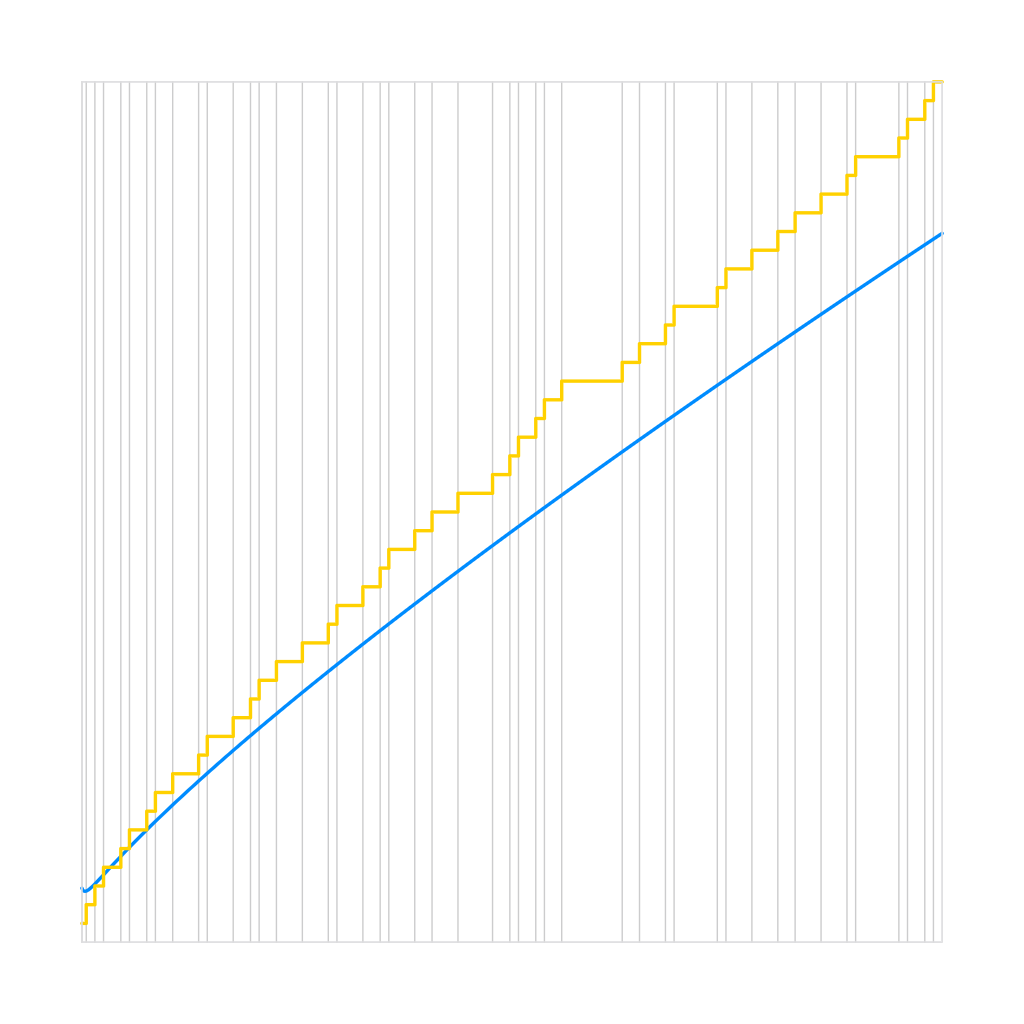
How many primes are there below a number? The answer is a staircase with one riser per prime, and two smooth curves that chase it without ever quite catching it.
The Riemann zeta function
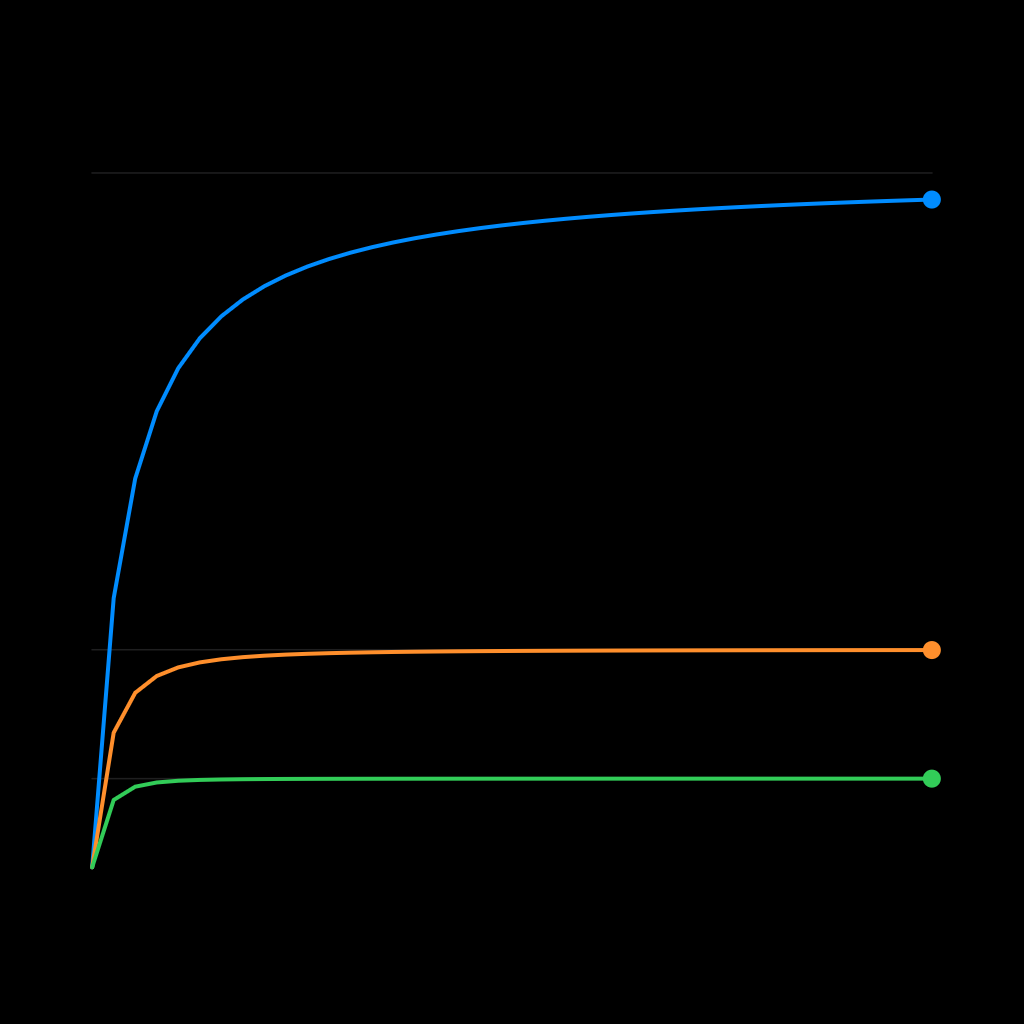
Add one over every whole number raised to the power s; the answer is zeta of s, it equals pi squared over six at s equal to 2, and it can be rewritten as a product over the primes.
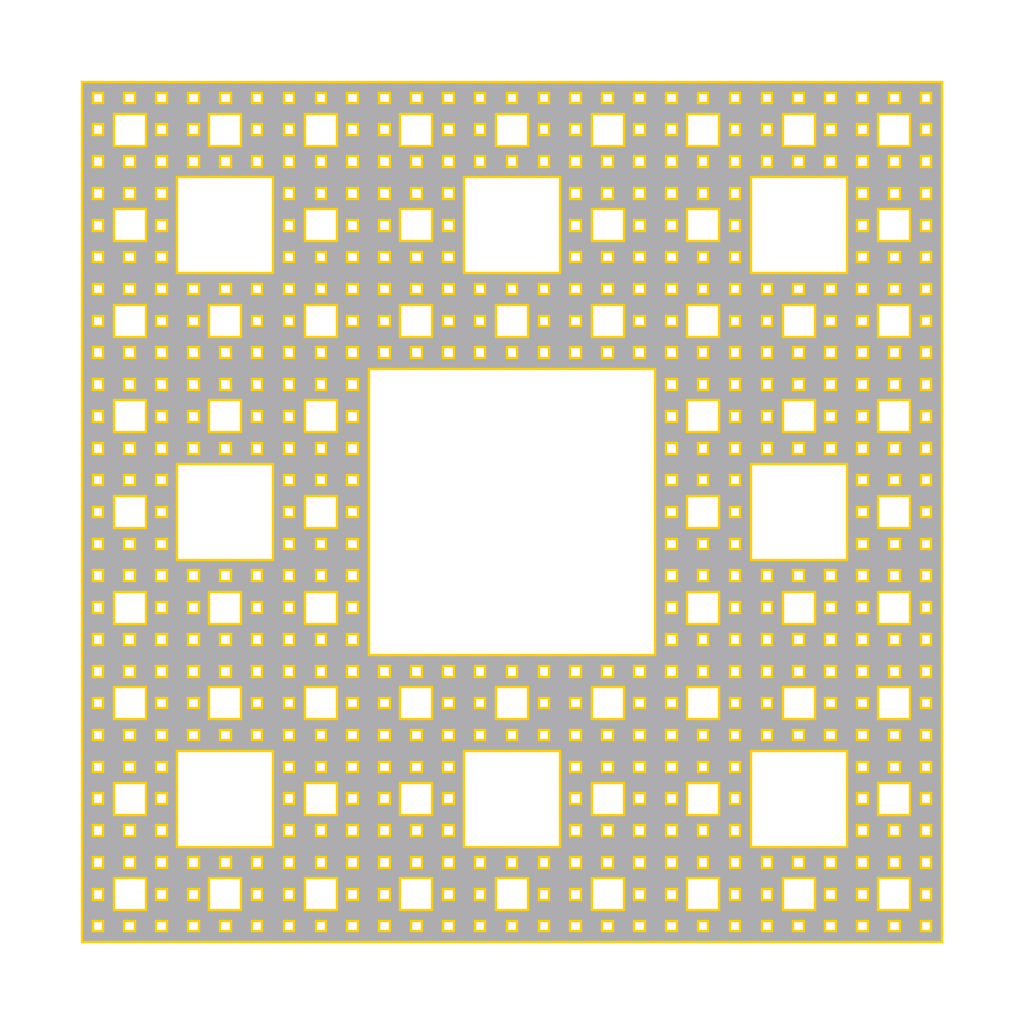
The Sierpinski carpet
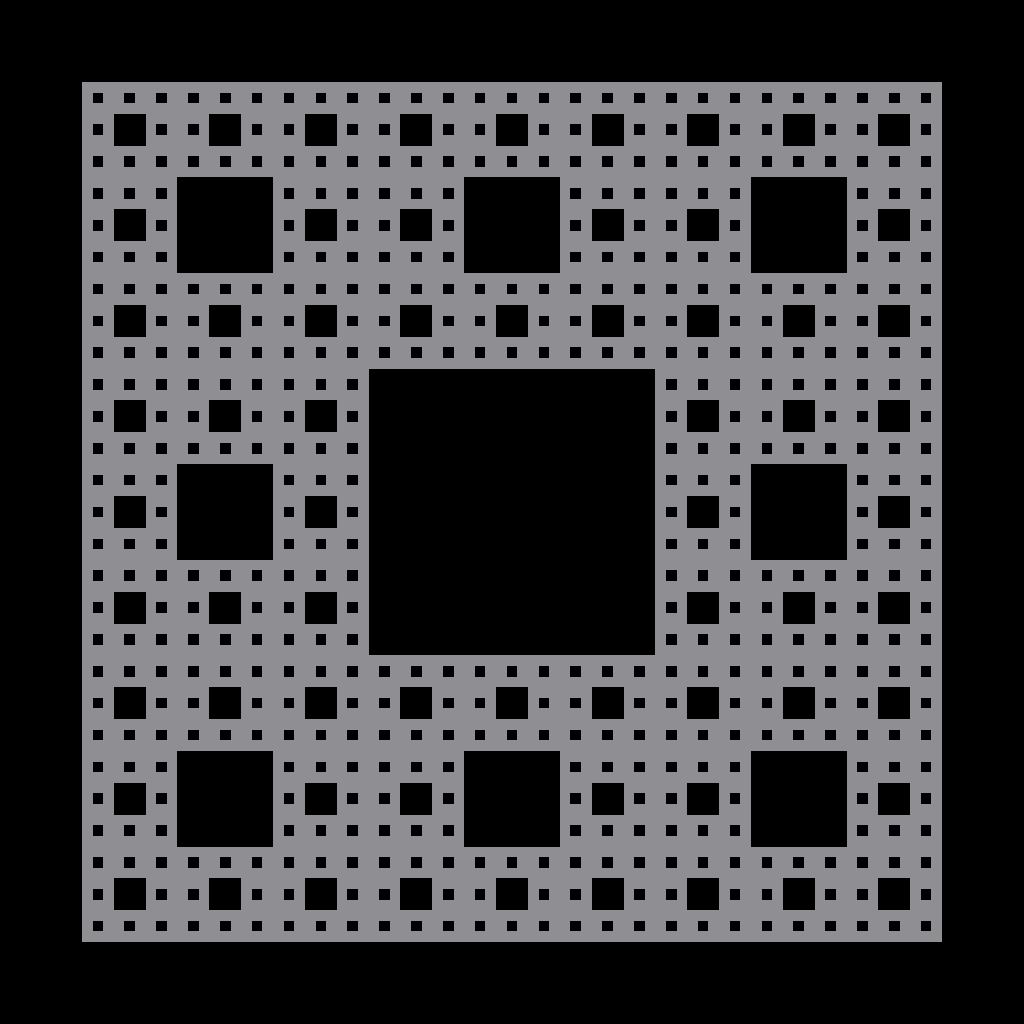
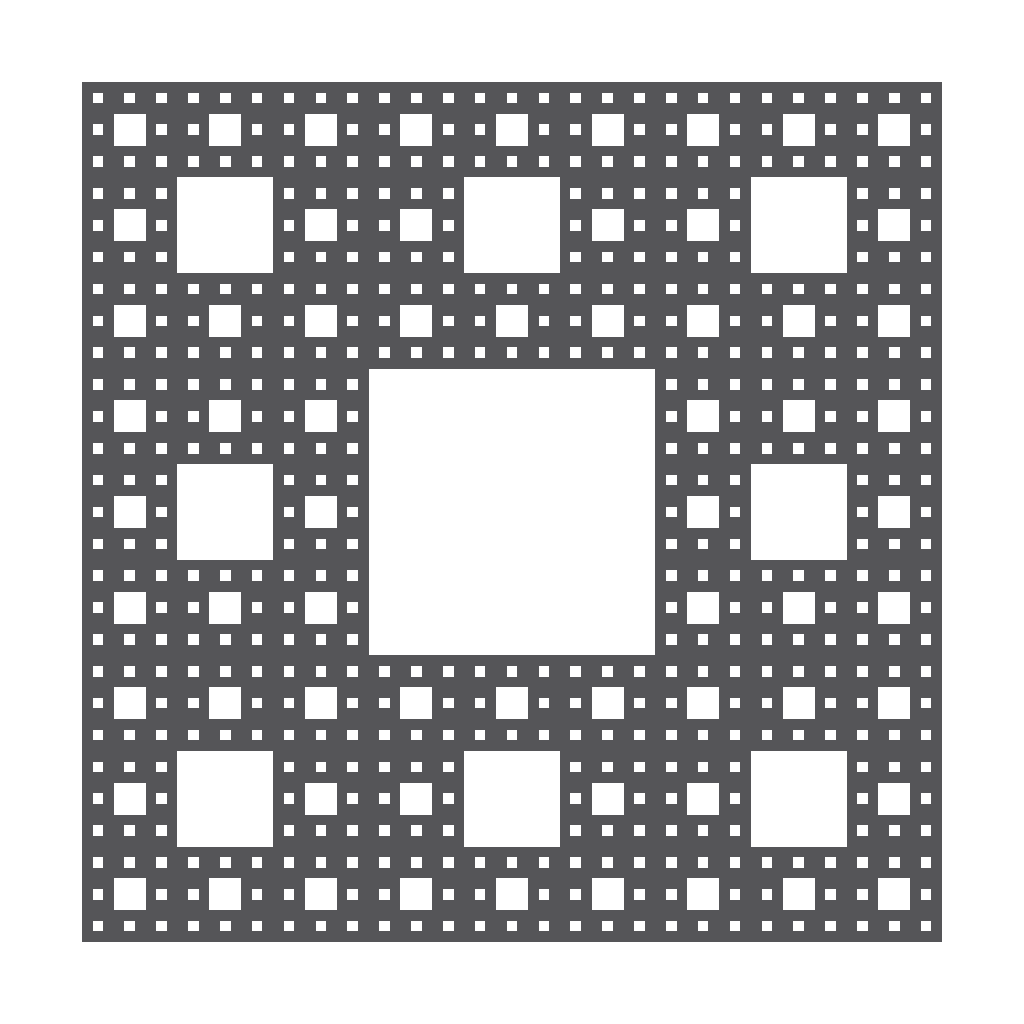
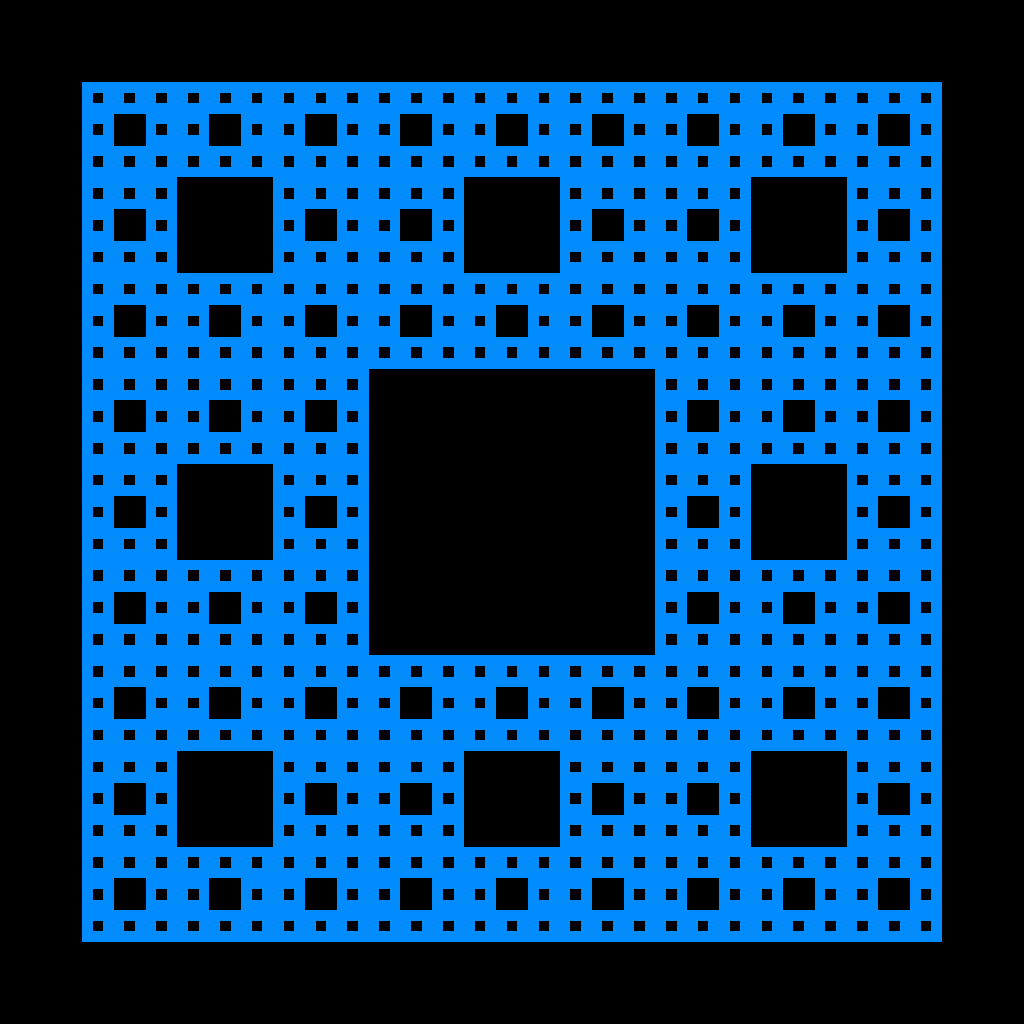
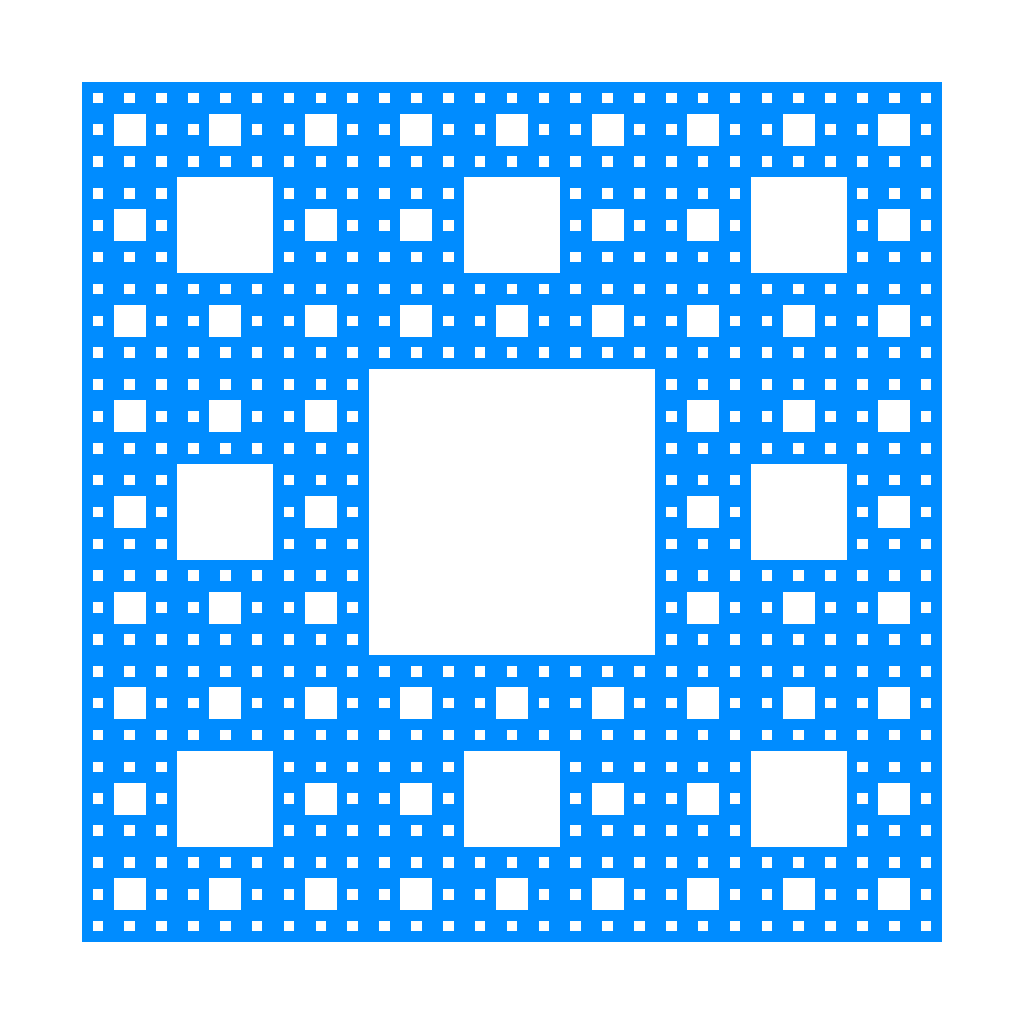
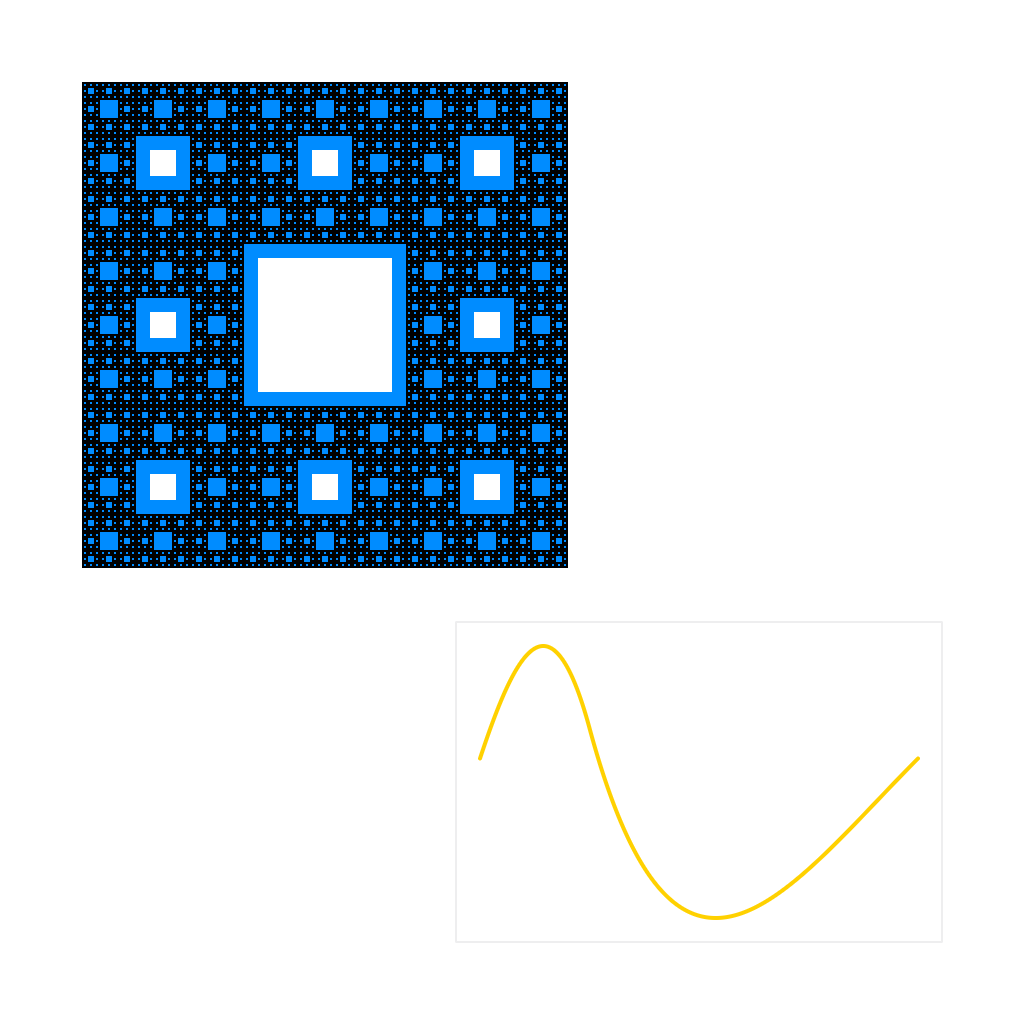
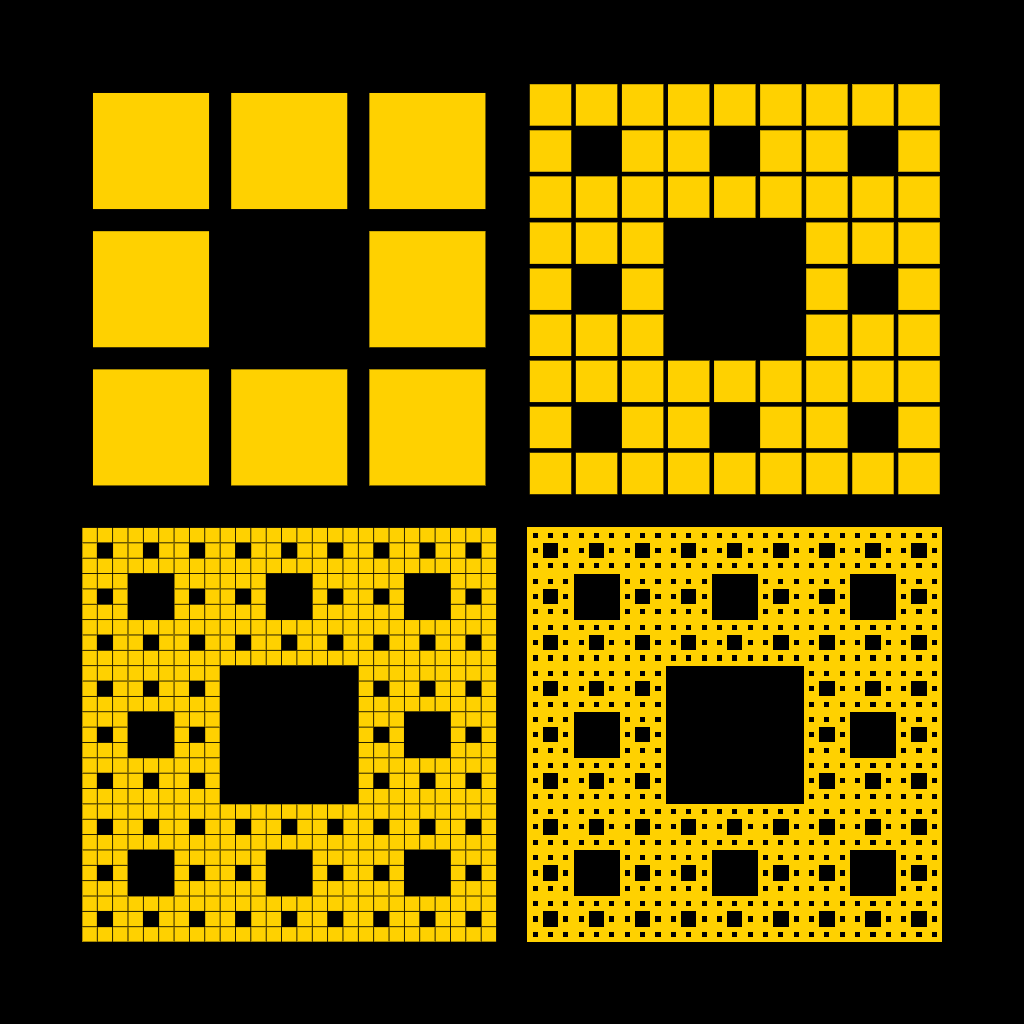
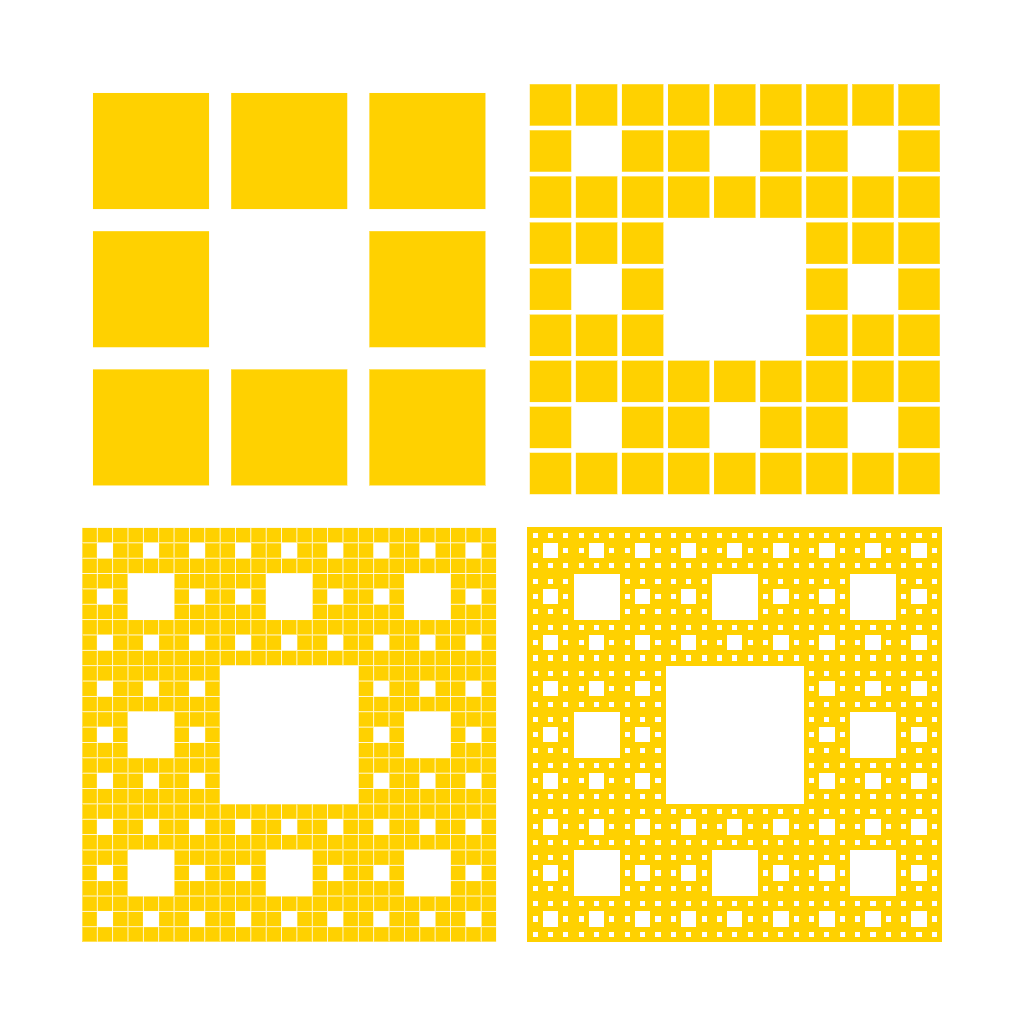
Cut a square into nine, throw the middle one away, then do the same to the eight that are left, and keep going for ever.
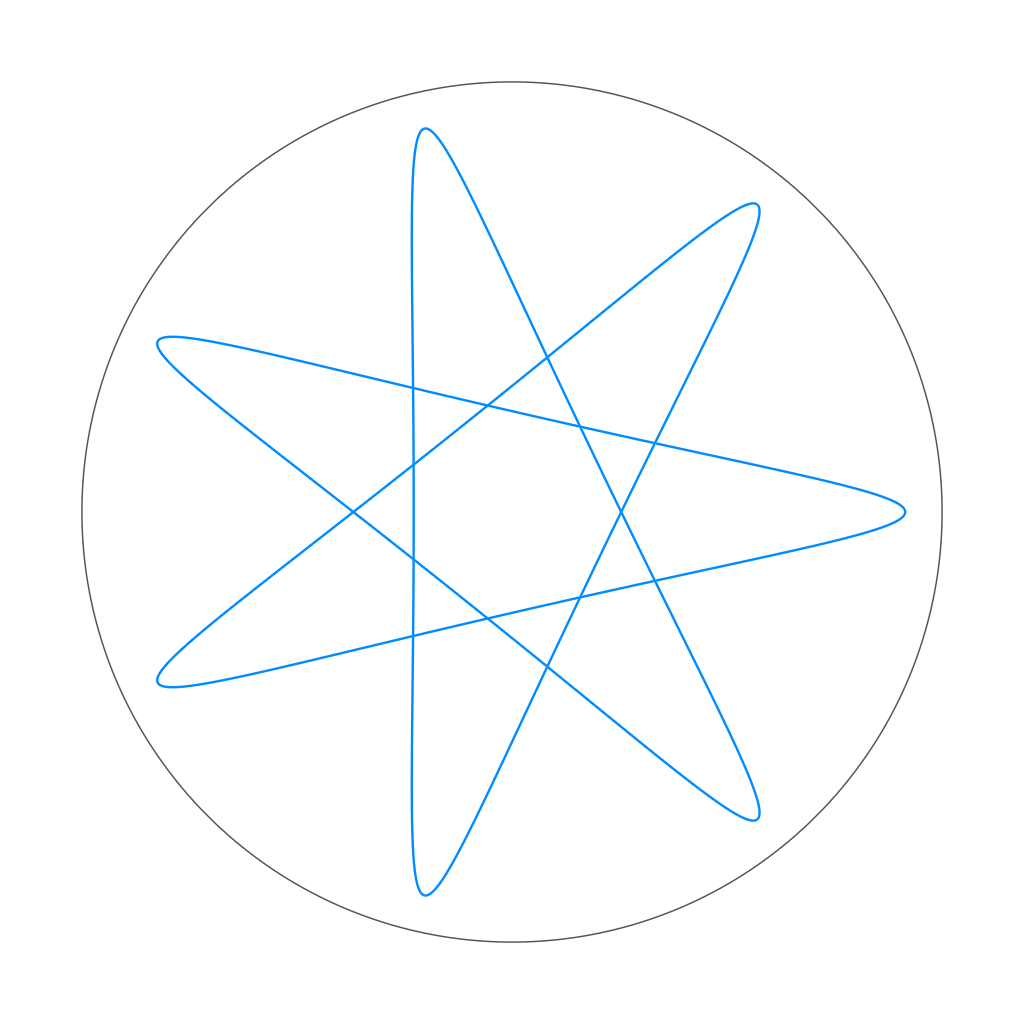
The spirograph
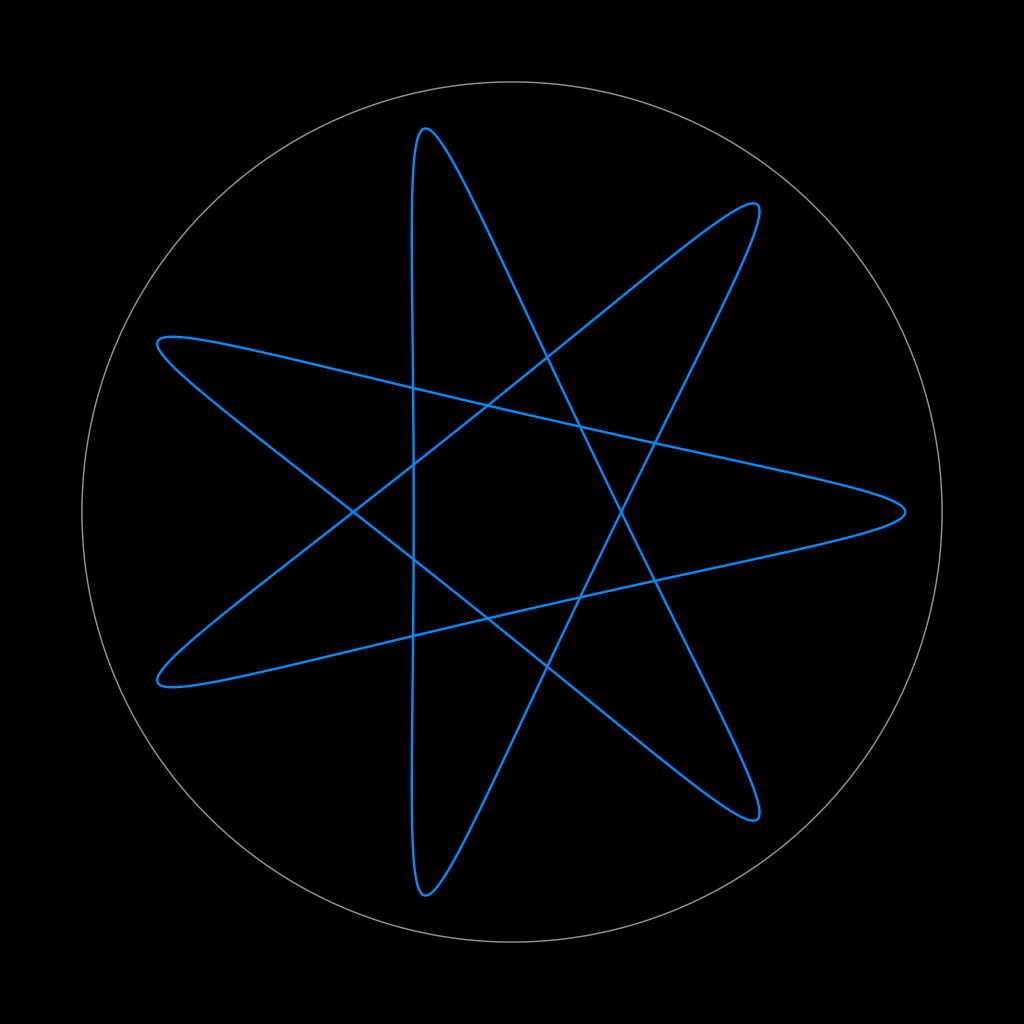
A small wheel rolls inside a big ring carrying a pen, and the fraction made by the two radii decides how many petals the pen draws and when it comes home.
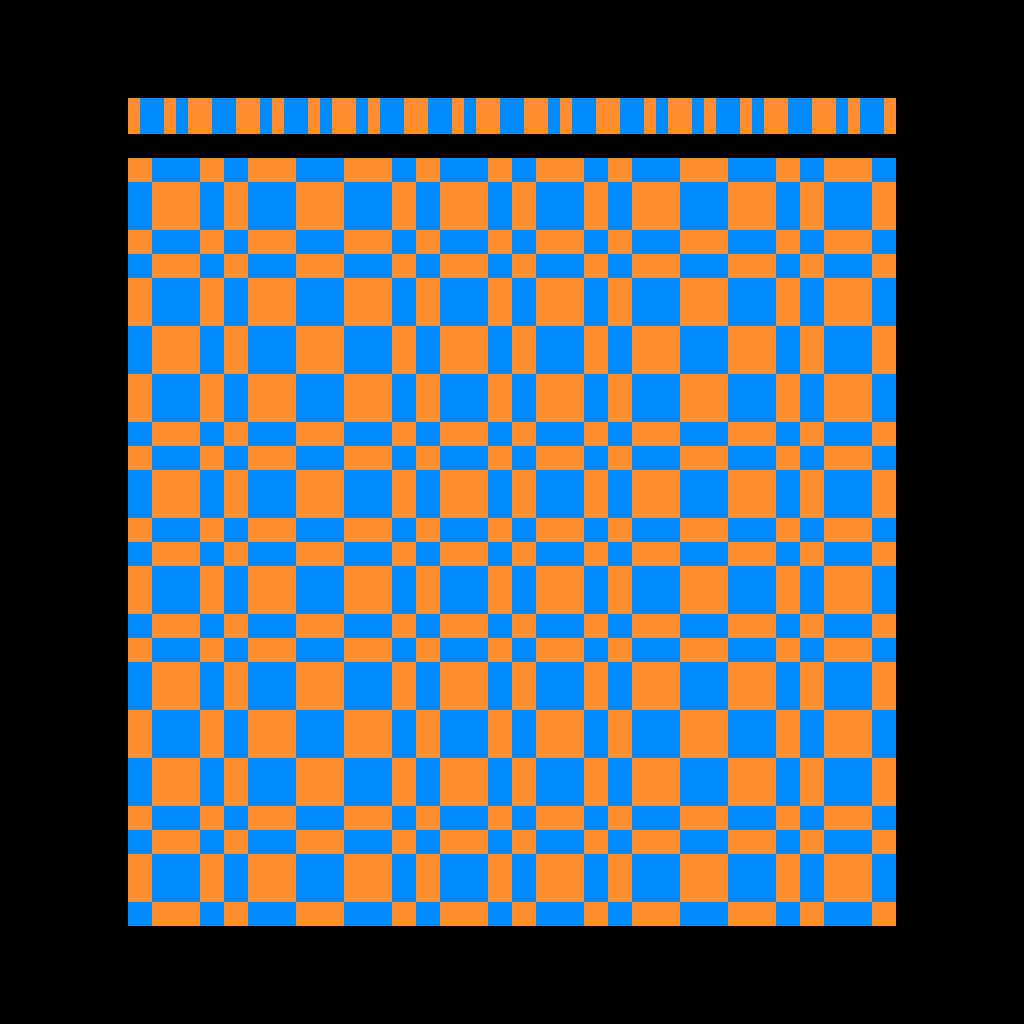
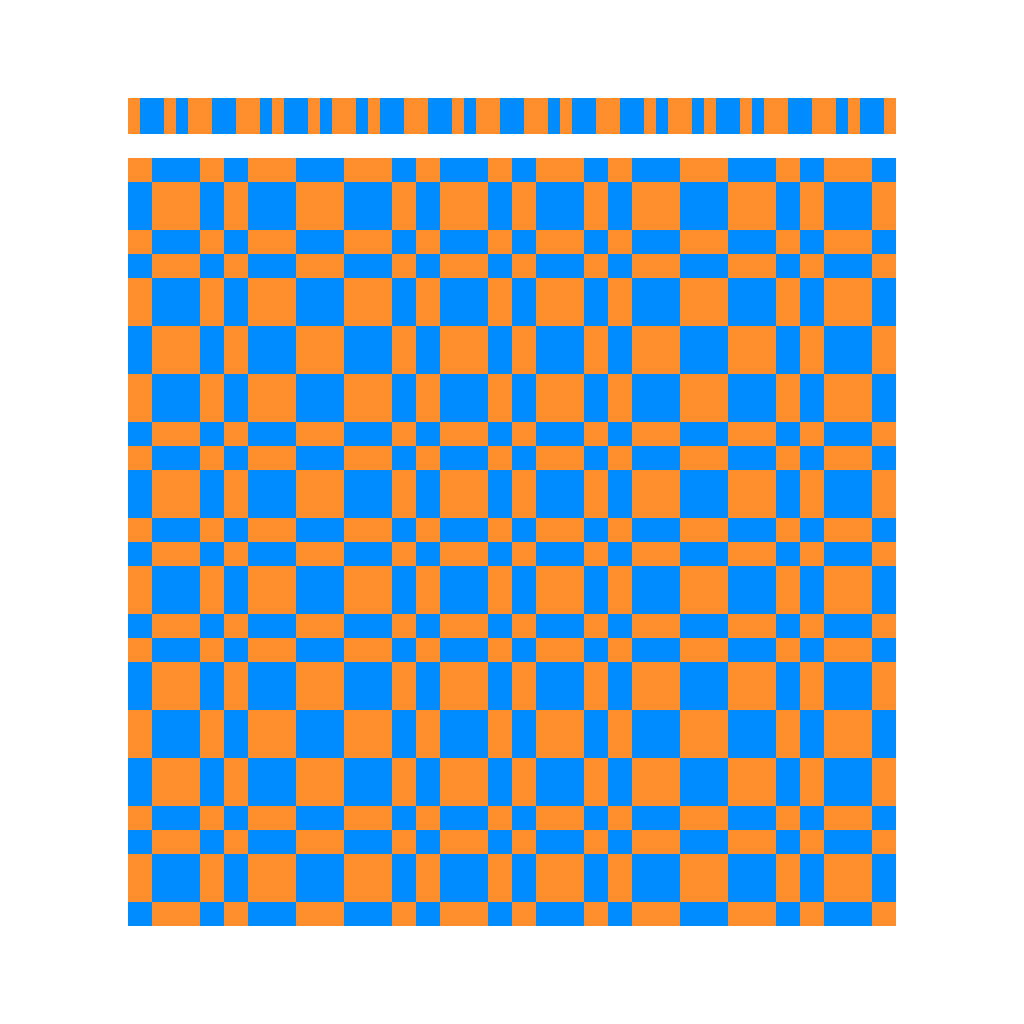
The Thue-Morse sequence
A string of noughts and ones built by writing a block and then its opposite for ever, which is also the parity of the ones in each place number written in binary.
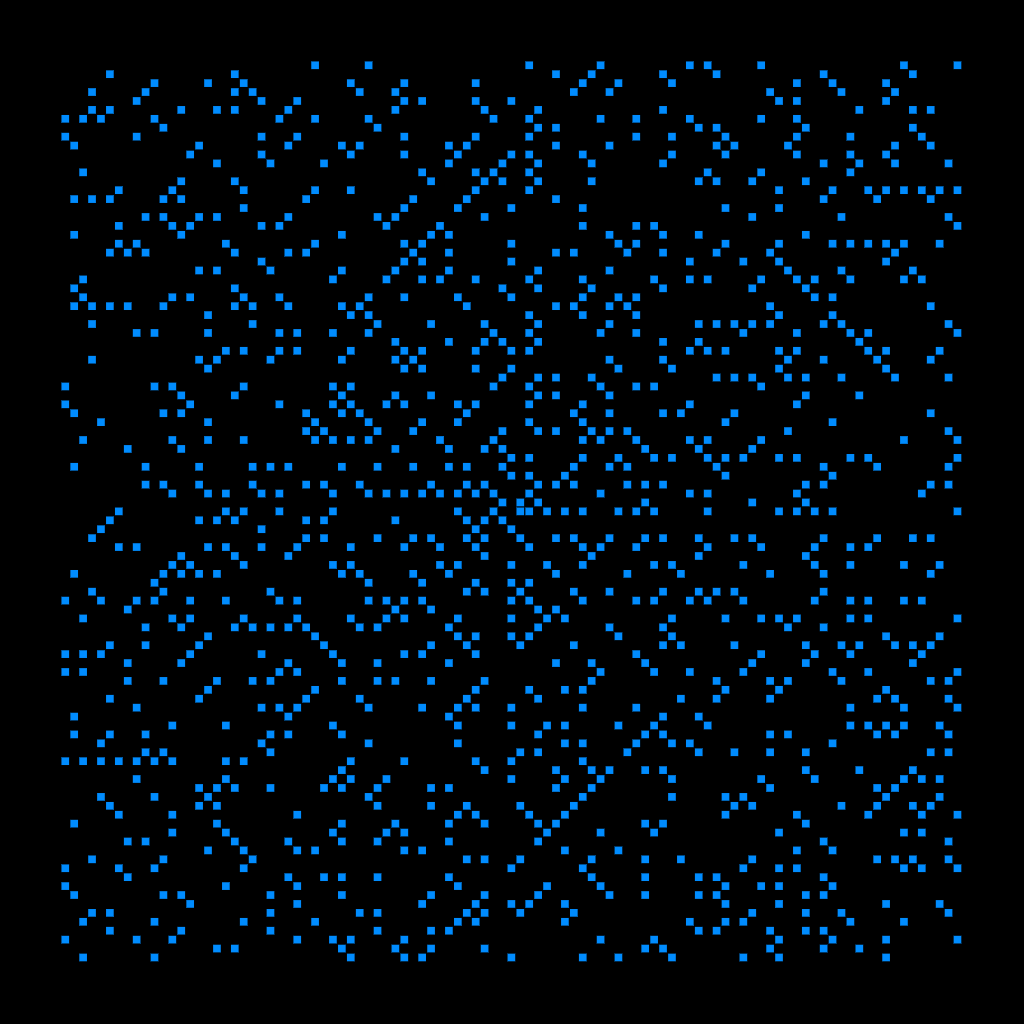
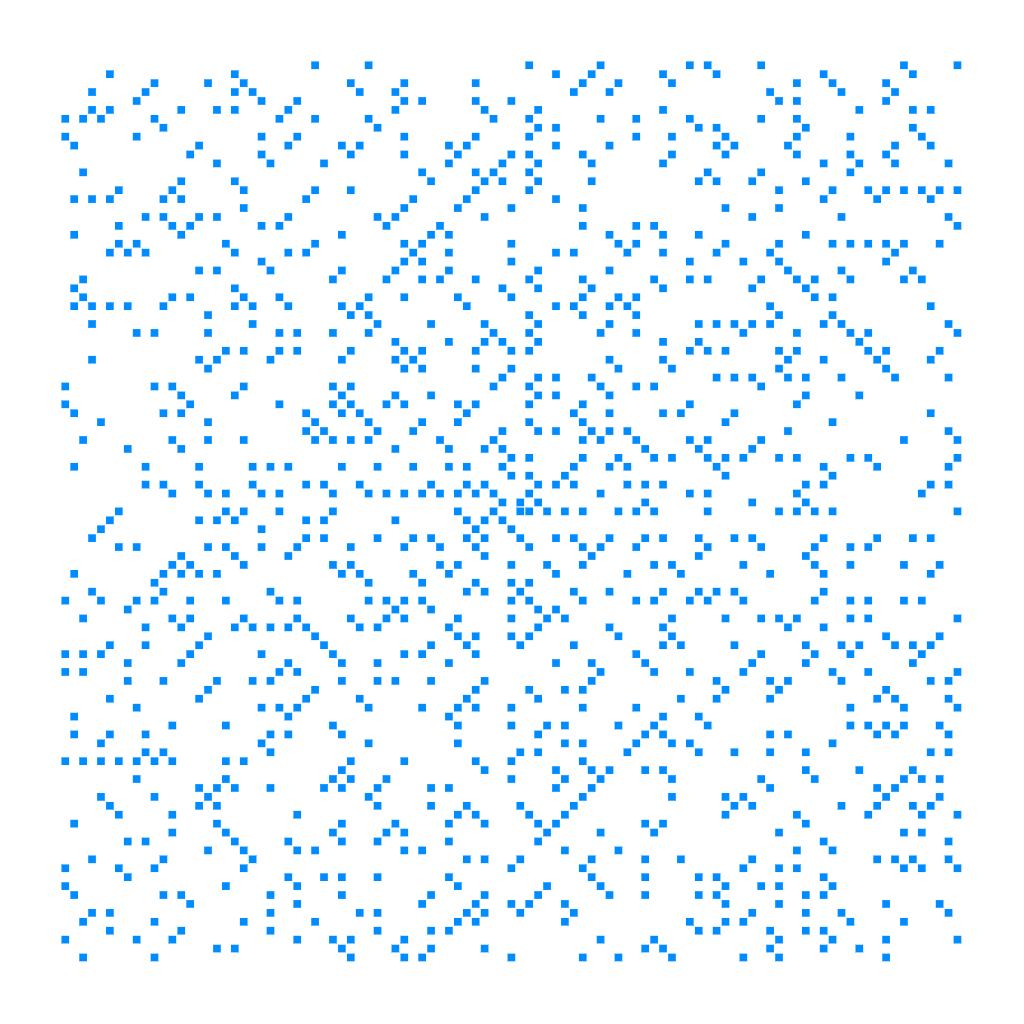
The Ulam spiral
Wind the whole numbers outwards on a square spiral, light up the primes, and they fall on diagonal streaks instead of scattering evenly.
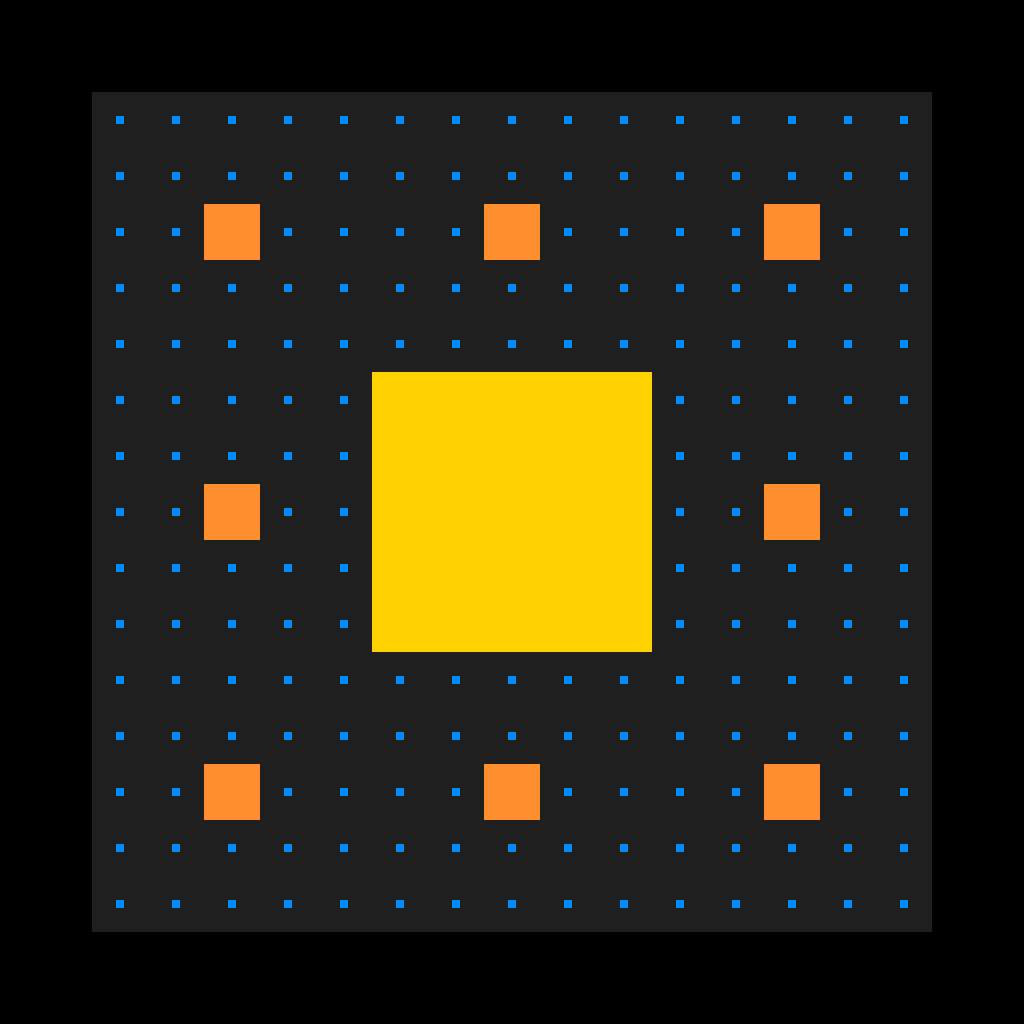
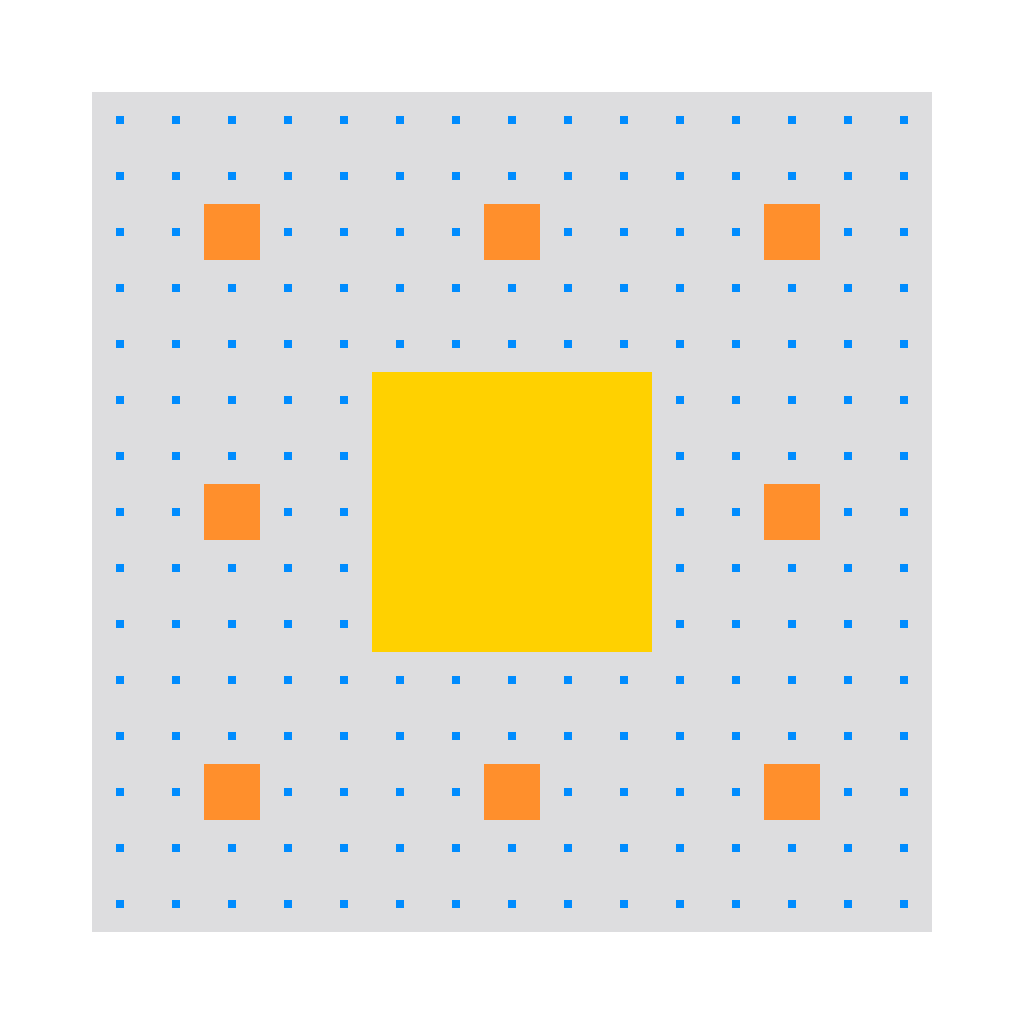
The Wallis sieve
Cut a square into nine and drop the middle, cut each survivor into twenty-five and drop the middle, and keep going; the area left is a quarter of pi.
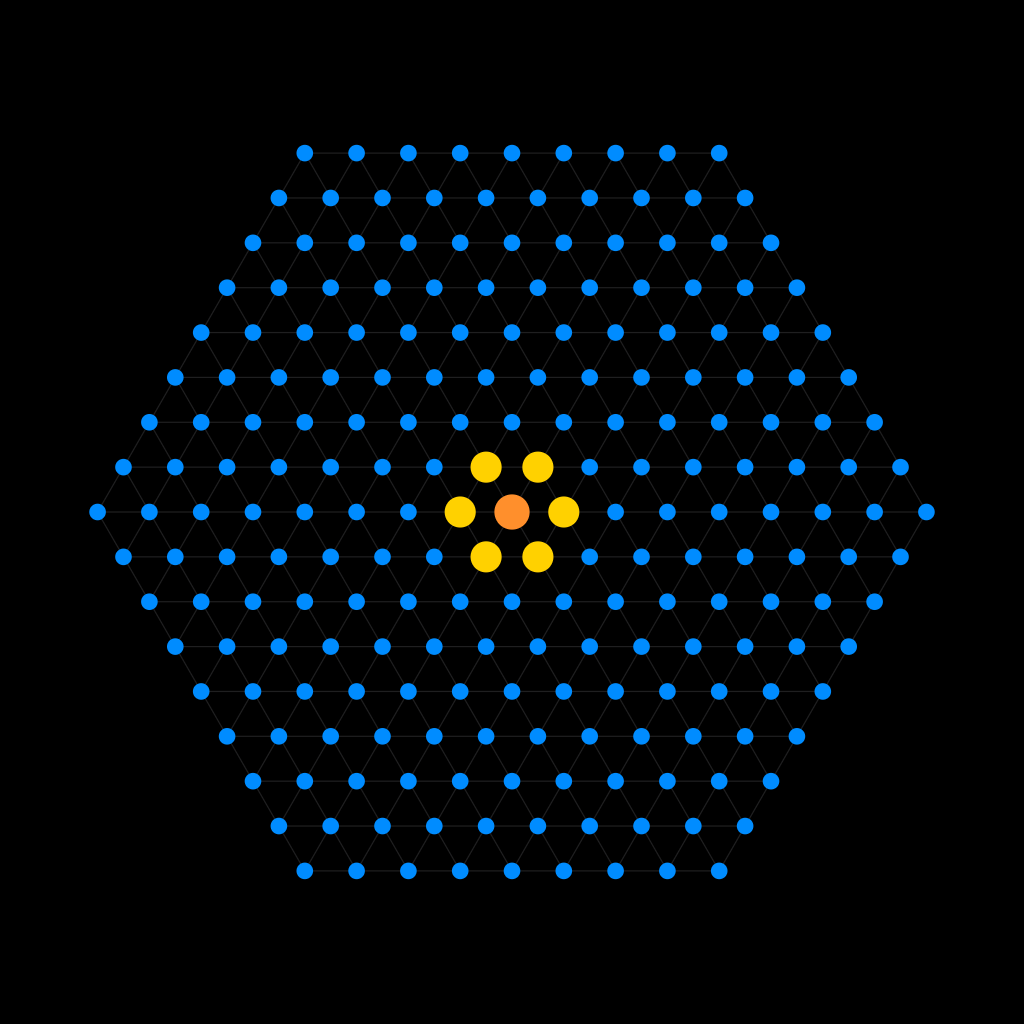

The Eisenstein integers
Numbers built from a cube root of one, drawn as a hexagonal lattice, with six units and a size rule that turns the honeycomb into a number system.
The Euler characteristic
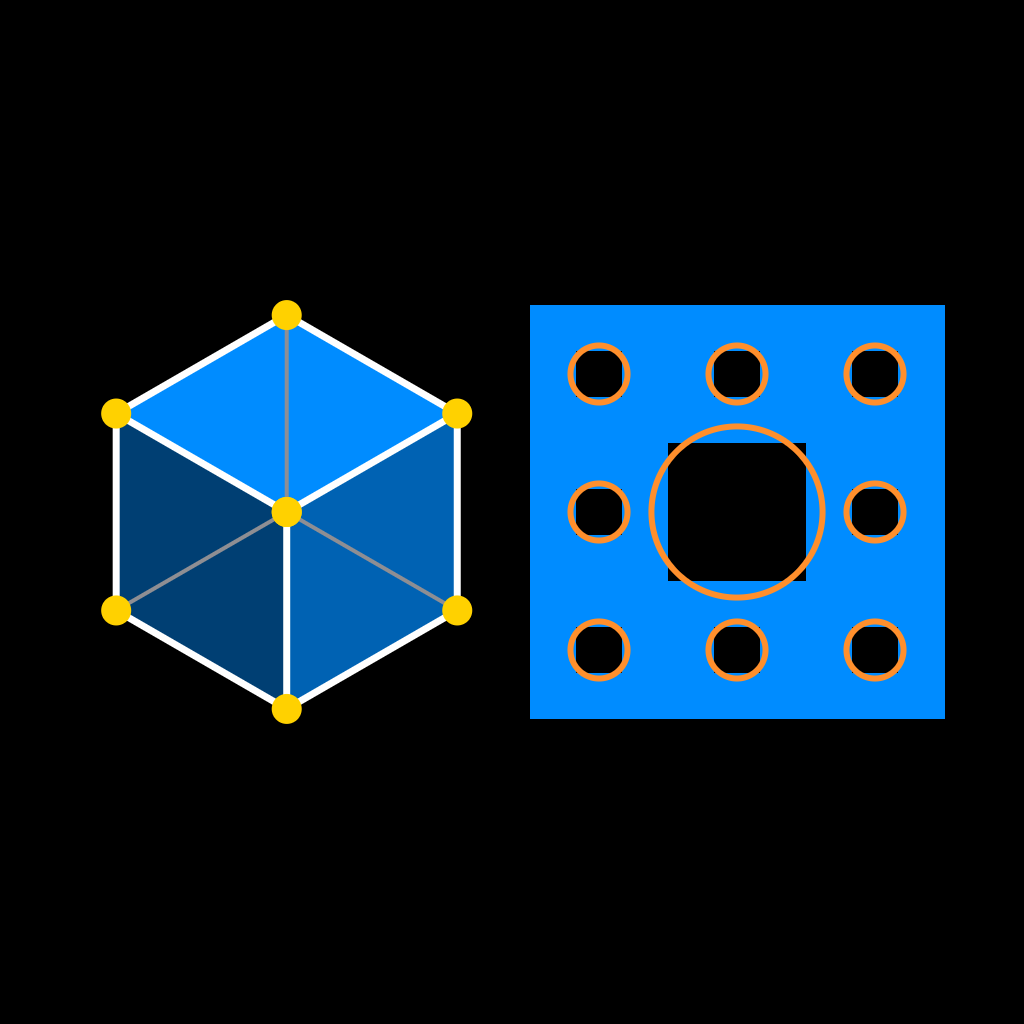
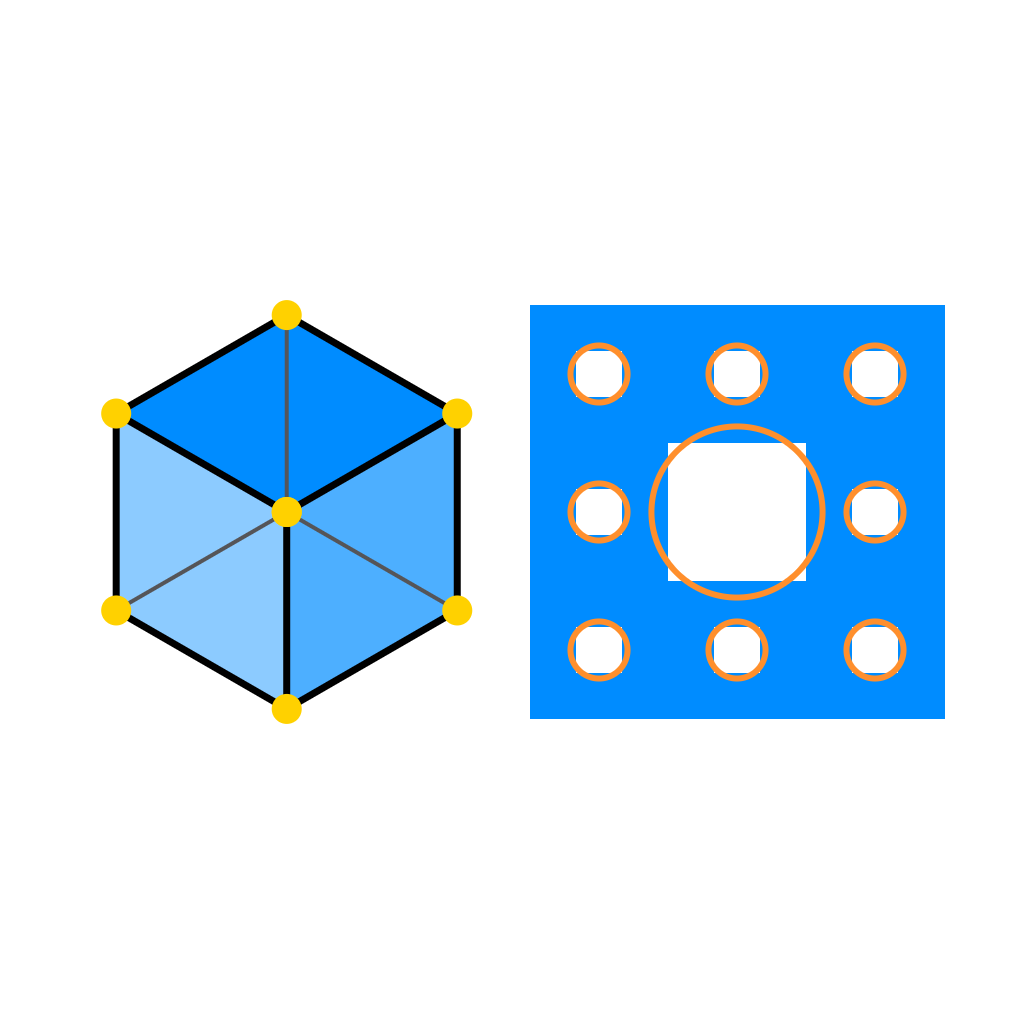
Count the corners, subtract the edges, add the faces; the answer is 2 for anything shaped like a ball, and bending the shape never changes it.
Goldbach's conjecture
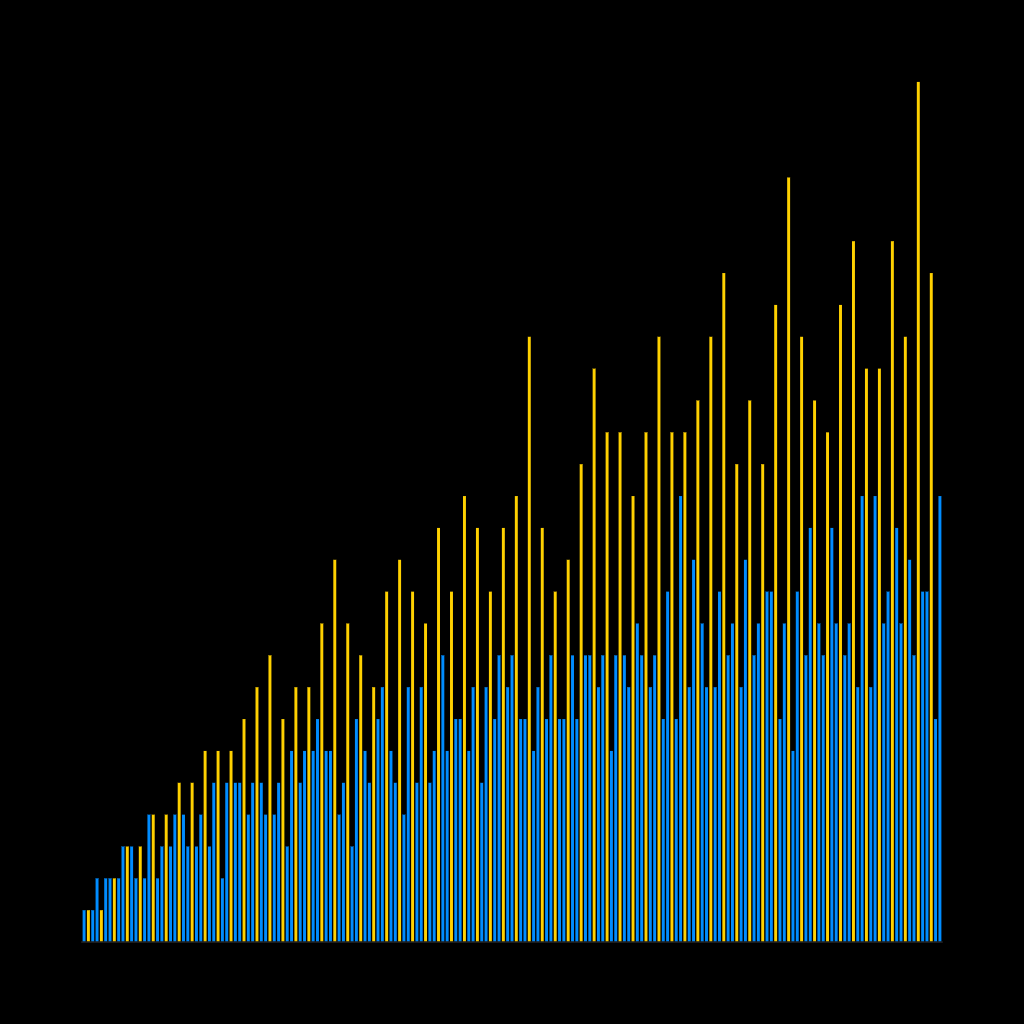
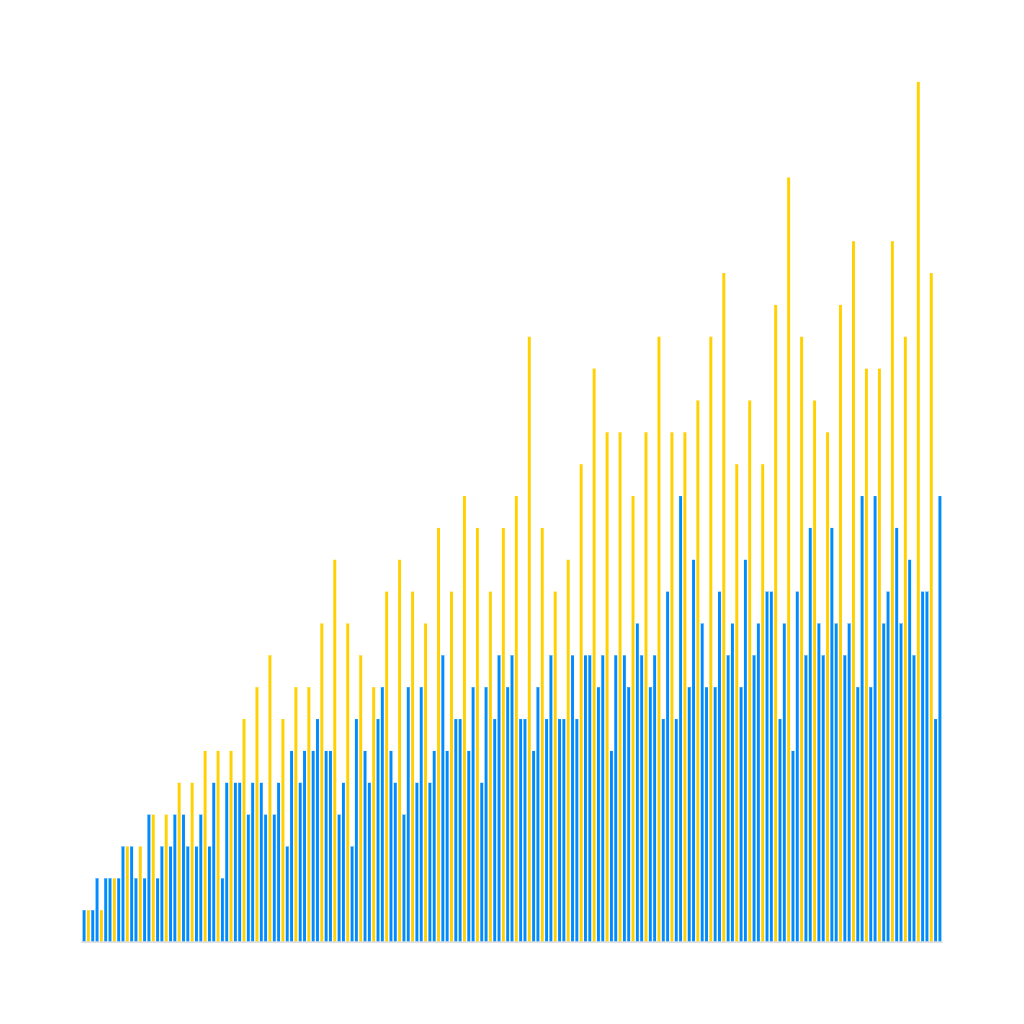
Every even number past two is a sum of two primes. Machines have checked it further than anyone can list and nobody has proved it.
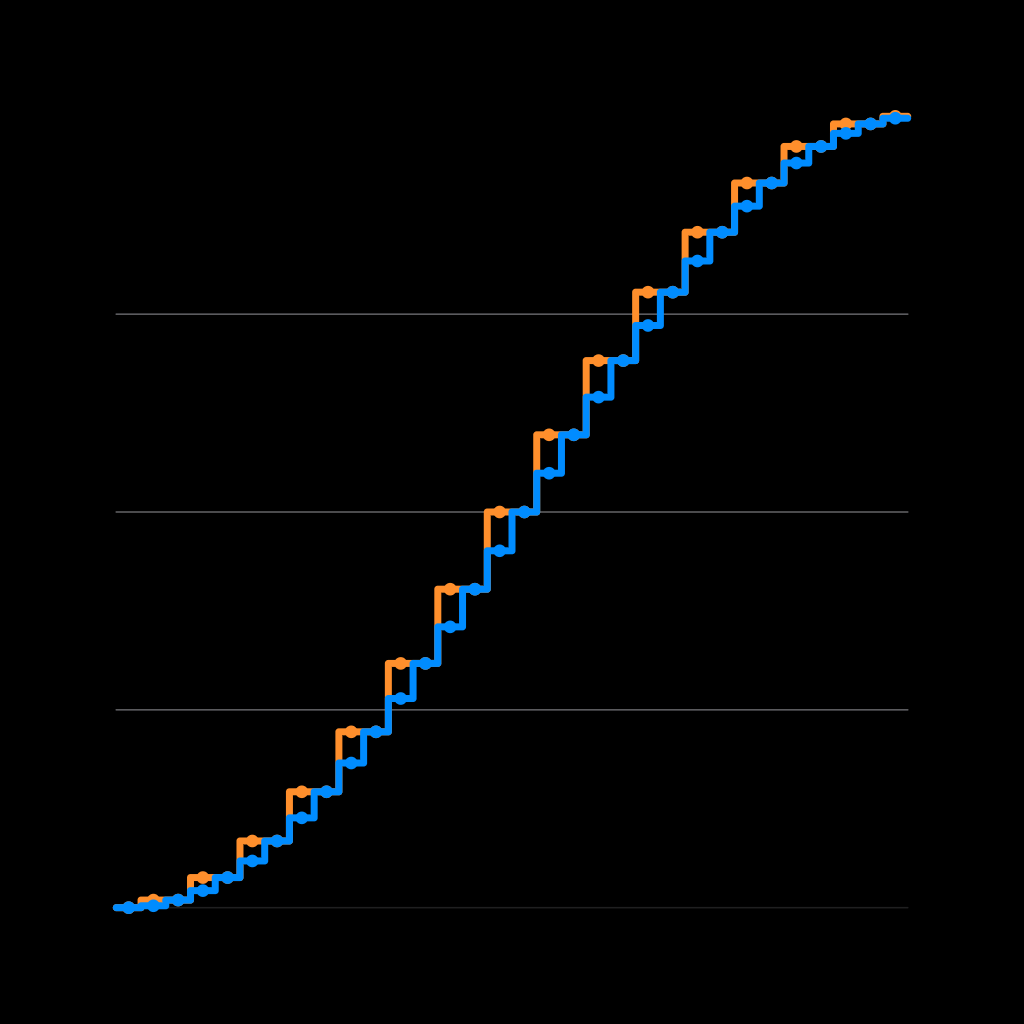
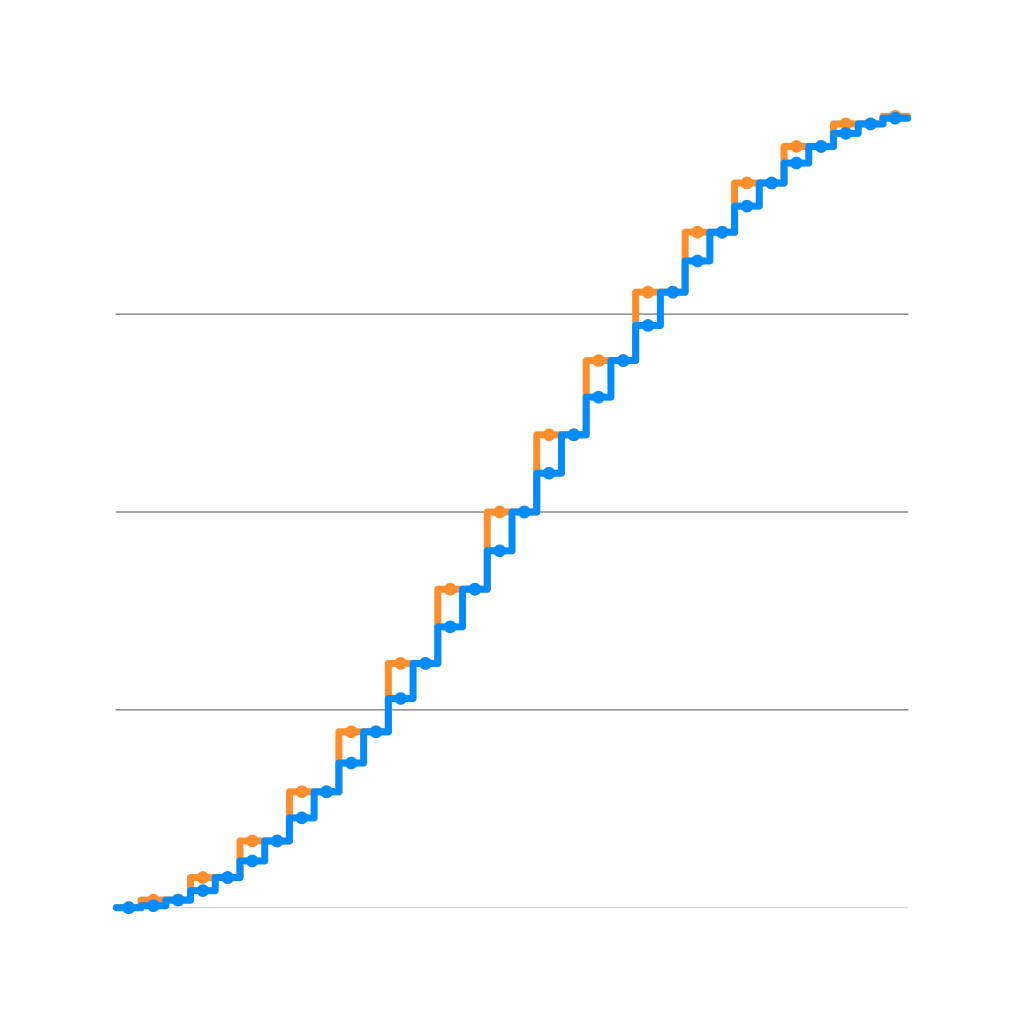
The graph Laplacian
Degree minus adjacency, one table per network; its eigenvalues are the tones the network can ring at, and the staircase they make says how it is knit together.
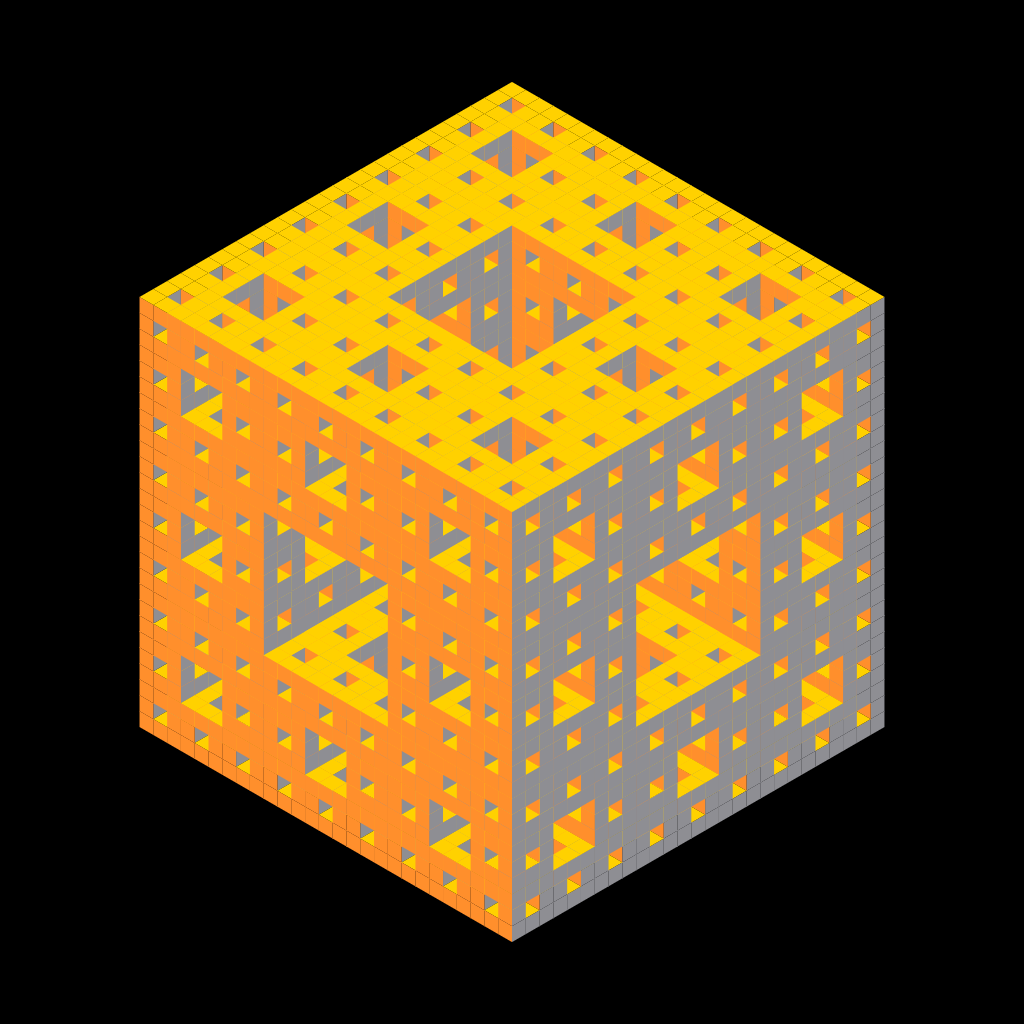
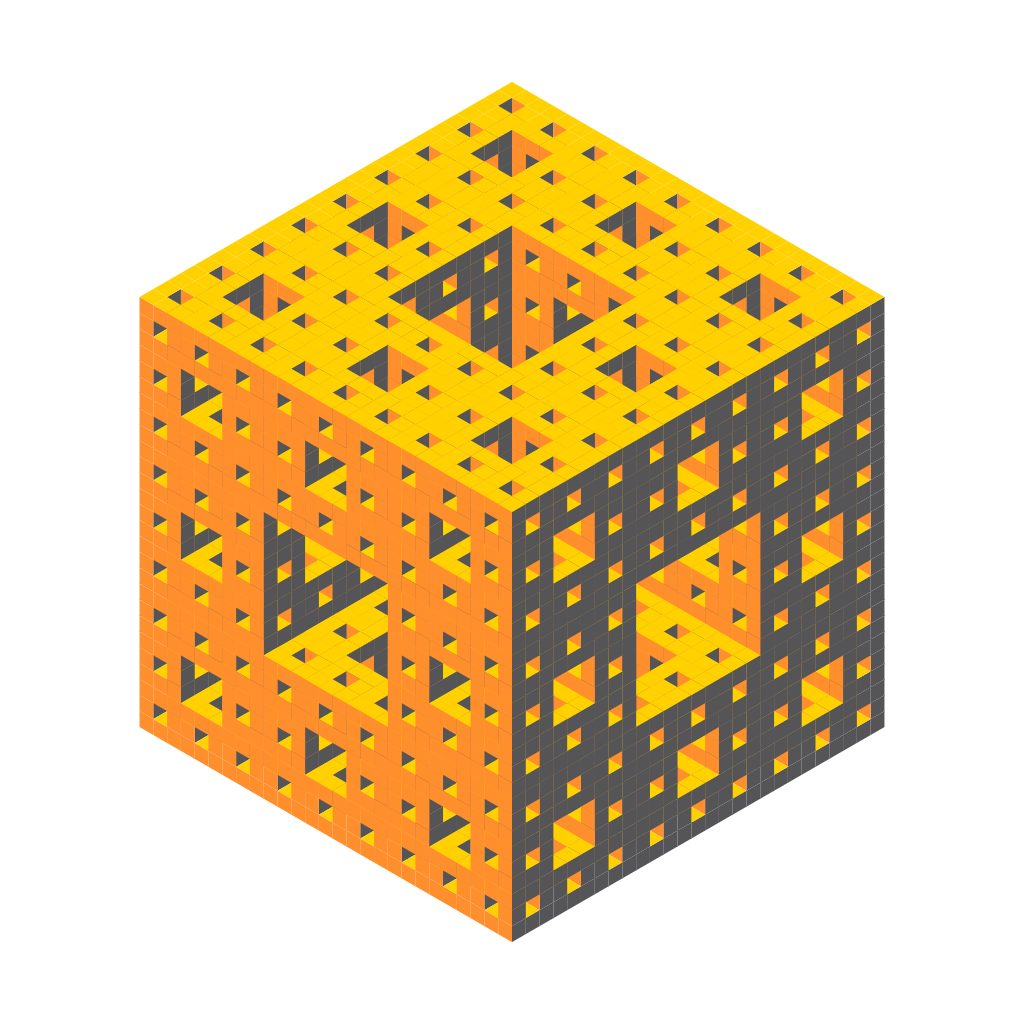
The Menger sponge
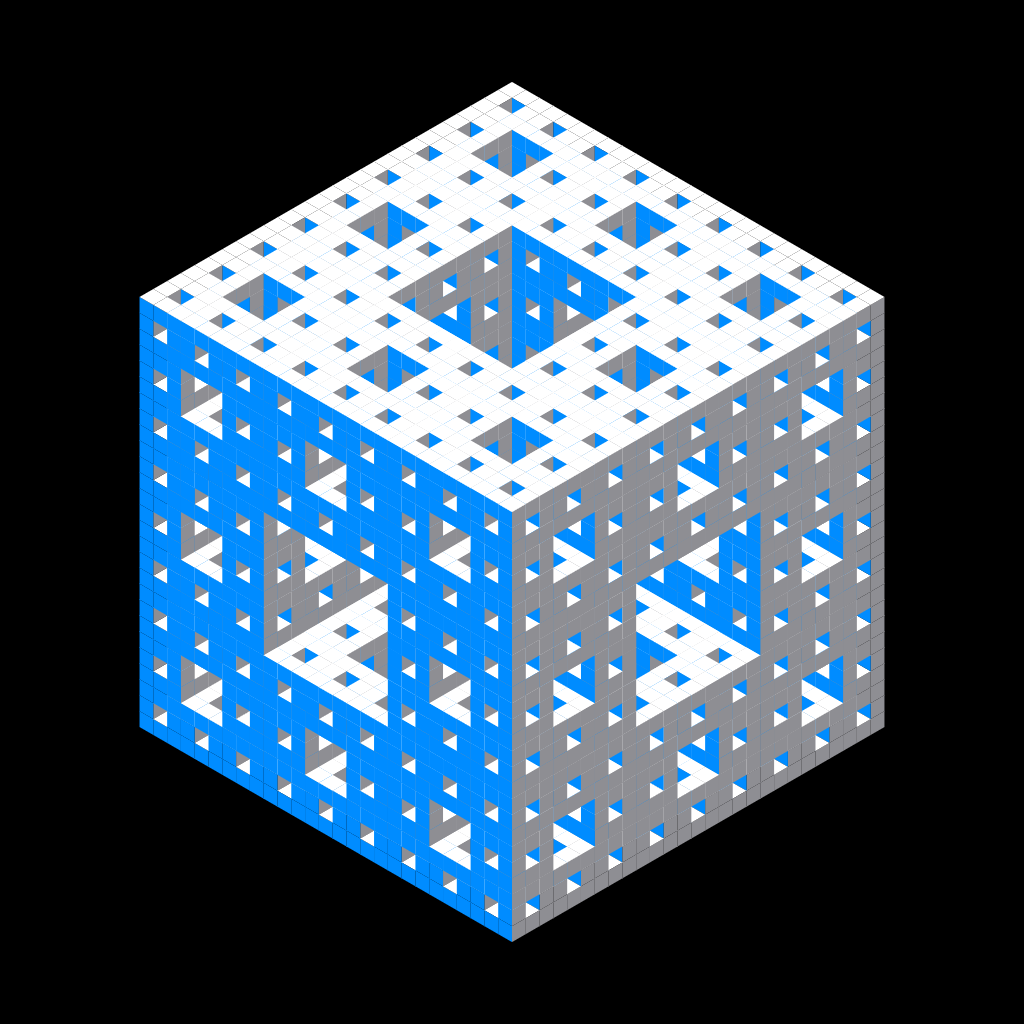
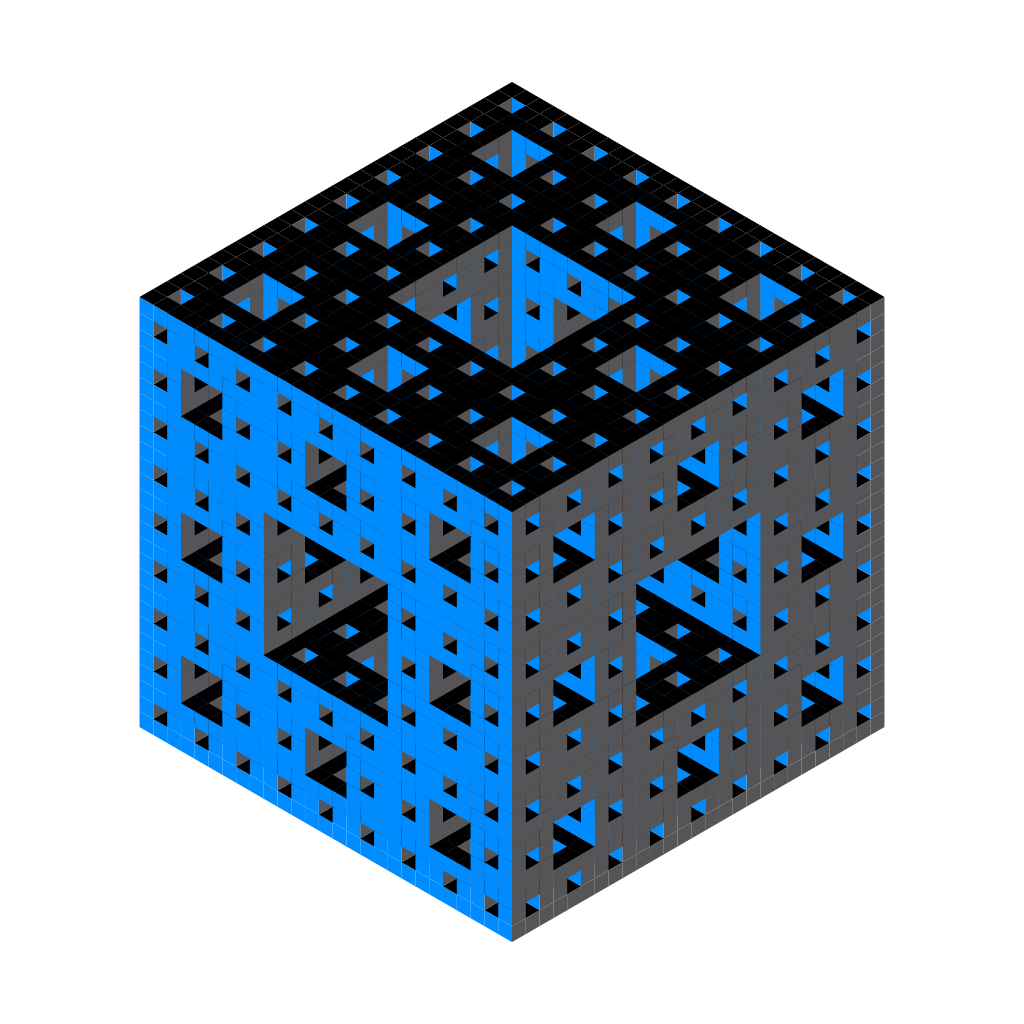
The carpet's solid cousin: cut a cube into 27, drill out the middle and the middle of each face, then do the same to the 20 cubes that are left.
The Mertens function
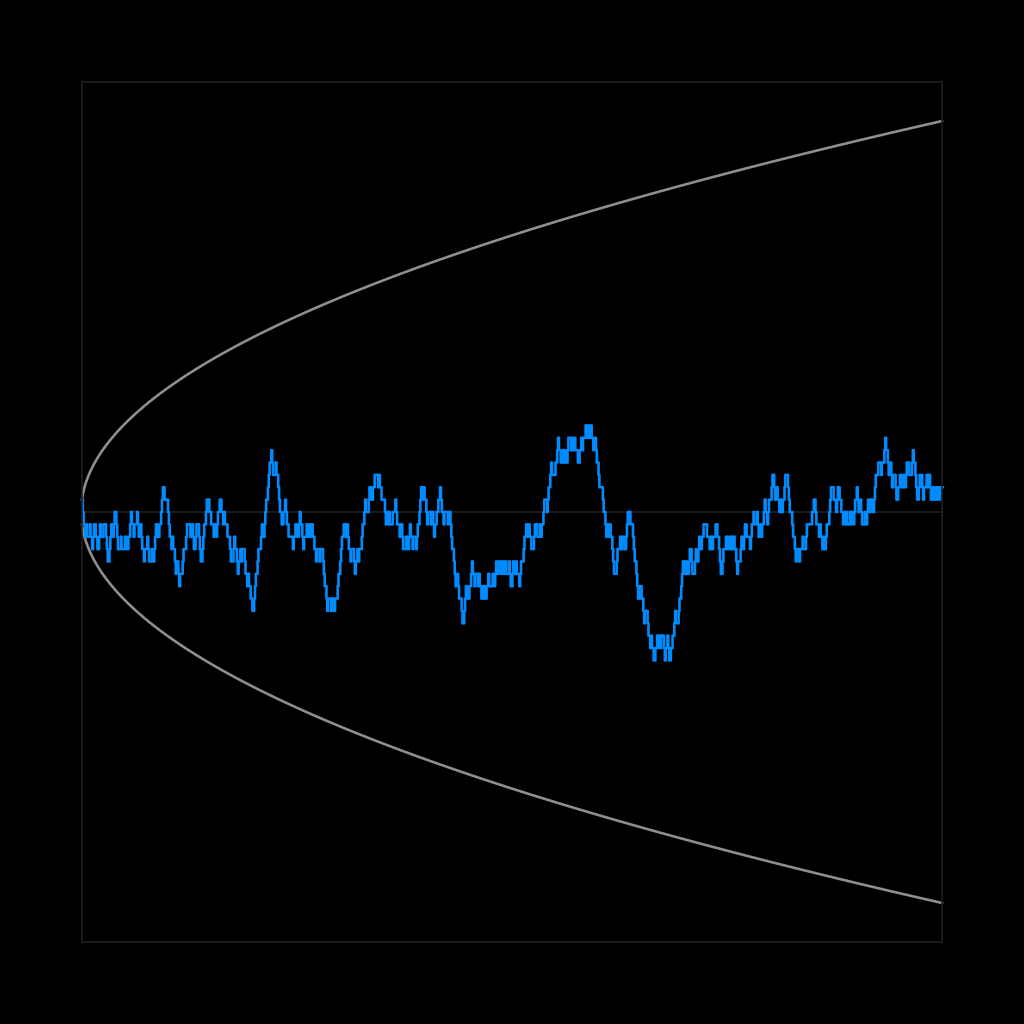
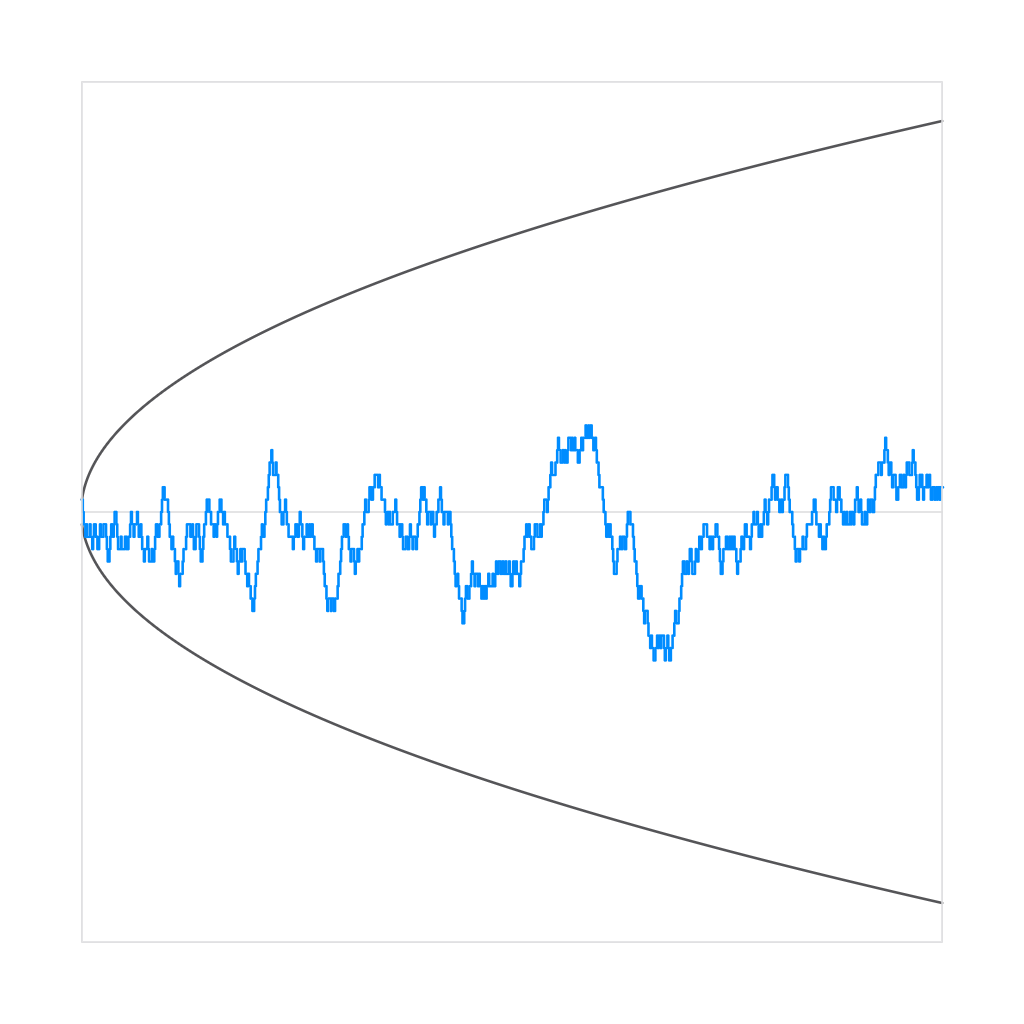
Mark every whole number plus one, minus one or nothing, then keep a running total. How far that total is allowed to wander is the Riemann hypothesis.

The transfer matrix
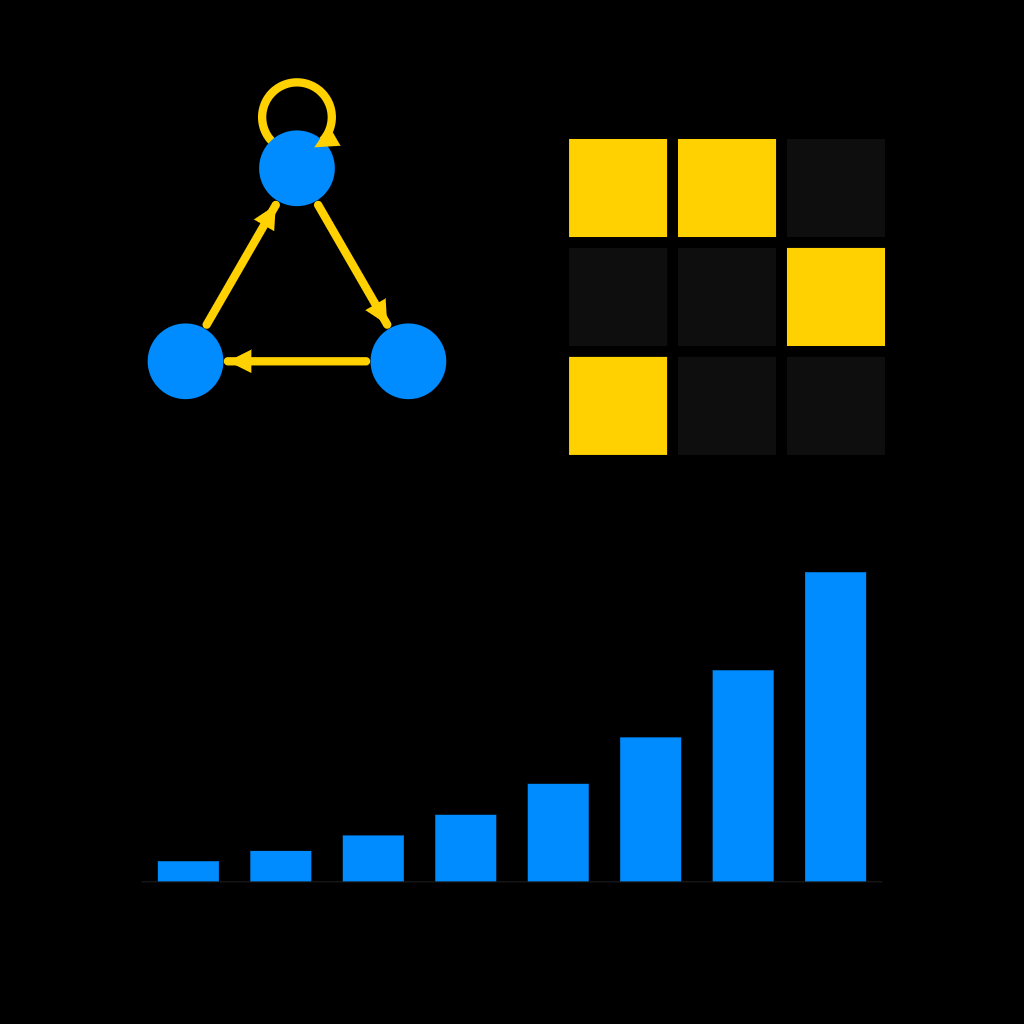
A table that says which state may follow which; multiply it by itself and it counts the walks of any length, and those counts grow like a fixed power.
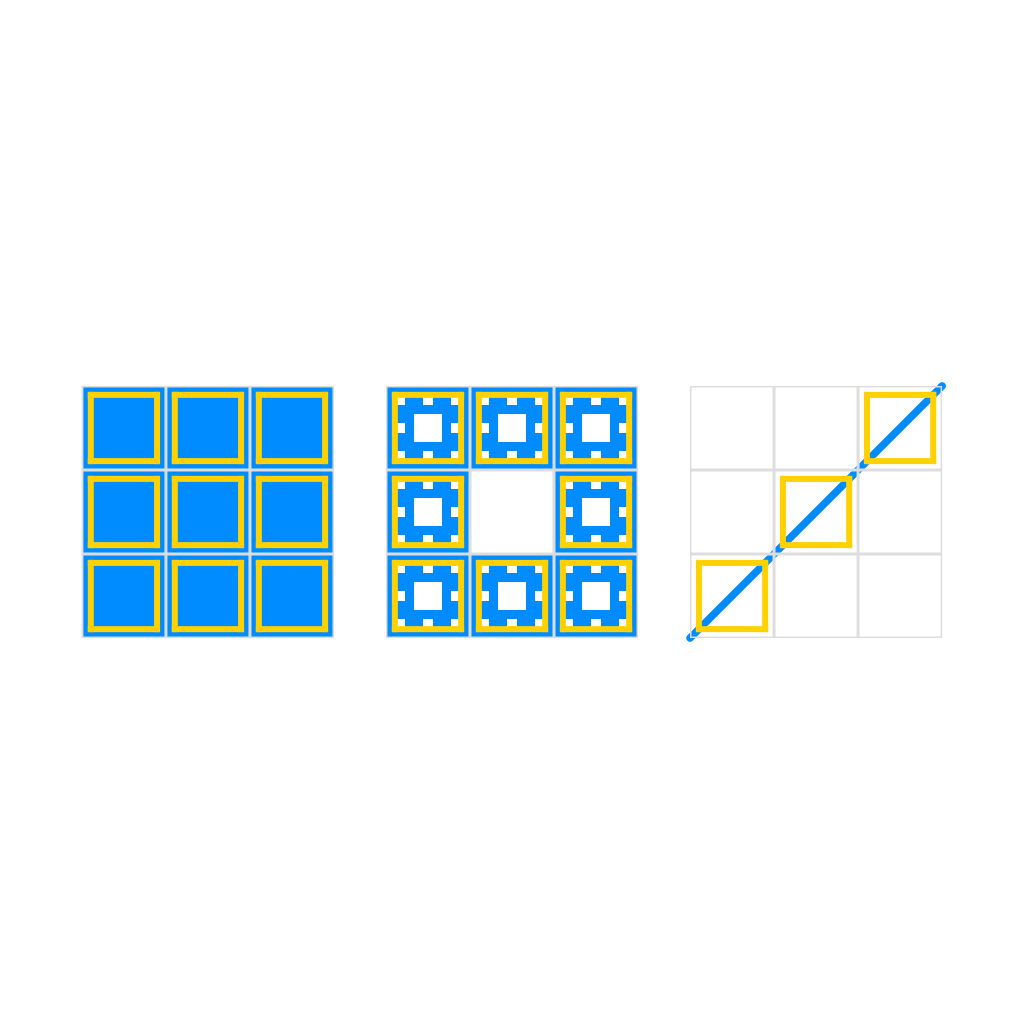
Fractal dimension
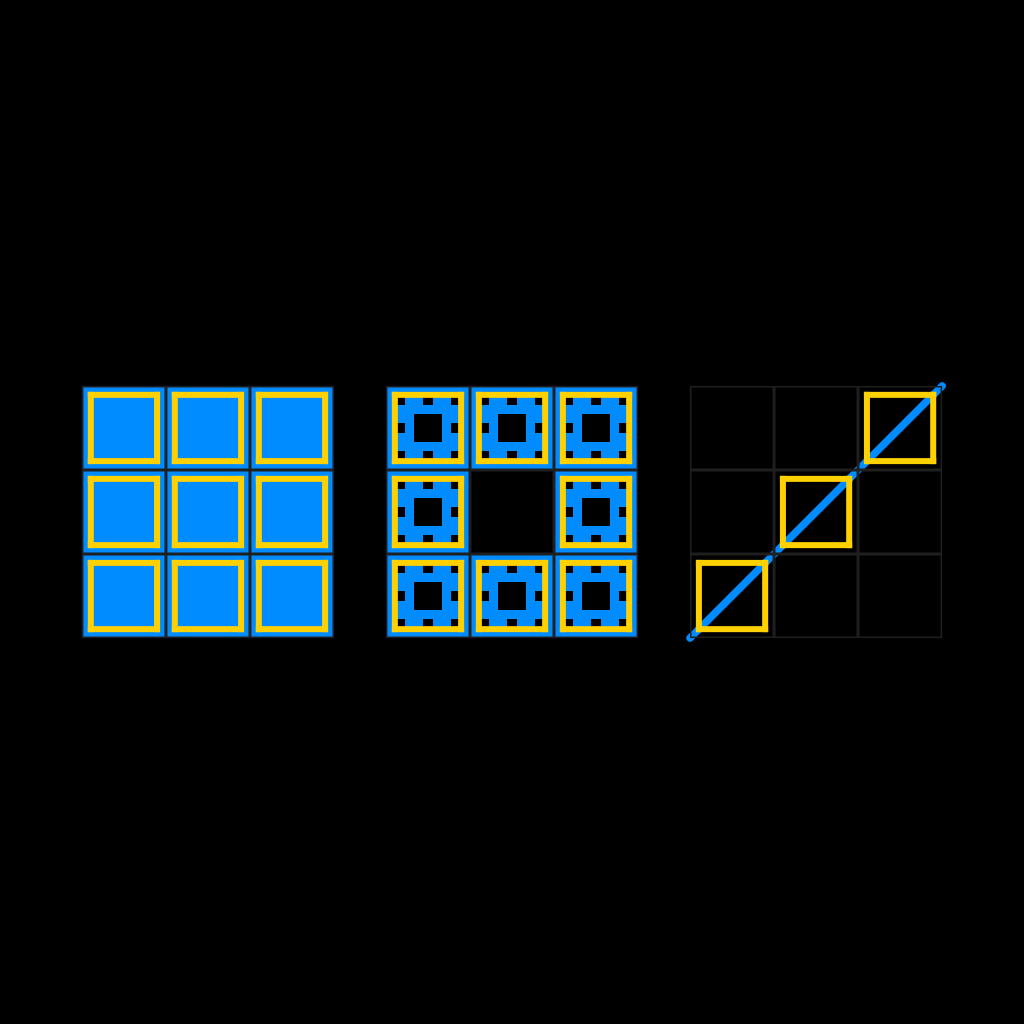
Cover a shape with boxes, shrink the boxes, and watch how fast the count grows; the growth rate is the dimension, and for a carpet it is not a whole number.
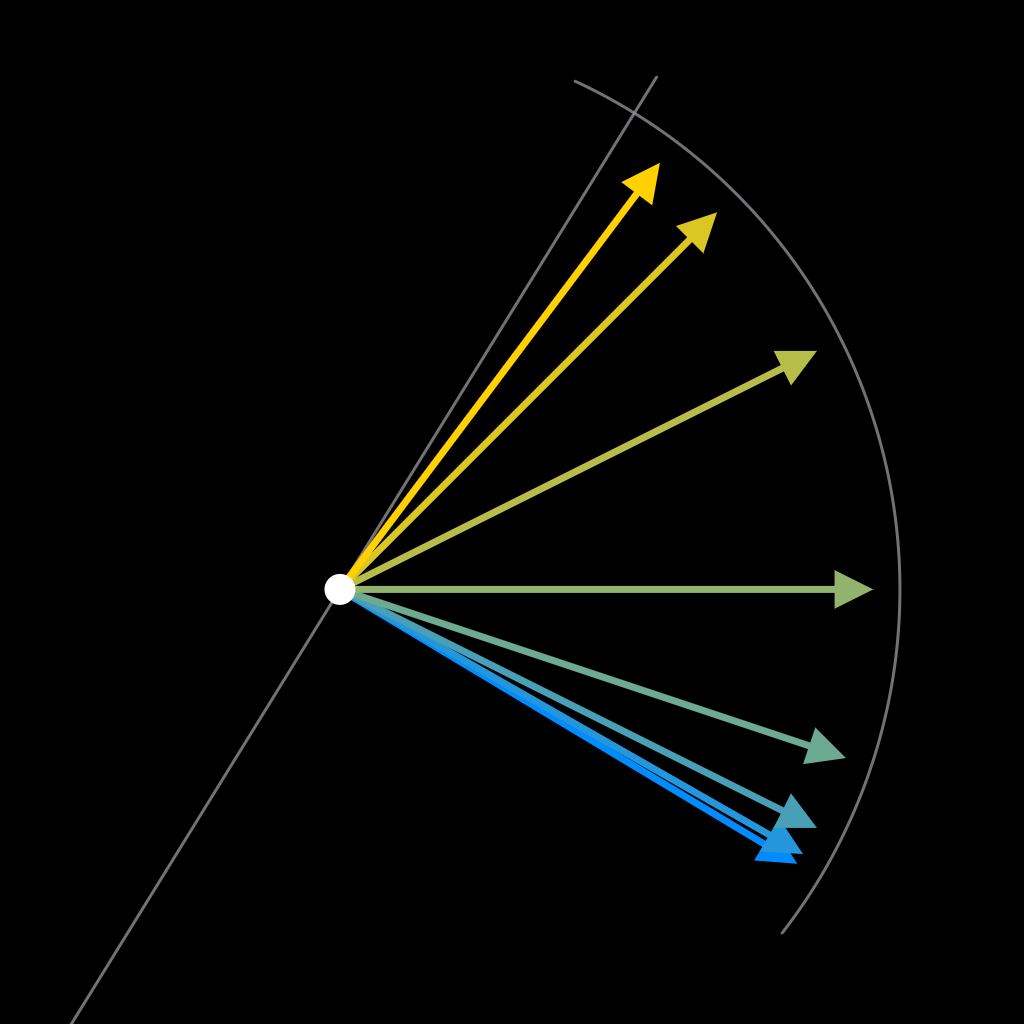
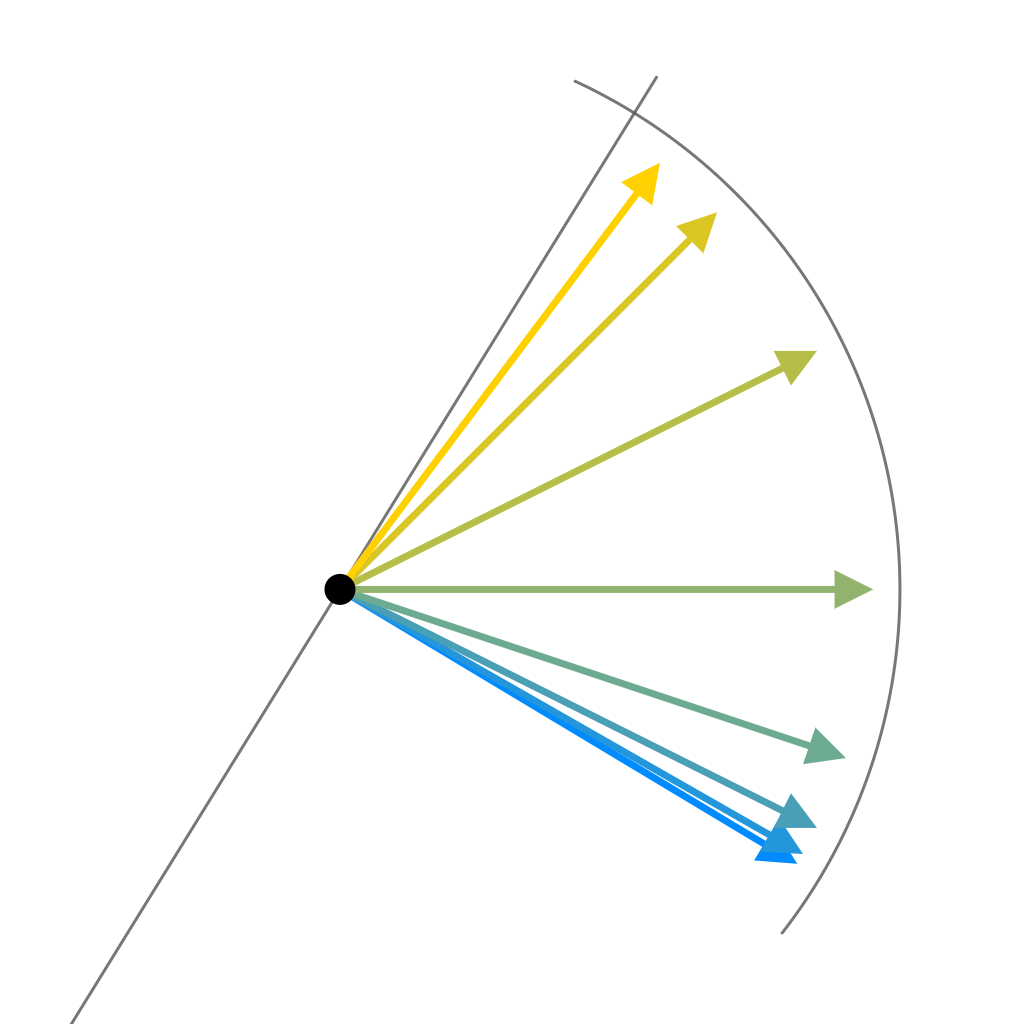
The spectral radius
Multiply an arrow by the same matrix again and again and it settles on one direction; the factor it stretches by there is the spectral radius.
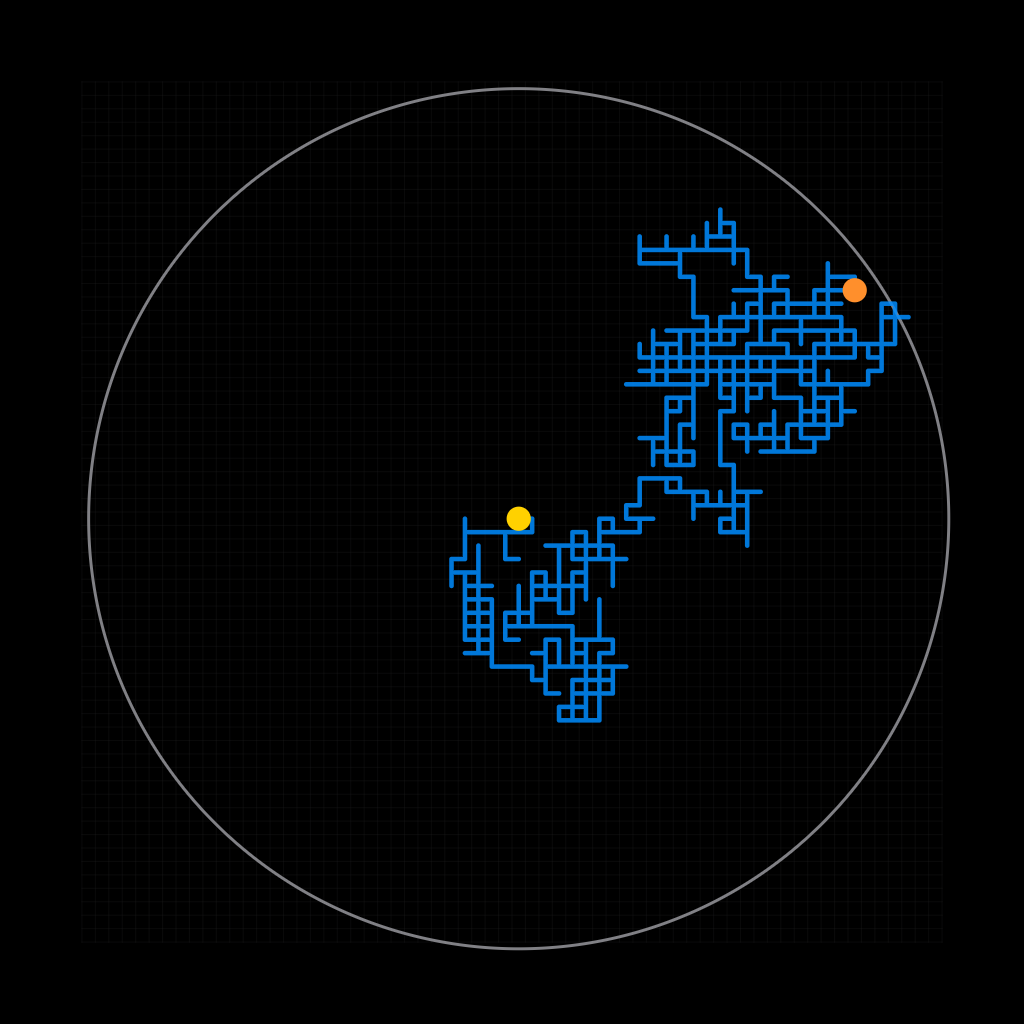
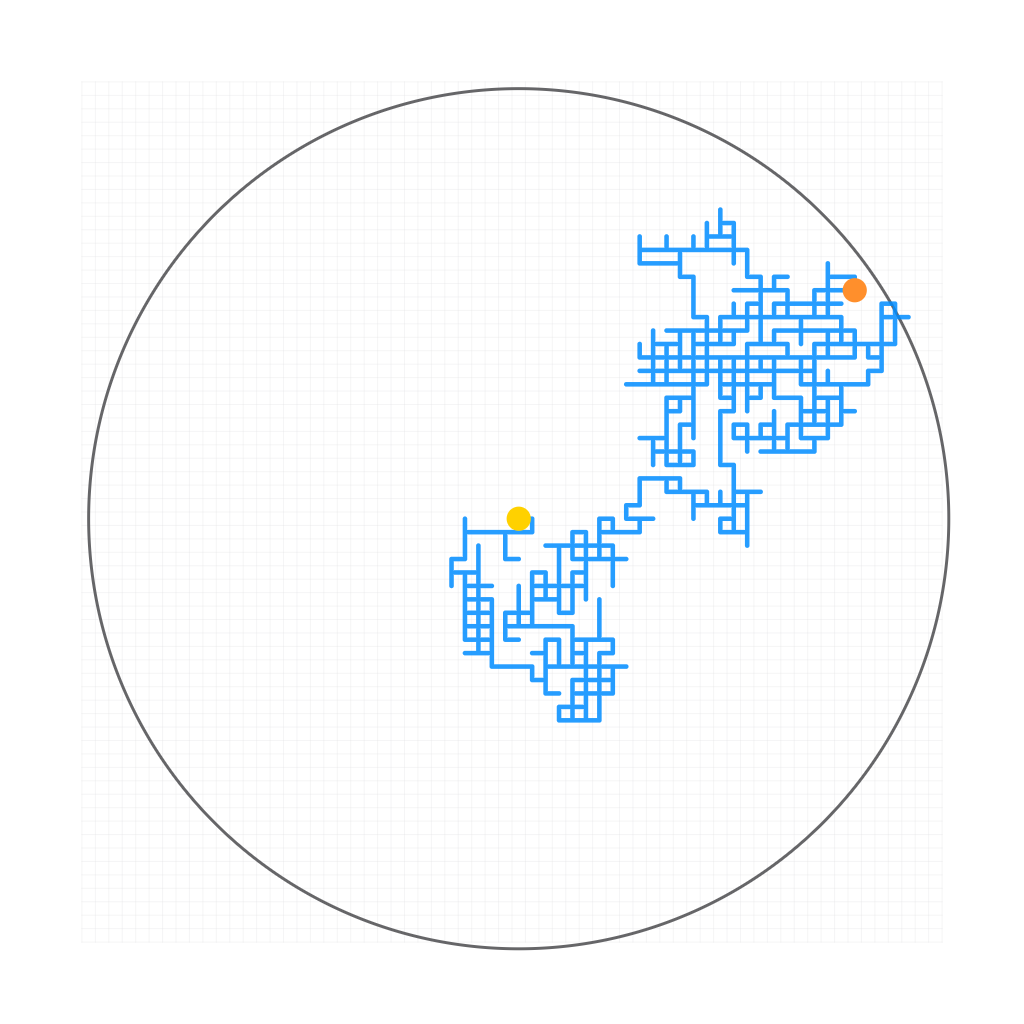
The random walk
A walker on a graph steps to a neighbour picked at random; after n steps on a grid it is about the square root of n away, and on a fractal it is slower.
Demos
Designs
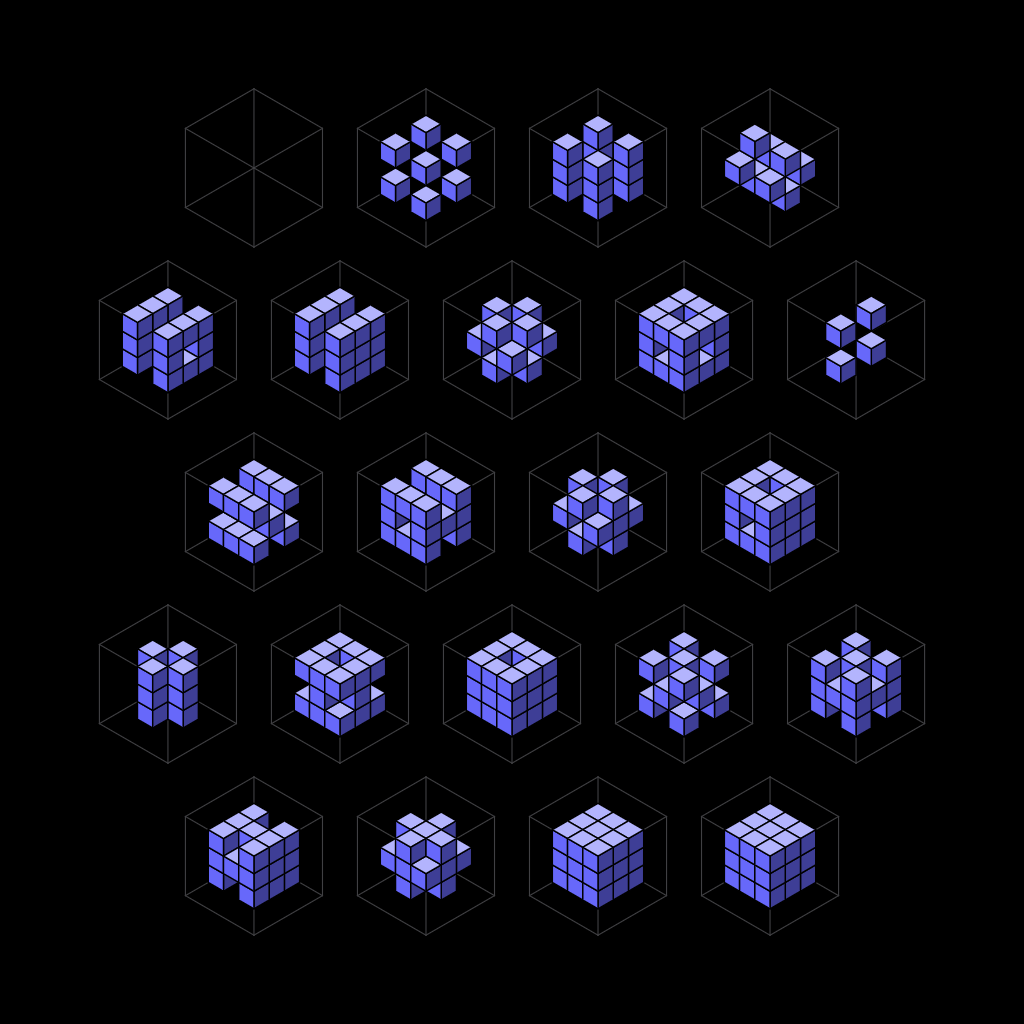
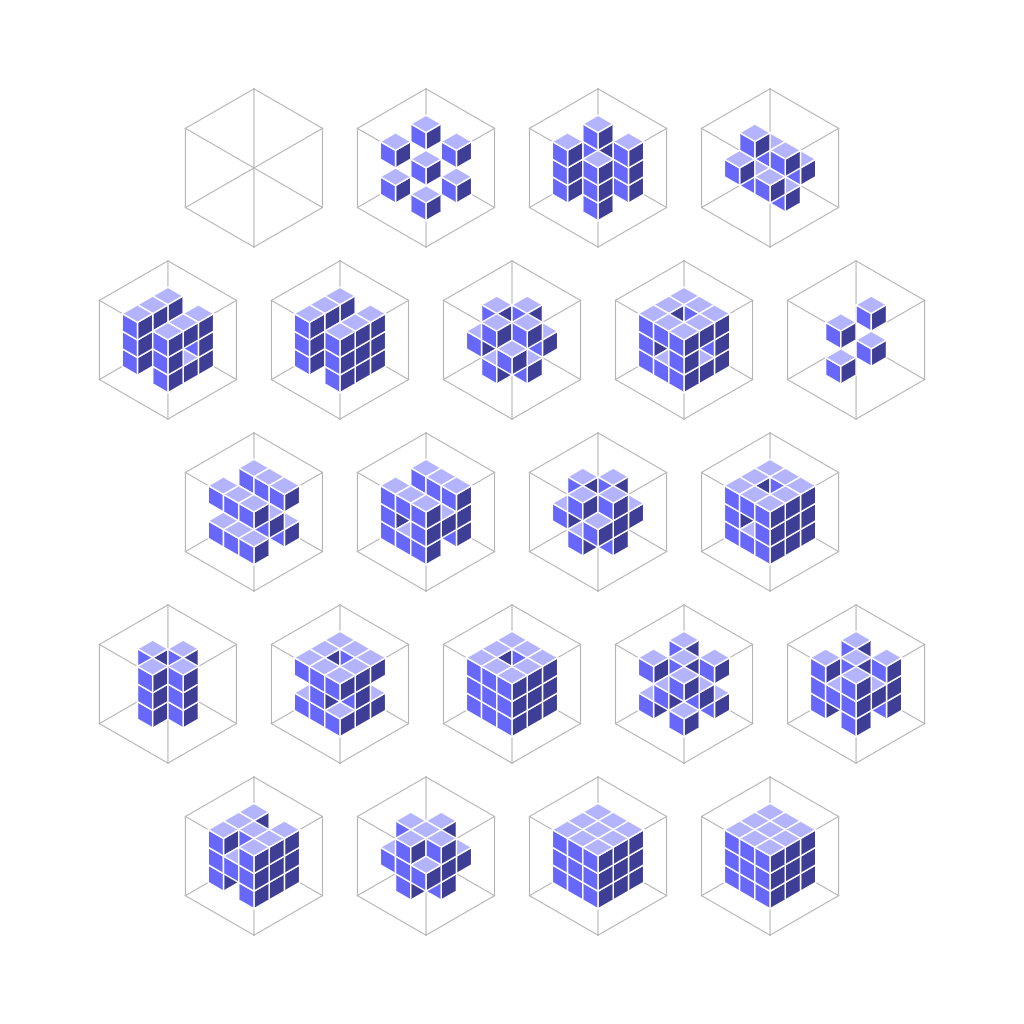
The universe
Rotations and reflections fold the corner masks of a hypercube into orbits, so the distinct designs of dimensions 1 to 4 are a finite gallery you can grow one by one.
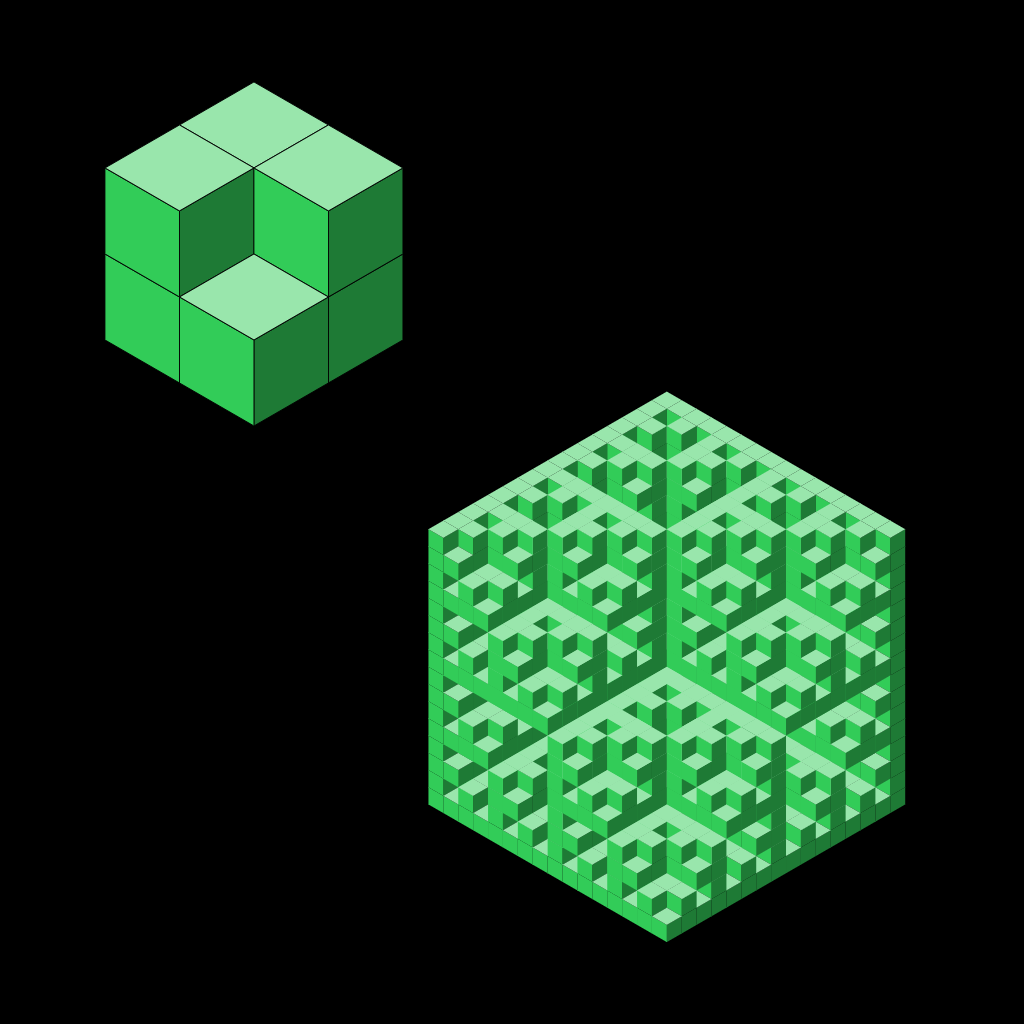
The sponge
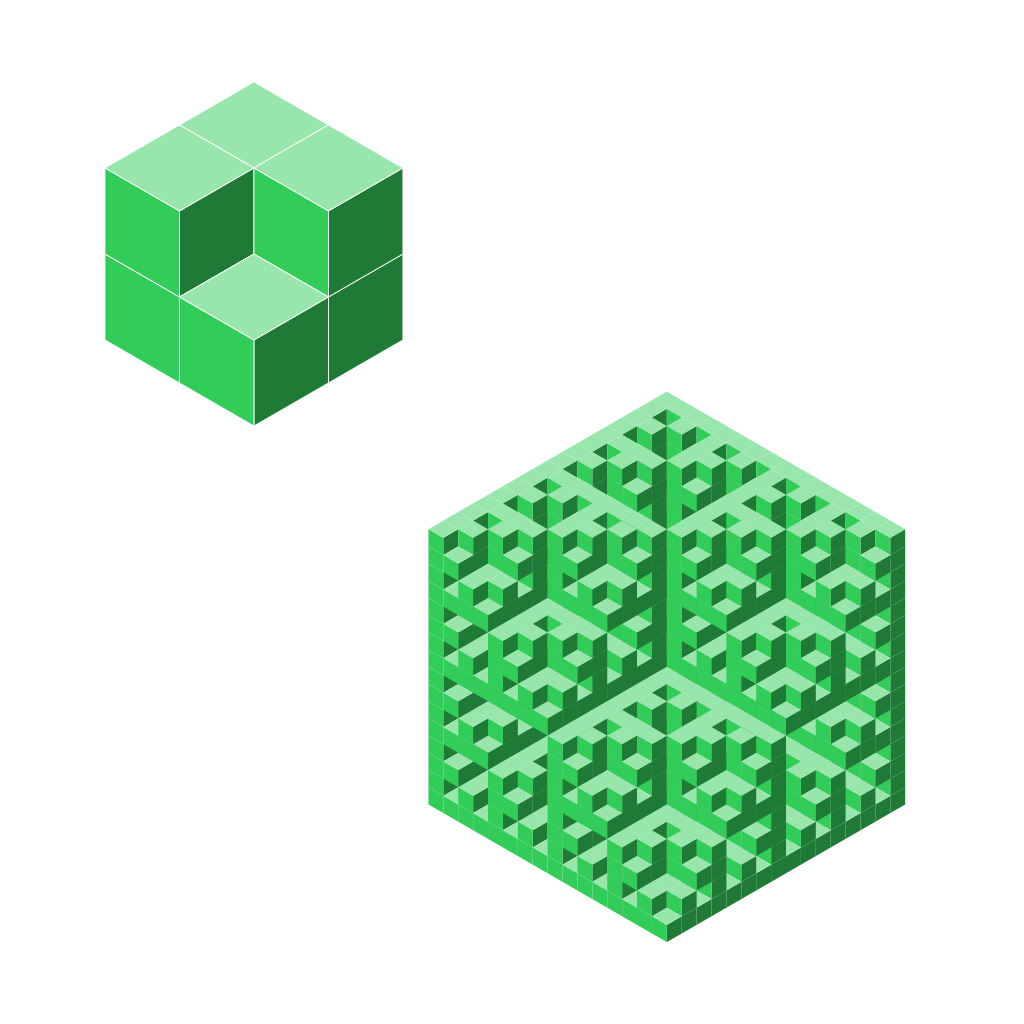
A code picks the filled corners of a cube and grows it level by level, with fills, voids and exposed faces answered by closed formulas before a cube is built.
The tile
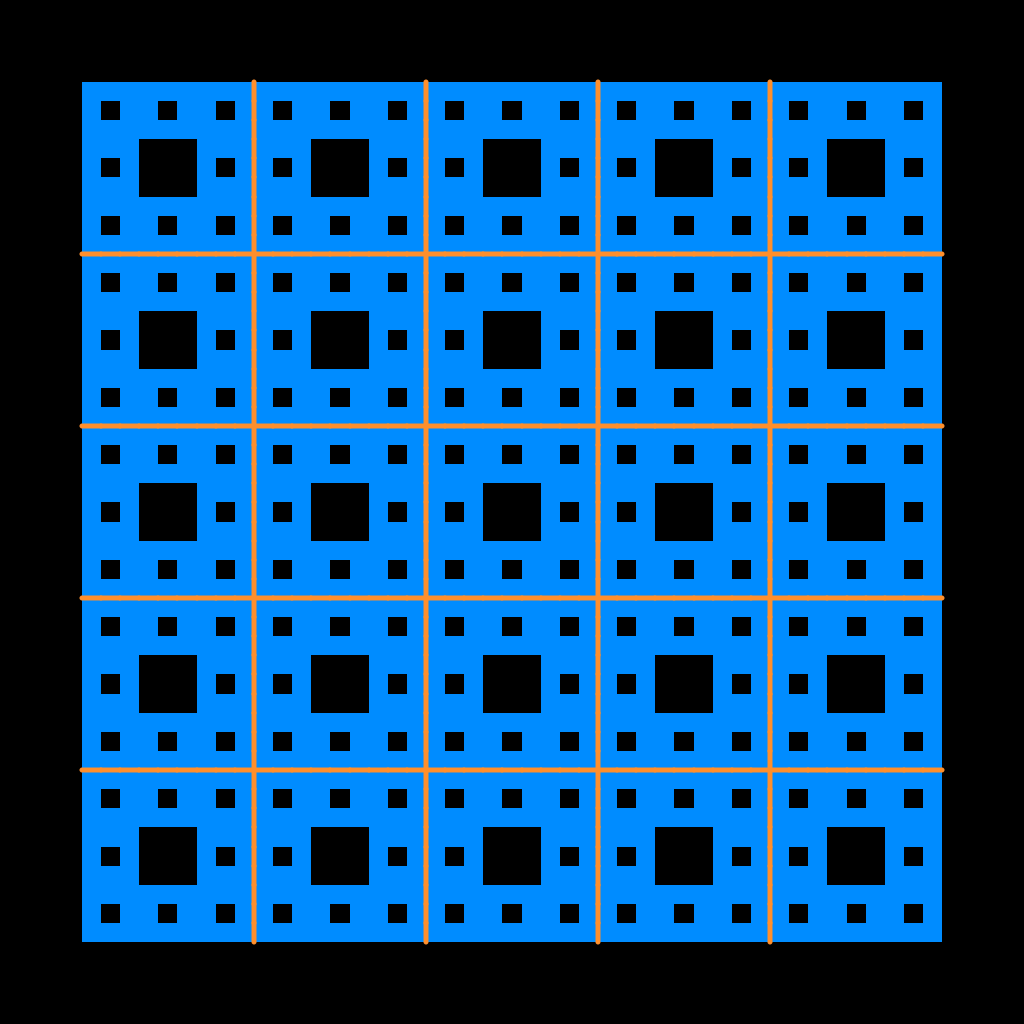
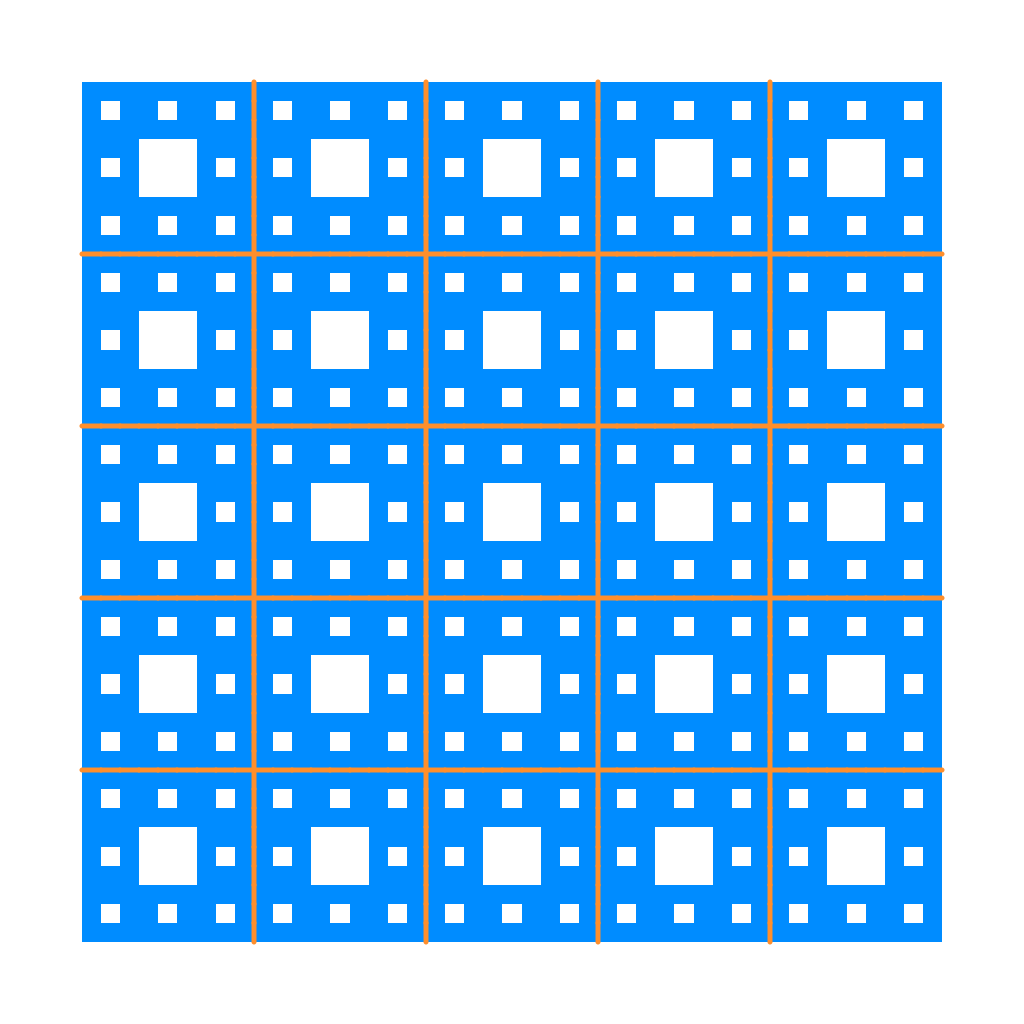
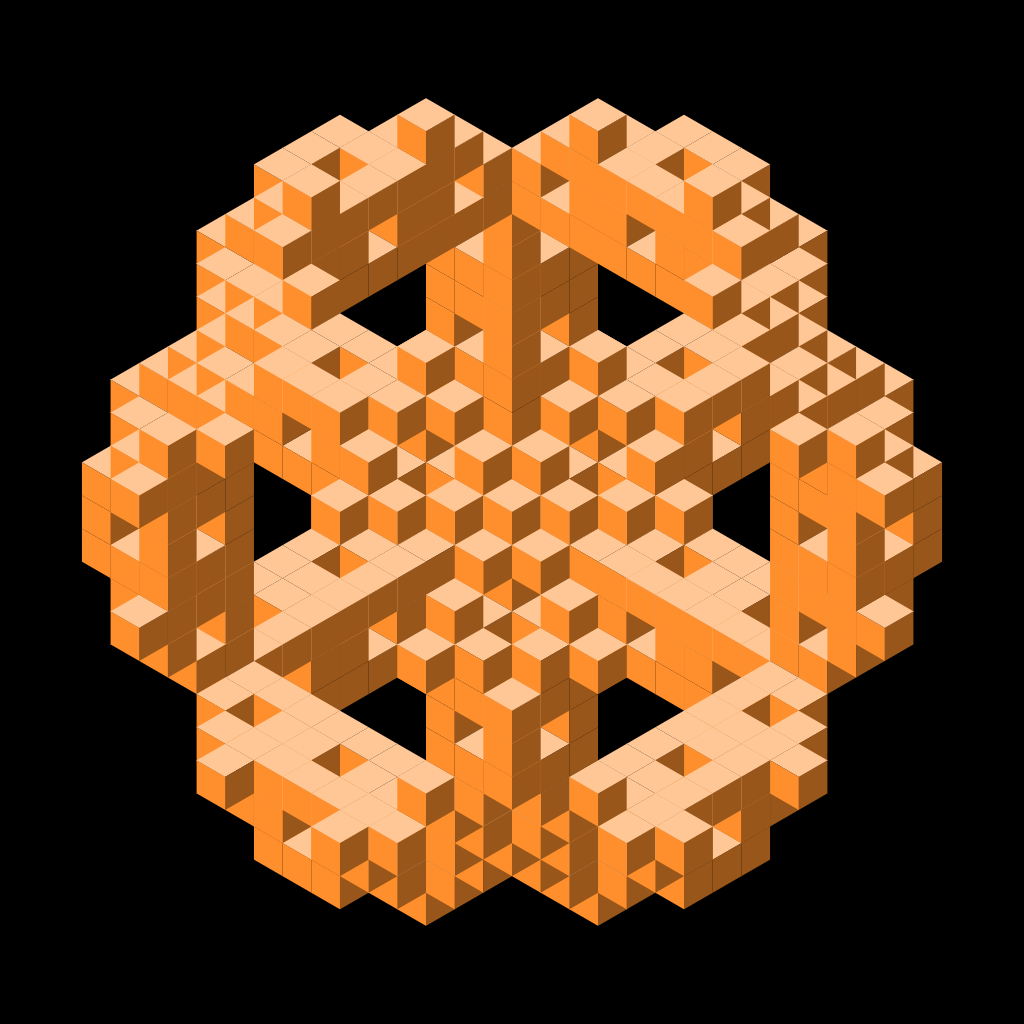
One design repeated: side by side on the square lattice in the plane and in the cube, interlocked as a hexagon on the triangular one, where the fills multiply by the copy count exactly and the exposed faces do not.
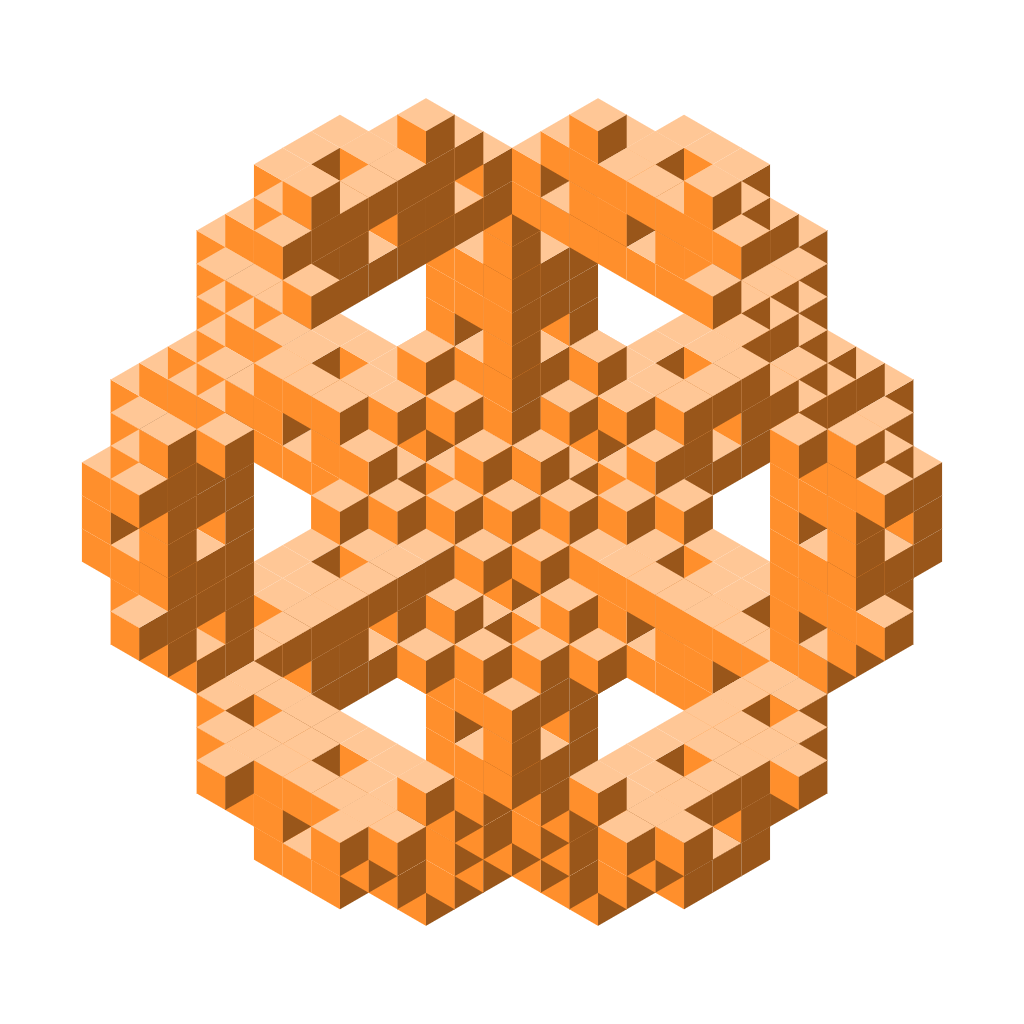
The crop
A named shape of rational radius keeps only the cells of a design it reaches, counted exactly in in, cut and out regions, and the disc count read radius by radius carries a self-similar main term with a log-periodic multiplier.
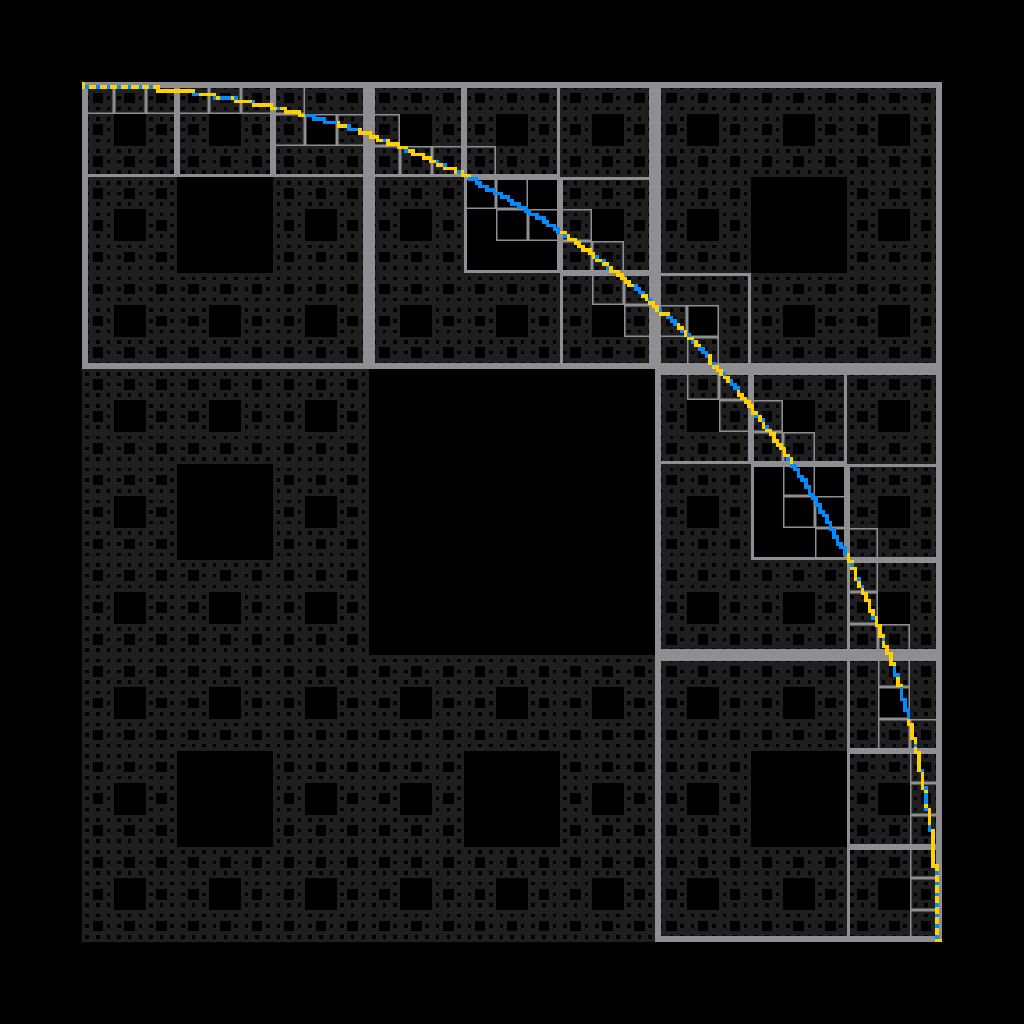
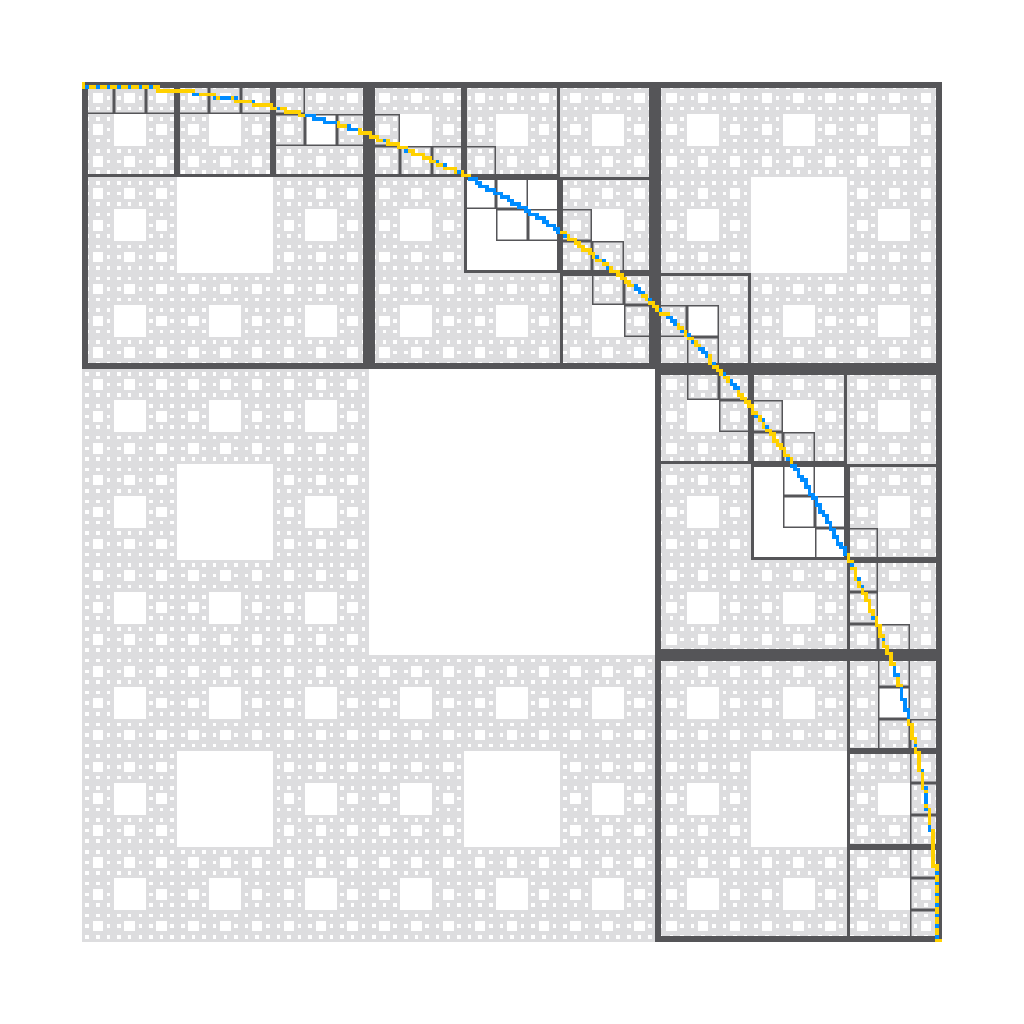
The shell
The cells a circle crosses on a design collapse by threes into a rooted tree whose every level holds exactly 2 floor(r / 3^j) + 1 boxes, and the cells the design fills are the leaves whose path never takes a centre seat.
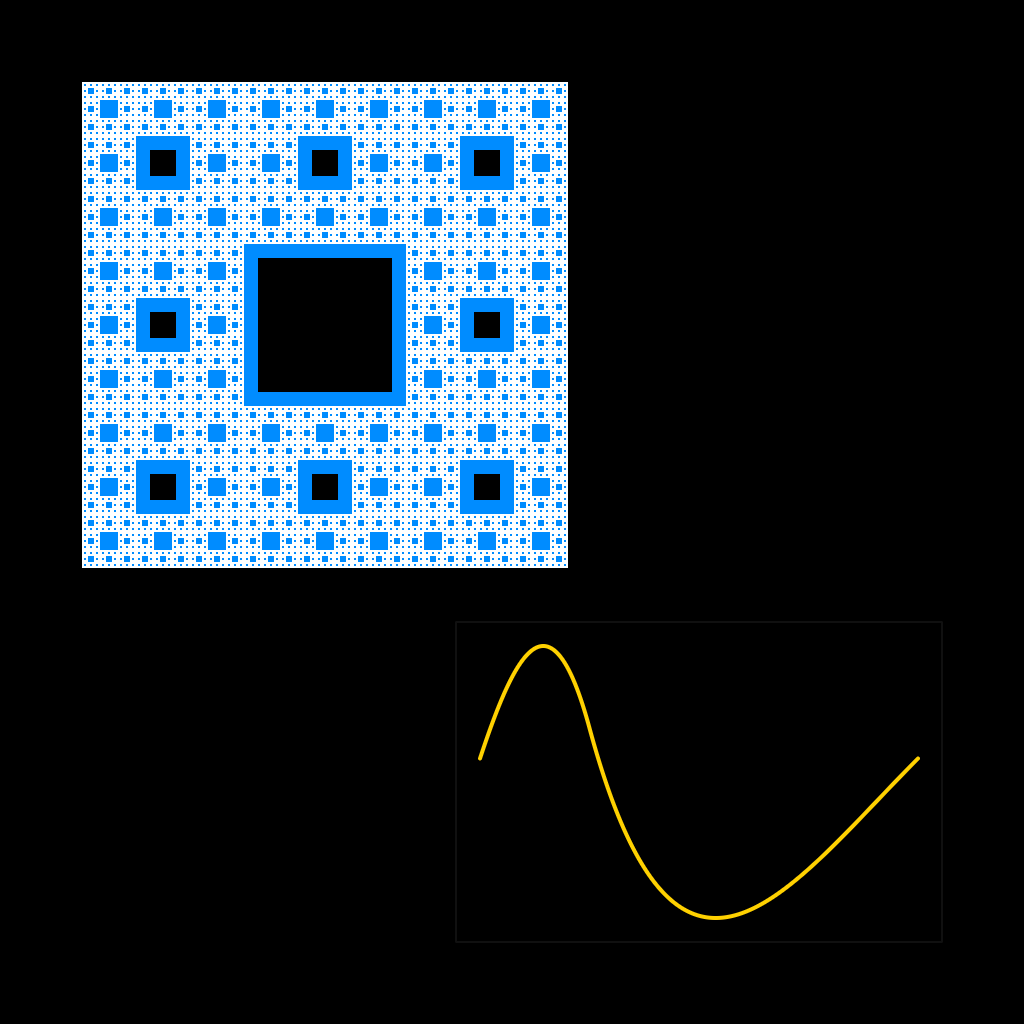
The tube
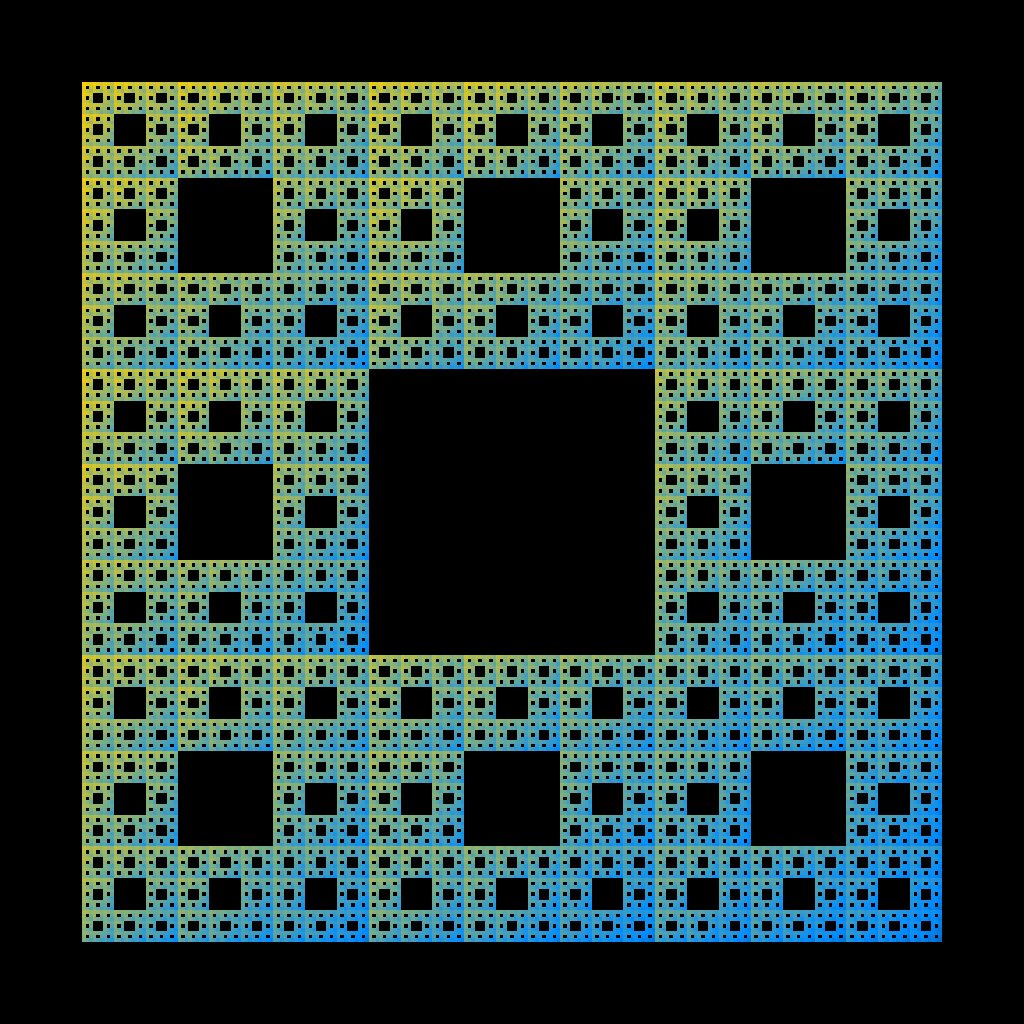
Fattening a design by a radius and measuring what it swallows gives an inner tube whose Minkowski reading never settles but circles one log-periodic profile, exact in closed form wherever the holes are isolated squares.
The weights
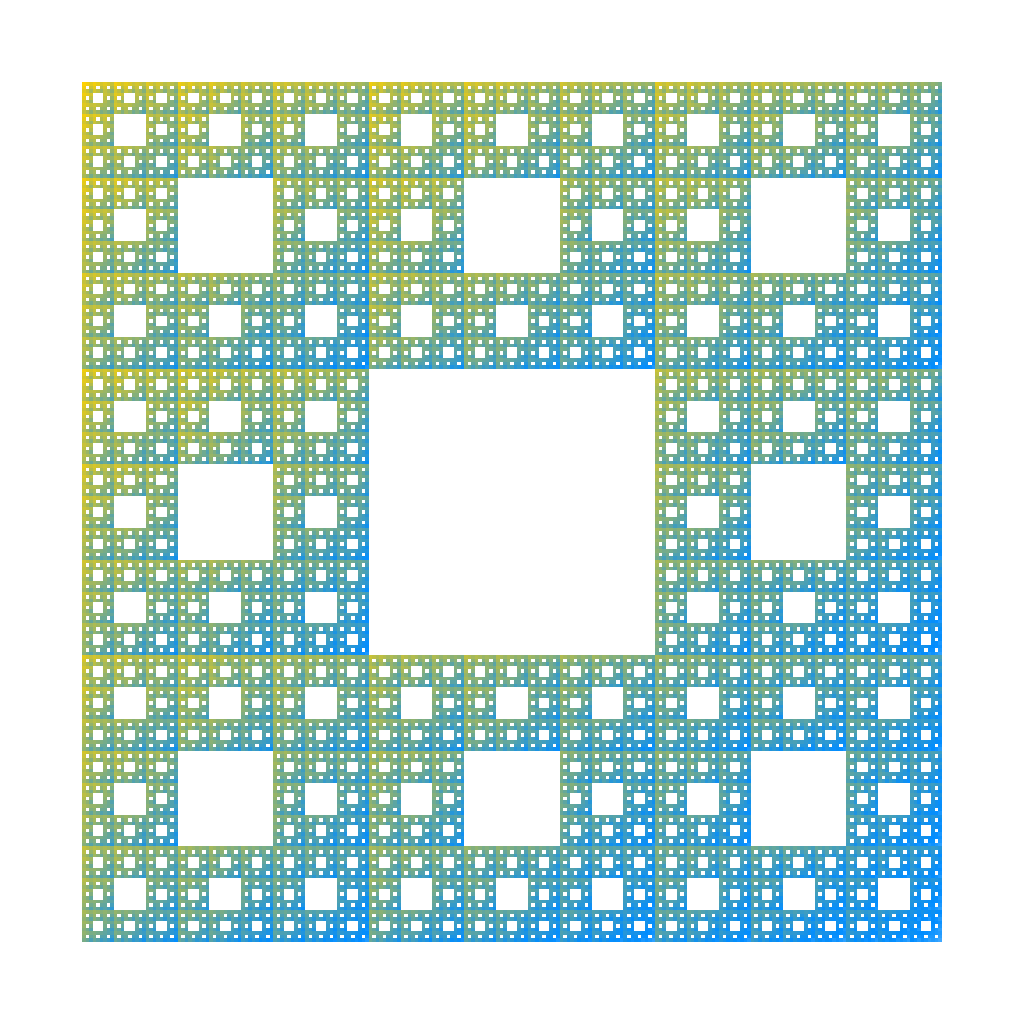
Give every filled corner of a design a weight and the support never moves while the mass does, so the pressure and its Legendre transform are closed forms in the weights alone and the multifractal spectrum becomes a curve you steer with sliders.
The tour
A dozen cards, each drawing a design live beside the integer sequence it counts and the OEIS record that holds the terms.
mrlylife
Life with the neighbourhood set free: the mask is a design at any side and level, the birth and survival counts come by hand or from a named sequence, and the board runs in one dimension or two.
The stills
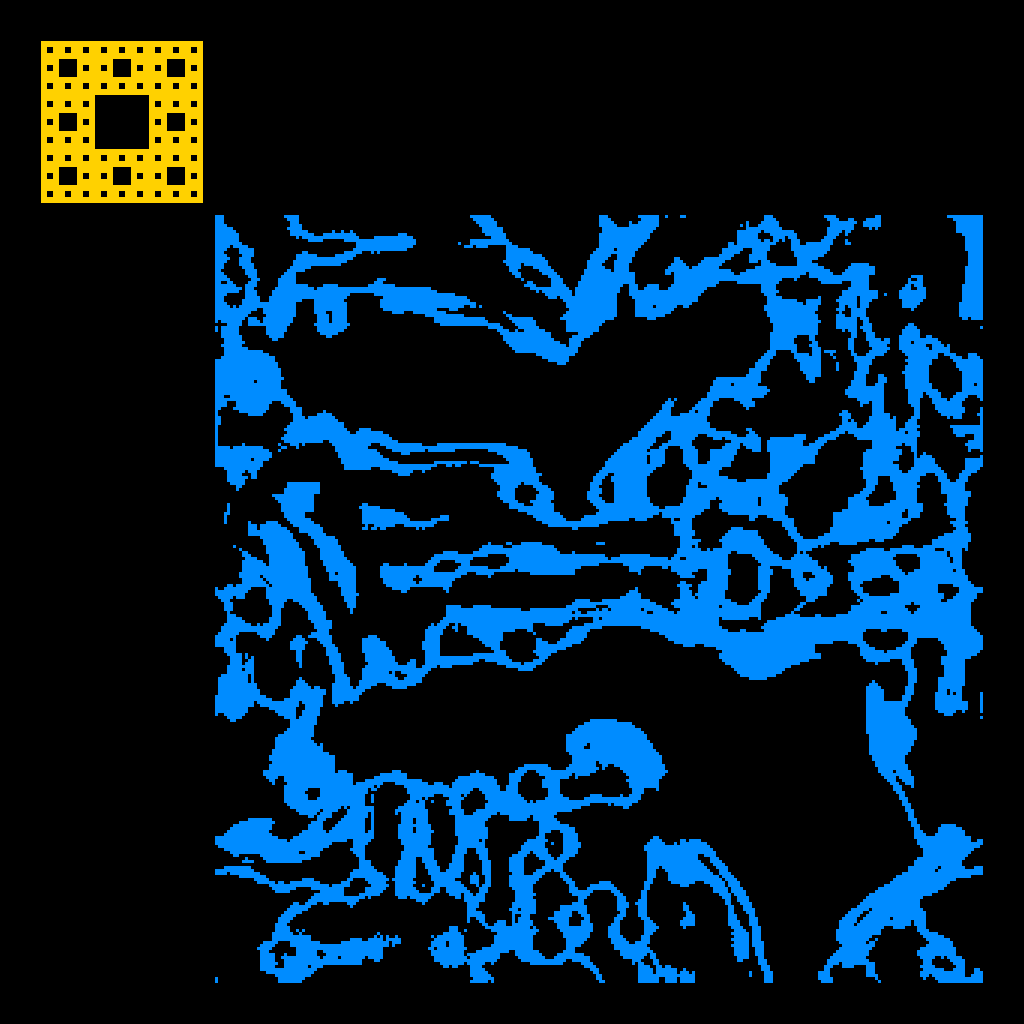
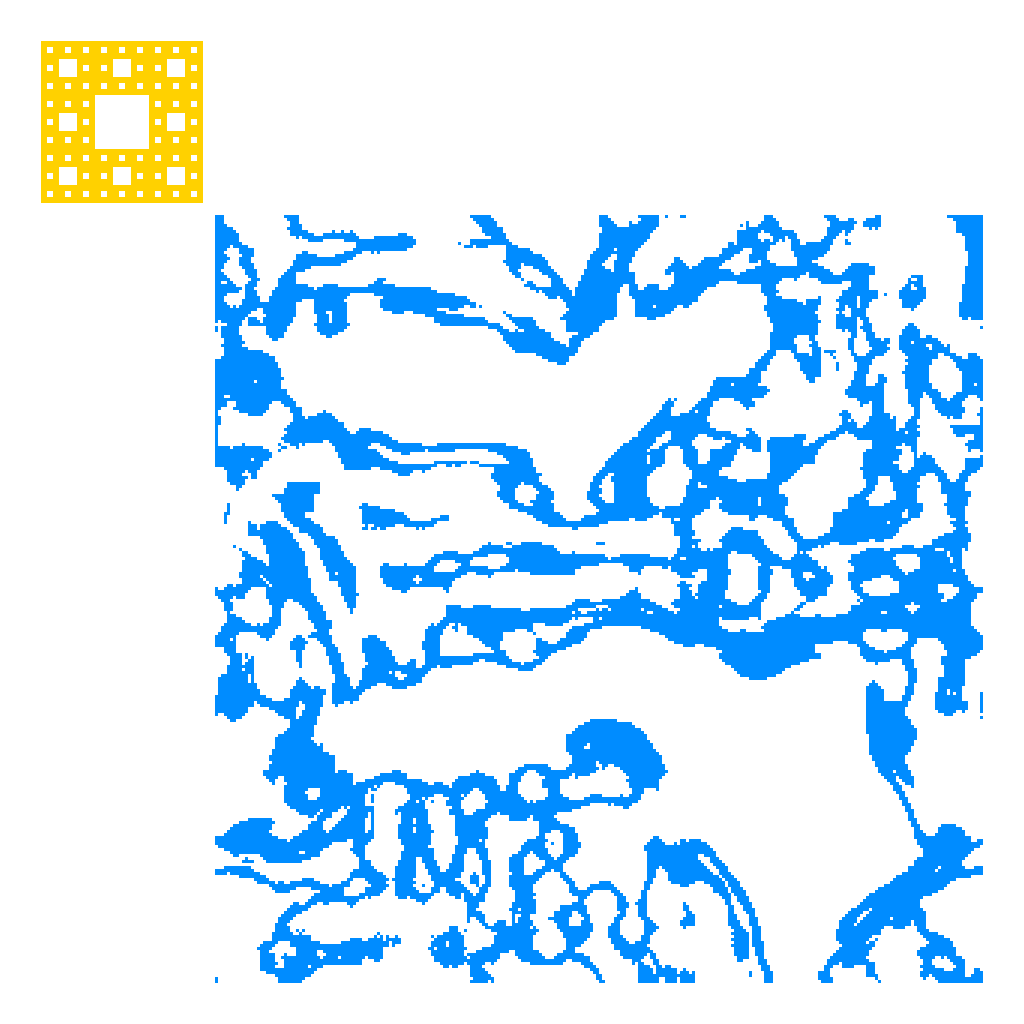
A Larger-than-Life rule on a big design mask runs a soup to a still, and the ring where the still's spectrum peaks, read beside the mask's own spectrum, is the wavelength the rule prefers.
The rules
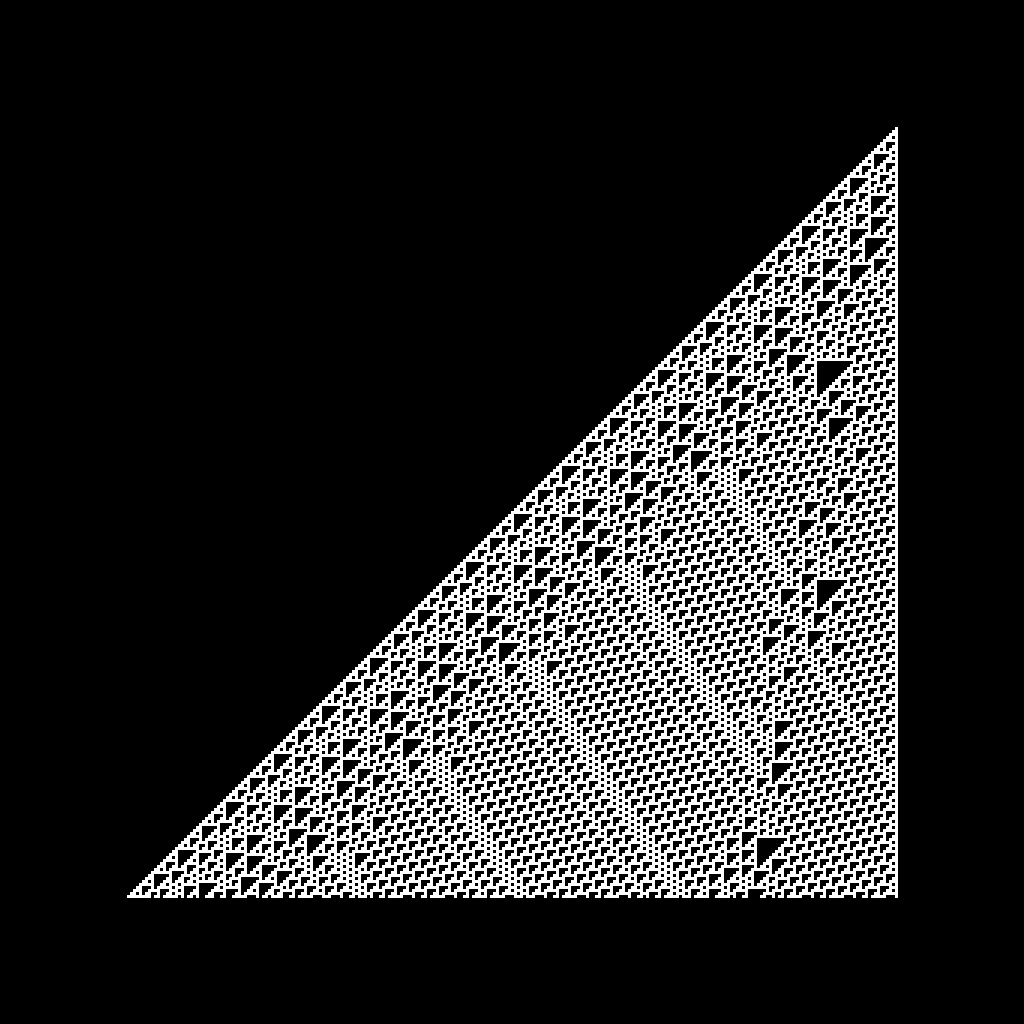
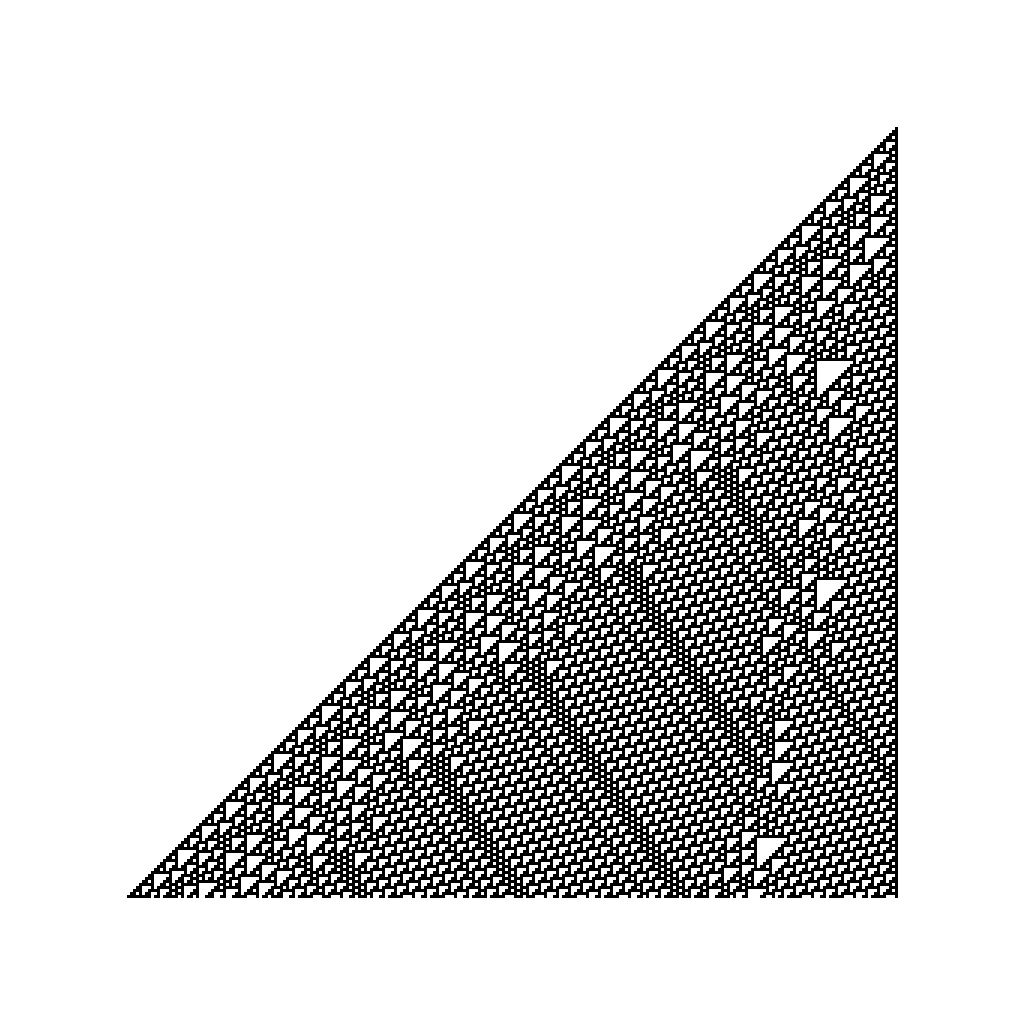
Wolfram's 256 elementary rules are the 256 three-dimensional parity designs bit for bit, so every rule arrives with a design's card, and the additive rules draw the plane designs in time.
The memory dial
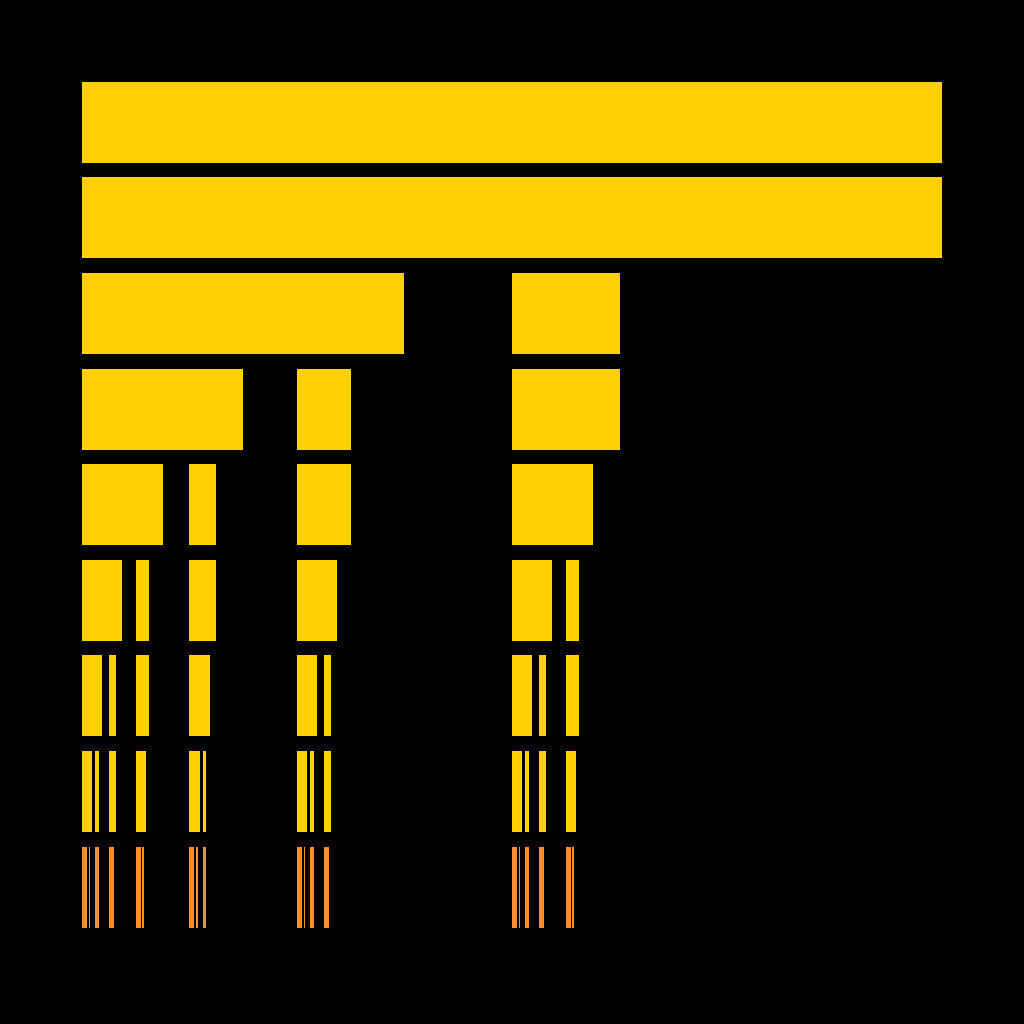
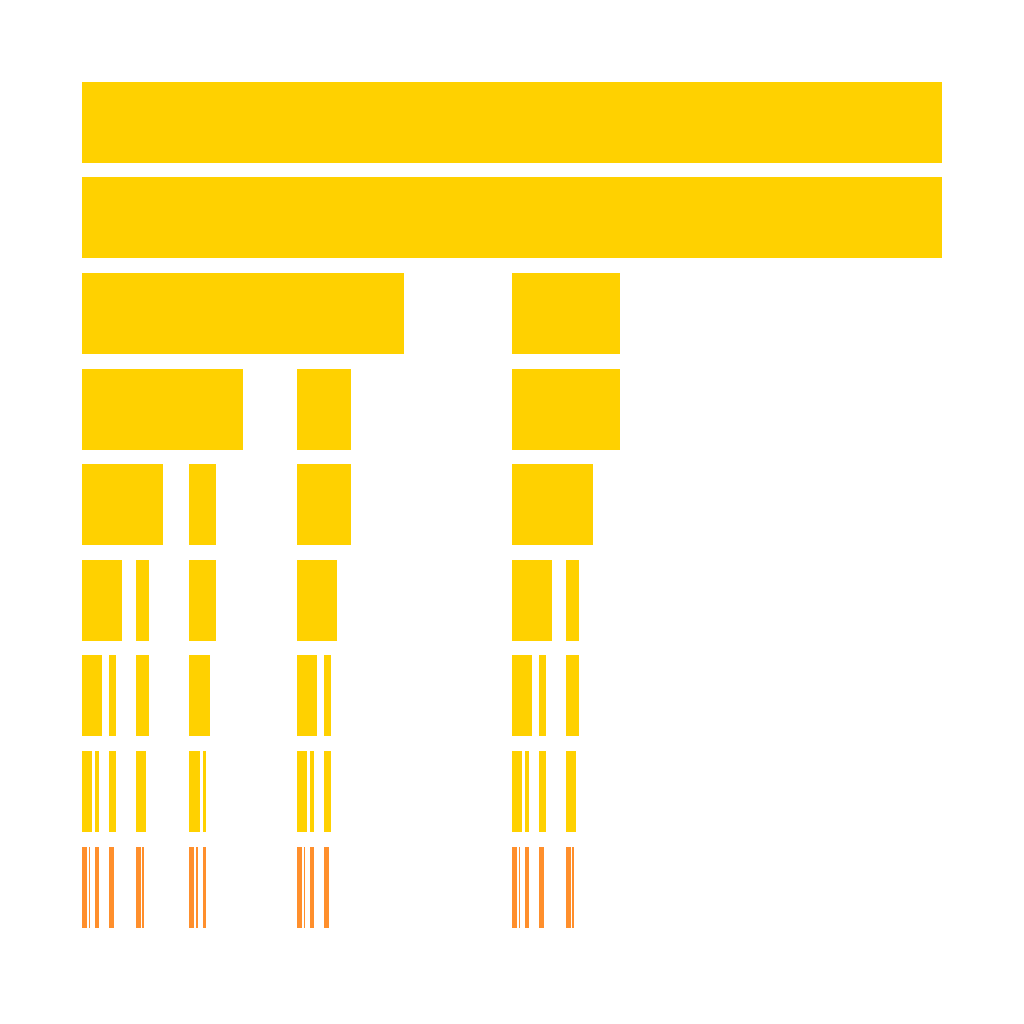
A rule on the last k digits thins a design's words: the accepted cells, the count a level, the Perron root that replaces plain doubling, and the bits a digit spends on remembering.

The place dial
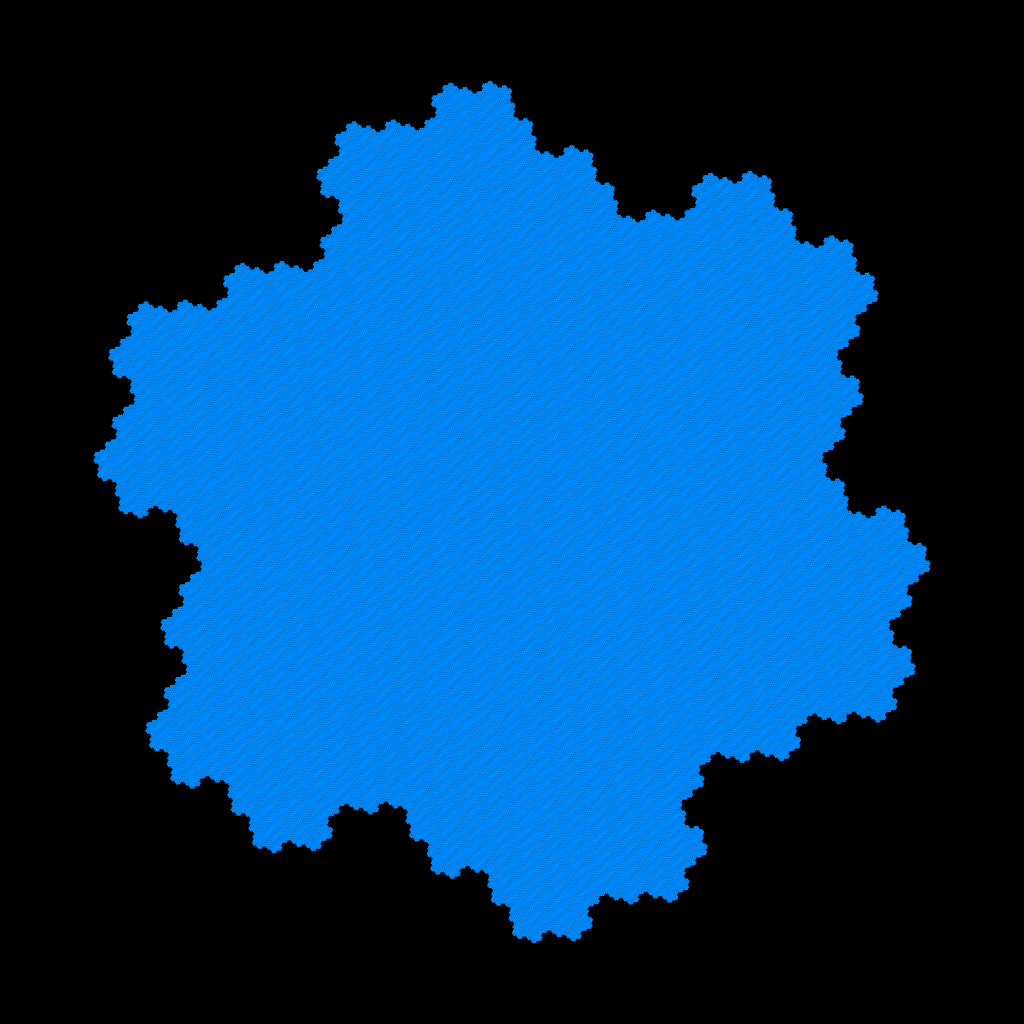
A design's digits become residues in a ring of the plane, its base an element of that ring and its copies turned by a unit each, so the word count never moves while the picture becomes a curve, a gasket or a tile, and two words can land on one point.
Slices and stacks
The cuts
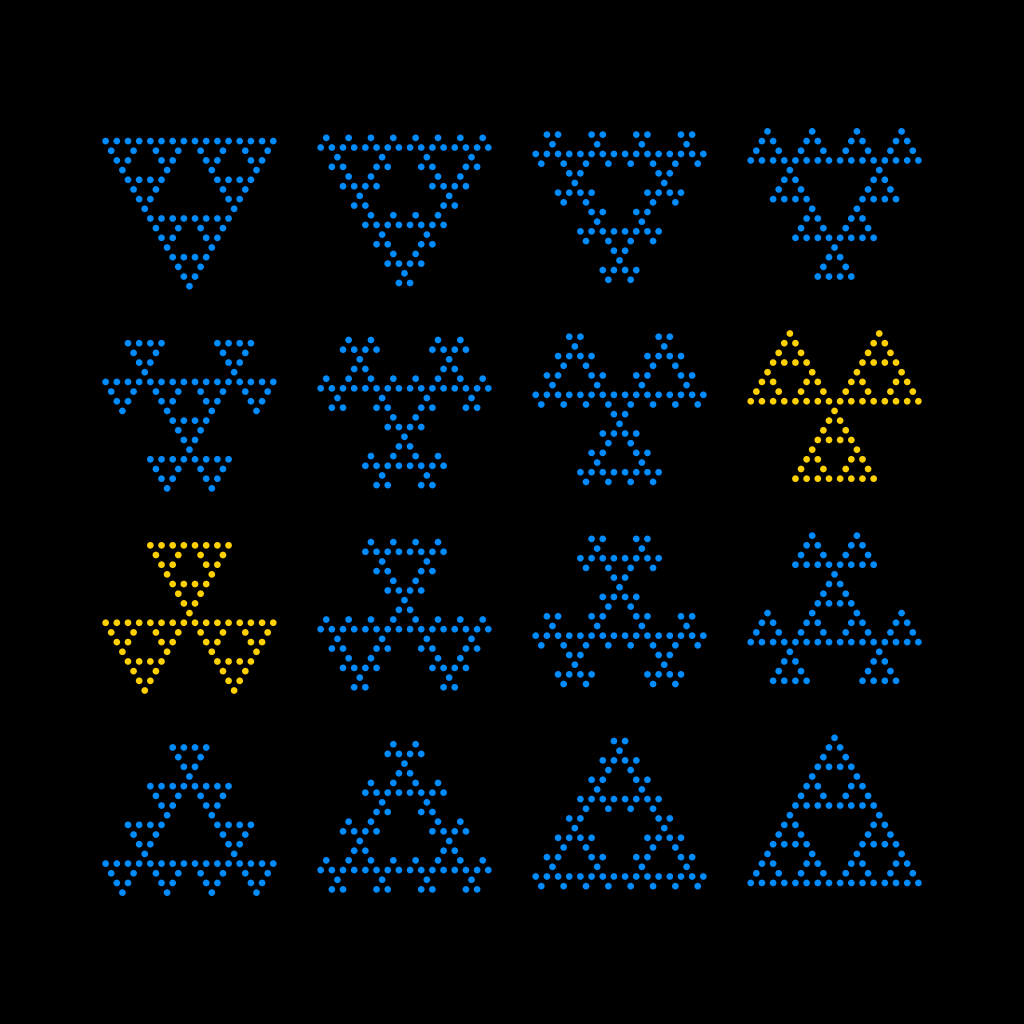
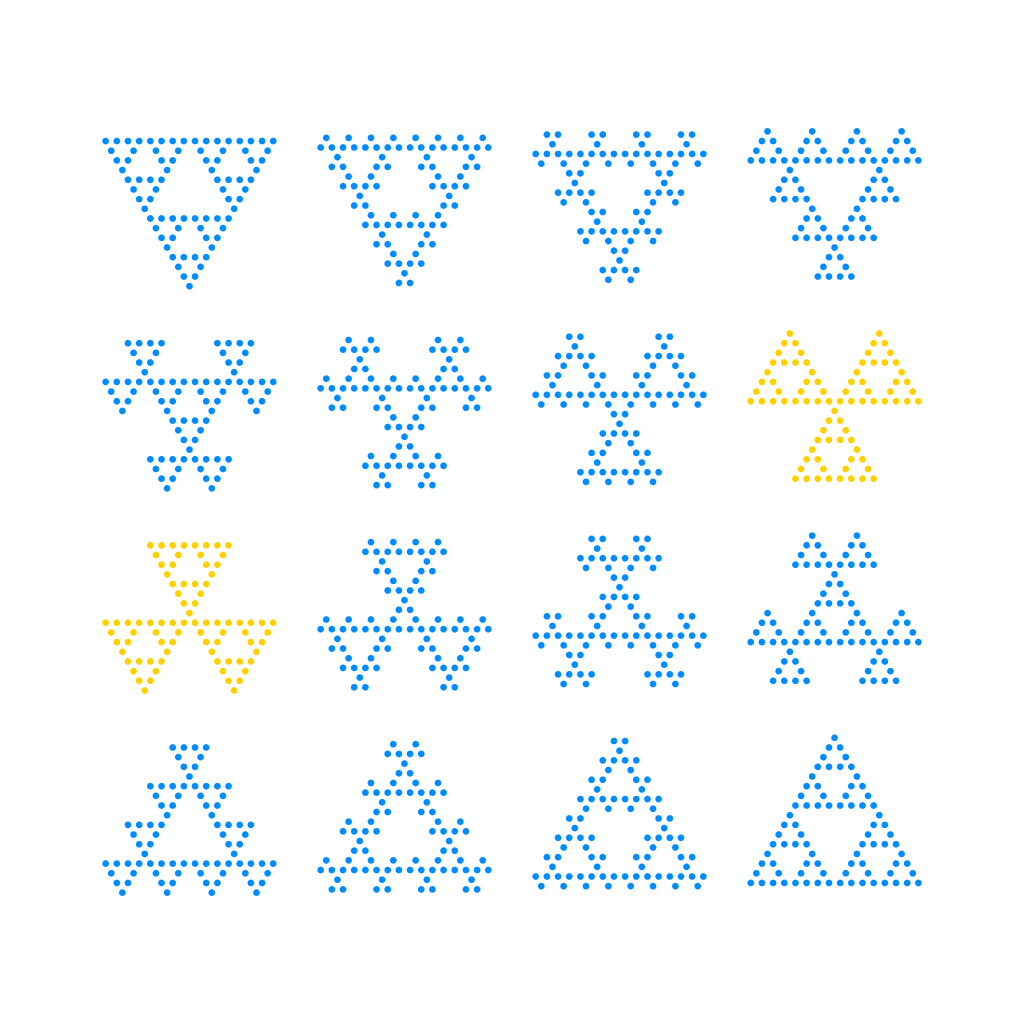
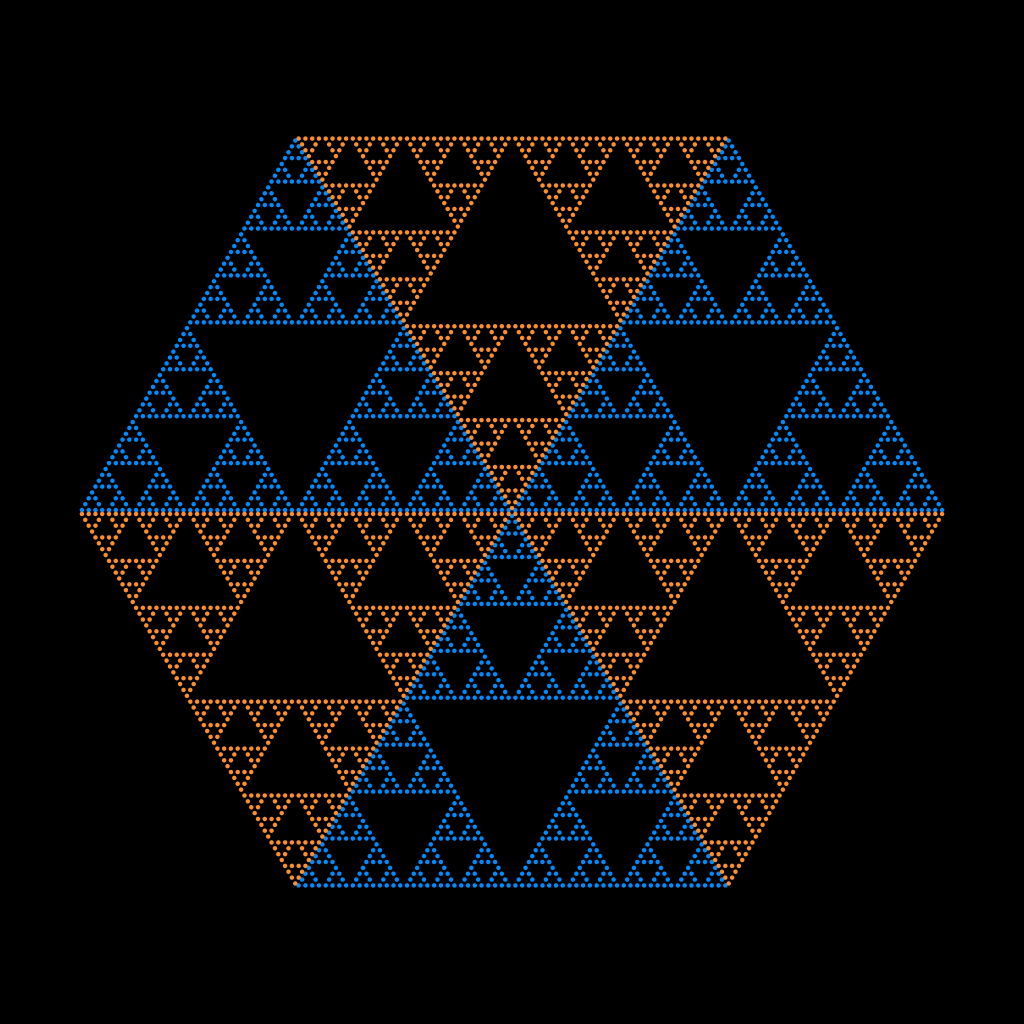
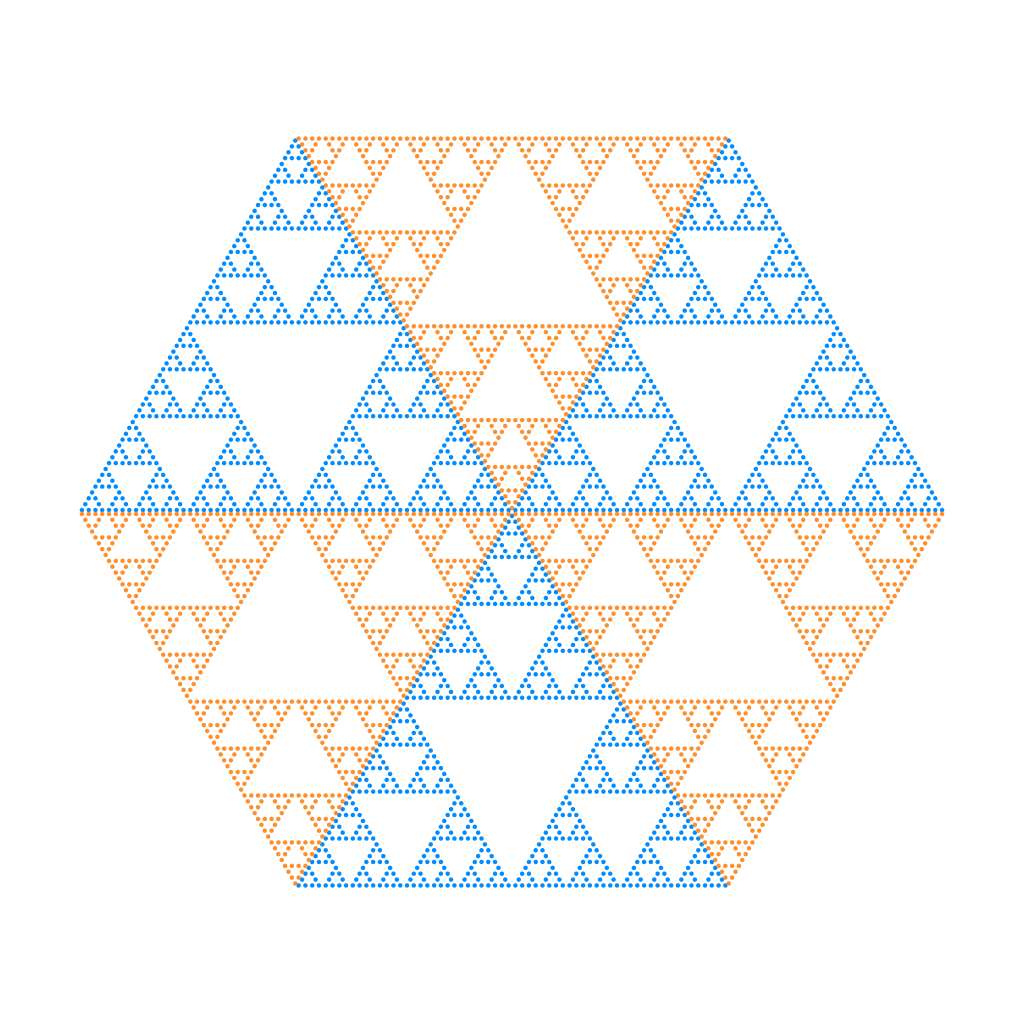
Every plane x + y + z = s through a level-L solid meets exactly 3^L cells, and the height's binary digits make each cut a Sierpinski gasket.
The slices
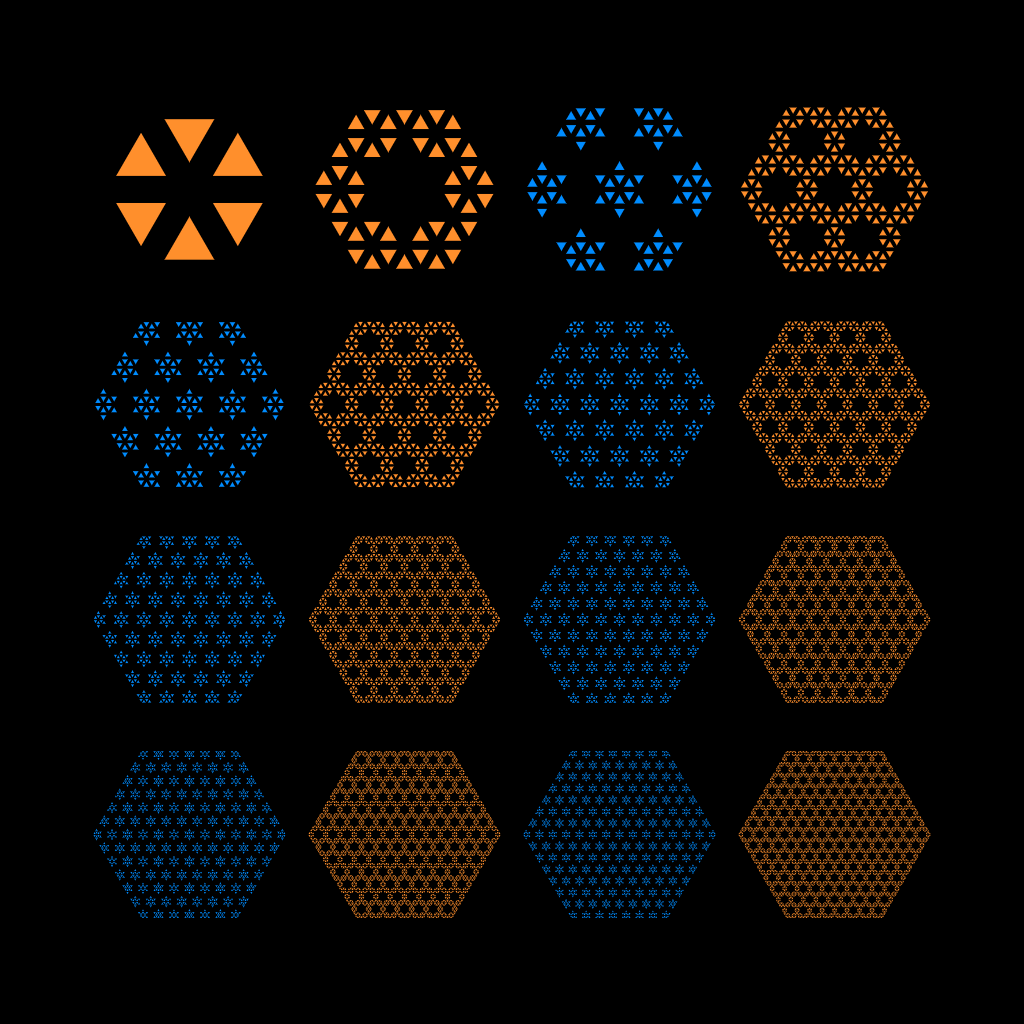
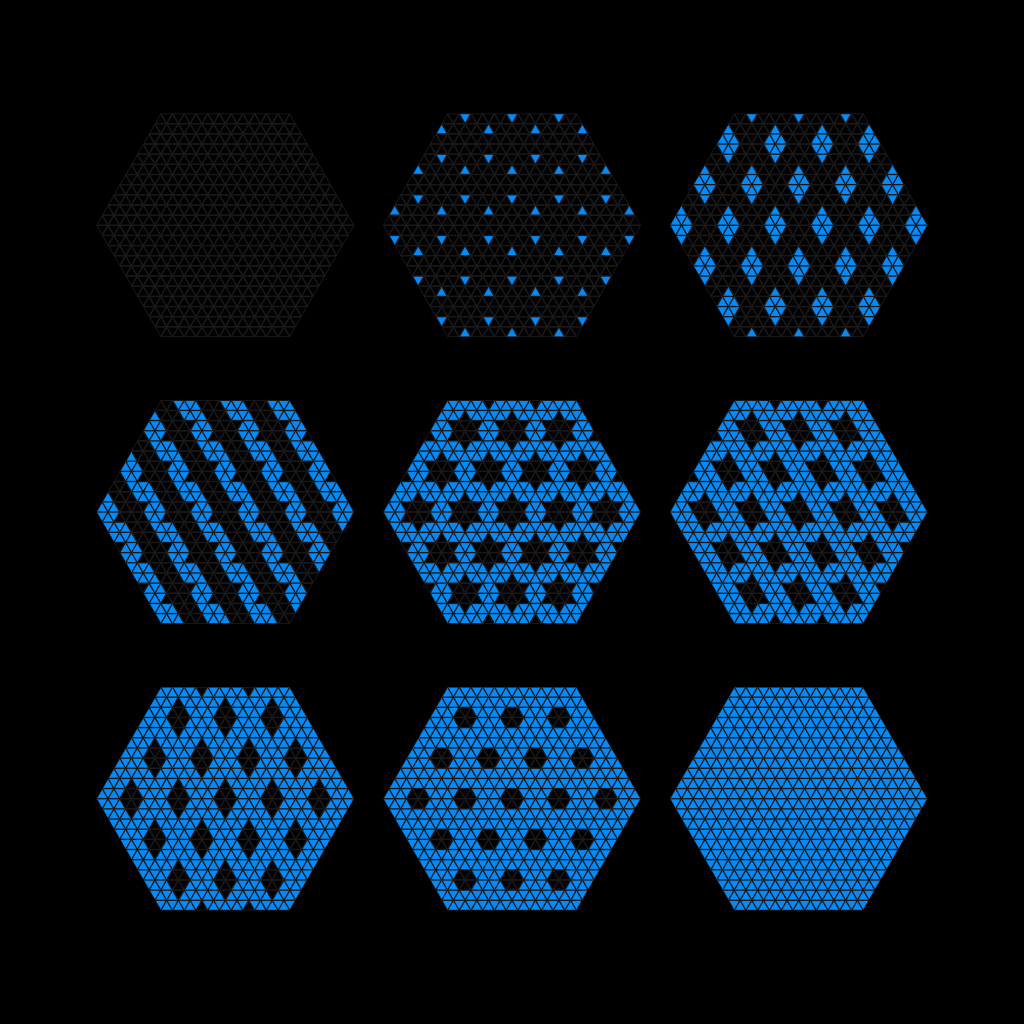
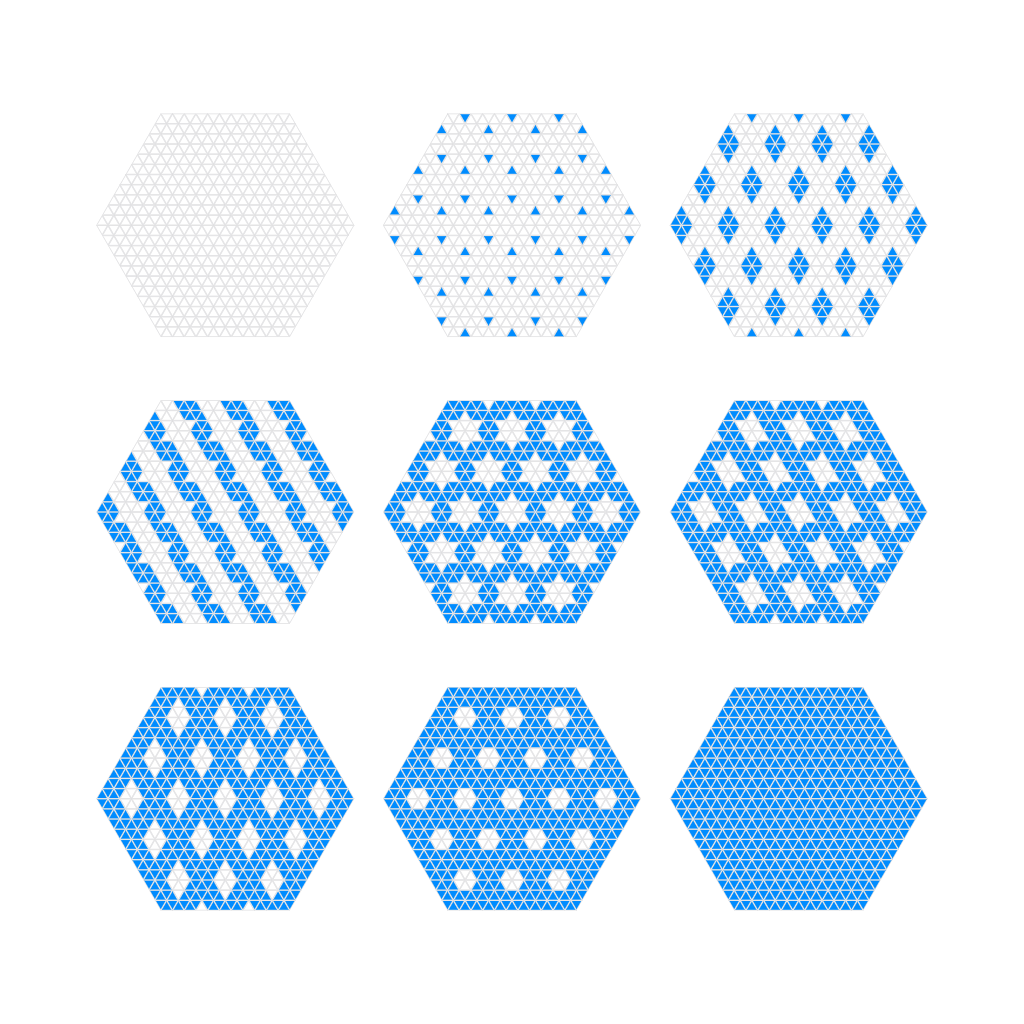
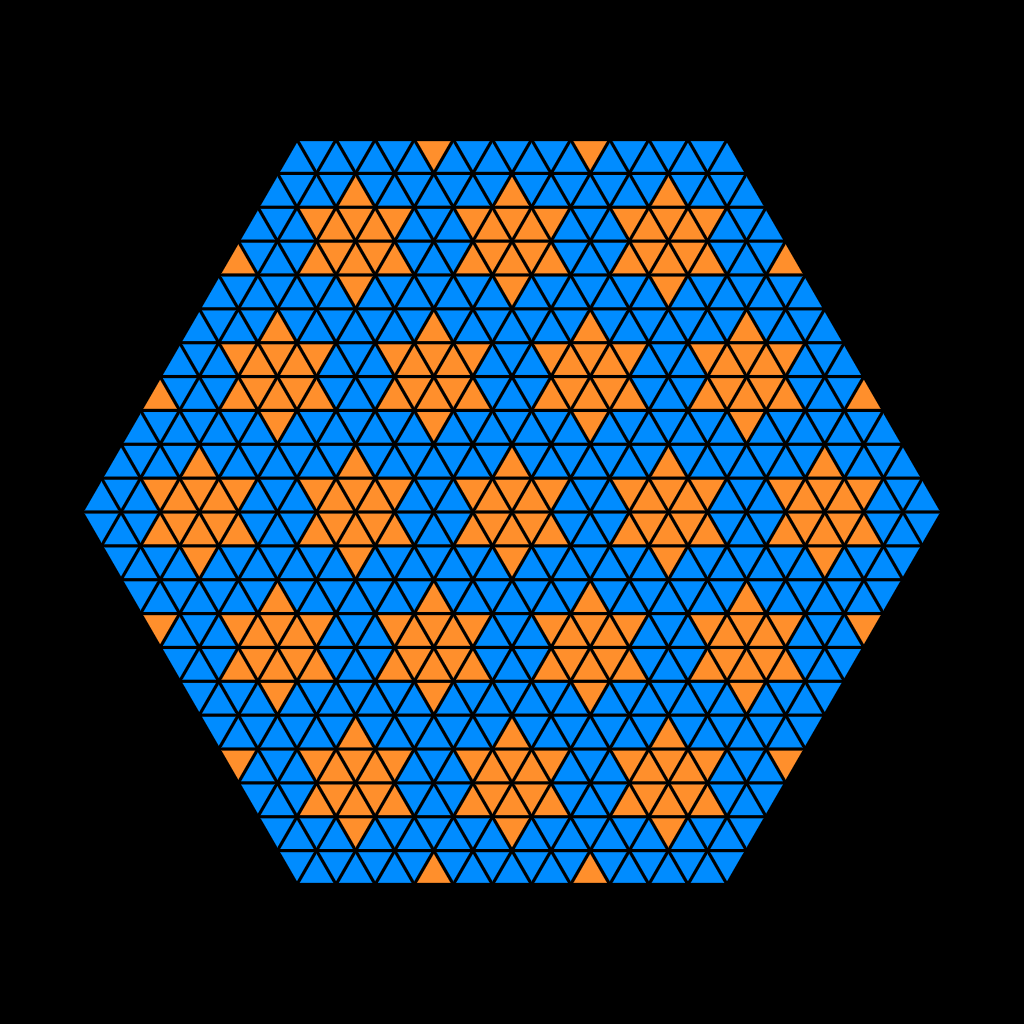
The central diagonal cut of a cube of odd side n = 2k-1 is a regular hexagon of 6n^2 unit triangles, and a design's parity rule fills them into many pieces or one pierced piece as k alternates.
The spectrometer
The inked share of the diagonal slice is an exact closed form in a design's Walsh spectrum, so the hexagon's two-step blink over the odd sides reads the eight-corner recipe back.
The volume
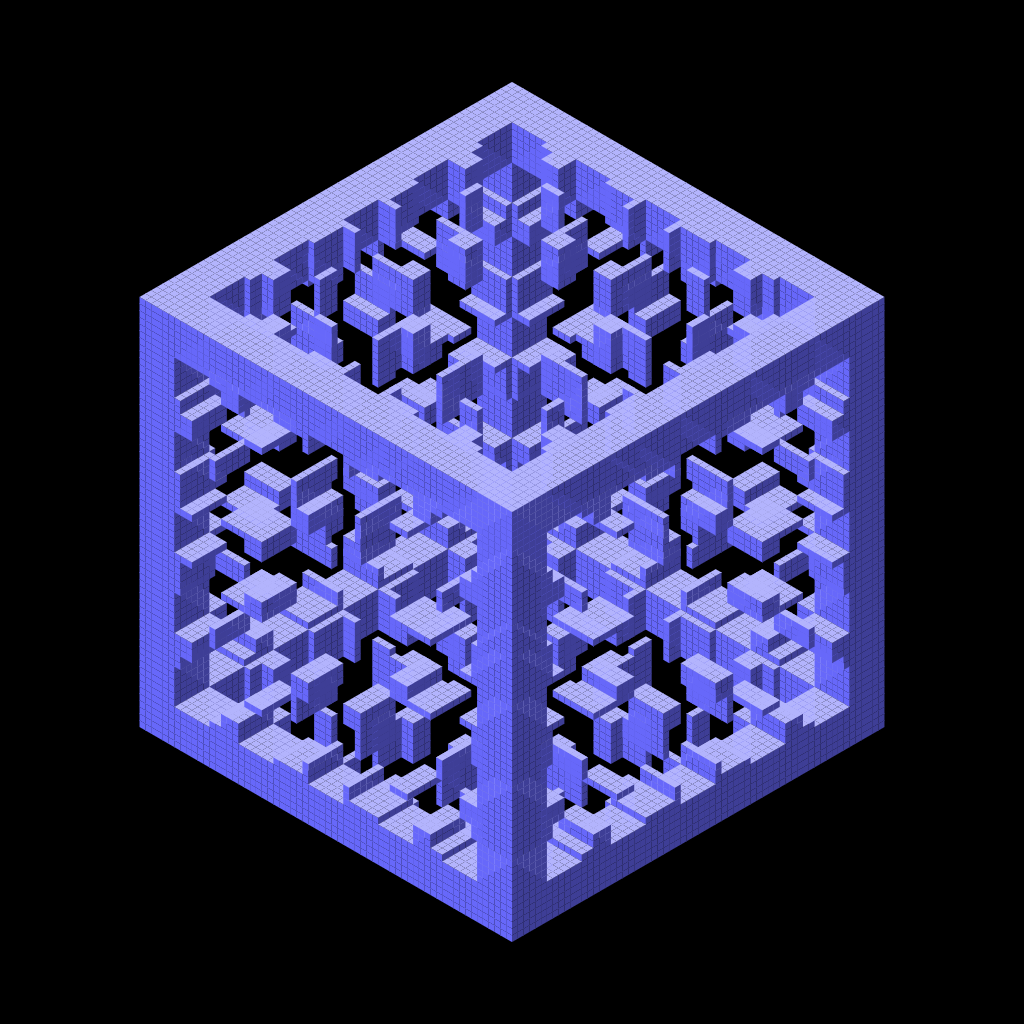
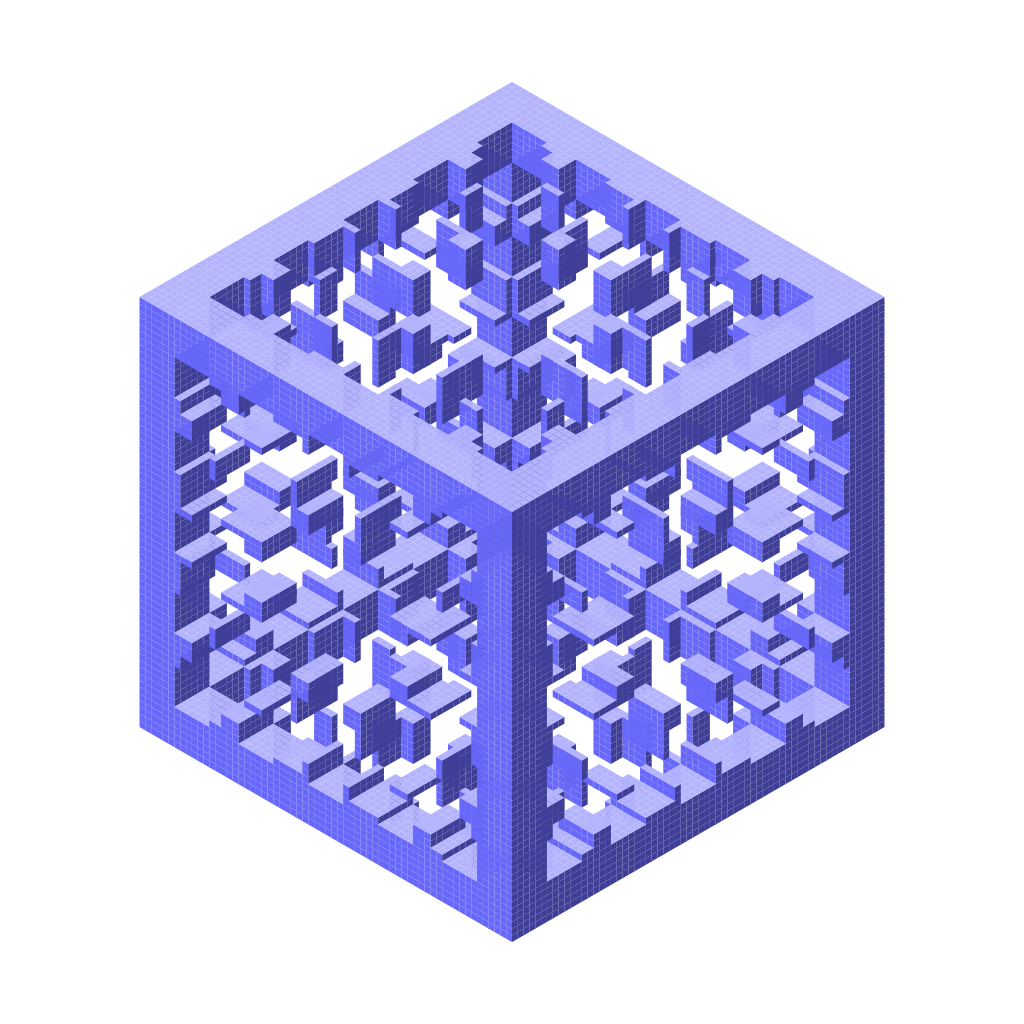
The moire stack of a cube design as a solid field, shelled at a level set and cut on any plane, where the central diagonal cut is the hexagon.
The tower
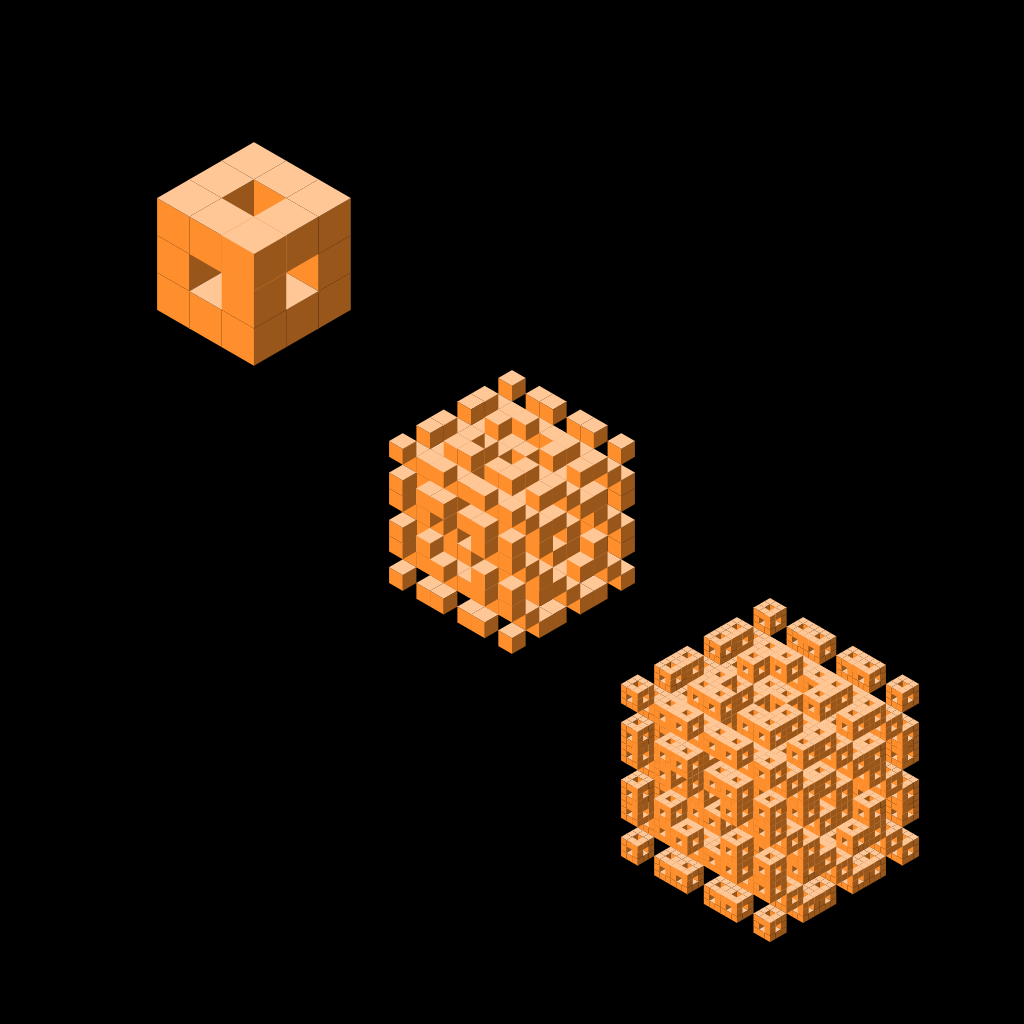
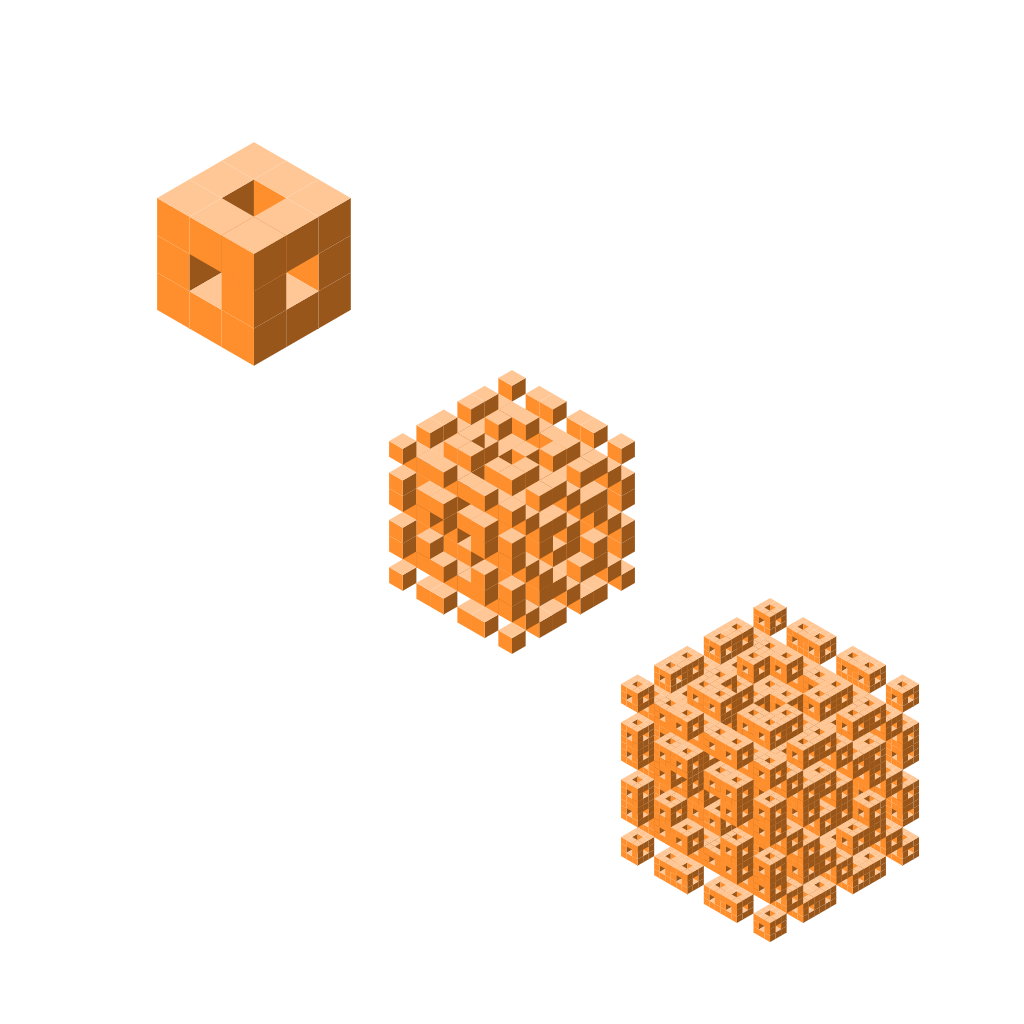
The tile held to one axis with the word rising a letter per block, where a block's fill fraction falls geometrically and its exposed count climbs, so the volume converges while the surface diverges.
The carry
The diagonal cut of a base-q sponge remembers only a carry, so ceil(D/2) past terms decide every count and the growth exponent misses the generic value, above it at odd dimensions and below it at even ones.
Moire
One design sampled at scale 1, 3, 5 and on, the layers stacked into a field where the interference is the finer grids landing on the coarse.
The tourbillon
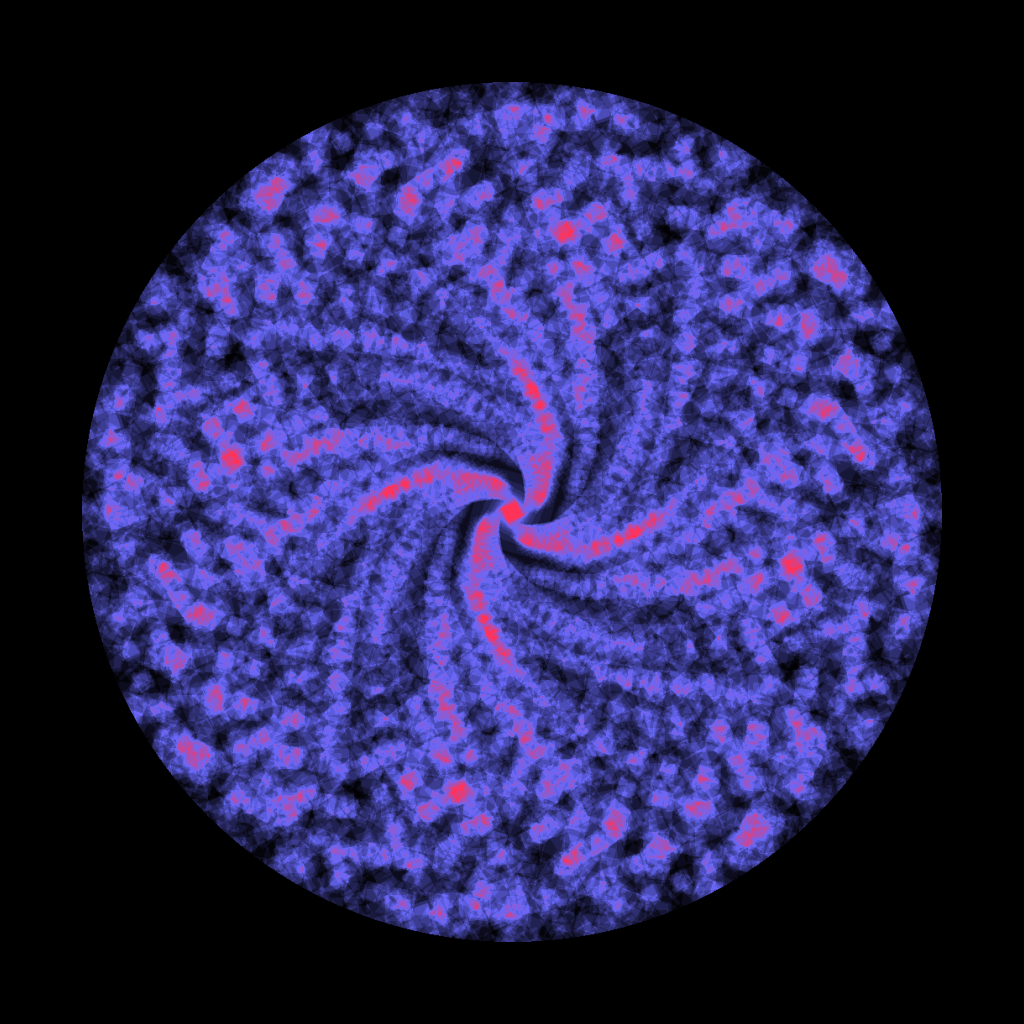
Turn every layer of the carpet stack by its own angle and the shared grid breaks, yet the centre is the one point every rotation fixes, so its value is the same fourteen layers of twenty-eight at every schedule.
The spirograph
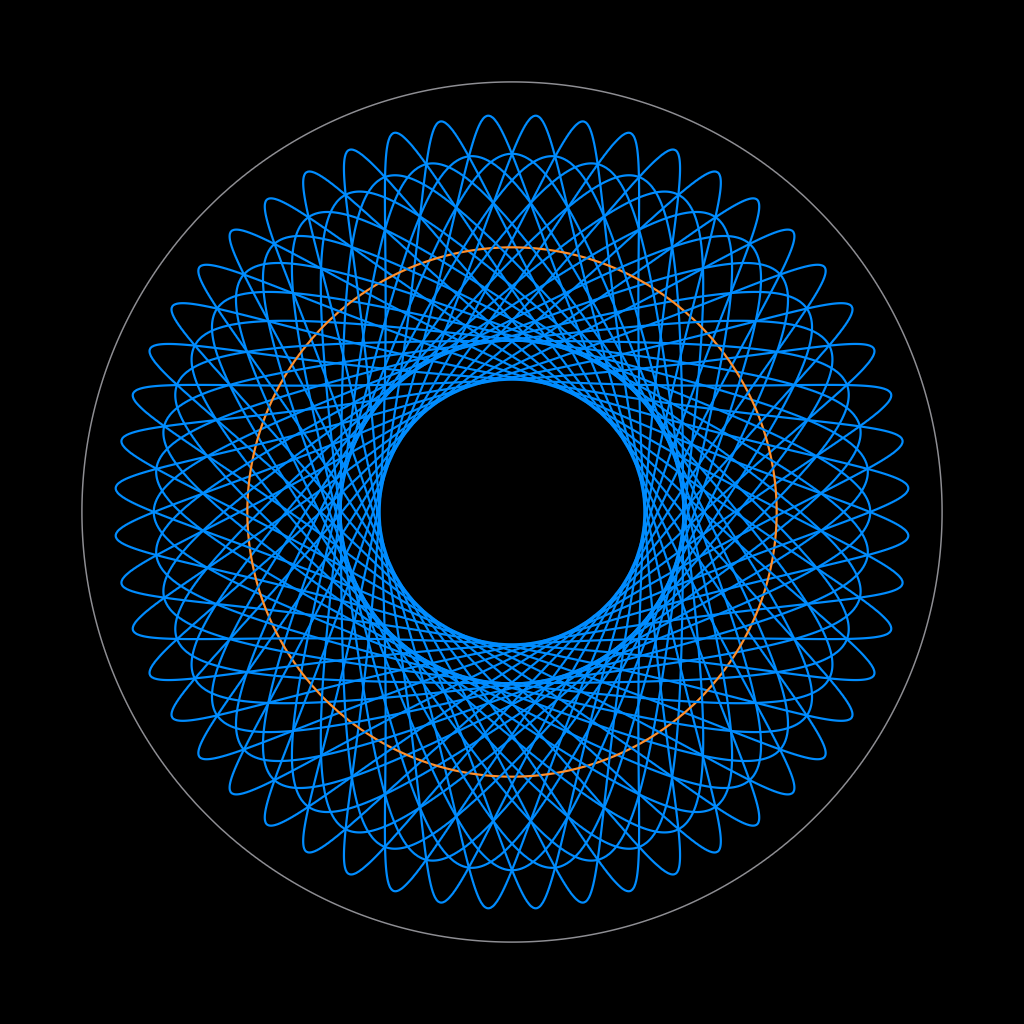
A design is the wheel and its cells are the holes, a pencil in every one, rolled without slipping on a line, a circle or a polygon: every pencil draws a trochoid, and on a circle two pencils draw one curve exactly when a rotation of a full turn over the wheel's reduced radius carries one seat onto the other.
The radial stack
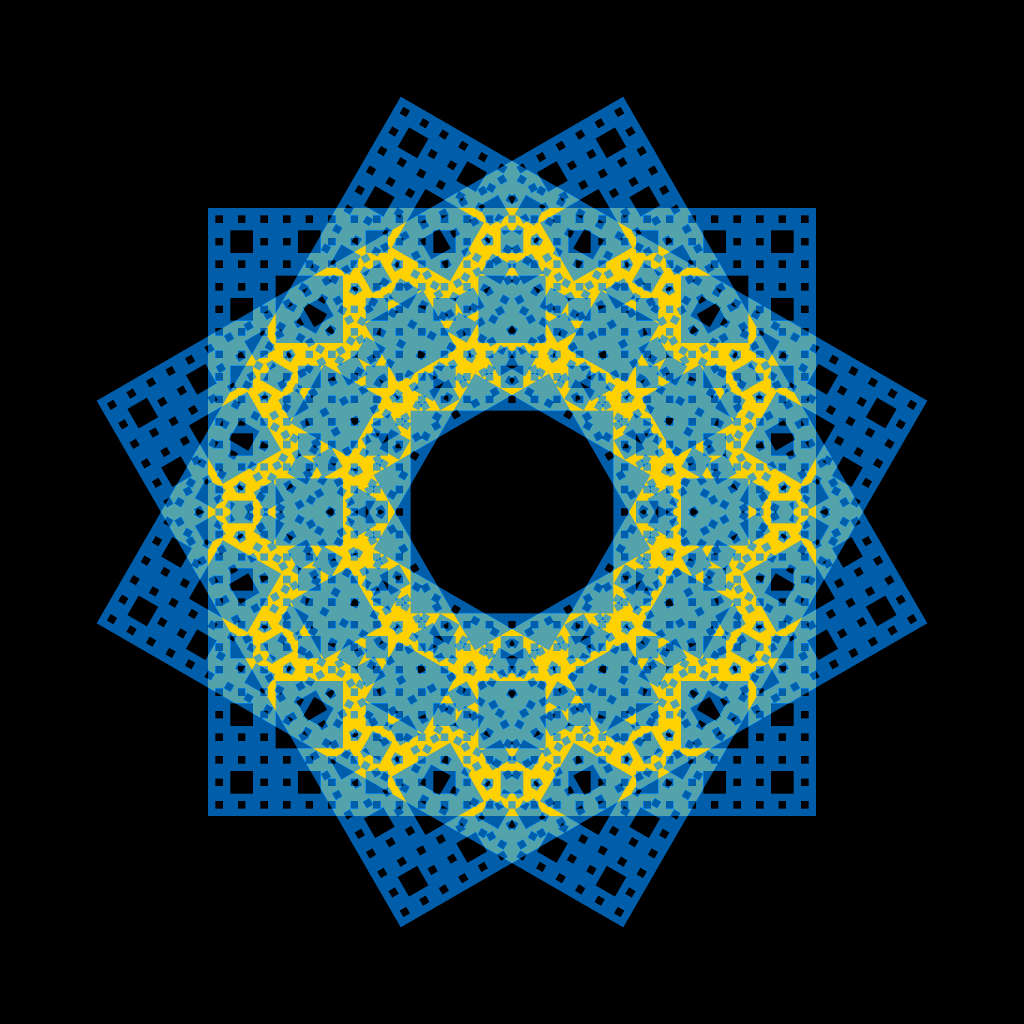
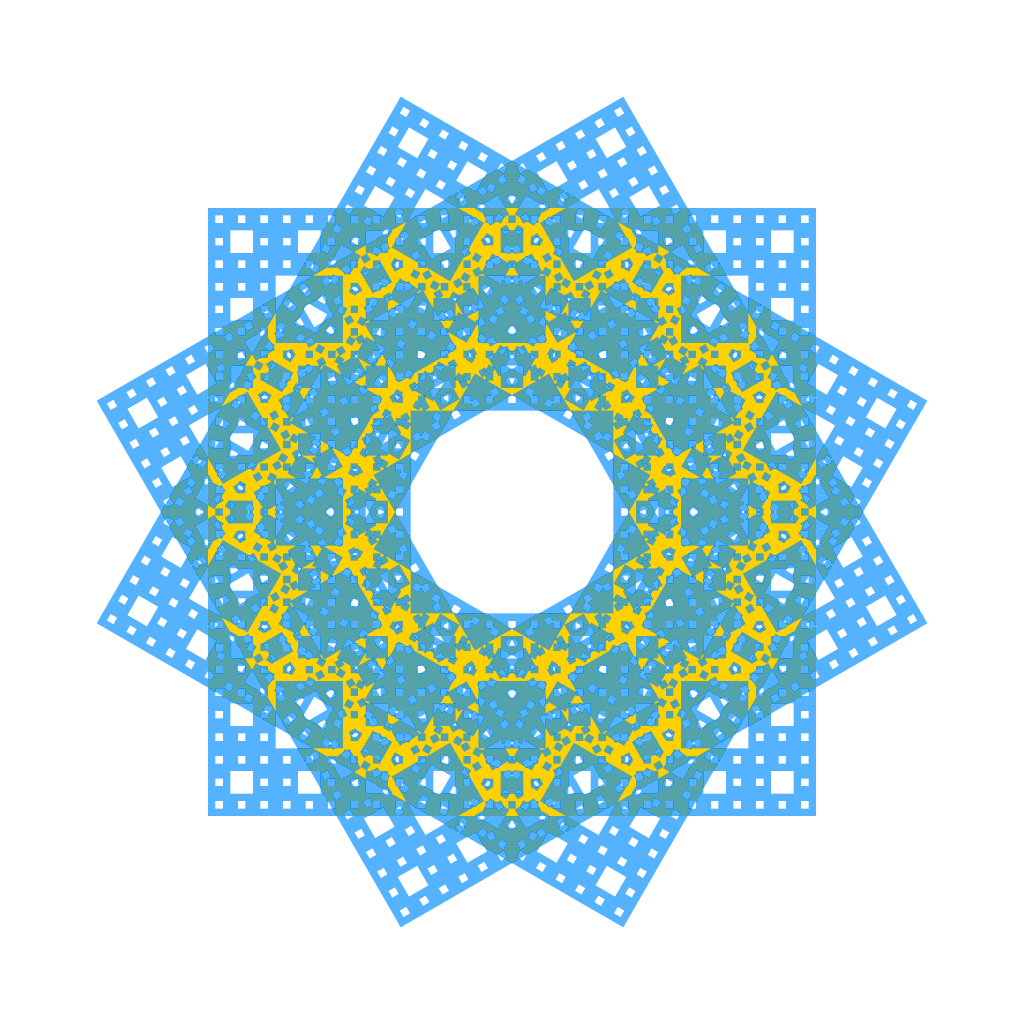
Turned copies of a design laid on each other keep only the circular harmonics whose order is a multiple of the copy count, and a design of rotation order g shows lcm(q, g) petals.

The spin
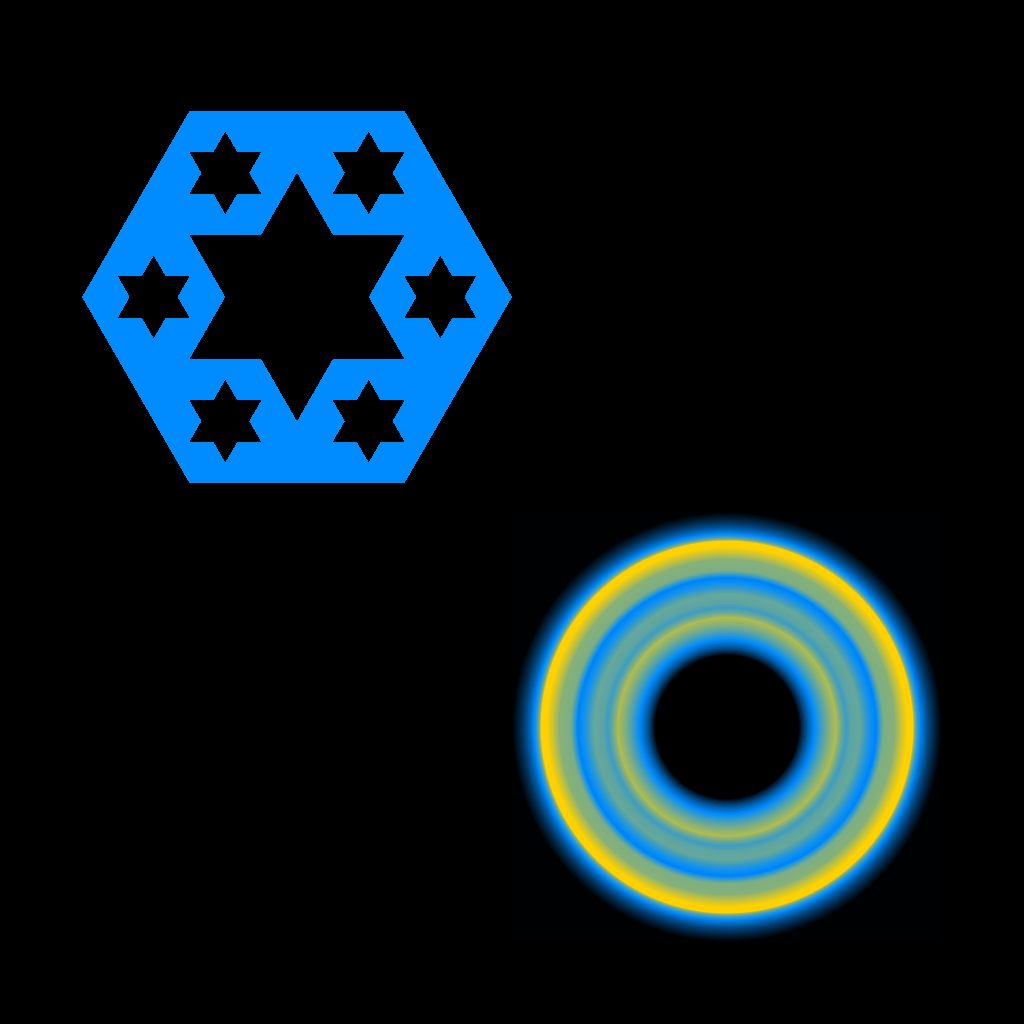
A design on a turntable strobed against the frame rate, beside the exact circle mean at every radius, which is the bullseye it becomes at infinite speed.
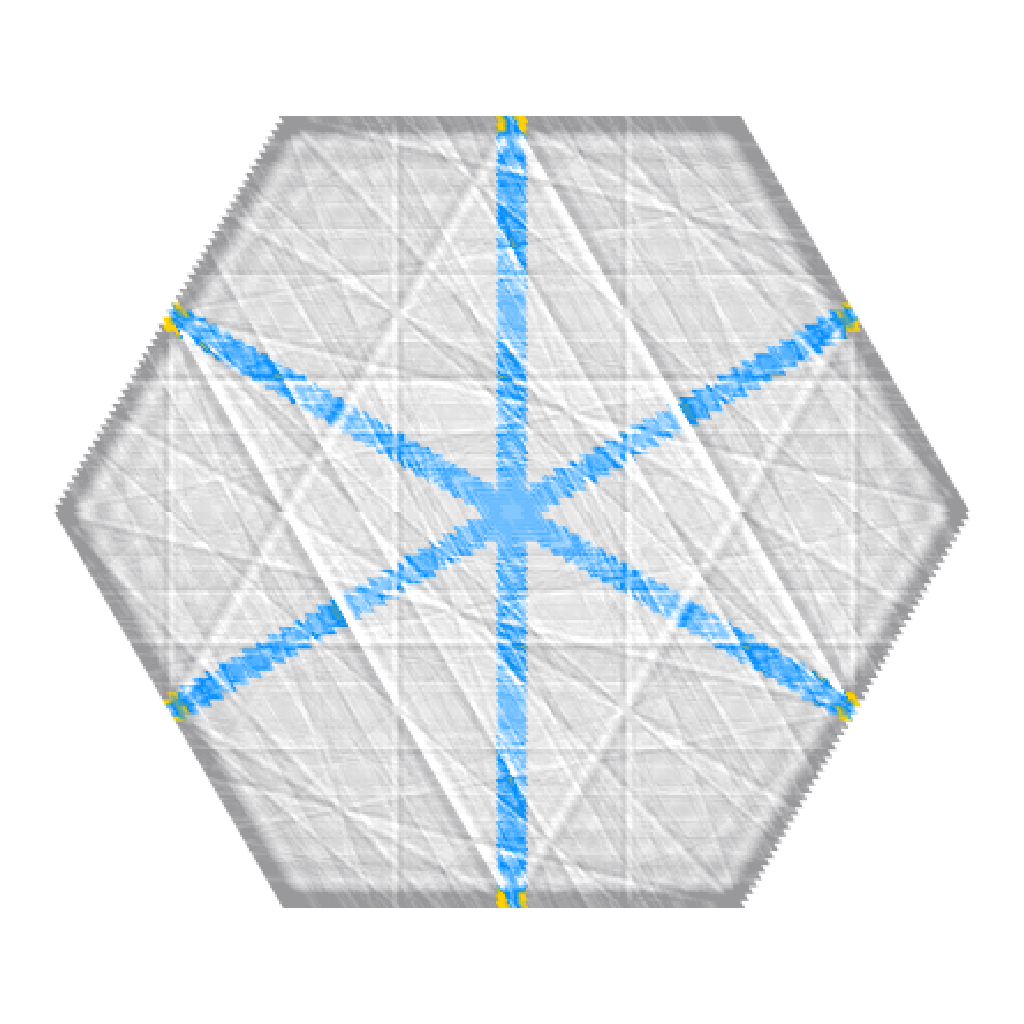
The ghost star
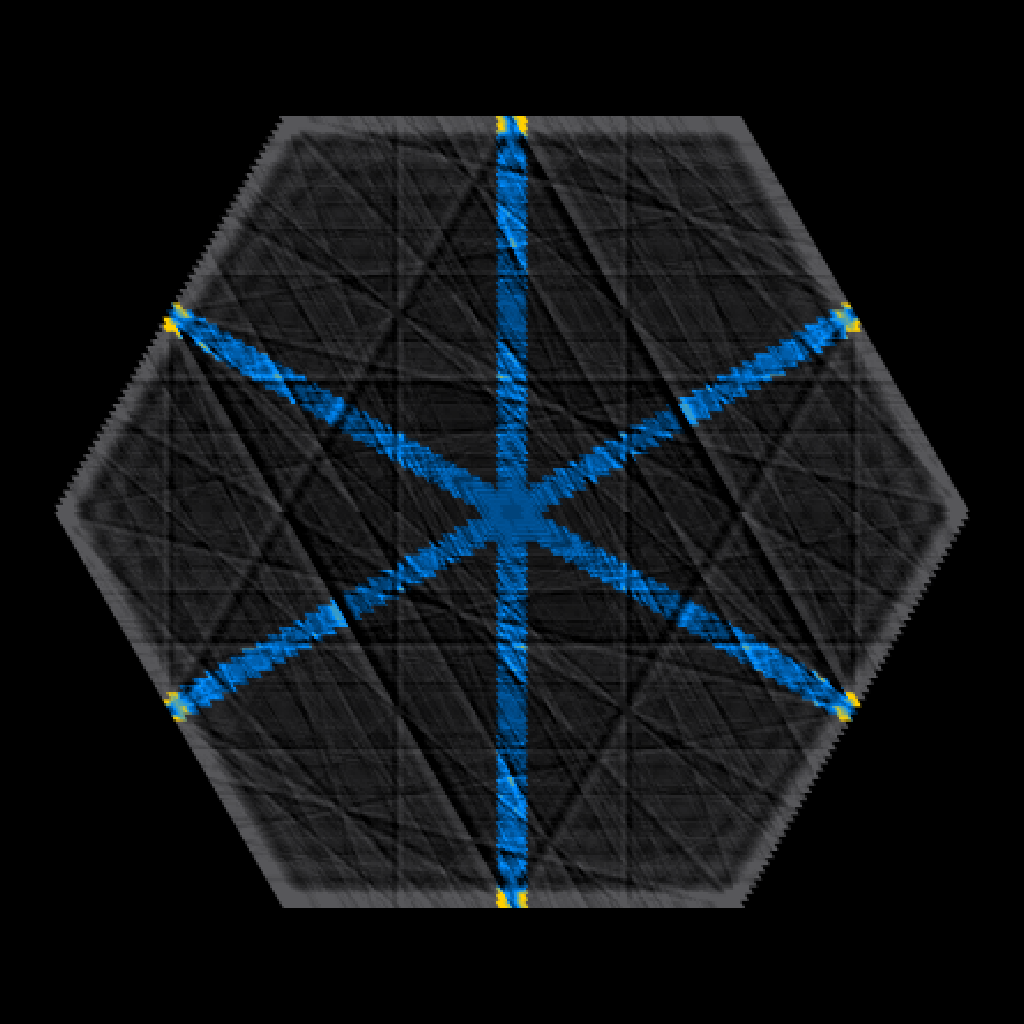
Stacking the hexagonal cuts of a carpet, one per odd side, stands a six-armed star at the centre that is not there in the limit: its arm's ink is exactly 1/2 + chi_8(n)/(2n) and its decay is exactly -1/4 read on the cube's own cells, but a different number in every frame that resamples it or widens it.
Words and order
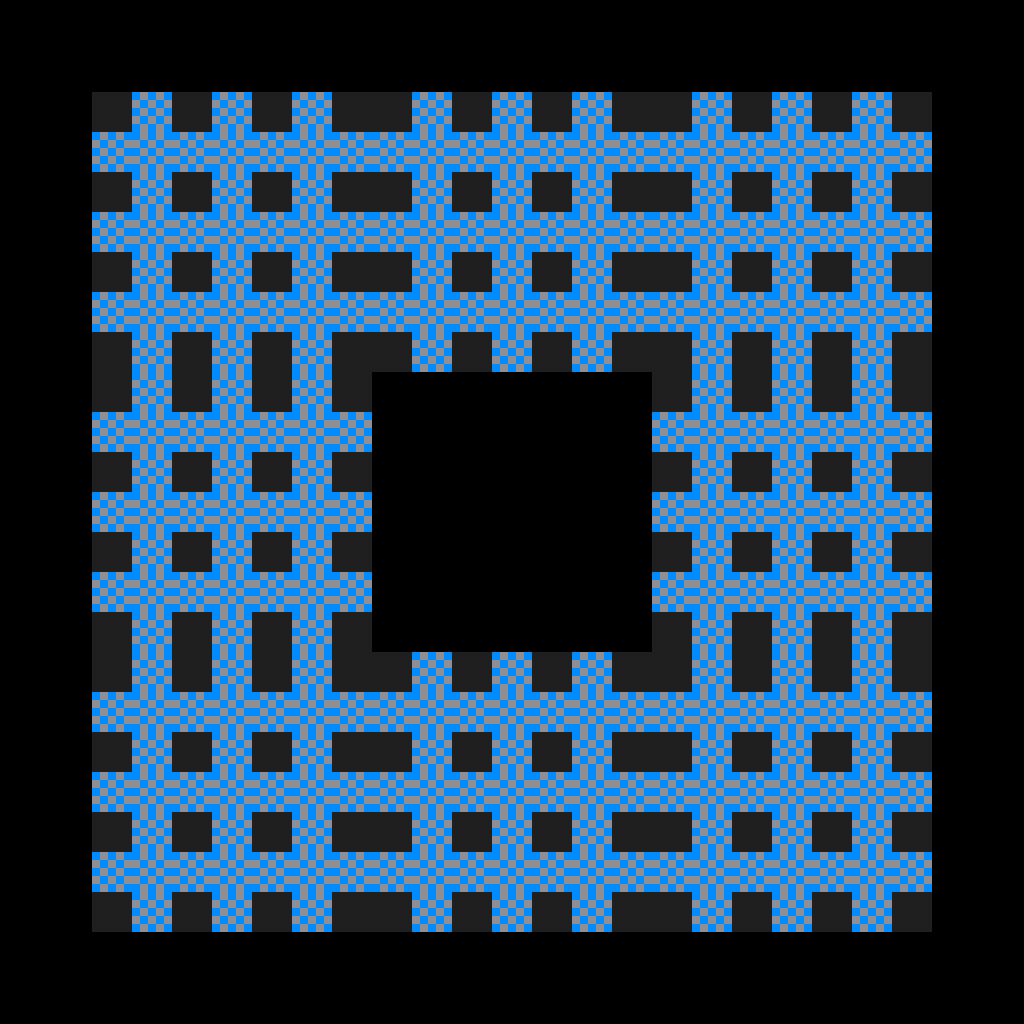
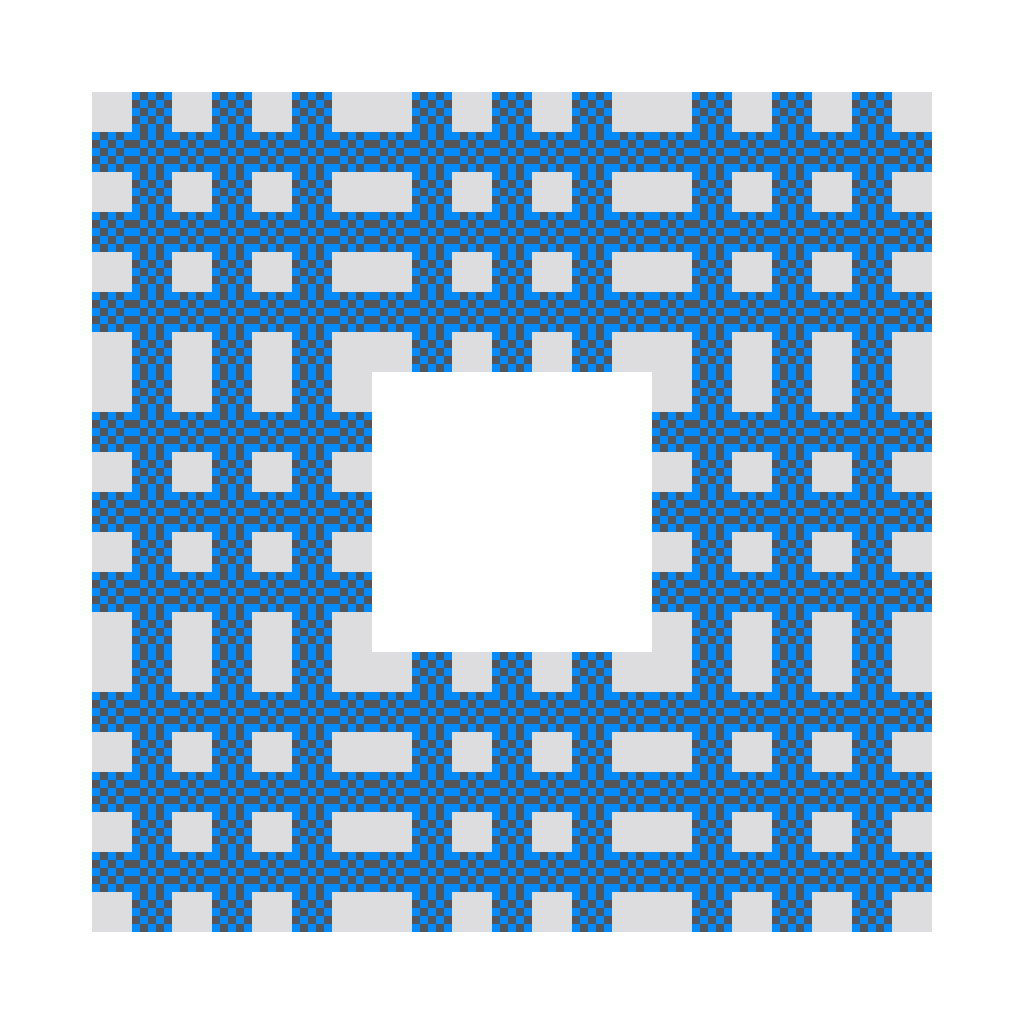
The words
One design per level folded by the Kronecker product, with the census, the component exponent, and what changes when the letters swap places.
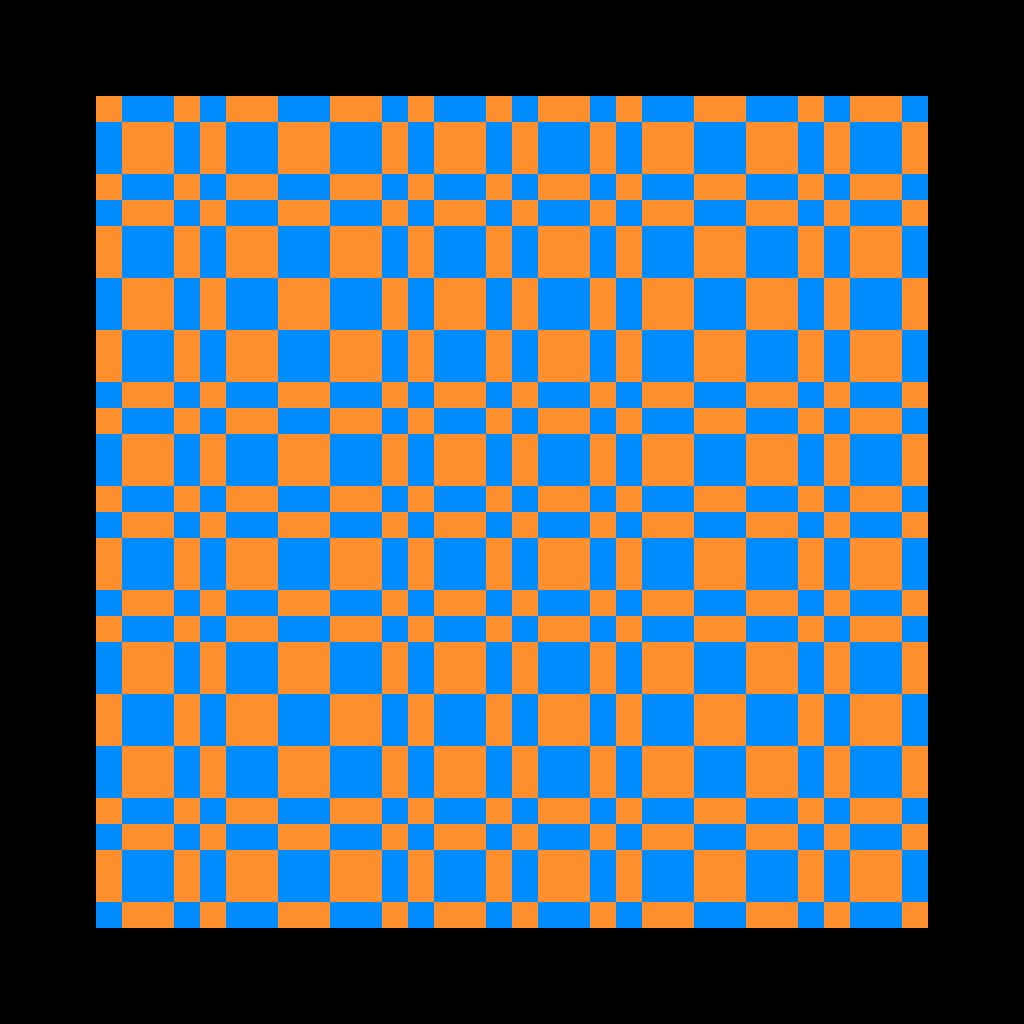
The Thue-Morse word
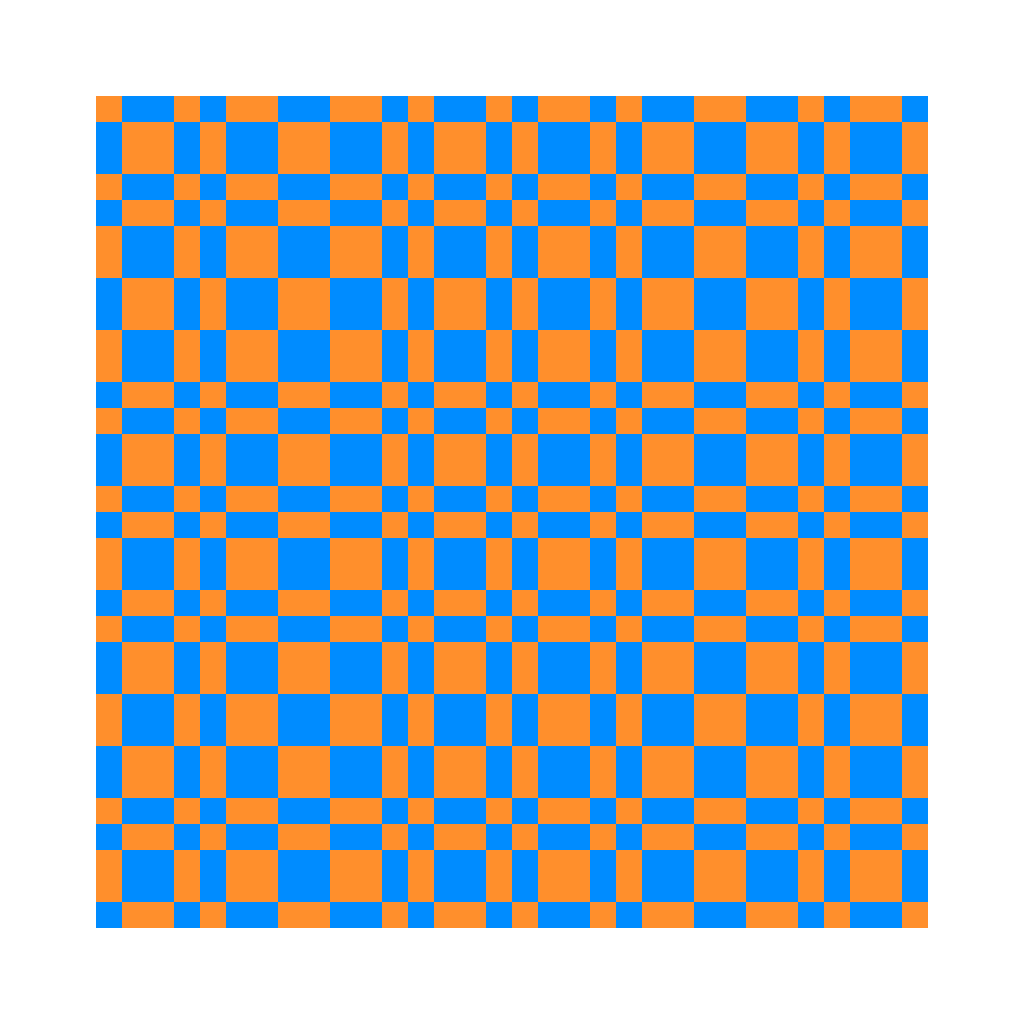
The Thue-Morse word built twice from one digit rule, lifted to four plane grids of which three are Kronecker powers of a plus-minus tile and one is not, with its runs and its boundary word.
Graphs, walks and spectra
The graphs
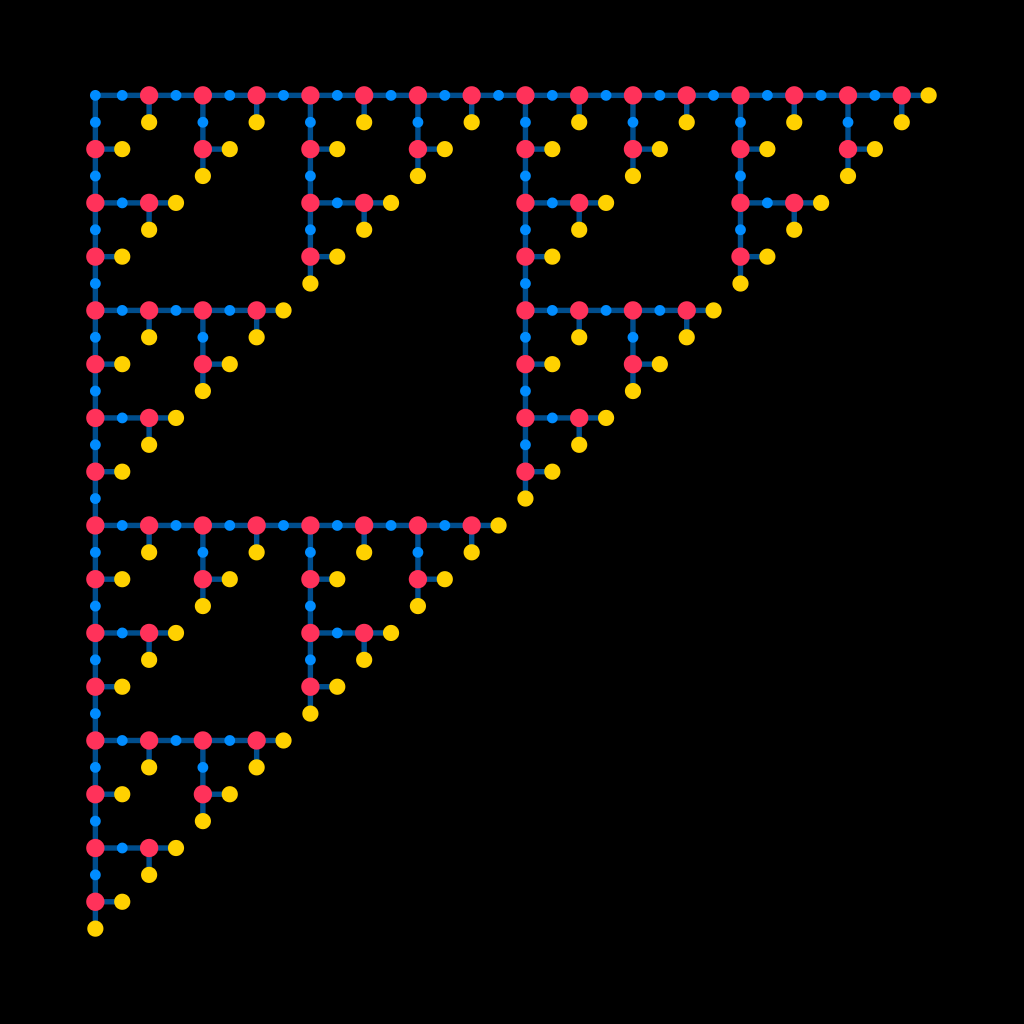
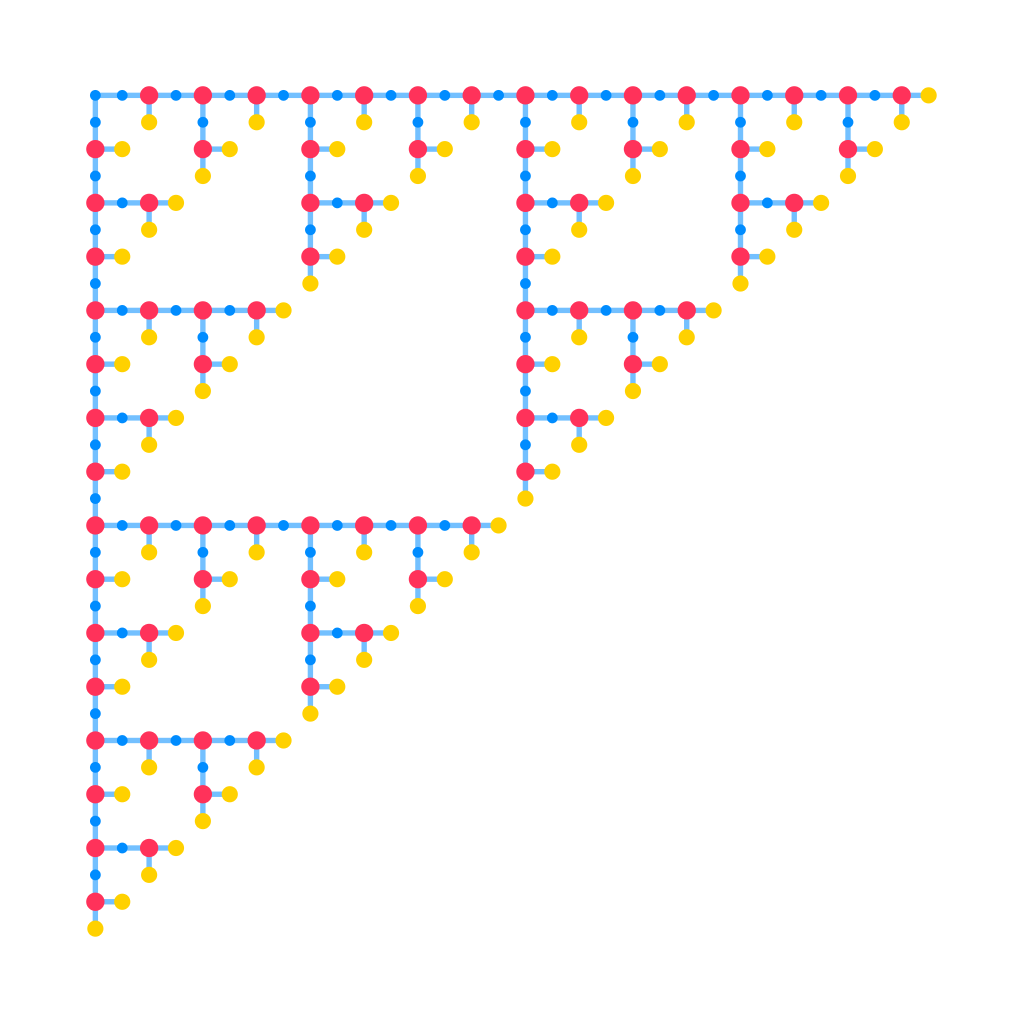
Joining every filled cell to its neighbours turns a design into a network with tips, junctions, pieces, length and a box dimension, flat, in the cube, on the hexagonal slice, or relaxed by force.
The spectra
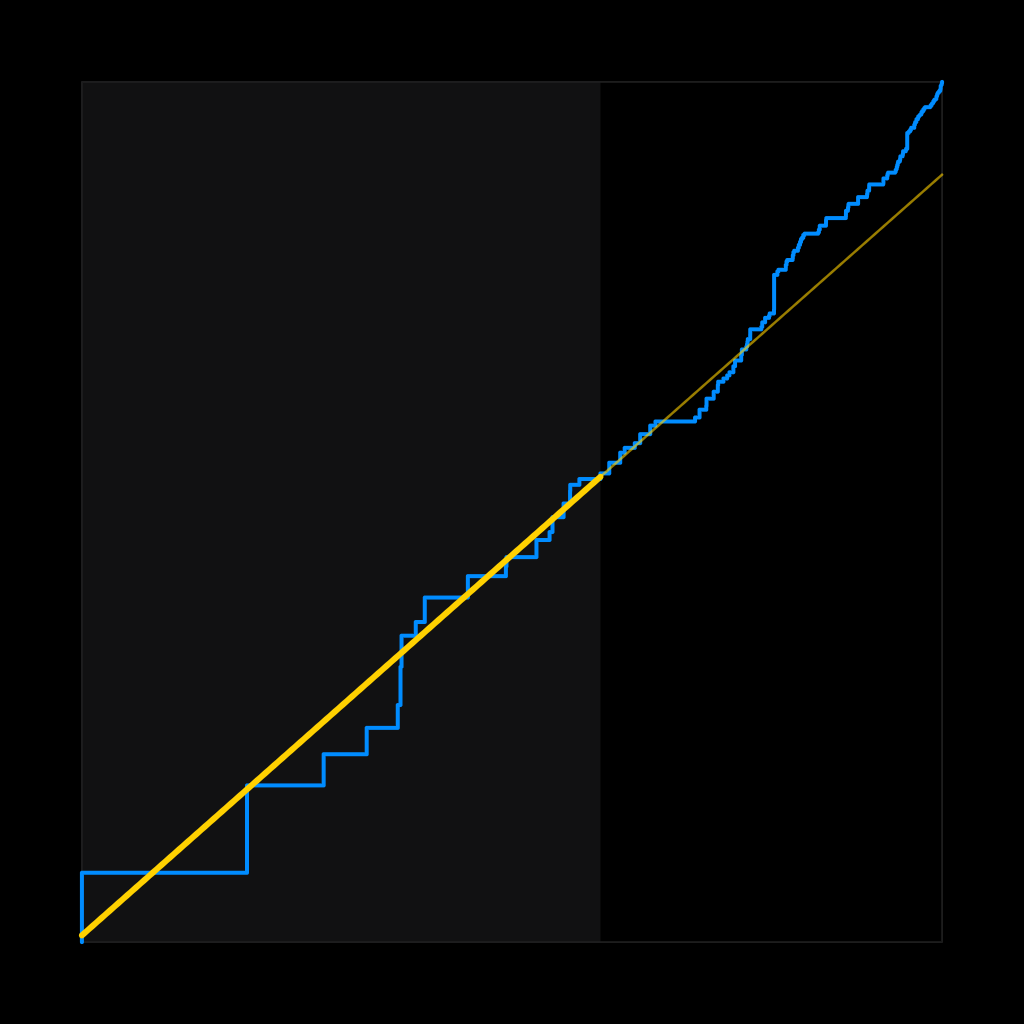
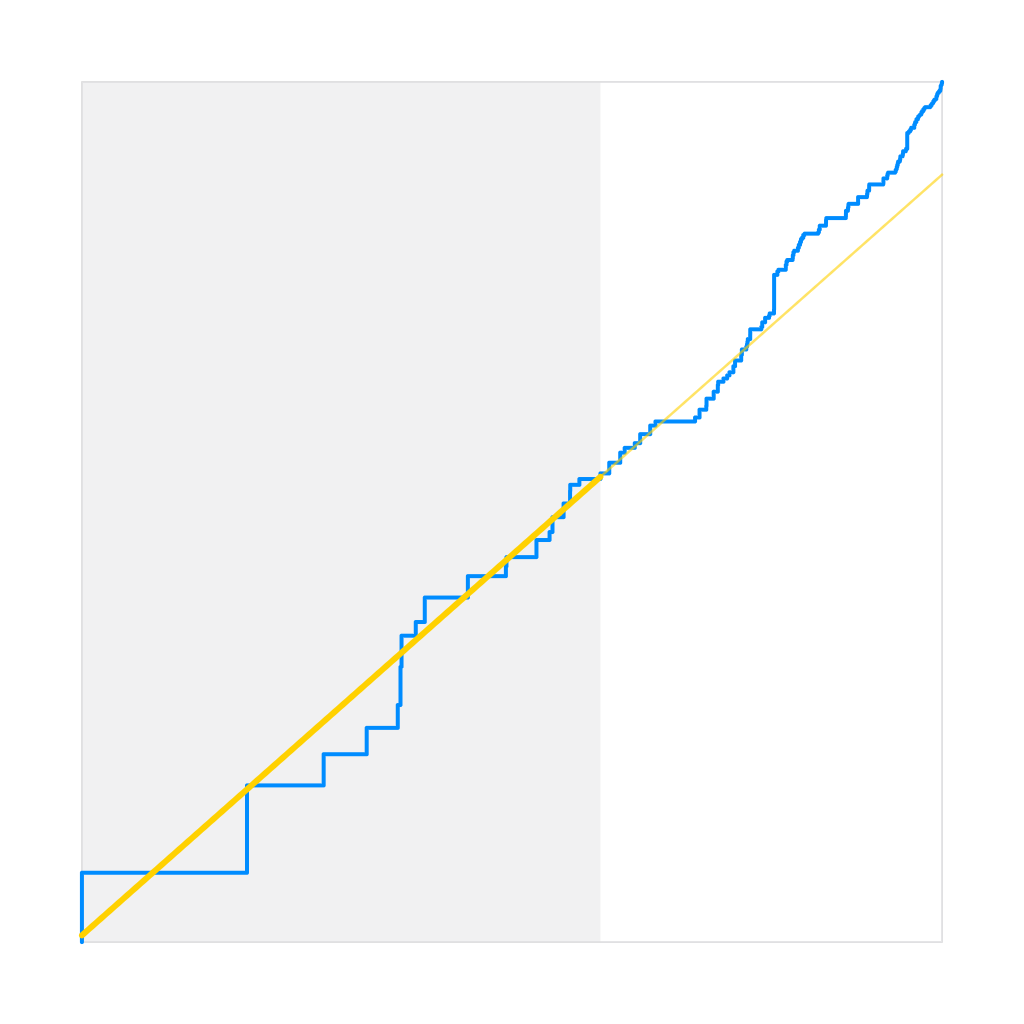
The normalised Laplacian of a design's graph puts a third of the Sierpinski triangle's spectrum on the single eigenvalue 1, and the slope of the low end reads the random-walk spectral dimension.
The race
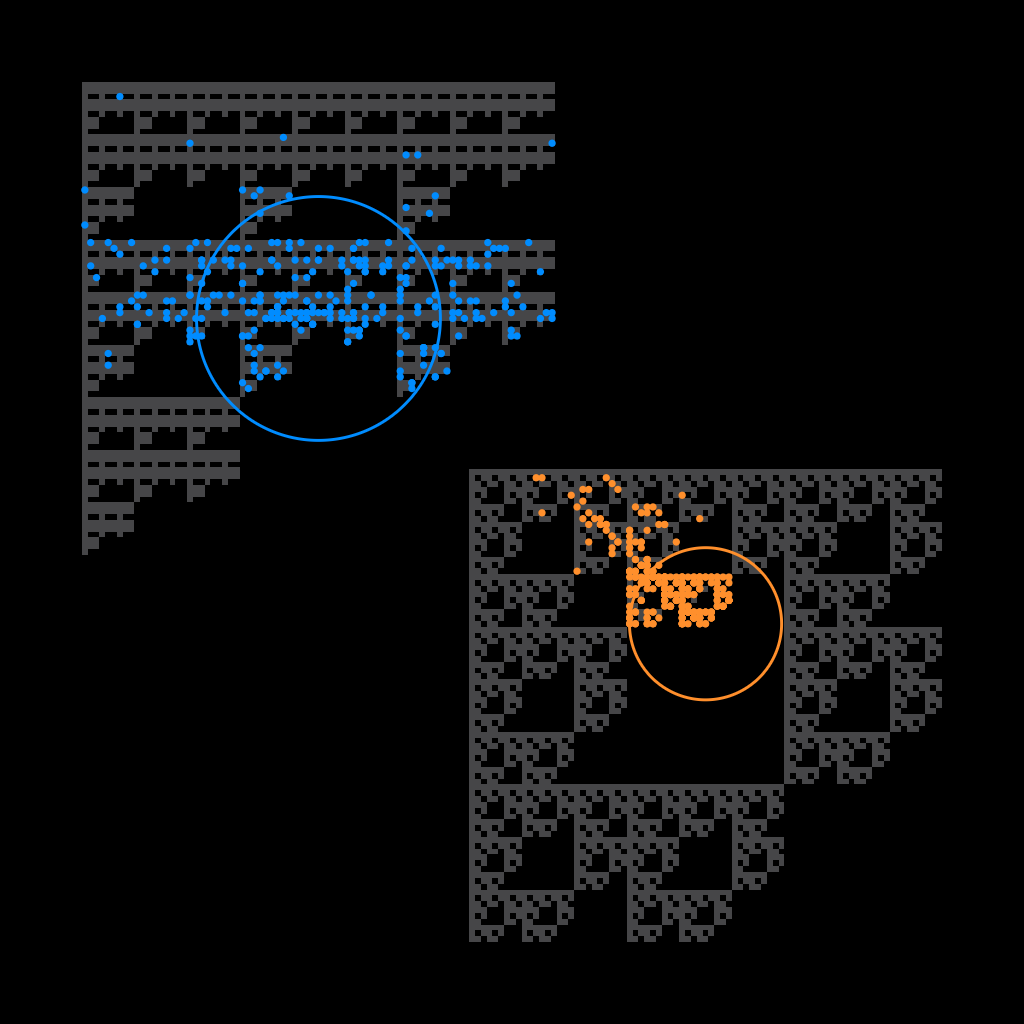
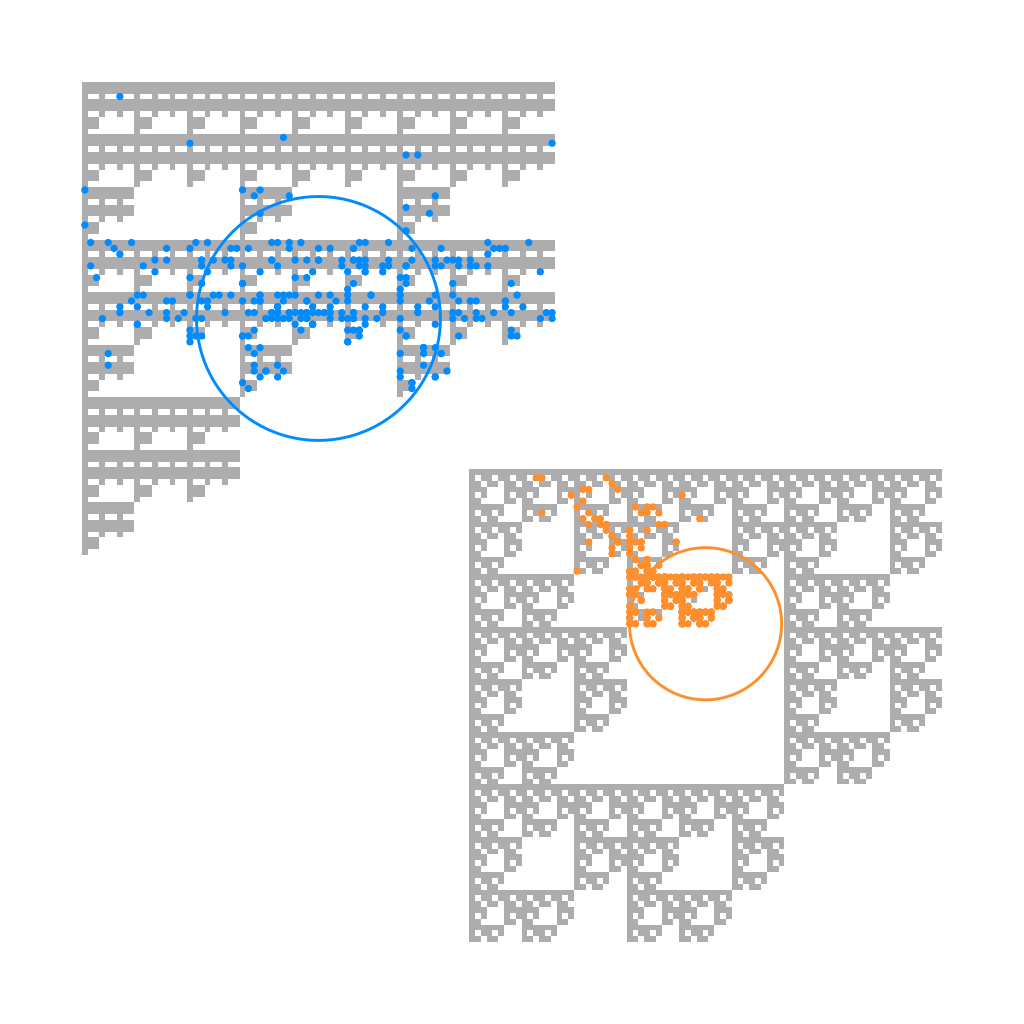
Two base-3 designs of the same mass and the same fractal dimension carry random walkers from home at different speeds, so the shape sets the walk, not the density.
The modes
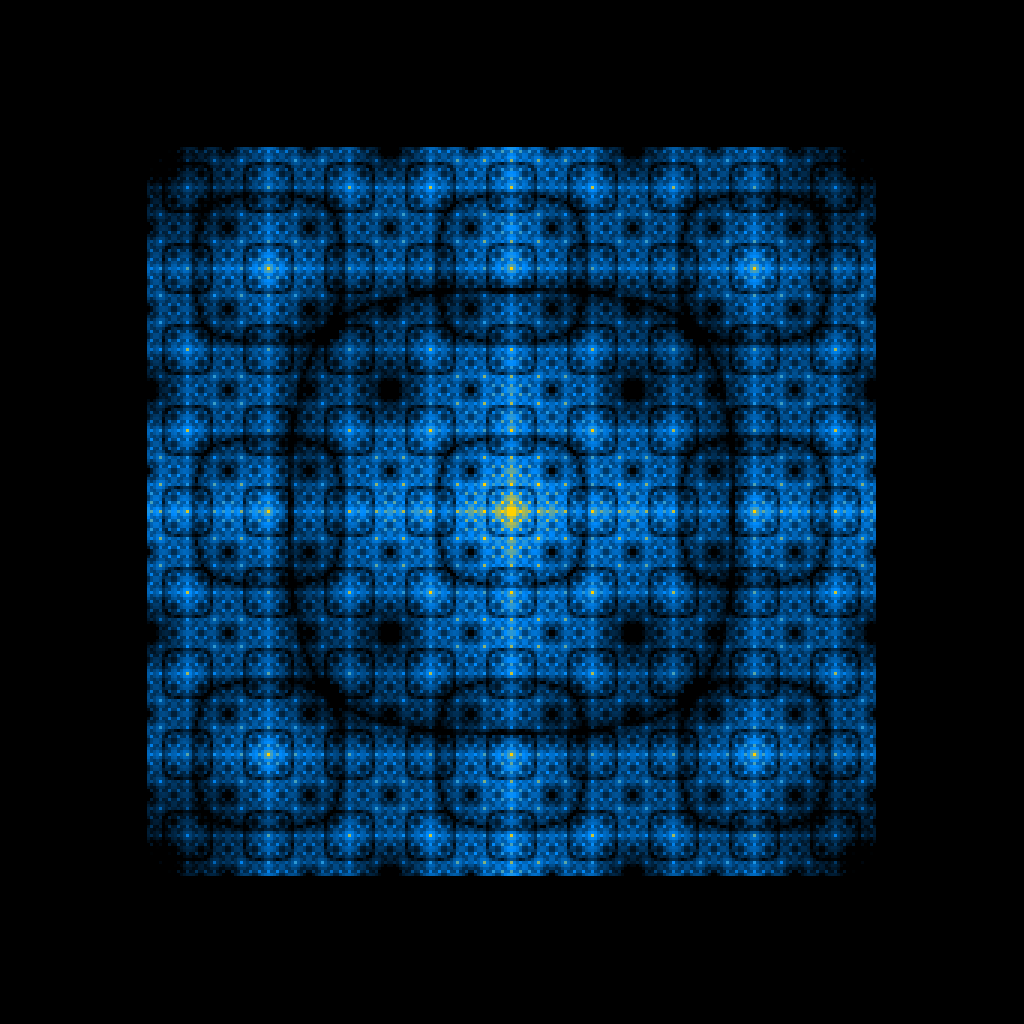
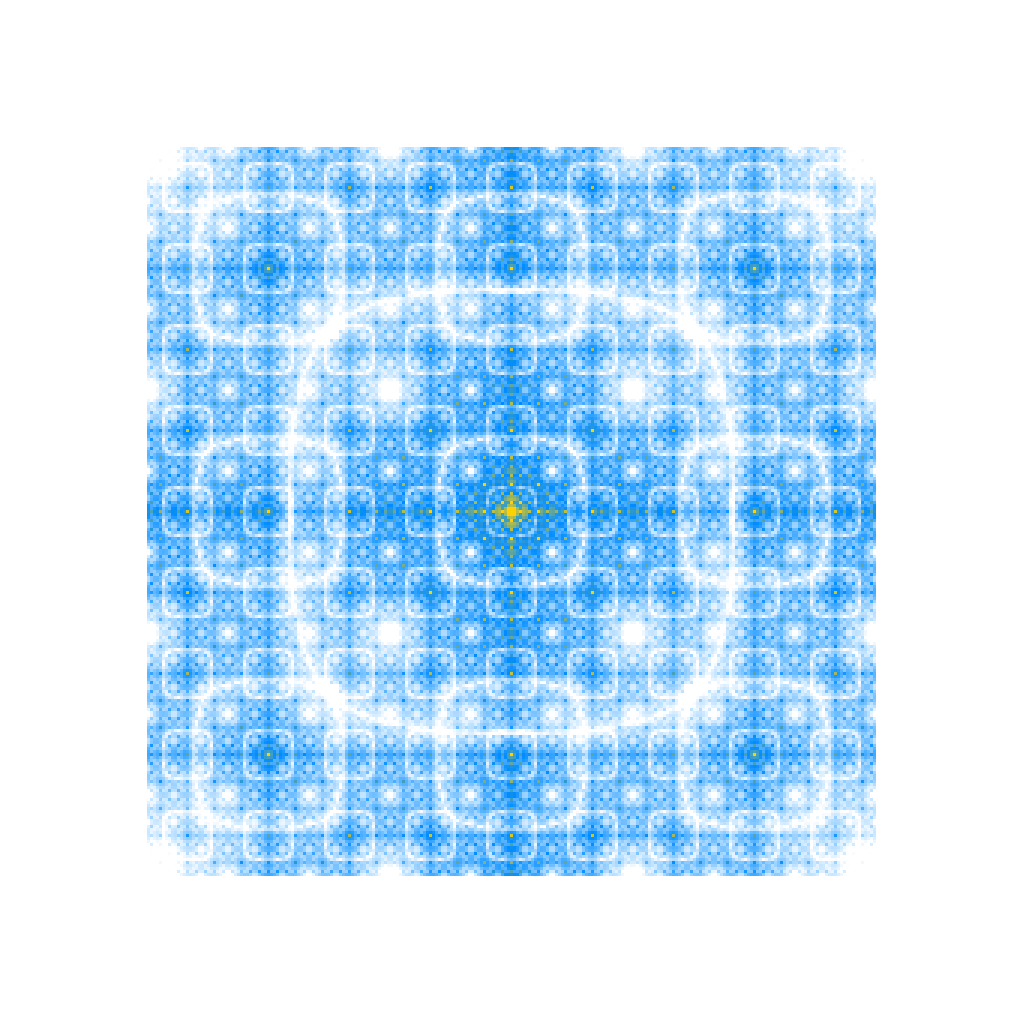
Laying a design's level-L mask over the torus picks out its modes, so every eigenvalue is a product of L rescaled copies of the tile's own transform and the field of eigenvalues is self-similar, a picture of the tile.
Primes in the lattice
The primes
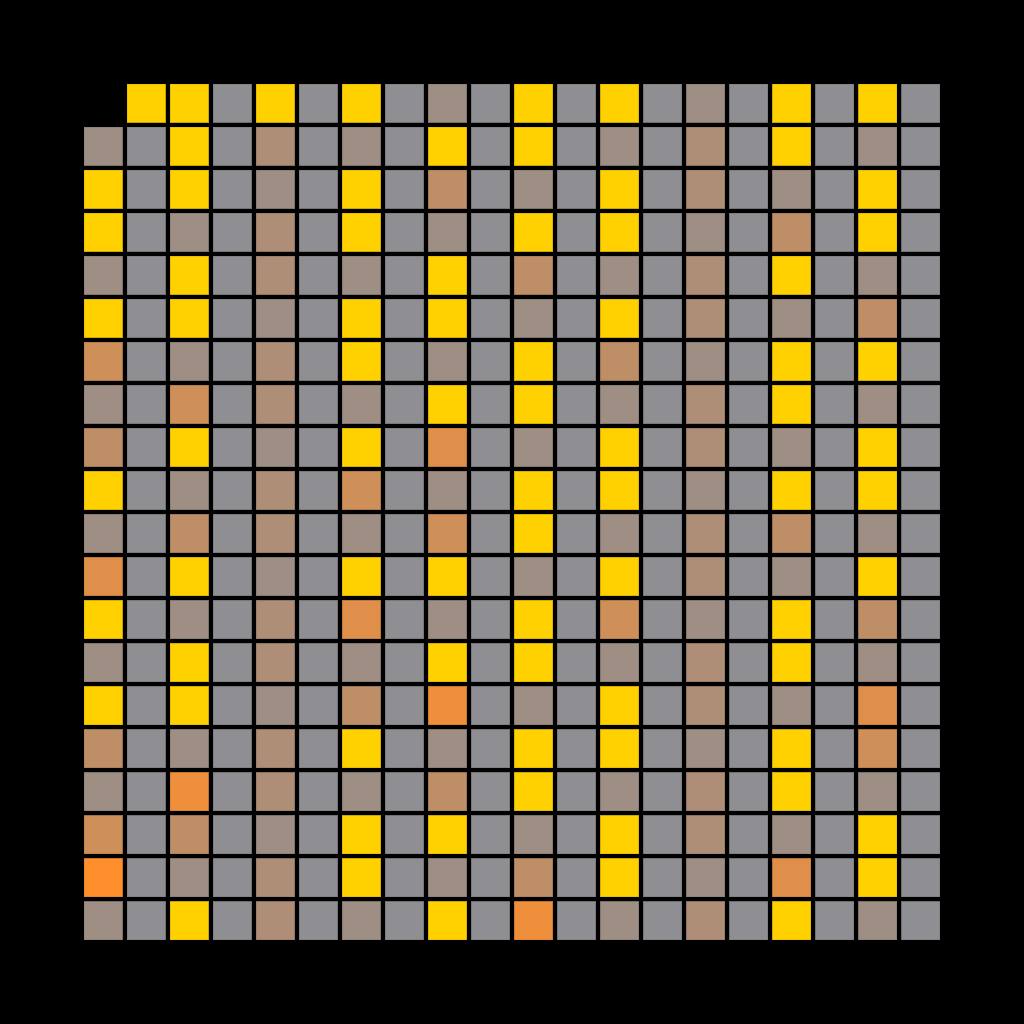
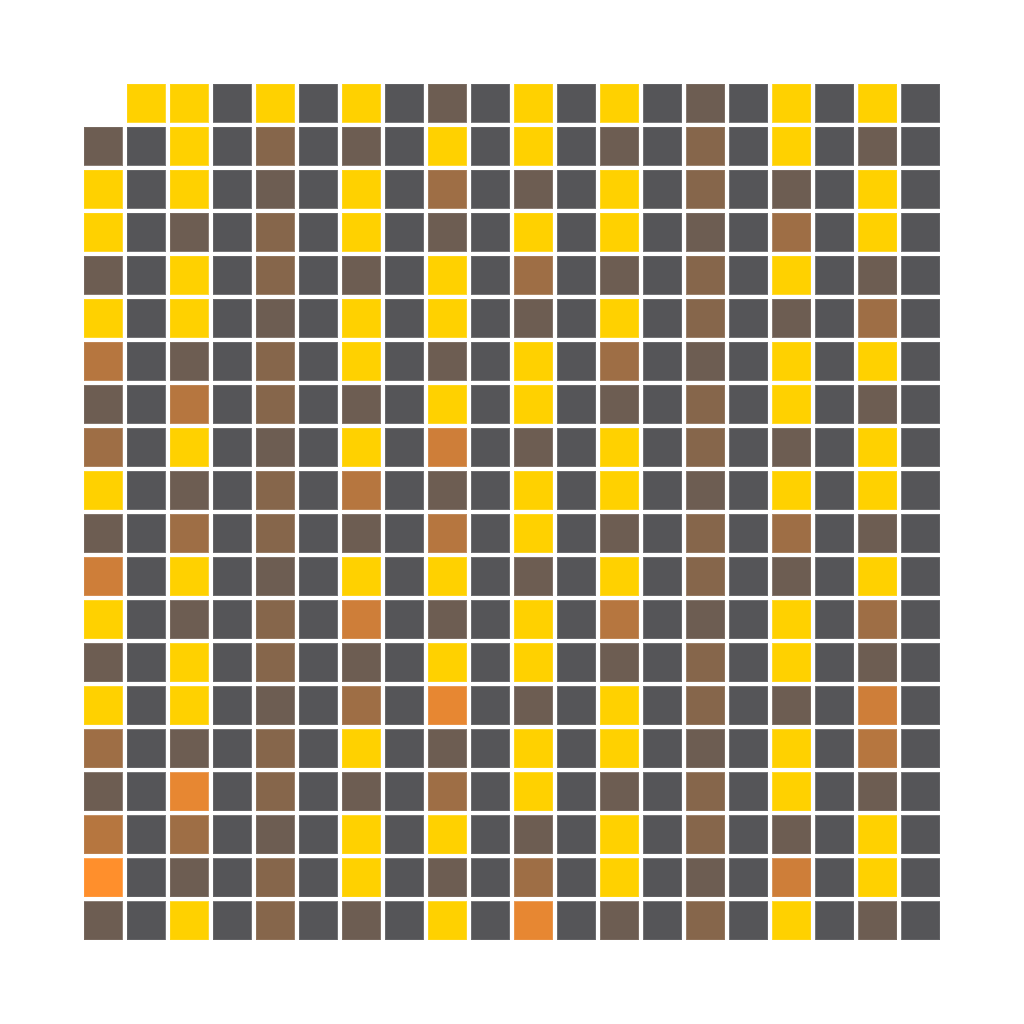
A number is prime when its stones make one rectangle, shown by the sieve, the divisor pairs, the pi(x) staircase against x / ln x and li(x), and a carpet stack whose layers correlate to zero exactly at the primes.
The Ulam spiral
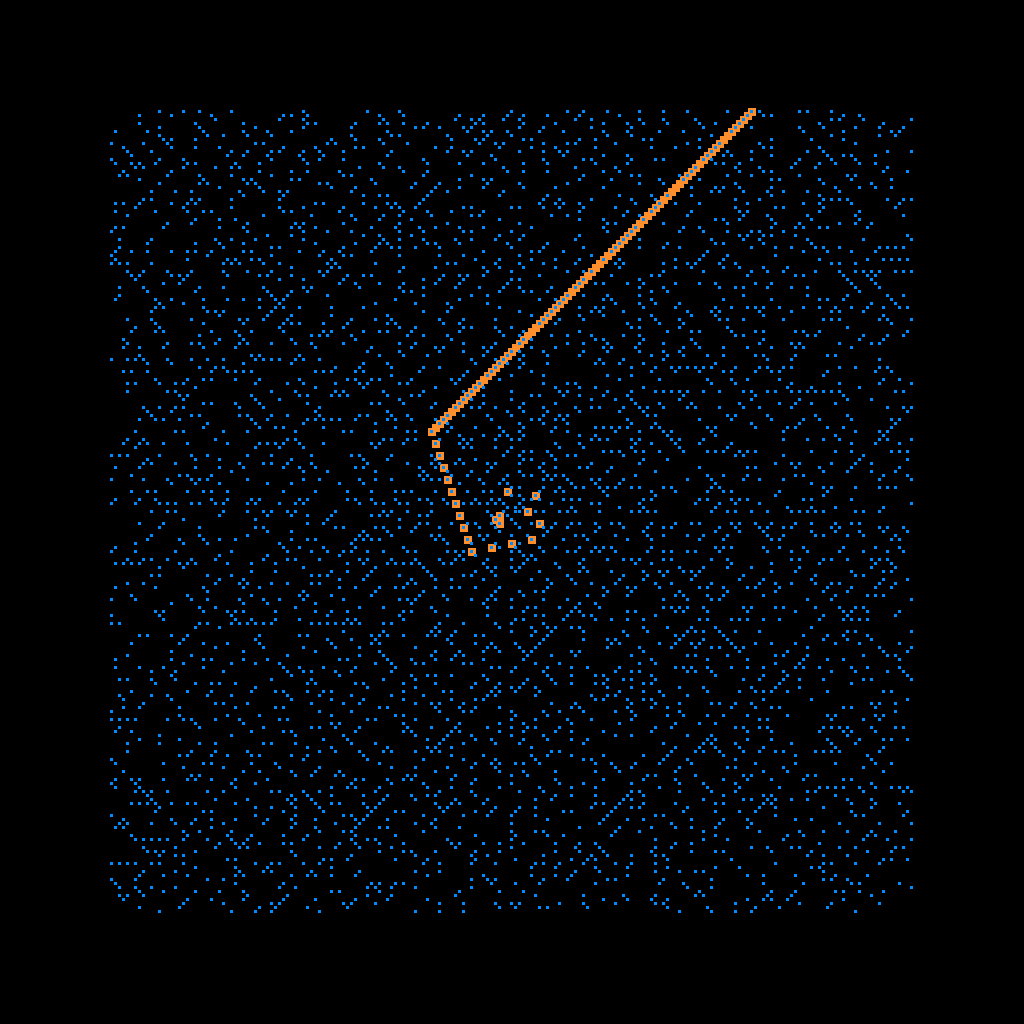
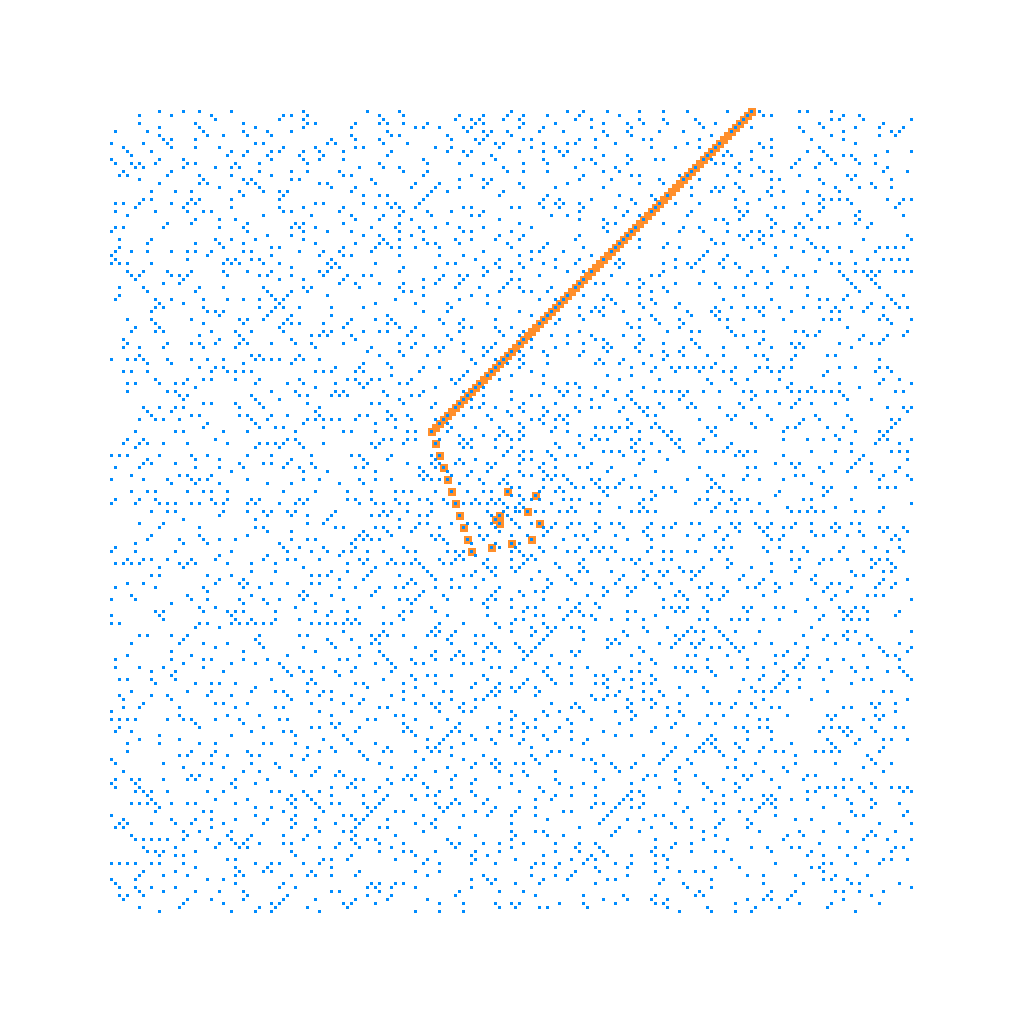
The whole numbers wound on squares or hexagons with the primes lit, where every straight line reads a quadratic and the prime-rich ones stand out as diagonals.
The snail
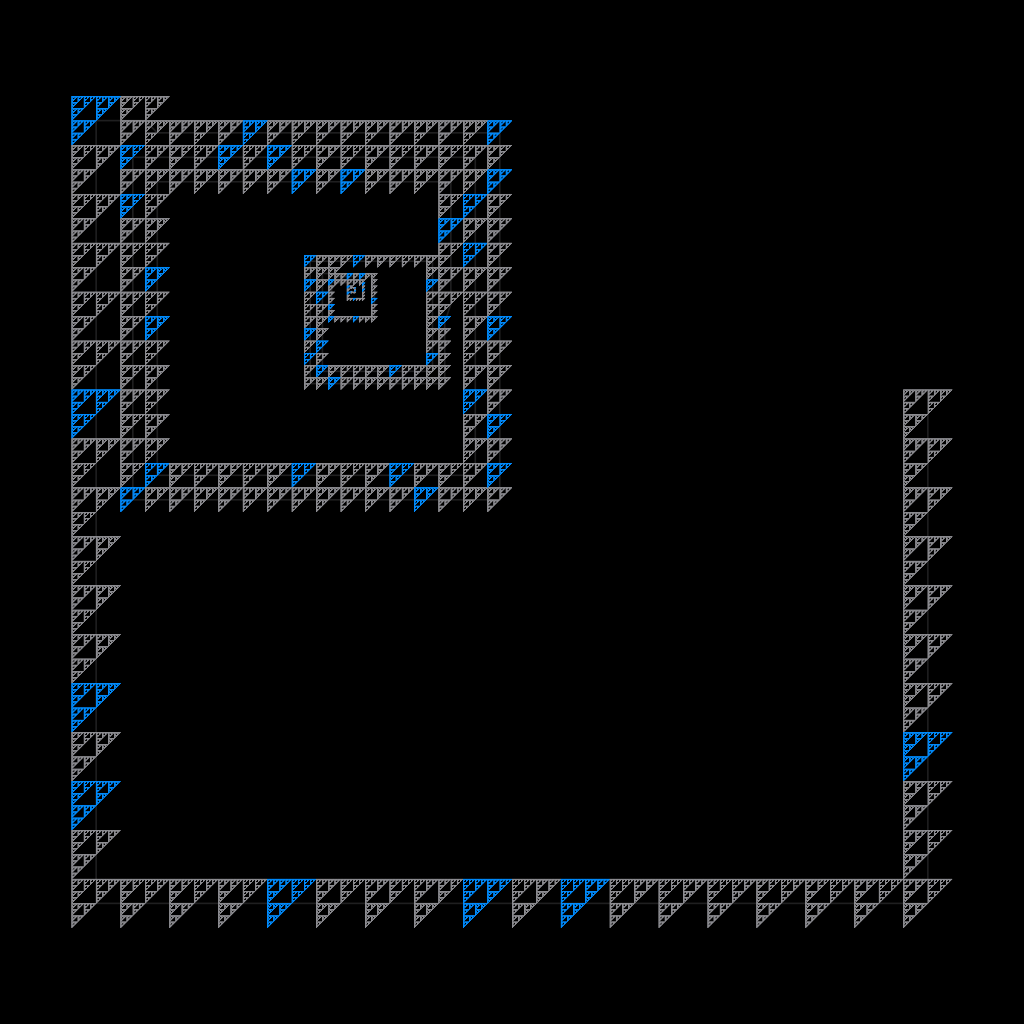
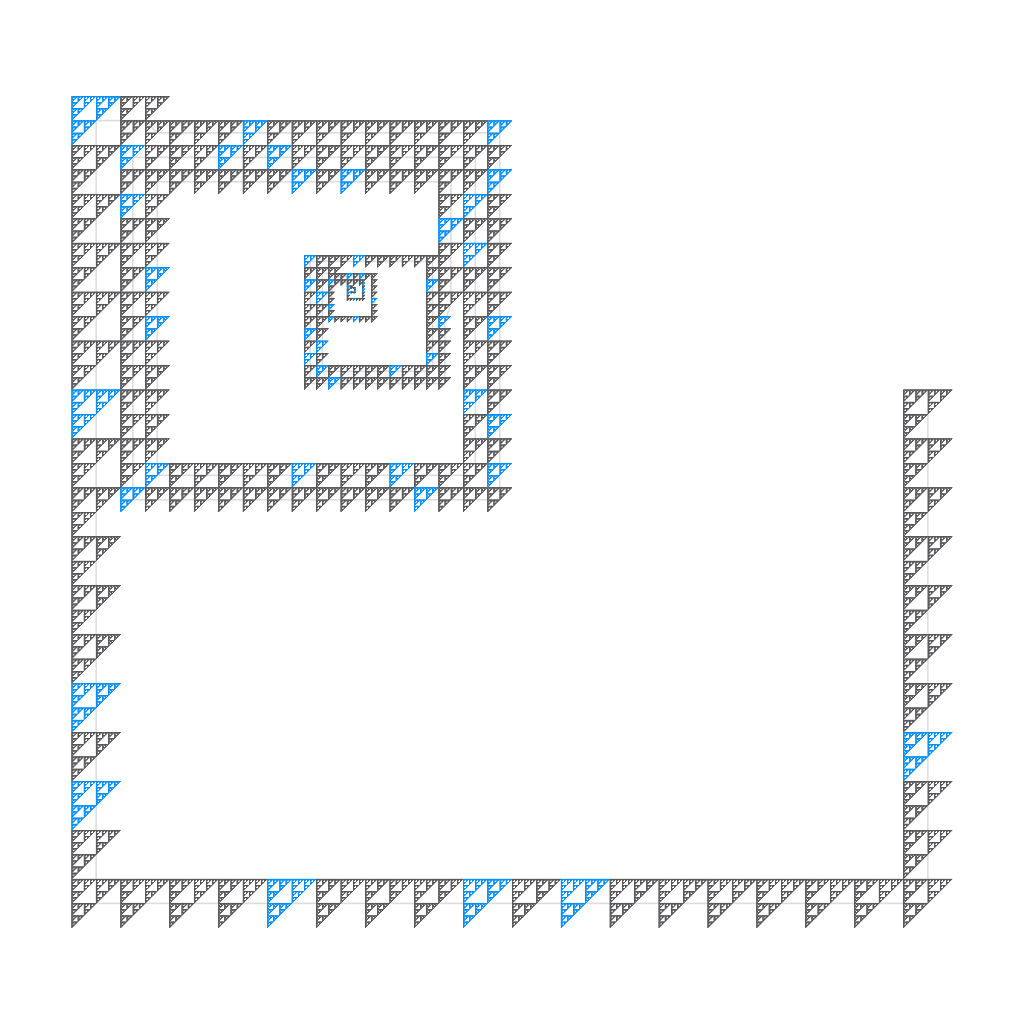
Every cell of the square winding that grows carries a design tile whose side is a power of the base, so the spiral widens by that factor at each new digit and curls outward like a shell, built of the primes alone or of every number by the same law.
Primes in the plane
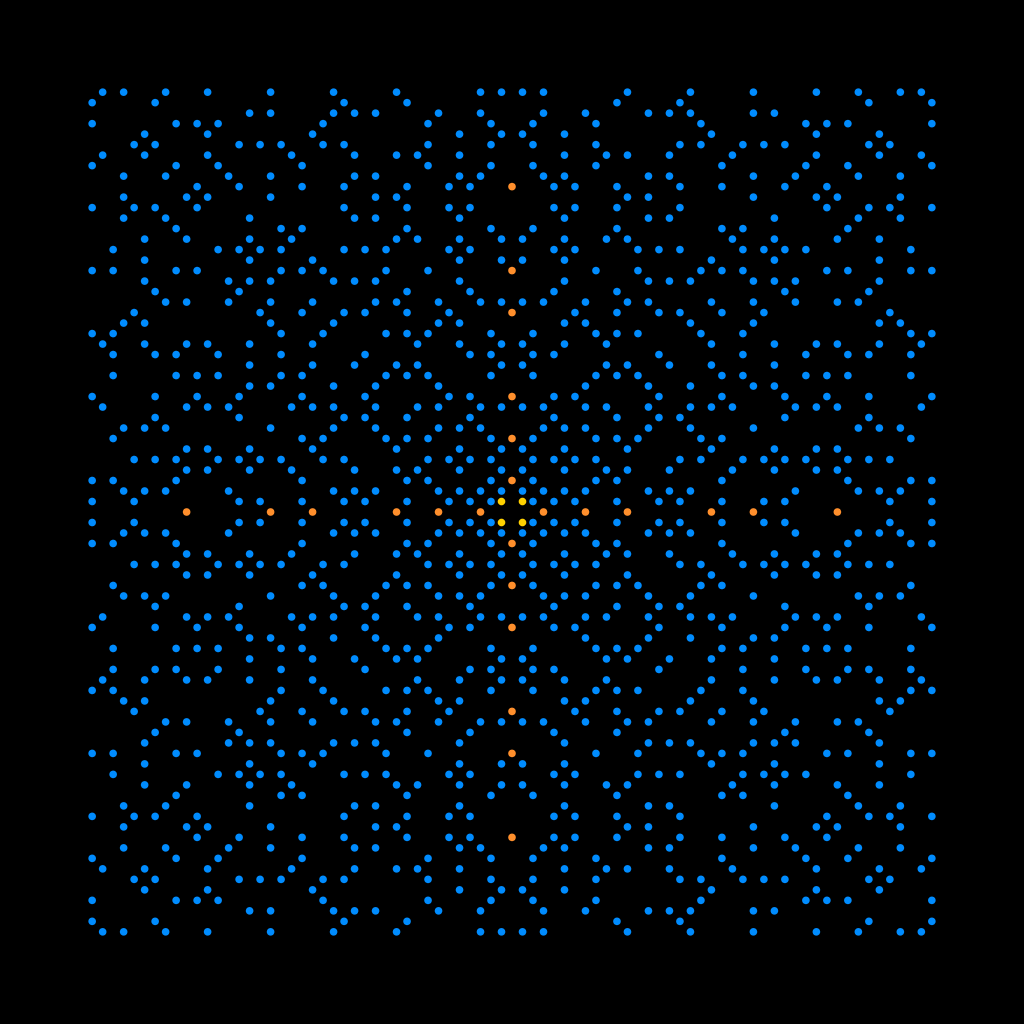
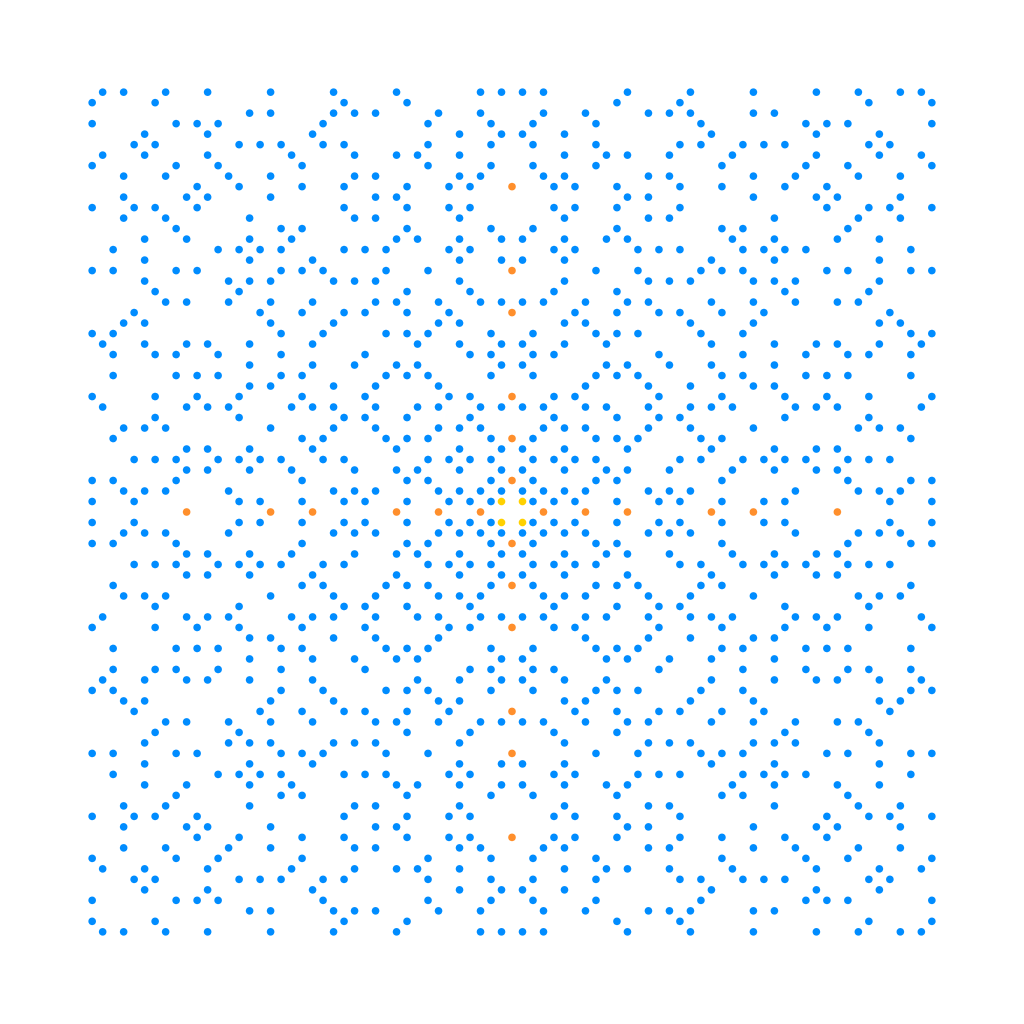
The Gaussian and Eisenstein primes as four- and six-armed snowflakes, coloured by whether an ordinary prime split, stayed inert, or ramified on entering the plane.
Fractions and zeros
The Apollonian gasket
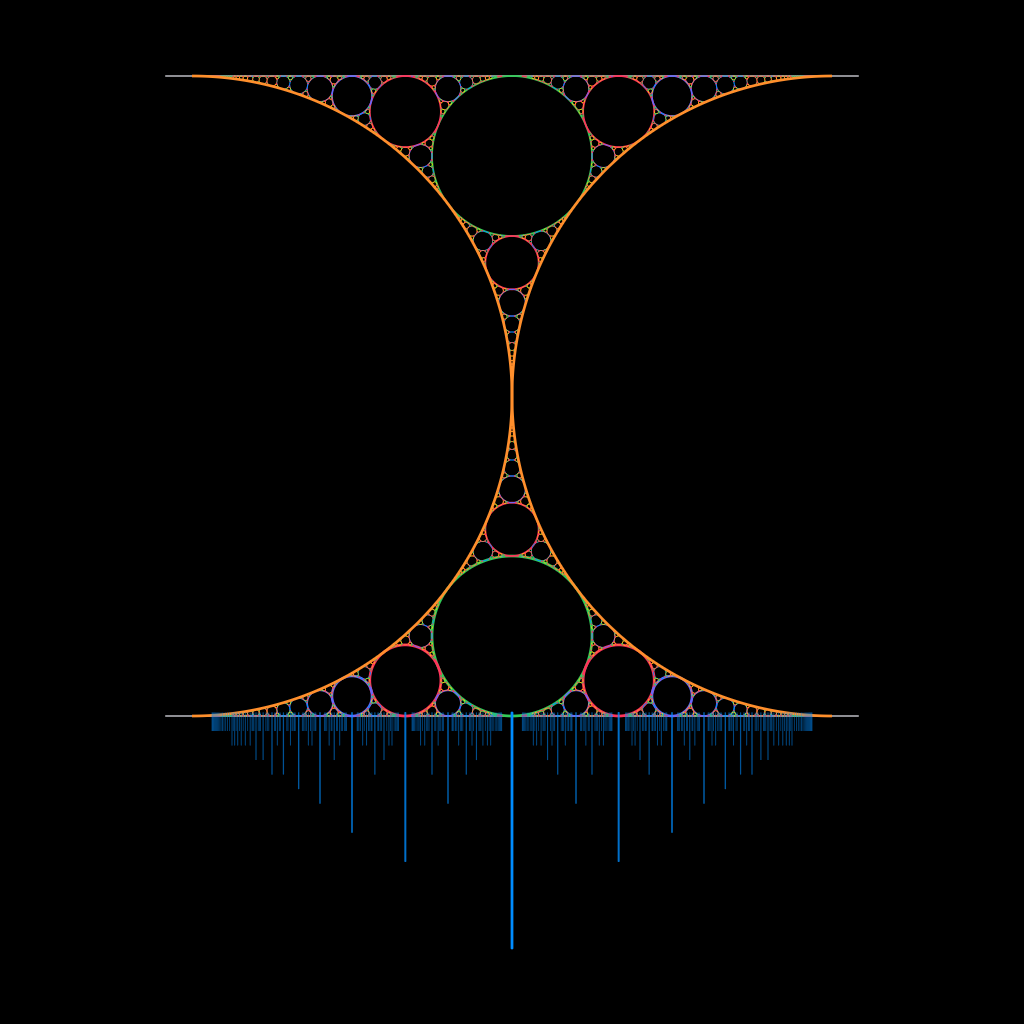
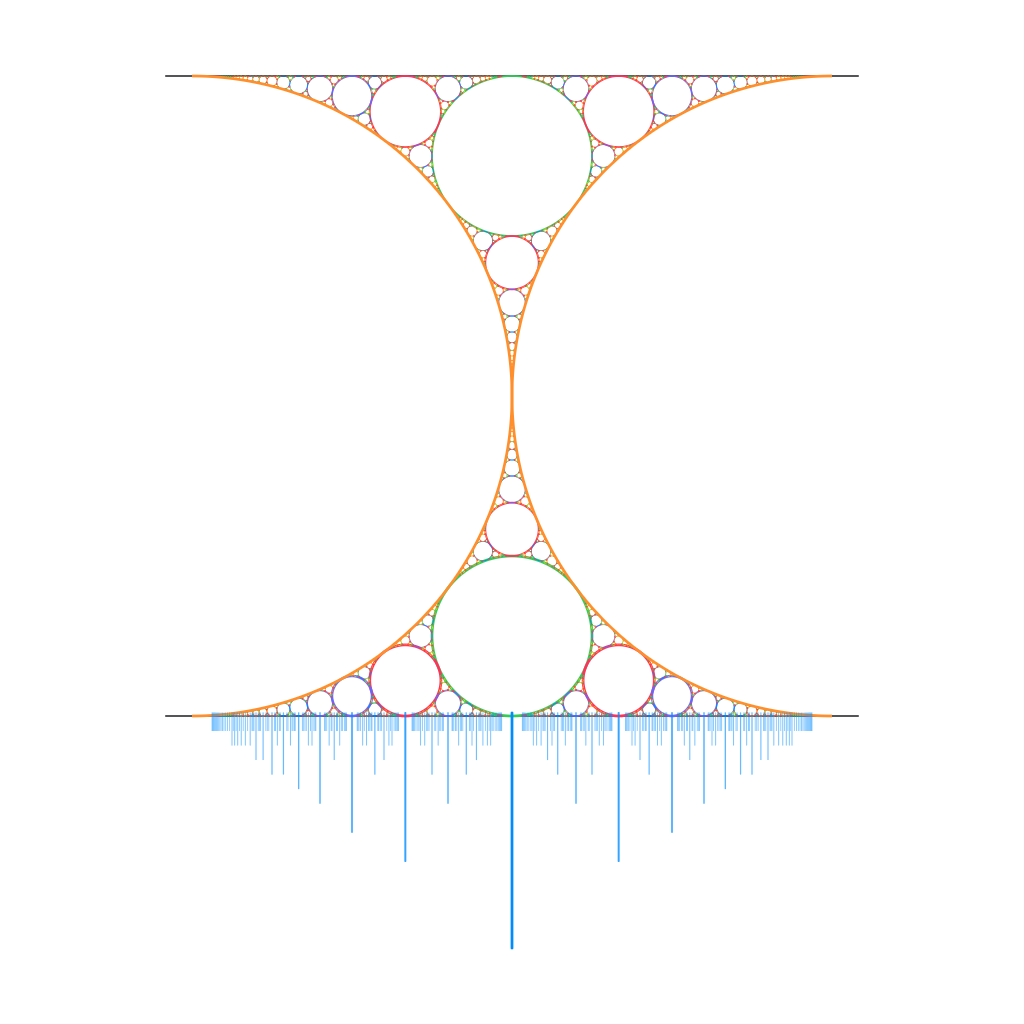
An integer root quadruple grows a whole packing by one square-root-free reflection, and the circles resting on the strip's line are the Ford circles, one to every reduced fraction, standing on the Farey stack's own nodes.
The critical line
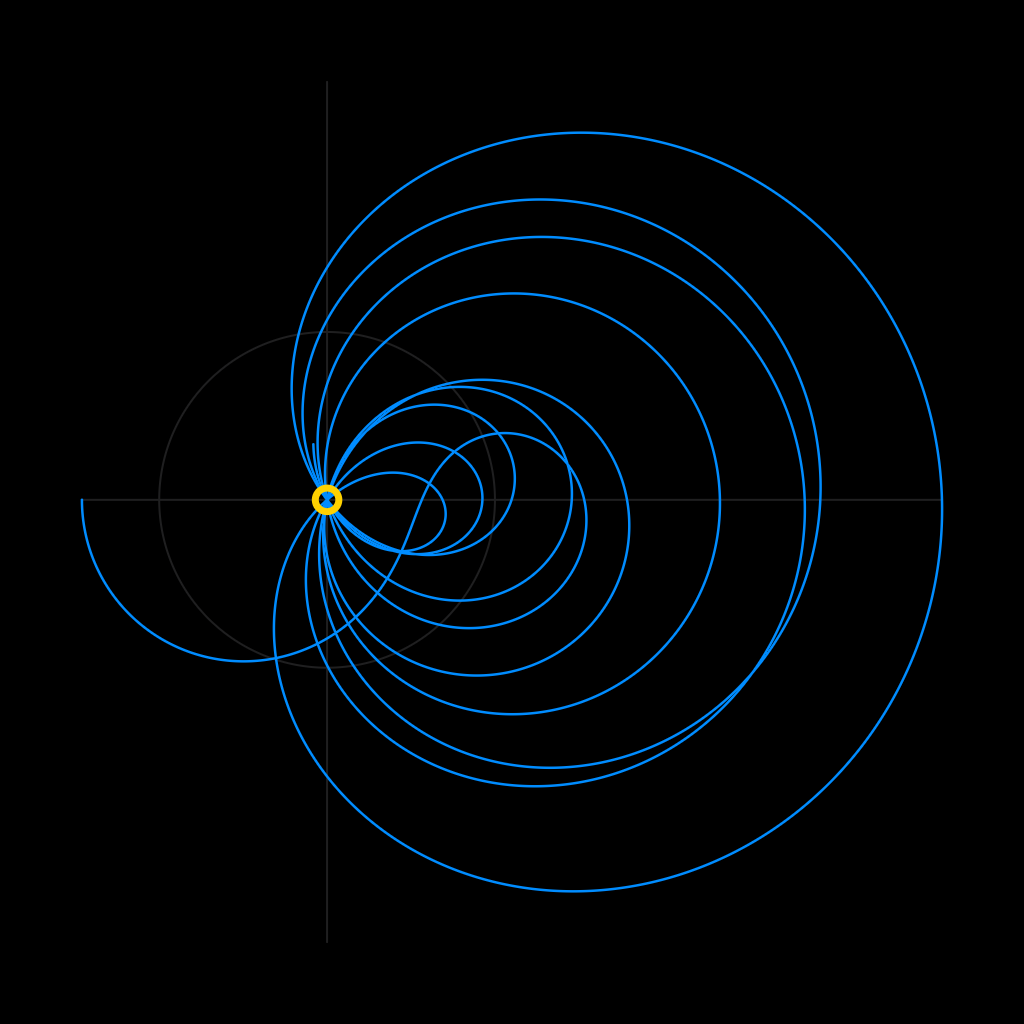
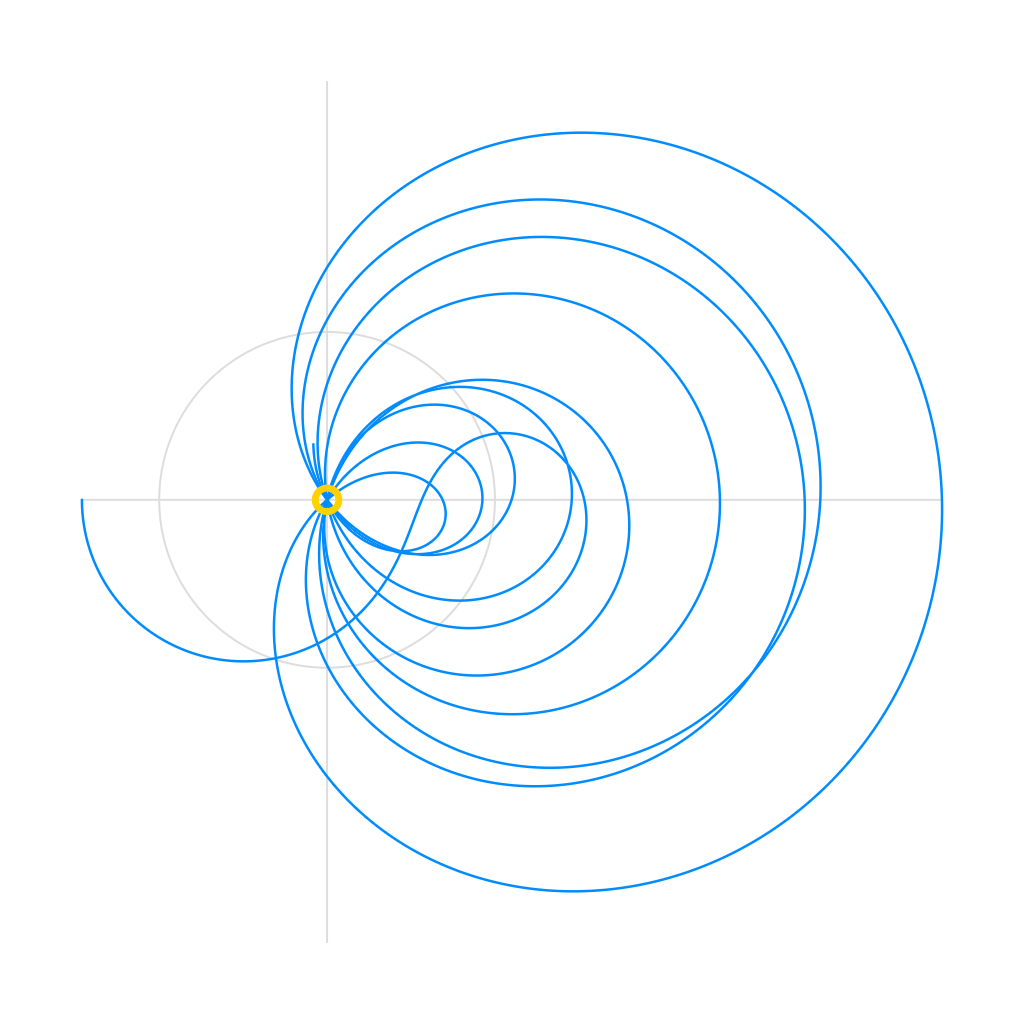
Zeta walked at s = 1/2 + it passes through the origin once per zero, and the zeros added one at a time fold a smooth curve into the prime staircase.
The Mobius echo
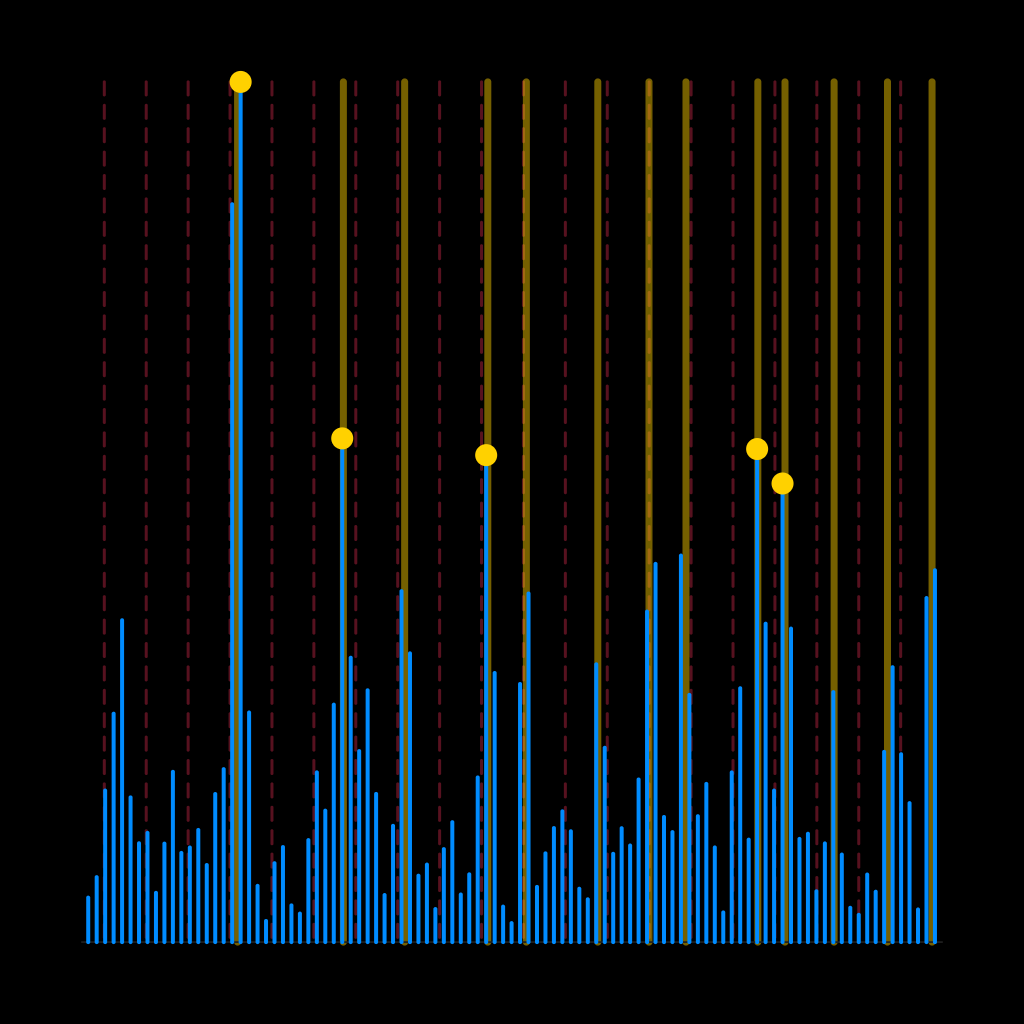
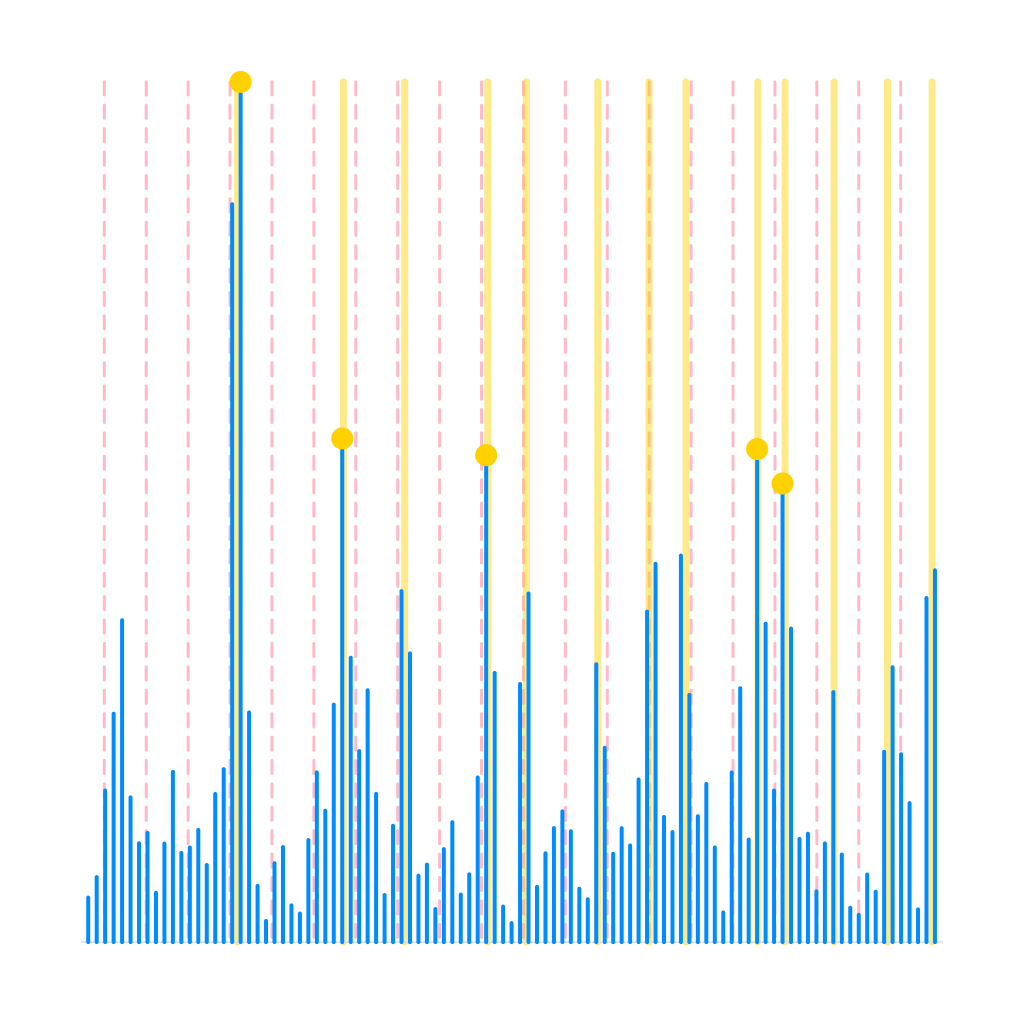
The Mobius meter of a digit design oscillates at the ordinates of the Riemann zeta zeros and never at the design's own pole lattice, because it is the classical Mertens function heard through the design's density: split that echo off and the zeros leave with it.
The ledger
The sequences
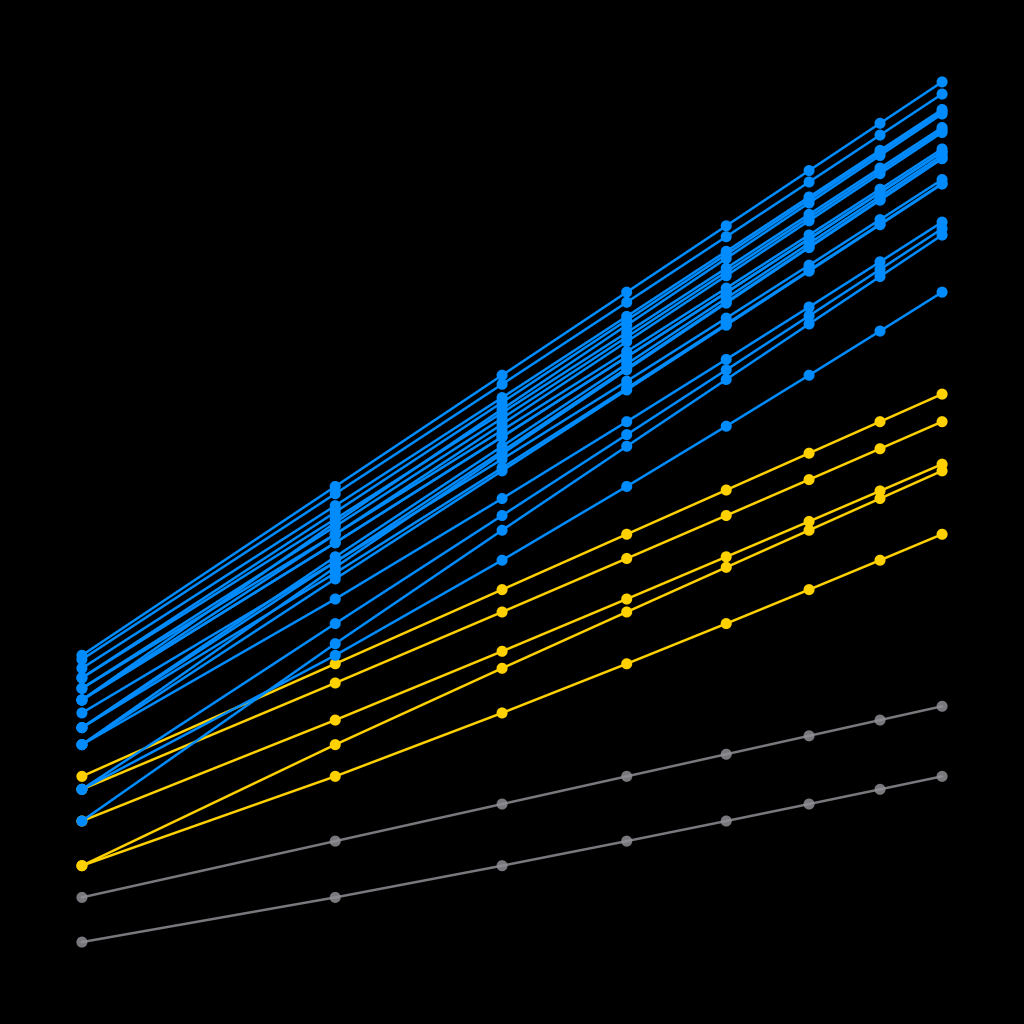
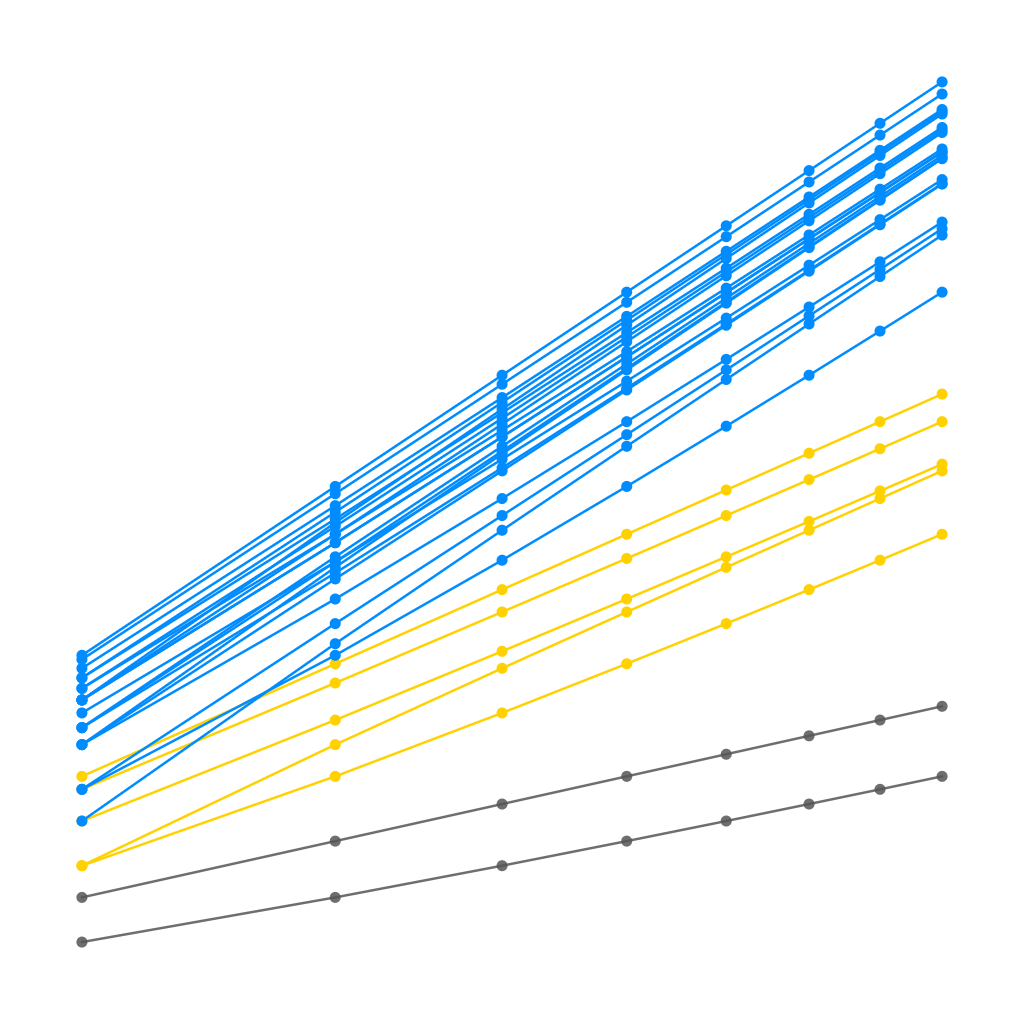
The searchable ledger of every integer sequence the designs write, with closed forms and the OEIS entry each one matches.
The plot
Any sequence the ledger holds drawn rather than listed, with the smallest linear recurrence its terms satisfy, its characteristic polynomial and its growth read out beside it, and a second sequence mixed in to see the rule a blend inherits.
The integers
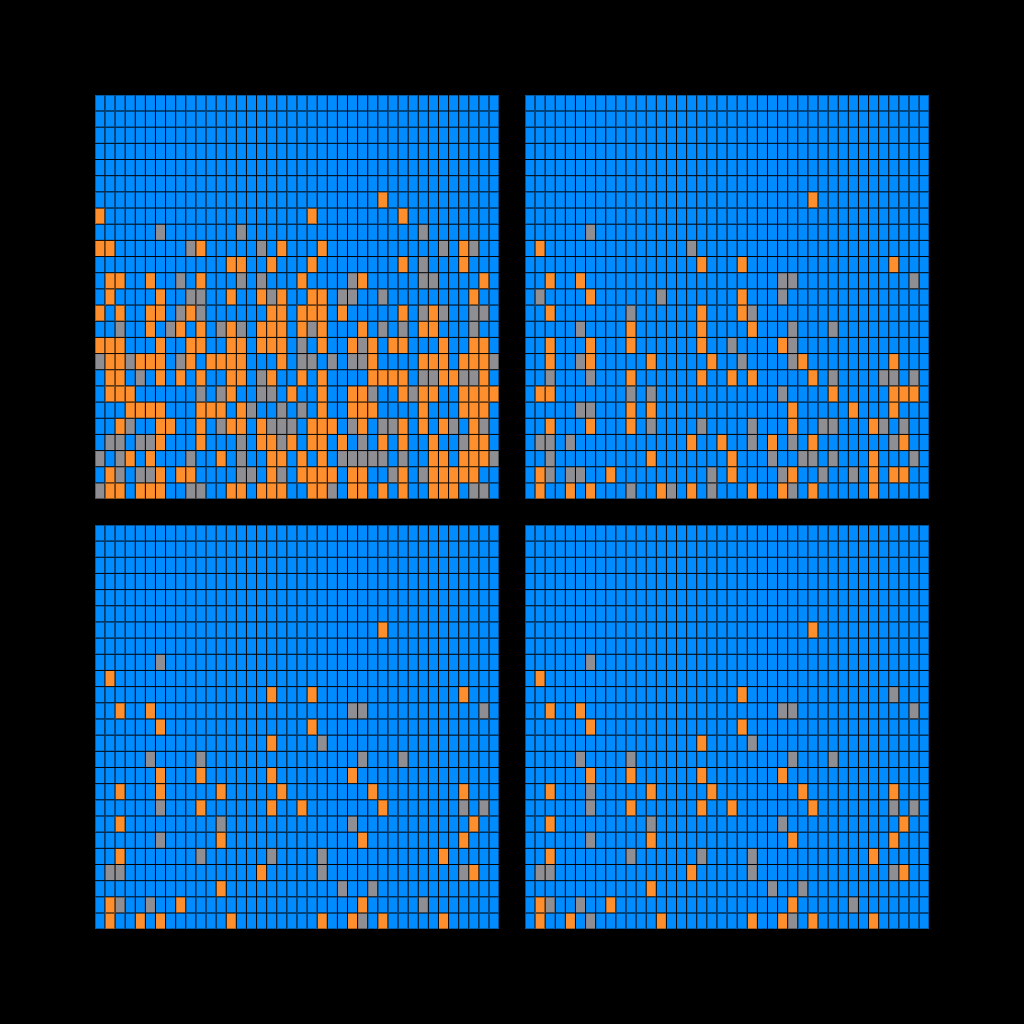
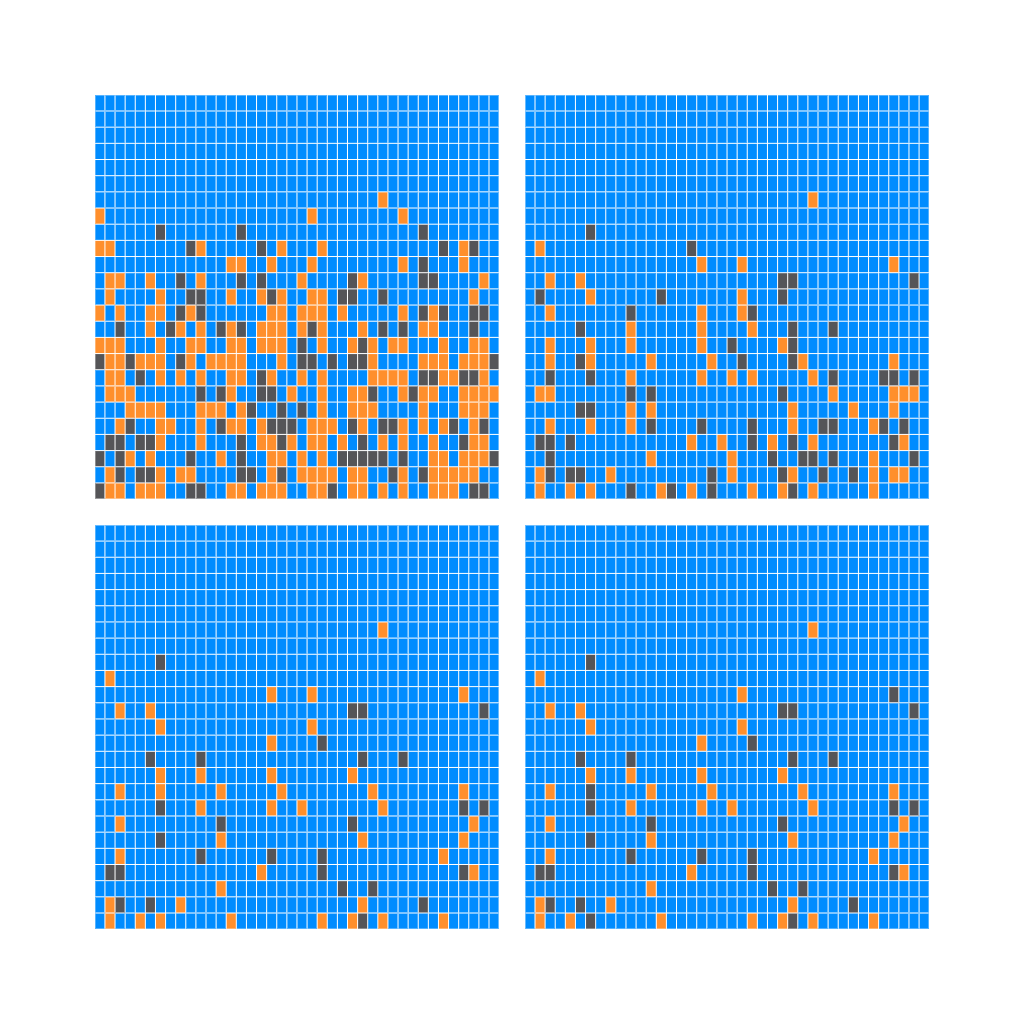
The union of every sequence the registry writes, read integer by integer: which of the first thousand the designs write, how many rows write each, and which are missed inside the pinned window.
Conway's Life
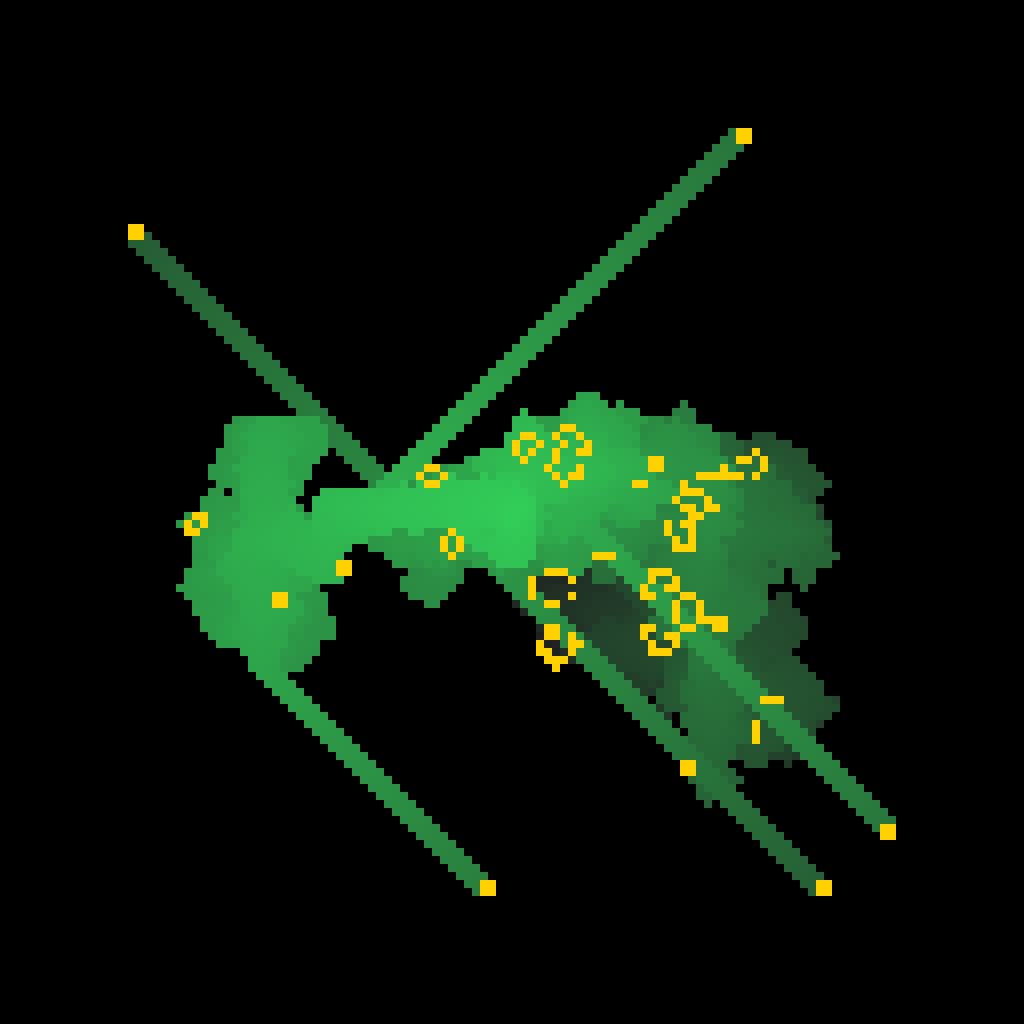
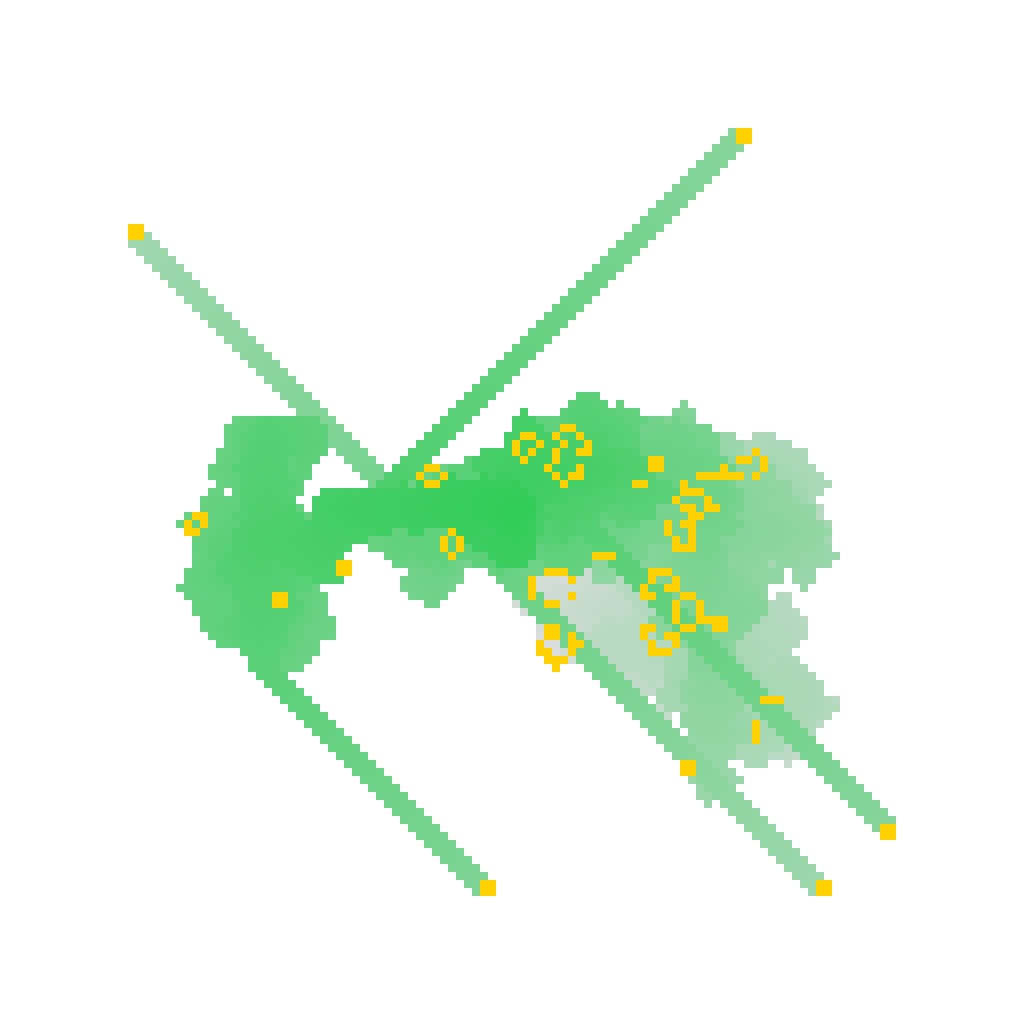
Conway's rule on the eight cells around, which are the side-3 carpet tile with its centre popped, seeded by soup, glider or R-pentomino and run to its fate.

Papers
The Spin Spectrum Reads a Pair Census
The spin spectrum of a design is one fixed linear function of its pair census, so some designs are homometric and no spin reading one level of refinement can tell them apart.
2026-09-14
Coprimality Density Above Dimension One
the visible-point density of every digit-restricted fractal above dimension one, exactly.
2026-08-23revised 2026-09-08


The Pincer at Dimension One: Two Edges and Two Closed Doors
the missing dimension-one estimate squeezed from both edges, and two routes past it proved shut.
2026-08-23revised 2026-09-08
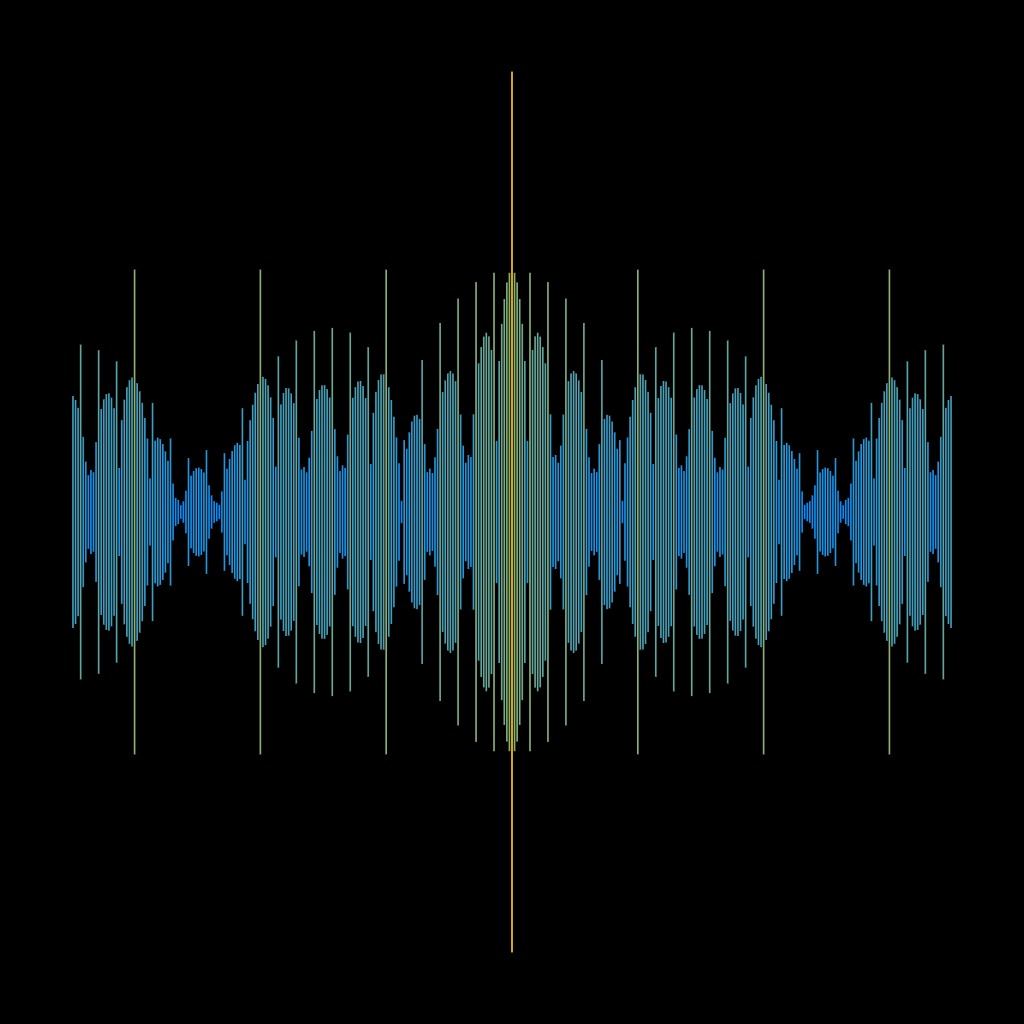
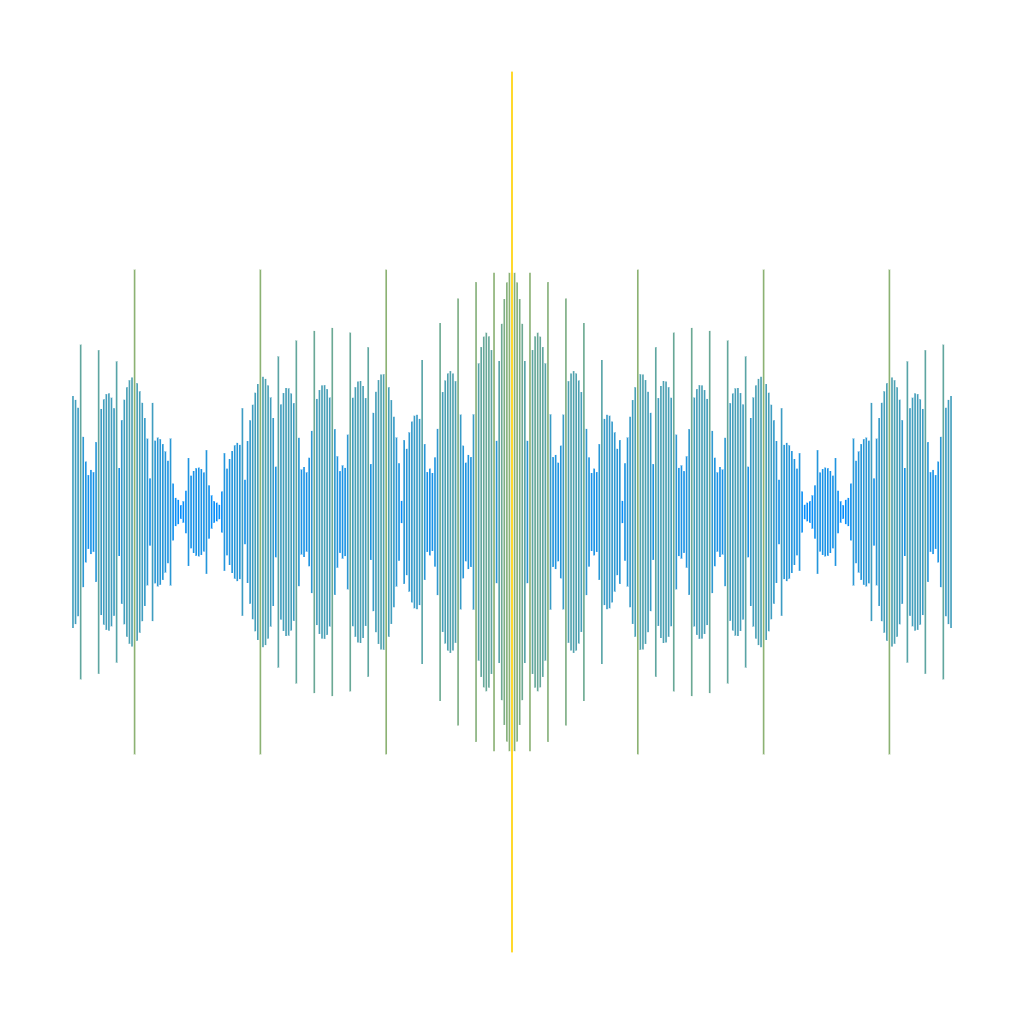
A Power Saving for Mobius Sums on Missing-Digit Integers, under GRH
under GRH, the Mobius function cancels by a power over the integers missing a digit, at every base from 3690 up.
2026-09-06revised 2026-09-08
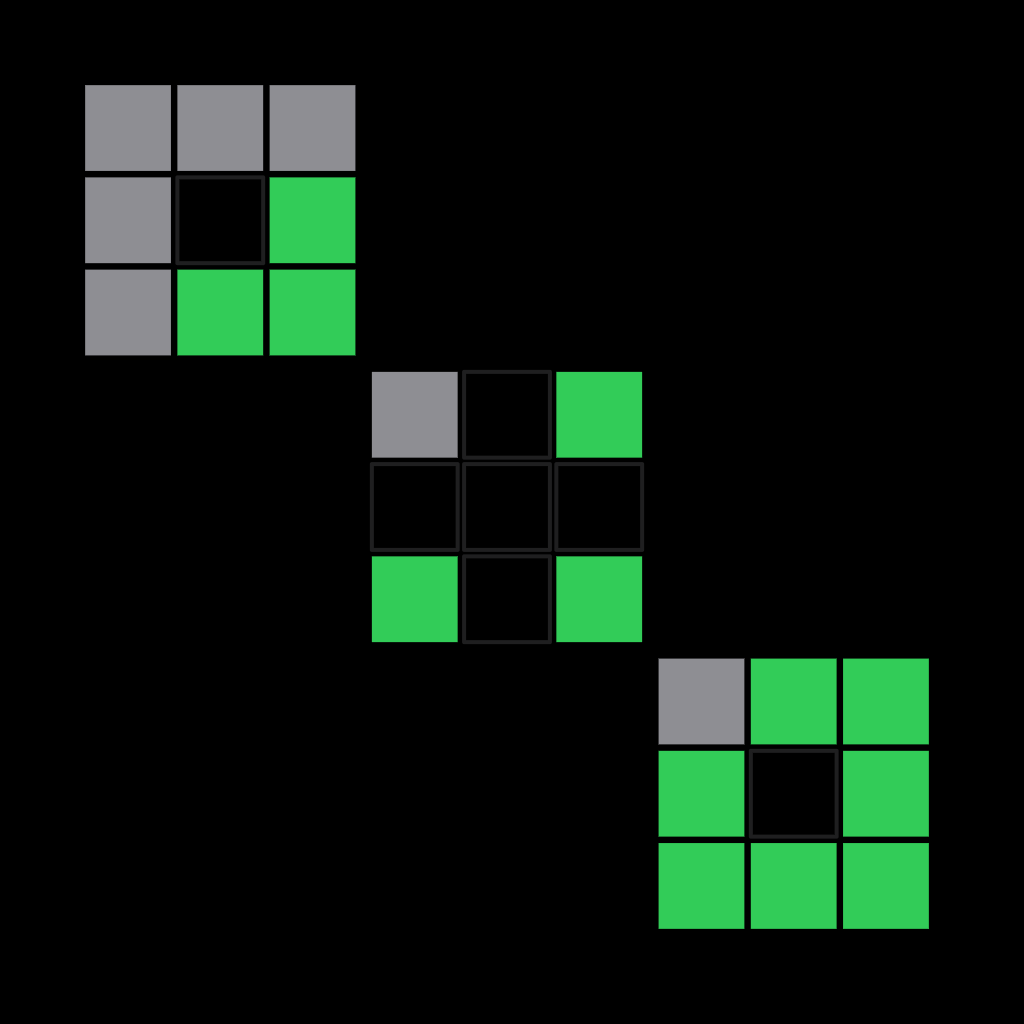
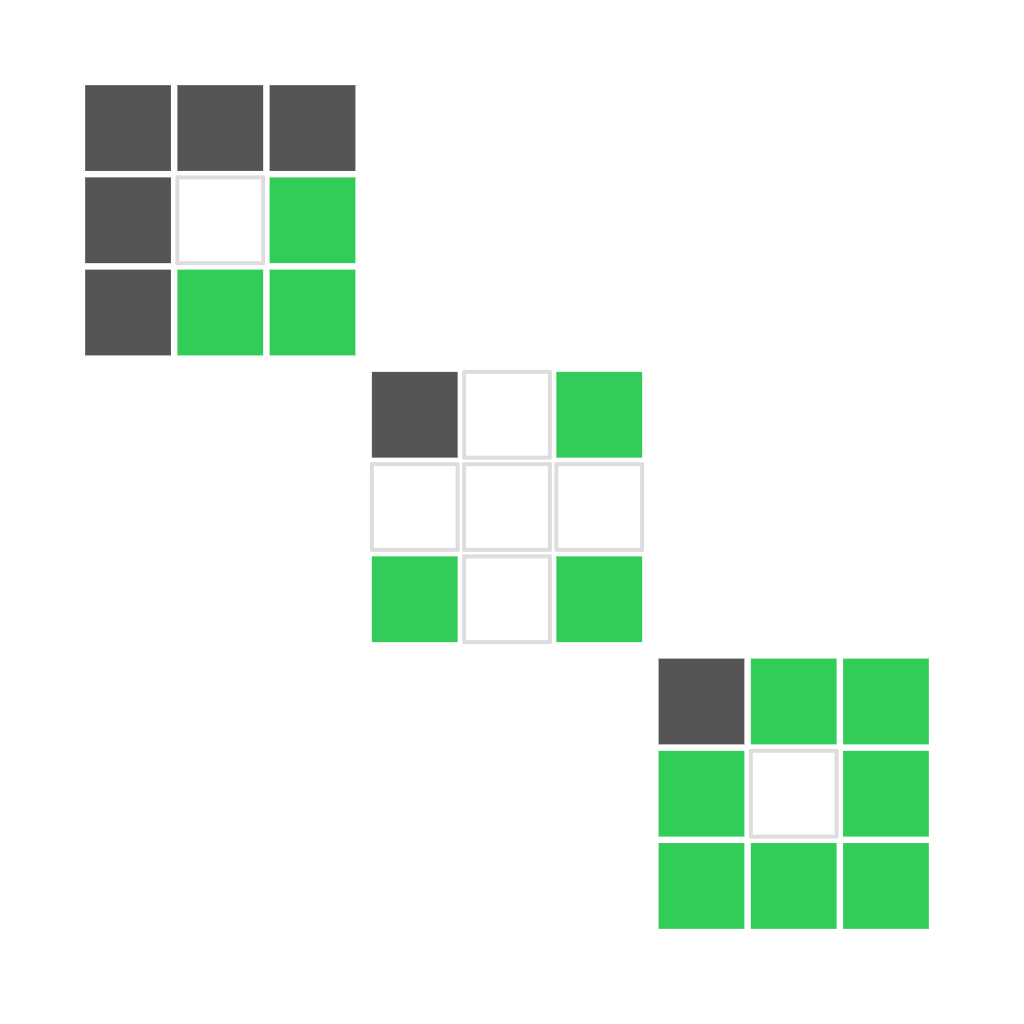
Pairwise Coprimality in the Menger Sponge
drilling the sponge's holes costs its coordinates exactly 12.25 percent of their pairwise-coprimality odds.
2026-08-23revised 2026-09-08
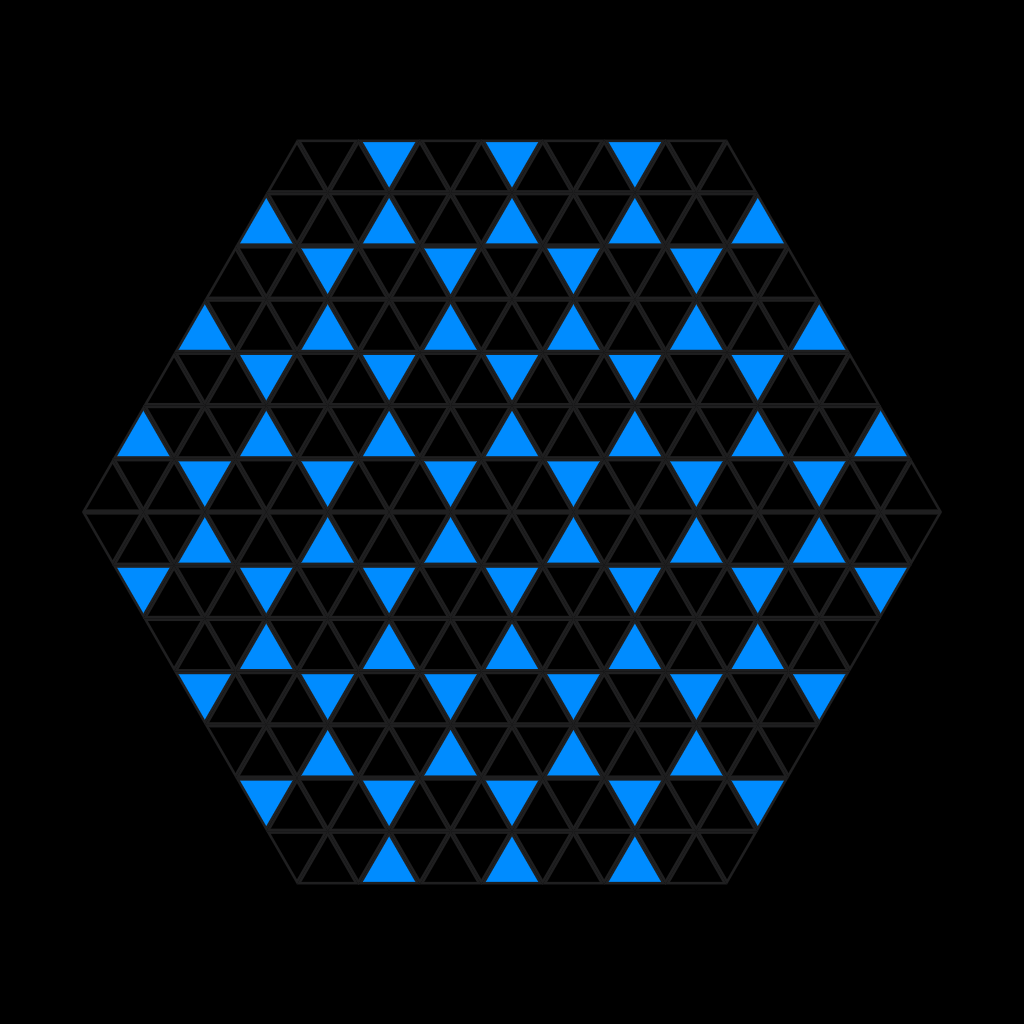
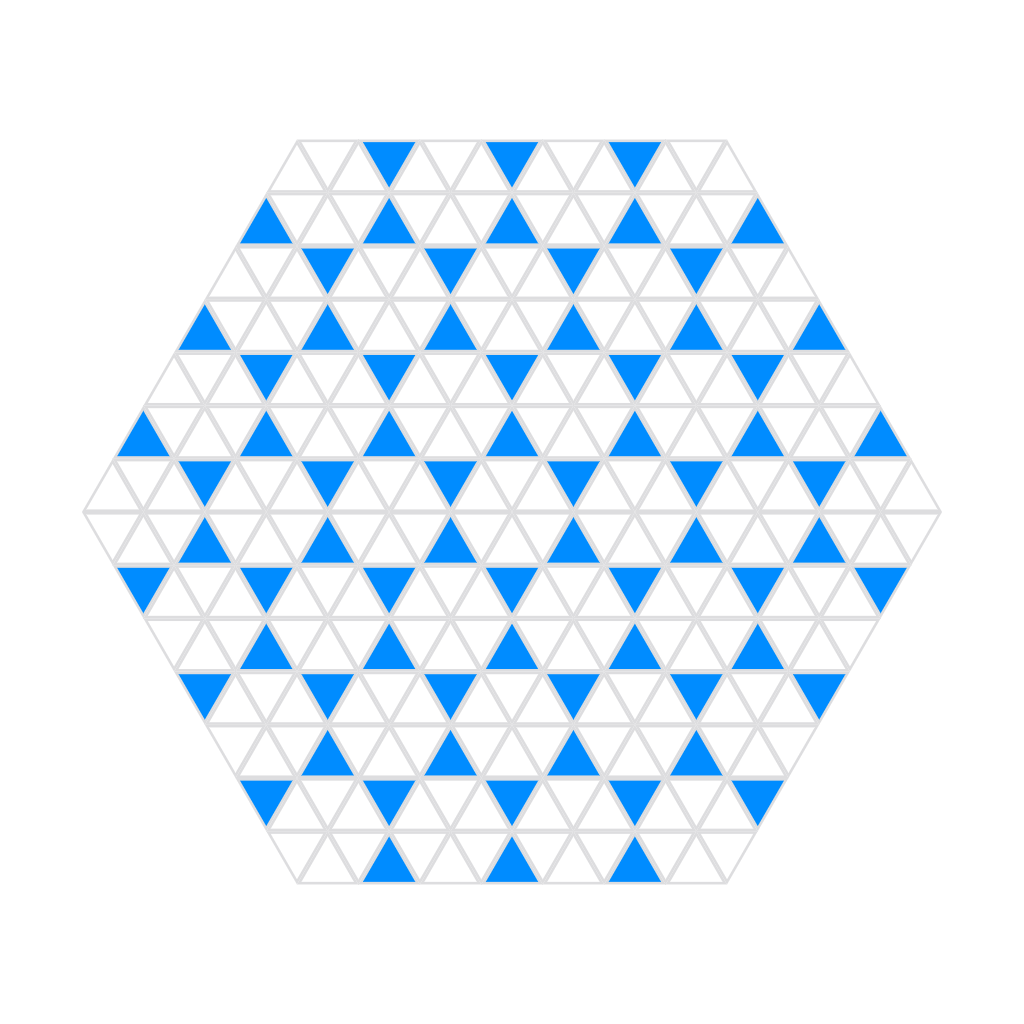
The Walsh Spectrometer: Exact Diagonal-Slice Ink for Every Three-Dimensional Parity Design
the exact slice ink of all 256 parity designs, with the design's Walsh spectrum as the coefficients.
2026-08-23revised 2026-09-08
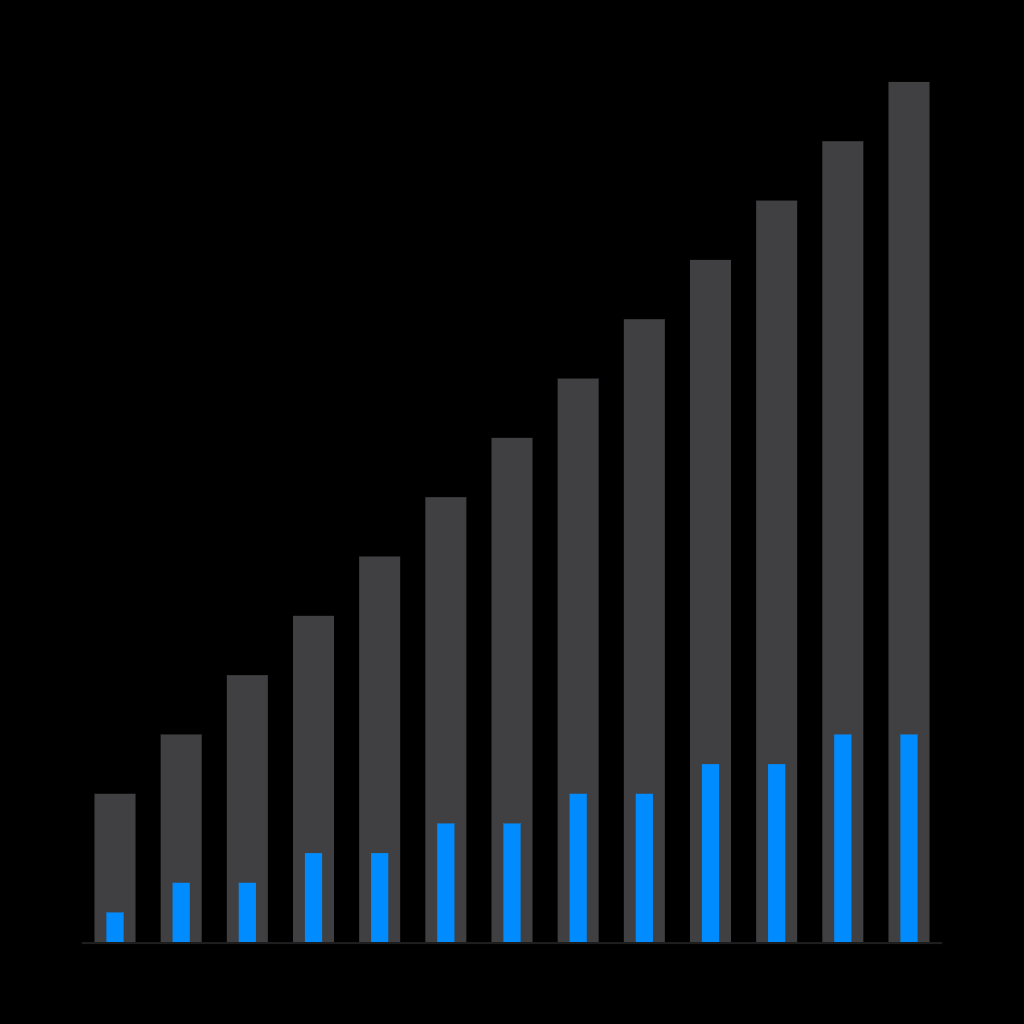
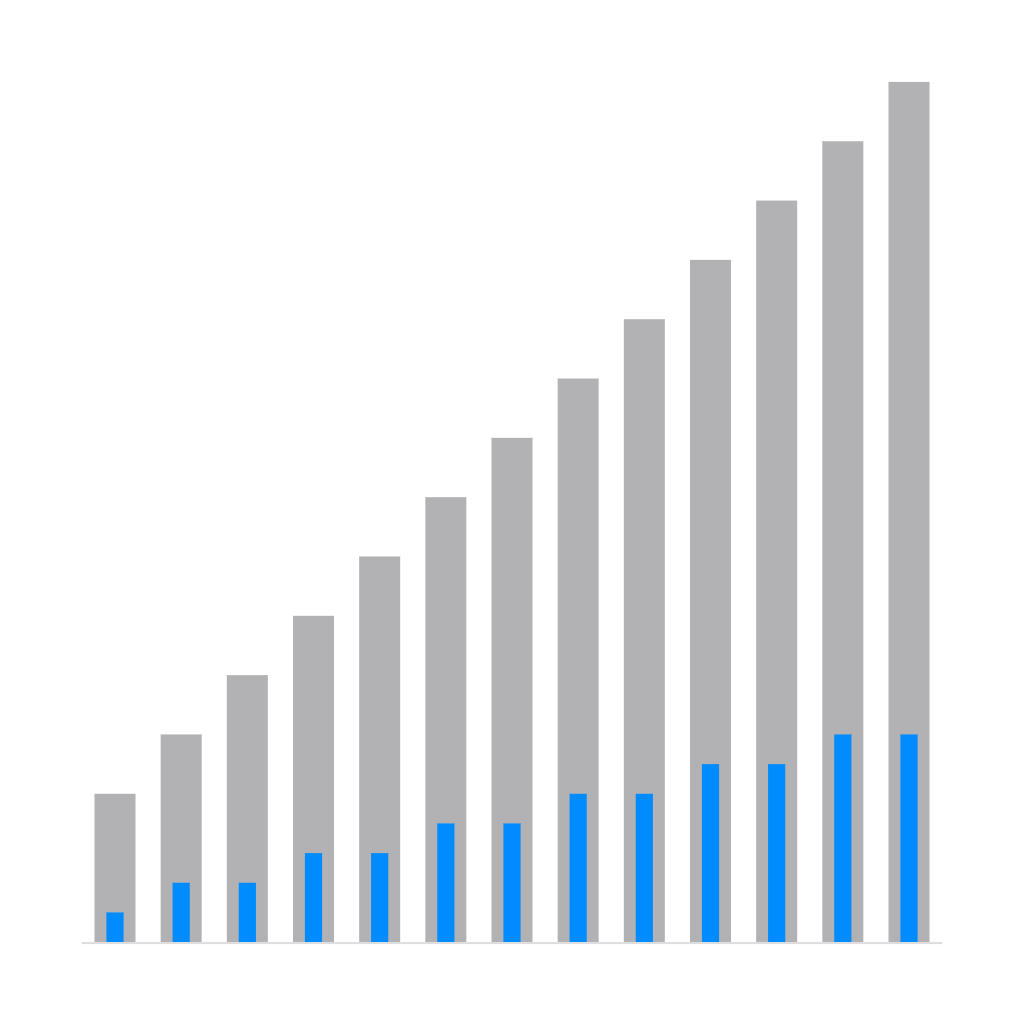
Menger Diagonal Slices: A Recurrence of Order ⌈D/2⌉
Menger diagonal slice counts obey a recurrence of order exactly ceil(D/2), and at odd D != 1 mod 3 their exponent provably beats the generic slice dimension.
2026-08-23revised 2026-09-08
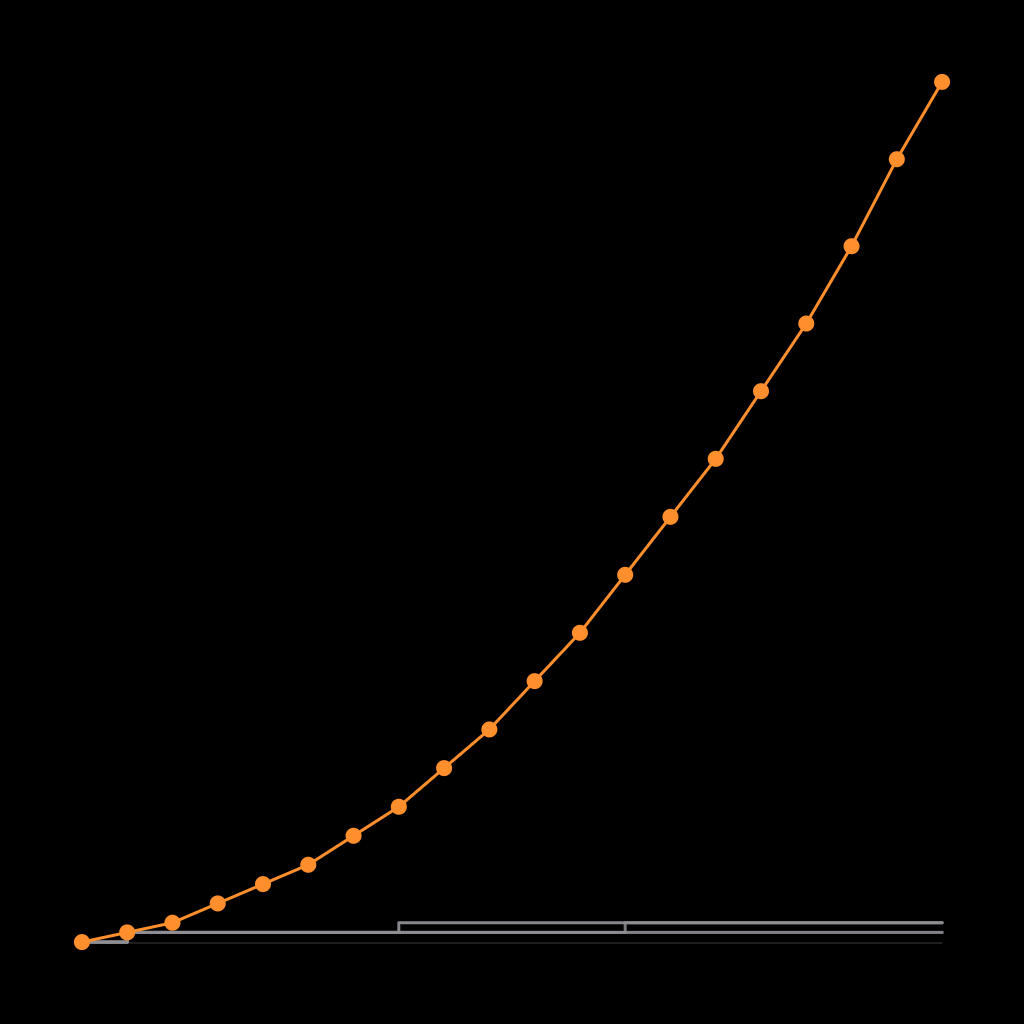
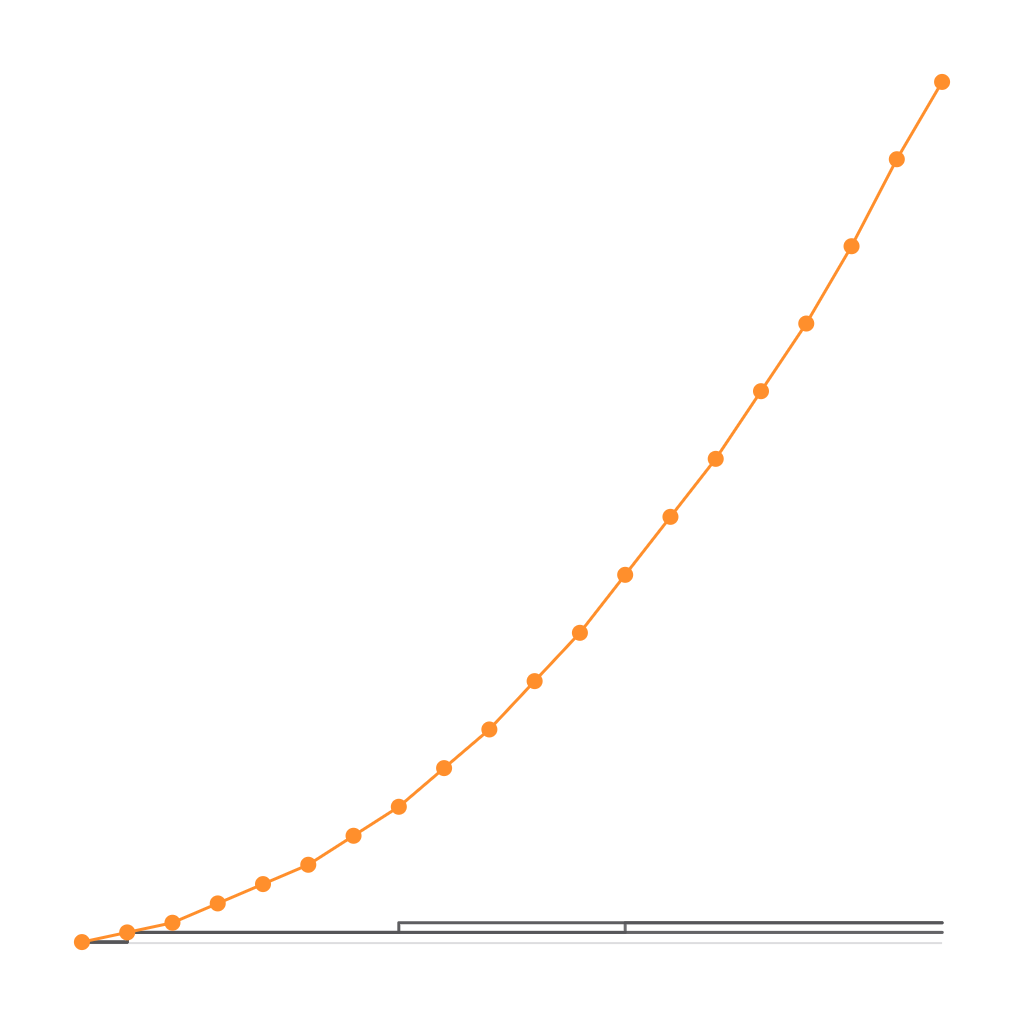
The Even Half of the Slice Sign Law
the even half of the slice sign law: below the generic exponent in every even dimension at bases 3 and 5, the quadratic base-3 transient identified exactly, and the Jacobsthal tent rank law behind the remaining strictness gap.
2026-08-24revised 2026-09-08
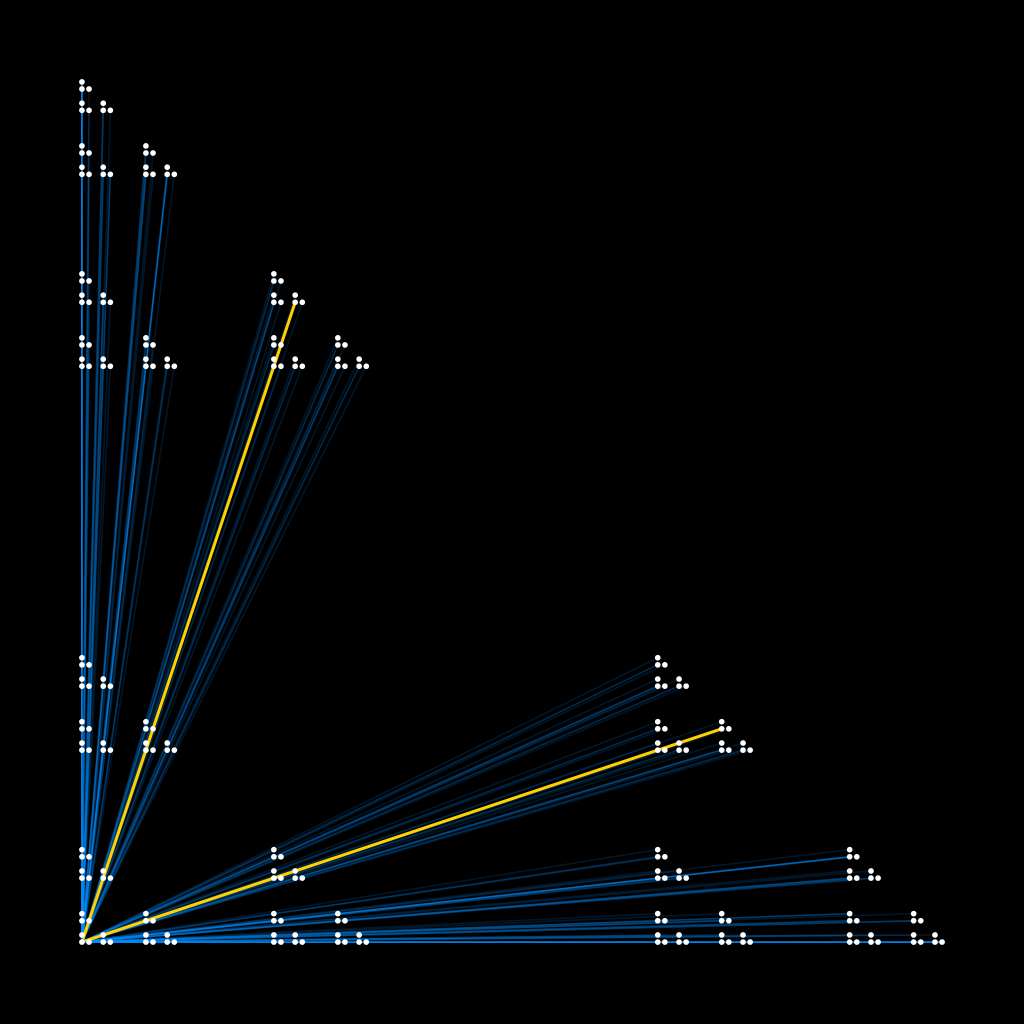
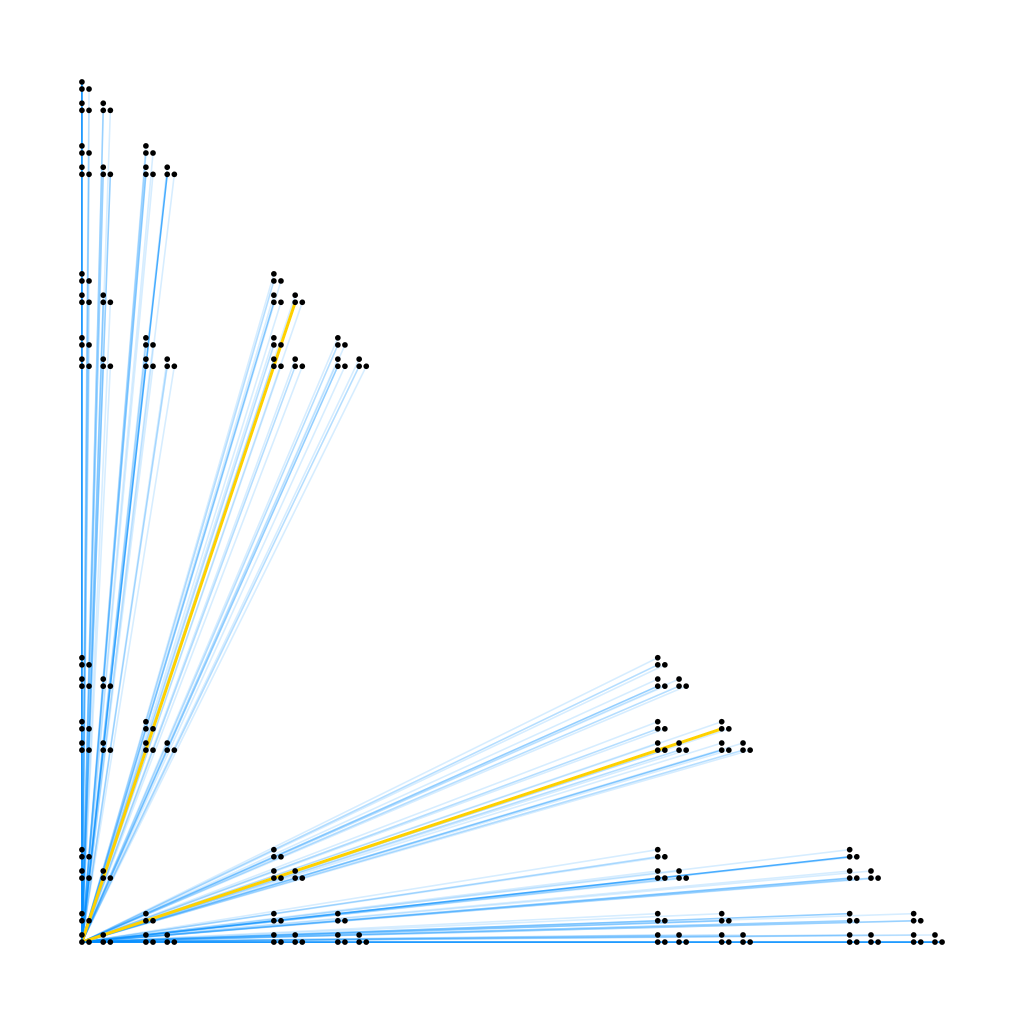
Base-3 Digit Designs: Diagonality, Ray Masses, and a Spectral Gap at Two
which origin lines hit a base-3 design, how much each catches, and a spectral gap at two.
2026-08-23revised 2026-09-08
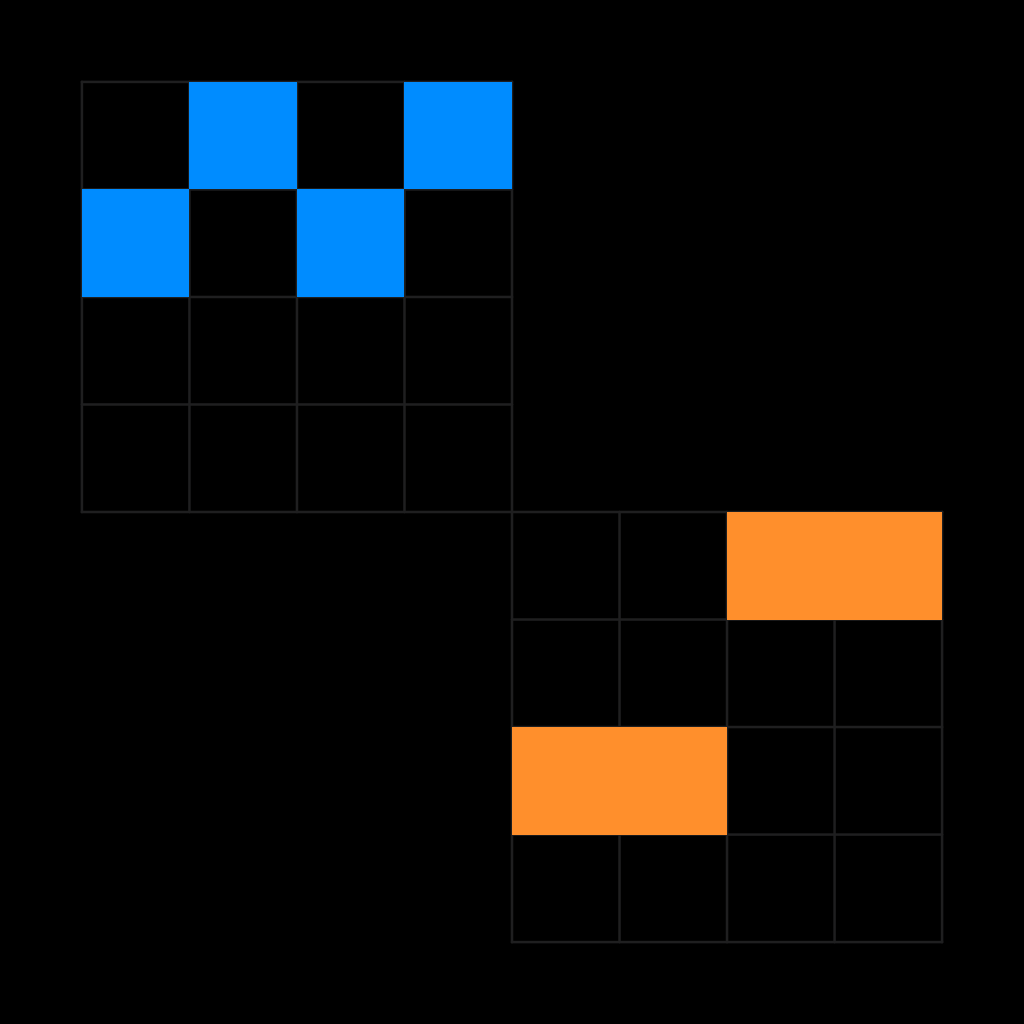
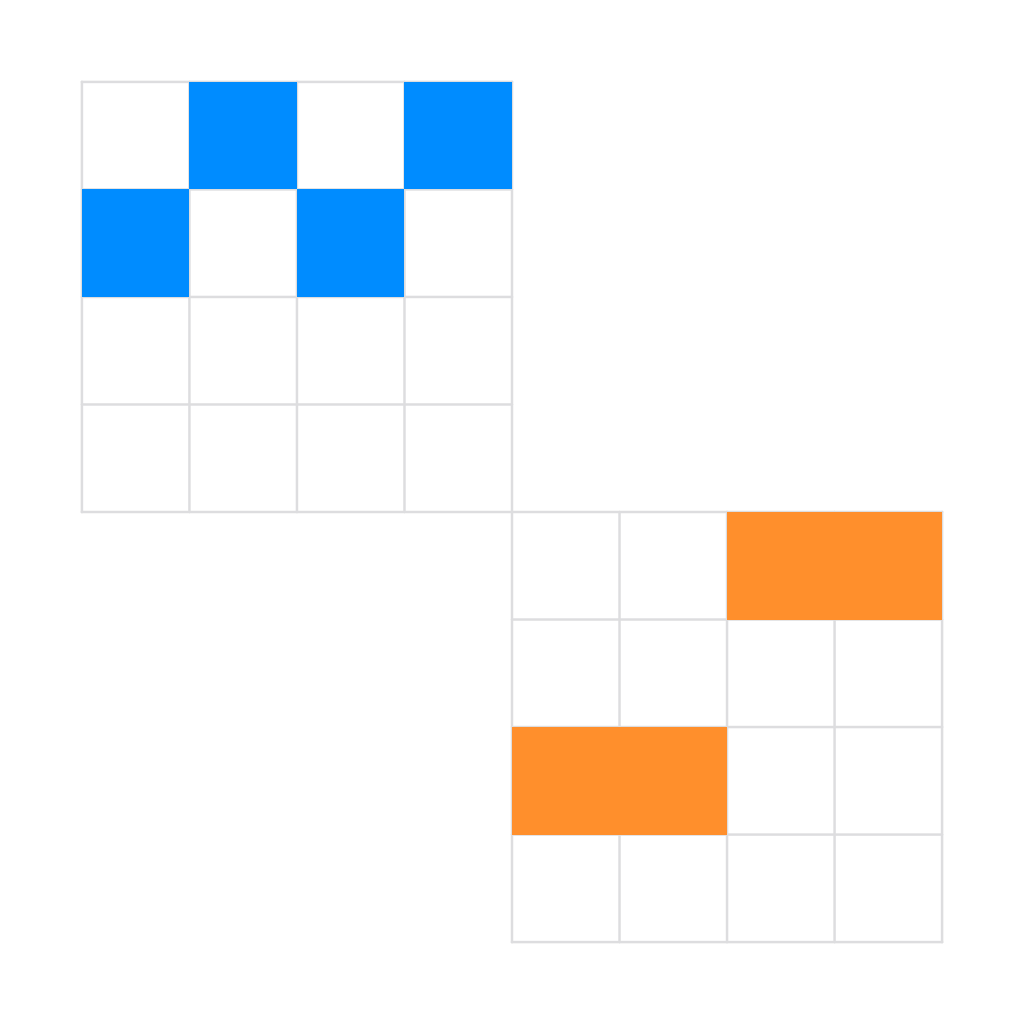
Order Sensitivity of Kronecker Design Words: What the Perfect Shuffle Cannot See
what survives swapping nested patterns, and the connectivity that does not.
2026-08-23revised 2026-09-08
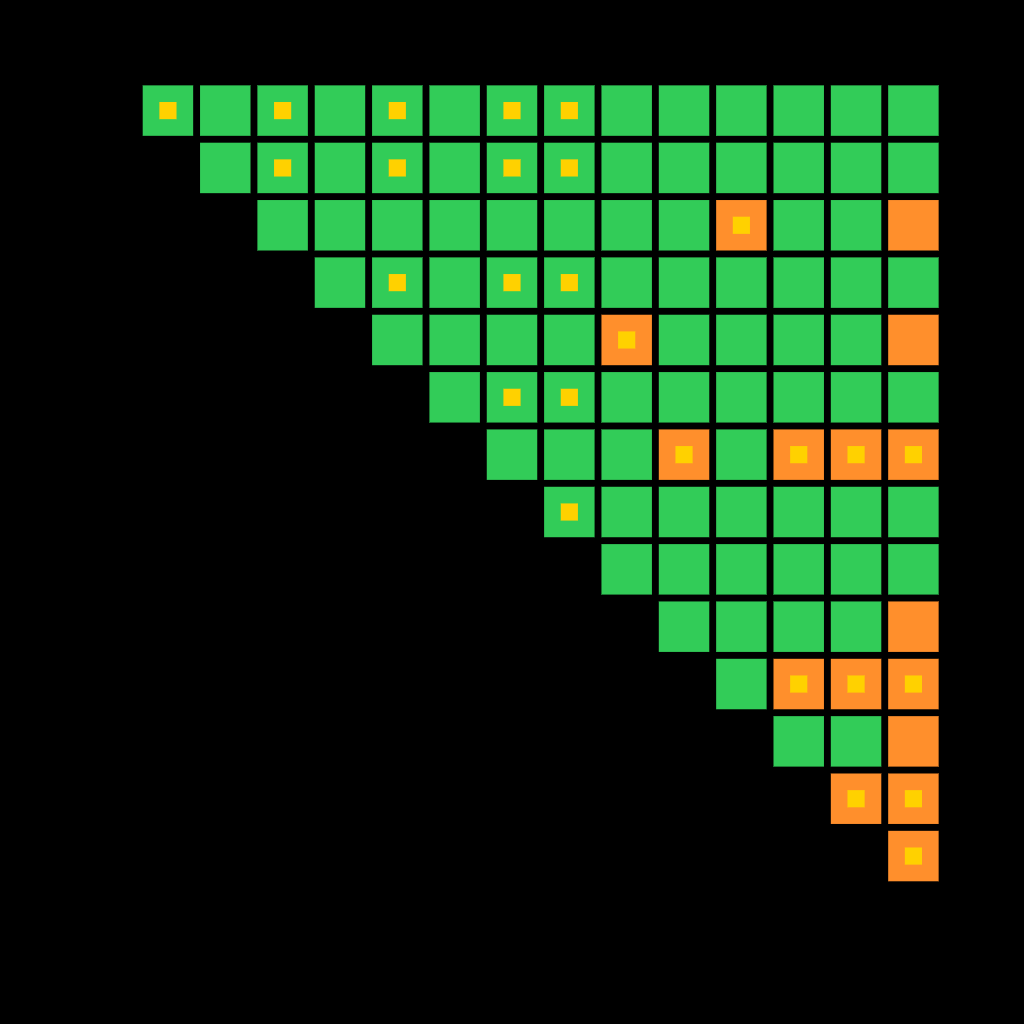
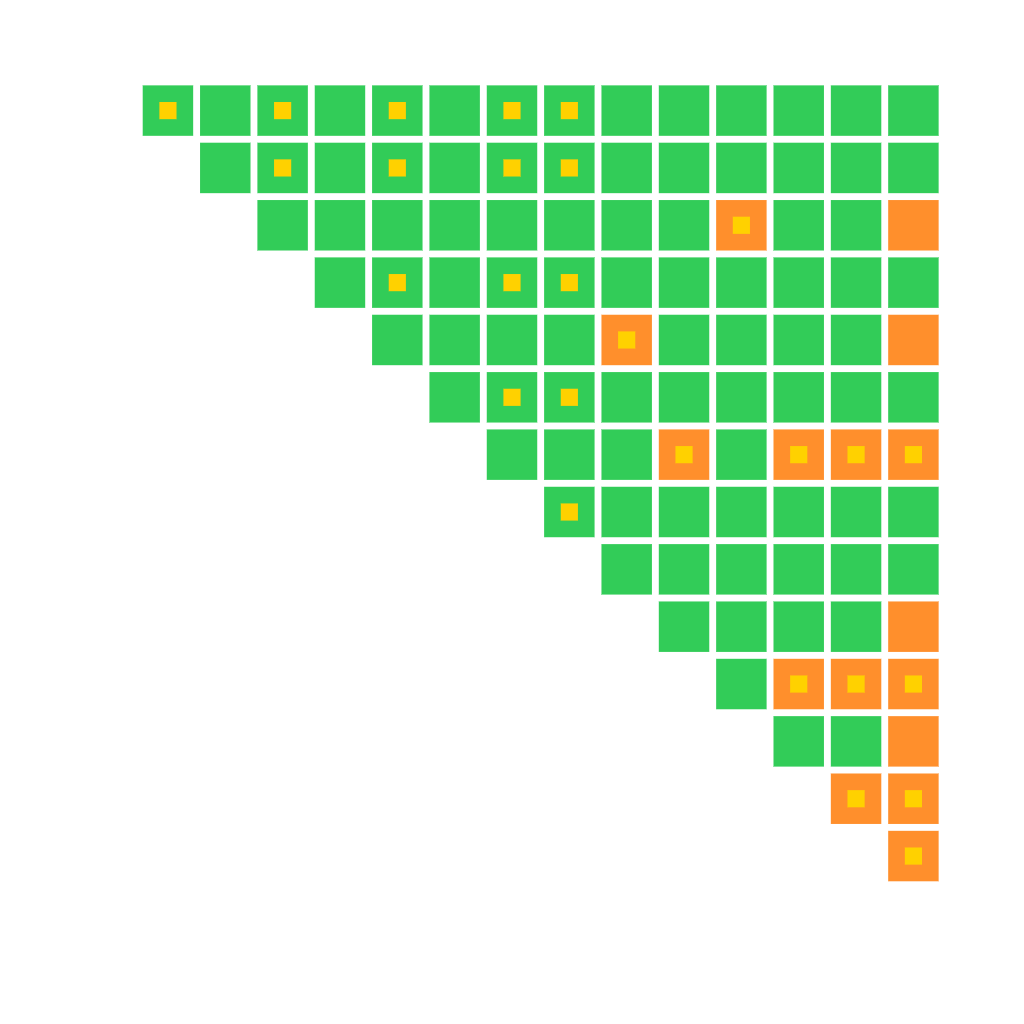
The Component Exponent of a Two-Letter Kronecker Word
the piece count of a two-letter nesting has a closed form on all 105 alphabets, so its growth rate exists, is order-blind, and mostly just repeats the cell count.
2026-09-02revised 2026-09-08
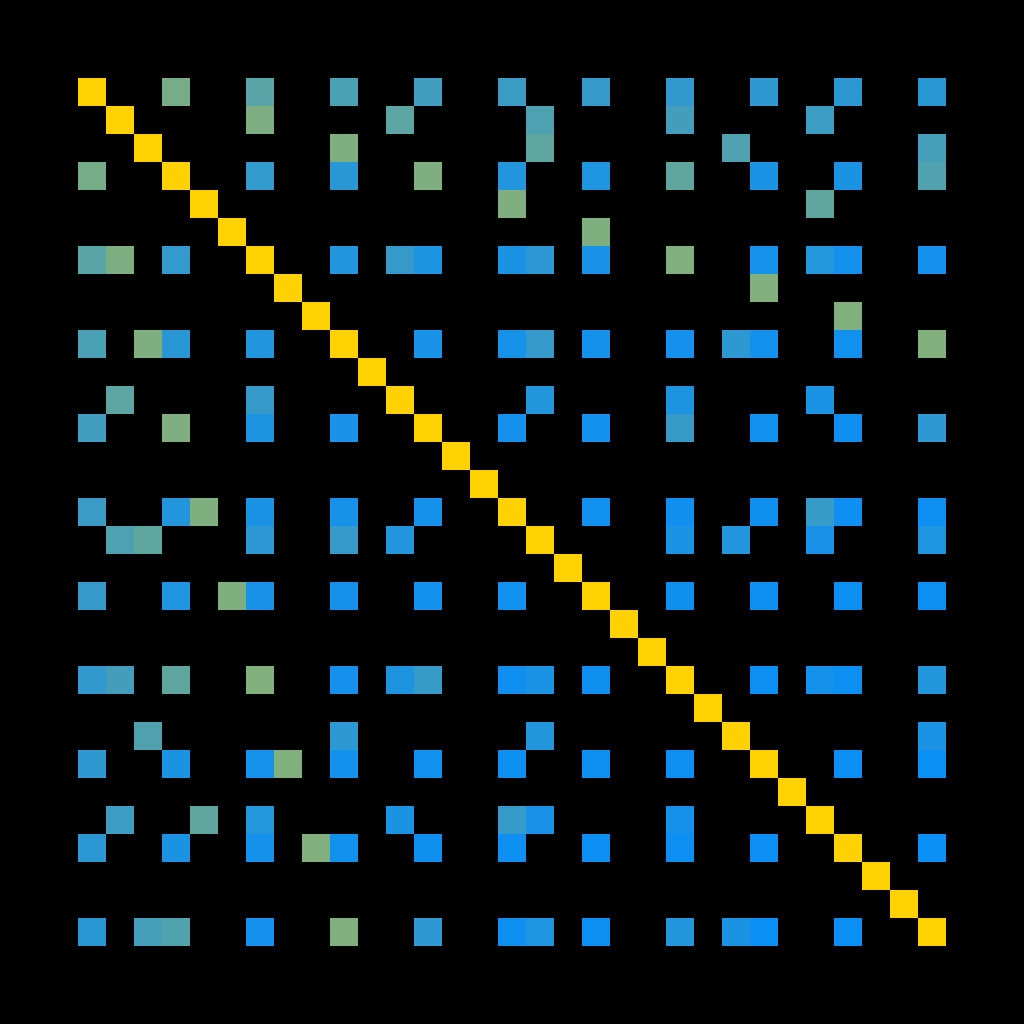
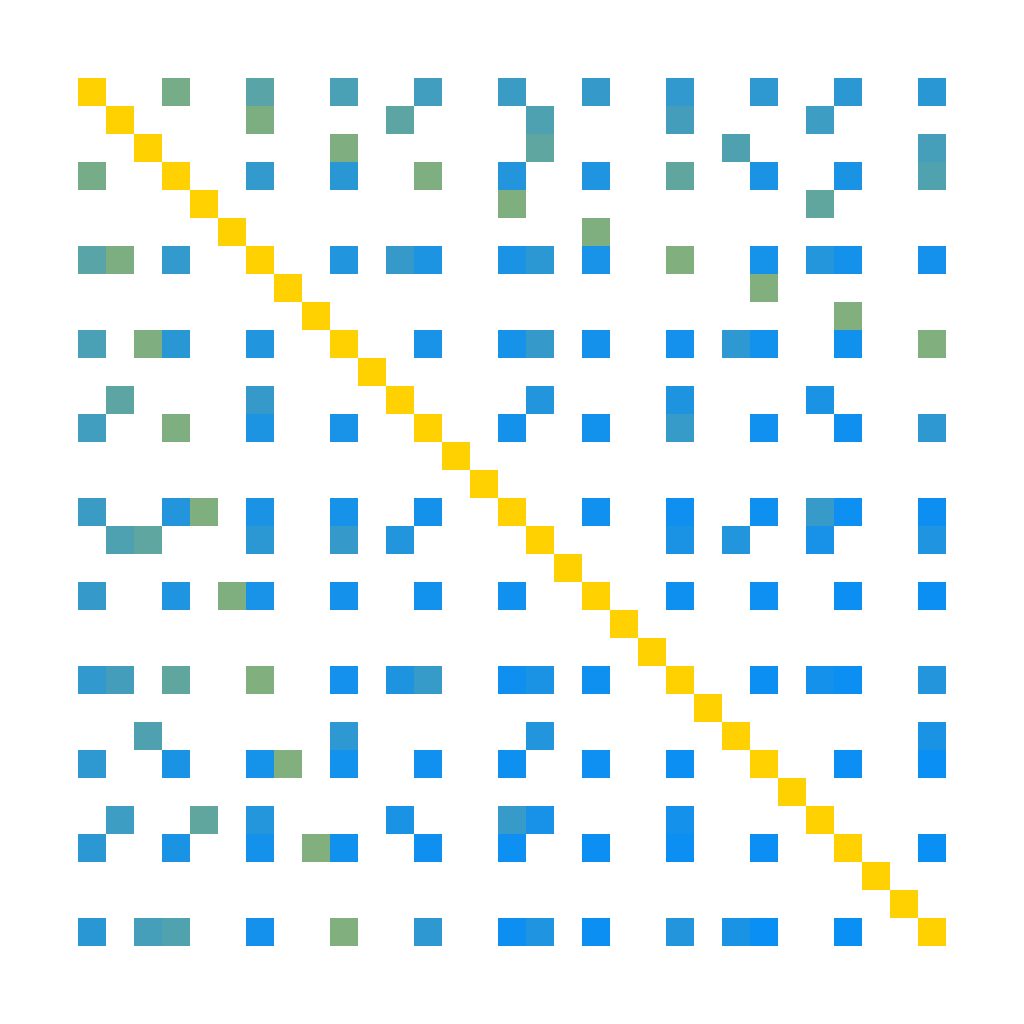
Parity Carpets Correlate by gcd: Four Exact Laws for a Square-Wave Stack
two parity carpets agree by an exact gcd law, zero exactly when the scales are coprime; the stack's full spectrum is the squared-divisor field of the frequency gcd, zeta quotients and nothing more.
2026-08-23revised 2026-09-08
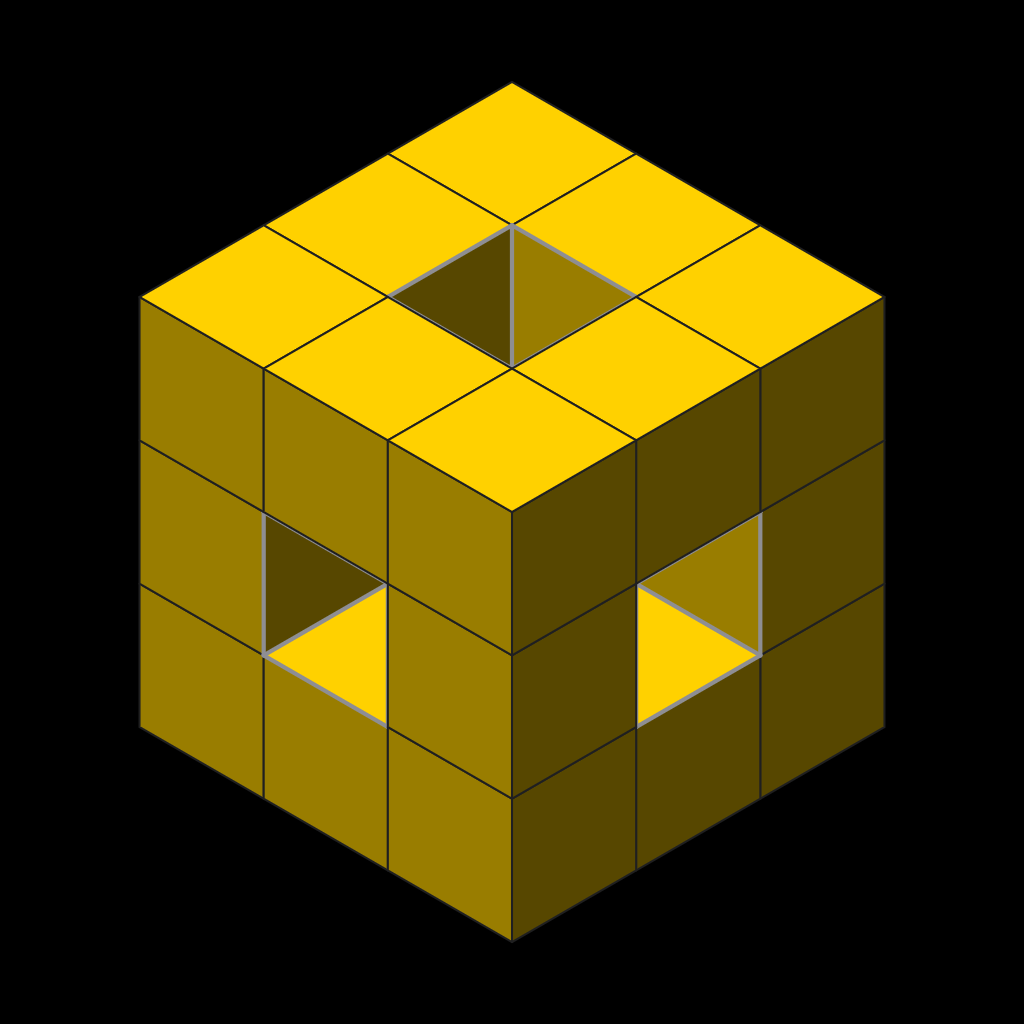
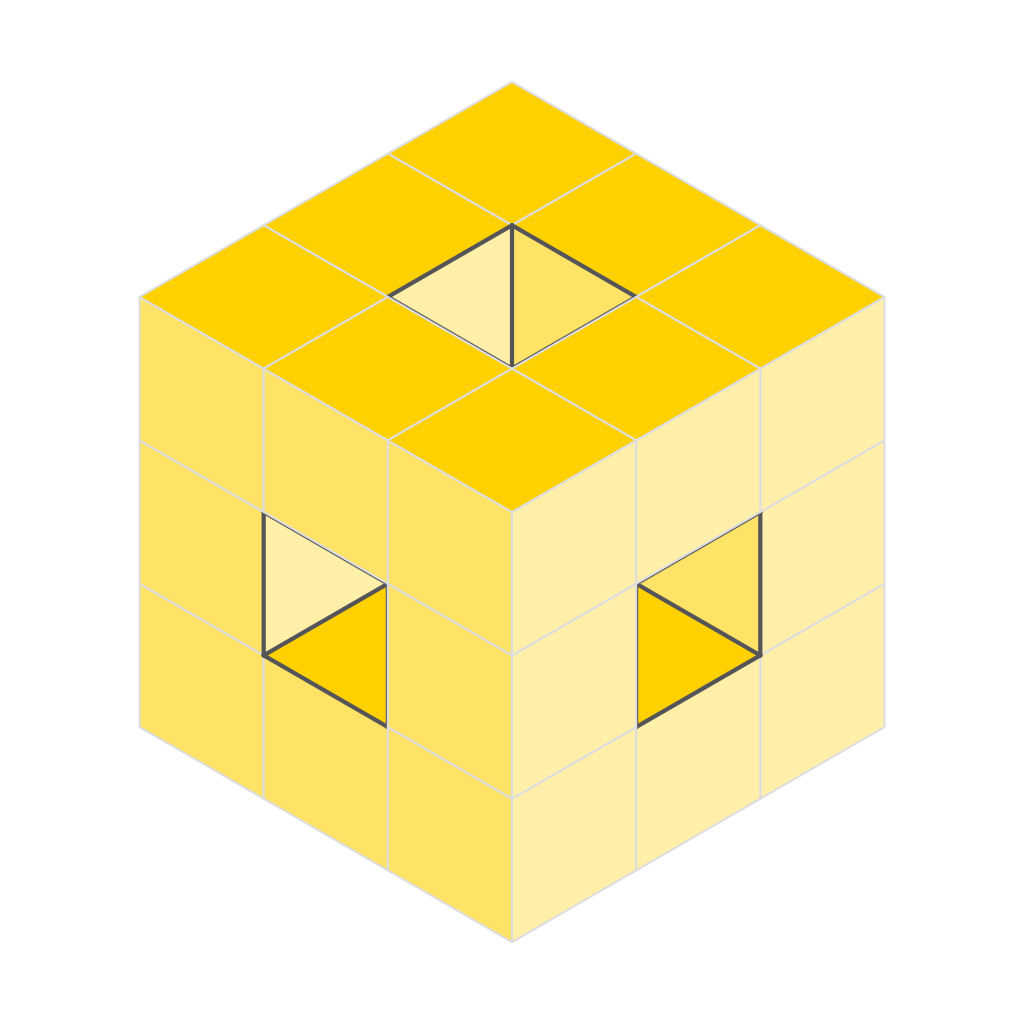
Divisor Avatars: Which Parity Designs Count the Divisors of a Power
when a parity design's cell census is the divisor count of a power, and exactly which integers have one.
2026-08-23revised 2026-09-08
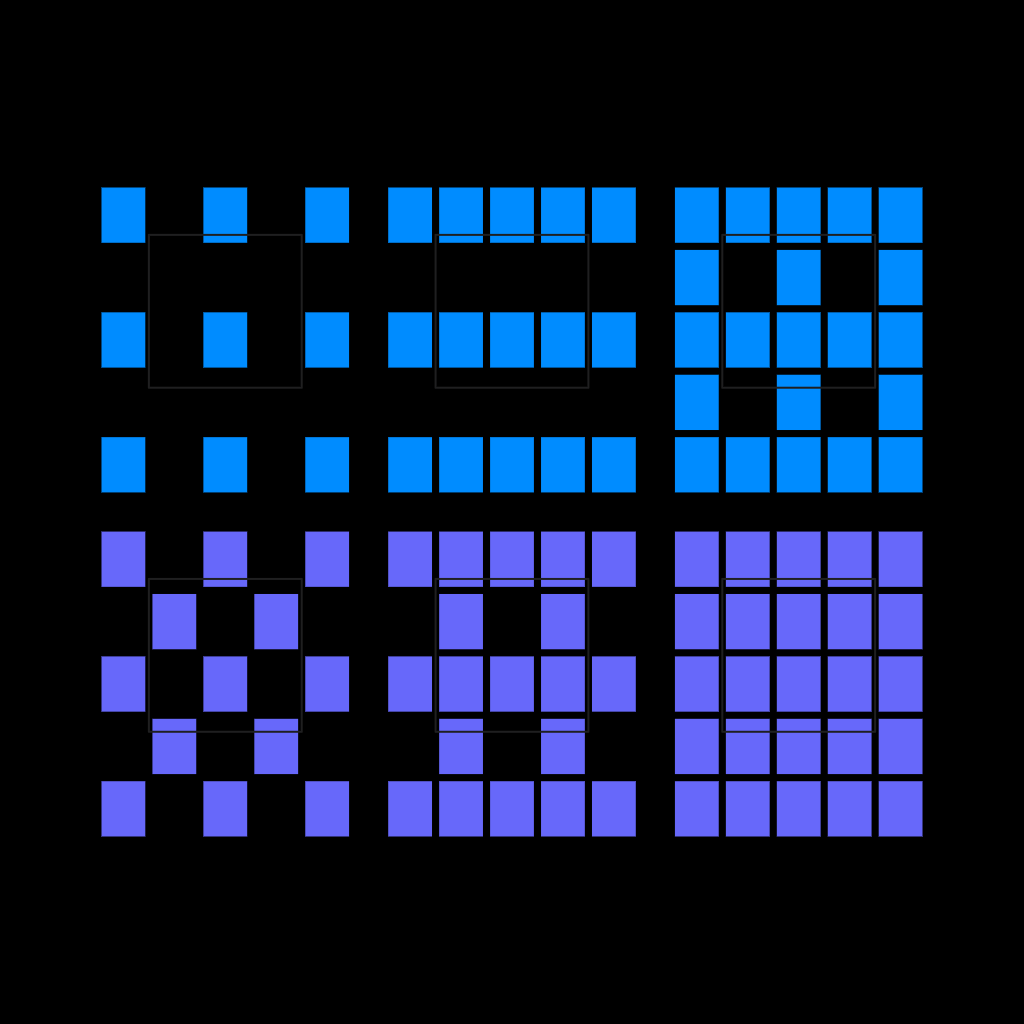
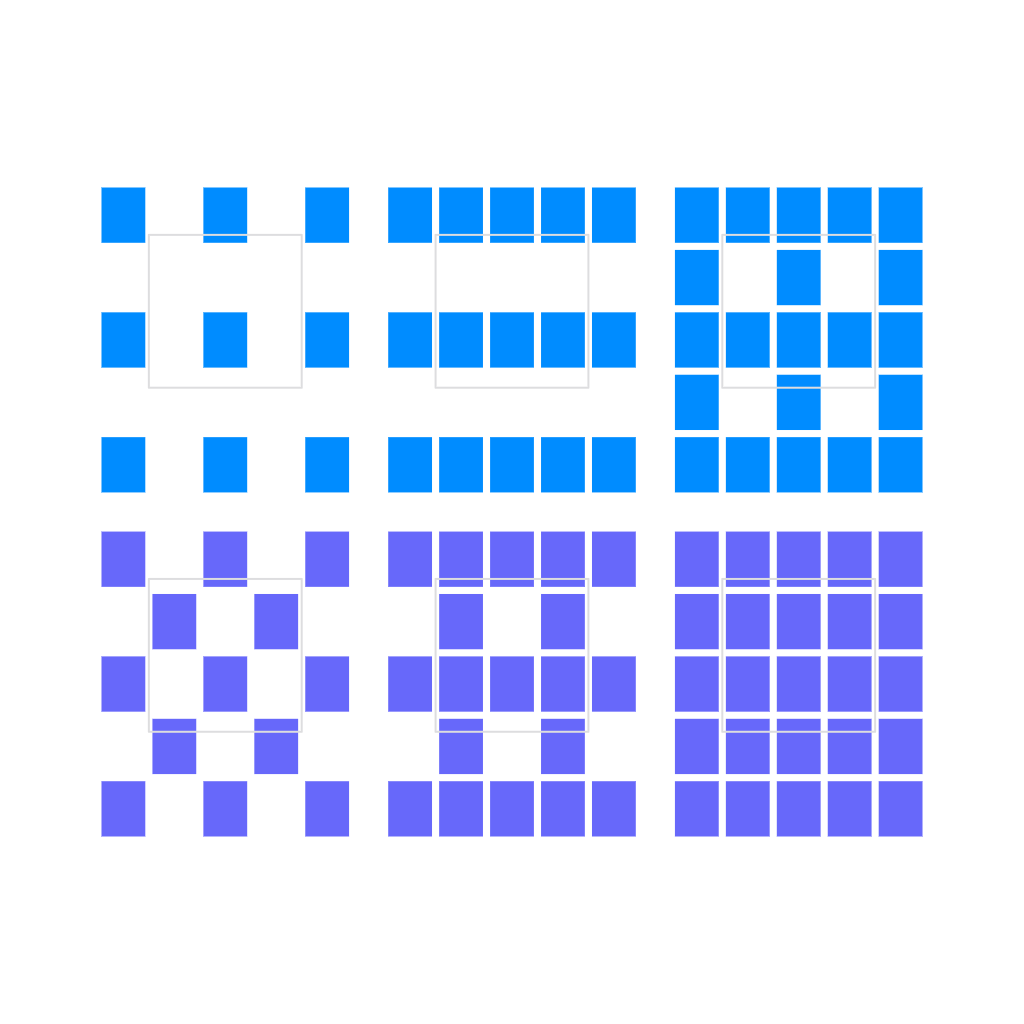
The Sequence Census of a Parity Design
how many integer sequences a parity rule can write, which ones the catalogue already holds, and why the polygonal numbers keep turning up.
2026-08-31revised 2026-09-08
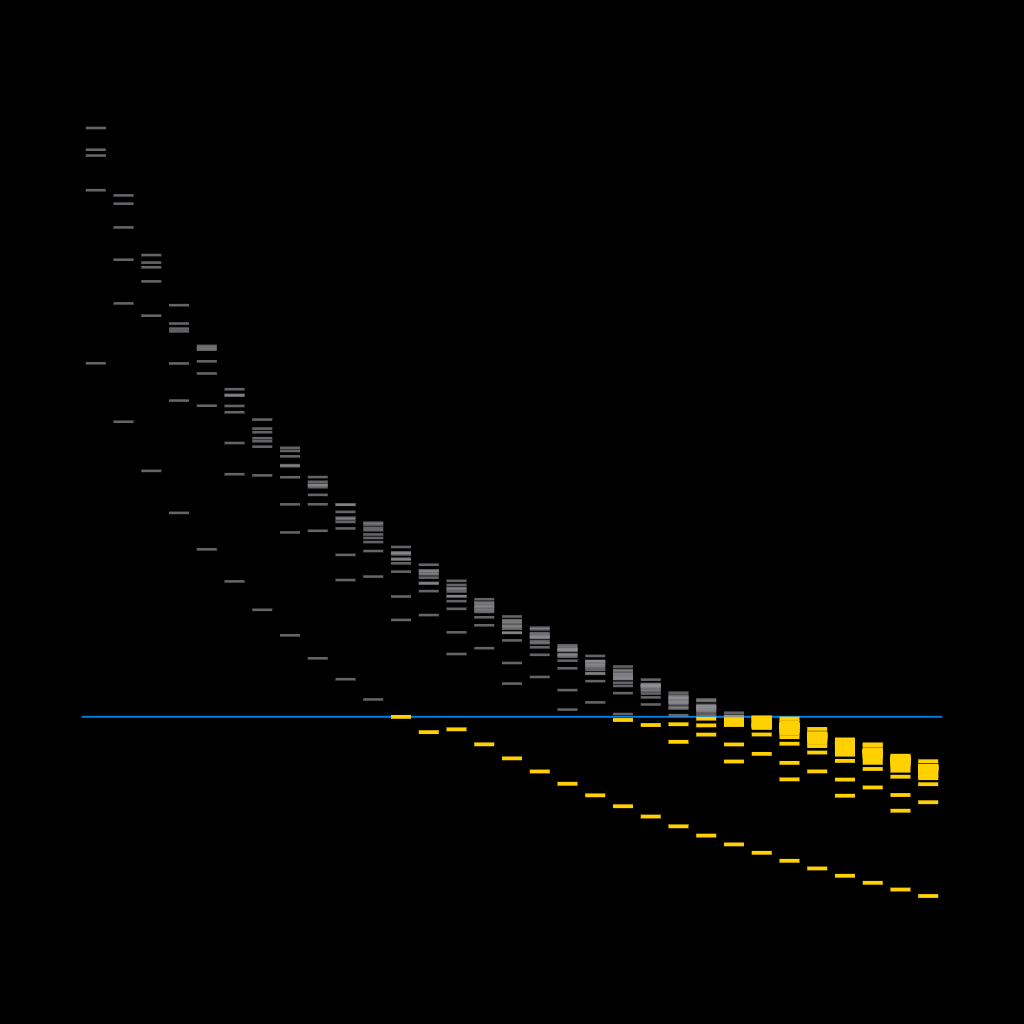
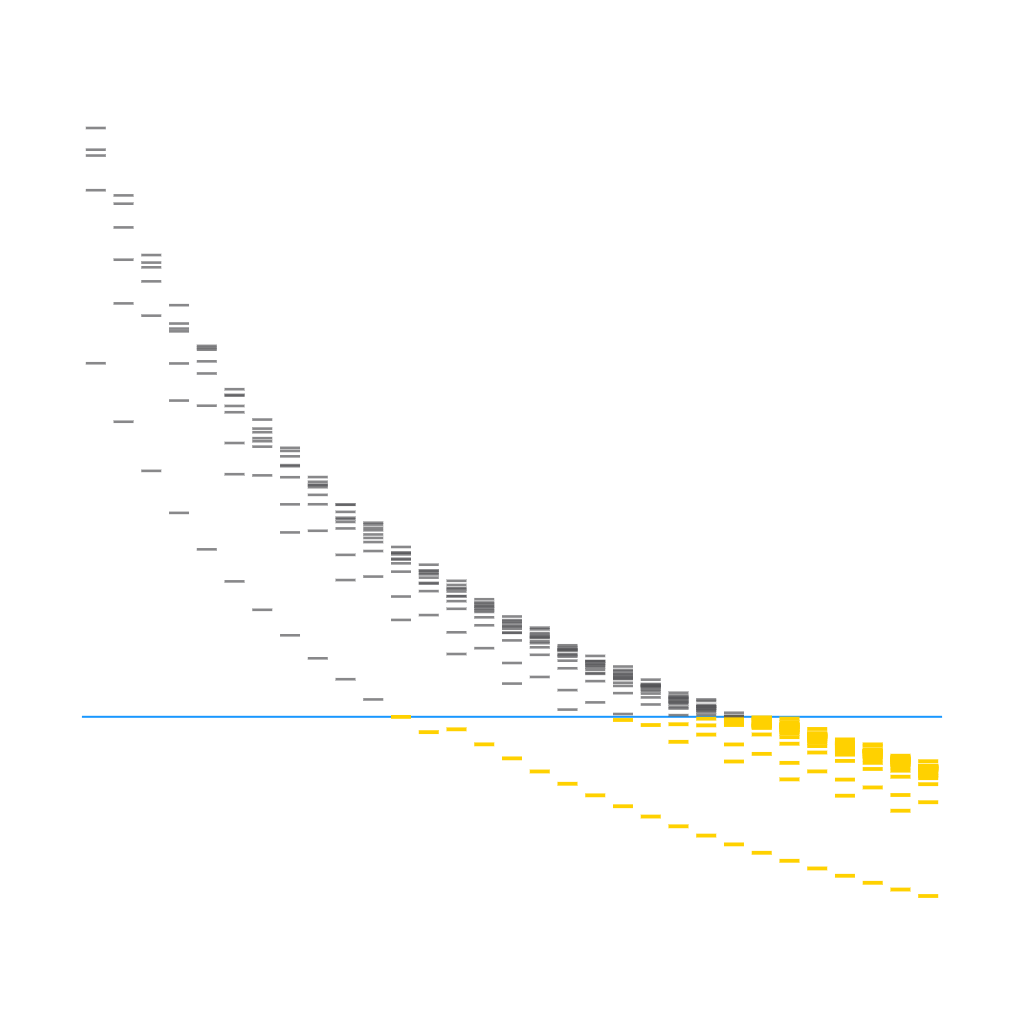
The First Base Below a Quarter
the least base whose one-missing-digit set has Fourier l^1 exponent below a quarter, and the least base whose every digit clears.
2026-09-07revised 2026-09-08
The Dirichlet Inverse of a Digit Design and the Transport of Zeros
the design's own Mobius function, and the zeros of its zeta that push its partial sums past the design's own size; still owes its outside read.
2026-09-07revised 2026-09-08
Research
Discoveries
The Apollonian gasket
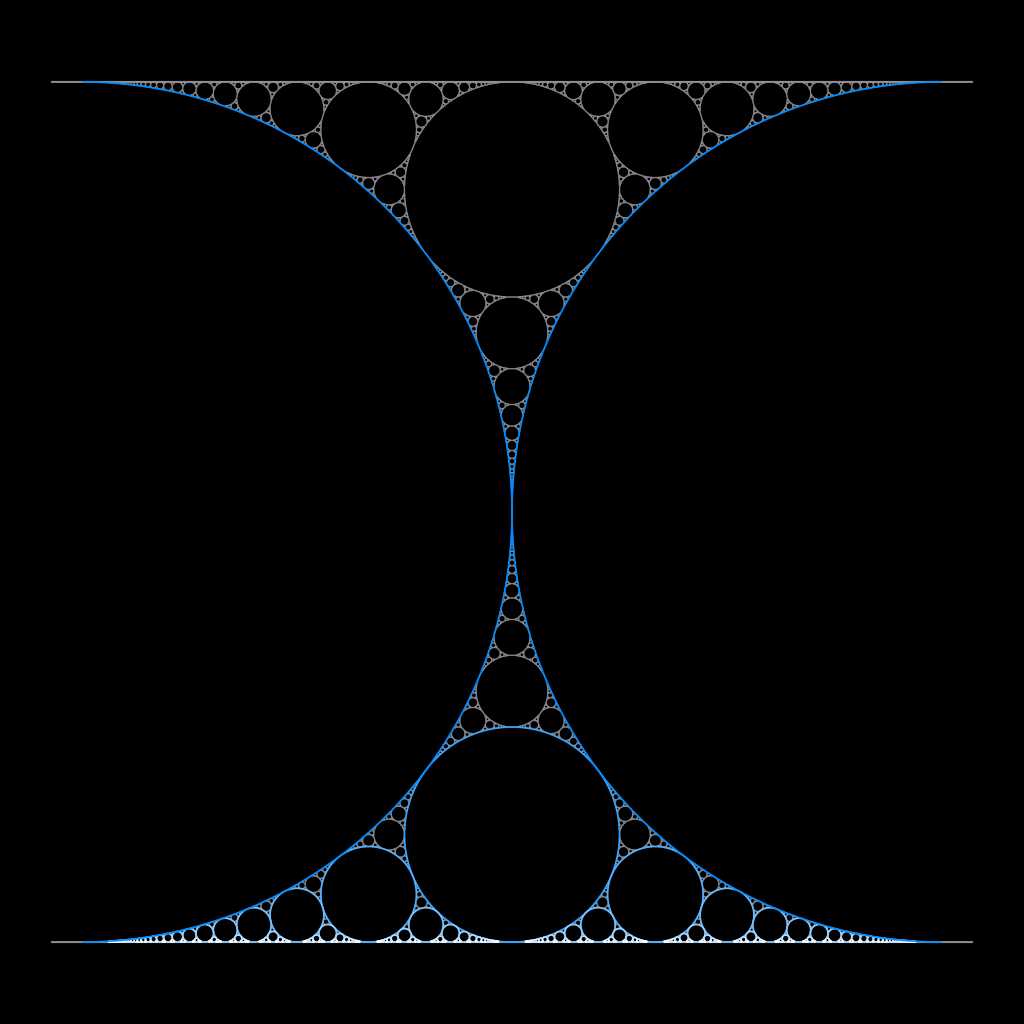
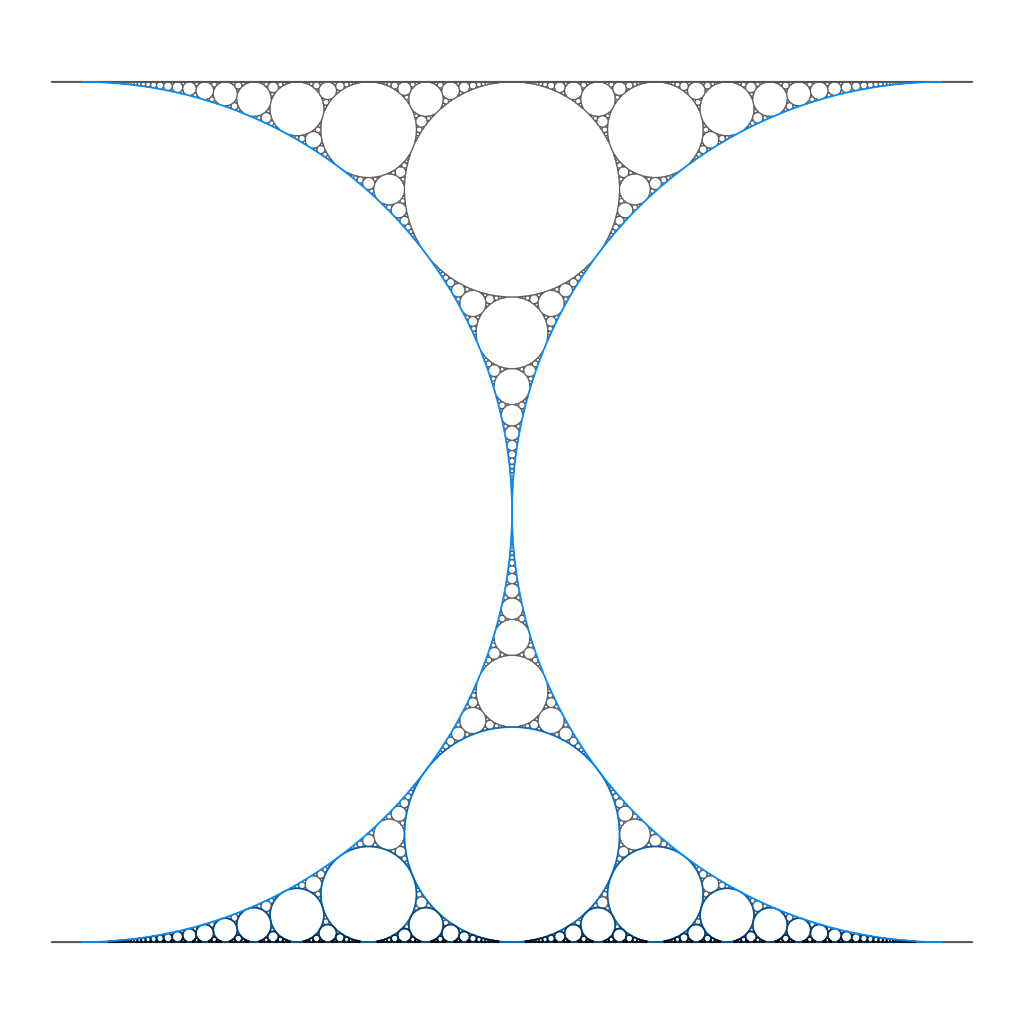
The circle face of the stack: the Descartes reflection as exact integer arithmetic on `(k, k x, k y)`, the strip packing's line-tangent circles proved to be exactly the Ford circles so the Farey stack is the packing's shadow with brightness `floor(Q sqrt(2/k))`, the curvature census, root quadruple excluded, whose exponent by ratio lands at `1.305` against the rigorous residual dimension, the eight residues mod 24, and why no design of base at most 100 carries that dimension.
The automata
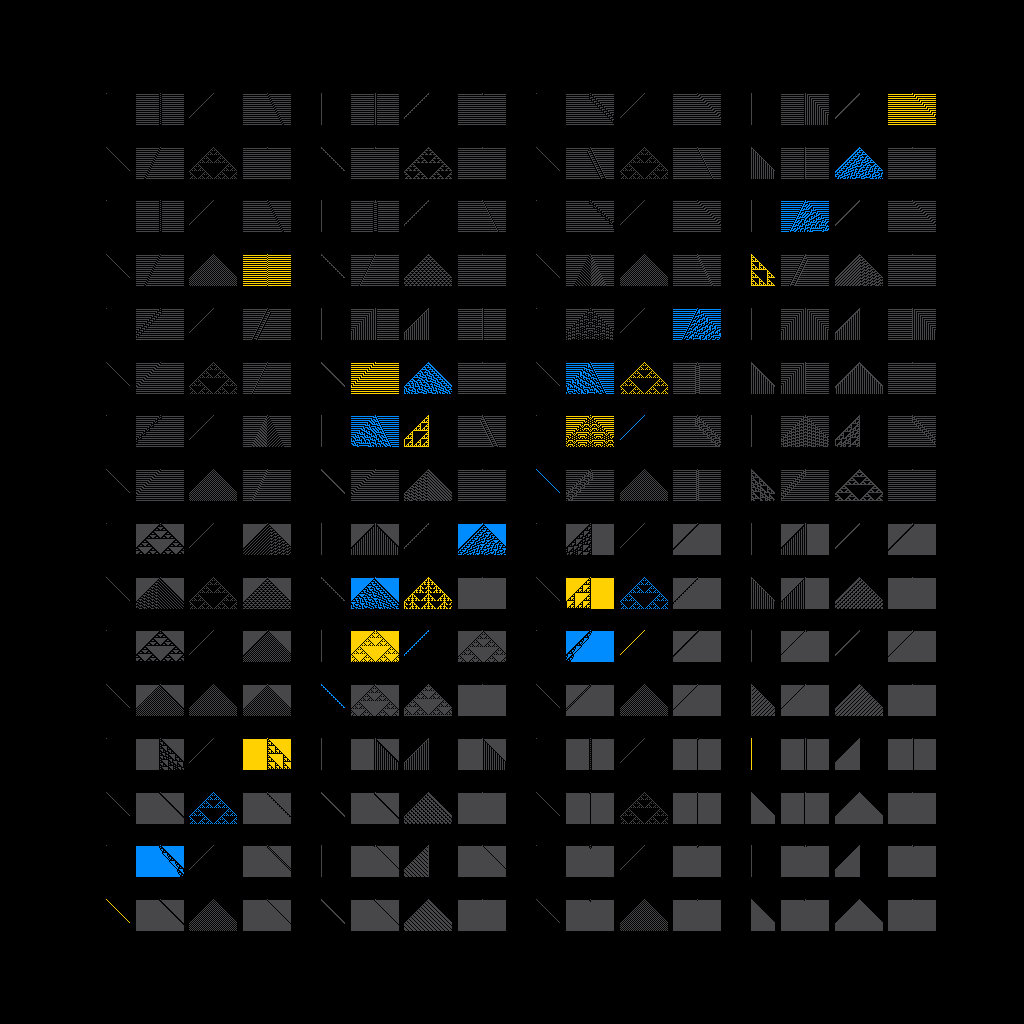
An elementary cellular automaton is a three-dimensional design read as a rule and Life a nine-dimensional one: what the identity buys, and what it cannot.
What base 3 hides
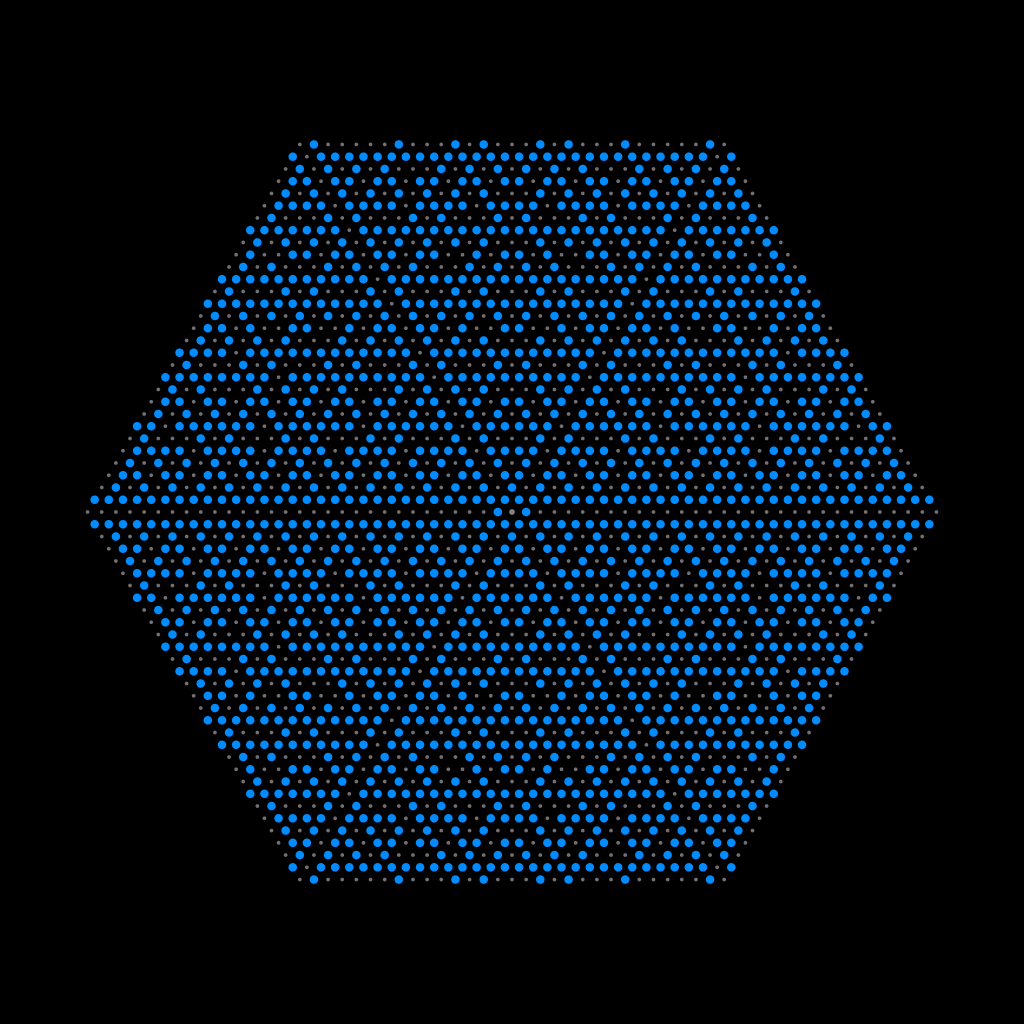
What base 3 hides: an Eisenstein L-value where base 2 hid pi, and the collapse theorem that turns any multiplicatively dependent family of bases into one design in base `r^lcm(e_i)`.
Beneath a design
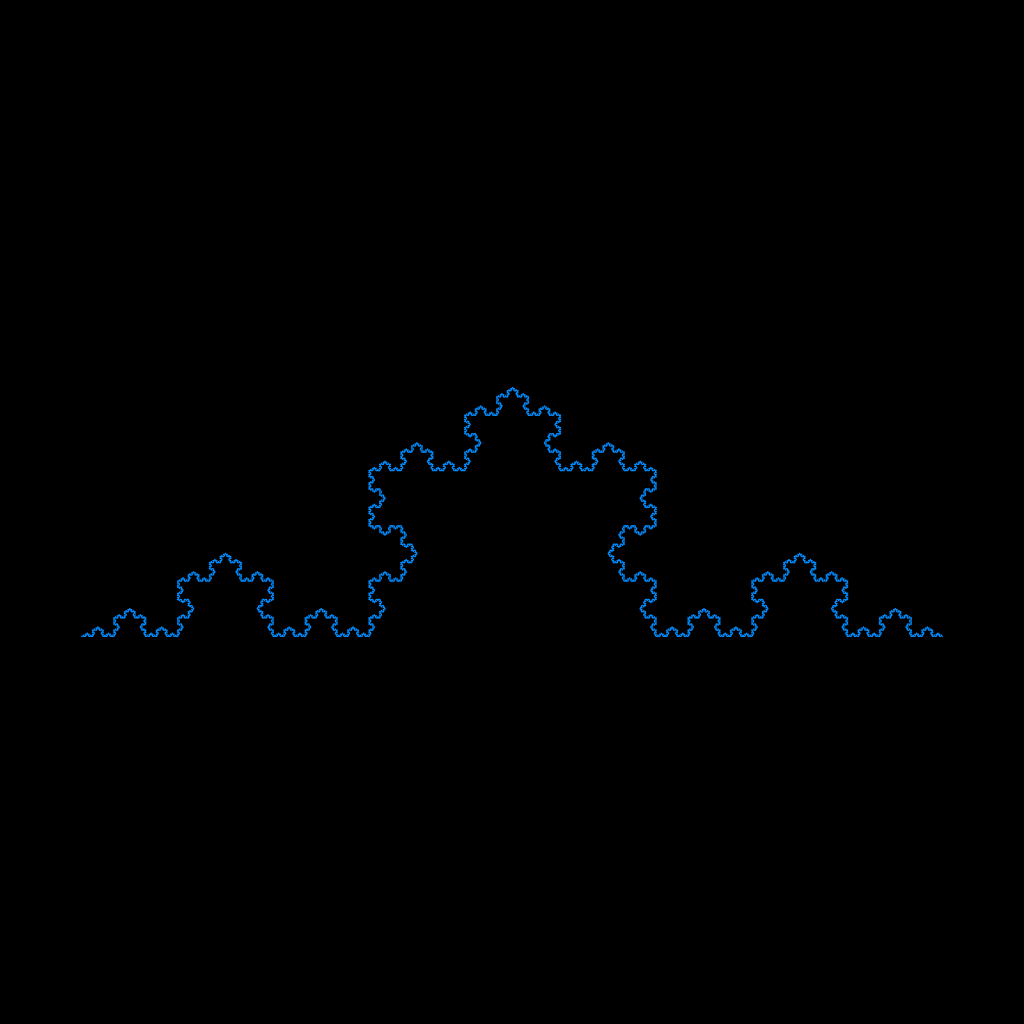
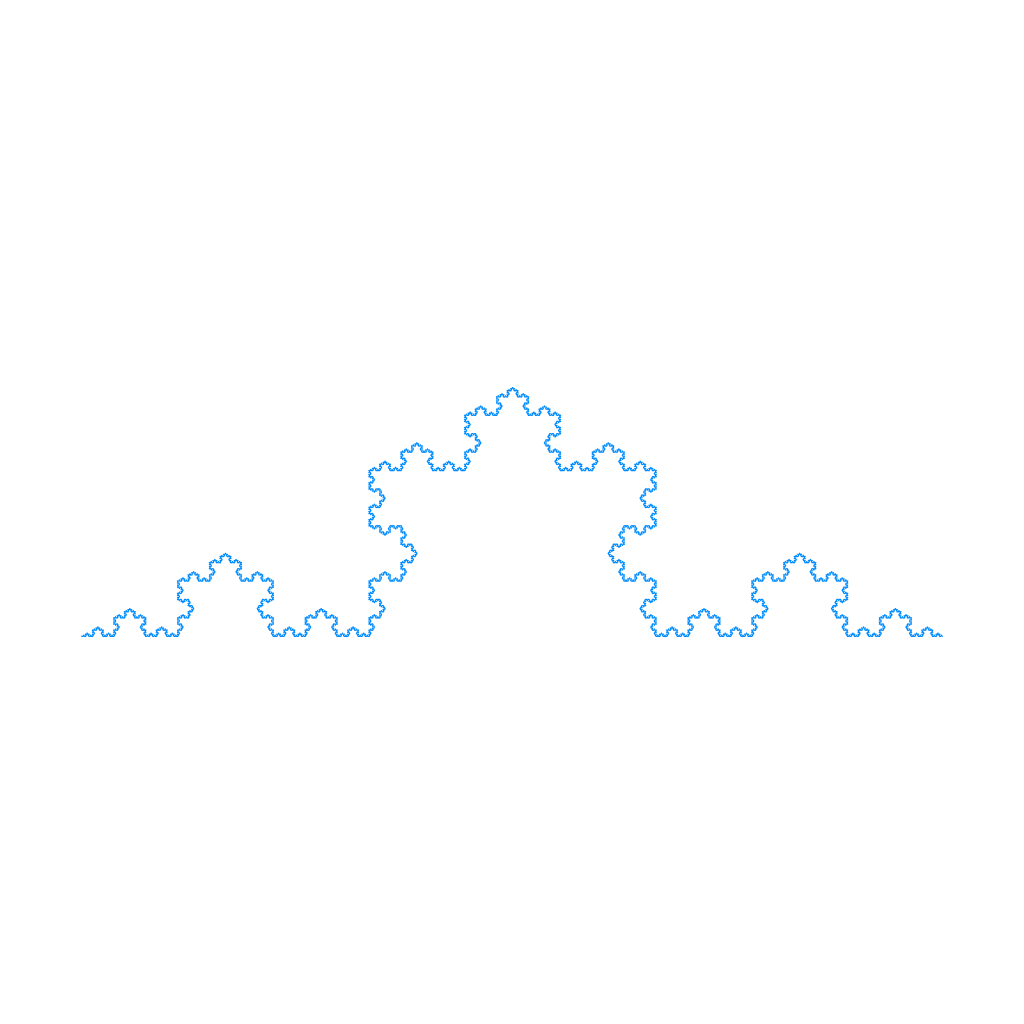
The object beneath a design as three slots, accept, place and glue: the memory dial priced by a transfer matrix with `kappa` zero on exactly the non-empty product rules over `19563` live classes, the Collatz carry landed on that dial as a four-state transducer of unbounded radius whose zero-carry sets are the golden and supergolden rules at `3n + 1` and `7n + 1`, and the radix dial that keeps every count, carries the gasket, the dragons and the Koch curve as codes with a twist vector, and loses the fill law the moment a digit turns; the Mobius meter of every width-three rule to `2^30` against its own mass, the memory zeta as a matrix ladder with one pole comb per eigenvalue, and the design census up to similarity and up to affine conjugacy.
A design is a Boolean function
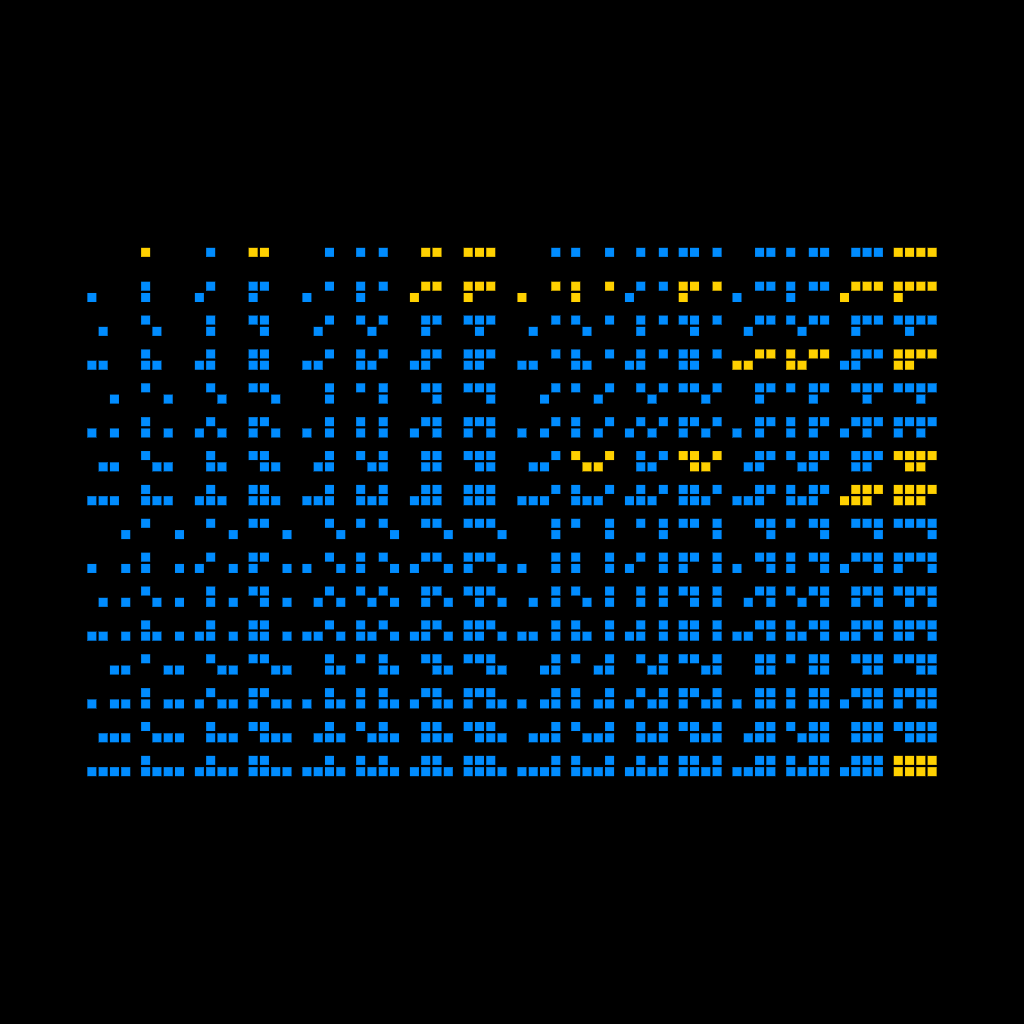
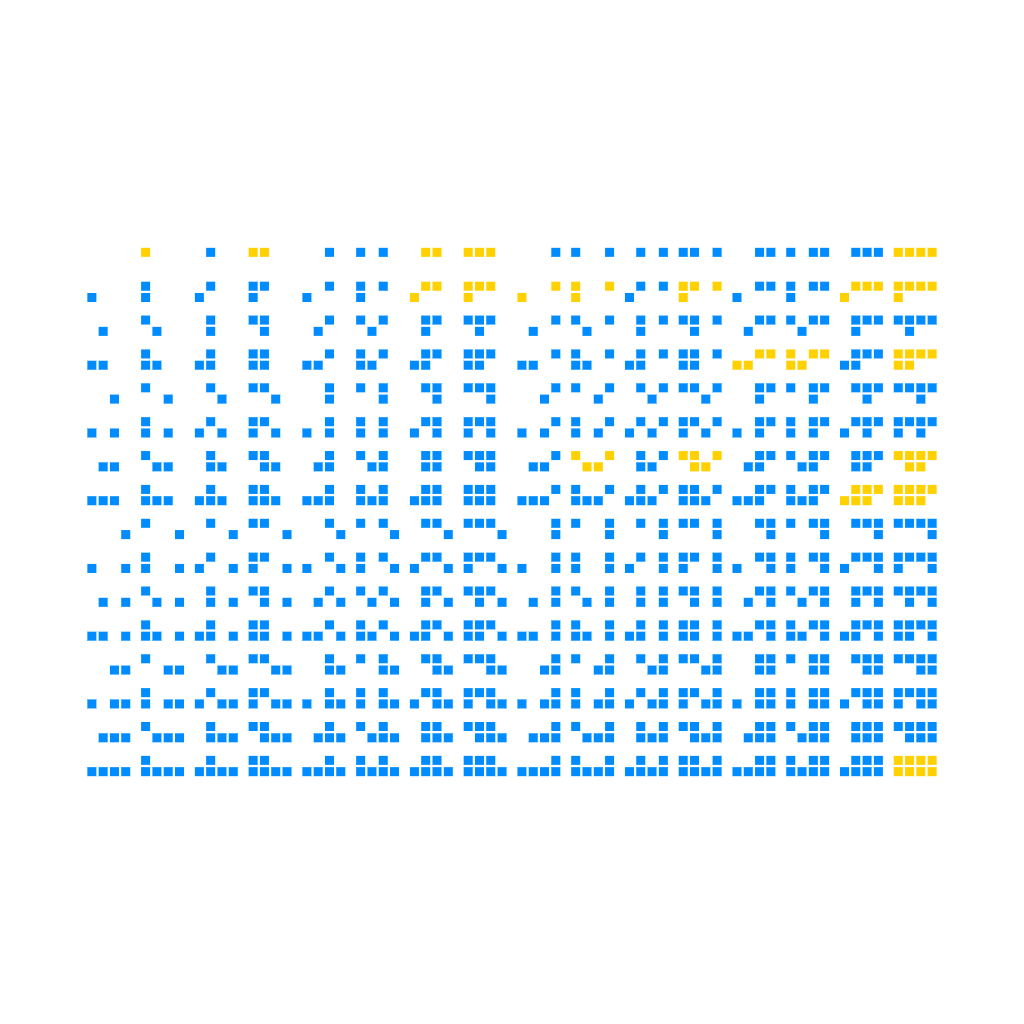
Designs are Boolean functions up to cube symmetry; the strongest theorem in the tree.
Two bases
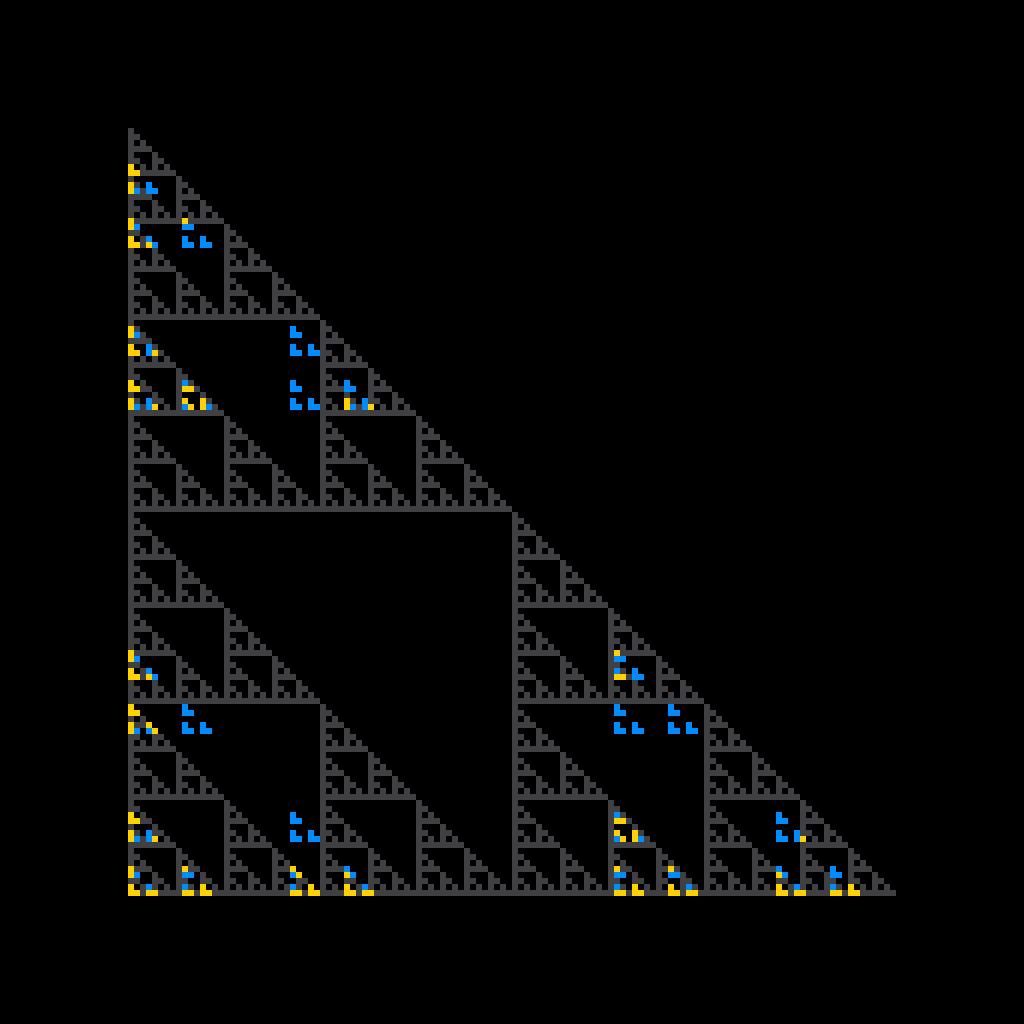
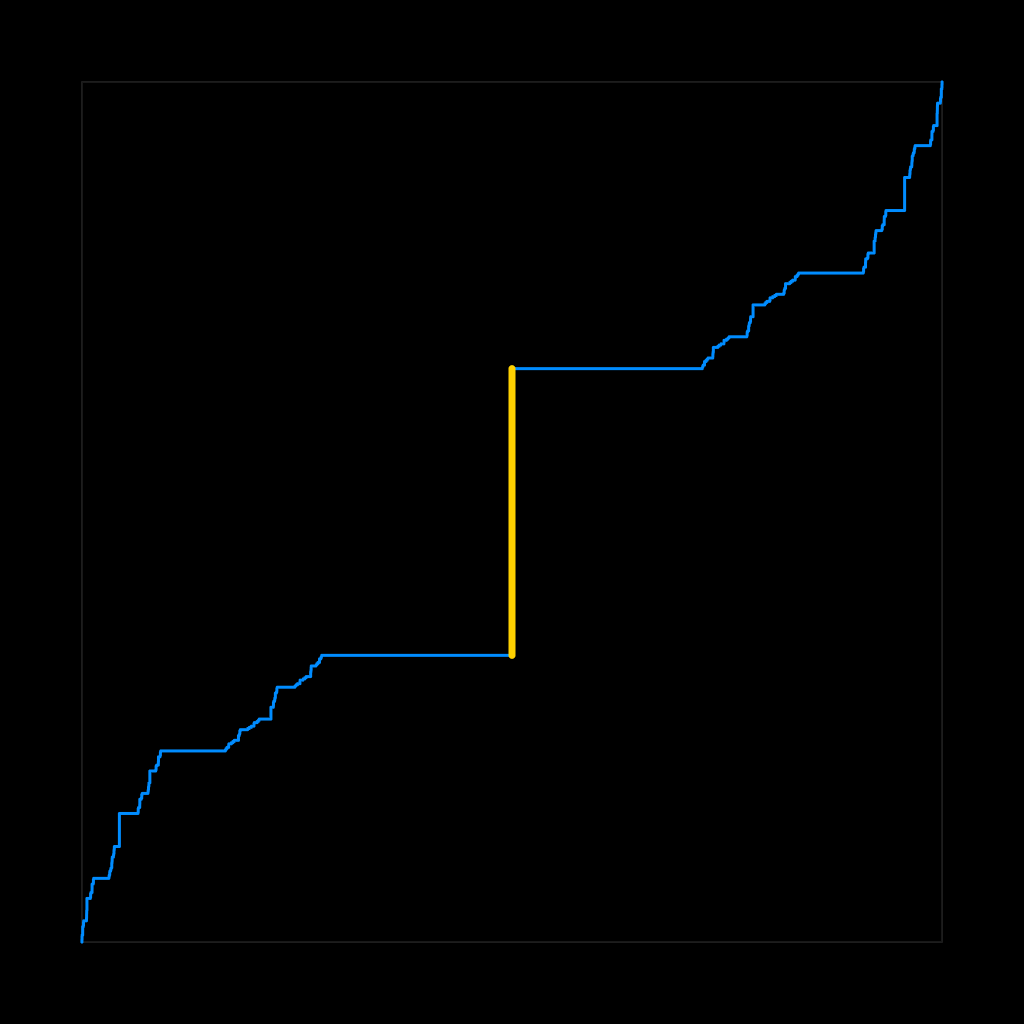
What a second multiplicatively independent base does to a design: Cobham and Cobham-Semenov at their sources, every proper dim 1 design proved base-locked by density alone, the semilinear designs of dim at least 2 pinned between a proved count condition and the block designs with the diagonal as the standing counterexample, the global planar budget Refuted twice and replaced by one budget per axis for product designs, the base-2 gasket against the base-3 gasket counted exactly to `3^24`, and a three-base object on the line whose budget is negative, with five members and no sixth below a height of `38170` decimal digits.
Complexity
Boolean complexity of the catalog, and the Laplacian spectra of the fractals it builds.
Structure against noise
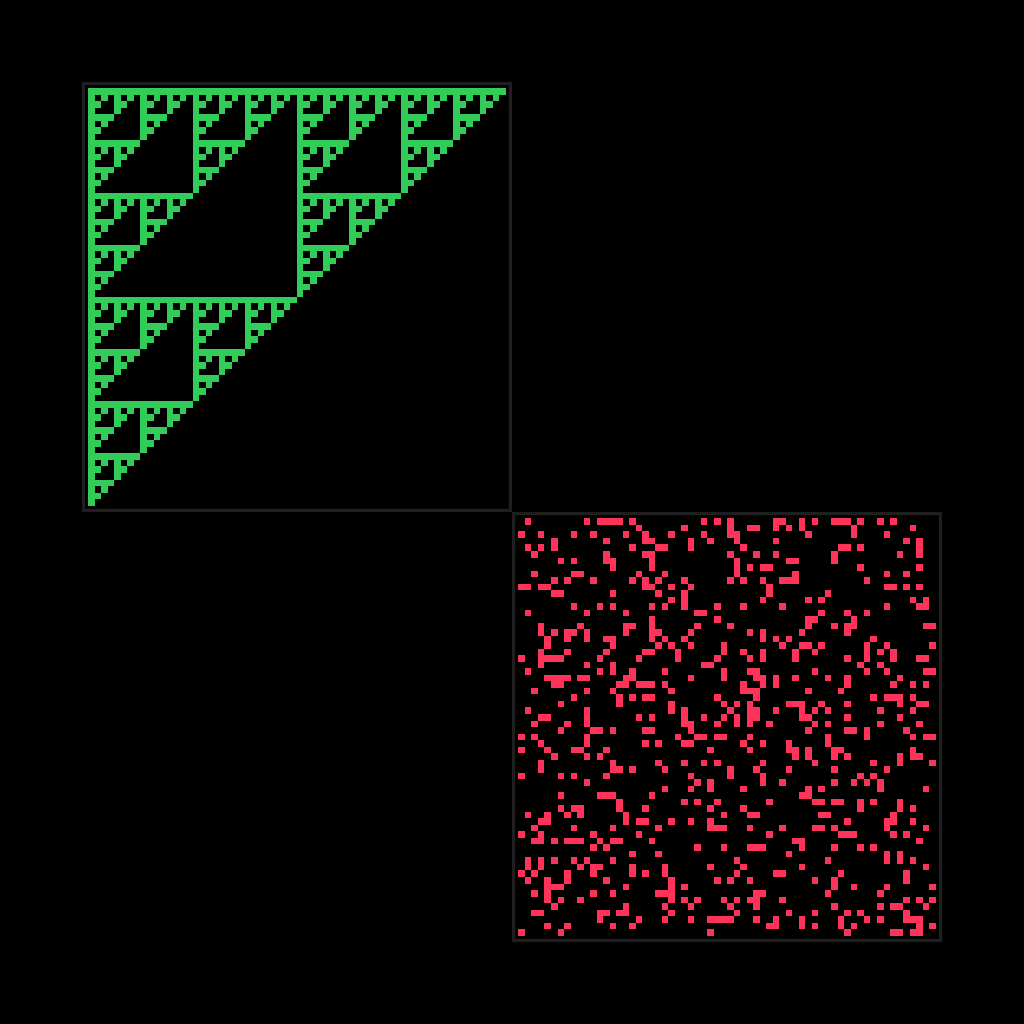
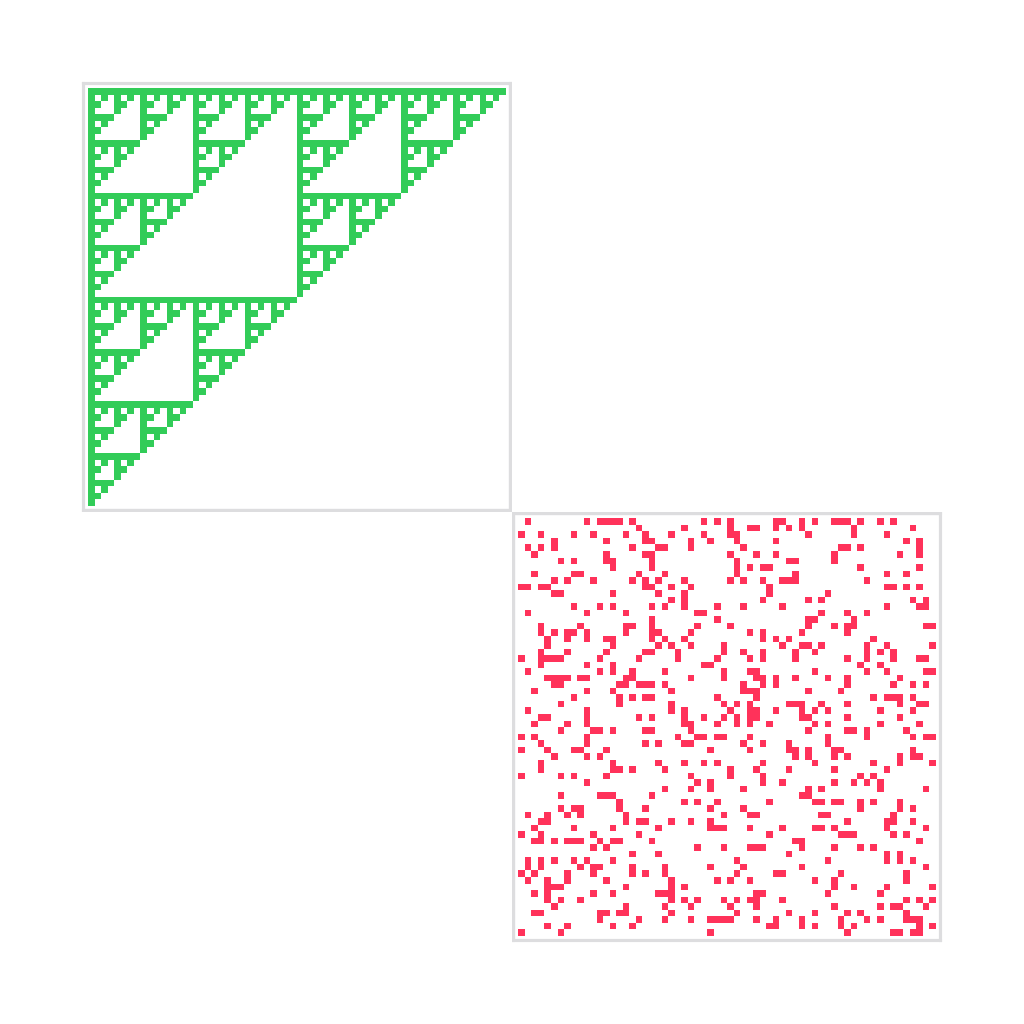
Self-similar designs raced against matched random cell sets on components and boundary.
The coprimality spine
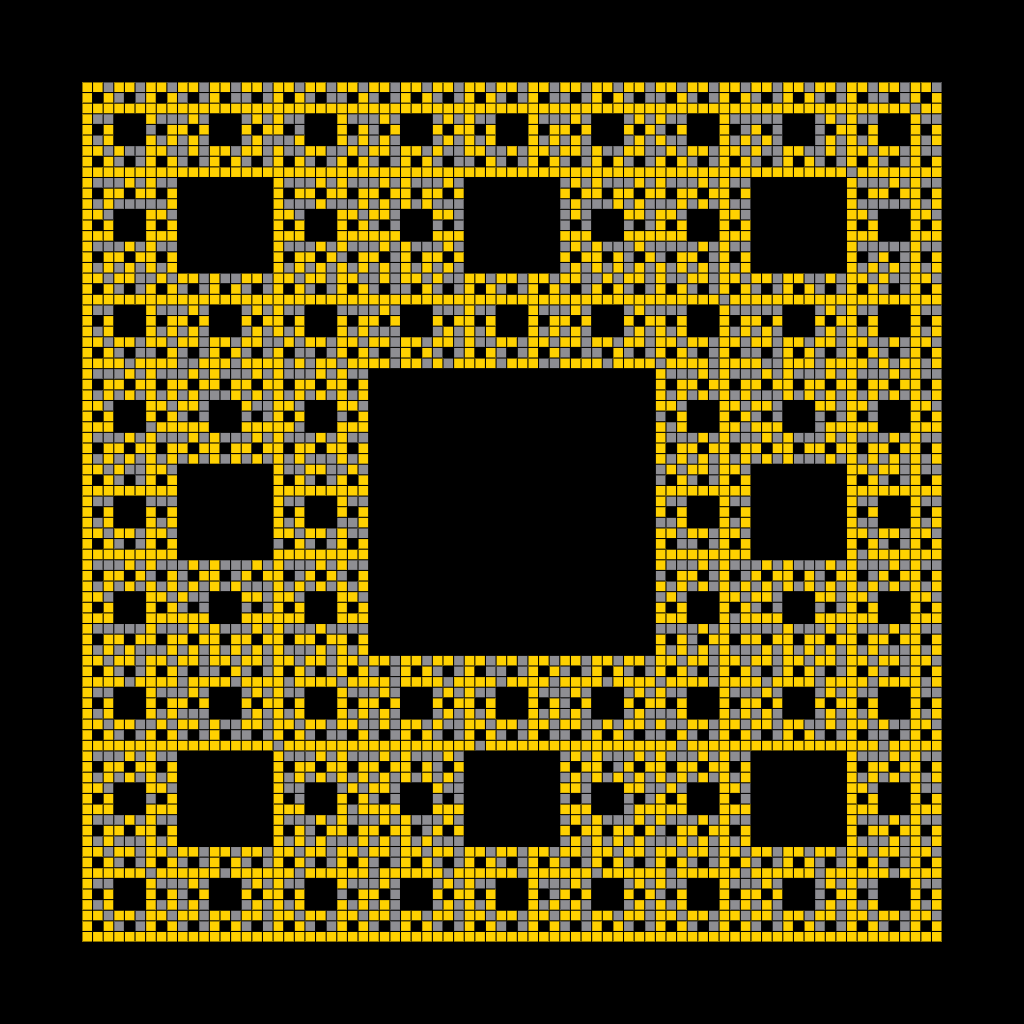
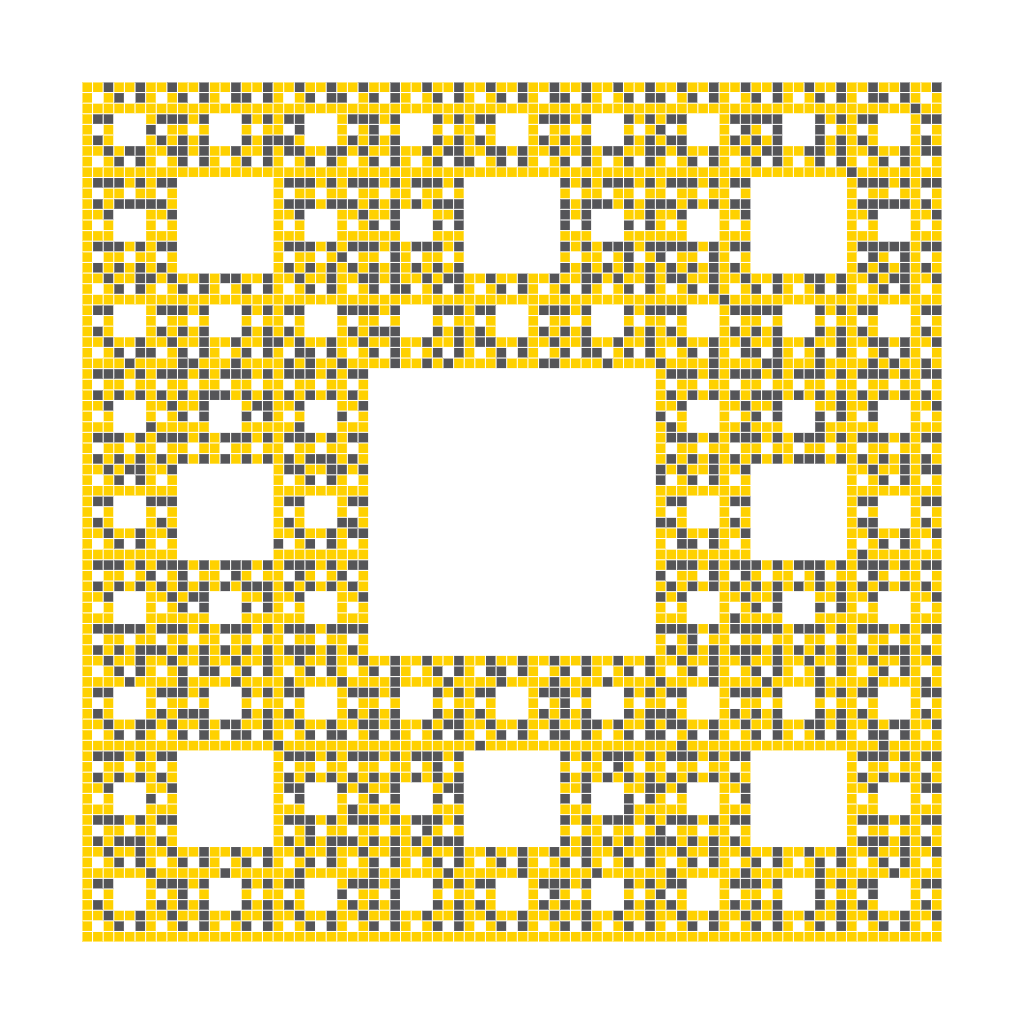
The coprimality spine: exact base-local factors on every design, the census behind them, the window at dimension one with the band automaton's critical out-degree and its algebraic block rate, and primes on a design, where the least base below the quarter threshold is 21 at one missing digit and 32 at two, the one-digit family closes at 34 and the two-digit family closes at 21 against the third.
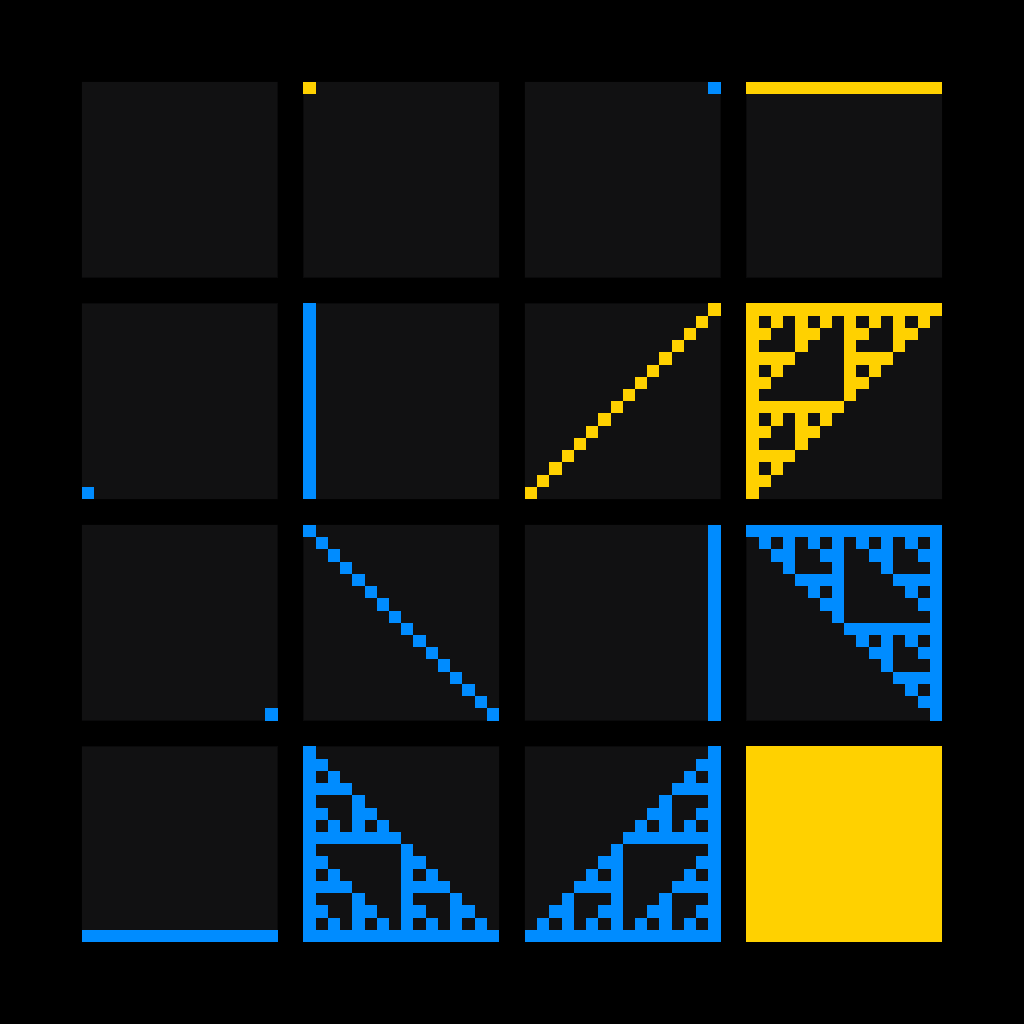
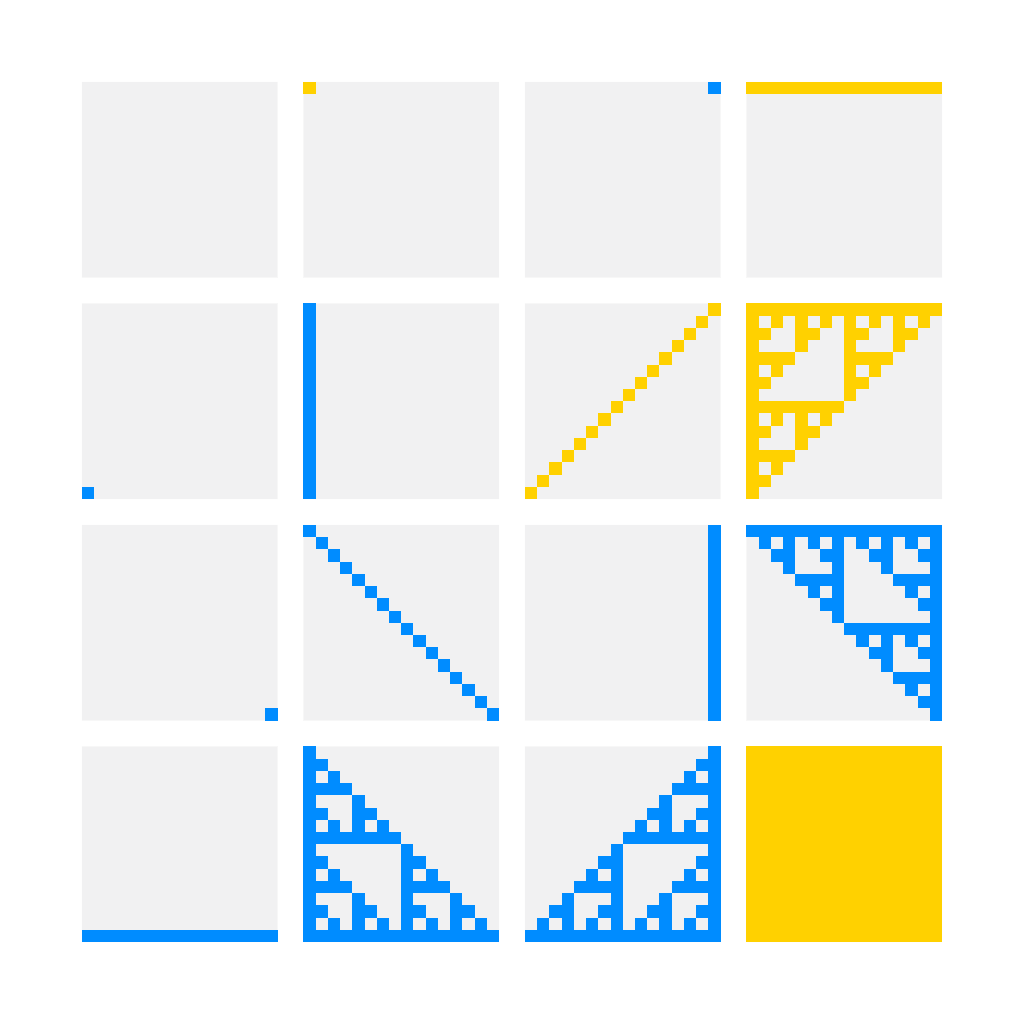
The core
What a design is, the headline counts, and the three genera.
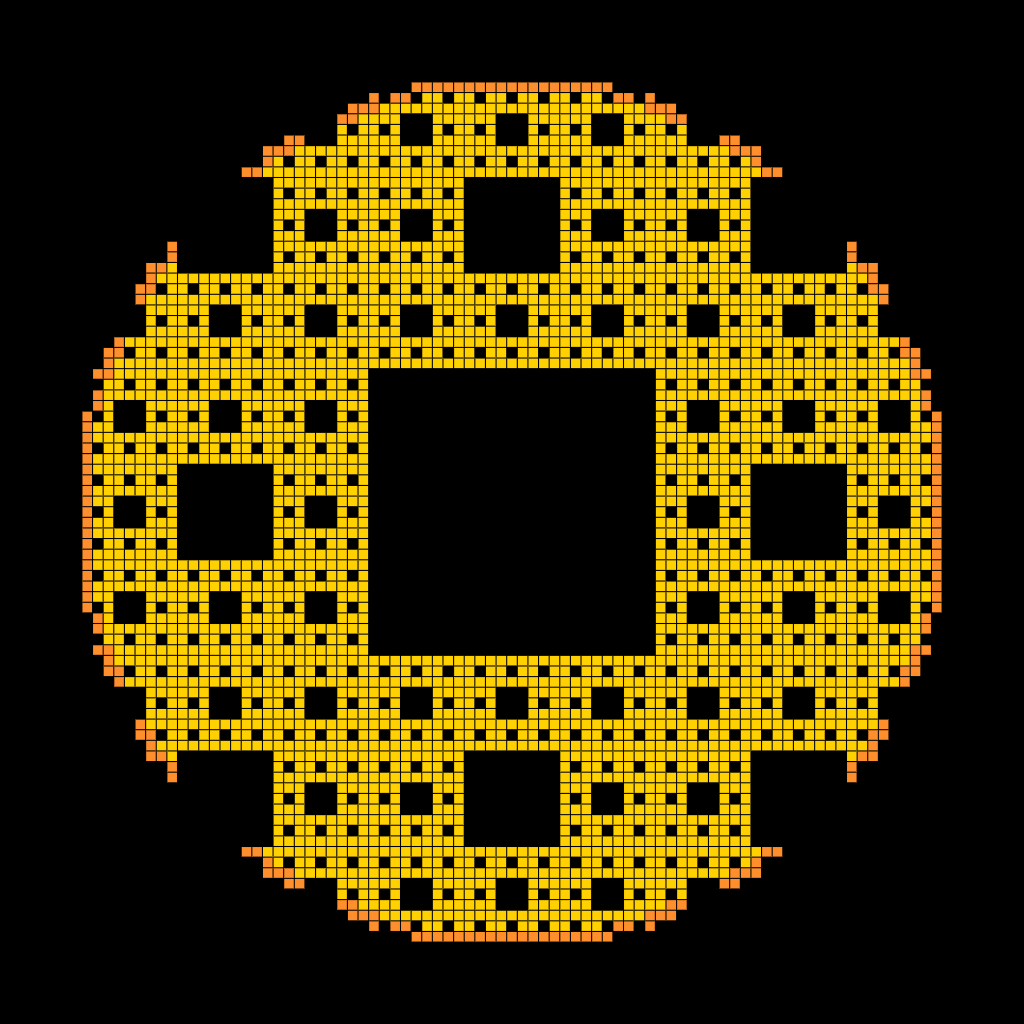
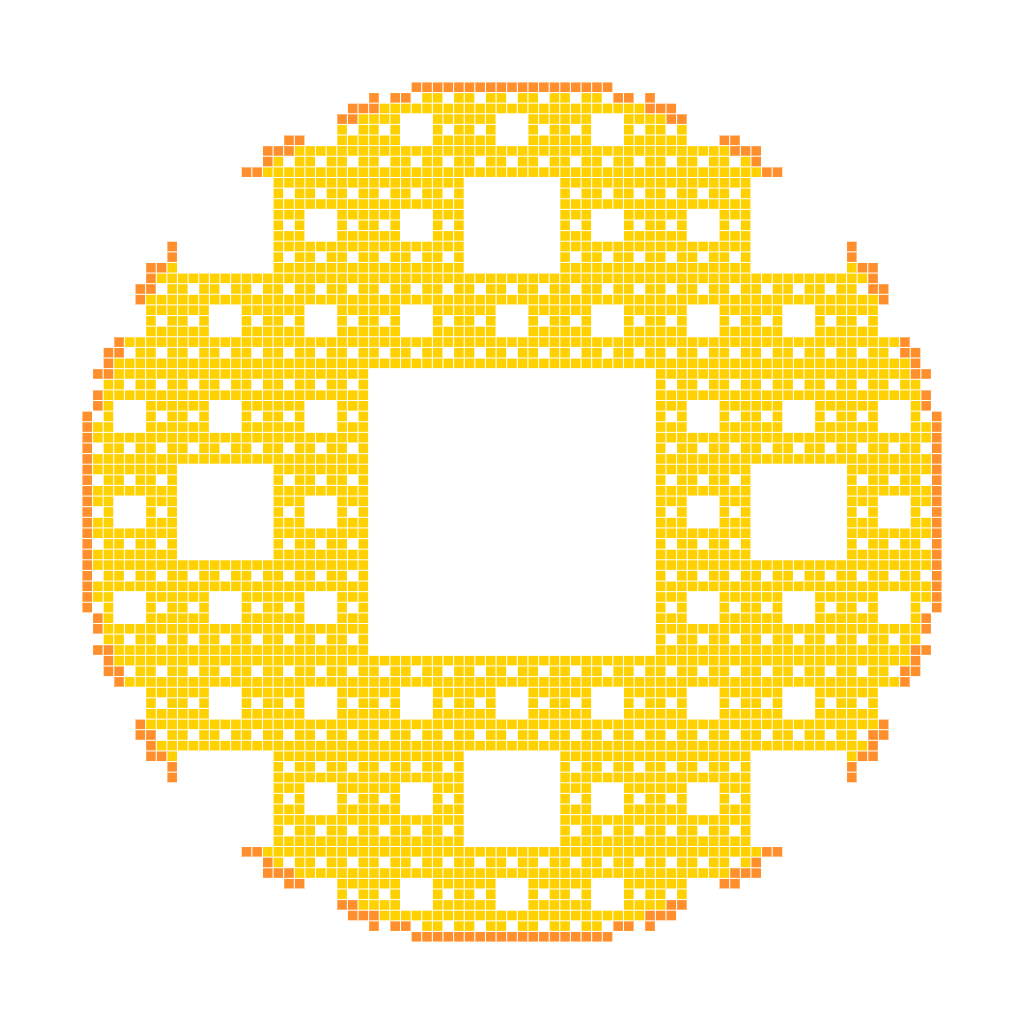
Crop
The circle on a design: the corner disc count, its log-periodic main term, and the crossing shell read as a rooted tree whose transfer operator is derived from the geometry.
Cuts
The six-gasket theorem: a diagonal cut through one parity solid is Sierpinski all the way down.
Complex dimensions
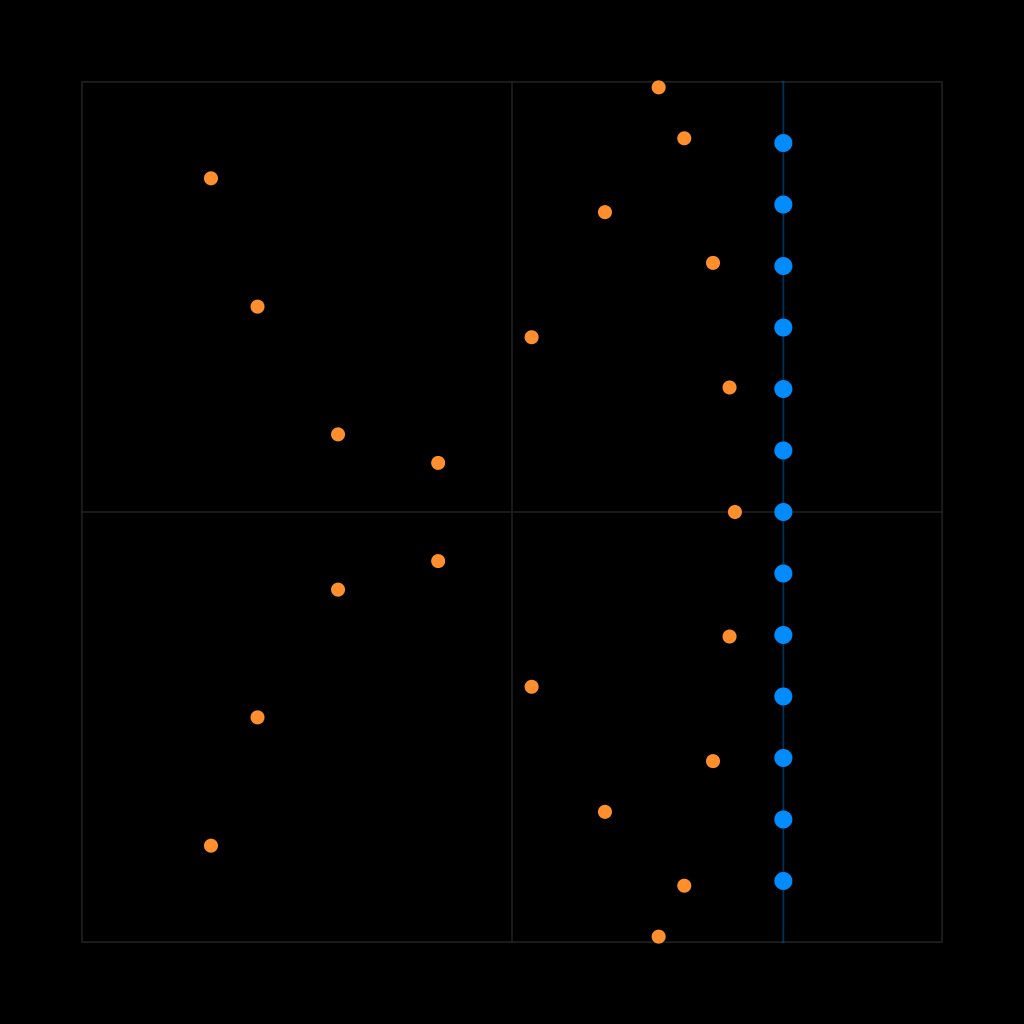
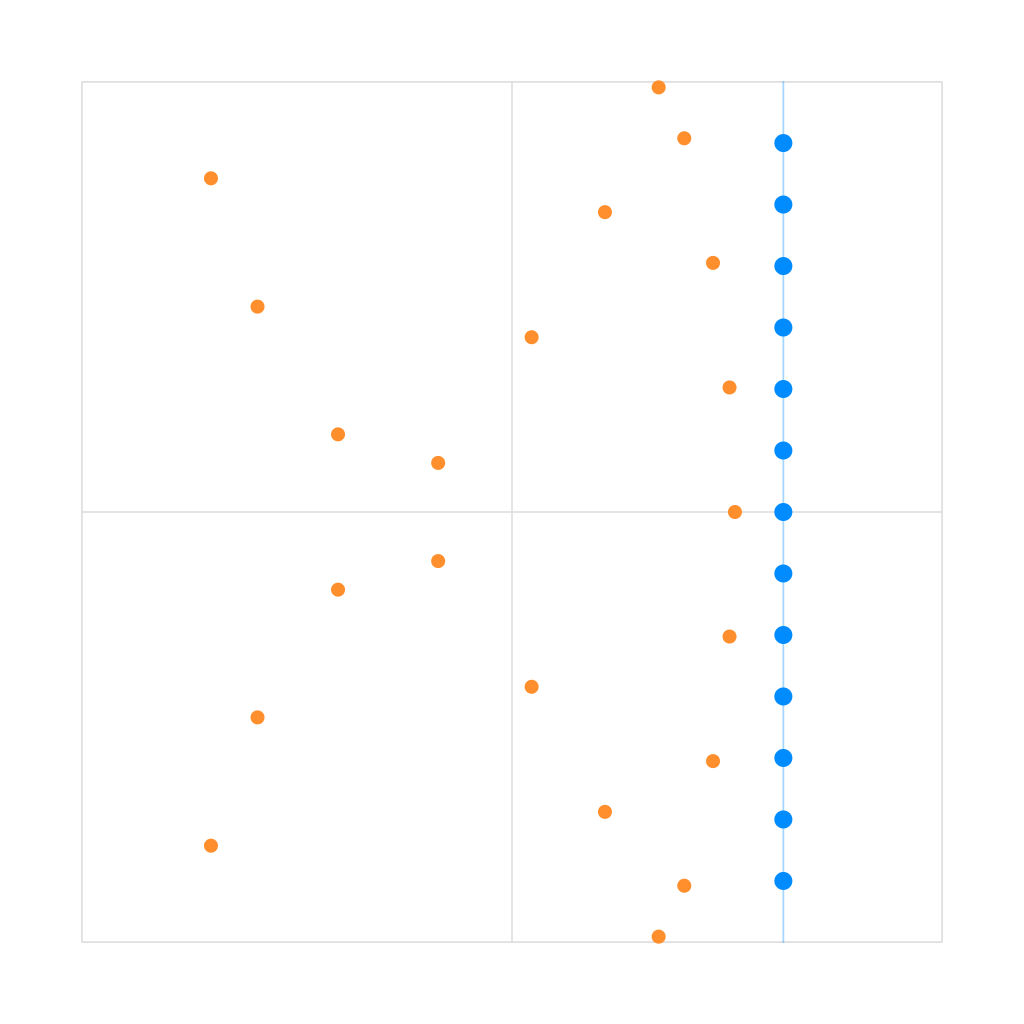
Complex dimensions: every design in the lattice class, the carpet proved not Minkowski measurable with its explicit profile, and the arithmetic pole at `s_0 + 2 pi i/log 3` certified genuine.
The stack is an RH-observable
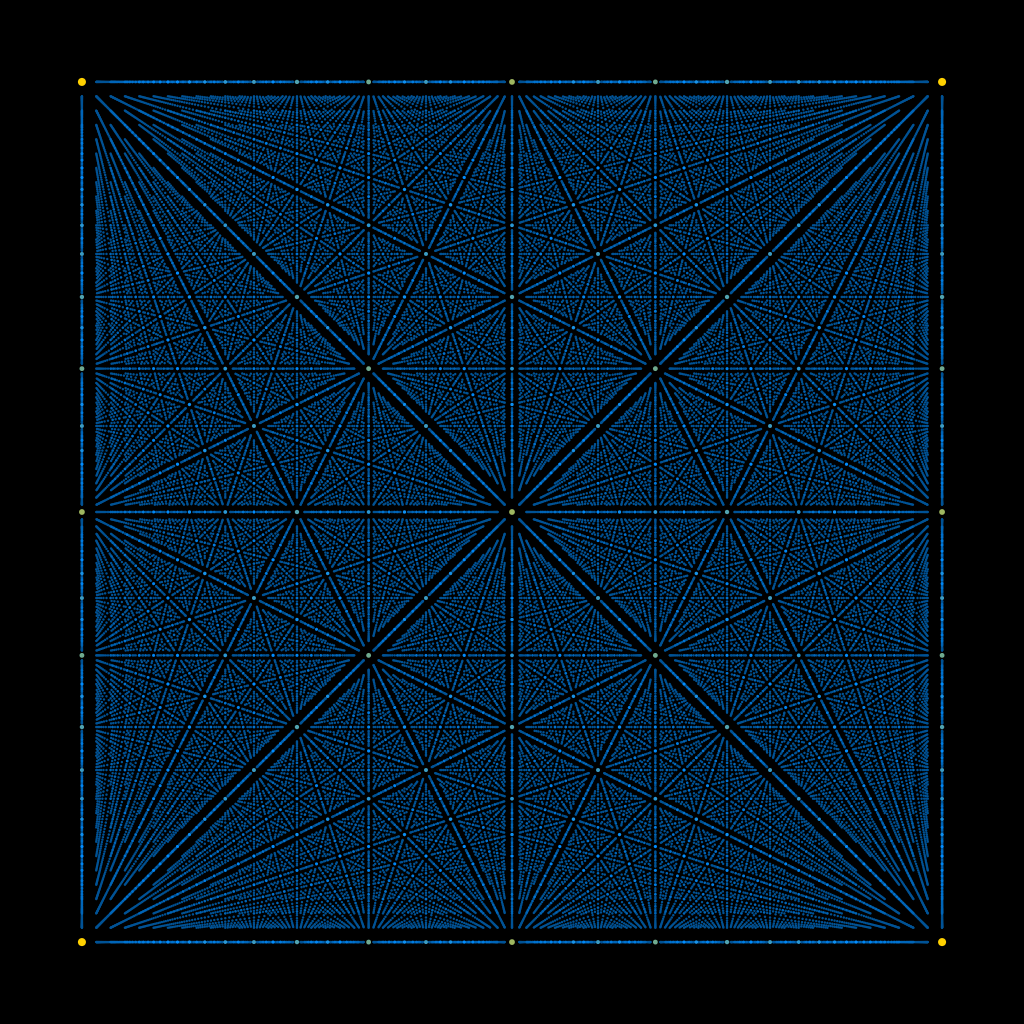
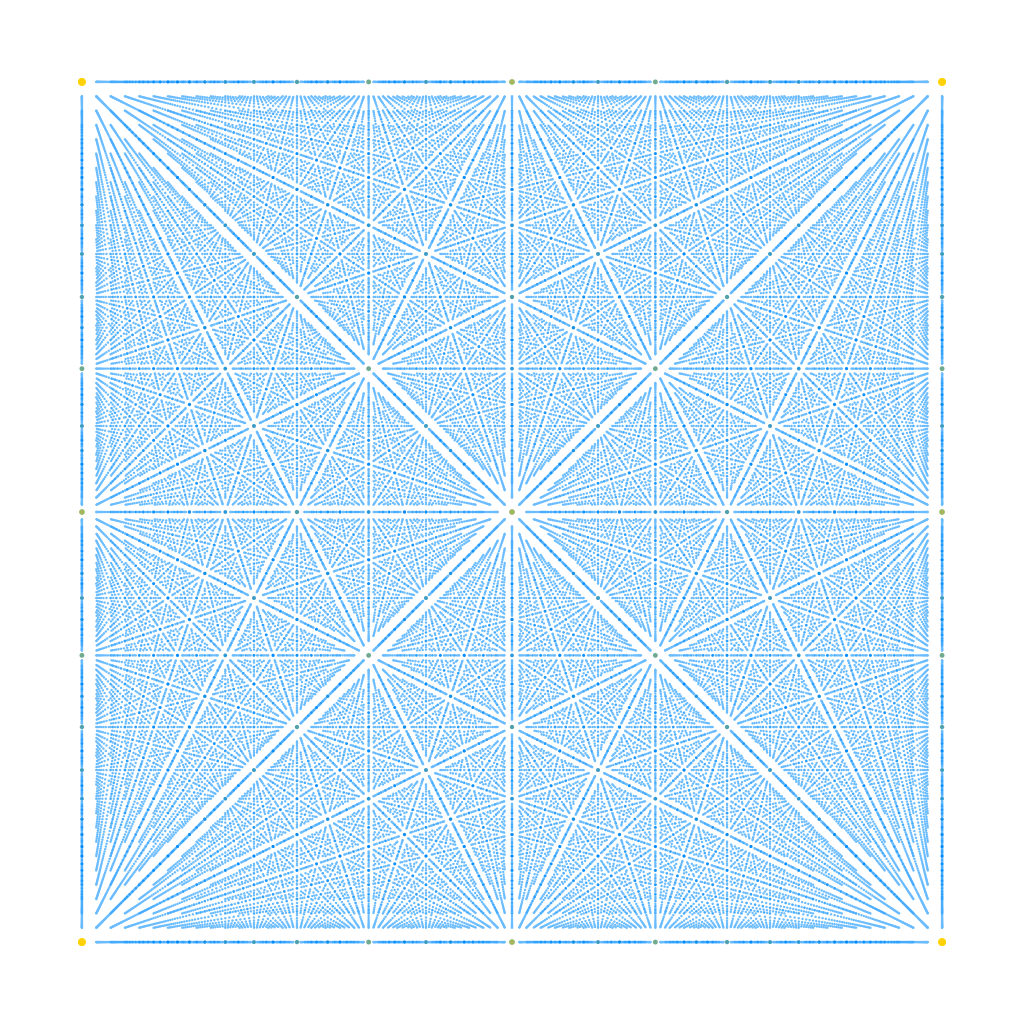
The stack's moire is a Farey resonance diagram; each scale `n` adds exactly `phi(n)` bright nodes, the stack is an address rather than a construction (any depth evaluates in closed form, which buys rendering and provably nothing toward RH), and restricting the Farey sequence to a digit design empties a fixed sixth of the line at base 3 `{0,1}` when both coordinates are restricted, while restricting the denominator alone leaves the Franel-Landau shape reading the same.
The hexagon moire
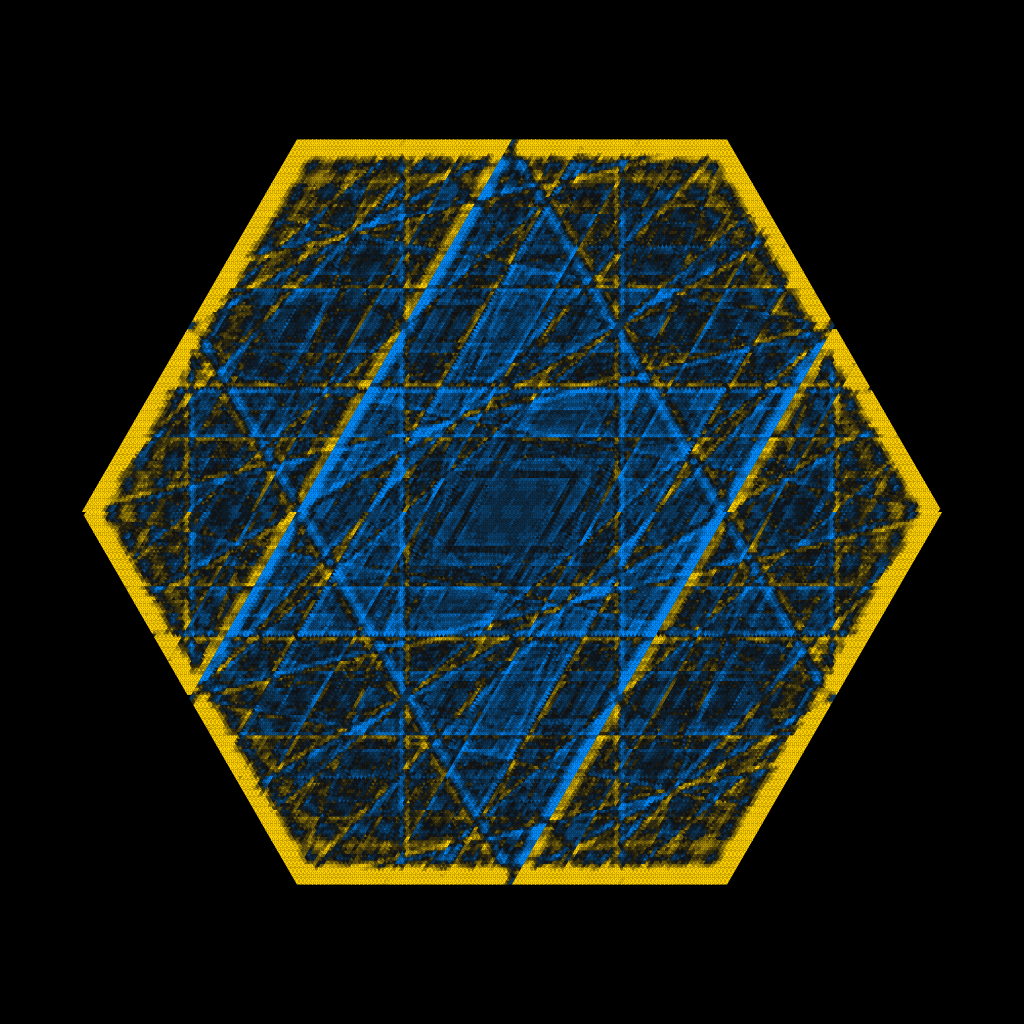
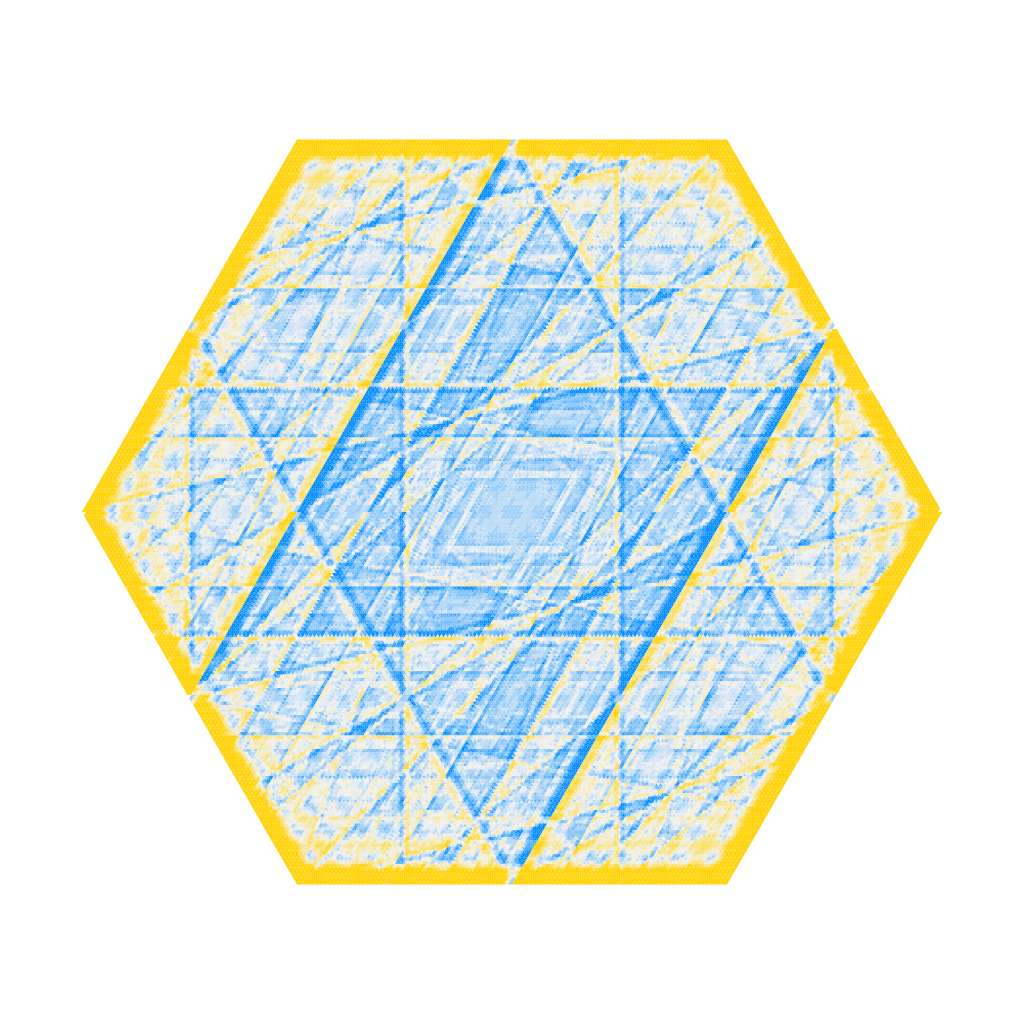
The moire of the stacked diagonal slices: the exact cut-ink laws, the doubling sign law, the quarter-line bands, and the ghost star, whose cell-frame decay is a closed form at every band width, `-1/4` at the arm and `-1/8` in the limit, every layer-pair constant an exact rational, and no frame-free coefficient.
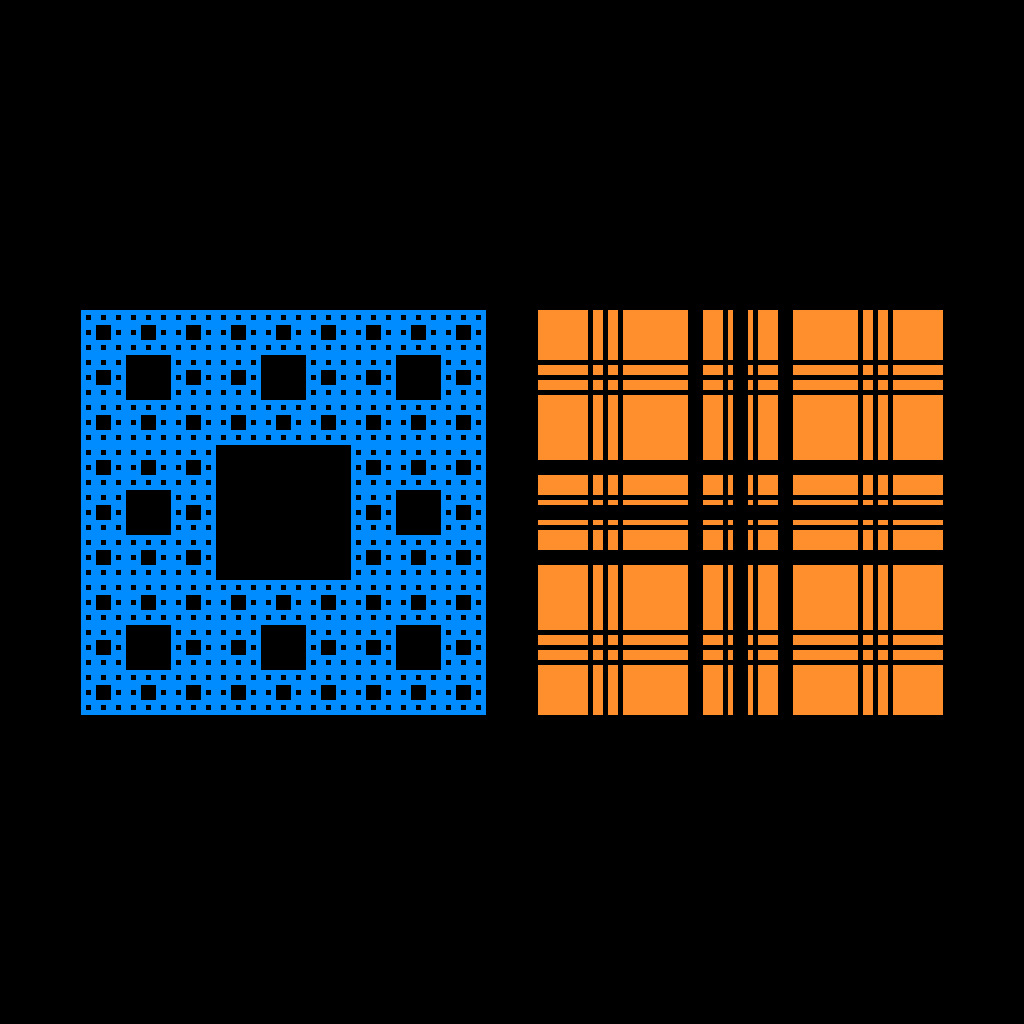
Information
A render as data: the rearranged SVD reads a design's code out of noise and peels a magic word, while the fractal codebook loses to deflate.
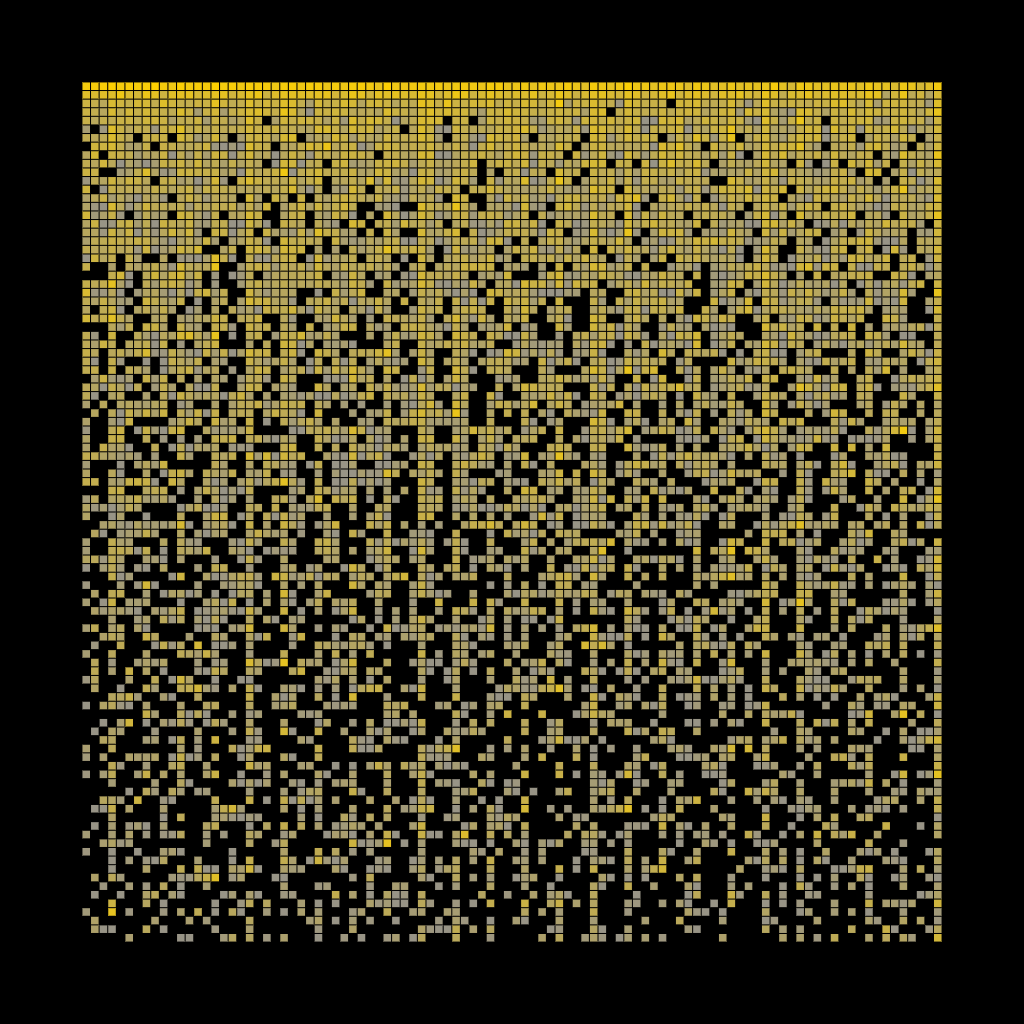
Integers
The census the other way round: which integers the whole registry writes, which it never writes, and which it writes thousands of times.
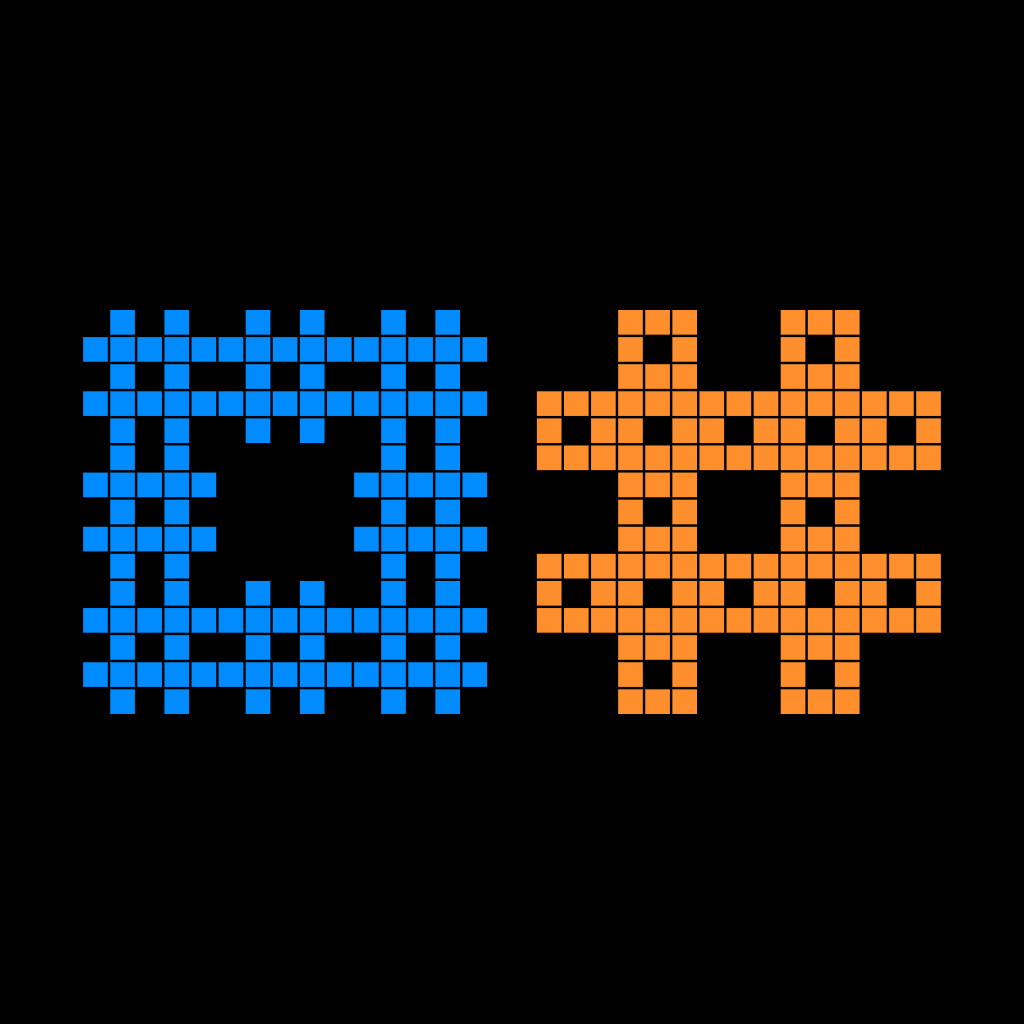

Magic words
A different design at every scale: the word grammar, what collapses by block reduction, and what only the letter order can see.
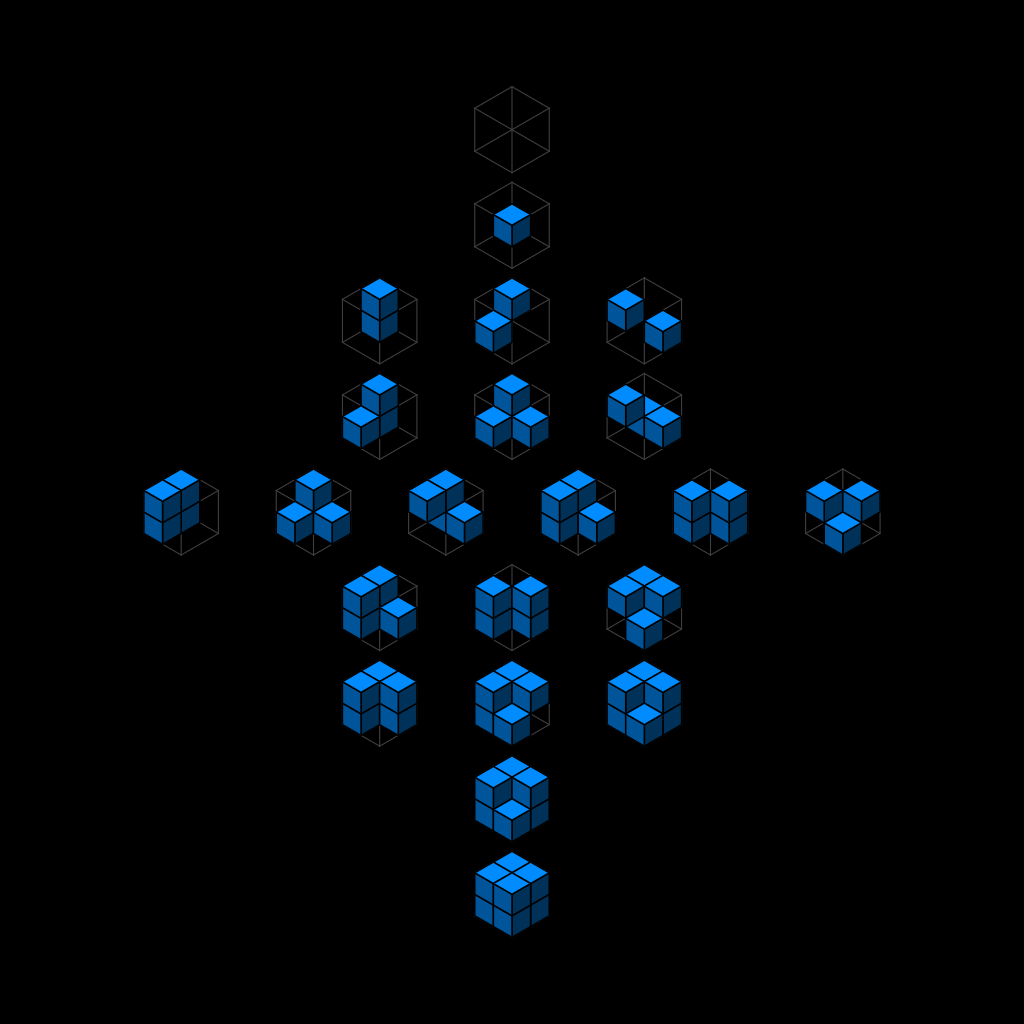
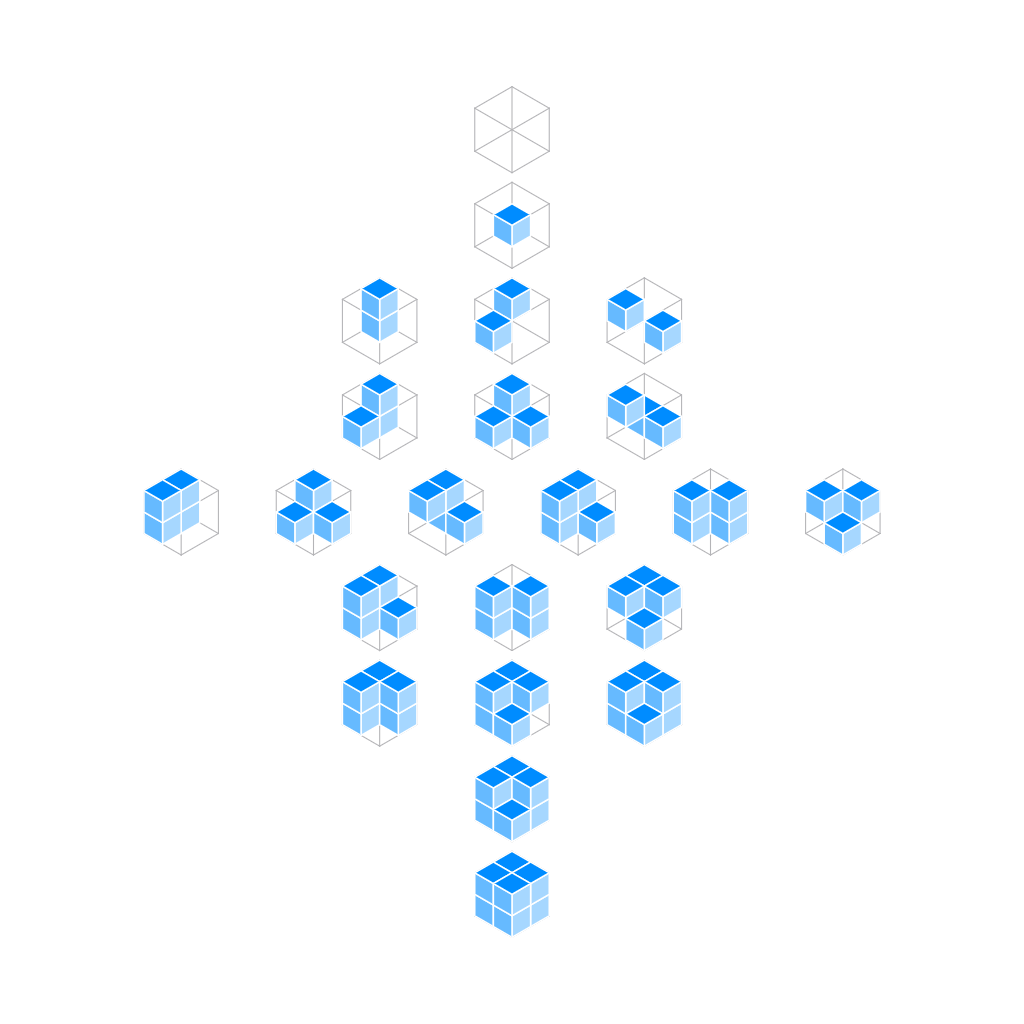
Method
How the results here are produced and checked, worked through on the odd-side fill polynomial.
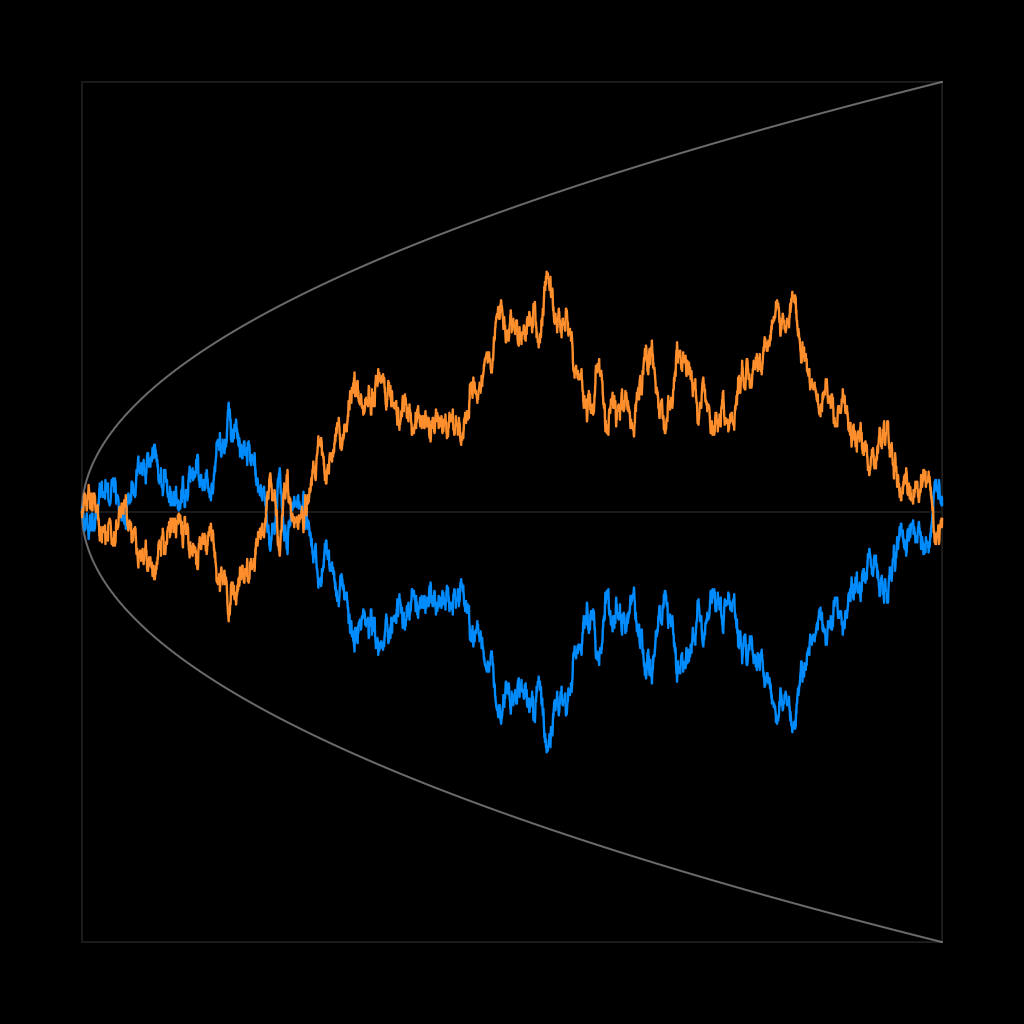
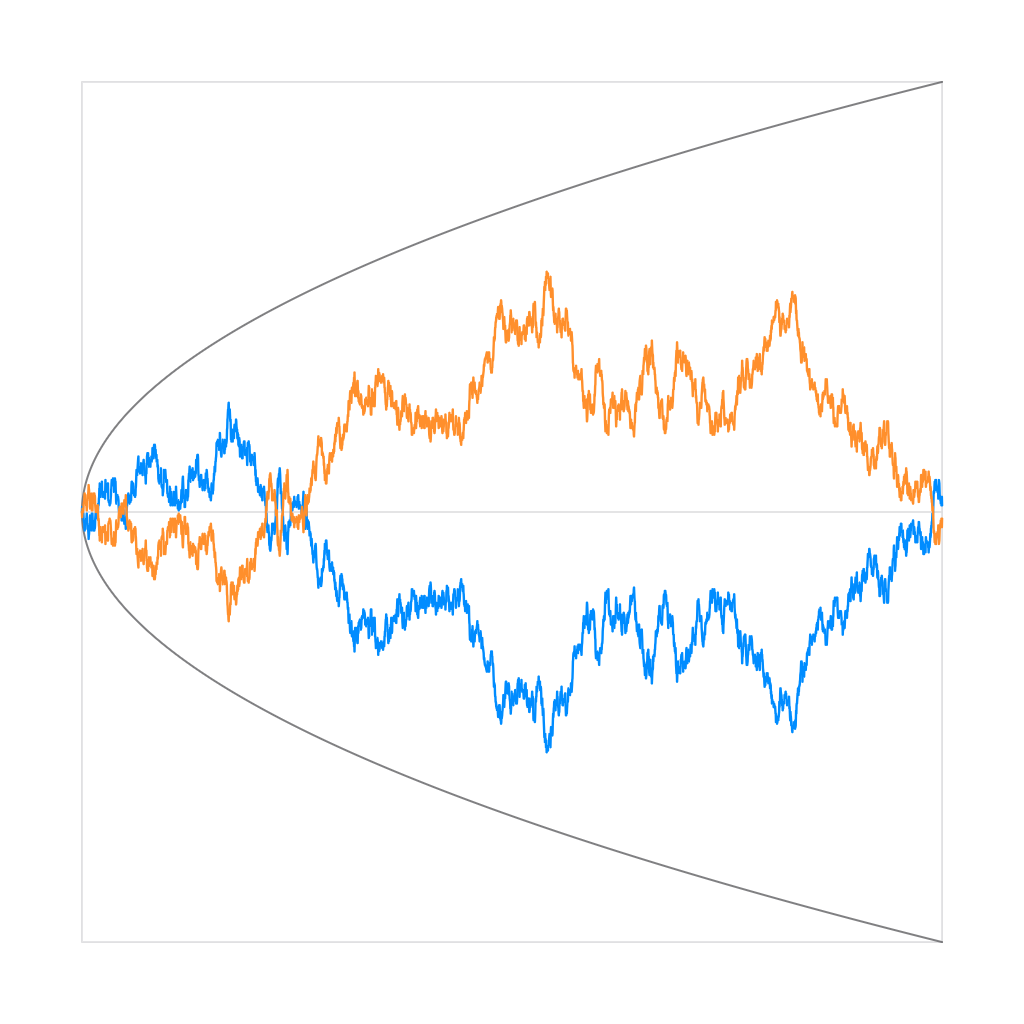
The Mobius meter across digit designs
The Mobius meter across digit designs: exact transfer between scaled columns, the 47-column cancellation census, a power saving on the dense columns under GRH, the pair route with its major-arc lemma and its `l^1` threshold `1/4`, and square-root cancellation as the open exponent.
Pi out of the stack
Pi recovered from the density of coprime points in the stacked set, two disjoint ways.
REFS
Every named reference, sequence id, theorem and attribution on this tree's root pages, resolved to a canonical URL. Ids that appear only inside a lab study are resolved in that study's own pages.
Sequences
Integer sequences fall out of the fractal work: cell counts, coprimality counts, Euler characteristics, design counts. This page is the ledger they are cited from. Every entry below meets the same
Slices
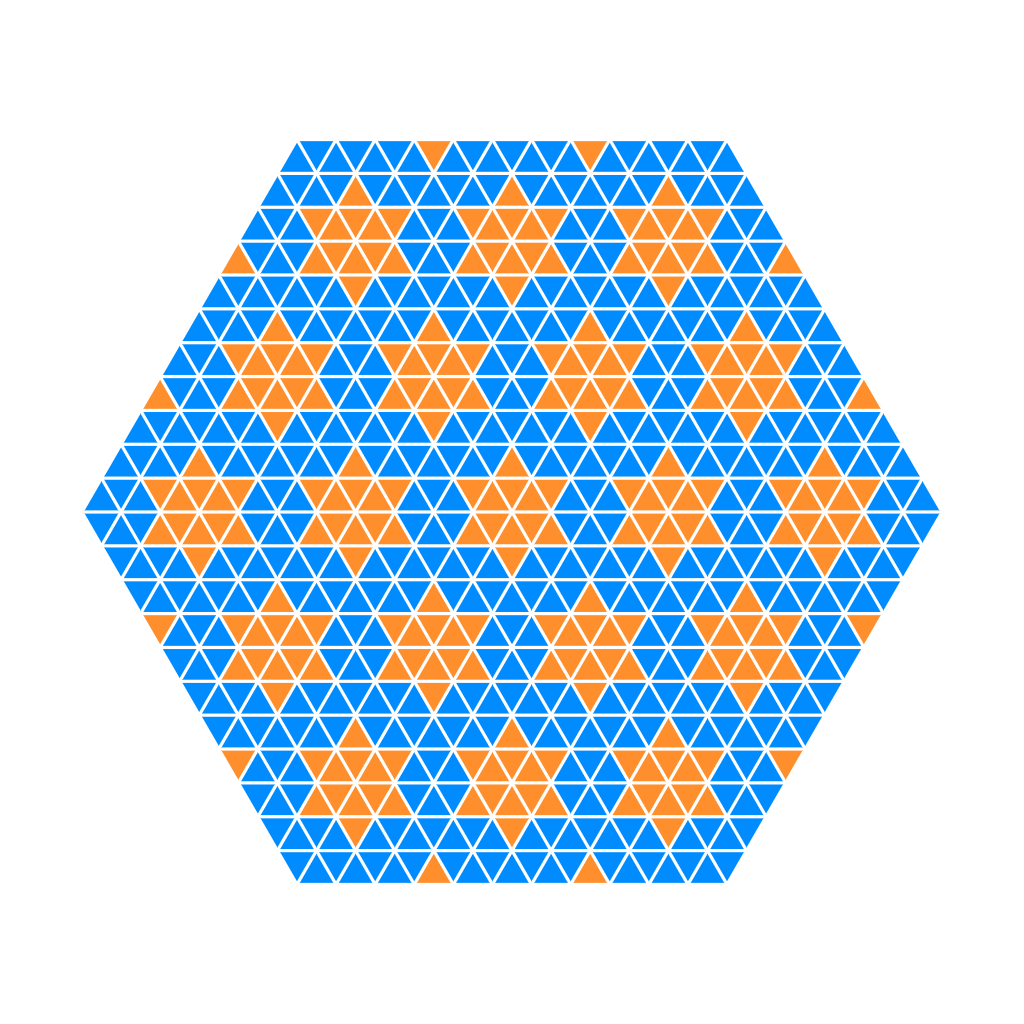
The diagonal slice of the solid cube: the `6n` census, centered-hexagonal vertices, and the splitting-prime rule.
Spectra
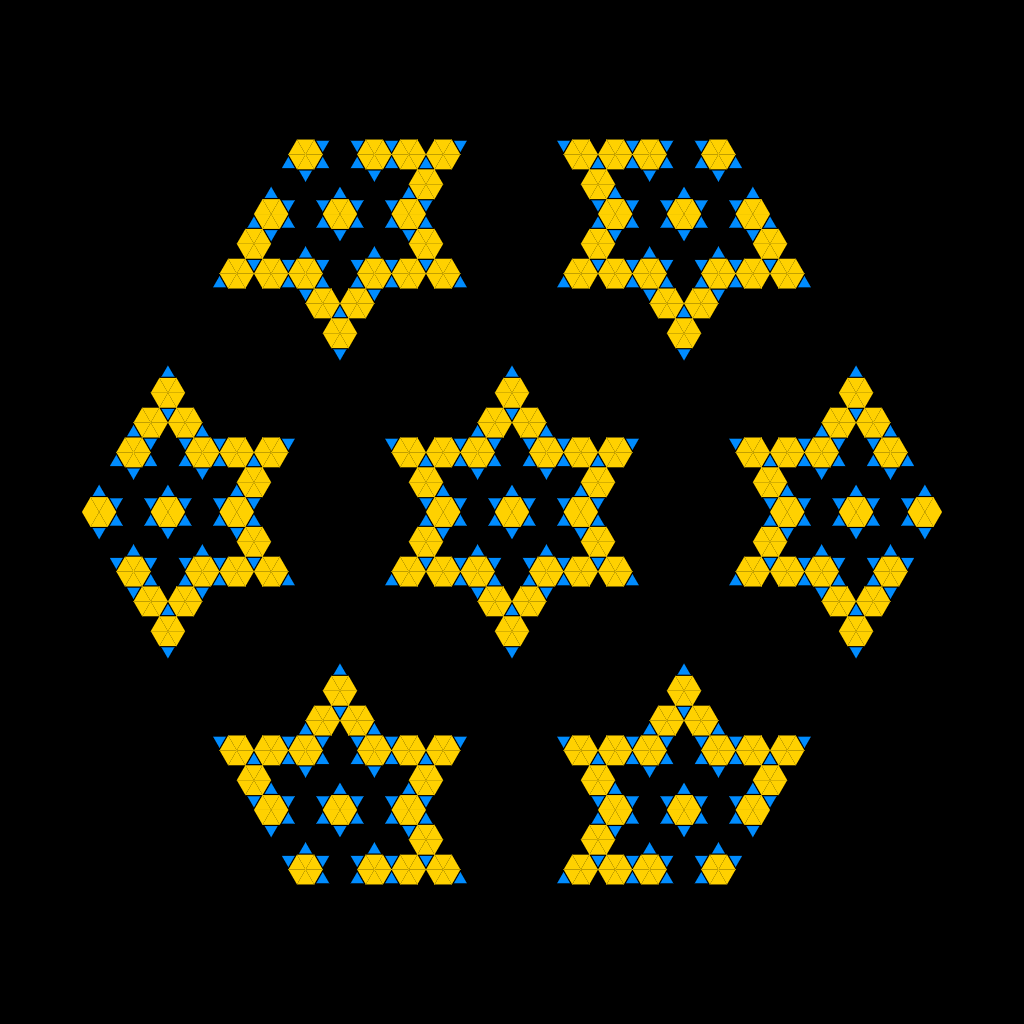
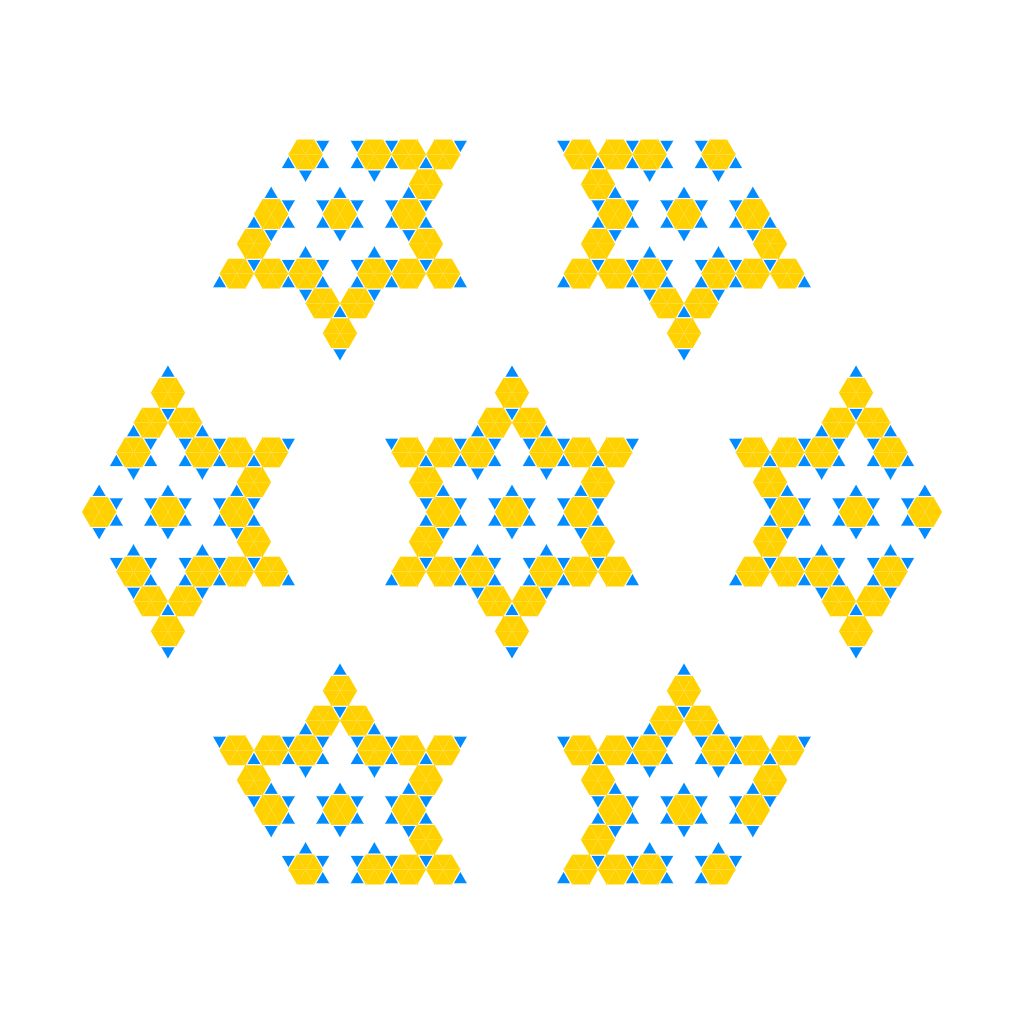
The tile grammar of the diagonal slice at every odd base: the two-tile claim, the closed forms, and the mod-4 split.
Spin
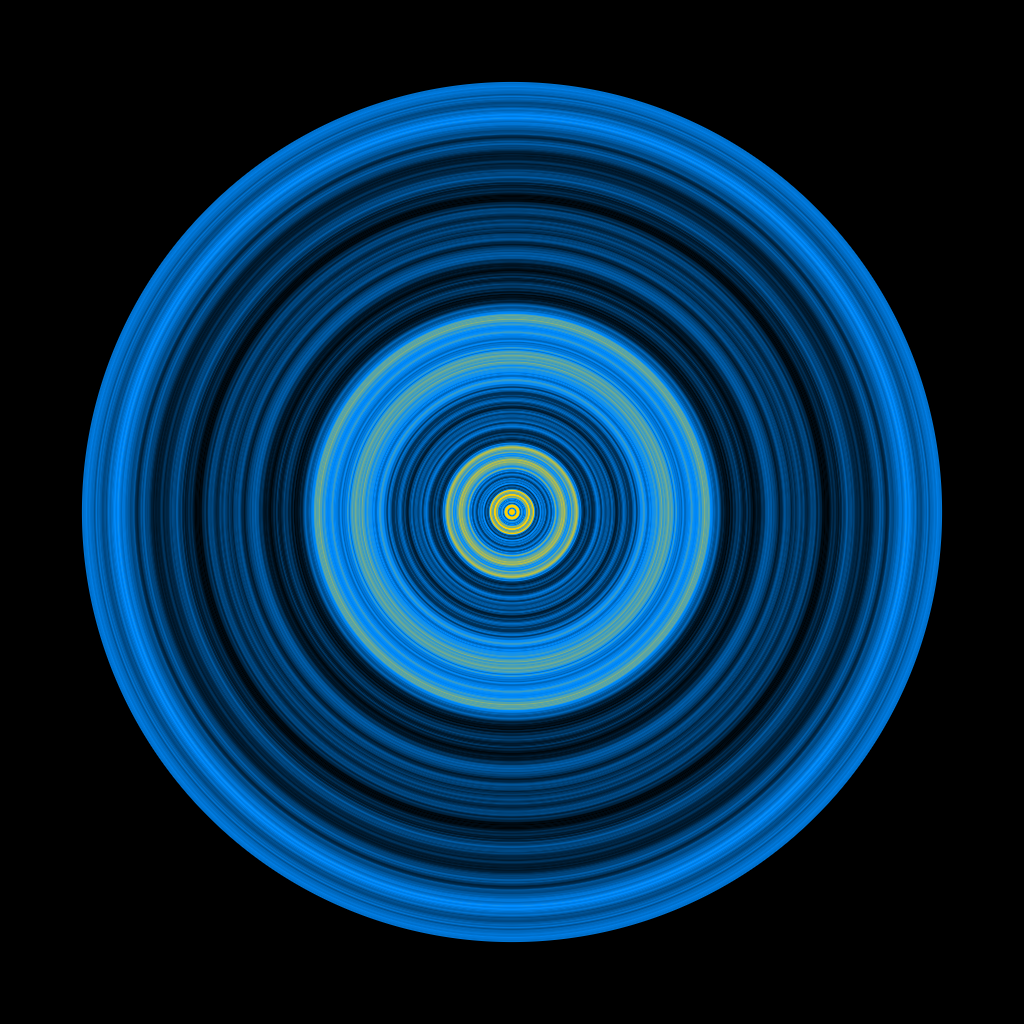
A design turned about its centre: the ripple identity, the complete spin spectrum, the sponge's opaque diagonal, and a Gaussian Farey.
The spirograph
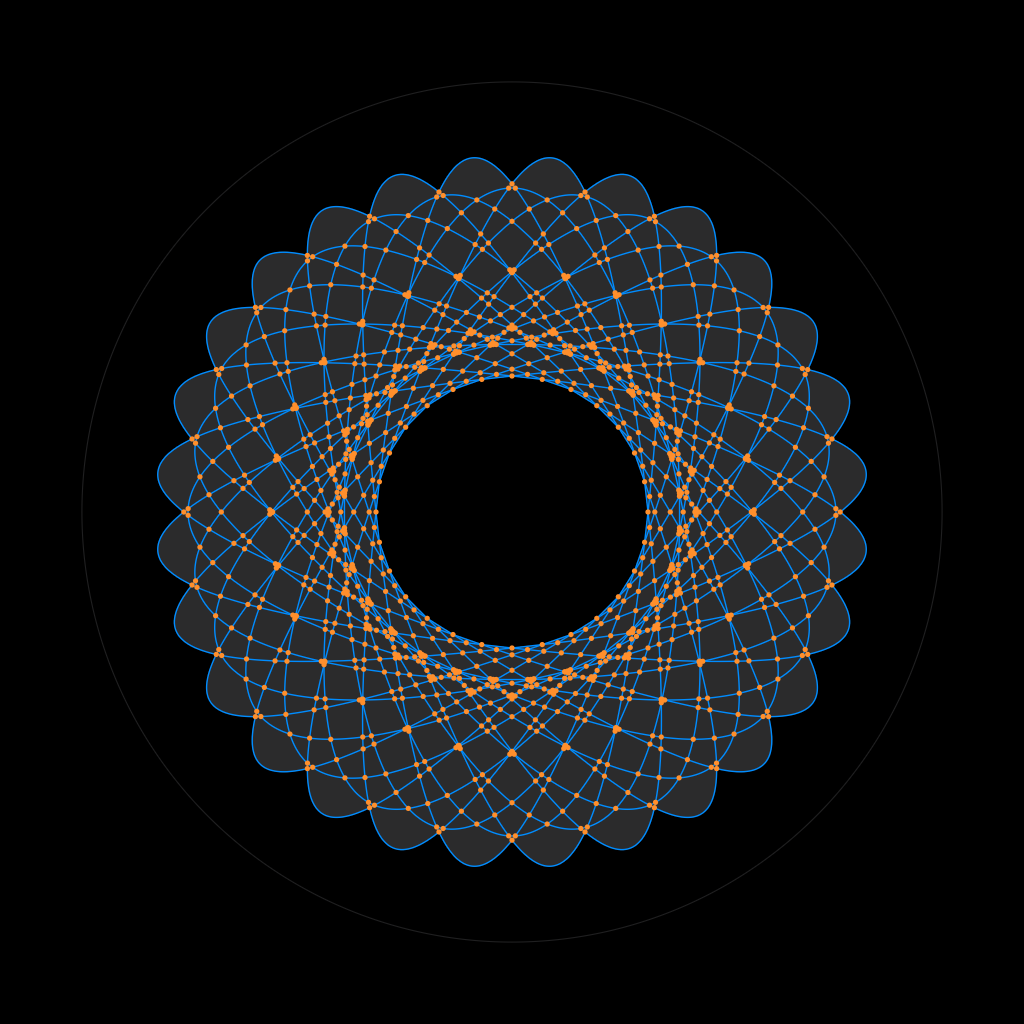
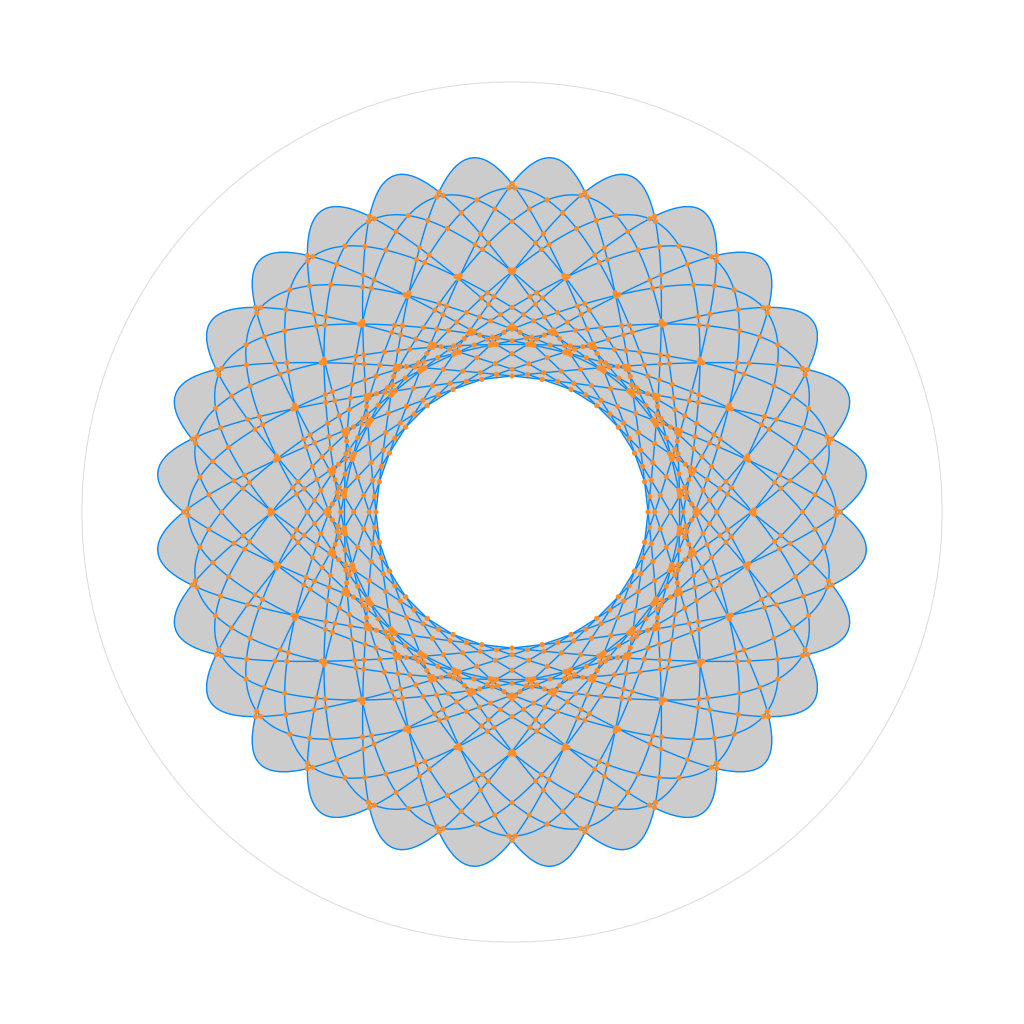
The roulette a design draws: the coincidence law that counts its distinct curves, the node count `2ab C(k,2) + k a(b-1)` inside the window `min(1, A)` with the plane cut into `nodes + 2` regions, the exact crossing staircase above the loop threshold whose thresholds are algebraic numbers obeying a reciprocity, the alignment reaches where four of the carpet's curves run through one point, and the walls, whose cover no closed form tried survives.
The algebra of the stack
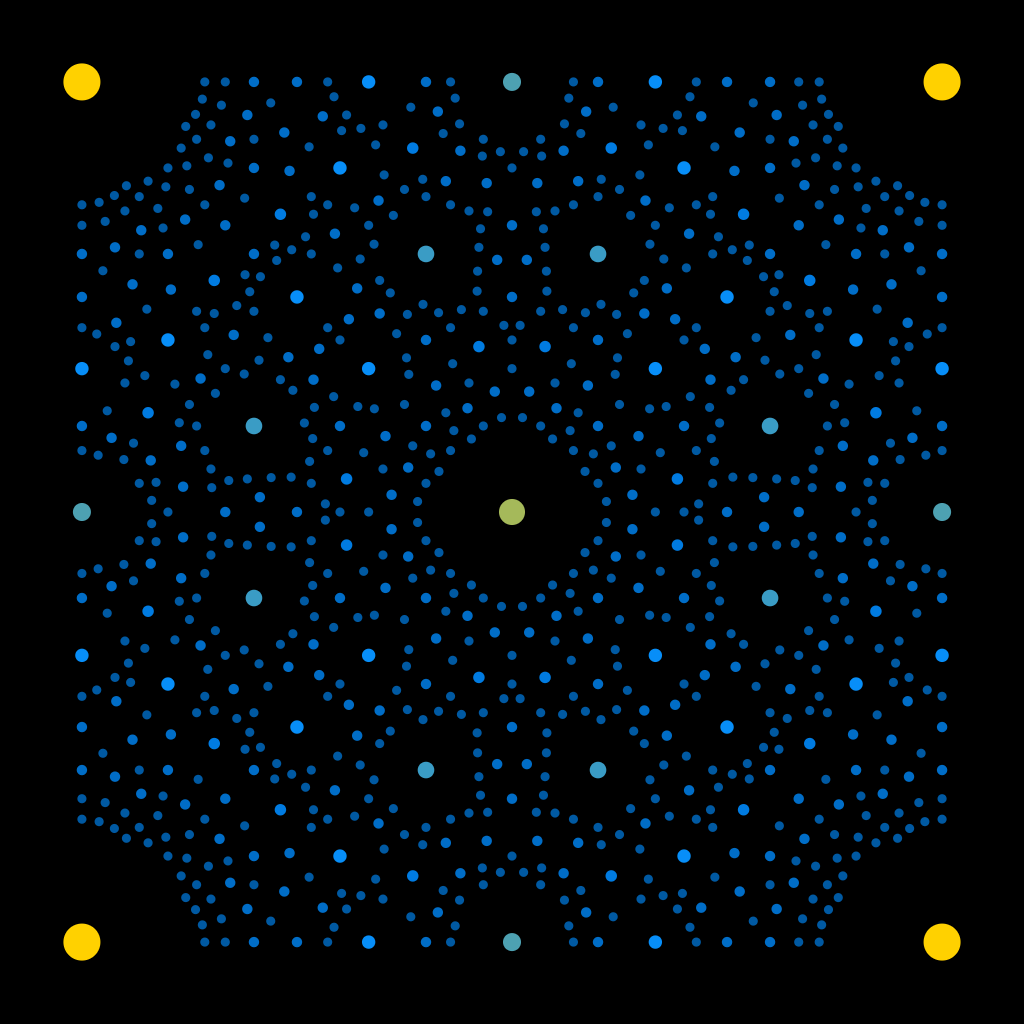
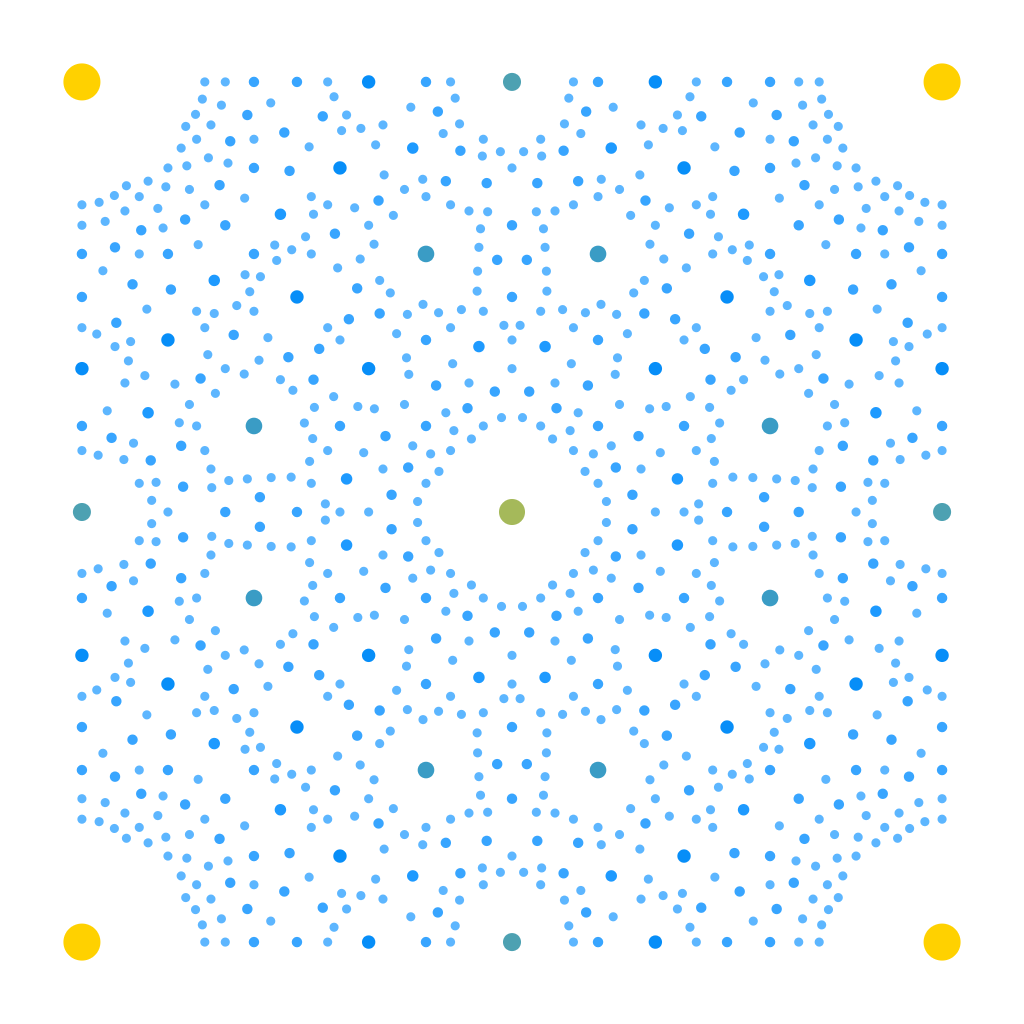
The algebra of the stack: stacking is Dirichlet convolution and the group knows nothing new, the exact spun stack is a Gaussian Farey whose Fourier `L^2` discrepancy obeys Franel's identity one field up and is equivalent to the Riemann hypothesis for `zeta(s) L(s, chi_-4)`, its hexagonal twin puts `L(2, chi_-3)` in a proved node constant, the layers are a dilation system whose symbol is `zeta(1 + s)` so no reweighting moves the line, and the lean is the operation outside the Dirichlet group that still lands a closed form.
The walk dimension
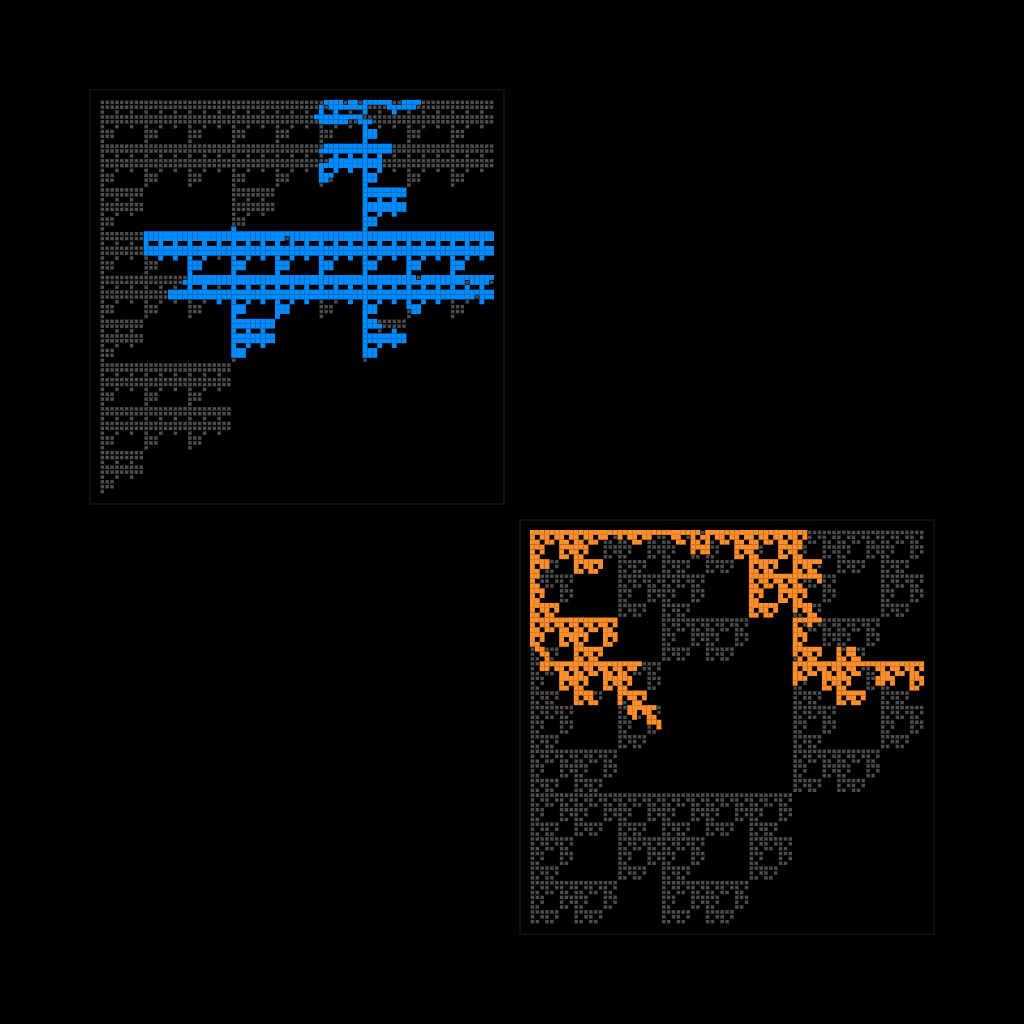
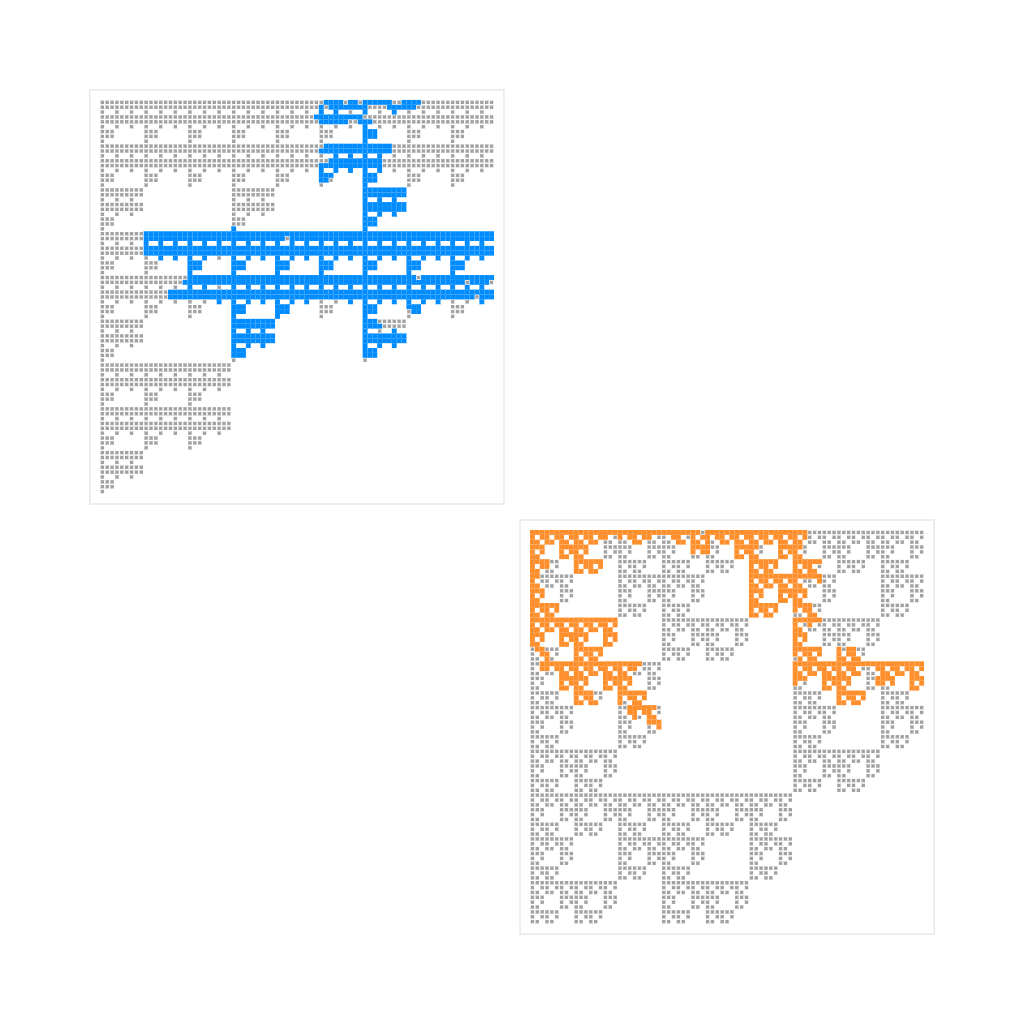
The walk-dimension census: same mass, different music.
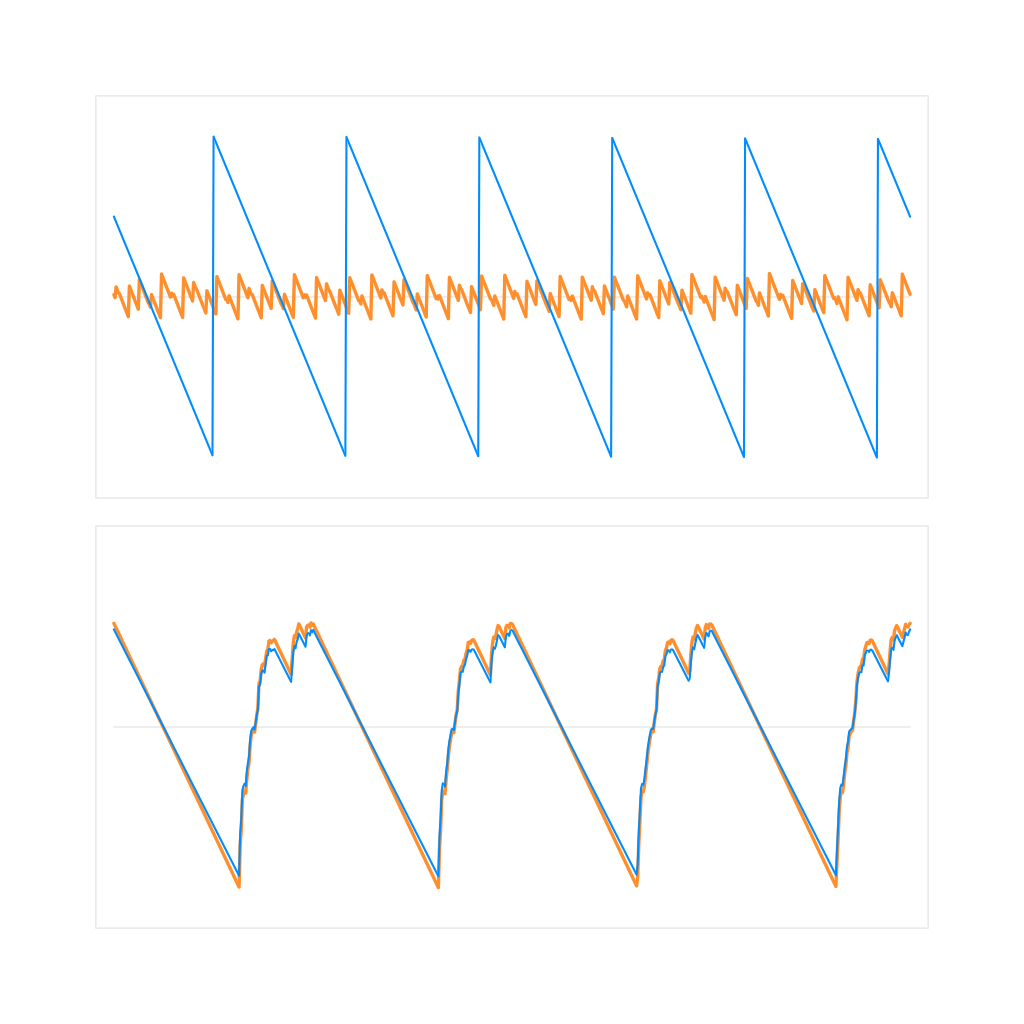
Weighted designs
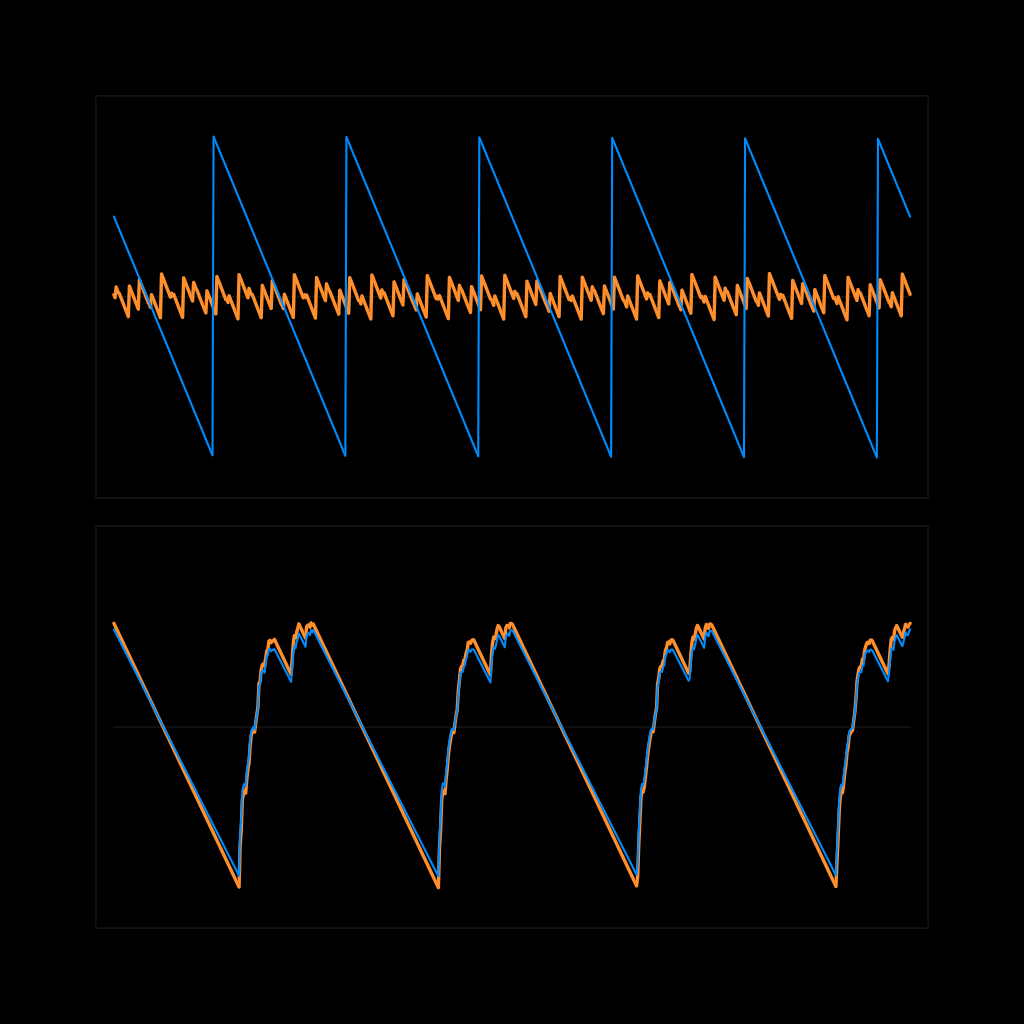
Weighted designs: what weights move on the mass side, what they never move on the length side, and the pressure that closes both.
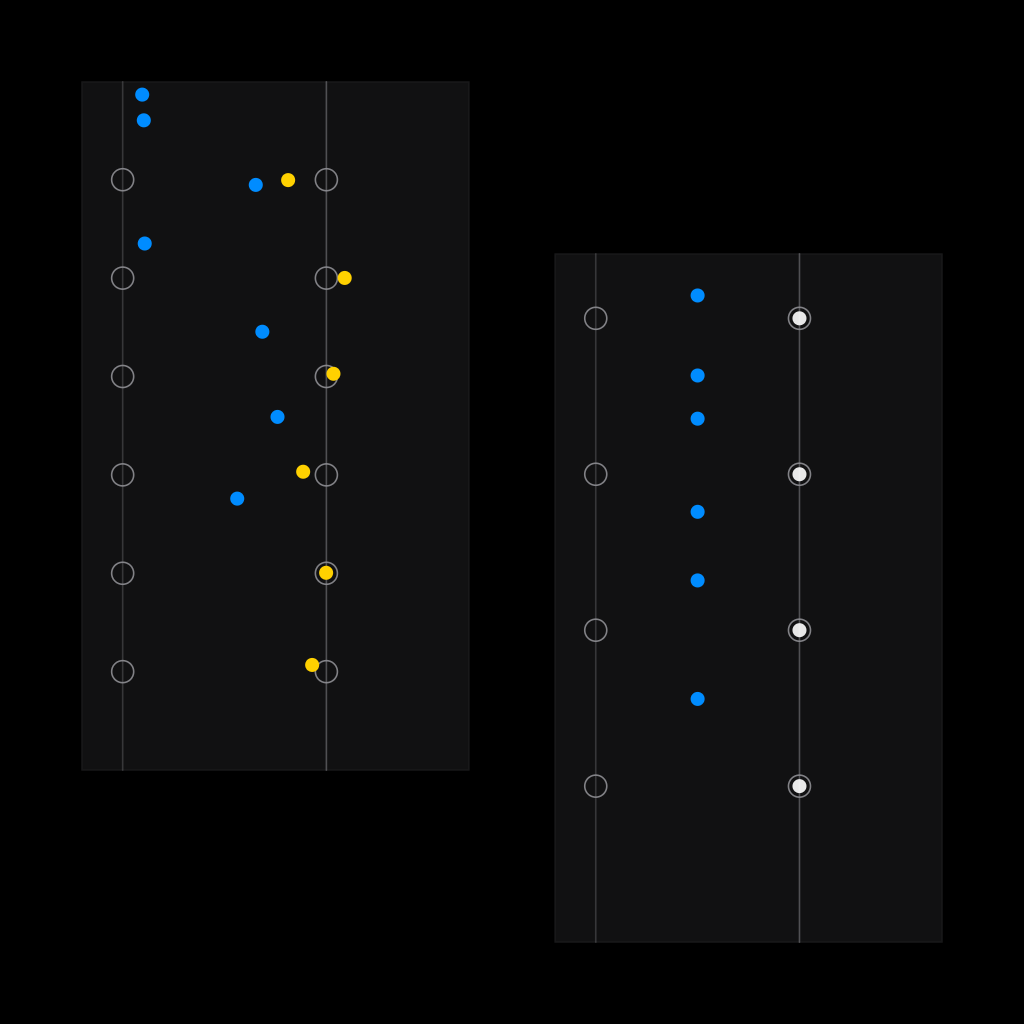
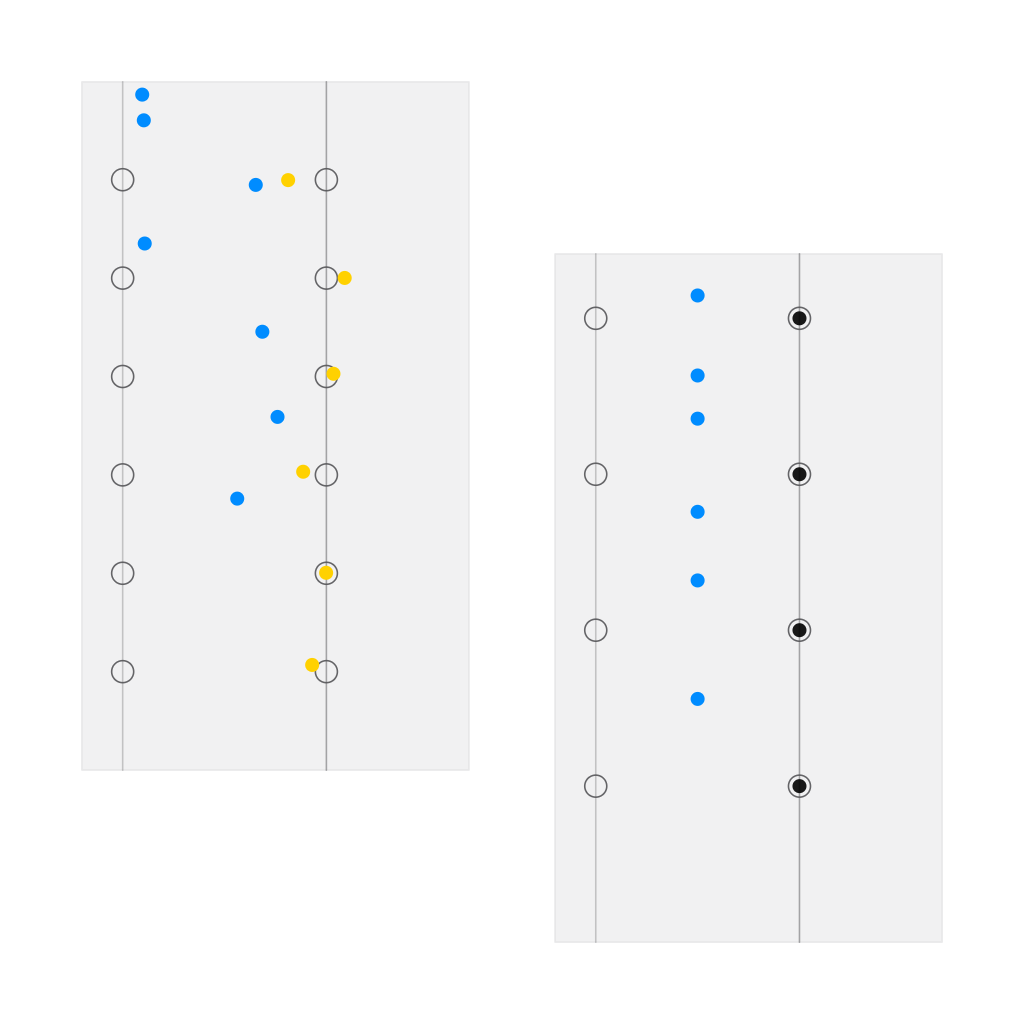
The zeta function of a digit design
The design's own zeta function: an explicit zero-free half plane and the census it closes, a residue comb whose teeth are Rouche-certified one by one, a second family that is no critical line and obeys no counting, symmetry, contraction or gain law, the ordinate shadow as a constant-free Newton step from each zeta zero, the multiplicativity wall with the three products that stand where the Euler product does not, and the identity zeta_F N_F = 1 whose Mertens function runs the wrong way.