MrlyMath
The mathematics of the mrly tree: a parity rule on the corners of a cube, substituted into itself by the Kronecker product, and everything that falls out of those two moves. One subject, one tree.
THE LAW
- Every claim carries exactly one tag: Proved, Verified, Conjecture, Refuted.
- Every printed number names its generator: a crate function in
../crates, a study inlab/, a paper on the shelf, or an OEIS entry. - A theorem from the literature is cited at its source; a claim of this tree never rests on a citation alone.
- Present tense, no dates, no names, no story: the mathematics and its witnesses, nothing else.
- Math is written in backticks so it renders everywhere; lines never wrap.
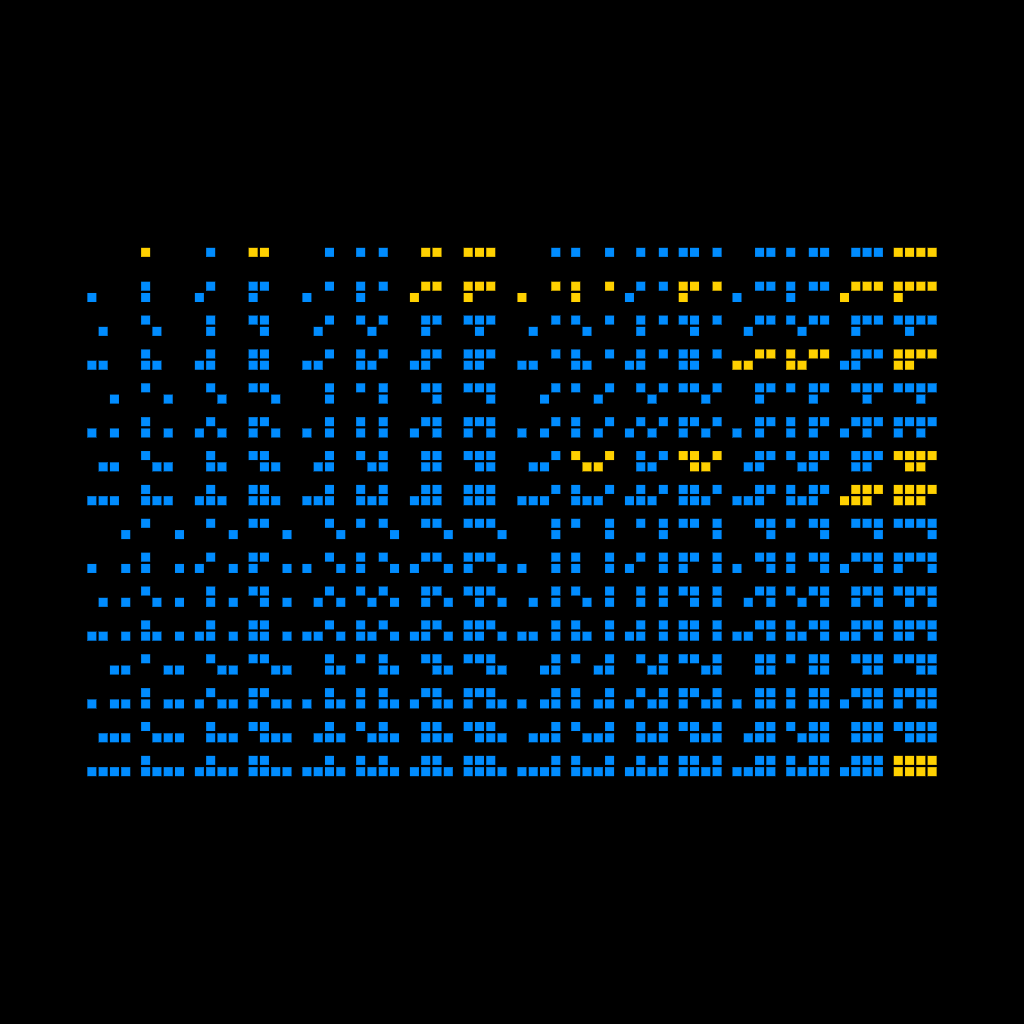
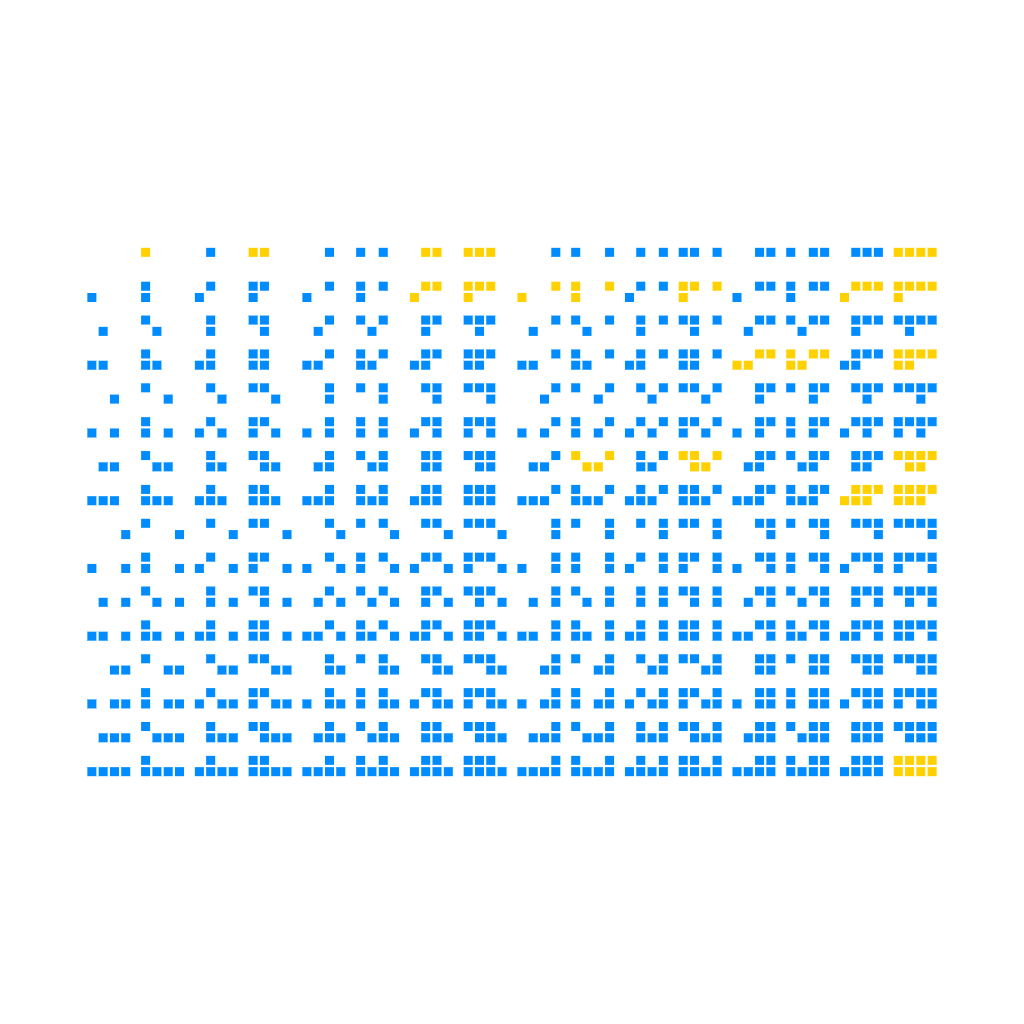
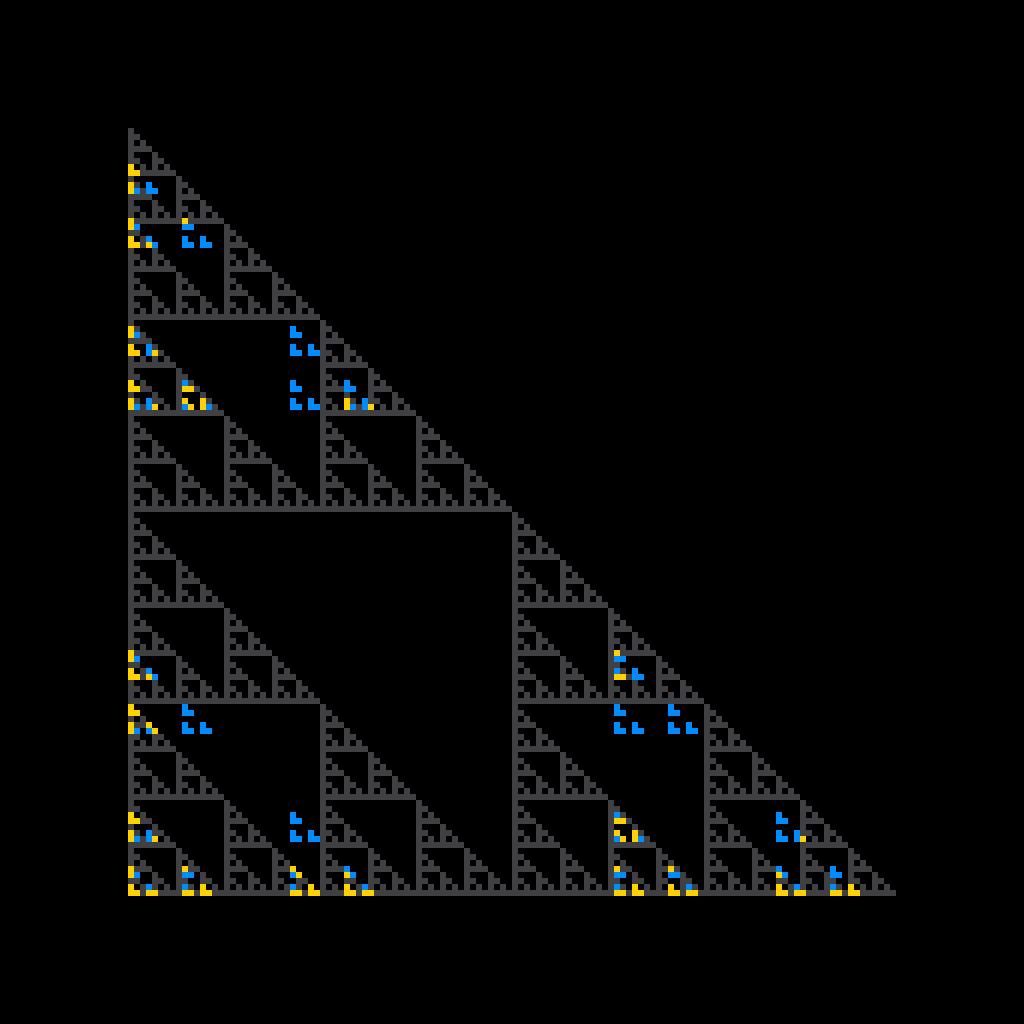
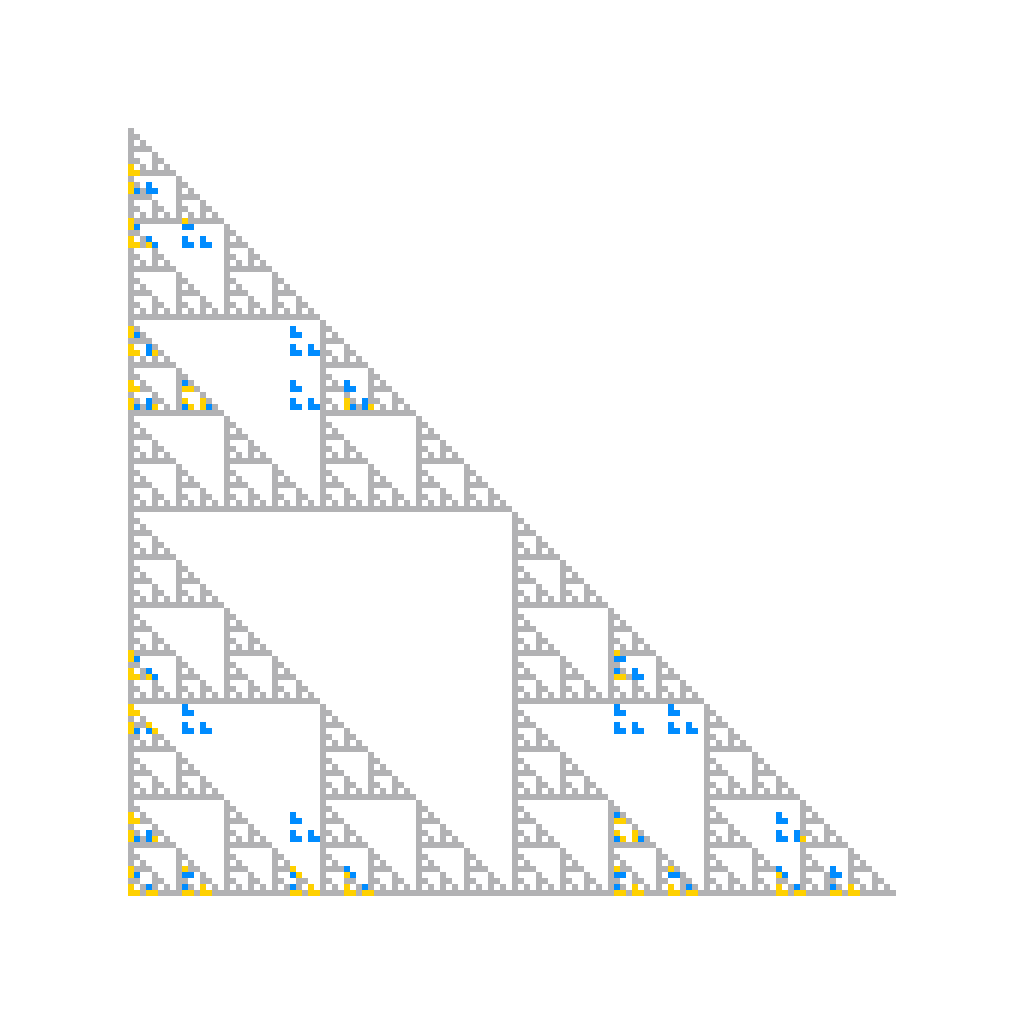
- A figure is drawn by a lab study, a crate function or a demo, never by hand.
- The demos in
../demosrun the same crates through wasm; a page links the demo that shows it. - A study in
lab/is deleted the day a crate function or a demo computes its numbers. - A paper on the shelf links the page it grew from; the page links the paper that proves it.
THE BAR
- One subject: MrlyMath, pure mathematics only.
- A study terminates in a proof, an OEIS entry, a crate function, or a demo.
- Anything that needs a physical lab to matter is out.
- A study whose headline is "MrlyMath fails here" stays off the shelf; refutation discipline inside a study stays.
- A new study is a new
lab/folder, plus a topic page when it earns one.
THE TREE
README.md- this page: what MrlyMath is, the law, the tree, the index.DISCOVERIES.md- the one ledger: every finding on a tagged line with its witness.REFS.md- every named reference resolved to a canonical URL.sequences.md- the OEIS ledger: every sequence this work produces, with terms, formulas and status.lab/<study>/- the code that regenerates the numbers; oneREADME.mdper study saying what it computes, how to run it, and which page lines it witnesses.- Lab studies are Rust crates in
lab/Cargo.tomldepending on the crates by path, or Python run withuvfrom the repo root; no comments, no logs, no data over 100KB. figures/- the figures the pages embed, each drawn by the study its page names.- Lowercase topic pages, one per idea, indexed under DOCS.
WHY IT MATTERS
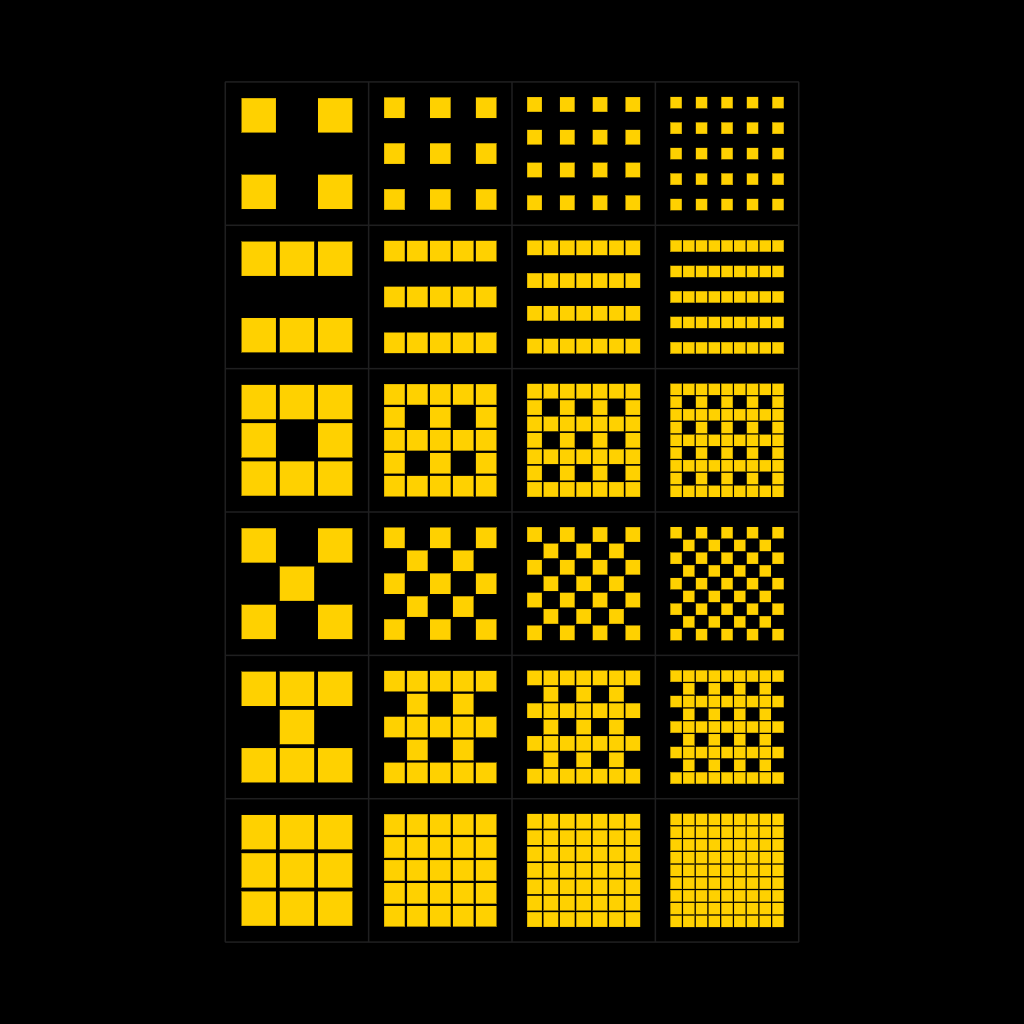
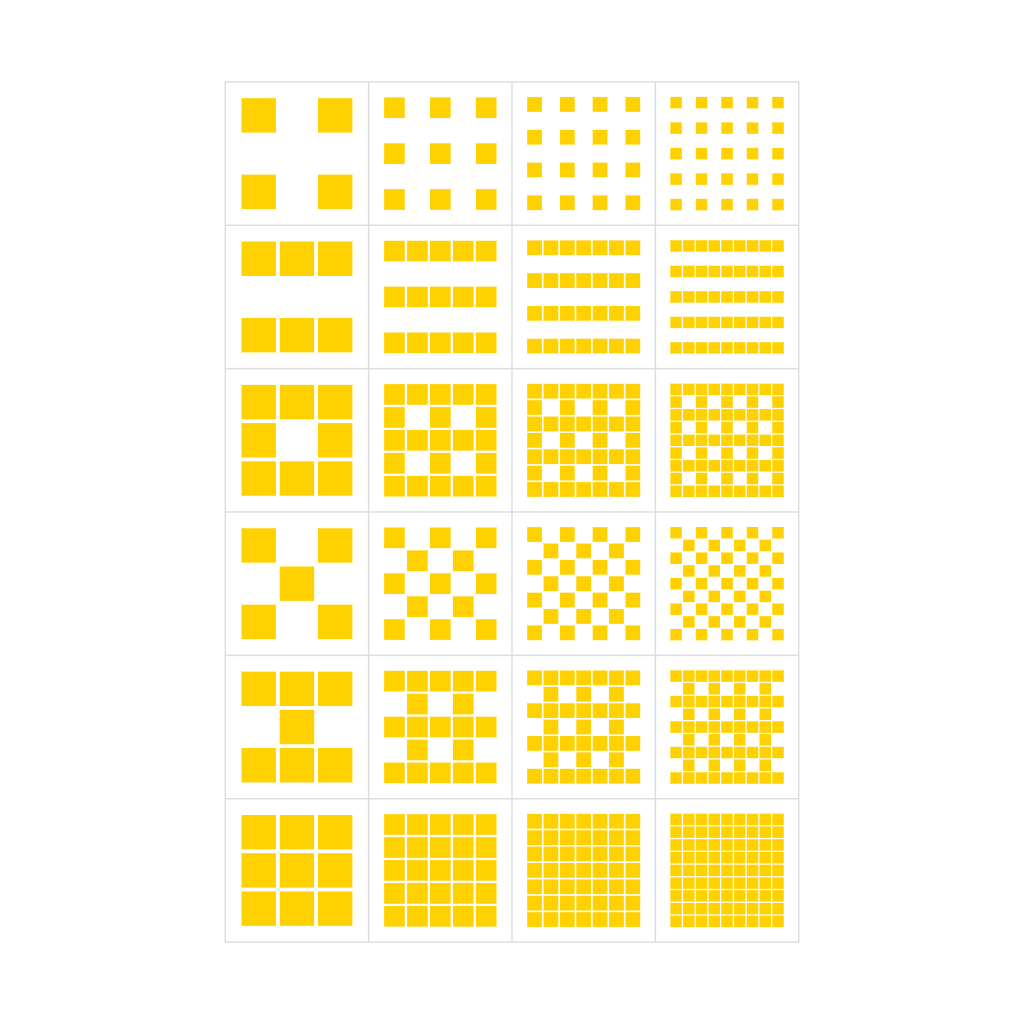
- The universe of shapes is finite and already enumerated. A design is a subset of the
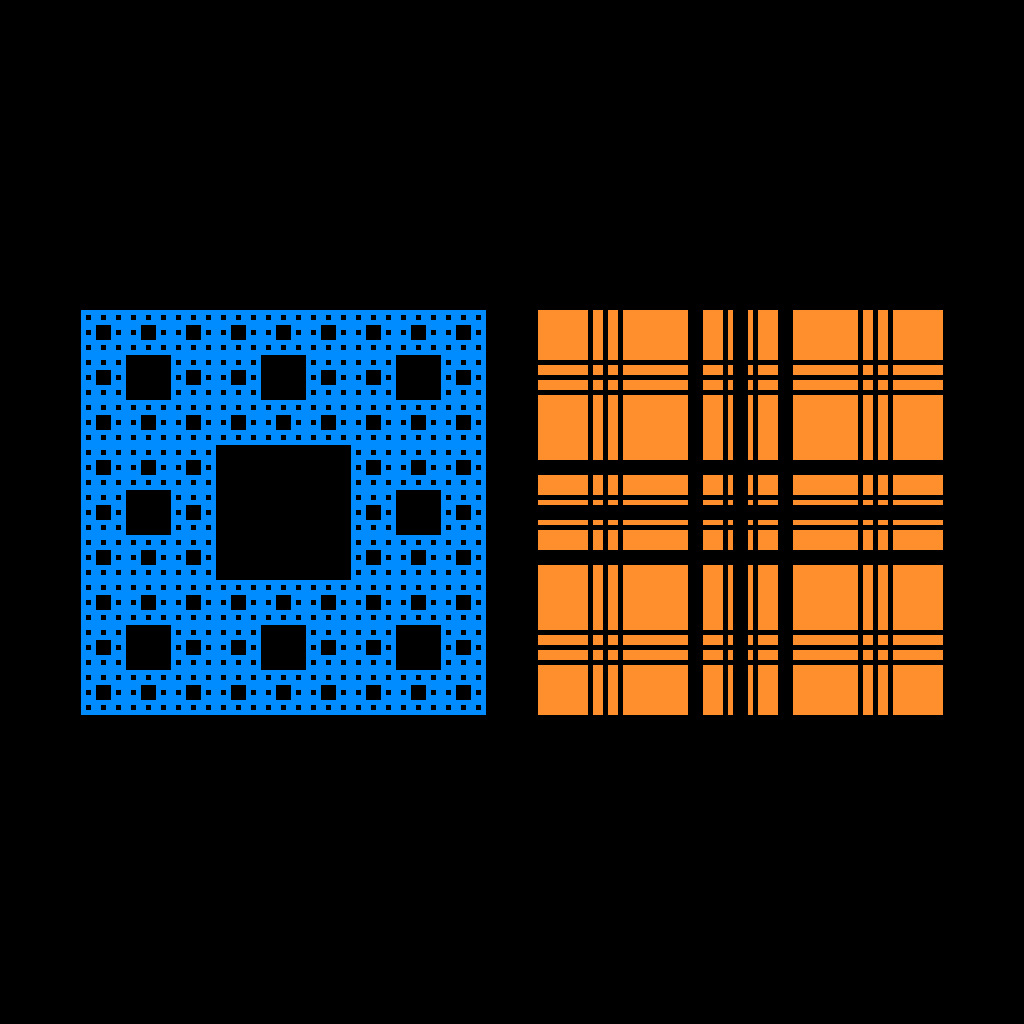
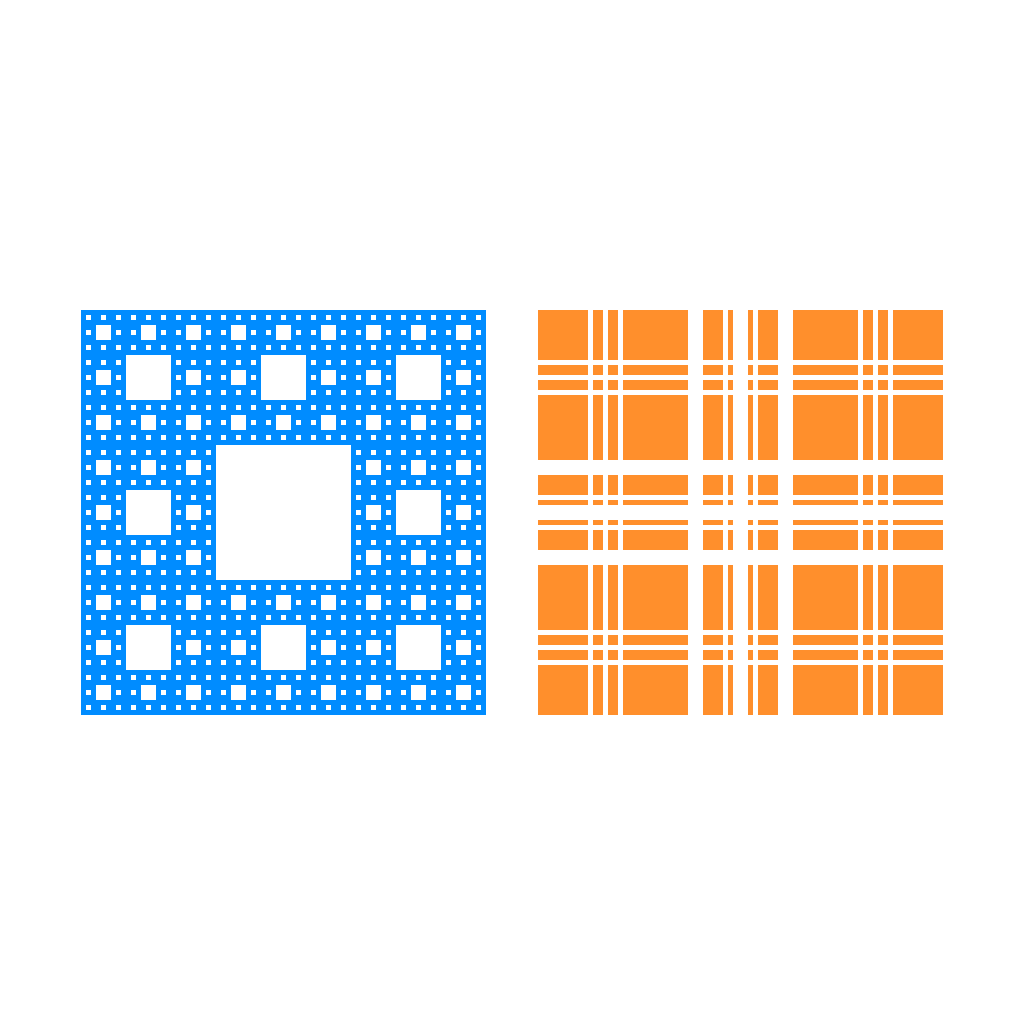
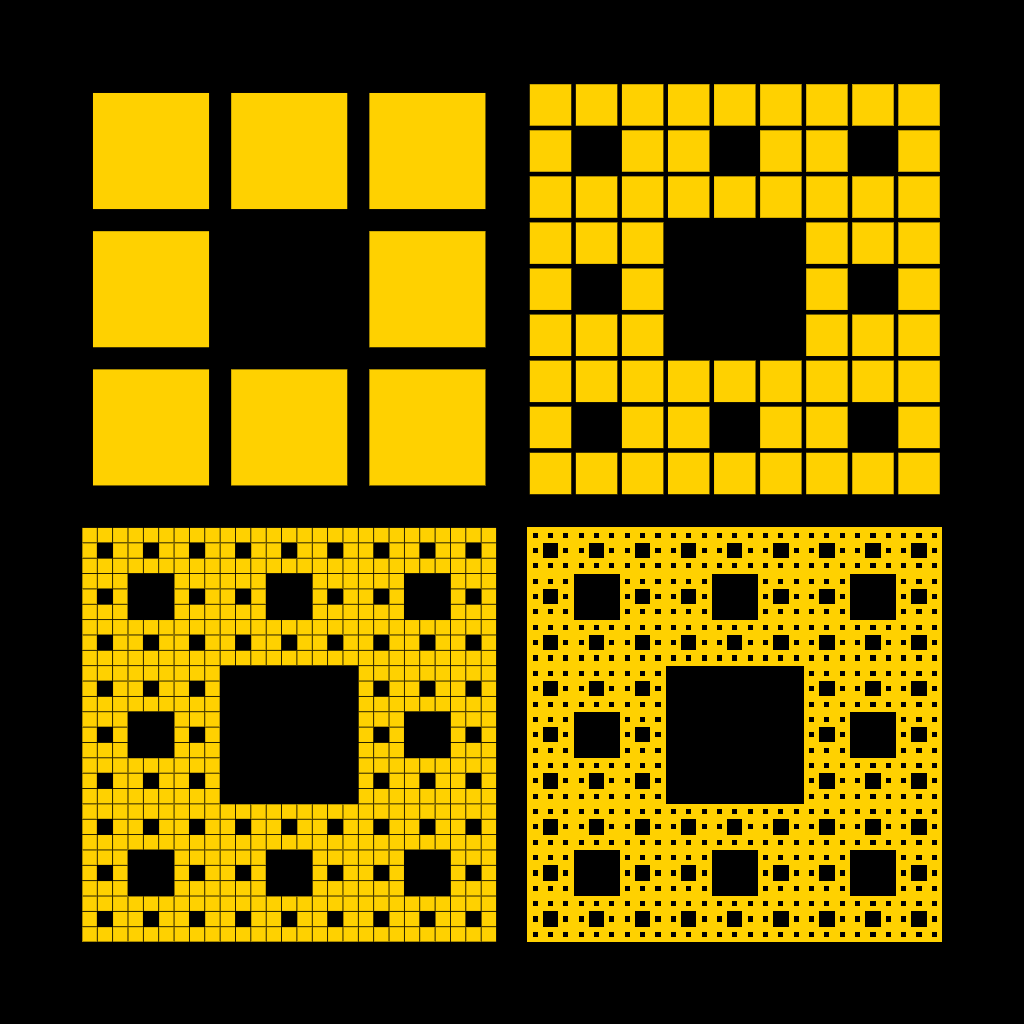
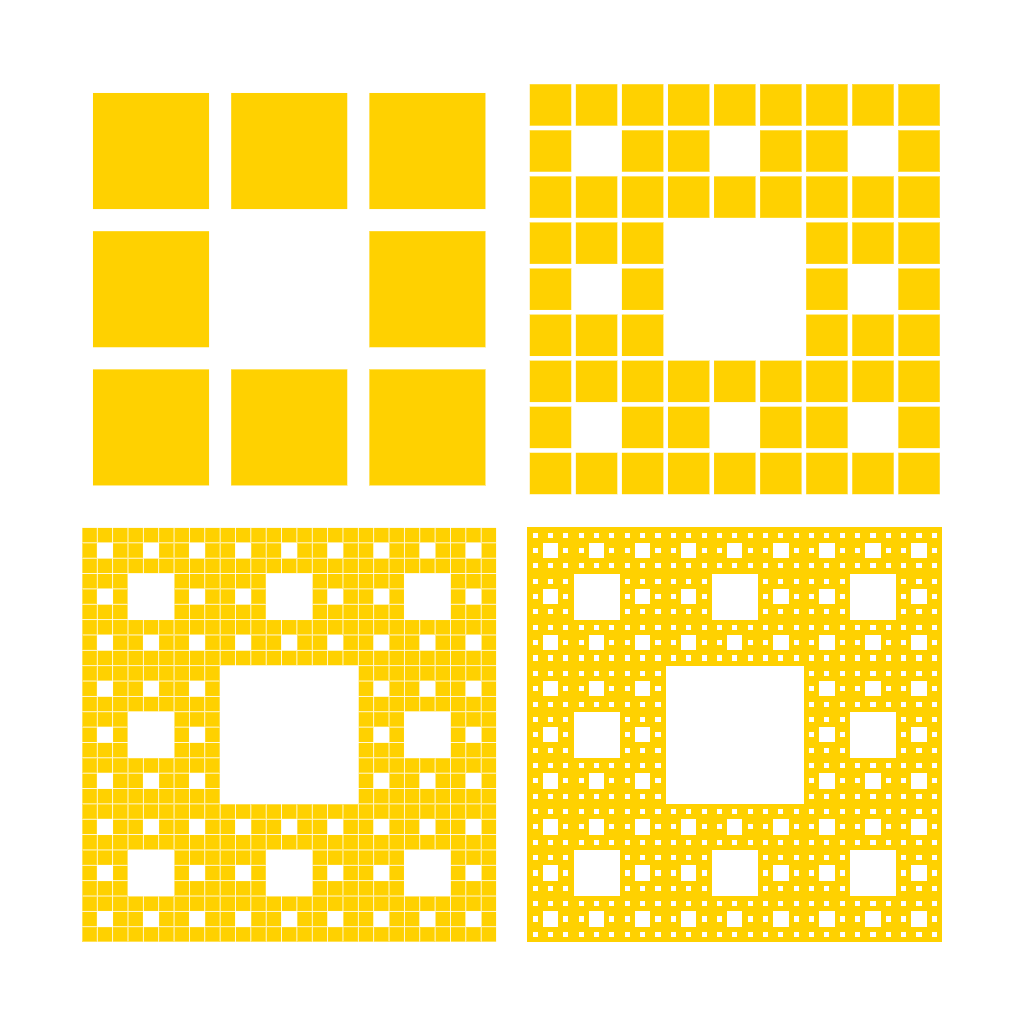
2^Dcorners of the parity cube, so there are2^(2^D)of them - 4, 16, 256, 65536 atD = 1..4- and the Sierpinski carpet and the Menger sponge are two entries in that list rather than two inventions (core). - Up to cube symmetry that list is a list mathematics already keeps: it is the NP-classification of Boolean functions, A000616. Sensitivity, certificate complexity and decision-tree depth are therefore properties of a fractal, with no translation step (bijection).
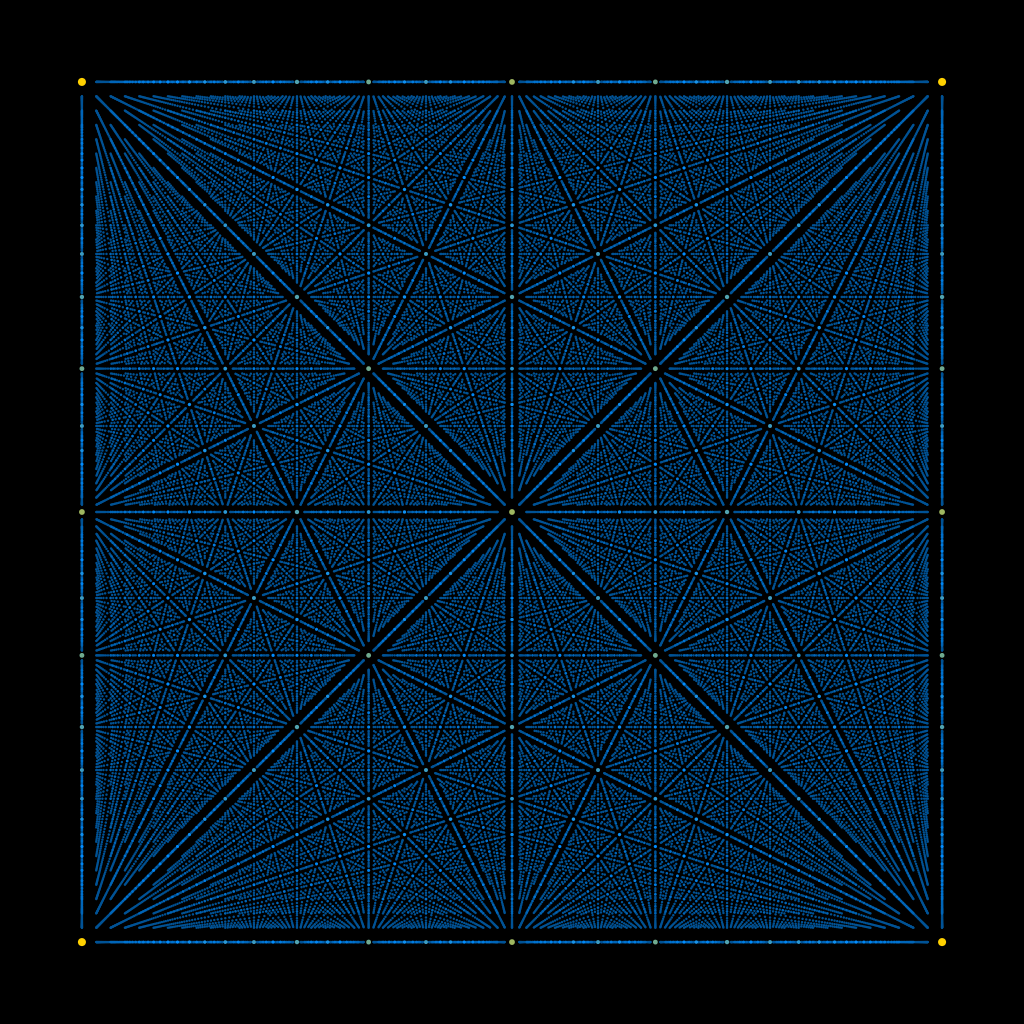
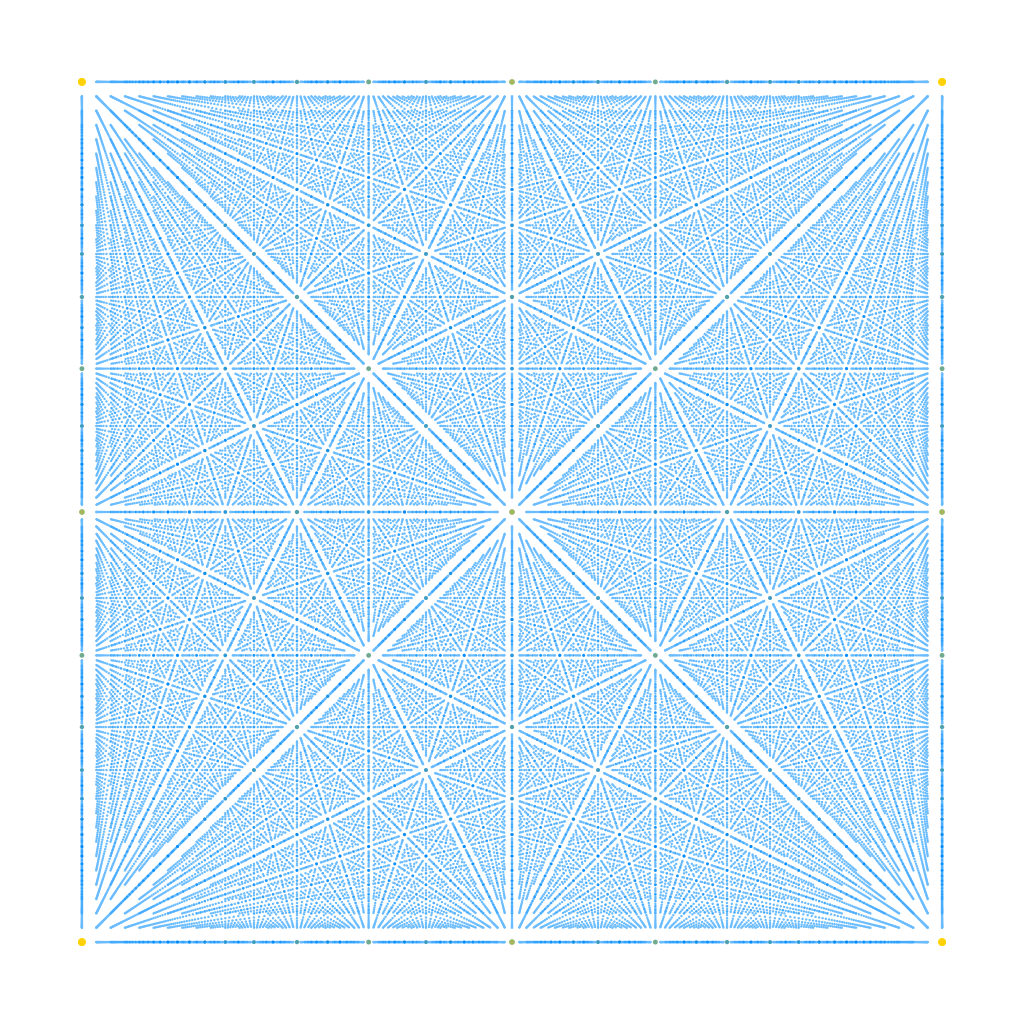
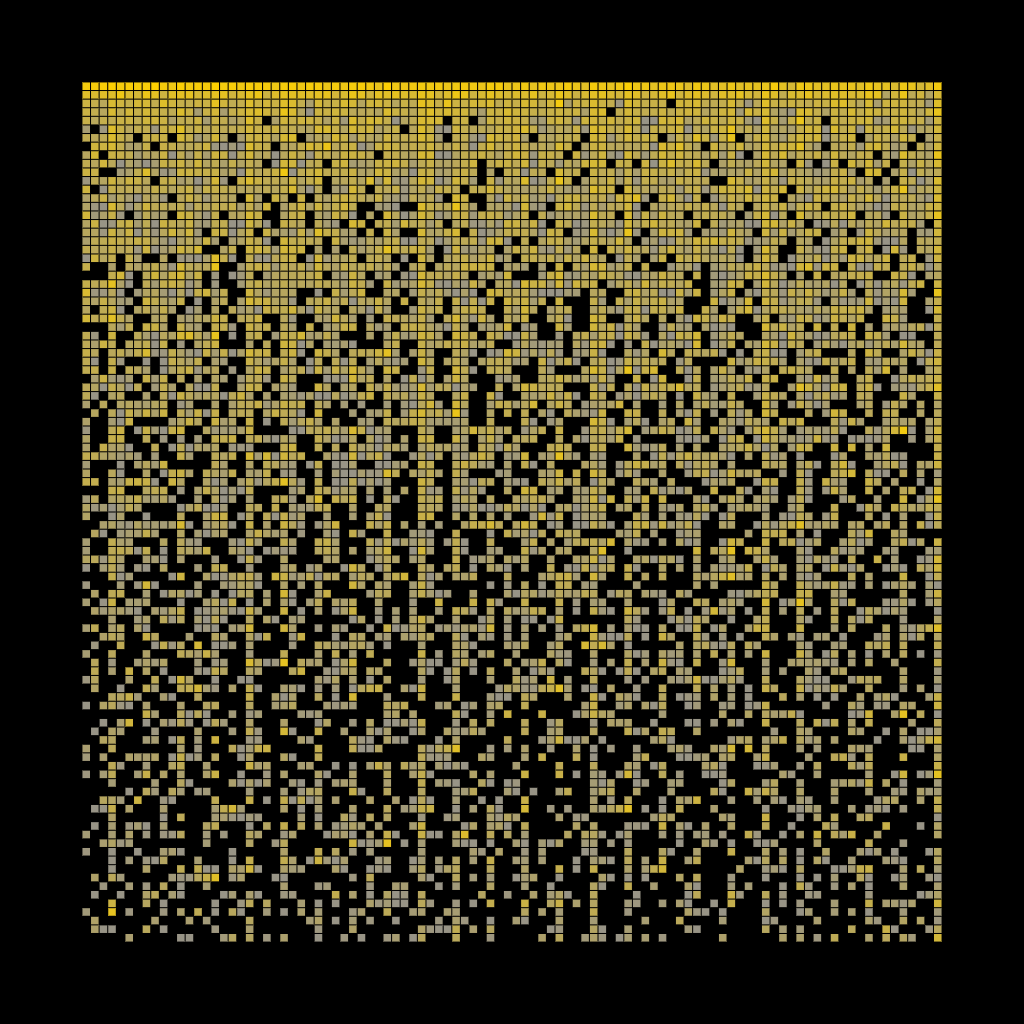
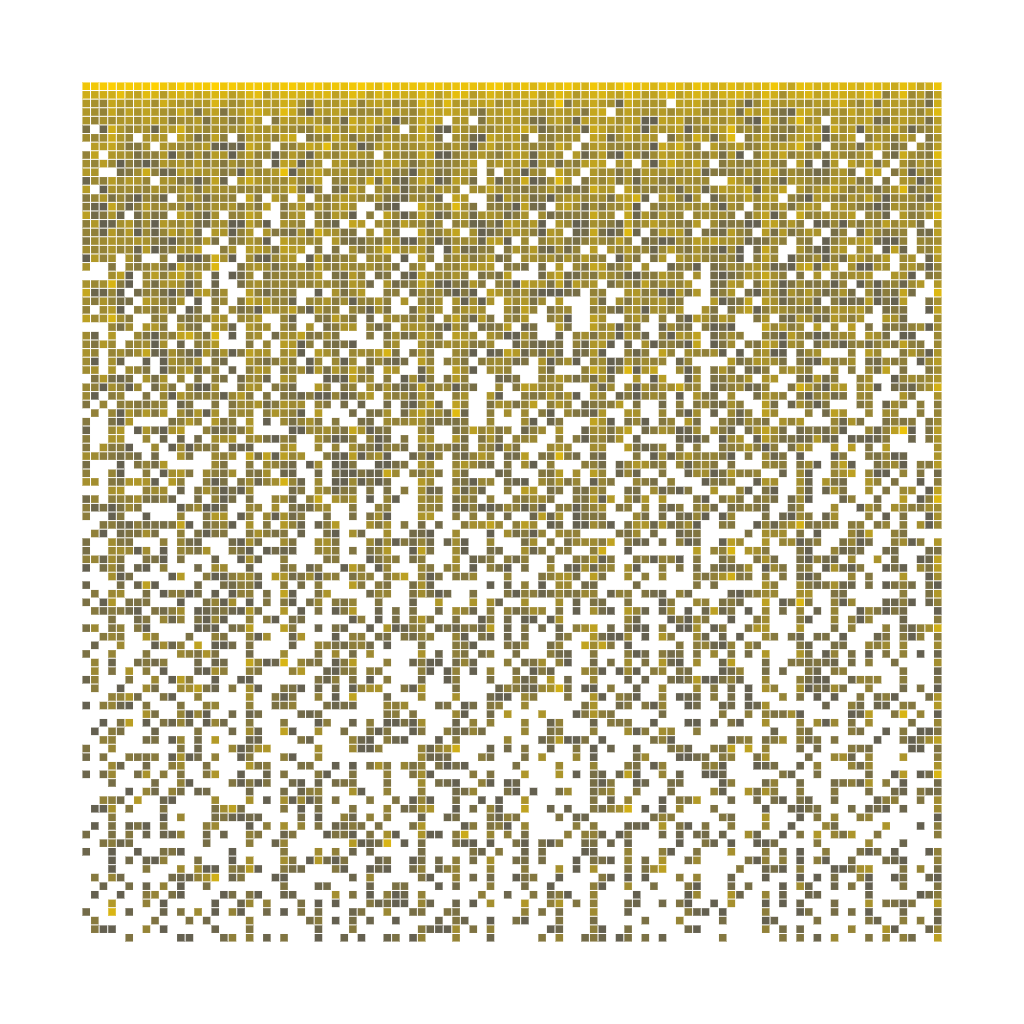
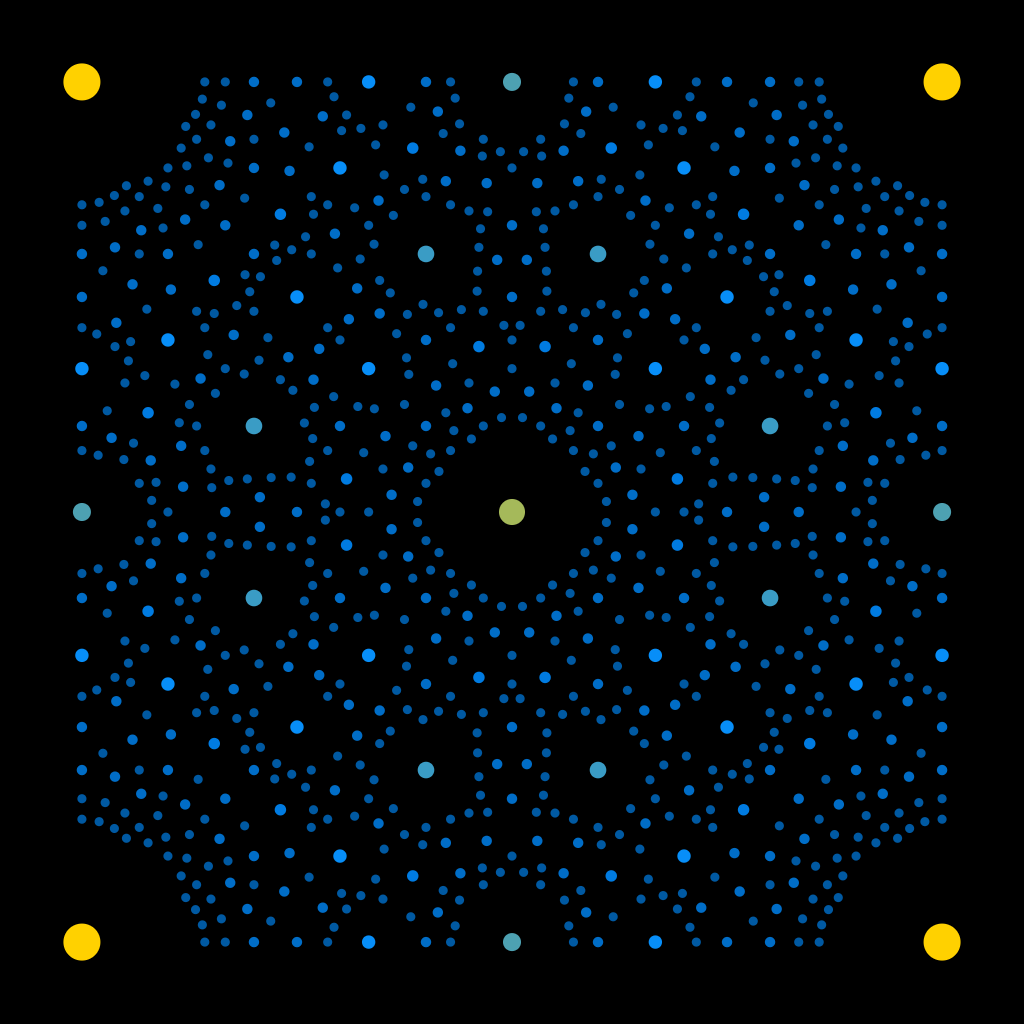
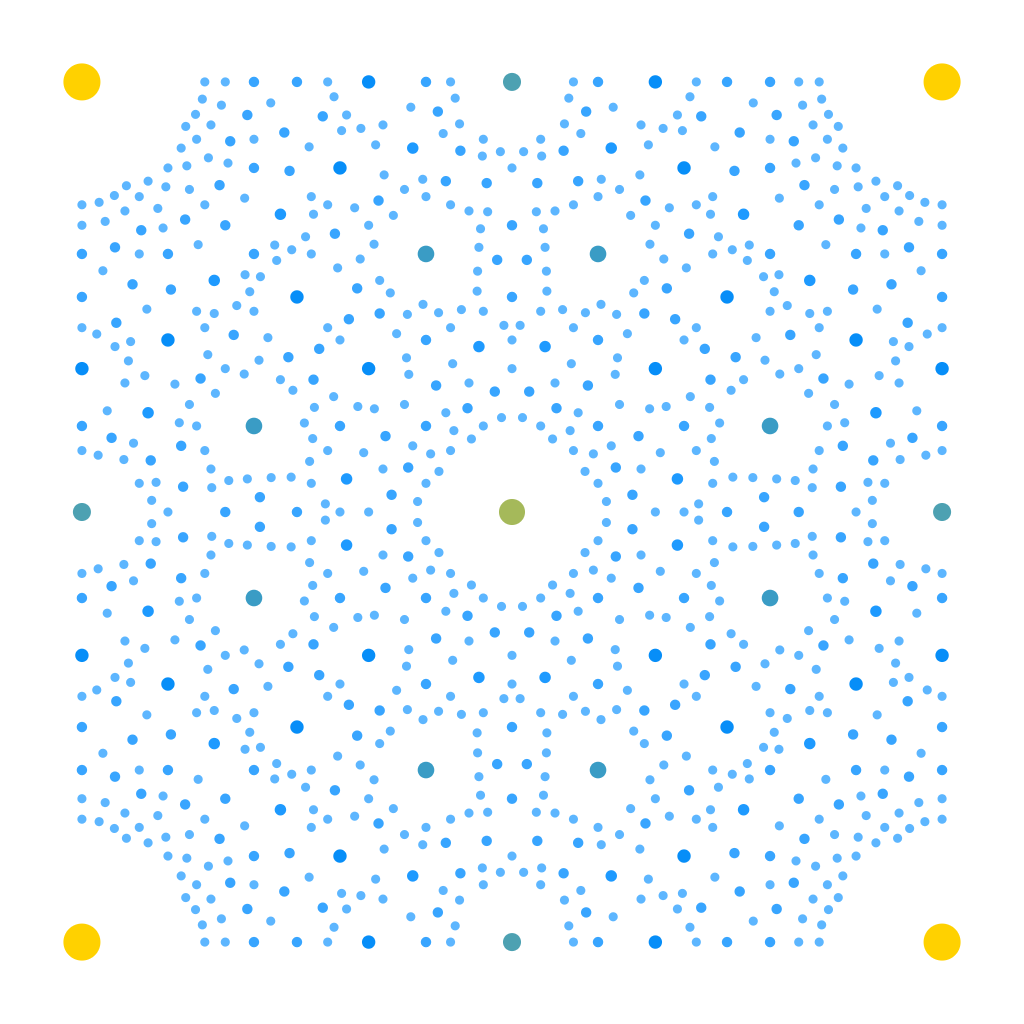
- The arithmetic the same construction exposes is not decorative. The bright nodes of the stacked grid are the Farey fractions, and how evenly they spread is equivalent to the Riemann hypothesis by Franel 1924 and Landau 1924, stated in modern form on the Farey sequence page (farey).
- Three sequences out of this work are with the OEIS, A395241, A396934 and A398348, and the fractal families behind them are published on Bourke's fractal page with the source PDF.
KEY FINDINGS
- A design zeta has zeros where the Euler product forbids them, every proper design carries one, and each is a proof that the design's own Mobius fails every square-root-shaped bound. Proved. With a_min the least nonzero digit, a_min^sigma zeta_F(sigma) < 2 puts no zero in Re s >= sigma, sigma_1 running 0.5 to 1.75 over twenty-four designs, and inside that edge the argument principle counts 157 zeros right of alpha below Im s = 40 over twenty-three designs, all located, twenty-one of twenty-four carrying one while the base 2, 3 and 4 full sets carry none at 1e-33; each rightmost sits in a 5e-5 winding box, and where 1 in F the transport theorem turns it into theta(nu_F) >= 0.4414555 up to >= 1.0026354, four designs putting their own Mobius above x itself. Near each pole line the zeros are a comb the residue places and a Rouche margin certifies, 11 of 106 poles proved to carry exactly one zero with every input bounded from the digit recursion, and the ordinate shadow is a constant-free Newton step rho_0 - zeta_F(rho_0)/zeta_F'(rho_0) whose median ratio reaches 0.99741809 at base 50 missing one digit and whose offset scales as (m/q)^1.04544 rather than (1-alpha)^0.71691. What has no law is everything coarse: no shared curve, no counting law, no symmetry about any vertical line, no contraction to alpha/2 and no gain law in (alpha, k/q) (Refuted five times), while the indicator of S_F is multiplicative exactly at the full digit set (Proved over 8177 sets to q = 12), so the position product stands where the Euler product does and the square-root shape can only be carried by mu restricted to S_F (zeta, mobius).
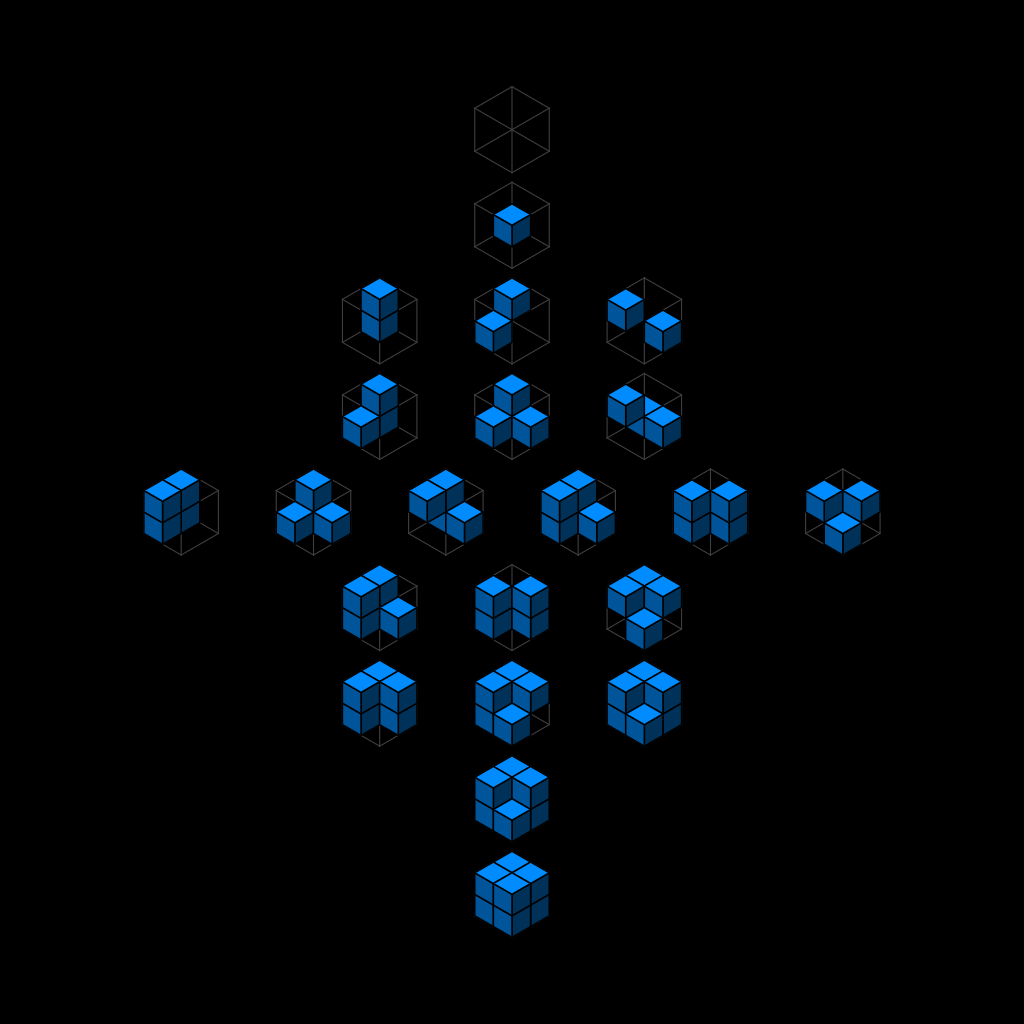
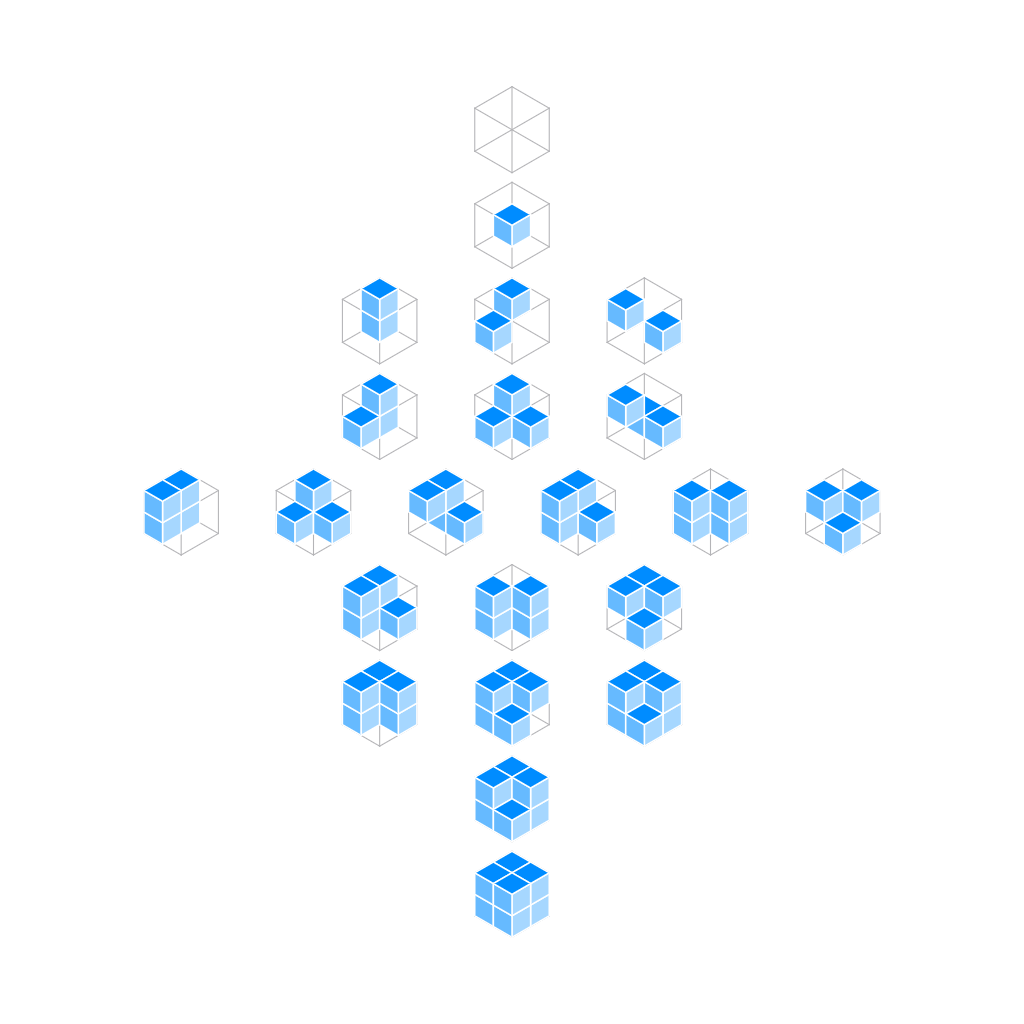
- A design is a Boolean function, and the counts follow. Proved. The indicator map is an equivariant bijection carrying cube symmetry (the signed permutations
B_D, order2^D * D!) onto NP-equivalence, so the class counts are A000616:3, 6, 22, 402, 1228158, 400507806843728atD = 1..6. Reproduced three independent ways - orbit walk on designs, orbit walk on truth tables, and a Burnside average - and checked against the live entry throughD = 7. The NPN sibling, adjoining output complementation, gives2, 4, 14, 222, which is A000370 atD = 1..4(bijection). - Past base 2 the same census is a known toroidal one. Verified. Burnside over one dihedral group per residue axis gives
2, 6, 26, 805, 172112, 239123150, 1436120190288, 36028817512382026atD = 2,q = 1..8, which is A255016, the toroidal binary arrays of Ethier and Lee 2015. Quotienting the same cells by the rigid hypercube group instead gives2, 6, 102, 8548, 4211744, which is A054247 and rown = 2of A361870. - The
D = 3line of that census is this tree's own OEIS entry. Verified. The same Burnside atD = 3gives2, 22, 111618, 6005363762644688, 7089215977519836239803174210135872, which is A398348, with a b-file ton = 14(bijection). - Every diagonal cut of
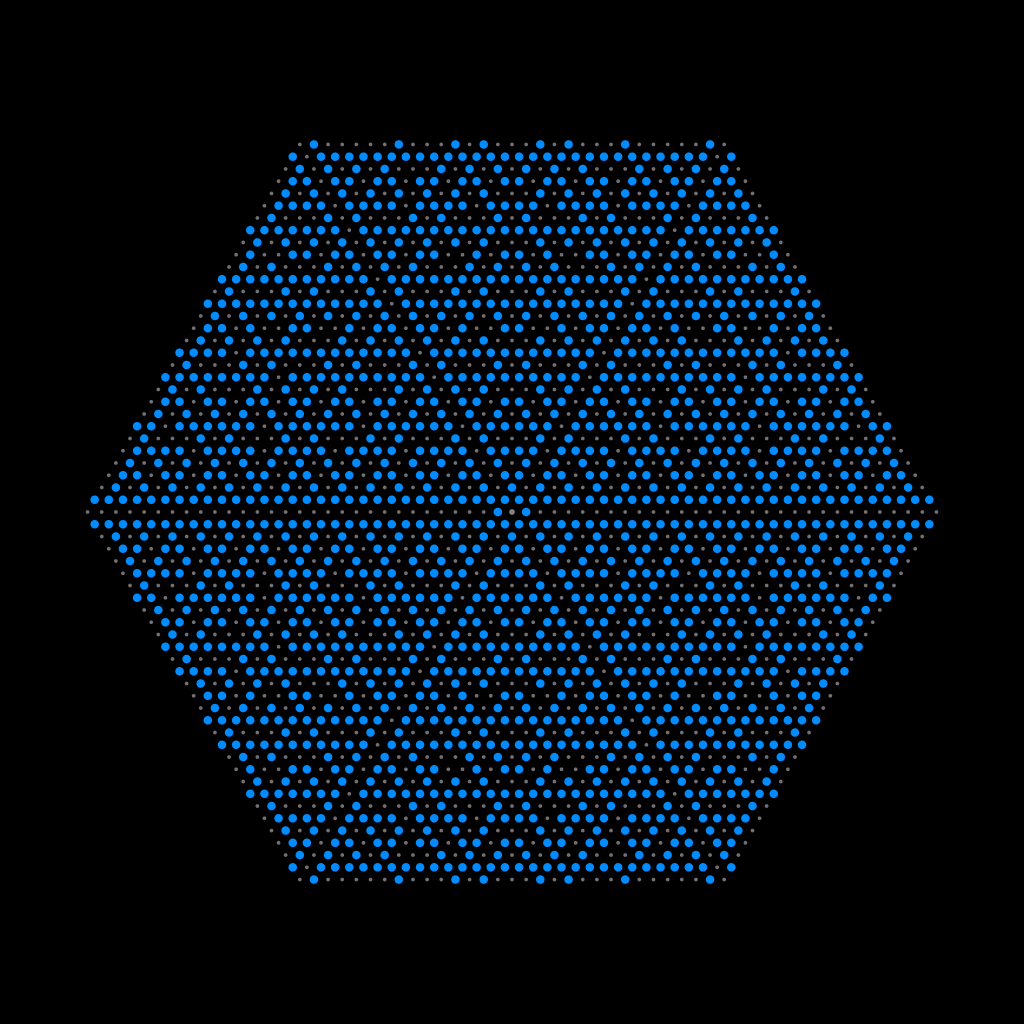
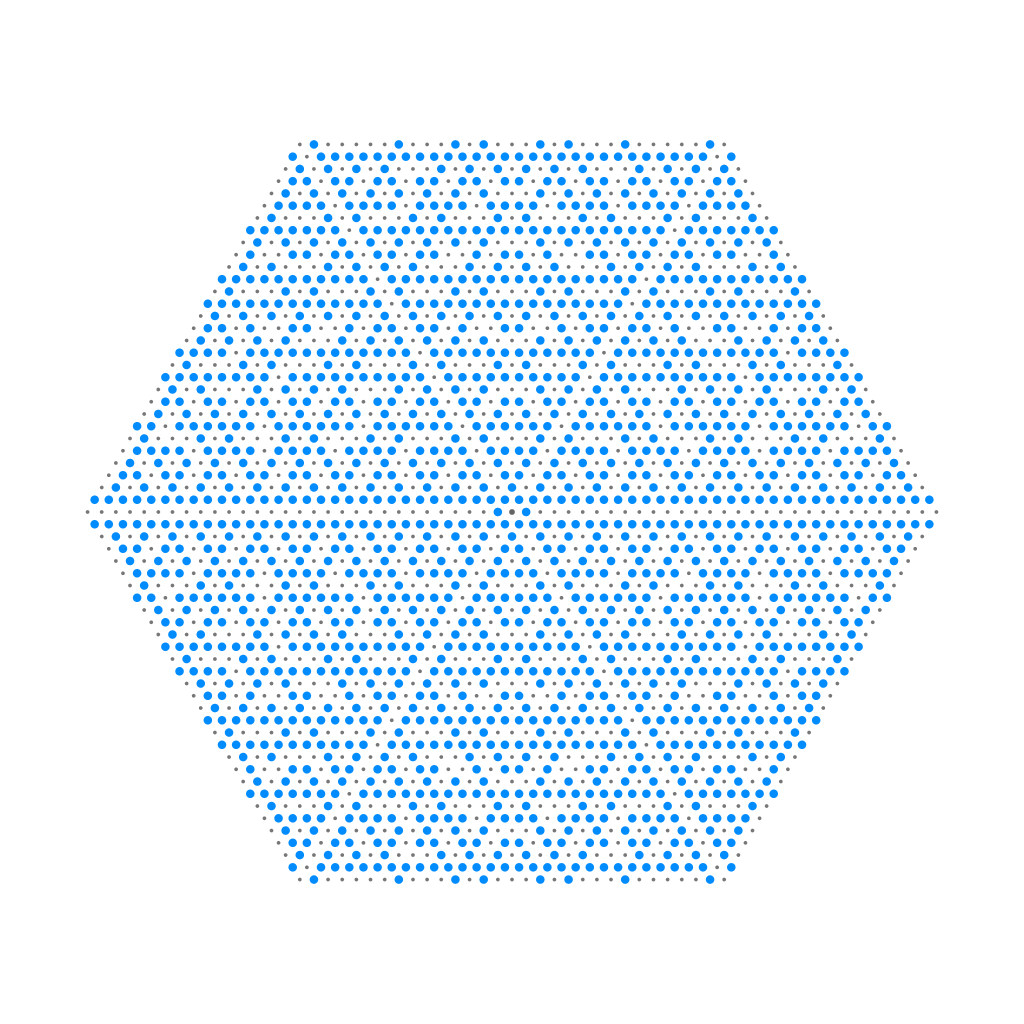
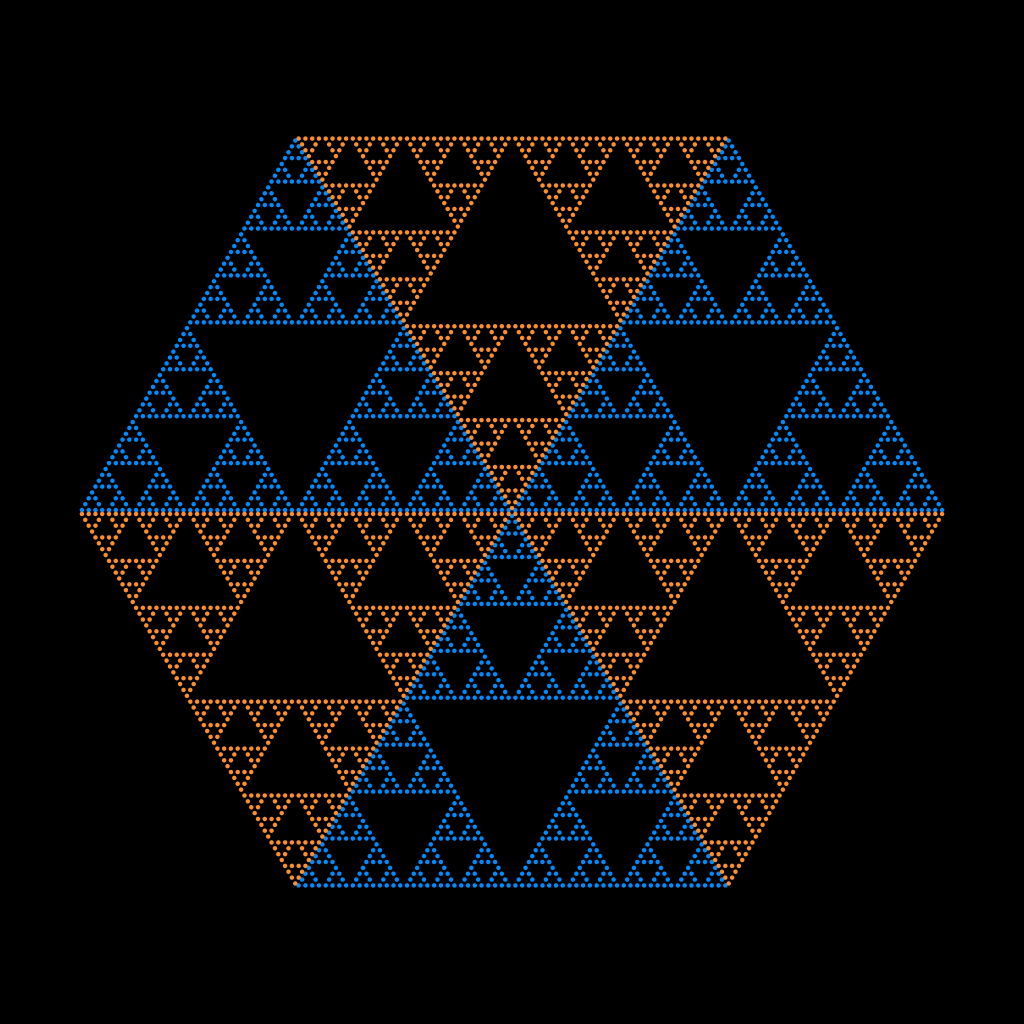
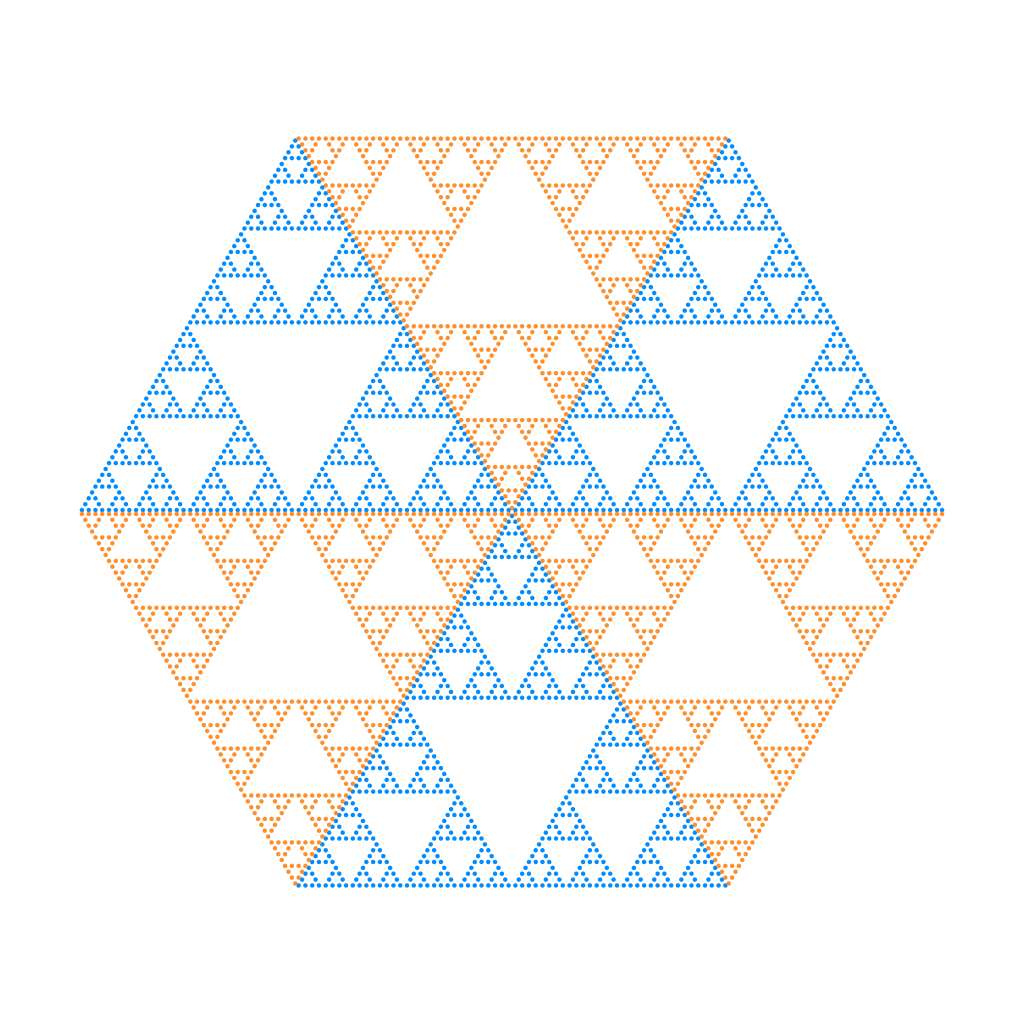
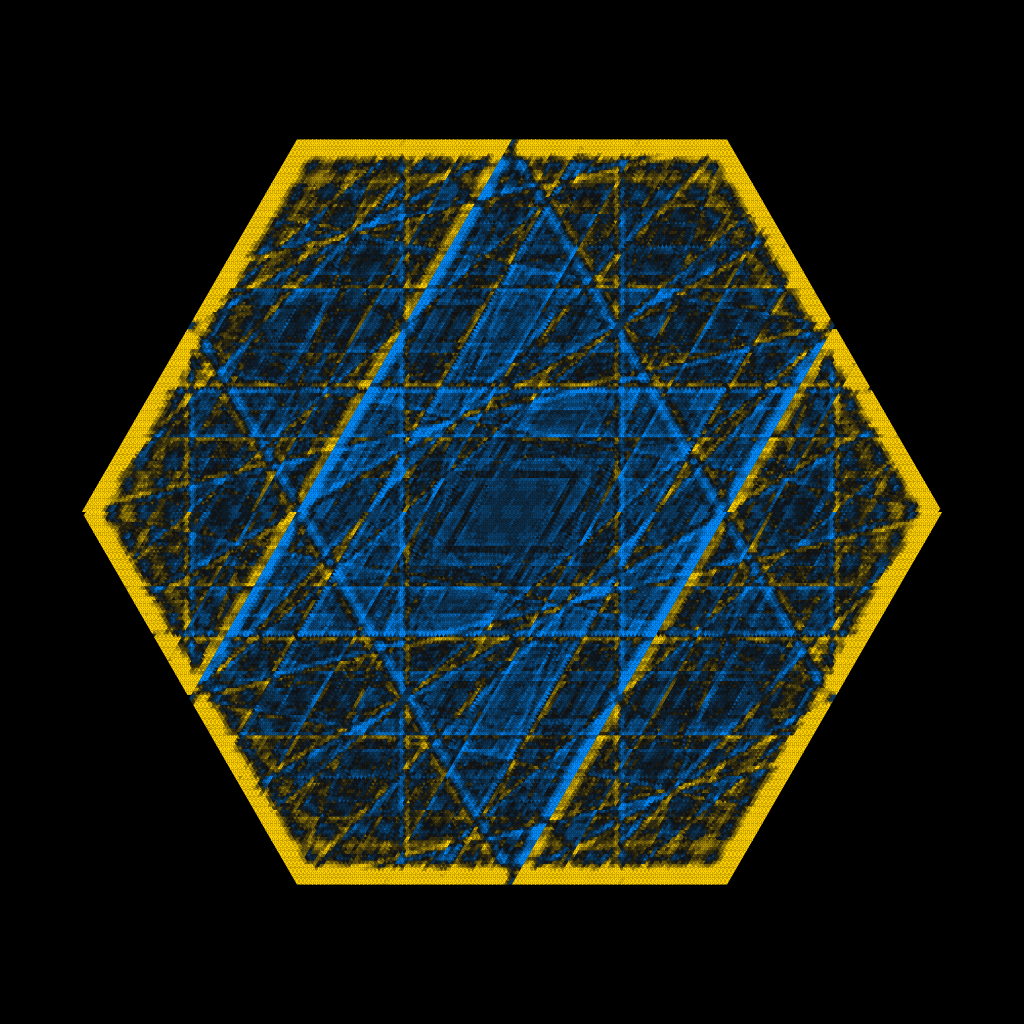
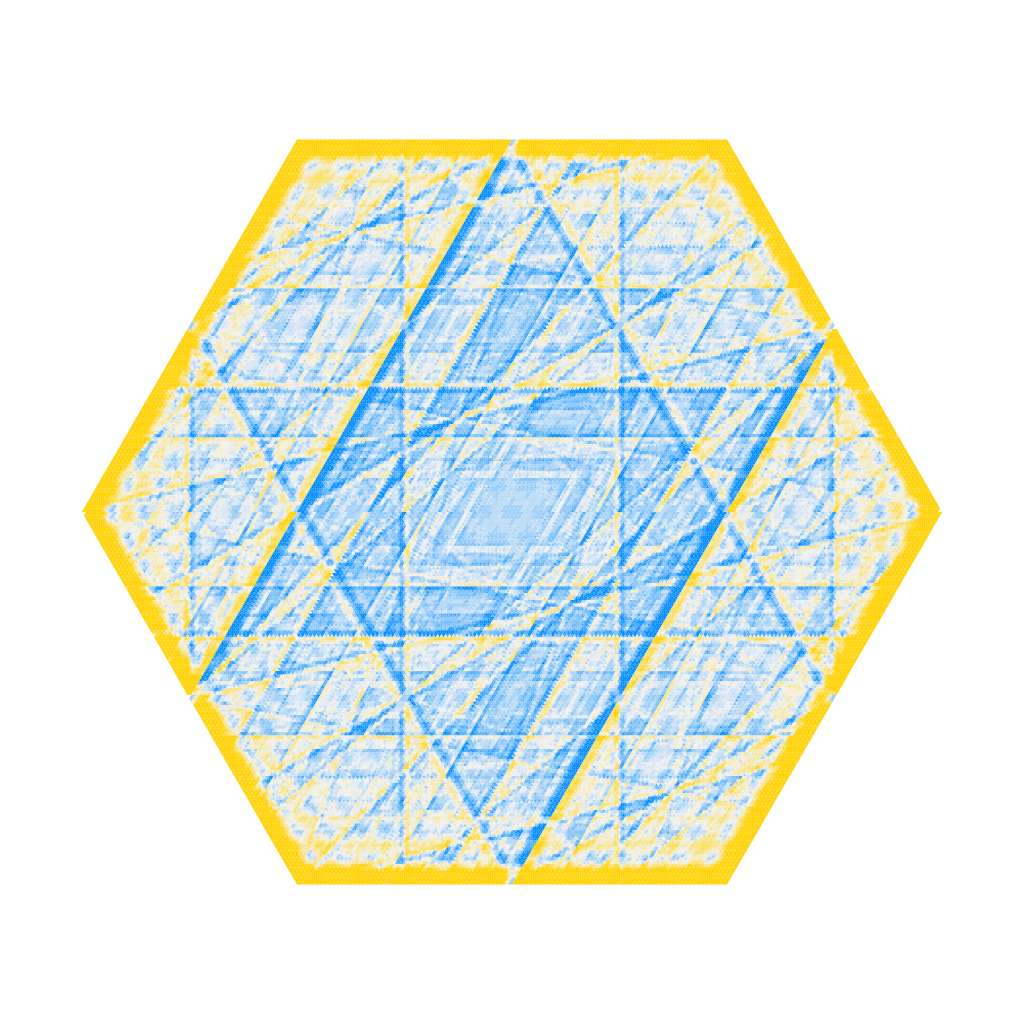
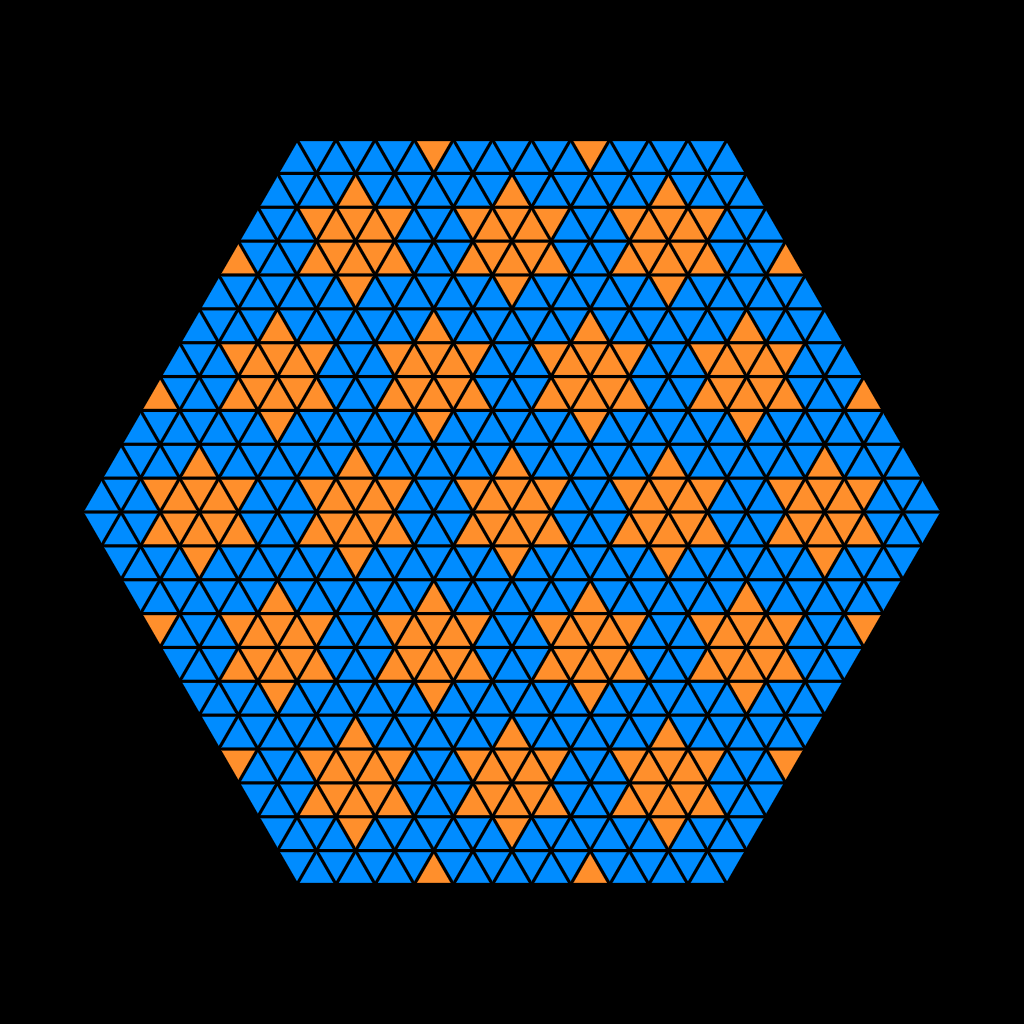
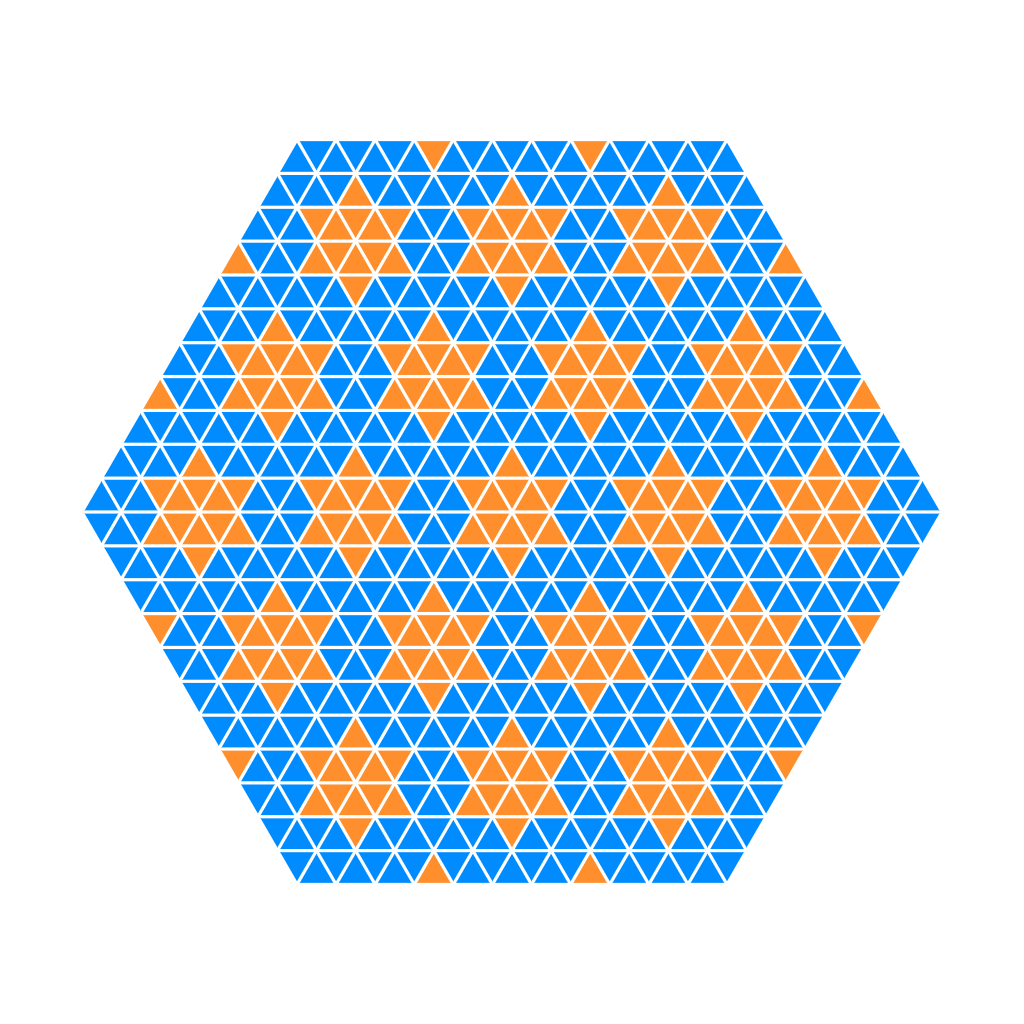
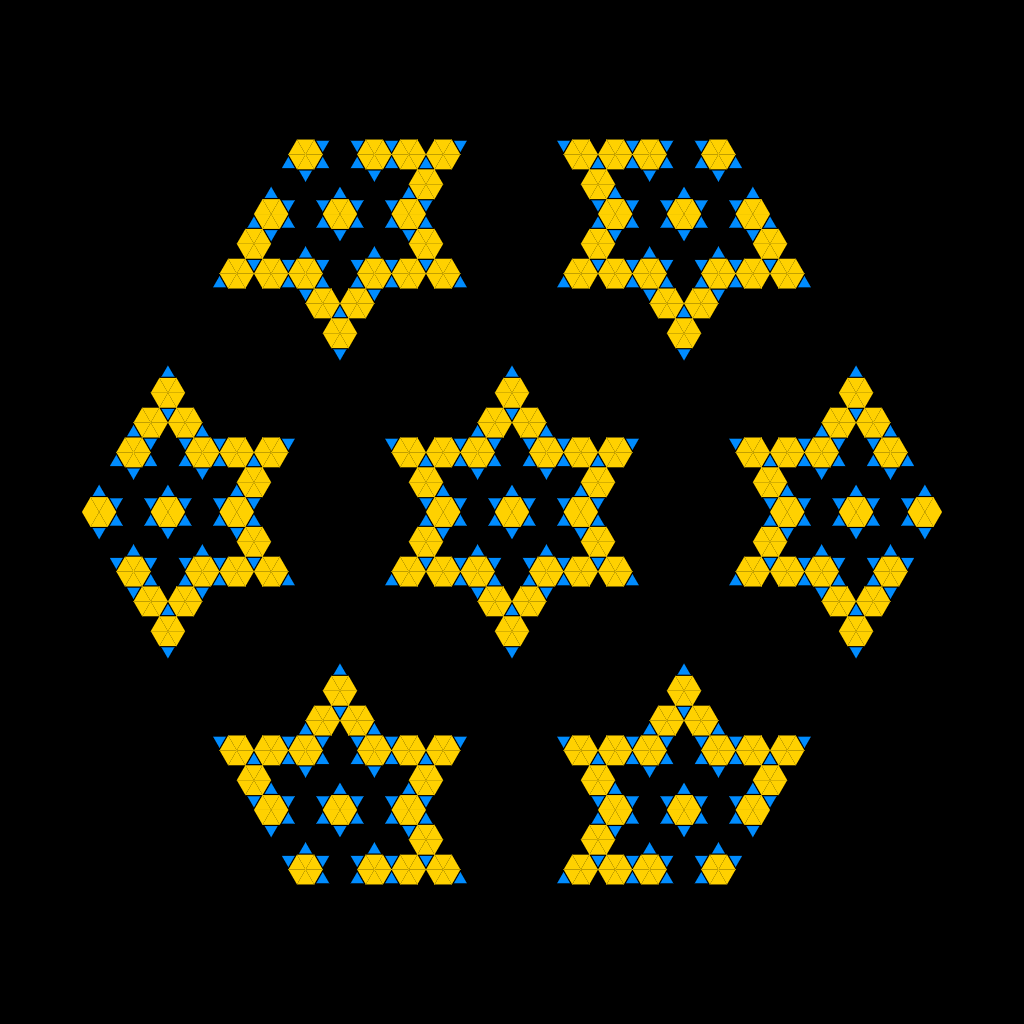
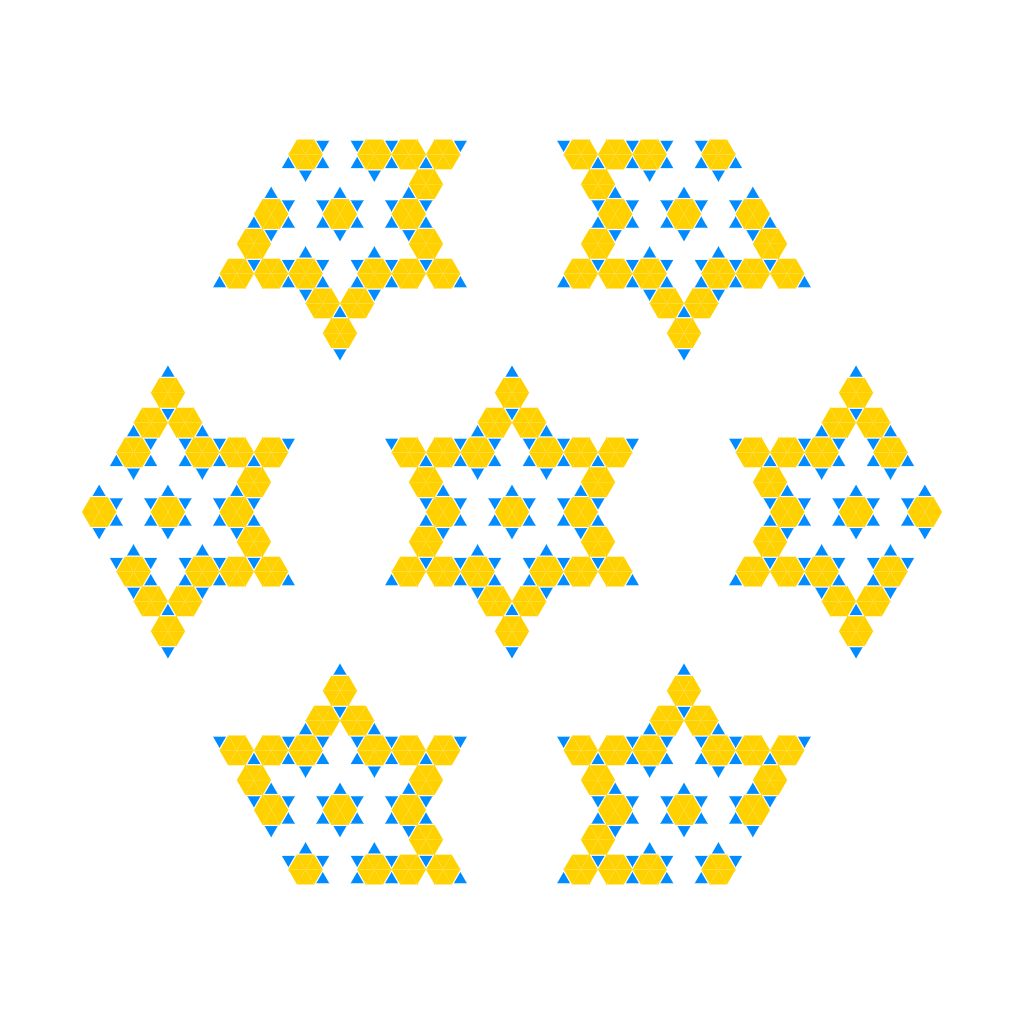
mrly_bang_d3_126is a Sierpinski gasket of exactly3^Lpoints. Verified. The binary digits of the height schedule which triple of corners each scale uses, so no height is deficient and the slice dimension islog(3)/log(2) = 1.584963at every one. The two central cuts together fall into six congruent gaskets of3^(L-1)tiling a hexagon, three per cut, with an order-12 symmetry group, toL = 8(6 * 3^(L-1) = 2 * 3^Lpoints in all: 18, 54, 162, 486, 1458, 4374, 13122). The object is the standard octahedron flake of dimensionlog(6)/log(2)(n-flake) and the digit-scheduled mechanism is published by Nakajima and Watanabe 2026 (journal version); what is specific here is the constancy - their digit changes the number of maps, this one changes only the orientation (cuts). - The flat slice is a page of Pascal's pyramid. Proved. At height offset zero the three coordinates have disjoint binary supports, which by Kummer's theorem is exactly the condition for the trinomial coefficient to be odd, so the lowest slice is the odd part of layer
2^L - 1of A268240, counted by A048883= 3^wt(n). The 2D analogue is A047999 with antidiagonal populations A001316, on record since Glaisher 1899; both b-files check term for term (b001316, b047999). The classical layer count swings between1and3^L;mrly_bang_d3_126's is3^Lat every admissible height (cuts). - Geometry under-determines Boolean complexity at
D = 4, with a named witness. Verified.mrly_bang_d4_27andmrly_bang_d4_281share genus,GF(2)degree, popcount and the fill polynomial4k^4 - 4k^3 + k^2- everything the fractal knows - and split six of seven complexity measures. Across both catalogsC = bson all 424 classes,s = bseverywhere atD = 3with exactly one exception atD = 4(mrly_bang_d4_7128,s = 2,bs = 3, orbit 24), and exactly two classes meetdeg = s^2,mrly_bang_d4_855andmrly_bang_d4_1911; the second is the textbook AND-of-ORs that Huang 2019 (journal) names as tight fors(f) >= sqrt(deg(f))(complexity). - The base-2 flake carries an exact interior band gap. Verified. The combinatorial Laplacian of the
mrly_bang_d3_23flake has no eigenvalue strictly inside its gap at any level toL = 6, the lower edge climbing1.000000, 1.827520, 1.975680, 1.996862, 1.999605, 1.999950, and the upper edge is exactly 4 in exact rational arithmetic - a simple eigenvalue, with3*4^(L-1)eigenvalues below 2 and none in[2, 4). The edge closes at a fittedc * 8^(-L)withcnear 12.9868, carried toL = 10; that rate is a fit with no mechanism, and stays Conjecture (complexity). - The slice mesh is classical lattice geometry, and its sequences are already catalogued. Verified. The central diagonal section of the odd cube is a hexagon of
6*n^2unit triangles with12k^2 - 6k + 1vertices andV - E + F = 1at every size; the vertex count is A154105 atn = k-1, the centered hexagonal number A003215 at index2k - 1, so a prime vertex count is always a cuban prime, A002407. Fork = 1..20ten values are prime (7, 37, 271, 397, 547, 919, 1657, 1951, 2269, 4219) and ten composite. Carpet and net partition the hexagon cell for cell (42 + 12atn = 3, up to3696 + 2070atn = 31), and their components and holes both run the centered hexagonal numbers (slices). - Two prior-art collisions, attached. Verified. The carpet face-count law derived in slices,
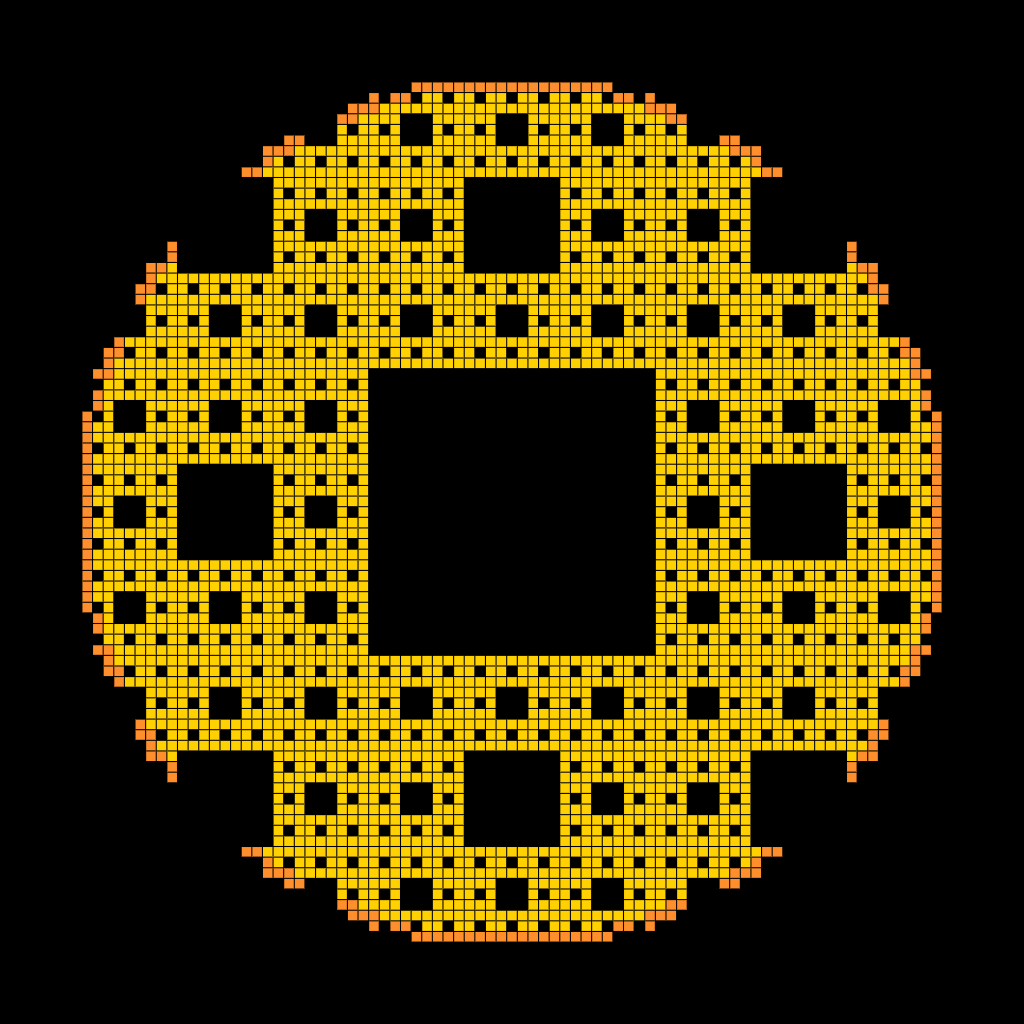
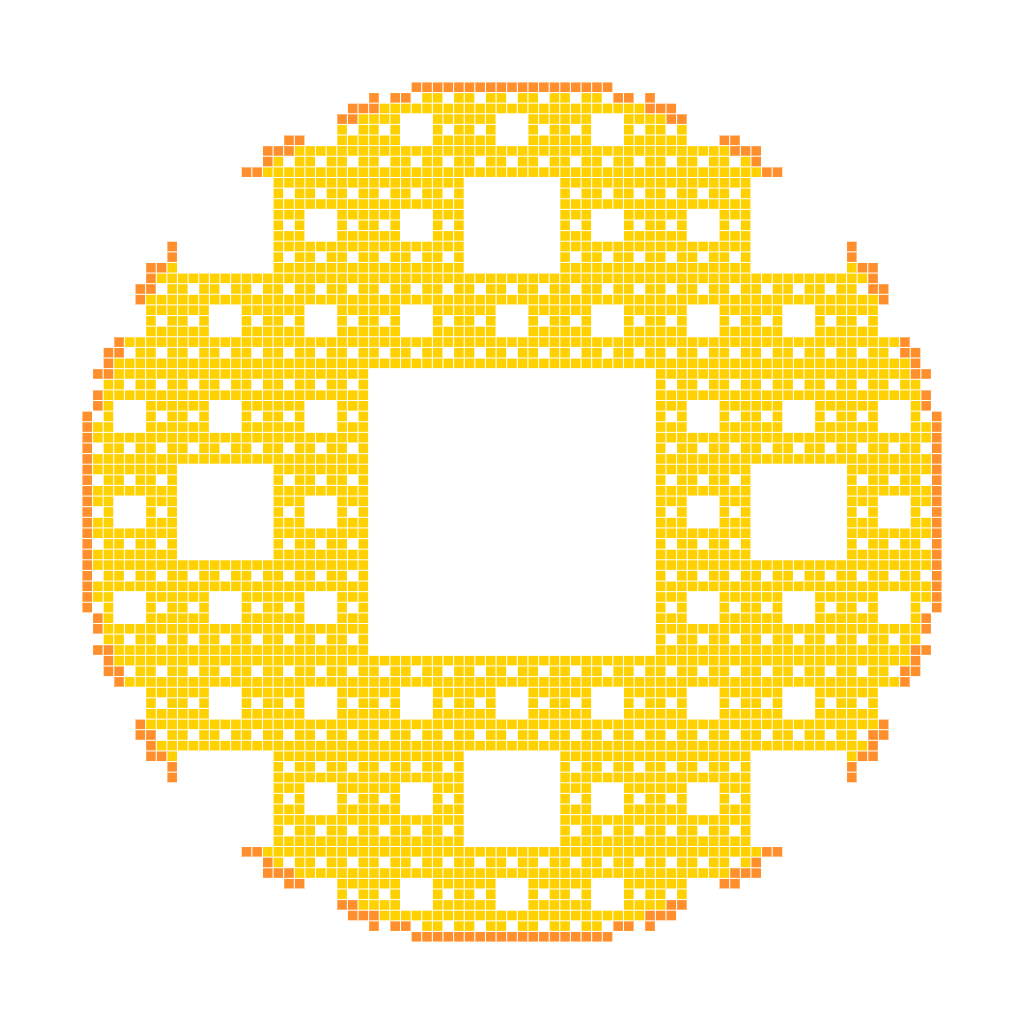
V(i) = 2*20^i + 4*8^iwith visible faces72, 1056, 18048, 336384, is A332705 verbatim, the surface area of a stage-nMenger sponge. The carpet slice census6, 42, 306, 2250, 16578printed in complexity is A299916 shifted by one: this work counts filled mesh triangles at levelL, A299916 counts hexagram holes of then-th descending size in the same cross-section, andcensus(L) = A299916(L+1). A299916's own name isa(n) = A299914(2n+1), an odd bisection of an arithmetic divisibility sequence with no geometry in the definition; the Menger reading is a single comment on the entry. Its recurrencea(n) = 9*a(n-1) - 12*a(n-2)hands the slice the closed form it lacked and a dimension oflog((9 + sqrt(33))/2)/log(3) = 1.8184. - Why the shared row is an identity and not a coincidence. Proved. Section the level-
Lsponge onx + y + z = 1.5*3^L: a surviving cube cuts a hexagon of 6 mesh triangles or a triangle of 1, so the census is6*H_L + T_L. Refining triples the plane offset, and of a cube's 27 subcubes the 20 survivors split by coordinate sum as1, 3, 3, 6, 3, 3, 1, so a hexagon cell keeps the 6 of sum 3 as hexagons and the3 + 3of sums 2 and 4 as triangles, while a triangle cell keeps 1 and 3 on either side. That is Abel's substitution proved by exhaustion, not quoted:H_(L+1) = 6*H_L + T_LandT_(L+1) = 6*H_L + 3*T_L, hence the census isH_(L+1). The same exhaustion gives the ledger54 = 6*6 + 6*1 + 12for a hexagon and9 = 1*6 + 3*1for a triangle, so exactly one 12-triangle hexagram is punched per hexagon and none per triangle, and holes of then-th descending size numberH_n = A299916(n). Two bijections, one index apart. Recomputed cold from the Menger digit rule forL = 0..5, where the empty area resolves into1, 6, 42connected components of descending size, each with six radial maxima, sixfold symmetry to0.001andmax/minradius1.68against the hexagram'ssqrt(3). - The isotropic-class count is proved, not fitted. Proved.
3, 5, 10, 19, 36, 71, 136, 271is the number of subsets of{0..D}up to reversal, minus one at evenD. That is A005418 at indexD + 2less the even-Dcorrection, recomputed toD = 16:..., 528, 1055, 2080, 4159, 8256, 16511, 32896, 65791. Nameable classes grow like2^D, half the2^(D+1)subsets of{0..D}, while all classes grow at least doubly exponentially, so almost every design is a compound (core). - Structure holds together where matched noise shatters. Verified. At identical grid and identical cell count, every self-similar design tested is one component at every size while the random control is not: the
256 x 256gasket reads 1 against5257.23 +/- 32.94, the81^3sponge 1 against31576.40 +/- 152.71, and 0 of 400 random draws ever reach one component at the32 x 32gasket. Boundary per cell runs the other way, 2.0003 against3.6006 +/- 0.0103at256 x 256(connectivity). - The component count of a magic word peaks at the checkerboard, and the peak is a theorem. Proved. One cell per component is an independent set of the
2^Lgrid, capped at2*4^(L-1)by a perfect matching, and the word(15^(L-1), 6)attains it: its composite is the checkerboard{i + j odd}, every filled cell isolated. The cap is met exhaustively over all words of lengths 1 to 4 and through the linear representation at length 5; the order-sensitivity census and the rank4, 4, 8, 11representations of components, Euler characteristic, boundary and holes are Verified by the same study (lab/magic-words, connectivity, magic). - The component exponent is order-blind at interior frequency on all 105 letter pairs, and the constant-word average is the wrong prediction. Proved. The component count of a magic word has an exact closed form on every letter pair, so along any word carrying both letters with positive frequency the growth rate exists, depends only on the letter frequencies, and equals the fill exponent on 89 of the 105 pairs, falling short on 16; the one linear functional exact on constant words,
Phi(f) = (f_6 + f_9) log 2, fails on 78 of the 105 pairs and is exact on the other 27, the Thue-Morse rate on the gasket-domino pairs is exactly(1/2) log 6with a written certificate, and at the boundaryf = (1, 0)three named words share one frequency vector with rates0,log 2and none, so the interior hypothesis is not decoration (connectivity, magic,lab/magic-words). - The tile monoid has no unique factorisation, and the word alphabet stops covering it at side 12. Proved. A composite's factors are forced once the ordered side profile is named - the 0/1 block reading, published for binary matrices by Voet and De Novellis 2025 and cited rather than claimed - but the profile itself is not recoverable:
I_m (x) I_n = I_n (x) I_mmanufactures shape-distinct factorisations at every side with two distinct prime factors, two factorisations reconcile exactly when their cut chains union to a divisor chain, factorisation is unique at every prime-power side, and the side-12 tile[12]{(0,0),(3,3)}factors into three irreducible letters and into two, the smallest side where length can break (magic,lab/code-factorisation). - Mass does not fix music. Verified. Codes 127 and 239 share fill 7 and hence
d_f = log(7)/log(3) = 1.7712exactly, identical density at every level, and separate in walk dimension by about 0.39 (2.26 against 2.64) with both generators agreeing and every drift bar an order of magnitude smaller. The carpet row lands near the accepted numerics,d_w2.097 to 2.123, on the rigorous foundation of Barlow and Bass 1999 (walks). - Every mrly design is lattice, and measurability fails only where the theorems reach. Proved. One-base designs have poles on a single vertical line,
s = d + 2*pi*i*m/ln(n), and the Cantor design is provably not Minkowski measurable, its limit profile swinging 3.53% and matching the closed form to4.9e-9. The literature is asymmetric: nonlattice sets are measurable in every dimension (Gatzouras 2000), lattice sets are not, but as a theorem only on the line (Falconer 1995, completed by Kombrink and Winter 2020; for strings, Lapidus and van Frankenhuijsen 2006, cited through secondary sources). In the plane the carpet is settled: its complement is a disjoint union of squares whose boundaries lie in the carpet, the tube is an exact hole sum, and the limit profile swings0.3662%, a corollary of Kombrink, Pearse and Winter 2016 with the explicit profile as the addition, extending to every design whose removed digit vectors are interior and pairwise non-adjacent; the sponge stays Conjecture (dimensions). - The spin spectrum is a complete invariant of the symmetry class. Verified. The rotation-invariant power
P_mat orders 0..12, read at levels 1 and 2, splits all 511 nonempty base-3 plane codes into exactly 101 spectra, the count of nonempty square-group orbits, with no cross-orbit pair agreeing to1e-9, while level 1 alone gives 97, four homometric pairs sharing every pair-class count; everyP_mis a linear functional of the pair census, and the census separates every orbit at base 5 and in three dimensions; the spin mass about any filled digit's fixed point obeysM(r/q) = M(r)/kexactly, so the log-periodic ripple is an identity whose slope reads the dimension, and the solid segments7and273prove the single-corner ripple incomplete across transpose classes (spin). - The sponge blocks every lattice line down its space diagonal. Proved. The 20 sponge digits and the 27 cube digits project along
(1,1,1)onto the same 19 classes, so by induction the sponge's diagonal shadow equals the solid cube's,3^(2L+1) - 3^(L+1) + 1(A220978), while its axis shadow is exactly the Sierpinski carpet at8^L; and the spun Farey counts its new radii by a Mobius sum over the radical, the Jordan totientJ_2(n)/n^2standing wherephi(n)/nstands on the line (spin). - The exposed-face law closes at every dimension. Proved. For any nonempty parity tile, the exposed-face count is C-finite of order at most
D + 1with characteristic polynomial(x - c) prod_a (x - l_a)over the face fills with adjacent pairs, the order-two law of the carpet and the sponge being the one-face-fill case; the same paper proves the plane's six odd-side rules are the classical polygonal and centered families by one mechanism and identifies the level-one slice row as the swinging factorial A056040 (sequence-census, sequences). - The Mobius meter transfers exactly across scaled digit sets, and its cancellation is censused at the RH shape. Proved. For digit sets
F = aF'inside{0..q-1}the mapm -> amis a carry-free, digit-length-preserving bijection: a square factor inakills the meter identically, a primeatwists it by sign - the base-3{0,2}column is the Thue-Morse-twisted{0,1}column - and at base 4 the pair is locked in exact anti-symmetryM_{0,2}(x) = -M_{0,1}(x/2)at every realx. The exact census over all 38 digit sets atq = 3, 4, 5plus the ten Kempner sets at10^8reads all 47 running-maximum exponents within0.054of1/2, and square-root cancellation against the set's own mass - open at every2 <= |F| <= q - 1with squarefree digit gcd, the full-set case being the classical Mertens-RH equivalence - stays Conjecture (mobius,lab/mobius-designs). - A negative result that closes a thread. Refuted. The spectra of every mrly fractal tested cluster rather than repel, excluding GOE and GUE by a wide margin up to 4096 nodes, with no bearing on the Riemann hypothesis (complexity).
- The component cocycle's joint spectral radius is the largest fill, and the finiteness property is free. Proved. In the frame of the four observables
comp, horizontal runs, vertical runs andfillevery class matrix is nonnegative, integer and lower triangular, so the cross-polytope on that frame is an extremal norm for all2^15 - 1subfamilies at once:JSR = max fill,LSR = min fill, and a single letter is a spectrum maximizing product; the joint spectral radius therefore carries nothing the order-blind fill law did not already give (connectivity,lab/jsr-schedules). - A design's disc count has a self-similar main term and an error one power below. Proved. Counting the filled cells of the carpet or the sponge whose centre lies within radius
rof the lattice corner givesr^d G(log_3 r) + O(r^(D-1))withGpositive and 1-periodic, level-free, the error bounded by the crossing count inside the shell| |y| - r | <= sqrt D; the resonance atr = 3^na non-Rajchman transform suggests is absent, and the Gauss circle yardstick is Huxley's131/208(crop,lab/circle-crop). - The crossing shell's index is bounded, its digit rate pinned to
1/9with a power saving. Proved. In the plane the shell is a monotone lattice path, so each box's leaf count isw + h - 1and the seat rate at leveljis a sum offloorof one circle arc over residue classes; van der Corput's Satz 5 gives|p_j - 1/9| <= 13.60 R^(-1/3) + 305.08 R^(-1/2) + 9.84 R^(-1)atR = r/3^j, the levels sum to781, and|log ind(r)| <= 1191for every radius, unconditionally (crop). - The ghost star's decay is a closed form at every band width, and the stack's pair constants are exact rationals. Proved. In the cell frame the band of half-width
Wdecays at exactly-(K + b)/(4(2K + 1)),K = floor(W/2), from-1/4at the arm to-1/8in the limit, its constant carryinggamma,ln 2,L(1, chi_8)and Catalan'sGand neverpi; one phase-map integral turns the doubling constant253/2160, the adjacent limit-11/135and the gcd echo29/135from fits into exact rationals on the named mask (hexagon).
DOCS
- core - what a design is, the headline counts, and the three genera.
- bijection - designs are Boolean functions up to cube symmetry; the strongest theorem in the tree.
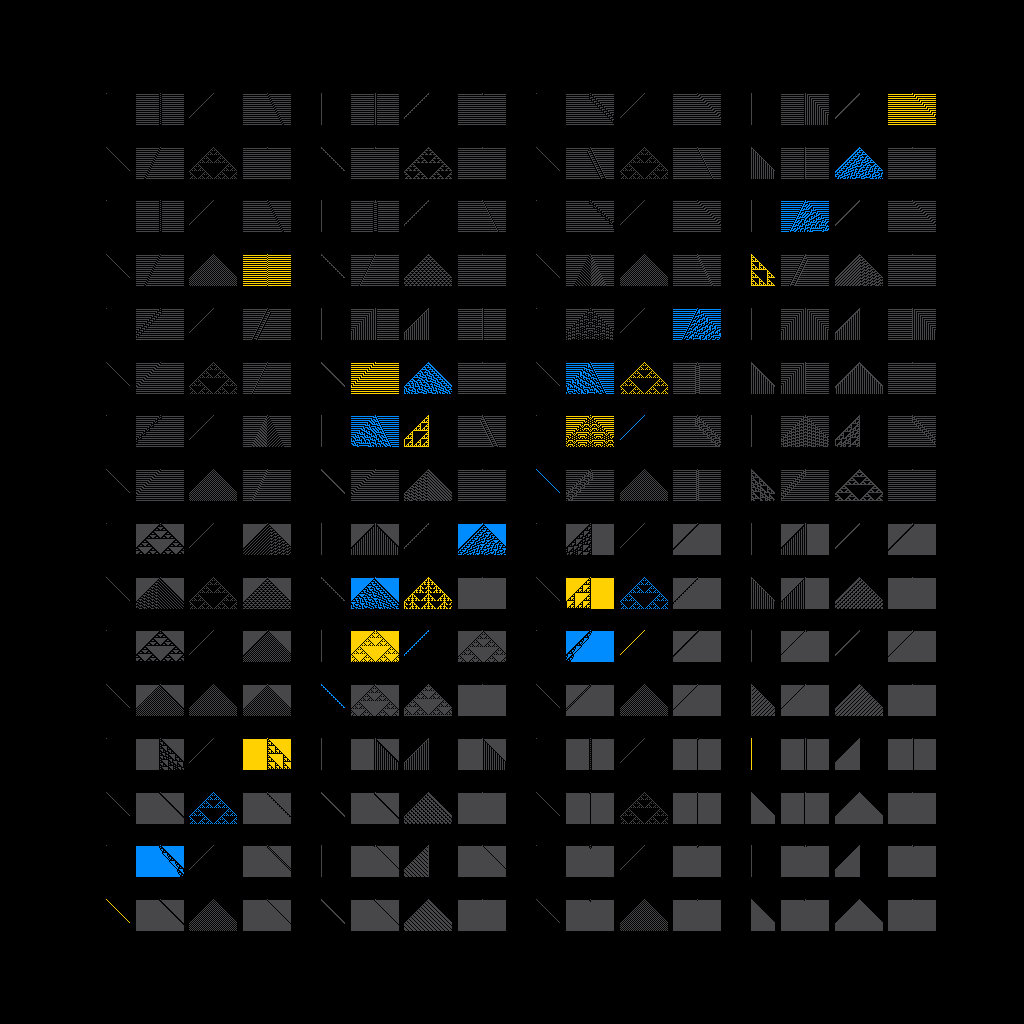
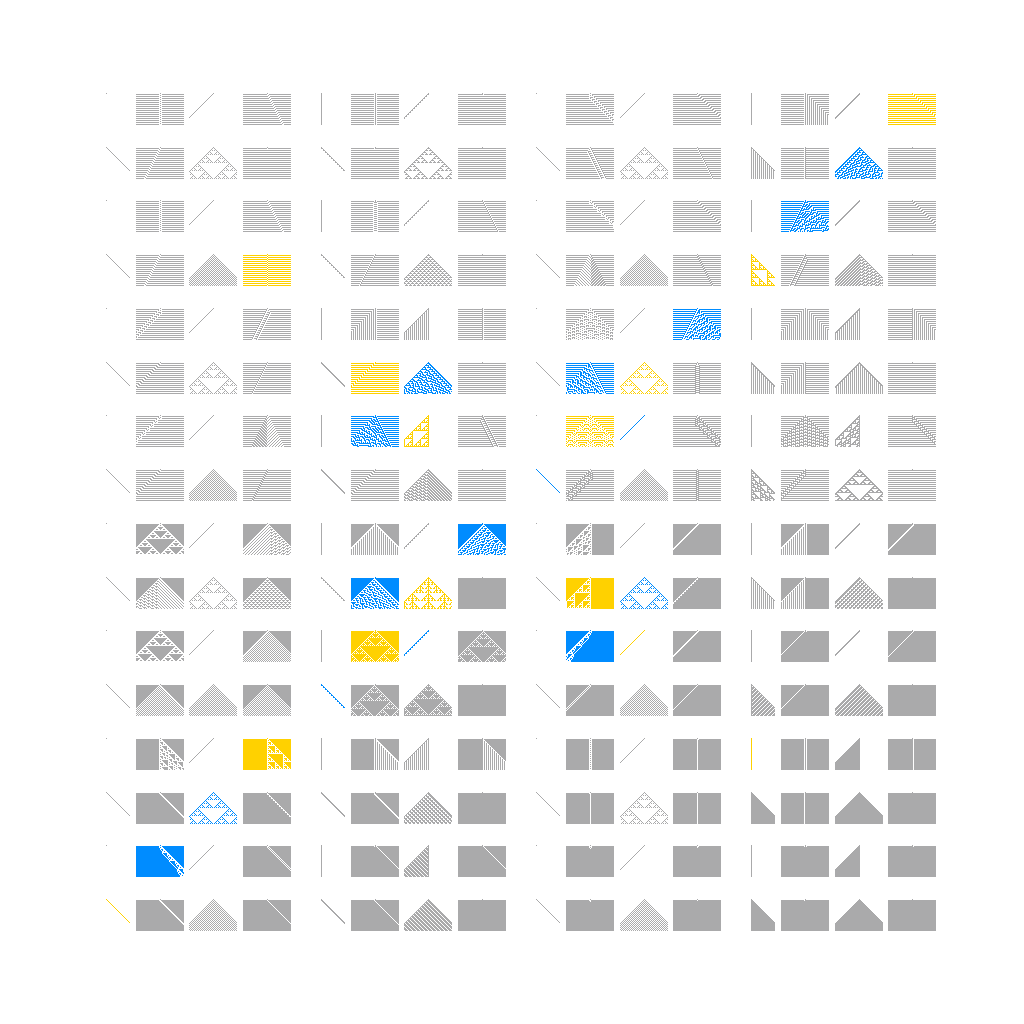
- automata - an elementary cellular automaton is a three-dimensional design read as a rule and Life a nine-dimensional one: what the identity buys, and what it cannot.
- complexity - Boolean complexity of the catalog, and the Laplacian spectra of the fractals it builds.
- cuts - the six-gasket theorem: a diagonal cut through one parity solid is Sierpinski all the way down.
- slices - the diagonal slice of the solid cube: the
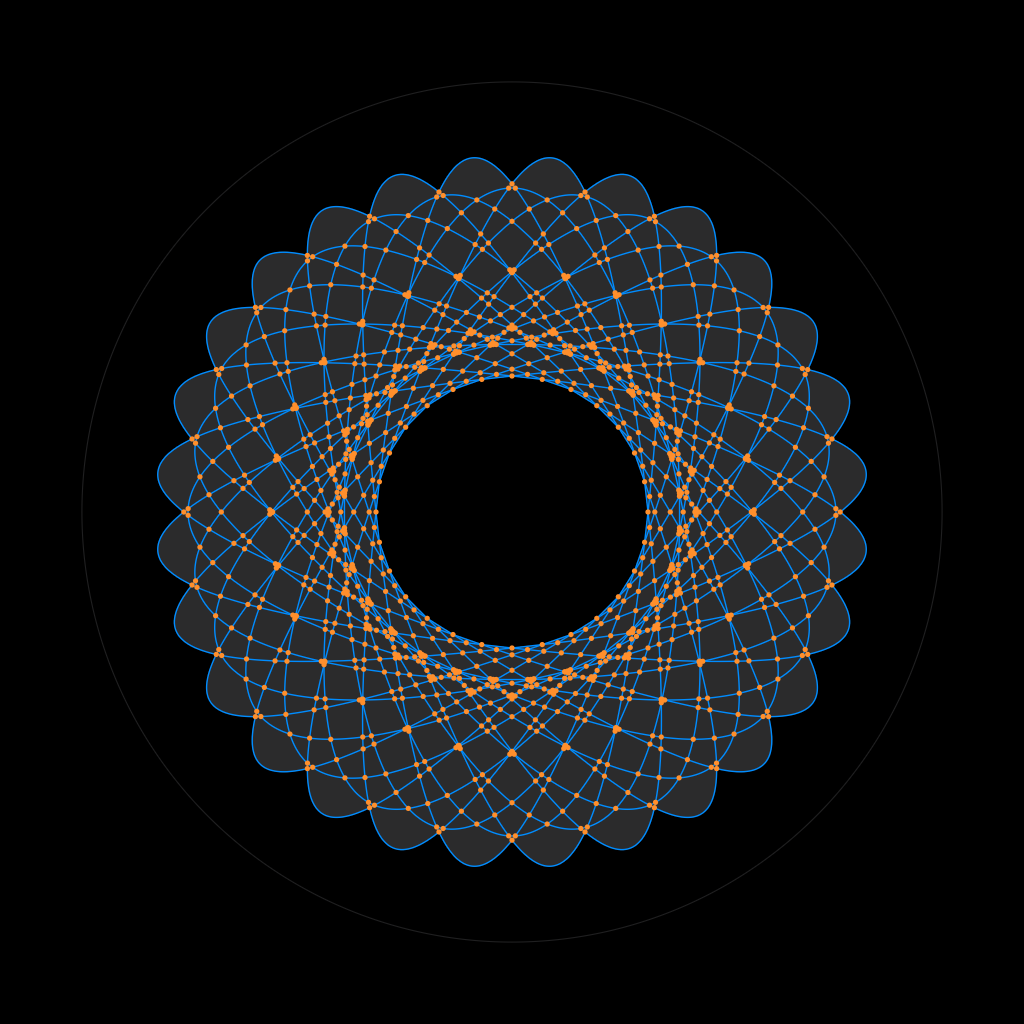
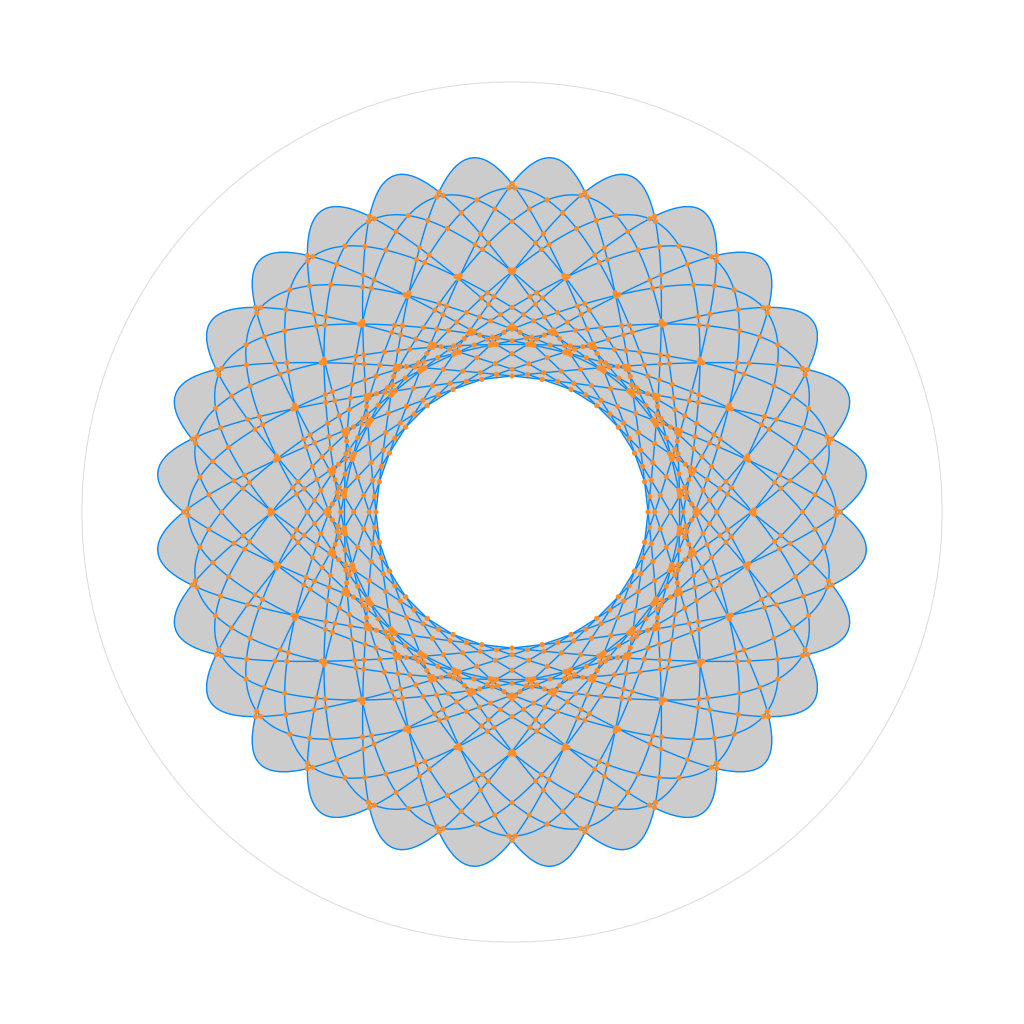
6ncensus, centered-hexagonal vertices, and the splitting-prime rule. - hexagon - the moire of the stacked diagonal slices: the exact cut-ink laws, the doubling sign law, the quarter-line bands, and the ghost star, whose cell-frame decay is a closed form at every band width,
-1/4at the arm and-1/8in the limit, every layer-pair constant an exact rational, and no frame-free coefficient. - dimensions - complex dimensions: every design in the lattice class, the carpet proved not Minkowski measurable with its explicit profile, and the arithmetic pole at
s_0 + 2 pi i/log 3certified genuine. - weights - weighted designs: what weights move on the mass side, what they never move on the length side, and the pressure that closes both.
- connectivity - self-similar designs raced against matched random cell sets on components and boundary.
- magic - a different design at every scale: the word grammar, what collapses by block reduction, and what only the letter order can see.
- walks - the walk-dimension census: same mass, different music.
- method - how the results here are produced and checked, worked through on the odd-side fill polynomial.
- farey - the stack's moire is a Farey resonance diagram; each scale
nadds exactlyphi(n)bright nodes, and the stack is an address rather than a construction: any depth evaluates in closed form, which buys rendering and provably nothing toward RH. - mobius - the Mobius meter across digit designs: exact transfer between scaled columns, the 47-column cancellation census, a power saving on the dense columns under GRH, the pair route with its major-arc lemma and its
l^1threshold1/4, and square-root cancellation as the open exponent. - pi - pi recovered from the density of coprime points in the stacked set, two disjoint ways.
- coprime - the coprimality spine: exact base-local factors on every design, the census behind them, the window at dimension one with the band automaton's critical out-degree and its algebraic block rate, and primes on a design, where the least base below the quarter threshold is 21 at one missing digit and 32 at two, the one-digit family closes at 34 and the two-digit family closes at 21 against the third.
- bases - what base 3 hides: an Eisenstein L-value where base 2 hid pi.
- spectra - the tile grammar of the diagonal slice at every odd base: the two-tile claim, the closed forms, and the mod-4 split.
- spin - a design turned about its centre: the ripple identity, the complete spin spectrum, the sponge's opaque diagonal, and a Gaussian Farey.
- crop - the circle on a design: the corner disc count, its log-periodic main term, and the crossing shell read as a rooted tree whose transfer operator is derived from the geometry.
- sequences - the OEIS ledger: every sequence this work produces, with terms, formulas, and verification status.
- integers - the census the other way round: which integers the whole registry writes, which it never writes, and which it writes thousands of times.
- information - a render as data: the rearranged SVD reads a design's code out of noise and peels a magic word, while the fractal codebook loses to deflate.
- zeta - the design's own zeta function: an explicit zero-free half plane and the census it closes, a residue comb whose teeth are Rouche-certified one by one, a second family that is no critical line and obeys no counting, symmetry, contraction or gain law, the ordinate shadow as a constant-free Newton step from each zeta zero, the multiplicativity wall with the three products that stand where the Euler product does not, and the identity zeta_F N_F = 1 whose Mertens function runs the wrong way.
SOURCES
Every reference is resolved, with the unresolved tail stated plainly, in REFS.md. The load-bearing external anchors:
- A000616 - NP-equivalence classes of Boolean functions; the design count in every dimension.
- A255016 and Ethier and Lee 2015 - toroidal binary arrays; the base-
qcensus atD = 2. - Huang 2019 - the Sensitivity Conjecture;
s(f) >= sqrt(deg(f))and its AND-of-ORs extremal case. - Nakajima and Watanabe 2026 - digit-scheduled slices of the Sierpinski tetrahedron; the published half of the cuts mechanism.
- Franel 1924 and Landau 1924 - Farey discrepancy as an RH equivalent.
- Gatzouras 2000, Falconer 1995, Kombrink and Winter 2020, Kombrink, Pearse and Winter 2016 - the lattice/nonlattice measurability split and the pluriphase case.
- A332705 and A299916 - the Menger sponge's surface, and the hexagram hole count of its diagonal cross-section, which A299916 carries in a comment and not in its arithmetic name.
- Bourke's fractal page and the source PDF - the published rendering of these families.
LICENCE
Text and figures CC BY 4.0; code MIT. The sequences themselves belong to the OEIS and its contributors.