Complex dimensions
The core page gives every design one real number, the dimension log(fill)/log(base). Fractal-string theory promotes that number to the real part of an infinite family - the complex dimensions, the poles of a zeta function attached to the set's gaps. This page computes them for the 1D designs, watches the imaginary parts surface as an oscillation in the box count, and follows the theory to its structural consequence, which needs careful qualifying.
lab/py/complex-dimensions regenerates every number below except those of the arithmetic-pole section, which lab/py/burnol-residue prints; both print only and keep no log.
The string of a design
A 1D design is a subset F of its base's digits, the filled ones; it draws the set of x in [0,1] whose digits all lie in F. That set is the attractor of fill = |F| maps x -> (x + f)/base, every one with the same contraction ratio 1/base, and its dimension is log(fill)/log(base). The core page's parity rule at base 3 fills digits {0,2} - the middle-thirds Cantor set, log(2)/log(3) = 0.630930.
The complement of the set is a multiset of gaps, and the gap multiset of a one-base design satisfies G = G_1 + fill copies of G/base. So its geometric zeta function - the sum of g^s over all gaps - has the closed form
zeta(s) = Z(s) / (1 - fill*base^(-s)), Z(s) = sum of g^s over level-1 gaps,
and its poles sit where the complex Moran equation fill*base^(-s) = 1 holds:
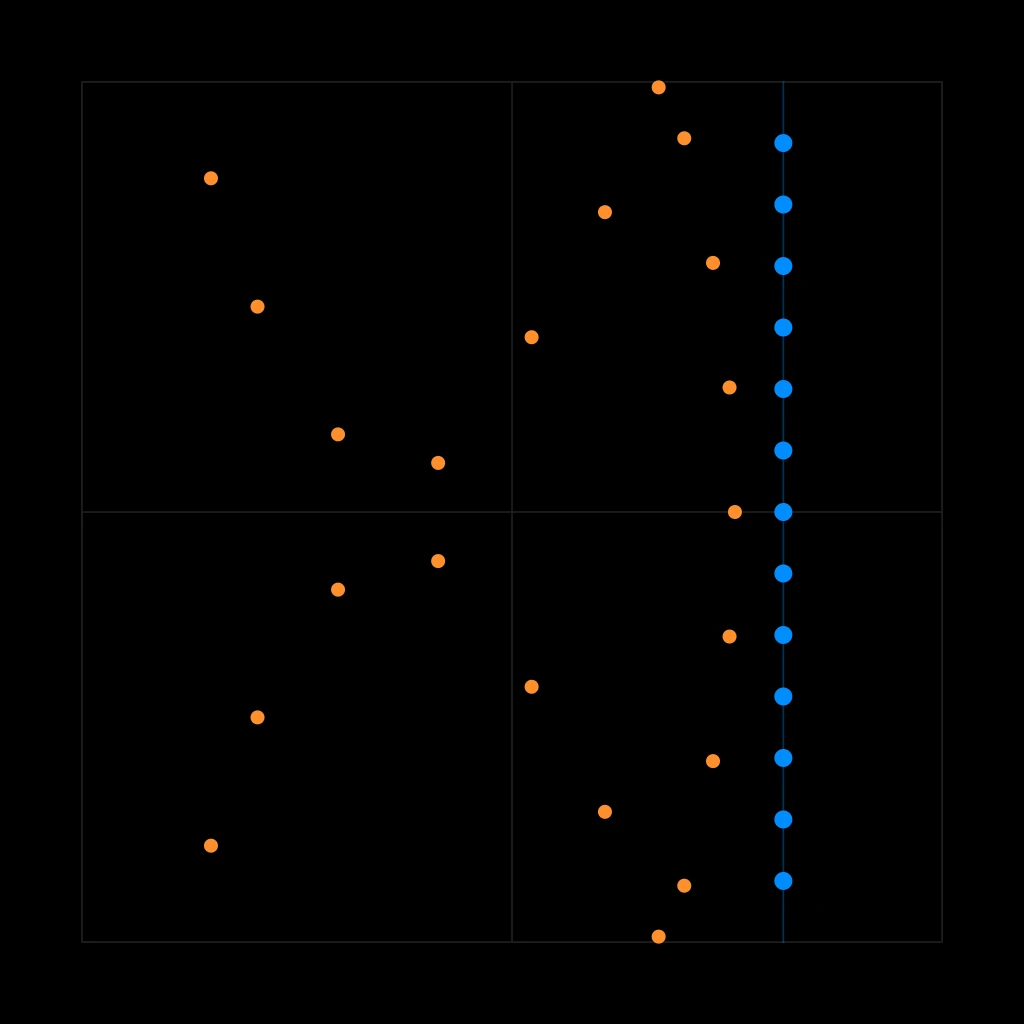
s = dimension + 2*pi*i*m/ln(base), m in Z.
One vertical line of poles, equally spaced at omega = 2*pi/ln(base). Sets whose complex dimensions line up on such an arithmetic progression are called lattice; sets with incommensurable ratios, whose poles spread out, are nonlattice. Every one-base design is lattice for the trivial reason that all its ratios are equal.
Verified (lab/py/complex-dimensions). The progression is derived in closed form above and then evaluated: for the Cantor design and three others (table below), all 81 predicted poles at m = -40..40 kill the denominator to 5e-14, and the numerator Z(s) stays bounded away from zero at every one of them - minimum |Z(s)| = 0.500000 for the Cantor design - so no zero is cancelled and every one is a genuine pole. The identity Z(1) = 1 - fill/base, the statement that the gaps of a measure-zero set fill the whole interval, holds for all four.
One caveat: the pole set is the zero set of the denominator only where the numerator does not vanish, and a design with no gaps (fill = base), with one filled digit (fill = 1, a point), or with none has an empty gap multiset, an identically zero zeta function, and no complex dimensions at all.
| object | dimension | omega = 2*pi/ln(base) |
|---|---|---|
base 3, digits {0,2} | 0.630930 | 5.719202 |
base 5, digits {0,2,4} | 0.682606 | 3.903963 |
base 15, digits {0,4,10,14} | 0.511916 | 2.320188 |
base 15, digits {0,2,4,10,12,14} | 0.661642 | 2.320188 |
The oscillation in the box count
The imaginary parts are not bookkeeping; they are visible. Let N(eps) be the number of eps-cells the set meets and detrend it: g(u) = ln N(exp(-u)) - dimension*u. A lattice set's g oscillates at angular frequency omega = 2*pi/ln(base) forever. About a filled corner the oscillation is an identity before it is a measurement: the corner lemma gives mu(B(r)) = w_0 mu(B(base r)), so ln mu(B(r)) - dimension ln r is exactly ln base-periodic at every one-base design.
Verified (lab/py/complex-dimensions). For all four objects the periodogram peak of g(u) lands within 1% of the predicted 2*pi/ln(base); for the Cantor design the Blackman periodogram on the direct DFT grid reads 5.7024 against the predicted 5.719202. Four-decimal peak values sit inside one frequency bin of the estimator's resolution and are properties of the estimator, not of the object; what is stable, and what ships, is the sub-1% agreement.
A second reading folds u modulo each candidate period and asks how much of the variance of g the folded profile explains. At 40 bins on a fixed window:
| object | ln(3) | ln(5) | ln(15) |
|---|---|---|---|
base 3, {0,2} | 0.192 | 0.030 | 0.016 |
base 5, {0,2,4} | 0.018 | 0.509 | 0.034 |
base 15, {0,4,10,14} | 0.007 | 0.022 | 0.667 |
base 15, {0,2,4,10,12,14} | 0.009 | 0.030 | 0.534 |
| two-ratio control | 0.082 | 0.047 | 0.038 |
| aperiodic control | 0.007 | 0.012 | 0.115 |
Verified (lab/py/complex-dimensions). Each lattice object folds best at its own ln(base), and the two controls fold well at none. But the two lattice signatures are not parallel in strength: the base-15 design's folding explains 66.7% of the variance at its period, the Cantor design's only 19.2% at its own. The Cantor figure is genuinely modest - the box count is a step function and grid alignment injects a large aperiodic component - and it moves between roughly 0.16 and 0.23 as the bin count and window vary (Conjecture; the study prints the 40-bin value only), so it is also partly a property of the estimator. The ordering is stable; the percentages are not constants of the objects.
The arithmetic pole, certified
The string above lives in [0,1]; its arithmetic twin is the set S of positive integers whose base-3 digits all lie in {0,1} (1, 3, 4, 9, 10, 12, 13, ..., the mobius page's S_F at base 3), with counting function A(x) and Dirichlet series K(s) = sum n^(-s), abscissa s_0 = log_3 2 = 0.630930. Burnol 2026 continues K meromorphically to C with simple poles among the same lattice s_(m,k) = s_0 - m + 2 pi i k/log 3 (Proposition 4.1), proves the real pole s_0 genuine with positive residue, gives every off-real residue as a limit of level sums, lambda_(0,k) = (log 3)^(-1) lim_j sum_(3^j <= n < 3^(j+1), n in S) n^(-s_(0,k)) (Proposition 5.1), and shows that a vanishing lambda_(0,k) empties the whole column s_(m,k), m >= 1 (Proposition 7.1); the paper states that it does not study the off-real residues further and prints none. Whether a single off-real pole is genuine is therefore open at source, and the mobius page accordingly says among. This section closes it for k = 1..10 by a certificate.
Proved. Write G(u) = A(3^u)/2^u. Splitting an element n = 3n' + a, a in {0,1}, gives A(3x) = 2A(x) + 1 - delta(x) for x >= 1, where delta(x) = A(x) - A(x - 1/3) is 0 or 1; so G(u+1) - G(u) = (1 - delta(3^u))/2^(u+1) lies in [0, 2^(-u-1)], G(u+j) increases in j, and Phi(u) = lim_j G(u+j) exists, is 1-periodic, satisfies 0 <= Phi(u) - G(u) <= 2^(-u), and is continuous: at any point the oscillation of Phi is at most the jump of G(u+j) there plus twice the uniform distance, 3 * 2^(-u-j) for every j. Hence A(x) = x^(s_0) Phi(log_3 x) + E(x) with |E(x)| <= 1. The profile is explicit on a third of its period: no element of S lies strictly between 11...1 = (3^(level+1) - 1)/2 and 100...0 = 3^(level+1), so A = 2^(level+1) - 1 on [(3^(level+1) - 1)/2, 3^(level+1)) and Phi(u) = 2^(1-u) for u in [1 - s_0, 1], from Phi(1 - s_0) = 2^(s_0) = 1.548562 down to Phi(1) = Phi(0) = 1. The profile is not constant, and that much is elementary.
Proved. For Re s > s_0, K(s) = s int_1^inf A(x) x^(-s-1) dx. Substituting the profile and x = 3^u, the Phi part is s log 3 F(s)/(1 - 3^(s_0 - s)) with F(s) = int_0^1 3^(u(s_0 - s)) Phi(u) du entire, and the E part is holomorphic on Re s > 0. So on Re s > 0 the poles of K are among the zeros s_(0,k) of 1 - 3^(s_0 - s), all simple with derivative log 3 there, and Res_(s_(0,k)) K = s_(0,k) c_k with c_k = int_0^1 Phi(u) e^(-2 pi i k u) du. The pole at s_(0,k) is genuine exactly when the k-th Fourier coefficient of the profile is nonzero; non-constancy says only that some c_k is nonzero and nothing about k = 1.
Proved (computer-assisted, lab/py/burnol-residue). Let Lev_j(w) = sum n^(-w) over the 2^j elements of S in [3^j, 3^(j+1)); Burnol's Proposition 5.1 reads lambda_(0,k) log 3 = lim_j Lev_j(s_(0,k)). Three elementary lemmas make the limit computable with a bound. (1) Splitting n = 3n' + a and expanding (1 + a/(3n'))^(-w) = sum_l (-1)^l ((w)_l/l!) (a/(3n'))^l, absolutely convergent since a/(3n') <= 1/3, then summing over the finitely many n' of level j: Lev_(j+1)(w) = 3^(-w) sum_(l >= 0) (-1)^l ((w)_l/l!) 3^(-l) gamma_l Lev_j(w + l) with gamma_0 = 2 and gamma_l = 1 for l >= 1. (2) |Lev_j(w)| <= 2^j 3^(-j Re w) for Re w >= 0: 2^j terms, each of modulus n^(-Re w) <= 3^(-j Re w). (3) At w = s_(0,k) + i, cutting the l-sum at T costs at most 2 * 3^(-ji) sum_(l > T) ((|w|)_l/l!) 3^(-l(j+1)): termwise |(w)_l| <= (|w|)_l, gamma_l <= 2 (slack by a factor 2, kept for the general engine), and (2) at w + l with 2^j 3^(-j s_0) = 1; the full sum is the binomial series (1 - 3^(-j-1))^(-|w|), increasing in |w| so an upper bound of |w| may stand in, and the cut is that closed form minus the interval partial sum; the same bound at i = 0, cut by (1 - x)^(-a) - 1 <= a x (1 - x)^(-a-1) for 0 <= x < 1 and a >= 0 and summed over j >= level, gives the level tail E_level = (3/2) |s| (1 - 3^(-level-1))^(-|s|-1) 3^(-level-1). The generator runs (1) on the vector of shifts i = 0..I from Lev_0 = 1 to level level = 40 in mpmath.iv at 128 bits, 3^(-s_(0,k)) = 1/2 being exact so that s_(0,k) and its Pochhammer symbols are the only transcendental inputs, adds the box of (3) at every step and E_level at the end, and prints endpoints floored and ceiled from exact fractions. At k = 1, I = 66: lambda_(0,1) lies in [0.231891517689918, 0.231891517689919] + i [-0.501067414481069, -0.501067414481068], width 3.4e-18, level tail 2.4e-19, at distance at least 0.552125193 from zero. So the pole of K at s_(0,1) = 0.630930 + 5.719202 i is genuine, c_1 is nonzero, and the counting function of S carries the frequency 2 pi/log 3 at the fundamental with a certified nonzero amplitude. The claim rests on Burnol's Proposition 5.1, the three lemmas above, and the outward rounding of mpmath's interval arithmetic; every bound used is proved.
Proved (computer-assisted, lab/py/burnol-residue --band). The same certificate at k = 0..10, level = 40, I from 52 to 164, widths from 2e-18 to 4e-13, the table printed by the generator:
k | Re lambda_(0,k) | Im lambda_(0,k) | abs(lambda_(0,k)) >= | zero excluded |
|---|---|---|---|---|
| 0 | [0.799023642655, 0.799023642656] | [-0.000000000001, 0.000000000001] | 0.799023642 | yes |
| 1 | [0.231891517689, 0.231891517690] | [-0.501067414482, -0.501067414481] | 0.552125193 | yes |
| 2 | [0.003963750587, 0.003963750588] | [-0.033400689772, -0.033400689771] | 0.033635062 | yes |
| 3 | [0.329059109066, 0.329059109067] | [-0.160535971769, -0.160535971768] | 0.366130708 | yes |
| 4 | [-0.039525178566, -0.039525178565] | [-0.366998806233, -0.366998806232] | 0.369121068 | yes |
| 5 | [-0.149130772496, -0.149130772495] | [0.032063501333, 0.032063501334] | 0.152538701 | yes |
| 6 | [0.116528526486, 0.116528526487] | [0.073732764792, 0.073732764793] | 0.137896403 | yes |
| 7 | [0.155123454907, 0.155123454908] | [0.001729927879, 0.001729927880] | 0.155133100 | yes |
| 8 | [0.252556366907, 0.252556366908] | [-0.100290430690, -0.100290430689] | 0.271740480 | yes |
| 9 | [0.079103971563, 0.079103971564] | [-0.275729544156, -0.275729544155] | 0.286852261 | yes |
| 10 | [-0.032664131229, -0.032664131228] | [-0.078686575787, -0.078686575785] | 0.085196964 | yes |
The k = 0 row is Burnol's positive real residue recovered, its imaginary interval the enclosure's own outward rounding and not a reading, since s_(0,0) is real and the residue's imaginary part is exactly 0. By Proposition 7.3 of the same paper, under its hypothesis 1 < N < base (here N = 2 at base 3, so the Pochhammer prefactors relating his mu_(m,k) to lambda_(m,k) never vanish), a nonzero lambda_(0,k) makes s_(m,k) a pole exactly when s_(m,0) is one, so each certified k settles its whole column against the real axis.
Verified (lab/py/burnol-residue). Two independent floating-point computations land on the certificate. Direct enumeration of Lev_20(s_(0,1)) over its 2^20 terms gives 0.231891518 - 0.501067414 i after division by log 3, at distance 1.9e-10 from the enclosure against its own bound 7.5e-10, the successive level differences 1.13e-08, 3.77e-09, 1.26e-09, 4.19e-10 contracting by 1/3. The counting side, from exact counts A(x) on 2^17 midpoints of one period at J = 30, gives c_1 = -0.082138842 - 0.049607499 i and s_(0,1) c_1 = 0.231891457 - 0.501067454 i, at distance 7.2e-08 (1.0e-06 on 2^15 midpoints: the quadrature error of a rough profile, not a certified bound); the sampled profile runs over [1.000003, 1.548557] and matches 2^(1-u) on [1 - s_0, 1] to 7.2e-10. A second certified enclosure by the functional-equation route, R_1 = 1 + sum_(m >= 1) (-1)^m ((s)_m/m!) 2^(-1) 3^(-m) K(s + m), each K(s+m) summed in intervals to level 13 plus its tail 3^(-13m)/(1 - 3^(-m)) and the m-series cut at 36 plus its tail, gives [0.23189098, 0.23189280] + i [-0.50106814, -0.50106632], width 1.8e-06, meeting the first. The engine is tested on two designs with known answers. On {0,2}, whose elements are twice those of {0,1}, the enclosure [0.135292875345483, 0.135292875345484] + i [0.329874091244466, 0.329874091244467] agrees with 2^(-s_(0,1)) times the {0,1} enclosure to every printed digit. On the full digit set {0,1,2}, where K is the Riemann zeta function, k = 0 returns [0.999999999999999, 1.000000000000001] around the residue 1 and k = 1 returns a box of width 1.7e-18 around 0, the regular point it must be.
Verified (lab/py/burnol-residue). Burnol's Proposition 7.1 recurrence carried down the k = 1 column from the certified lambda_(0,1): lambda_(1,1) in [0.6950303416, 0.6950303417] + i [0.3777908610, 0.3777908611], lambda_(2,1) in [-0.1945129694, -0.1945129693] + i [0.2161122817, 0.2161122818], lambda_(3,1) in [0.0645979040, 0.0645979041] + i [0.1353703406, 0.1353703407], all nonzero. The first two meet the closed forms Theorem 7.4 forces, lambda_(m,k) = (-1)^m (s - 1)...(s - m) lambda_(0,k) [t^m] (1/E(t)) at s = s_(0,k), E the moment generating function of the Cantor measure of {0,1} with moments 1/4 and 3/32, so [t^1] = -1/4 and [t^2] = 1/64: lambda_(1,1) = (s - 1) lambda_(0,1)/4 and lambda_(2,1) = (s - 1)(s - 2) lambda_(0,1)/64.
What is Burnol's and what is new. The continuation, the lattice, the positivity at s_0, the limit formula and the column proportionality are Burnol 2026, cited; that A(x) x^(-s_0) oscillates is elementary (A(3^level) = 2^level against A((3^(level+1) - 1)/2) = 2^(level+1) - 1, the profile lemma) and nothing here discovers it. New is the certificate at k = 1..10, the k = 0 row recovering Burnol's theorem: the pole at s_(0,1), and at every s_(0,k) for k = 1..10, is genuine, the residue enclosed to 4e-18 at k = 1 and 4e-13 at k = 10, which is what a complex-dimension claim on the arithmetic side needs. The engine takes any base and digit set F containing 0; only base 3 is certified here, and the zeta check and the {0,2} scaling are its tests. No statement is made about k > 10, about other bases, or about the real-axis residues lambda_(m,0) beyond m = 0.
Composition multiplies the base
Compose two rules by alternating bases across levels: base 3 with digits {0,2} at odd levels, base 5 with digits {0,4} at even ones.
Verified (lab/py/complex-dimensions). The alternation produces exactly the one-base design at base 15 with digits {5*d1 + d2} = {0,4,10,14} - checked as integer arithmetic and then as geometry, eight alternating levels and four base-15 levels producing the identical 256 intervals as exact fractions. So the composite is a different lattice period, omega = 2*pi/ln(15) = 2.320188, not a departure from the lattice class - and the table above shows its signature is the sharpest of the family, 66.7% of variance at its own period.
Two qualifications, both load-bearing. First, base 5 with digits {0,4} is not a mrly design: the core page's move one fills by parity, and the even digits of base 5 are {0,2,4}, three of them - nor is the base-15 composite a parity design. The parity-faithful versions - base 5 {0,2,4} and their composite base 15 {0,2,4,10,12,14} - run alongside and behave identically, which is the real point: the argument turns on the base, not on which digits the rule picks.
Second, the structural claim that one contraction ratio per level implies lattice is false without a periodicity hypothesis. (Refuted.) An aperiodic control that alternates bases 3 and 5 on a Thue-Morse schedule uses exactly one ratio per level and is not self-similar at all, so it is neither lattice nor nonlattice: its best folding is 0.115 against the composite's 0.667, and its periodogram peak matches no 2*pi/ln(base). What survives, and needs no computation, is the statement for mrly designs proper: move two is a Kronecker power of one tile, so the schedule is constant, every level subdivides by the same base, and periodic cross-base alternation multiplies into one product base. Neither move can express two ratios inside one level - move one only chooses which cells of a fixed base^dim grid survive, and every cell of that grid is the same size. (Verified for the alternation; the one-tile argument is read off the definition.)
"Read off the definition" has a proof behind it, and it covers more than one tile. Block reduction, Proved: for any designs c_1, ..., c_p and any level >= 1, the periodic word (c_1, ..., c_p)^level equals (A_(c_1) (x) ... (x) A_(c_p))^((x) level), by associativity of the Kronecker product and nothing else. (The case p = 2 is the base-15 alternation Verified above; a check on six test cases at periods 2 and 3, lengths to 6, matching the flat word cell for cell against the self-Kronecker power of the composite, is Verified, lab/rs/magic-words.) So every periodic schedule is the ordinary self-similar theory of its one-period composite tile, of base prod_i base_i and fill prod_i fill_i; the base-15 composite above is the case p = 2, and its agreement was never in doubt. The corollary is the sharper half. The first genuinely non-stationary behaviour requires an aperiodic word, which is exactly why the Thue-Morse control above is neither lattice nor nonlattice rather than being a third kind of composition. For an aperiodic word at one common base with fill_i = fill(c_i), the scale dimension is lim_level (sum_(i <= level) log fill_i) / (level log base) when the limit exists; characterizing which words make it exist, and which leave the dimension fluctuating, is open. (Conjecture, untouched.)
The genuine way out is a two-ratio system: maps of ratio 1/3 and 1/5 mixed within one level, outside the mrly family, with dimension 0.518370 solving 3^(-s) + 5^(-s) = 1. Verified (lab/py/complex-dimensions). Its 21 complex dimensions in the box Re in [-3,3], Im in [-40,40] - a complete list, by the argument principle: the winding number over the box is 21 and 21 roots are found - have real parts spread from -0.699926 to 0.518370 and fit no arithmetic progression, the worst offset being 0.43, 0.17 and 0.38 of a step for the three candidate spacings. Nonlattice is a real, different behaviour, and no mrly design or composition exhibits it.
Measurability, with its hypotheses
A set is Minkowski measurable when M(eps) = eps^(dimension-1) * V(eps) - V the inner tube, the length of the set's eps-neighbourhood inside the gaps - has a limit as eps -> 0. The lattice/nonlattice split decides this, and what is known is narrower than it looks.
Proved. The Cantor design {0,2} at base 3 is not Minkowski measurable. Splitting the tube sum at the scale of eps gives the exact limit profile
M -> 2^(1-dimension) * (t^(dimension-1) + t^dimension), t in [1/3, 1),
one fixed profile traversed each time eps is divided by 3, with minimum 2.494975716 at t = (1-dimension)/dimension = 0.584963 and maximum 2.583040469 at the ends - a swing of 3.53%, so the profile is not constant and the limit does not exist. The measured tube matches the closed form to 4.9e-9 at the minimum (lab/py/complex-dimensions).
Verified (lab/py/complex-dimensions). The other three lattice objects behave the same way: the swing of M(eps) over successive windows is flat from u = 15 out to u = 60 (eps = 8.8e-27), and each object satisfies M(eps) = M(eps/base) at its own base to 1e-9 or better and at neither other candidate. The two-ratio control does the opposite: its swing decays monotonically 3.79% to 0.42% and is still falling - converging, as the nonlattice side predicts.
The literature, read rather than recalled, is not symmetric. Nonlattice self-similar sets under the open set condition are Minkowski measurable in every dimension (Gatzouras 2000). Lattice sets are not - but as a theorem only on the line, for a nontrivial set of non-integer dimension (Falconer 1995, completed by Kombrink and Winter 2020; for self-similar strings, Lapidus and van Frankenhuijsen 2006 - that attribution rests on secondary citations, the book itself being unopened for this page). In dimension 2 and above the lattice direction is an open conjecture of Lapidus, proved under a pluriphase hypothesis and for particular families, open in general.
So the claim that every mrly design is not Minkowski measurable ships only with two qualifications, and both bite on real designs.
- Nontrivial fill and non-integer dimension. The theorem's own hypotheses exclude integer dimension, and the exclusion is not exotic:
bang dim 2, code 3, the core page'spin(y), fills 2 of 4 at base 2, has dimensionlog(2)/log(2) = 1exactly, draws a segment - and a segment is Minkowski measurable. The solid, single-point and empty designs have no gaps and no oscillation to have. At base 3 in 1D the only design of non-integer dimension is{0,2}itself. (Proved: the counterexample and the census of which designs the statement covers are read off the definition.) - Dimension one, and the carpet. For 1D designs with
2 <= fill < baseand non-integer dimension, non-measurability is a theorem, and for the Cantor design it is proved outright above. For the carpet it is a theorem too: proved below with its explicit profile, and a corollary of the pluriphase theorem of Kombrink, Pearse and Winter 2016. For the sponge it is proved too, computer-assisted, in the sponge section through the criterion of Kombrink, Pearse and Winter 2016, which needs no pluriphase hypothesis; the pluriphase theorem itself does not reach it with the open cube as its open set, because the level-1 hole is the plus of seven cubes whose six outer windows and whose arm walls, carpets with windows of their own, are not in the sponge - the window centre(1/2, 1/2, 1)lies on the hole's boundary at distance1/6from the sponge and the wall-window centre(2/3, 1/2, 5/6)at distance1/18- so the tube inside the hole is not the parallel volume of the hole, and Lapidus, Pearse and Winter 2011 name the Menger generator as neither convex nor pluriphase.
The carpet, proved, and the class it opens
Proved. The Sierpinski carpet F, base 3 with the eight digit pairs other than (1,1), of dimension log(8)/log(3) = 1.892789 at dim 2, is not Minkowski measurable, and its tube has an explicit limit profile. Three facts about the holes make the tube a sum. First, the carpet contains the boundary of the unit square: a coordinate equal to 0 or 1 reads 0.000... or 0.222... in base 3, whose digit pairs never read (1,1); so the carpet contains the image of that boundary under every word of maps, the boundary of every retained square at every level. Second, the complement of the carpet in the open unit square is the disjoint union over levels m >= 1 of 8^(m-1) open squares of side 3^(-m), the middle squares of the retained level-(m-1) squares: a point outside the carpet leaves the retained squares at a first level m; it lies in a retained level-(m-1) square Q but in none of the eight retained subsquares of Q, and since bd Q lies in those eight subsquares, it lies in the open middle of Q, whose boundary consists of edges of the eight surrounding retained squares, hence lies in the carpet by the first fact. Third, for a point x of a hole H, dist(x, F) = dist(x, boundary of H): the boundary lies in F, and every point of F lies outside H, so the segment to it crosses the boundary first. The inner parallel area of an open square of side s is h(s, eps) = 4 eps s - 4 eps^2 for 2 eps < s and s^2 otherwise, so the tube inside the unit square is exactly V(eps) = sum_(m >= 1) 8^(m-1) h(3^(-m), eps), and the part of the eps-neighbourhood outside the unit square is the collar 4 eps + pi eps^2, which the factor eps^(dimension-2) sends to 0 because the dimension exceeds 1. Write eps = 3^(-j) t with t in [1/3, 1). The level-m hole is fully covered when 3^(-m) <= 2 eps, which reads m >= j + 1 for t < 1/2 and m >= j for t >= 1/2; the two geometric sums give, up to terms of size (3/8)^j and 8^(-j),
M(eps) = eps^(dimension-2) V(eps) -> G(t) = t^(dimension-2) (1 + 4t/5 - 4t^2/7)        for t in [1/3, 1/2),
                                          = t^(dimension-2) (9/8 + 3t/10 - t^2/14)     for t in [1/2, 1).
G is continuous at t = 1/2, where both branches give (44/35) 2^(2-dimension), is C^1 there, and takes the rational value 379/280 at both ends t = 1/3 and t = 1. Its stationary points are roots of quadratics: the maximum 1.355617083 at t = 0.429638, the minimum 1.350670209 at t = 0.692137, a swing of 0.3662%, a tenth of the Cantor design's 3.53%. A swing above zero is the whole proof: G is not constant, so M(eps) has no limit. The non-constancy needs no digits either: on [1/3, 1/2) the function t^(2-dimension) G(t) is a polynomial, and a polynomial equal to c t^(2-dimension) on an interval with 2 - dimension not an integer forces c = 0, while G > 0. lab/py/complex-dimensions/carpet_tube.py checks the hole decomposition cell by cell to level 5, the level sum against the closed form as exact rationals at 96 values of eps, the profile against the level sum at eps = e^(-u), u in [50, 60], and a level-6 distance transform, which uses no hole lemma, against the closed form at eps = 21/729 as equal rationals.
Verified against the source. The statement is a corollary of Kombrink, Pearse and Winter 2016, Theorem 1.1(ii), restated as Theorem 3.4: the attractor of a lattice self-similar system under the open set condition, with non-integer Minkowski dimension, is not Minkowski measurable when some strong feasible open set O satisfies the projection condition and the attractor is pluriphase with respect to Gamma(O), the set O minus the images S_i(O), meaning that the area of F_eps inside Gamma is piecewise polynomial in eps (Definition 2.9). For the carpet with O the open unit square: O is strong feasible because (1/2, 1/4), digits 0.111... and 0.0202..., lies in F and in O; the projection condition holds because every point of a closed retained subsquare has all its nearest carpet points inside that subsquare, the segment to any other point of F crossing the subsquare's boundary first, so S_i O lies in the closure of pi_F^(-1)(S_i F); Gamma is the closed middle square together with the four grid segments, the area of F_eps inside it is 4 eps/3 - 4 eps^2 on (0, 1/6] and 1/9 beyond, one polynomial piece; and the paper's Figure 1 caption says that with this O the carpet F is monophase with respect to Gamma and that bd O lies in F, without spelling the conclusion out; the monophase case under that compatibility is Lapidus, Pearse and Winter 2013. The theorem is the literature's; what is added here is the explicit profile, its extrema and the one-paragraph proof.
Proved. The same argument covers a class. Let a one-base design at base base >= 3 in dimension dim >= 2 remove at least one digit vector, every removed vector having all coordinates in {1, ..., base-2} and any two differing by at least 2 in some coordinate. Then every hole is an isolated open cube surrounded by retained cells, its boundary lies in the set, the retained count fill lies strictly between base^(dim-1) and base^dim, so log(fill)/log(base) is never an integer, and with h(eps) = 1 - (1 - 2 eps)^dim for 2 eps < 1 and 1 otherwise the profile is G(t) = t^(dimension-dim) sum_(j in Z) fill^(j-1) base^(-j dim) h(t base^j), t in [1/base, 1), both tails geometric because fill base^(1-dim) > 1 and fill base^(-dim) < 1. G > 0, every term being nonnegative and the covered levels contributing the constant 1/(base^dim - fill); on [1/base, 1/2) the function t^(dim-dimension) G(t) is a polynomial and dim - dimension is not an integer, so G is not constant and the design is not Minkowski measurable. The parity carpets, the all-odd class removed at every odd base and in every dimension, are in this class; the carpet is base 3, dim 2, where the sum is the two branches above. A design whose removed cells form a plus, the sponge's hole shape, leaves the class twice: with the removed cells touching the boundary of the unit cube the hole's boundary is not in the set, and even for an interior plus the inner parallel volume of the hole stops being polynomial at the first radius where the arcs about its reentrant corners meet, so the closed form stops there and what remains is the characterisation of Kombrink, Pearse and Winter 2016, Corollary 3.2, measurability if and only if their periodic function is constant. The tube demo fattens a design by a radius and reads the inner tube back, where the Minkowski reading never settles but circles one log-periodic profile, exact in closed form wherever the holes are isolated squares.
The sponge, through the criterion without pluriphase
Objects. The sponge F is base 3 at dim 3 with the 20 digit triples holding at most one 1, dimension D = log(20)/log(3) = 2.726833. O is the open unit cube, Gamma = O minus the 20 open subcubes: the closed plus H of the 7 removed cubes, less the six outer windows, plus the grid faces of measure zero. W = F meeting the boundary of H: 24 wall carpets, each face of an arm shared with a retained cube, each a copy of the carpet at side 1/3 in its plane. T(delta) is the volume of F_delta inside H, and p the periodic function of the criterion.
Verified against the source. Kombrink, Pearse and Winter 2016, Theorem 3.1 and Corollary 3.2, need only this: F the attractor of a self-similar system under the open set condition, nontrivial (D < d), lattice with base r, and O a strong feasible open set (O meets F) satisfying the projection condition S_i O inside the closure of pi_F^(-1)(S_i F). Then eps^(D-d) lambda_d(F_eps) ~ (log r / sum_i r_i^D log r_i) p(eps) with p(eps) = eps^(D-d) sum_(l in Z) r^(l(D-d)) lambda_d(F_(r^l eps) meet Gamma), and F is Minkowski measurable if and only if p is constant. The paper says so in words: no monophase or pluriphase condition is present, and the projection condition restricts nothing since the central open set always satisfies it. Pluriphase enters only in Theorem 3.4, which is the tool for proving p non-constant without computing it; here p is computed. For the sponge, r = 1/3, all 20 ratios equal, the prefactor is 1/(20 3^(-D)) = 1, and r^(l(D-3)) = (27/20)^l.
Proved. Three lemmas about distances, all read off the digit rule at most one 1 per triple. Folding: for x in a closed retained subcube Q_a and y in F, the point y' obtained coordinatewise by keeping y_k when b_k = a_k, reflecting it across the shared face plane when |b_k - a_k| = 1, and translating it by 2/3 when |b_k - a_k| = 2, lies in F (a reflection replaces one first digit and complements the tail digits d -> 2 - d, which fixes the count of 1s in every triple) and in Q_a, and is at least as close to x; so dist(x, F) = dist(x, S_a F), which is the projection condition for O the open unit cube, and O is strong feasible since (1/2, 1/4, 1/4), digits 0.111..., 0.0202..., 0.0202..., lies in F. Clamping: for x in the closed plus H and y in F, clamping the coordinates of y into [1/3, 2/3] one at a time, the first two for a point of an arm along the third axis, gives a point of F (a clamped coordinate reads 0.0222... or 0.2000..., whose tail triples (2, ., .) or (0, ., .) hold at most one 1 because the two other coordinates never both read 1) inside H, no farther from x; so dist(x, F) = dist(x, W) with W = F meet bd H, the 24 wall carpets. Locality: a point of an arm is nearest to one of its own four walls, and a point of the centre cube to one of the cube's 12 edges, all of which lie in W, because every other wall's nearest point is on an edge shared with those. The farthest point of H from W is the centre at distance sqrt(2)/6, so T(delta) = 7/27 for delta >= sqrt(2)/6, and the series has the constant 20/27 from the levels below.
Proved. For delta <= 1/6: in the centre cube the tube is the union of twelve edge cylinders, pi delta^2 - 8 sqrt(2) delta^3 by inclusion and exclusion of quarter, bi- and tricylinders at the eight corners. In an arm with coordinates u, v across and z along, the distance to the wall u = 0 is sqrt(u^2 + d(v, z)^2) with d the planar distance to the wall's carpet, the distance to the boundary of the hole holding (v, z); the four-wall union reduces by symmetry to the quarter u, v <= 1/6, where only the walls u = 0 and v = 0 reach, so the arm's tube is 4 (2 V1 - V2). V1, the tube of one wall over half the arm, is (1/2) sum_(m >= 1) 8^(m-1) J(3^(-m-1), delta) with J(s, delta) = int_0^(min(delta, s/2)) 4 (s - 2t) sqrt(delta^2 - t^2) dt, an arcsine closed form, the exact analogue of the carpet's hole sum with the polynomial h replaced by a circular integral: this is where the plus stops being pluriphase. V2, the overlap of the two wall tubes, is 2 A1 - delta^2/3 + Deep: A1 is the same hole integral over the strip within delta of the shared edge, summed by a digit recursion over the hole columns with one cut column per level, and Deep, the set of points beyond both wall tubes yet inside the corner column, needs a point at distance more than sqrt(delta^2 - d^2) from each wall, which confines it to holes of both walls within s^2/(4 delta) of the column's far faces; it is bounded above by the boxes of the hole pairs to level 7 and a column count beyond. So T(delta) = (pi + 8) delta^2 - 8 sqrt(2) delta^3 + 48 (V1 - A1) - 24 Deep with 0 <= Deep <= 3.84e-5 at delta = 1/6 and 2.42e-10 at 1/12. lab/py/sponge-tube evaluates it: T(1/8) in [0.234186414, 0.234701259], T(1/12) in [0.180947086, 0.180947093], and a raster of distances from the walls and edges on 120^3 cells per cube, bracketed by the half diagonal, gives [0.23229, 0.23708] and [0.17665, 0.18531], both containing the closed form. At delta = 1/6 the strip is the half wall, so A1 = V1 by the wall's reflection symmetry and T(1/6) = (pi + 8)/36 - sqrt(2)/27 - 24 Deep, in [0.256188319, 0.257110405], Proved.
Proved (computer-assisted, lab/py/sponge-tube). For eps in (sqrt(2)/18, 1/6] every radius eps/3^l, l >= 0, is at most 1/6 and every radius 3^k eps, k >= 1, at least sqrt(2)/6, so p(eps) = eps^(D-3) (20/27 + sum_(l >= 0) (27/20)^l T(eps/3^l)), summed to l = 40 with the tail bounded by (27/20)^41 T_up(eps/3^41) (20/9), where T_up(delta) = pi delta^2 + 24 sum_m 8^(m-1) s_m delta min(s_m, 4 delta) dominates T and contracts by 11/27 per level from delta = 1/36 down, which every radius of the tail satisfies. The bands, interval enclosures rounded outward: p(1/12) in [2.122718, 2.122723], p(1/8) in [2.134668, 2.135742], p(1/6) in [2.135019, 2.136794]. So p(1/6) - p(1/12) >= 0.012296, a relative swing of at least 0.5792 %, above the carpet's 0.3662 % and below the Cantor design's 3.53 %.
Proved (computer-assisted). The sponge is not Minkowski measurable: p takes two values at least 0.012296 apart, so it is not constant, and Corollary 3.2 applies with the open unit cube, whose hypotheses are checked above. The tube formula reads lambda_3(F_eps) = eps^(3-D) p(eps) (1 + o(1)) with p multiplicatively periodic of period 3 and explicit on (sqrt(2)/18, 1/6]. What rests where: the criterion is the paper's; the folding, clamping and locality lemmas, the centre and arm decompositions and the Deep bound are written here; the hole sums, the level tails and the bands are printed by the generator, every arithmetic step in mpmath interval arithmetic at 133 bits with outward rounding, the level tails, the Deep bound as exact rationals and the series tail as an interval, so the bands are enclosures and not estimates; the raster is a float check and carries nothing. One caveat travels with mpmath: its interval + - * / sqrt and integer powers are exactly directed, while pi, atan2, exp and log are guard-bit approximations rounded outward, a drift below 1e-30 absorbed by the printed rounding of at least 5.6e-9. The certificate uses T on (0, 1/6] only, 1 - log_3(2)/2 = 0.6845 of the logarithmic period; T past 1/6 and Deep itself are the next subsection. No closed-form argument replaces the two evaluated phases, unlike the carpet's polynomial-against-power line; the lattice conjecture in dimension 3 stays open in general, and this settles one set.
The paper The Menger sponge is not Minkowski measurable writes this section out for an outside reader: the criterion at source, the folding, clamping and locality lemmas with their proofs, the tube formula with its arcsine integrals and the bound on Deep, the certificate with its two caveats, the checks run beside it, and the figure.
The sponge tube demo drags the radius: a plane slice of the tube, T and p from the closed form on (0, 1/6], and the Minkowski reading climbing onto p, both broken on the phases (1/6, sqrt(2)/6], where it reads the crate's tube and not exact.
The tube past 1/6, and Deep in closed form
Objects. In an arm, with u, v across and z along, d(w, z) is the distance in its plane from a wall point to the wall's carpet, the same carpet on all four walls, and Q = [0, 1/6]^2 x [0, 1/3] is the quarter of the arm at the edge u = v = 0. For a radius delta put lambda = min(delta, 1/6), and let Deep(delta) be the volume of the points of [0, lambda]^2 x [0, 1/3] with u^2 + d(v, z)^2 > delta^2 and v^2 + d(u, z)^2 > delta^2, the Deep above when delta <= 1/6. A hole of the wall carpet, of side s and across-range (p, p + s), is crossing when p < lambda < p + s. Crossing holes of level m exist exactly when the m-th ternary digit of 3 lambda is 1; they share one across-range, have side s_m = 3^(-m-1), and number the product over the earlier digits of 2 for a digit 1 and 3 for any other. For lambda = 1/6, 3 lambda = 0.111... in base 3: 2^(m-1) crossing holes at every level, centred on 1/6. For lambda = 1/12, 3 lambda = 1/4 = 0.0202...: none. At a ternary fraction either expansion serves: the one extra hole it may name has lambda on its edge and gives P = 0. The pair integral of a crossing hole is P = 4 int_0^tau (s/2 - R)_+ (min(tau, s - R) - max(a, R))_+ da with tau = lambda - p and R = sqrt(delta^2 - (p + a)^2). The thresholds are delta_m = sqrt(1/36 + s_m^2/4) = sqrt(9^m + 1)/(6 * 3^m): delta_1 = sqrt(10)/18 = 0.175682, delta_2 = 0.167692, delta_3 = 0.166781, delta_4 = 0.166679, falling to 1/6 (lab/rs/sponge-window).
Proved. At every radius, every point of Deep(delta) has (v, z) and (u, z) in one and the same crossing hole, so Deep(delta) is the sum of P over the crossing holes. Write alpha = lambda - u and beta = lambda - v, both in [0, lambda]. The two inequalities force d > 0 at (v, z) and at (u, z), so they lie in holes h and h', where d is the distance to the hole's boundary (Lemma 3.5 of the paper); since delta >= lambda they give d(v, z)^2 > lambda^2 - u^2 = alpha (2 lambda - alpha) >= alpha lambda and d(u, z)^2 > beta lambda. If h is not crossing its right edge is at most lambda, so d(v, z) <= beta; likewise d(u, z) <= alpha if h' is not crossing. Neither crossing: beta^2 > alpha lambda and alpha^2 > beta lambda, and the smaller of alpha, beta would exceed lambda. h' crossing with across-range (p', p' + s') and h not: (v, z) is outside h' although z is in its along-range, so v <= p' and beta >= gamma = lambda - p' > 0, while d(u, z) <= u - p' <= gamma; then gamma^2 > beta (2 lambda - beta) >= gamma (2 lambda - gamma) forces p' < 0. The mirror case is the same. Both crossing: (lambda, z) lies in both open squares, so h = h'. In one crossing hole put a = u - p and b = v - p in (0, tau], and e the depth of z in the along-range. The conditions read e > max(R(a), R(b)), min(b, s - b) > R(a) and min(a, s - a) > R(b). For a < b the second implies the third, since (p + b)^2 + min(a, s - a)^2 - (p + a)^2 - min(b, s - b)^2 is 2p(b - a), 2p(b - a) + s(2b - s) or (b - a)(2p + 2s) in the three orderings of a and b against s/2, positive because every hole has p >= s > 0. Counting e on both sides of the along-centre and a, b both ways gives P. Its integrand is a product of two factors linear in a and R, so P is elementary: R, a R and R^2 integrate by the arcsine and powers, cut where R equals s/2, tau or s - tau, a or s - a.
Proved. On [1/6, sqrt(2)/6], with c = sqrt(delta^2 - 1/36),
T(delta) = pi delta^2 - 8 sqrt(2) delta^3 - 4 delta^2 arccos(1/(6 delta)) + (2/3 + 16 c^2) c + 2/9 - 24 Deep(delta),
Deep(delta) = sum_(m >= 1) 2^(m-1) P_m(delta),  P_m = 4 int_0^L (L - R)_+ (L - max(a, R))_+ da,  L = s_m/2,  R = sqrt(delta^2 - (1/6 - L + a)^2).
Past 1/6 the far walls of an arm reach no point of Q sooner than the near ones: the wall u = 1/3 carries the same carpet, since 2/3 = 0.2000... puts no 1 in any triple, exactly as 1/3 = 0.0222... does on the near wall, so the distance to it is sqrt((1/3 - u)^2 + d(v, z)^2); so each quarter's tube is Q less Deep, the arm's is 4 (1/108 - Deep), and six arms give 2/9 - 24 Deep. In the centre cube the distance to the twelve edges is the hypotenuse of the two smallest of the distances X, Y, Z to the faces, so the uncovered part is 48 copies of {X <= Y <= Z <= 1/6 : X^2 + Y^2 > delta^2}, of volume 48 int_(delta/sqrt(2))^(1/6) (1/6 - Y)(Y - sqrt(delta^2 - Y^2)) dY, which integrates to 1/27 less the first four terms of T. Those four terms are the edge cylinders pi/36 - sqrt(2)/27 above at 1/6 and 1/27 at sqrt(2)/6. The level-m term is positive exactly below delta_m, where R at a = L equals c. So T is one elementary function on [sqrt(10)/18, sqrt(2)/6], where the arms are swallowed, and on each [delta_(m+1), delta_m) that function less m arcsine terms: the breakpoints accumulate at 1/6 from above and nowhere else. At 1/6 the sum runs over every level, so T(1/6) = (pi + 8)/36 - sqrt(2)/27 - 24 Deep(1/6) is an exact series, not only an enclosure. Below 1/6 the lemma turns the one uncomputed term of the tube formula above into a sum of the same integrals, and at 1/12 the sum is empty: Deep(1/12) = 0, and T(1/12) is the arcsine hole sum alone.
Verified (lab/rs/sponge-window; the crate's deep and exact in mrlyrs::math::three::sponge, with tests). Against the crate's exact distance, at eleven radii over the sub-intervals of (1/6, sqrt(2)/6] down to (delta_5, delta_4) and at 1/6: a raster of every crossing row to level 4 inside its confinement box lands within 6.12e-3 relative of that level's integral, down to 4.0e-13 at level 4, and every bracket of cells beyond the radius plus or minus the half diagonal contains it; the raster of the centre cube lands within 2.31e-3 of its closed uncovered part, inside its bracket; and no arm cell outside the boxes is farther than the radius. The crate sums each P by 16-point Gauss-Legendre in the angle asin(R/delta) on the pieces between its kinks, since the expanded arcsine form cancels at deep levels; the lab's own adaptive quadrature of P, level by level, meets it to 3.2e-21 at all fifteen radii. The sum reproduces the Monte Carlo of the paper's checks: Deep(1/6) = 1.894504e-6 against 1.8882e-6 +- 1.4e-8, and Deep(1/8) = 4.827978e-8 against 4.7432e-8 +- 2.9e-9, where the proved bounds read 3.84e-5 and 2.15e-5. T(1/6) = 0.2570649366, inside the enclosure above.
Verified (lab/rs/sponge-window). With T exact at every radius, p is known on a full period: maximum 2.139869 at eps = 0.148577, minimum 2.122663 at eps = 0.081380, swing 0.8106 %, logarithmic mean over the period 2.130510. On the phases (1/6, sqrt(2)/6] it falls at every step from p(1/6) = 2.136706 to p(sqrt(2)/6) = 2.122798, so neither extremum lies there. p(1/6) and p(1/8) = 2.135739 sit inside the certified bands above; the crate's profile, with Deep set to 0, reads the upper edges 2.136794 and 2.135741. These are double-precision values of the closed form, not enclosures; the certificate above carries the non-measurability.
The door this shuts, and what would open it
Every design has an exact geometric zeta function: for fill pieces at base base, zeta(s) = 1/(1 - fill*base^(-s)), whose poles are the complex dimensions s = log_base(fill) + 2*pi*i*m/ln(base) this page already tabulates. What that bookkeeping meets is a thirty-year-old theorem. (ISP) at a dimension a asks: if a fractal string of dimension a has spectral counting function N(x) = W(x) - C*x^a + o(x^a) with C nonzero, must the string be Minkowski measurable? Lapidus and Maier 1995: (ISP) at a holds for all strings of that dimension if and only if zeta has no zeros on the line Re(s) = a. So (ISP) at every a in (0,1) except a = 1/2 is equivalent to RH, and (ISP) at 1/2 is false outright, the midfractal case being the obstruction. That is RH stated entirely in the language of fractal geometry, and it is the highest-adjacency RH equivalence this tree touches.
And it is vacuous here. Every one-base design is lattice - proved in the sections above, not restated - so the complex dimensions sit periodically on one vertical line and the Lapidus-Maier machinery has nothing to say about the degenerate case. Measurability is not out of reach here: it is trivially settled and therefore empty.
Scope guard, the same one this page already applies: the lattice/nonlattice dichotomy is exact for self-similar STRINGS and settles dimension one. A one-base carpet or sponge is certainly lattice, but lattice membership alone does not prove higher-dimensional non-measurability. State the dimension and the object class every time. The carpet and the sponge are settled above, the carpet by its explicit profile and the sponge through the criterion of Kombrink, Pearse and Winter with no pluriphase hypothesis, see the sponge section; the general lattice case in dimension 2 and above is what stays open.
What would give it content: several incommensurable scaling ratios. Drop the single base and allow pieces scaled by r_1, ..., r_N with ln(r_i)/ln(r_j) irrational for some pair - a Moran construction, or a graph-directed self-similar set. Complex dimensions become quasiperiodic instead of periodic, measurability becomes a real question, and (ISP) acquires content. The two-ratio system verified above is the smallest instance of exactly this. "Several bases" is not automatically non-lattice: the contraction system and its separation hypotheses have to be specified before any of the above applies. This is independently the single most valuable generalization available to the tree, arrived at from two directions - the measurability question and the RH map both end on the same instruction.
Staircase schedules, the cheapest non-stationary object
- Instead of a constant word, stack
carpet_3, thenmagic(3,5), thenmagic(3,5,7), and so on; Kronecker associativity flattens that to the staircase word3 | 3,5 | 3,5,7 | 3,5,7,9 | .... - Letter
base_joccursn - j + 1times in the firstnblocks, so the controls are immediate and non-negotiable:side = prod_j base_j^(n-j+1),fill = prod_j fill_j^(n-j+1), anddimension_n = Sum_j (n-j+1)*ln(fill_j) / Sum_j (n-j+1)*ln(base_j). - The staircase word is aperiodic and not eventually periodic, so block reduction does not apply to it. It is the cheapest concrete non-stationary schedule available.
- The weights
(n-j+1)are a Cesaro profile - the earliest letter carries weightn, the newest carries 1 - so if the letter dimensions converge the whole dimension converges to their limit; the interesting regime is letter dimensions that oscillate. - The generalisation is what makes this a programme rather than an example: a staircase is one weight profile, any letter-multiplicity schedule is another, and the question "which dimension functions are realisable by a schedule and which are not" quantifies over all schedules and is native to the construction.
- Caveat that travels with every mixed number. If each factor is rendered at its native base,
side_i = base_i, the filled points have the mixed-radix formx = a_1*(base_2...base_level) + ... + a_levelwitha_iinF_i, and that is the correct arithmetic object. A factor rendered at a side unrelated to its residue base is still a valid tile product, but it is not a mixed-radix digit construction and inherits no digit theorem for free. lab/py/slice-ladder-controlsprints the five staircase dimensions -1.892789261,1.892315261,1.893034267,1.894190425,1.895495742atn = 1..5- assuming the carpet at one base has fillbase^2 - ((base-1)/2)^2; the run states that assumption before any number. (Verified under that assumption; confirm the definition against the core page before quoting any number from it.)
The unequal split
Objects. The patch is the attractor K of six similarities of the plane, x -> x/2 and x -> x/3 + t for the five translations t in {(2/3, 0), (2/3, 1/3), (2/3, 2/3), (0, 2/3), (1/3, 2/3)}. Its letter splits one cell into children of two sizes, drawn on the 6-grid: the half covers a 3 x 3 block in a corner, each third a 2 x 2 block, and an L of seven cells stays empty. The same letter with k thirds beside the half has the Moran function f(s) = 1 - 2^(-s) - k 3^(-s), and the patch is k = 5. A cell is the image of the unit square under a word of the maps; a word with a halves and b thirds draws a cell of side 2^-a 3^-b, and N(r) counts the cells of side at least r, the unit square included. D is the patch's dimension, P = 2^(-D) and Q = k 3^(-D), so P + Q = 1, and the natural measure gives the half the weight P and each third 3^(-D). Every number of this section is printed by lab/py/unequal-split, verbs patch, poles, count and ripple, or rounded from a printed one.
The patch
Proved. The six open images of the open unit square are disjoint open squares inside it, so the open set condition holds, and by Hutchinson 1981, 5.3(1), the dimension of K is the root of the Moran equation 2^(-s) + 5*3^(-s) = 1, D = 1.778602507. Since 2^m = 3^n has no solution in positive integers, log 2/log 3 is irrational and the patch is nonlattice; by block reduction above no design and no periodic composition is. With the half in a corner, five thirds is the most: a third whose interior misses the half [0, 1/2]^2 has its lower left corner at x >= 1/2 or at y >= 1/2; those with x >= 1/2 lie in a strip of width 1/2, overlap pairwise in x and so stack in y, at most three; the others have x < 1/2 <= y, lie in a strip of height 1/2 and so sit side by side with left edges below 1/2, at most two. So k = 1..5 are planar patches, while k >= 7 admits no open set condition in the plane at all, the squared ratios summing to 1/4 + k/9 > 1, which disjoint images of one bounded open set forbid by area. As a string the equation stands at every k, and k = 1 is the 2-3 nonlattice equation of Lapidus and van Frankenhuijsen 2003, Section 2.2.4.
Proved. The level render, the union of the cells of the words of length level, is a picture on side 6^level: a cell of side 2^-a 3^-b with a + b = level covers 2^b 3^a grid cells per axis at a grid corner, so the fill is sum_a C(level, a) 9^a (4k)^b = (9 + 4k)^level, 29^level here. That is the fill of a base-6 design with 29 filled digits, and the dimension the tree would read off it is log 29/log 6 = 1.879323585, not D; the picture is not that design either, since level 2 differs from the Kronecker square of the level-1 tile in 336 of its 1296 cells. A level keeps a cell of side 2^(-level) beside one of side 3^(-level), so no level is a cover at one scale. Verified (patch): the open set condition as exact rationals, the fill to level 4 with no cell covered twice, the 336, and the census of cells to word length 7, every size 2^-a 3^-b met exactly C(a+b, a) 5^b times.
Its complex dimensions
The sides of all the cells sum to the scaling zeta function, sum over cells of side^s = sum_n (2^(-s) + k 3^(-s))^n = 1/f(s) for Re s > D, the analogue of 1/(1 - fill*base^(-s)) above; its poles, the zeros of f, are the complex dimensions.
Proved. Every zero lies in the strip D_l <= Re s <= D, where D_l is the real root of k 3^(-s) = 1 + 2^(-s): right of D the two terms have modulus summing below 1, and left of D_l the term k 3^(-s) outweighs 1 + abs(2^(-s)). On the line Re s = D the only zero is D itself, since equality in the triangle inequality needs t ln 2 and t ln 3 both in 2 pi Z, and an irrational ratio forces t = 0. A lattice string, all ratios powers of one r, makes f a polynomial in r^s, so its zeros lie on finitely many vertical lines, each an arithmetic progression; the patch's real parts take infinitely many values, by the approach to the line below. The strip is Theorem 2.5 of Lapidus and van Frankenhuijsen 2003, read at source, with the same D_l.
Verified (poles). For every k = 1..27 the box Re [D_l - 1/4, D + 1/4], Im [-60, 60] holds exactly 21 zeros: the winding number of f around its boundary is 21, the smallest abs(f) on the boundary exceeds a Lipschitz bound on the change of f over one step by a factor of at least 161 where 1 suffices, and Newton from the roots of the lattice approximant 1 - x^41 - k x^65 (65/41 a convergent of log2 3) finds all 21, so the list is complete; 21 is the count (ln 3/pi) 60 + O(1) of the same theorem. The lowest real part comes within 0.0116 of D_l at every k. The patch's first complex dimensions, the upper half of the box:
Re | Im |
|---|---|
| 1.778603 | 0 |
| 1.241037 | 5.976088 |
| 1.455984 | 11.106537 |
| 1.719303 | 17.347538 |
| 1.124789 | 22.929912 |
| 1.657088 | 28.338580 |
| 1.552742 | 34.630309 |
| 1.171657 | 39.856618 |
| 1.766880 | 45.665889 |
| 1.330529 | 51.782362 |
| 1.355854 | 56.873751 |
Eleven distinct real parts, and some imaginary part misses the multiples of 2 pi/ln 2, 2 pi/ln 3 and 2 pi/ln 6 by at least 0.470, 0.058 and 0.461 of a step: no vertical line, no progression. For the 2-3 nonlattice equation, k = 1, the root that Section 3.1 of the same paper prints, .7675115443 + 45.55415979 i, lies 4.0e-8 from the root of its lattice approximant 1 - 2^(-s) - 2^(-485 s/306), the polynomial it was computed from, and 7.6e-5 from the true complex dimension 0.7674996132 + 45.55423466 i, the approximation error of that lattice string at that height.
Proved. The complex dimensions come arbitrarily close to the line Re s = D, at a rate set by how well log2 3 is approximated; this is Theorem 4.3, equation (4-9), of the same paper, with multiplicities 1 and k, restated here by the implicit function theorem. Take t with t ln 2 in 2 pi Z and theta = t ln 3 reduced mod 2 pi. Then f(D + it + z) = 1 - P e^(-z ln 2) - Q e^(-i theta) e^(-z ln 3) depends on t only through theta, is analytic in (z, theta), vanishes at (0, 0) with z-derivative f'(D) = P ln 2 + Q ln 3 > 0, so the implicit function theorem gives an analytic zero z(theta), and expanding to second order,
z(theta) = -i Q theta/f'(D) - P Q (ln 2)^2 theta^2/(2 f'(D)^3) + O(theta^3).
At t = 2 pi q/ln 2 for a convergent p/q of log2 3, theta = 2 pi (q log2 3 - p) tends to 0, so D - Re w = 2 pi^2 P Q (ln 2)^2 (q log2 3 - p)^2/f'(D)^3 + O(theta^3). Verified (poles, Newton at 60 digits in PARI, abs(f(w)) below 1e-69 at every root):
q | Im w | D - Re w | law | ratio |
|---|---|---|---|---|
| 2 | 17.347538 | 5.929932e-02 | 6.000528e-02 | 0.988235 |
| 5 | 45.665889 | 1.172287e-02 | 1.174806e-02 | 0.997856 |
| 12 | 108.687857 | 7.941580e-04 | 7.942712e-04 | 0.999857 |
| 41 | 371.728633 | 5.682884e-04 | 5.683464e-04 | 0.999898 |
| 53 | 480.416496 | 1.885987e-05 | 1.885993e-05 | 0.999997 |
| 306 | 2773.811103 | 4.519898e-06 | 4.519902e-06 | 0.999999 |
| 665 | 6028.038703 | 8.242791e-09 | 8.242791e-09 | 1.000000 |
| 15601 | 141418.701264 | 1.431886e-09 | 1.431886e-09 | 1.000000 |
| 31867 | 288865.441232 | 2.282902e-10 | 2.282902e-10 | 1.000000 |
| 79335 | 719149.583728 | 5.809059e-11 | 5.809059e-11 | 1.000000 |
| 111202 | 1008015.024959 | 5.606353e-11 | 5.606353e-11 | 1.000000 |
| 190537 | 1727164.608687 | 1.799884e-14 | 1.799884e-14 | 1.000000 |
| 10590737 | 96002068.502749 | 1.183140e-14 | 1.183140e-14 | 1.000000 |
| 10781274 | 97729233.111436 | 6.445263e-16 | 6.445263e-16 | 1.000000 |
| 53715833 | 486919000.948492 | 5.215918e-17 | 5.215918e-17 | 1.000000 |
The partial quotient 55 of log2 3 puts a complex dimension within 1.8e-14 of the line at height 1.7e6, and the last row within 5.3e-17 at height 4.9e8. The lattice designs above have their whole column on the line; the patch has one point there and a sequence approaching it.
The count of cells
Proved. The cells of side at least r are the unit square, when r <= 1, together with the cells of side at least 2r inside the half and of side at least 3r inside each third, so N(r) = 1 + N(2r) + k N(3r) with N(r) = 0 for r > 1, and N(r) = sum C(a+b, a) k^b over 2^-a 3^-b >= r. In U = ln(1/r) the Laplace transform of N is 1/(s f(s)): its poles are the complex dimensions and s = 0, where the residue is 1/f(0) = -1/k. The box count of the oscillation section rebuilt from cells, the cells of side at most r whose parent is larger, numbers 1 + k L with L the count of cells larger than r, every such cell having been split into 1 + k, so it carries the same reading.
Proved. N(r) r^D tends to C = 1/(D f'(D)), 0.573459971 at k = 5. The limit exists by Theorem 1 of Lalley 1989: N(e^(-T)) is his count N(T, x), at every x, for the function -log of the first map's ratio on the full shift on six symbols, nonlattice because its periodic sums a ln 2 + b ln 3 lie in no discrete subgroup. The value is forced: F(U) = N(e^(-U)) e^(-DU) has Laplace transform 1/((s + D) f(s + D)), and if F tends to C then s times the transform tends to C as s -> 0+, which reads 1/(D f'(D)). The carpet, the lattice control, does the opposite: N(r) = (8^(m+1) - 1)/7 with m the integer part of log_3(1/r), so N(r) r^D is a fixed non-constant ln 3-periodic function of ln r less r^D/7, and never converges.
Verified (count). The count as exact integers out to r = e^(-300): 59448 sizes, sorted by exact comparison of the integers 2^a 3^b, N reaching 232 digits, and the identity N(r) = 1 + N(2r) + 5 N(3r) exact at every one. Over windows of length 10 in U, with F/C sampled at 200001 points:
| window | min F/C | max F/C | mean - 1 | swing | swing sqrt(U) | carpet swing |
|---|---|---|---|---|---|---|
[10, 20] | 0.794332 | 1.264454 | -0.000375 | 0.470122 | 1.486657 | 2.062470 |
[20, 30] | 0.836870 | 1.182388 | -0.000433 | 0.345518 | 1.545201 | 2.070132 |
[40, 50] | 0.881974 | 1.121301 | -0.000075 | 0.239327 | 1.513635 | 2.081449 |
[80, 90] | 0.916164 | 1.086485 | -0.000103 | 0.170321 | 1.523396 | 2.093786 |
[160, 170] | 0.941725 | 1.062159 | +0.000036 | 0.120434 | 1.523381 | 2.089572 |
[290, 300] | 0.956827 | 1.046449 | +0.000000 | 0.089622 | 1.526205 | 2.064570 |
Over these six windows the mean sits on C to 4.4e-4, the swing falls without a floor, and the carpet's swing, relative to its own mean, stays between 2.06 and 2.10. Conjecture: the swing decays like 1.52 U^(-1/2), its product with sqrt(U) staying in [1.486, 1.546] on the six printed windows, read only at starts that are multiples of 10 and not at other starts; the jump of F/C at the size 2^-a 3^-b is the binomial probability C(a+b, a) P^a Q^b over C, of order U^(-1/2), but no bound is proved.
Verified (count). The detector of the oscillation section, run on g(u) = ln N(e^(-u)) - D u over u in [50, 300] at step 0.002. Folded into 40 bins, g keeps 0.003, 0.005 and 0.004 of its variance at ln 2, ln 3 and ln 6, against the carpet's 0.999 at ln 3. The Blackman periodogram does not go flat; it reads the complex dimensions. Its ten highest peaks between 2 and 600 sit within 0.001 of the imaginary parts of ten zeros of f, every one with D - Re w below 0.019, and their heights match 2 e^(-(D - Re w) u)/(abs(w f'(w)) C), averaged under the same taper, the residue of 1/(s f(s)) at w, to 1.3%:
| peak | height | complex dimension | D - Re w | residue height |
|---|---|---|---|---|
| 45.666 | 1.111e-02 | 1.766880 + 45.666 i | 1.17e-02 | 1.112e-02 |
| 63.021 | 2.881e-03 | 1.760015 + 63.021 i | 1.86e-02 | 2.845e-03 |
| 108.688 | 2.848e-02 | 1.777808 + 108.688 i | 7.94e-04 | 2.849e-02 |
| 154.354 | 7.700e-03 | 1.772177 + 154.353 i | 6.43e-03 | 7.723e-03 |
| 217.376 | 9.444e-03 | 1.775427 + 217.376 i | 3.18e-03 | 9.456e-03 |
| 263.040 | 8.456e-03 | 1.775897 + 263.041 i | 2.71e-03 | 8.467e-03 |
| 326.064 | 3.242e-03 | 1.771463 + 326.063 i | 7.14e-03 | 3.251e-03 |
| 371.728 | 8.661e-03 | 1.778034 + 371.729 i | 5.68e-04 | 8.664e-03 |
| 480.416 | 7.379e-03 | 1.778584 + 480.416 i | 1.89e-05 | 7.380e-03 |
| 589.104 | 5.019e-03 | 1.777545 + 589.104 i | 1.06e-03 | 5.021e-03 |
The peaks sit near 2 pi q/ln 2 for q = 5, 7, 12, 17, 24, 29, 36, 41, 53, 65, the q that bring q log2 3 near an integer, each moved off it by the -Q theta/f'(D) of the expansion above; the carpet's six highest peaks sit at 1, 2, 3, 4, 5 and 6 times 2 pi/ln 3 to the printed three decimals. The expectation is the zeros and their residues, computed from f alone and never fitted to g. The fluctuation of N(r) r^D is not periodic: it is a sum of decaying waves at incommensurable frequencies over a sawtooth that shrinks, and it converges.
What the detectors see
The count of cells sees the unequal split; the spin ripple of the spin page, which reads the mass M(r) = mu(B(c, r)) of the natural measure mu within radius r of a point c, does not, one point at a time. ripple computes M from the six maps, enclosing it between the cells inside the ball and those not yet decided at relative size 1e-4.
Proved. Let c be the fixed point of one map, of ratio rho, and suppose no other child comes within r_0 of c. Then M(r) = rho^D M(r/rho) for r < r_0: in mu = sum_i w_i mu(S_i^(-1) .), with S_i the six maps and w_i their weights, only the term of the map fixing c meets the ball, and that map pulls B(c, r) back to B(c, r/rho). So ln M(r) - D ln r is exactly periodic in ln r, with period ln(1/rho). At the corner (0, 0), fixed by the half, r_0 = 2/3 and the period is ln 2; at (1, 0) and (1, 1), fixed by thirds, r_0 = 1/3 and the period is ln 3. The ripple keeps its level periodicity about every such point.
Verified (ripple). Over 120 radii a 24th of a period apart, down from 0.999 r_0, the enclosures of M(r) and rho^D M(r/rho) meet at all 96 shifted radii about each of the three corners. Folded into 24 bins, each ripple keeps all its variance at its own period and almost none at the other:
| centre | period | swing | enclosure | fold ln 2 | fold ln 3 | fold ln 6 |
|---|---|---|---|---|---|---|
(0, 0) | ln 2 | 0.23906 | 8.2e-5 | 1.000 | 0.052 | 0.079 |
(1, 0) | ln 3 | 0.15388 | 4.2e-5 | 0.043 | 1.000 | 0.064 |
(1, 1) | ln 3 | 0.17843 | 6.7e-5 | 0.059 | 1.000 | 0.036 |
Proved (computer-assisted, ripple). Two ripples see what one cannot. A ripple G with periods ln 2 and ln 3 is constant: M is monotone and right-continuous, so G is right-continuous and continuous off a countable set; its periods contain the group Z ln 2 + Z ln 3, dense because the ratio is irrational, and invariance under a dense group carries the value at one continuity point to every other, then right-continuity to all points. The three ripples are not constant, their swings exceeding their double-precision enclosures at least 2661-fold, so the ripple about (0, 0) has period ln 2 and not ln 3, the one about (1, 0) period ln 3 and not ln 2, and the two share no period at all, their groups of periods being cyclic and ln 2/ln 3 irrational. On a design every map of every word has ratio a power of 1/base, so every identity of this kind has period a multiple of ln base, and any two such ripples share a period. Two fixed points with incommensurable ripples are a reading no design can give.
Verified against the source. The measure and the tube follow the same split. Rapaport 2022, Corollary 1.6: a self-similar measure of an affinely irreducible system on R^d that is not Rajchman forces every ratio to be theta^(-n_i) for one algebraic integer theta > 1; here 2 = theta^(n_1) and 3 = theta^(n_2) would give 2^(n_2) = 3^(n_1). A homothety fixes a line only when the line passes through its fixed point, and the six fixed points (0, 0), (1, 0), (1, 1/2), (1, 1), (0, 1), (1/2, 1) lie on no line, so the system is affinely irreducible and every self-similar measure on the patch with positive weights, the natural one included, has Fourier transform tending to 0. On the line the same holds for the string of the 2-3 nonlattice equation by Theorem 1.2 of Li and Sahlsten 2019, which needs only some log r_i/log r_j irrational and no separation. And by Gatzouras 2000, Theorem 2.3(i) with Theorem 2.4, a self-similar set under the open set condition whose log-ratios lie in no lambda Z is Minkowski measurable, with no further hypothesis: the patch is Minkowski measurable, where the carpet, proved above, is not.
What survives and what dies
The patch sits beside the designs as their nearest neighbour outside the family: one letter, substituted into itself, with the Kronecker product replaced by the plain composition of maps.
- Survives, the dimension: the weighted child matrix of the letter is the
1 x 1matrix2^(-s) + k 3^(-s), equal to 1 exactly ats = D, Hutchinson's equation above;log(fill)/log(base)is the case of one size. - Survives, the box dimension: the count of cells is
C r^(-D) (1 + o(1)), soln N(r)/ln(1/r)readsD, as the level count readslog(fill)/log(base)on a design. - Survives, the string's zeta:
1/f(s), the Moran function in the denominator where1 - fill*base^(-s)stood; the complex dimensions are its poles,Dis simple and alone on its line, and the residues drive the count term by term. - Survives, the corner lemma: about every fixed point with a clear window, with that map's ratio in place of
1/base. - Dies, the level: a level mixes the sides
2^(-level)and3^(-level), its render readslog 29/log 6and notD, and the count by size replaces the count by level. - Dies, the code: the render is no Kronecker power of its tile, so nothing that takes a design's code, the spin census, the design zeta or the digit transform, has an input.
- Dies, the carry automaton: the cells ordered by size interleave words of every length along
a ln 2 + b ln 3, and no base reads their addresses digit by digit. - Dies, the lattice: the count converges instead of oscillating, the tube has a Minkowski limit, and the measures with positive weights are Rajchman.
- The one reading that keeps a period is local: the ripple about a fixed point. Its period changes from point to point, and that change is the nonlattice signature in the spin's own language.
Where the numbers live
lab/py/complex-dimensions is the one pass behind every number on this page - the poles, the box-count periodogram and folding, the composition, the two-ratio control and the tube - and it prints only. lab/py/slice-ladder-controls prints the staircase dimensions, and lab/py/burnol-residue the arithmetic-pole section: the certified residues, the band, the controls and the column. lab/py/unequal-split prints the unequal split: the patch, its complex dimensions and their approach to the line, the count of cells with its periodogram, and the ripples. The dimension formula this page extends, and the designs it names, are the core page; the spectral side of the same fractals is the complexity page.