The walk dimension
Every page before this one weighs a design: the fractal dimension log(fill) / log(base) says how fast mass accumulates with scale, and the fill law makes it exact. This page listens to a design instead. Drop a random walker on the graph of a pattern - one node per filled cell, one edge per face-adjacent pair - and watch it spread: MSD(t) ~ t^(2/d_w). On any solid grid the walk dimension d_w is 2. On a fractal the walker keeps hitting holes at every scale and d_w > 2: distance costs more time than it should. The fractal dimension and d_w together fix the spectral dimension d_s = 2 log(fill) / (log(base) * d_w), which is how the low Laplacian spectrum - the density of the shape's slow modes, its music - scales.
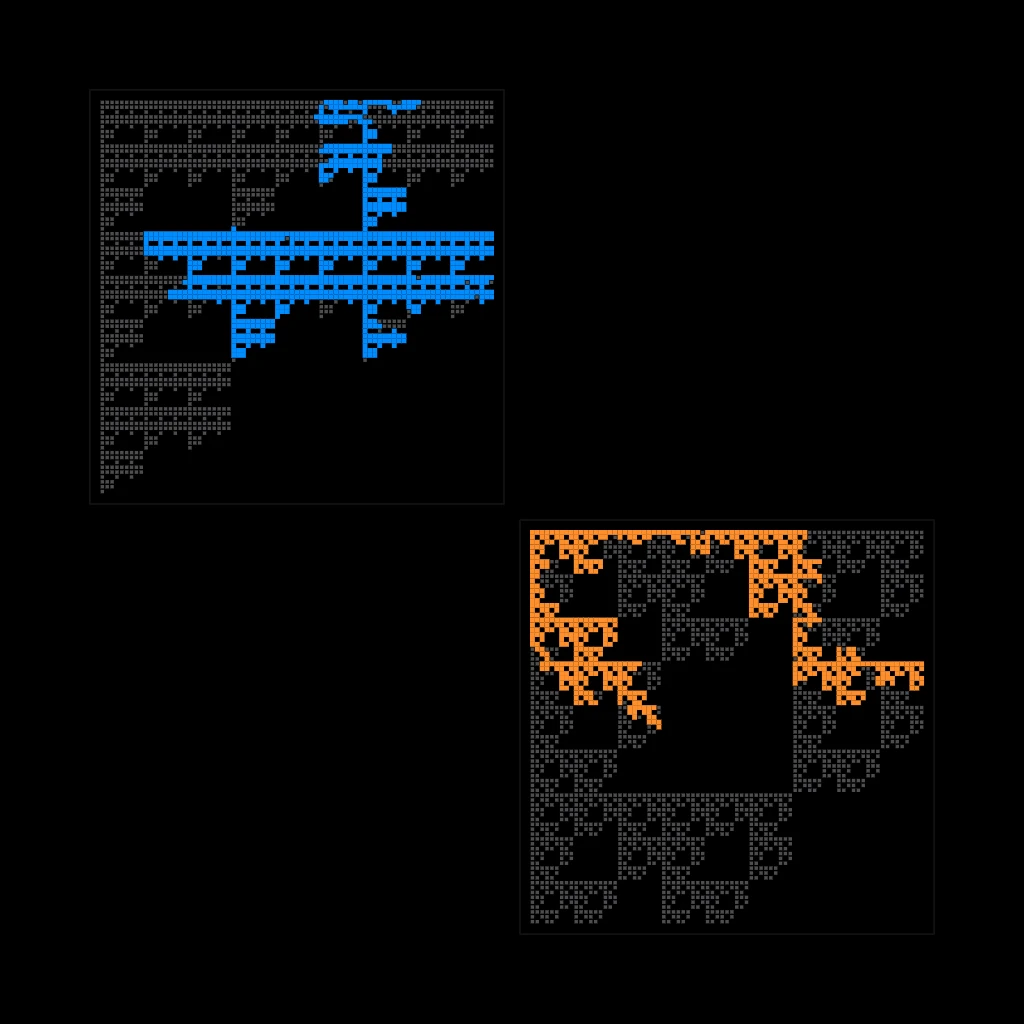
The question this page answers by census: does the mass fix the music? Two designs with the same fill draw fractals of the same dimension, the same density at every level, the same fill polynomial degree. Do they walk the same? They do not, and the failure is exhibited three different ways.
The generator is lab/rs/walk-dimension, which also draws the figure. The race demo runs the experiment live: two base-3 designs of the same fill, random walkers on both at once.
The method, and what gates it
Two readings, no shared method, both anchor-gated - the census aborts if the gates fail.
- The spectral reading builds patterns by Kronecker power and reads
d_woff eigenvalue level ratios: on a self-similar graph the low Laplacian eigenvalues scale by a fixed time factor per level, solambda_k(level)/lambda_k(level+1) -> base^(d_w). Level pairs 4 to 5 in 2D, 3 to 4 in 3D (160000 nodes), modesk = 1..4, with the previous level pair kept as the drift bar. Eigenvalues are dense through faer up to 2000 nodes and above that a block Krylov Rayleigh-Ritz projection through a projected conjugate gradient. - The walker reading builds patterns from the digit rule, finds components by its own BFS, and runs 20000 seeded blind-ant walkers, fitting
MSD(t)in a window kept clear of the lattice scale and the truncation walls. The walker digits depend on the random stream; the values printed here are the lab stream's, and every gate passes on it.
Three anchors, all passing in both readings. (Verified, lab/rs/walk-dimension.)
| anchor | exact value | spectral route | walker route |
|---|---|---|---|
| solid grid | d_w = 2; lambda_2 = 2 - 2*cos(pi/side) | machine-exact lambda_2; d_w = 1.99990 | d_w = 2.0035 |
| the path drawn by code 7 | d_w = 2; same closed form | machine-exact; d_w = 1.99999 | d_w = 2.0094 |
| corner-glued Sierpinski gasket | tau = 5, d_w = log(5)/log(2) = 2.321928 | ratios 4.9973, 4.9973, 4.9945, 4.9972 at levels 7 to 8 | d_w = 2.3590 (1.60%) |
The gasket values are exact by spectral decimation (Rammal-Toulouse); the solid and path closed forms are the classical tridiagonal spectrum. (Proved, classical; the gate measurements Verified.)
Who can walk at all
A walker needs somewhere to go. Of the 26 base-3 classes (the bijection page counts them; the orbit walk is re-run here and agrees, 26 classes of the 72-element wreath group with orbits summing to 512), the representatives that sustain a spanning single component at level 5 are 79, 95, 127, 239, 255 and 511. The other representatives crumble - the giant component's share of the pattern falls with level (rep 15: 0.42 at level 4, 0.32 at level 5; rep 31: 0.22 then 0.13; the rest are already dust). The walking minority is the census. (Verified, all 26 representatives at level 4 and level 5, lab/rs/walk-dimension.)
Spanning is not a class invariant. Testing one representative per class is sound for the fractal dimension, the fill polynomial and every other quantity on this page, because the toroidal group preserves them. It is not sound for spanning: the group wraps residues, so it does not preserve which cells touch a wall. Counted over codes rather than representatives, exactly 95 of the 511 non-empty codes have a giant component touching all four walls at level 5, and they fall in seven classes; only 83 codes in six classes - 79, 95, 127, 239, 255, 511 - are a single spanning component, so the two units of count differ. The extra class is that of rep 238 (fill 6, size 6): 238 itself crumbles - 1556 components at level 5, giant share 0.0312 - while its classmates 245, 350, 371 and 413 also carry 1556 components at level 5, the level-1 tile being already 4-disconnected, with giant share 0.0624, and it is their giant component alone that touches all four walls; 427 crumbles like 238. This is the same "wrap caveat" the next section records, arriving one section early. The census below is unaffected - it is a census of named designs, not of classes - but "exactly six classes" is the wrong unit for the 95. (Verified, all 511 codes at level 5, lab/rs/walk-dimension.) A conduction sweep gives those four spans_x = spans_y = 1 with fom_iso 0.387097, 0.141732, 0.065060, 0.031665, 0.015694, 0.007824 at level 1..6, and a drumhead sweep gives them caps = 1 with r1 0.841650, 0.466162, 0.386839, 0.364230 at level 1..4, against fom_iso = 0 and caps = 0 for 238 and 427 at every level; no lab study regenerates those sweeps. (Conjecture.)
The census
Spectral d_w from the lambda_2 ratio at levels 4 to 5; walker d_w from MSD; d_s by the Einstein relation from the walker value. (Verified, both readings, lab/rs/walk-dimension, agreement within 1.6% outside the two flagged rows; d_s = 2 log(fill) / (log(base) * d_w) is used here as the working definition of d_s, which is a theorem for the classical carpets and gasket and a definition elsewhere.)
| design | fill | dimension | d_w spectral | d_w walkers | d_s |
|---|---|---|---|---|---|
bang dim 2, base 3, code 79 | 5 | 1.4650 | 2.466 | 2.494 | 1.17 |
bang dim 2, base 3, code 95 | 6 | 1.6309 | 2.543 | 2.582 | 1.26 |
bang dim 2, base 3, code 127 | 7 | 1.7712 | two branches - see below | 2.245 | 1.58 |
bang dim 2, base 3, code 239 | 7 | 1.7712 | 2.640 | 2.643 | 1.34 |
bang dim 2, base 3, code 255 | 8 | 1.8928 | 2.190 | 2.167 | 1.75 |
bang dim 2, base 3, code 495 (carpet) | 8 | 1.8928 | 2.097 | 2.124 | 1.78 to 1.81 |
bang dim 2, base 3, code 511 (solid) | 9 | 2.0000 | 2.000 | 1.998 | 2.00 |
bang dim 2, code 7 | 3 of 4 | 1.5850 | 2.586 | 2.755 (drifting) | 1.15 to 1.23 |
bang dim 3, base 3, code 23 (sponge) | 20 | 2.7268 | 2.164 | 2.169 | 2.51 to 2.52 |
The spectral column is the lambda_2 reading throughout; the means over modes k = 1..4 for reps 79 and 95 are 2.4667 and 2.5452. The walker column is reproducible to about 0.01 across random streams; the spectral column to every printed digit.
The carpet row lands where the literature points: rigorous carpet analysis is Barlow-Bass, and the accepted numerics sit near d_w ~ 2.10, d_s ~ 1.80 - measured here as 2.097 to 2.124 and 1.78 to 1.81 without tuning anything. (Verified against stated literature values, not re-derived.)
Finding one: same mass, different music
Codes 127 and 239 share fill 7, hence dimension log(7)/log(3) = 1.7712 exactly, identical density at every level, identical leading fill behaviour. Their bulk walk dimensions separate by ~0.39 - 2.25 against 2.64 - with both readings agreeing on each side and every drift bar an order of magnitude smaller than the gap. The spectral dimensions land at 1.58 against 1.34: same mass, different music, and not by a little. (Verified, lab/rs/walk-dimension.) The fractal dimension does not determine the walk dimension, exhibited inside one fill class of one base - the walk analogue of what the complexity page shows for Boolean measures at dim 4.
The same split appears across constructions: the base-2 3-of-4 design and the corner-glued gasket share the dimension log(3)/log(2) and separate cleanly in d_w - 2.59 measured against 2.3219 exact. (Verified; the gasket side is Proved, classical.)
Finding two: the wrap caveat turns physical
Codes 255 and 495 are one symmetry class - the base-3 group wraps residues, so the carpet (centre hole) and the corner-hole design sit in one orbit, as the bijection page's census counts them. Their truncations walk differently: 2.17 to 2.19 against 2.10 to 2.12, stable across two level pairs in both readings. The residue rotation is a symmetry of the rule, not of the drawn pattern, and the walker feels the difference the fixed-side caveat of the core has always recorded for fill counts. (Verified, lab/rs/walk-dimension.)
The two are not one shape, and the separation needs no limit argument to explain it. Under the symmetry group of the drawn pattern - the dihedral group of the square - 495 is an orbit of size one, the centre-hole carpet, while 255 sits in {255, 447, 507, 510}, the corner-hole tiles. No rotation or reflection carries one to the other. The 9-member toroidal class {255, 383, 447, 479, 495, 503, 507, 509, 510} is exactly the union of three physically distinct dihedral orbits. (Proved, by listing the orbits.) Two sweeps separate them hard on every observable: a drumhead sweep splits the nine fill-8 codes into {495} at r1 1.108058, 1.075820, 1.017770, 0.960365, {383, 479, 503, 509} at 0.978010, 0.912888, 0.844316, 0.786655, and {255, 447, 507, 510} at 0.962769, 0.858300, 0.757199, 0.675372; a conduction sweep puts 255 against 495 at fom_iso 0.845610 versus 0.803571 at level 1 and 0.288823 versus 0.458852 at level 6, a 59% gap. No lab study regenerates those sweeps. (Conjecture.) So the d_w split is two different shapes measured separately, which is the expected outcome, not a puzzle about infinite volume. What remains genuinely open is only the narrow version: whether the rule-level identification says anything about the limits at all.
Finding three: one design, two exponents
Code 127 refuses to be one number. Its low eigenvalue ratios split into two stable branches - modes 1 and 2 scale with exponent near 2.53, modes 3 and 4 with 2.20 to 2.29 - at both level pairs, while the walkers side with the fast branch at 2.245. The spectral drift on that branch is 0.004; the walker drift is stream-dependent, 0.028 on the lab stream, where the carpet is the cleanest fit of the census at 0.0005. The slow mode is localized: its eigenvector's weight sits in the sub-block hanging from tile cell (2,0). The design is a two-row body with a flap at every scale, and its slowest relaxation is a flap breathing through a neck, not bulk diffusion. (Verified, lab/rs/walk-dimension: branches at two level pairs, localization read off the eigenvector.) Read as a spectrum of exponents - bulk transport near 2.25, a pendant-mode family near 2.53 - with persistence in the limit open. (Conjecture.)
Music never beats mass
Every subject measures d_w >= 2, equivalently d_s <= log(fill) / log(base), with the solid attaining equality. A design can only slow a walker down, never speed it up past free diffusion - holes at every scale are obstacles, whatever else they are. (Verified across the census; stated as measurement, not theorem - the general inequality for this family is not proved here.)
Shortest paths: two limits that do not commute
A walker measures time; a shortest path measures distance, and on one family of designs distance has two different large-scale shapes depending on which limit is taken first. Take bang dim 2, code 7 at odd side N and level L: the side-N tile voids a cell iff both its digits are odd, and the level-L render is its L-th Kronecker power, cell side N^(-L) in the unit square. At N = 3 it is bang dim 2, base 3, code 495, the Sierpinski carpet; read as a base-N code with bit N*i + j the tile is 33226431 at N = 5, and past N = 11 it no longer fits the code space while the rule still draws. Write K(N, L) for the union of the closed filled cells, K(N) for the intersection over all levels, d_(N,L)(x, y) for the infimum of the Euclidean lengths of paths in K(N, L) from x to y, and D(N, L) = d_(N,L)((0,0), (1,1)) for the corner distance. Side first means N -> infinity at a fixed level; level first means L -> infinity at a fixed side. The generator is lab/py/carpet-geodesics.
Paths through corner contacts never arise. Proved. Two void cells of one level differ by at least 2 in some digit, so their closures are disjoint, and a deeper void sits inside a filled cell whose border digits 0 and N - 1 are even, at least one finer cell from its border. So the closures of all voids are pairwise disjoint: K(N, L) is the unit square minus finitely many open squares with disjoint closures, every point of it has a neighbourhood in it that is a disc, a half disc, a quarter disc at a corner of the square or three quarters of a disc at a void corner, and the closed set and its interior give the same infimum. Shortest paths exist by Arzela-Ascoli and are polygons that bend only at void corners, so the visibility graph on void corners computes d_(N,L) exactly. The convention does matter one dimension up; see dim 3 below.
The corner distance does not commute. Proved. sqrt(2) <= D(N, L) <= 2 - (2 - sqrt(2)) (1 - 1/N)^L. The lower bound is the straight line. For the upper bound, climb the left edge to (0, 1/N), kept at every level since its digits are all 0; follow the line y = x + 1/N through the N - 1 filled cells (i, i + 1), whose digits have opposite parity, each entered and left at opposite corners; leave along the top edge. Each of those cells is a copy of K(N, L - 1) scaled by 1/N, so D(N, L) <= 2/N + (1 - 1/N) D(N, L - 1) with D(N, 0) = sqrt(2), which solves to the bound. Hence lim_(N -> infinity) D(N, L) = sqrt(2) at every level, while the next two paragraphs give lim_(L -> infinity) D(N, L) = 2 at every odd N >= 5 and 2 sqrt(5)/3 at N = 3. The double limit of the corner distance does not commute, and no homogenisation enters this statement.
Side 3 is the exception. Proved. D(3, L) = 2 sqrt(5)/3 = 1.490712 at every level L >= 1 and in the limit. At level 1 the only void is the centre (1/3, 2/3)^2, a path around one convex obstacle is shortest when it bends at a corner, and the two corners on the short side give (0,0) -> (2/3, 1/3) -> (1,1) or its mirror, of length 2 sqrt(5)/3; deeper levels only remove points. Both legs survive every level. The segment from (0,0) to (1, 1/2) meets the filled cells (0,0), (1,0), (2,1) in scaled copies of itself, of its half-turn and of itself, and the half-turn meets (0,1), (1,2), (2,2) in copies of the half-turn, of the segment and of the half-turn, so neither ever meets a void; the second leg is the mirror image of the first in the line x + y = 1. Slopes 1/2 and 2 survive at side 3, as in the slope set {0, +-1/2, +-1, +-2, infinity} of the classical design read at source in Durand-Cartagena and Tyson 2011, whose Theorem 4.1 covers the designs that void only the centre cell of the side-N tile; at N >= 5 this design voids every odd-odd cell, close to a quarter of the tile, and leaves that family.
Level first at side 5 and up: the taxicab metric. Proved. For odd N >= 5, K(N) holds no segment of non-axis slope, every rectifiable path in K(N) is at least as long as the taxicab distance between its ends, and D(N, L) is nondecreasing in L with limit 2. By the dihedral symmetry of the tile take a segment of slope s in (0, 1] inside K(N), crossing many cells of a deep level j; every cell whose interior it meets is filled, and a finer cell means a cell of level j + 1. (i) s < 1/2: the segment crosses a whole level-j row band, inside it the whole odd finer row 1, over a horizontal run of 1/s > 2 finer cells; along the band the finer columns read even, odd, ..., even within a cell and even again at the next, so a run of even columns has length at most 2 and the segment enters an odd finer column while strictly inside the odd row, an open void. (ii) 3/N <= s < 1: the rise per column is s cells, so at least a fraction 1 - s of the columns are crossed inside one cell from its left side to its right; there the segment rises sN >= 3 finer rows, so it crosses a whole odd finer row over a run 1/s > 1 inside one cell, whose columns strictly alternate, and enters a void. At N = 5 and 1/2 <= s < 3/5 the one placement with no whole odd finer row, a start height 5a in (1, 3/2) finer rows, ends inside finer row 3 over the run ((3 - 5a)/s, 5], which meets finer column 3. (iii) s = 1: if the offset of the line from the level-j grid is a whole number of cells, it runs corner to corner through a filled cell and meets the finer void (1, 1); if the offset is a fraction f with Nf whole, the same happens one level down; otherwise it meets the two filled cells of a column along diagonals of fractional finer offsets Nf and N(1 - f), a diagonal of fractional offset g with g < N - 2 crosses an odd-odd finer cell, and both escape only if N - 2 < Nf < 2, impossible once N >= 5. For paths: a rectifiable path has a tangent at almost every point. Fix a non-axis direction; by compactness over the finitely many 2 x 2 blocks of filled, void and outside cells, rescaled by self-similarity, there is kappa > 0 such that every segment of that direction and length r in the square has a point whose disc of radius kappa r lies in a void or outside the square, for otherwise the rescaled segments converge to a non-axis segment inside K(N). A path with that tangent at a point stays within o(r) of such a segment over arc length r and must cross the segment's normal at that point, inside the disc: impossible. So the tangent is axis-parallel almost everywhere, the length is int |x'| + |y'|, and that is at least the taxicab displacement. The boundary path has length 2, and since the K(N, L) decrease to K(N), near-shortest paths converge by Arzela-Ascoli and d_(N,L) is nondecreasing in L with limit the intrinsic metric of K(N), so D(N, L) -> 2. No rate is proved: the envelope only gives 2 - D(5, L) >= (2 - sqrt(2)) 0.8^L.
Side first, level 1: the free directions are the axes and the diagonals. Proved. As N -> infinity the voids of level 1, read in cell units, are the periodic squares (2a + 1, 2a + 2) x (2b + 1, 2b + 2), and the filled set is a street grid: even rows and even columns of width 1 around unit blocks. A line misses every void exactly when it is an even row or column, or a diagonal y = x + k with k odd, which in the unit square is the line y = x + 1/N and its odd translates: it crosses only cells of opposite digit parity and touches void corners. Every other slope s in (0, 1) crosses an odd row over a horizontal run 1/s > 1, longer than an even column. Once the line rises 3 rows, it passes a point whose disc of radius (1 - s)/(2 (1 + s)) lies inside a void, and that radius is sharp. Proof. Rising 3 rows, the line crosses a whole odd row, since every interval of length 3 holds one. Let m be the crossing's midpoint, at mid-height, and let D be the distance from m to the nearest odd-column centre, so D <= 1. If D <= 1/2, the column centre on the line has horizontal depth 1/2 and vertical depth 1/2 - sD >= (1 - s)/2. Otherwise, a point t inside that column has horizontal depth t and vertical depth 1/2 - s(D - 1/2 + t). Equating the two gives t = (1/2 - s(D - 1/2))/(1 + s), which is least at D = 1, an even column centred under m. The margin is what the next proof uses.
Side first, every level: the map's limit is the octagon. Proved. For a norm nu let Phi(nu) be the stable norm of the street grid whose filled set carries nu: Phi(nu)(v) = lim_(T -> infinity) d_nu(0, T v)/T, with d_nu the least nu-length of a path in the street grid, a limit by subadditivity. Side first, the filled cells of level L are level-(L - 1) media seen from infinitely far; that motivates the definition nu_L = Phi^L(euclid), the candidate level-L norm at infinite side. That the design's own metric tends to nu_L is the Conjecture two paragraphs down; this paragraph proves a statement about the map alone. Four facts: Phi(nu) >= nu, since int nu(gamma') >= nu(int gamma'); Phi is monotone and positively homogeneous; Phi(nu) = nu in the eight free directions, by the free lines; and so Phi(nu) is at most the gauge of the octagon spanned by the nu-unit vectors in the free directions. Let oct be the gauge of the regular octagon whose vertices are the eight free unit vectors; then Phi(oct) = oct. Theorem. nu_L increases to oct, uniformly on the circle. Proof. From euclid <= oct, monotonicity gives nu_L <= nu_(L+1) <= oct, with value 1 on the free unit vectors at every level; the increasing limit nu* is fixed by Phi, since (1 - eps) nu* <= nu_L <= nu* passes through Phi. If the unit ball B of nu* were larger than the octagon, B would have an exposed point w outside it (Straszewicz), in a non-free direction, exposed by a linear f with f(w) = 1 and f < 1 on the rest of B. A path of displacement T w costs T + int (nu* - f)(gamma'), and nu* - f is at least eta > 0 per unit length on directions eps away from w; since Phi(nu*)(w) = 1, near-shortest paths spend only o(T) length off direction, and all but a vanishing share of their windows of length l stay within eps l + o(1) of a segment of direction near w. With l fixed by w and long enough to rise 3 rows, such a segment passes a point at depth kappa > 0 inside a void, by the margin above, and a path that close to it must cross its normal there, inside the void. So B is the octagon. The same argument shows that the ball of every fixed point of Phi is the octagon spanned by its own unit vectors in the eight free directions. So oct is the only fixed point equal to 1 on the eight free unit vectors, but not the only fixed point: the taxicab norm, the maximum norm and every multiple of oct are fixed too.
The map, iterated, from one side. Verified, verb map. For each of 720 directions, the best cycle through translates of the four void corners gives a point of the true unit ball. The hull of those points lies inside the ball, so every reading is an upper bound on nu_L, and a lower bound on the gap to the octagon. The edges run within a window of 6 periods; a wider window only lowers the bounds. At angle 22.5 degrees, where oct = 1.082392, nu_L <= 1.029173, 1.050508, 1.064891, 1.073404 at L = 1..4. The gap to the octagon is at least 5.21e-2, 3.26e-2, 1.85e-2, 9.71e-3, so no level up to 4 reaches the octagon. Past L = 15 the bounds sit at the octagon and say nothing; no rate is claimed. Level 1 alone is not the octagon: the path (0,0) -> (2,1) -> (3,2) -> (4,2) in cell units costs sqrt(5) + sqrt(2) + 1 = 4.650282 against 2 (1 + sqrt(2)) = 4.828427, because inside a solid street a straight run can take any slope.
From the map to the render. The identification lim_(N -> infinity) d_(N,L)(x, y) = nu_L(x - y) is periodic homogenisation of a length metric with obstacles at level 1, the Riemannian setting of Acerbi and Buttazzo 1983, and reiterated homogenisation above it; this page does not prove it, so the octagon of the render, lim_L lim_N d_(N,L) = oct, is a Conjecture resting on it, with the map's limit Proved. In the free directions it is not needed: there oct is Euclidean and the corner bound above is the diagonal case. At level 1 it is Verified, verb bridge: the exact d_(N,1)((0,0), (1, (N-1)/(2N))) reads 1.122716, 1.135394, 1.136527, 1.139652 at N = 11, 21, 31, 41 against nu_1 of the same vectors 1.128108, 1.135734, 1.138440, 1.139826, within 0.06/N.
dim 3: the map's limit is a ball with 18 vertices. Proved, for the map. bang dim 3, code 23 at odd side N voids a cell iff at least two of its digits are odd. Here the convention matters: face-adjacent voids share a face, the closed complement of the open voids keeps those faces as membranes, and at infinite side every grid plane is then a solid sheet in which every direction is free. This page takes the union of the closed filled cells, which drops the membranes and has no pinch edge: around every grid edge of a tile one or three of the four cells are filled. At infinite side the filled set is a jungle gym of unit rods along the three axes. A cell whose digits on two axes are odd is void, so a free line projects to a free line of the street grid on every coordinate plane it does not project to a point: the free directions are the 6 axes and the 12 face diagonals, the face diagonals inside even layers, and the body diagonals are blocked, since offsets y - x and z - x both odd force z - y even. The margins come from the projections, near a body diagonal from a projection whose offset is at least 1/4 from every odd integer, which one of the three always is, and the proof above runs unchanged: Phi^L(euclid) increases to the gauge of the convex hull of the 18 free unit vectors. That hull has 18 vertices, 48 edges and 32 triangular faces. The 12 face-diagonal unit vectors span a cuboctahedron, with 8 triangles in the planes +-x +- y +- z = sqrt(2) and 6 squares in the planes +-x = 1/sqrt(2) and its images. Each axis vector lies beyond its own square, since 1 > 1/sqrt(2), and strictly inside every other face plane, since 1 < sqrt(2) and 0 < 1/sqrt(2). So each square becomes a pyramid of 4 triangles, all 18 points are vertices, there are 8 + 24 = 32 faces, 3 * 32/2 = 48 edges, and 18 - 48 + 32 = 2. Verb hull recounts all three. As in dim 2, the ball is the map's: that the dim 3 render's metric tends to it rests on the same open identification. Level first in dim 3 is not settled here.
Exact corner distances. Verified, verb corner, Dijkstra on the visibility graph of void corners: D(3, L) = 1.490711985000 at L = 1, 2, 3, 4, equal to 2 sqrt(5)/3 to 1e-12; D(5, L) = 1.460112615949, 1.485180310941, 1.504787873051 at L = 1, 2, 3; D(7, L) = 1.446998600642, 1.464884551783 at L = 1, 2; D(9, 2) = 1.458269875850; D(11, 2) = 1.449562910791. Each is nondecreasing in L and below the envelope; D(5, 3) and D(11, 2) are the verb's two long cases. At side 5, 2 - D(5, L) reads 0.539887, 0.514820, 0.495212 at L = 1, 2, 3. That is consistent with the proved limit 2 but does not show it.
Level 1 is exact: D(N, 1) = sqrt(2) + (2 sqrt(5) - 3 sqrt(2))/N for every odd N. Proved. The path (0,0) -> (1/N, 2/N) -> (1 - 2/N, 1 - 1/N) -> (1,1) climbs column 0, rides the free diagonal and leaves along row N - 1. For the lower bound at N >= 5, any path crosses the line x + y = 3/N outside the void (1,1) and later the line x + y = 2 - 3/N outside the void (N - 2, N - 2); its length is at least that of the three-piece polygon through the two crossing points, a convex function of their positions, least on the allowed set at the void corners (1/N, 2/N) and (1 - 2/N, 1 - 1/N) or their mirrors, the mixed choice being longer by sqrt(2 (N - 3)^2 + 2) - sqrt(2) (N - 3) > 0 cells. At N = 3 it is the paragraph on side 3. (Verified, verb level1, at every odd N from 3 to 41 to 4.4e-16.)
The crossover is at most linear in L/N. Proved; an excess of at least a L log N / N is Refuted. The envelope gives D(N, L) - sqrt(2) <= (2 - sqrt(2)) L/N. So along L = cN, limsup_(N -> infinity) D(N, cN) <= 2 - (2 - sqrt(2)) e^(-c), and no excess of at least a L log N / N with a > 0 fits under it. An excess of at most order L log N / N is implied by the envelope and stands. The level-1 constant 2 sqrt(5) - 3 sqrt(2) = 0.229495 does not repeat per level: N (D(N, 2) - sqrt(2)) reads 0.354834, 0.354697, 0.396507, 0.388843 at N = 5, 7, 9, 11 against 2 (2 sqrt(5) - 3 sqrt(2)) = 0.458991, and N (D(5, 3) - sqrt(2)) = 0.452872 against 0.688486, so a corner distance near sqrt(2) + 0.23 L/N holds at level 1 only. No lower bound past level 1 is proved. It is open whether D(N, cN) has a limit above sqrt(2) for c > 0, which would make L/N the scale of the crossover: no ratio L/N is sampled here at two sides.
Prior art. For the classical design at side 3, the abstract of Cristea 2005, the only part read, states that the geodesic and Euclidean metrics are equivalent. Its taxicab geodesics, the sharp ratio of the taxicab to the Euclidean metric and its intrinsic diameter are in Berkove and Smith 2020; the slopes of segments in the designs that void only the centre cell are Durand-Cartagena and Tyson 2011, Theorem 4.1. Side first is periodic homogenisation of a length metric with expensive squares, of which Schwetlick, Sutton and Zimmer 2014 compute a two-phase case and find piecewise affine limits with infinitely many lines of discontinuity. What the odd-odd rule adds is a quarter of the tile void at every scale: that removes every non-axis slope from side 5 on, and it makes the octagon the limit of the side-first map from the Euclidean norm.
Conduction at large side
A shortest path reads one line of the render; a current reads all of it. Take the same design, bang dim 2, code 7 at odd side N and level L, and the same K(N, L). Write sigma(N, L) for its conductance across the unit square: unit conductivity on the interior of K(N, L), potential 0 on the left edge and 1 on the right, no current through the top and bottom edges or into any void. It is the least Dirichlet energy and the total current, and at side 3, 1/sigma(3, L) is the resistance R_L of Barlow 2013, equation (2.4). The per-level ratio is rho(N, L) = sigma(N, L)/sigma(N, L + 1), and the resistance scale is rho(N) = lim_(L -> infinity) sigma(N, L)^(-1/L), which exists at side 3 by Theorem 2.8 there; at other sides every statement below about rho(N) is about every limit point of sigma(N, L)^(-1/L). With m_N = (3N - 1)(N + 1)/4, the fill of the tile, the walk dimension is d_w(N) = log(m_N rho(N))/log N, the survey's definition, which its heat kernel bound, Theorem 2.11, ties to diffusion at side 3. Side first and level first mean what they mean above. The generator is lab/py/conduction-at-large-side; its network refines each cell k times per axis, and at k = 1 it is the graph of the census.
The cell is an L. Proved. As N -> infinity level 1 read in cell units is the street grid above: voids (2a + 1, 2a + 2) x (2b + 1, 2b + 2), a square array of square holes of side 1 and period 2, solid fraction 3/4. Write sigma* for its conductivity, the mean current under a unit mean field. The array is symmetric under the reflection in every line x = k + 1/2 and every line y = k + 1/2, so the periodic potential is odd about the first lines and even about the second: it is fixed on the lines x = k + 1/2 and no current crosses the lines y = k + 1/2. So sigma* is the conductance of the unit square minus its top right quarter, between the left edge and the lower half of the right edge, with every other boundary insulated. A quarter turn about a hole centre makes the array isotropic.
Obnosov's value, read in its restatement. Verified. In a matrix of conductivity 1 with inclusions of conductivity z > 0, sigma_e(z) = sqrt((1 + 3z)/(3 + z)). That is read in Moulinec, Suquet and Milton 2018, section 4, equation (58), for a square array of square inclusions of volume fraction 0.25, which is this array; they credit it to Obnosov 1999, whose abstract, the only part read, describes complex variable solutions for three doubly periodic two-phase structures. The statement is for positive z. The restatement notes that sigma_e is analytic off the cut [-3, -1/3], so z = 0 is a regular point, and z -> 0 gives 1/sqrt(3) = 0.5773502692. That the insulating array takes this limit is continuity at z = 0, which the ring extension below supplies. No duality delivers the value. Interchanging the phases sends this array to the array of solid fraction 1/4, not to itself, so duality gives only sigma_e(z) sigma_e(1/z) = 1, which the formula satisfies; the self-dual checkerboard, where duality alone gives sqrt(sigma_1 sigma_2), is the exception. Verified, verb cell: on the L at mesh 2M per side, M = 64, 128, 256, 512, the network misses 1/sqrt(3) by -2.111e-4, -8.381e-5, -3.327e-5, -1.320e-5, orders 1.3328, 1.3331, 1.3333, the h^(4/3) of the corner singularity r^(2/3). Richardson gives 0.5773502680, bar 6.4e-9, off by 1.2e-9. At z = 0.01, 1/9, 1/3, 3, 9, 100 the network meets the formula within 6e-8, the products sigma_e(z) sigma_e(1/z) read 1 within 7e-8, and z = 1e8 gives 1.732050843 against sqrt(3).
Duality at every side. Proved. In the continuum, for every odd N and level L, sigma(N, L) sigma_inf(N, L) = 1, where sigma_inf is the conductance when every void is a perfect conductor carrying no net current. Let u be the potential of sigma(N, L) and psi its stream function, whose gradient is the current turned a quarter turn. No current enters a void, so psi is single-valued and constant on every void boundary; it is 0 on the bottom edge and sigma(N, L) on the top; it is insulated on the left and right edges, where u is constant; and its flux around a void is the circulation of grad u, zero. So psi/sigma(N, L) is the potential of the problem turned a quarter turn, with floating perfect conductors in the voids, and its current through the bottom edge is int_0^1 d_x u(x, 0) dx/sigma(N, L) = 1/sigma(N, L); the design is its own transpose. The same argument gives sigma(N, L; z) sigma(N, L; 1/z) = 1 for voids of conductivity z. Verified, verb dual: after Aitken on k = 16, 32, 64, the bar being the shift from k = 8, 16, 32, the product reads 1.0000152 with bar 5.0e-5 at N = 5, L = 1 and 1.0000145 with bar 2.5e-5 at N = 3, L = 2.
Tools from H-convergence. Proved, from statements read at source. Write M(c, 1) for the symmetric conductivity fields on a bounded open set Omega with values between c and 1. Lecture 1 of Allaire 2010 states, without proof: a sequence A_N in M(c, 1) G-converges to A* when, for every f in L^2(Omega), the solutions u_N in H^1_0(Omega) of -div(A_N grad u_N) = f converge weakly to those for A* (Definition 2.2.1); every sequence has a G-convergent subsequence (Theorem 2.2.2); the G-limit is unique and the fluxes A_N grad u_N converge weakly in L^2 to A* grad u (Proposition 2.2.3). Theorem 1 of Murat 1978 is the div-curl lemma: if p_N -> p and q_N -> q weakly in L^2(omega), with div p_N and curl q_N bounded in L^2(omega), then p_N . q_N -> p . q in distributions on omega. Three consequences follow. Local flux: if A_N G-converges to A* on Omega, omega is open in Omega, and v_N -> v weakly in H^1(omega) with div(A_N grad v_N) = -g for a fixed g in L^2(omega), then A_N grad v_N -> A* grad v weakly in L^2(omega). For a subsequence the fluxes tend to some tau. The div-curl lemma, applied to the pairs (A_N grad v_N, grad u_N) and (A_N grad u_N, grad v_N), with u_N the Dirichlet solutions for any f, together with the symmetry of A_N, gives tau . grad u = A* grad v . grad u almost everywhere on omega. The u so obtained are dense in H^1_0(Omega), because -div(A* grad) maps H^1_0 onto H^(-1) and L^2 is dense there. So the identity holds for u = psi x_j, with psi a cut-off equal to 1 on a ball in omega, and tau = A* grad v. Restriction: the same density argument, run on the Dirichlet solutions of an open subset, shows that a G-limit on Omega restricts to the G-limit on every open subset. Averages: if g_N is Y-periodic and bounded in L^2(Y) with means tending to m, then g_N(N x) -> m weakly in L^2; to see this, freeze a test function on each period.
Side first: level L conducts 3^(-L/2). Proved. Theorem. lim_(N -> infinity) sigma(N, L) = 3^(-L/2) at every level L. Proof. Give every void of every level conductivity c in (0, 1); write a_(N,L) for the field, in M(c, 1), and sigma(N, L; c) for its conductance. Let s(z) = sqrt((1 + 3z)/(3 + z)), S_0 = 1 and S_L(c) = S_(L-1)(c) s(c/S_(L-1)(c)). Claim: a_(N,L) G-converges on the open unit square to S_L(c). It is true at L = 0. In cell units y = N x the field a_(N,L) is a restriction of the 2-periodic field A_N, whose period holds three copies of a_(N,L-1) and one void square of conductivity c. On every bounded open set A_N G-converges to B, which is S_(L-1)(c) on the filled squares and c on the voids: every subsequence has a G-convergent subsequence, and by restriction and uniqueness its limit is S_(L-1)(c) on each open filled square, by the claim at L - 1 rescaled, and c on each void. The periodic corrector w_N of A_N is bounded in H^1 of a period. Local flux, applied to xi . y + w_N, which solves div(A_N grad) = 0, sends the homogenised matrix of A_N, the mean of A_N (xi + grad w_N), to that of B, which is S_L(c) by Obnosov's formula scaled by S_(L-1)(c). Now let A* be the G-limit of a subsequence of A_N(N x) on the unit square. Local flux, applied to xi . x + w_N(N x)/N, which tends to xi . x weakly in H^1, makes the fluxes tend to A* xi, and averages makes the same fluxes tend to S_L(c) xi. So A* = S_L(c), whatever the relative speed of the two scales, and the claim holds. The square: the potentials u_N of the mixed problem are bounded in H^1; local flux on the whole square makes their currents tend to S_L(c) times the limit gradient; the weak form passes to the limit and forces the limit x_1; and the conductance is the mean current int a_(N,L) d_1 u_N, so sigma(N, L; c) -> S_L(c). Removing c: sigma(N, L) <= sigma(N, L; c) <= (1 + c C_L) sigma(N, L), with C_L free of N. The left side is monotonicity. For the right, extend the insulated potential into each void from its ring, the 8 cells of its own level around it, all filled, finest level first, by one extension rescaled. A cell lies in at most 4 rings, so the energy grows by at most (1 + 4 C_0^2)^L. The voids miss the edges, so the extension keeps the boundary values and is a test potential for sigma(N, L; c). Hence S_L(c)/(1 + c C_L) <= liminf <= limsup <= S_L(c) for every c, and S_L(c) -> 3^(-L/2) as c -> 0. The scales separate because N grows; the theorem is side first at a fixed level, and it gives no rate past level 1.
The ring extension. Proved. Take the reference void (1, 2)^2, its centre p and its ring (0, 3)^2 minus the closed void. Let m be the mean of u on the ring, r = |x - p|_inf, T(p + r theta) = p + (1 - r) theta, and let eta(r) rise linearly from 0 at r = 1/4 to 1 at r = 1/2. Set Eu = m + eta(r) (u - m)(T x) in the void. On each of the four triangles cut by the diagonals, T is bi-Lipschitz on 1/4 <= r <= 1/2, with derivatives at most 4, and its image lies in the ring; at r = 1/2 it is the identity, so Eu matches u on the void's boundary and lies in H^1. Poincare on the four 3 x 1 rectangles of the ring, with constant 3/pi from the Neumann spectrum of a rectangle, chained through the corner cells they share, bounds u - m by grad u. So int_void |grad Eu|^2 <= C_0^2 int_ring |grad u|^2, with C_0 a number of this one geometry; a rescaling leaves 2D energy unchanged, so C_0 serves every void at every side.
Level 1 has rate 1/N. Proved. |sigma(N, 1) - 1/sqrt(3)| <= C/N. The periodic potential x_1 + chi(N x)/N, its corrector cut off inside the first and last cell columns, which hold no void, is a test potential. Its stream function sigma* x_2 + xi(N x)/N, cut off inside the first and last cell rows, gives a test current of flux sigma*, so Thomson's principle bounds sigma(N, 1) below. The square holds ((N - 1)/2)^2 whole periods, and the leftover strips and the cut-offs cover O(N) cells of energy O(N^(-2)) each. Verified, verb side: N (sigma_k(N, 1) - sigma_k(infinity, 1)), the infinite side taken at the same mesh, reads 0.65535, 0.65895, 0.66063, 0.66144 at N = 11, 21, 41, 81 and k = 16, and falls with k: 0.67017, 0.66008, 0.65535 at N = 11, k = 4, 8, 16.
An Archie law at infinite side. Proved. At infinite side level L has solid fraction (3/4)^L and conductance 3^(-L/2), so its conductance is its solid fraction to the power log 3/log(16/9) = 1.9094, at every level.
The resistance scale is trapped. Proved. beta_N <= rho(N, L) <= alpha_N at every level, with beta_N = (N + 1)/(2N) + (N - 1)/(N + 1) = (3N^2 + 1)/(2N(N + 1)) and alpha_N = 2N/(N + 1); at N = 3 these are the 7/6 and 3/2 that shorting and cutting give in Barlow 2013. Each filled cell of the tile holds a copy of K(N, L) scaled by 1/N, of resistance R_L = 1/sigma(N, L). The optimal potential of K(N, L) takes the same values on its top and bottom edges, by the mirror in y = 1/2, so copies glued in a column, each with its own potential, form a test potential of K(N, L + 1) that is constant on every vertical tile line. A column of n filled cells then conducts n/R_L; the even columns hold N filled cells and the odd ones (N + 1)/2, and in series that gives R_(L+1) >= beta_N R_L. The optimal current of K(N, L) crosses its left and right edges with the same profile, by the mirror in x = 1/2, so copies glued in a row form a test current with no flux across the horizontal tile lines. The (N + 1)/2 even rows conduct, each of resistance N R_L, and the odd rows are cut by their voids, so R_(L+1) <= alpha_N R_L. As N -> infinity the interval tends to [3/2, 2], with sqrt(3) inside. The argument holds on the network at every mesh, and verb scale asserts the bounds on every reading.
The scale per side. Verified, verb scale. rho(N) is the deepest reading at the mesh k whose last level step is smaller, every level whose render has side at most 3200 at k = 1 and 2700 at k = 2.
N | k | rho(N, L), L = 1, 2, ... | rho(N) | [beta_N, alpha_N] | d_w(N) | 2 + log(3 sqrt(3)/4)/log N |
|---|---|---|---|---|---|---|
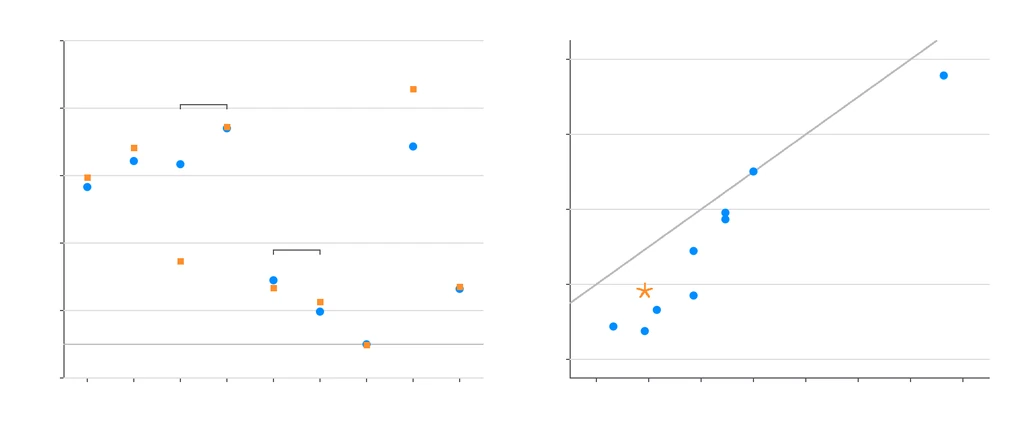
| 3 | 1 | 1.28105, 1.25607, 1.25213, 1.25157, 1.25150, 1.25149 | 1.25149 +- 1e-5 | [7/6, 3/2] | 2.0970 +- 8e-6 | 2.2381 |
| 5 | 1 | 1.40528, 1.38714, 1.38642, 1.38642 | 1.38642 +- 2e-6 | [19/15, 5/3] | 2.0947 +- 9e-7 | 2.1626 |
| 7 | 1 | 1.47203, 1.46033, 1.46028 | 1.46028 +- 6e-5 | [37/28, 7/4] | 2.0903 +- 2e-5 | 2.1344 |
| 9 | 2 | 1.50940, 1.50712 | 1.50712 +- 3e-3 | [61/45, 9/5] | 2.0865 +- 7e-4 | 2.1191 |
| 11 | 2 | 1.54066, 1.53971 | 1.53971 +- 1e-3 | [91/66, 11/6] | 2.0835 +- 3e-4 | 2.1091 |
The bar is the larger of that step and the gap between meshes k = 1, 2 at the deepest common level. At N = 9, 11 only the first step fits under the side cap, so the bar is wide; at N = 3, 5, 7 steps past the first fit, and the table prints the rows the verb prints. The side-3 reading meets the rho ~ 1.251 of numerical calculations reported in Barlow 2013; Barlow, Bass and Sherwood 1990, where those calculations are announced, is read as its abstract only, which states no value. d_w(3) = 2.0970 meets the spectral census row of code 495, 2.097, from an independent generator.
Side first, the scale tends to sqrt(3). Proved; the rate is a Conjecture. The theorem gives lim_(N -> infinity) rho(N, L) = sqrt(3) at every level. Verified, verb rate: rho(N, 1) at k = 2 reads 1.50940, 1.54066, 1.58189, 1.61788, 1.64991, 1.66765 at N = 9, 11, 15, 21, 31, 41, and N (sqrt(3) - rho(N, 1)) reads 2.0038, 2.1053, 2.2525, 2.3977, 2.5463, 2.6404, still growing. A fit r - a/N + b/N^(4/3) with r free returns r = 1.7316 against sqrt(3) = 1.7321, max residual 8.4e-5. With r = sqrt(3) and correction exponent 5/4, 4/3, 3/2 the fit returns a = 4.050, 3.605, 3.159, residuals 2.4e-4, 1.2e-4, 6.1e-4, all below the mesh shift at N = 9, where k = 4 reads 1.50830 (verb side). That sqrt(3) - rho(N, 1) is of order 1/N, with a coefficient between 3.1 and 4.1 for these models, is a Conjecture from the fits; N (sqrt(3) - rho(N, 1)) is still rising at N = 41, where it reads 2.6404.
Level first: the limits commute. Conjecture. lim_(N -> infinity) rho(N) = sqrt(3): every limit point of sigma(N, L)^(-1/L) as L -> infinity tends to sqrt(3) as N -> infinity. The level drift shrinks with the side: at one mesh the first ratio rho(N, 1) exceeds the deepest reading by 2.96e-2, 1.89e-2, 1.18e-2, 7.60e-3, 4.99e-3 at k = 1 and by 1.46e-2, 8.42e-3, 4.48e-3, 2.28e-3, 9.50e-4 at k = 2, at N = 3, 5, 7, 9, 11, while rho(N, 1) -> sqrt(3) is proved. At N = 9, 11 the deepest reading is level 2, so the drift there is the first step only. If the drift tends to 0, the level-first Archie exponent log(rho(N))/log(N^2/m_N), which reads 1.9046, 1.8739, 1.8657, 1.8640, 1.8648, tends to 1.9094 as well. Shortest paths do not commute; there is a reason to expect that conduction does. Side first, a level sees a filled cell through one number only: at infinite side a cell is a homogeneous medium whatever it holds, so the side-first map on the shape of a cell's response is constant, with one fixed point, which a perturbation of order 1/N moves only a little. The side-first map Phi on norms keeps the shape; it fixes the taxicab norm, the maximum norm and every multiple of the octagon, and level first at side 5 and up lands on the taxicab norm, another of its fixed points. That is a reason, not a proof; a proof wants a homogenisation error for K(N, L) of order 1/N, uniform in L.
The walk-dimension law. The bounds are Proved; the law is a Conjecture. (d_w(N) - 2) log N = log(m_N/N^2) + log(rho(N)), so the trap gives log(m_N beta_N/N^2) <= (d_w(N) - 2) log N <= log(m_N alpha_N/N^2) at every side. The lower end is log(1 + (N - 1)^3/(8 N^3)) > 0, so d_w(N) > 2 at every odd N: in this family music never beats mass. The ends tend to log(9/8) = 0.1178 and log(3/2) = 0.4055, so d_w(N) - 2 decays like 1/log N, with every limit point of its coefficient in that interval; at N = 3 the interval is [0.0364, 0.2877]. That the coefficient tends to log(3 sqrt(3)/4) = 0.2616, the law d_w(N) = 2 + log(3 sqrt(3)/4)/log N + o(1/log N), is exactly the commuting Conjecture. The readings 0.1065, 0.1524, 0.1757, 0.1901, 0.2002 at N = 3, 5, 7, 9, 11 rise toward it. At small side the law is useless: it predicts 2.2381 at N = 3 against 2.0970, because the terms it drops, (log(4 m_N/(3 N^2)) + log(rho(N)/sqrt(3)))/log N, sum to -0.1412 there.
dim 3: a number, no closed form here. Verified. bang dim 3, code 23 at odd side N voids a cell iff at least two of its digits are odd. At infinite side the period-2 cell is half solid, the four unit cubes with at most one odd coordinate, and the same reflections cut it to the unit cube minus the four octants with at least two upper coordinates, between the faces x = 0 and x = 1. Verb dim3 at M = 8, 16, 32, 64 reads 0.3128582, 0.3146679, 0.3153962, 0.3156869, orders 1.3132 and 1.3247; Aitken on the two triples gives 0.315887 and 0.315880, Richardson on the last pair 0.315878, so sigma_3 = 0.31588 with bar 1e-5. If the side-first theorem holds in dim 3, level L conducts sigma_3^L at solid fraction (1/2)^L, an Archie exponent log(1/sigma_3)/log 2 = 1.6626. That is a Conjecture: the dim 3 voids are tunnels that reach the faces of the cube, and the extension step above does not apply as written. No closed form for sigma_3 is known to this page.
Prior art. At side 3, Barlow and Bass 1990, read as its abstract, proves rho^n/4 <= R_n <= 4 rho^n; the survey Barlow 2013 states the existence of rho, the bounds 7/6 and 3/2 and the value rho ~ 1.251. The value of the array is Obnosov's. What the odd-odd rule adds: at infinite side every level is the same array, so side first the scale is exactly sqrt(3) and the Archie exponent exactly log 3/log(16/9); level first the scale is trapped, and at N = 3..11 the Archie exponent reads within 0.05 of its side-first value.
Where the honest line falls
Everything in the walk census is finite-level measurement. The scaling windows reach side 243 in 2D (level pair 4 to 5) and side 81 in 3D; the base-2 subject's walker estimate is still drifting at side 256 and its spectral value is the one to quote; heat-trace and staircase estimators carry a known finite-size bias (about 5% low on the solid, where the answer is 2 exactly; Conjecture, no lab study regenerates that figure) and serve only as consistency checks. The Einstein relation is imported as a definition of d_s outside the classical cases. No claim of the walk census is a limit theorem, and its two open questions - the class split's fate and 127's second exponent - are tagged as such; the limit theorems of the page are those on shortest paths and on conduction at large side. Readings, gates, census table and figure: lab/rs/walk-dimension, about six minutes.
Weigh two shapes and the scale reads the same; drop a walker on each and one of them is twice as far from home. The mass is one number. The music is another.