Rep-tiles
A shape that cuts into a few smaller copies of itself, all of one size, can be cut again and again, and run backwards the same cut grows it to cover the whole plane.
A rep-tile is a shape that can be cut into n pieces that are all congruent to each other and are each a smaller copy of the whole. The pieces may be turned and may be flipped over. Such a shape is rep-n, and the area fixes the scale: n equal pieces share the area, so each is the whole shrunk by the factor sqrt n in every direction. The square cut into four quarters is rep-4. The equilateral triangle cut along the three lines joining the midpoints of its sides is rep-4 too, and the same cut works for every triangle and every parallelogram. Rep-tile is Golomb's word, and Golomb 1964 collects plane figures that cut into four replicas of themselves and more.
The L-tromino, three squares in an L, is rep-4: double it and the L of side 4 is cut into four L's, two pointing the parent's way and two turned a quarter turn. As a substitution tiling it is called the chair. The sphinx is the pentagon made of six equilateral triangles, with sides 3, 1, 1, 1 and 2 in turn round its edge, a row of five triangles with one more standing on its end like a head. Double it and it can be cut into four sphinxes in exactly one way, and three of the four are mirror images of the parent. Heo 2024 notes that the sphinx is still the only known rep-tile polygon that is not convex and has an odd number of sides, and that a convex rep-tile polygon is always a triangle or a quadrilateral.
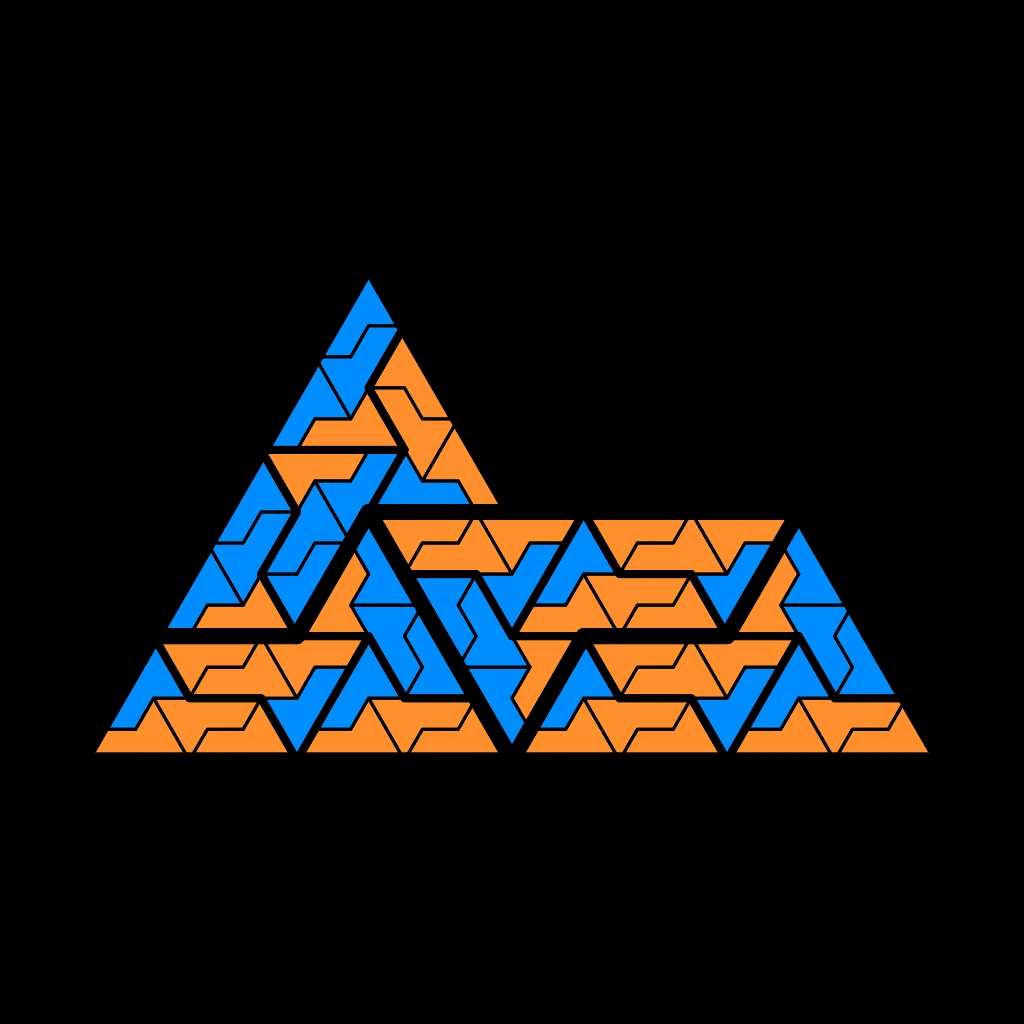
The figure is the sphinx cut three times, 64 sphinxes in all, with the gaps between them narrowing level by level so the four big sphinxes, the sixteen middle ones and the 64 small ones read at once. The 28 that face the same way as the parent are blue and the 36 mirror images orange. Each cut turns a sphinx into one of its own hand and three of the other, so the two counts at each level are the columns of the powers of [[1, 3], [3, 1]]: (1, 0), (1, 3), (10, 6), (28, 36).
A cut can always be repeated. Cut each of the n pieces of a rep-n tile the same way and the tile falls into n^2 copies, then n^3, so a rep-n tile is rep-n^k for every k; a tile that is rep-m and rep-n is rep-mn by doing one cut and then the other. Run the cut backwards and the tile is a substitution with one kind of tile, or two when the pieces are mirrored: inflate by sqrt n and the large tile is covered by n tiles of the old size; inflate again and each of those is covered in turn. The supertiles grow without end, and Ngai, Sirvent, Veerman and Wang 2000 note that this inflation argument makes every rep-tile tile the plane.
A polyomino, a shape of whole unit squares joined edge to edge, can only be rep-n when n is a square k^2. At a corner of the polyomino one piece must fill the right angle alone, since every angle of a piece is a right angle or three of them, so that piece sits square to the grid; a piece sharing a stretch of edge with it does too, and so every piece does. Then the lowest edge of the polyomino, a whole number of units long, is covered by whole edges of pieces, each a whole number of units divided by sqrt n, so sqrt n is a fraction, and the square root of a whole number is a fraction only when it is whole. Every rectangle is rep-k^2 for every k, laid as a k by k grid of small copies, the domino of domino tilings among them, and the L-tromino is rep-k^2 for every k >= 2.
Even rep-2 has few members. Allowing turns but no flips, and turns by rational multiples of pi, Ngai, Sirvent, Veerman and Wang find exactly six rep-2 tiles up to similarity: the right isosceles triangle, the rectangle with sides in the ratio 1 : sqrt 2, and four with fractal edges, the twindragon, the tame twindragon and the Heighway and Levy dragons. Those fractal edges come from number systems. Take a lattice, an integer matrix M that stretches it in every direction, and n = abs(det M) digits, one from each class of the lattice modulo M. Bandt 1991 proves that there is exactly one rep-n tile T with M T the union of the n copies T + d: it is the set of numbers written in base M with those digits after the point, sum d_j M^(-j). Base 1 + i on the square lattice with digits 0 and 1 gives (1 + i) T = T union (T + 1), the twindragon, rep-2. A matrix of determinant 3 on the triangular lattice gives the terdragon, rep-3, and a matrix of determinant 7 whose digits are the centre of a hexagon and its six corners gives the Gosper island, rep-7. Each has area and tiles the plane, but its edge is a fractal: the twindragon's edge has fractal dimension 2 log lambda / log 2 = 1.523627..., with lambda the real root of x^3 - x^2 - 2, against 1 for a polygon.
The cut of a rep-tile also orders its pieces, and when the pieces can be run through in a chain, each entered where the last is left, the chain refined level by level is a space-filling curve: the square cut into four gives Hilbert's curve, into nine Peano's, and the Gosper curve runs through the seven islands of a Gosper island one after another.
In the tree
The Sierpinski carpet is the rep-9 square with its middle copy thrown away at every level. The toolpaths note and the radix dial build the radix tiles, the twindragon, the terdragon and the Gosper island among them, as designs of the tree.