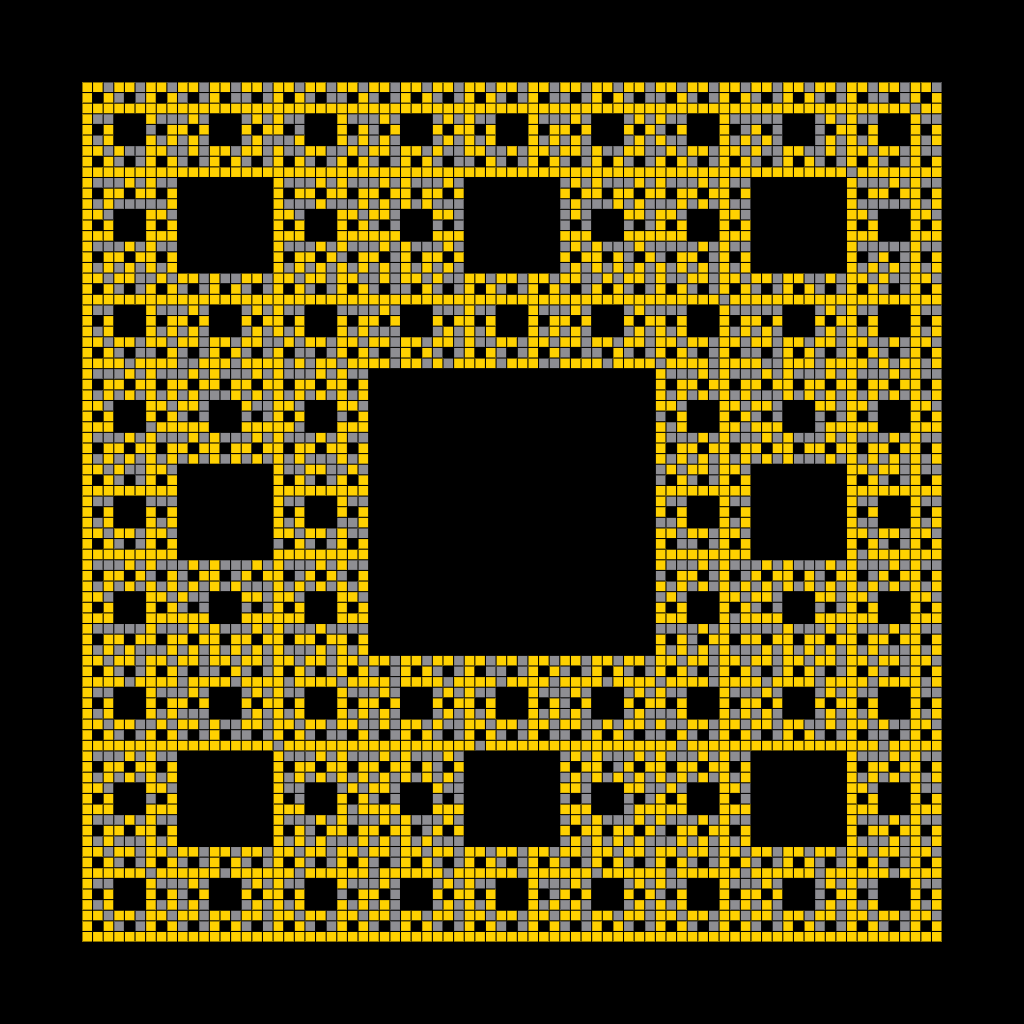
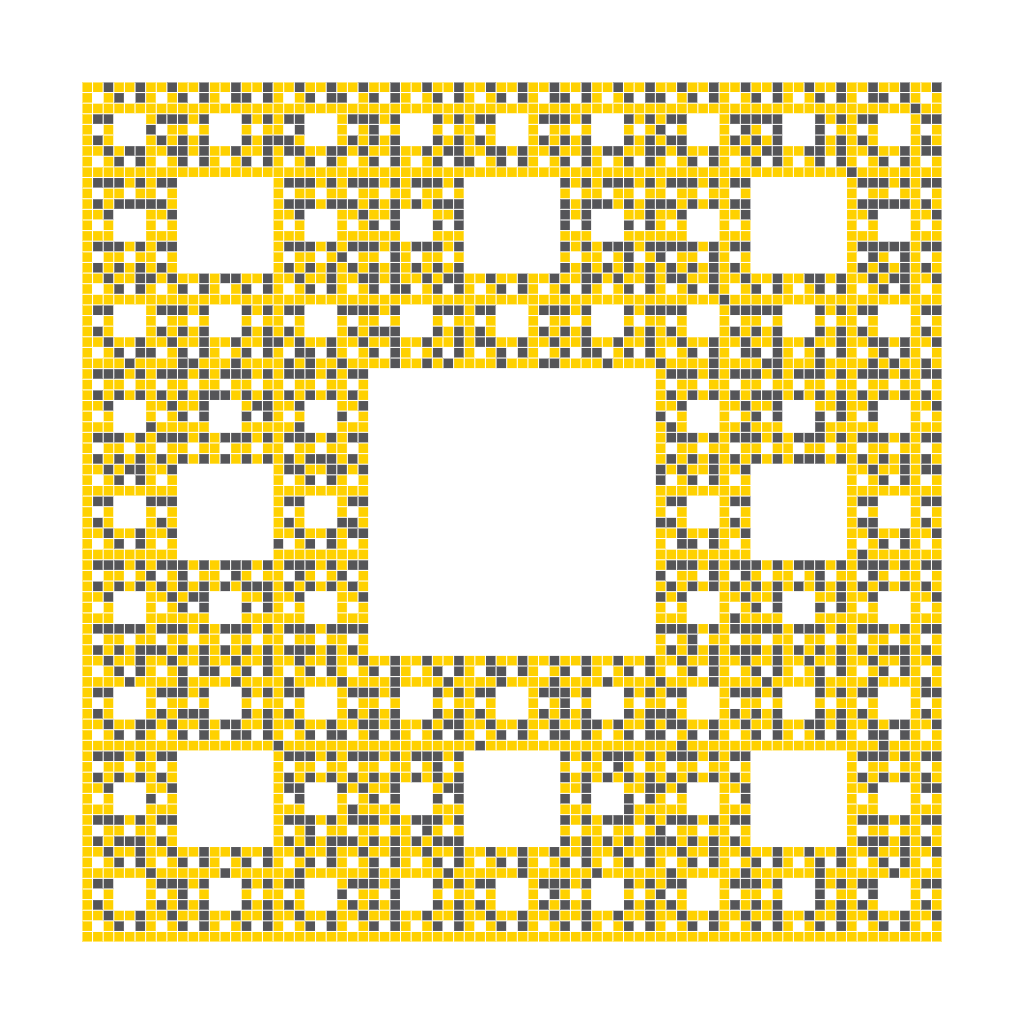
The coprimality spine
- Every fractal in this family counts the same thing on a different grid: the points of a digital design whose coordinates share no common factor.
- Each design has its own density constant, and the constants are one theorem with one input per design; this page is that theorem and the open front behind it.
- The base of the design contributes an exact factor, the bracket, known in closed form at every finite level; every prime away from the base contributes the classical factor
1 - p^(-dim). - Above dimension one the join is a theorem on the shelf; at dimension one it is open exactly for primes in one window of exponents, and that window is the standing problem here.
- The Sierpinski gasket is the worked case throughout, because its sequence is A396934 and its density
16/(3*Pi^2)is stated in the ledger. - Every claim carries one tag: Proved means a proof is given or restated here or on the shelf, Verified means recomputed by the named study or lane, Conjecture means supported and open, Refuted means shown false.
THE OBJECT
- A design is a triple
(base, dim, F): a basebase >= 2, a dimensiondim >= 2, and a setFof filled digit-vectors,Fa subset of{0,...,base-1}^dimwithfill = |F| >= 2. - The set at level
levelisS_level = { x in [0, base^level)^dim : every digit-vector of x in that base lies in F }, holding exactlyfill^levelpoints, one per string oflevelchoices fromF; it is the substitution rule of the core read on coordinates rather than cells. - The count of interest is
A(level) = #{ x in S_level : gcd(x_1, ..., x_dim) = 1 }, and the question is whatA(level)/fill^levelconverges to. - Let
Diffbe the subgroup ofZ^dimgenerated by the differencesF - Fandm(F)its index; the design is spanning whenm(F) = 1. - Condition (E):
F - Fhas full rankdimand every prime dividingm(F)dividesbase, i.e.rad(m(F)) | rad(base); spanning is (E) at index 1, and (E) is the hypothesis of every theorem below. - Non-spanning designs are outside the theory, not anomalies inside it: base 2,
dim 2, code 9 is a diagonal pair whose whole fractal is the linei = j, and its coprime count is stuck at1forever. Proved. - Six census lines fail spanning, satisfy (E), and obey the density formula unchanged, as do constructed index-4 designs at bases 4 and 6 (
lab/rs/design-census). Verified. - When (E) fails at a prime
pnot dividingbase, the Euler factor atpis replaced by a coset-corrected factor that can depend onlevel, andA(level)/fill^levelcan fail to converge: base 7,dim 2,F = { v : v_1 + v_2 = 1 mod 3 },fill = 16, index 3, has period-3 subsequential limits0.698175, 0.698175, 0.465450, each matched by the corrected constant to3e-04(coprime-density-above-dimension-one). Verified. - The household failure is the Cantor dust
F = {0,2}^2at base 3, dimensionlog_3(4) = 1.26, which fails (E) at index 4 and hasA(level) = 0at every level, every coordinate being even, against a naive0.512938; dimension above one does not exempt a design from (E). Proved. - One shear repairs it: dust points are
2*ywithyin the{0,1}^2design, which satisfies (E) withfill = 4 > 3, so the dust's#{gcd = 2}density is exactly81/(16*Pi^2) = 0.512938, the constant surviving one prime down (coprime-density-above-dimension-one). Proved.
THEOREM 1: THE BASE IS EXACT
- For every squarefree
edividingrad(base)and everylevel >= 1:#{ x in S_level : e | x_i for all i } = fill_e * fill^(level-1), withfill_e = #{ v in F : e divides every component of v }. Proved. - The proof:
e | base*yfor every integery, so writingx = v_0 + base*ythe divisibility ofxbyeis the divisibility of the last digit-vectorv_0; that vector is pinned to one offill_ecorners and the otherlevel - 1are free, with no error term at any level. - At a prime base
base = pthe only digit-vector divisible bypis zero, sox = p*ymaps{x in S_level : p | x}bijectively ontoS_(level-1)withgcd(x) = p*gcd(y), and#{ x in S_level : p^a | gcd(x) } = a_0^a * fill^(level-a),a_0 = 1if0is inF, else0. Proved. - Every design is its own Euler factor at the base prime, and the factor is self-similar rather than approximate: the Vicsek plus demands digit
1somewhere at every position, soa_0 = 0, no point of the plus has gcd divisible by 3 at any level, and its density is larger than6/Pi^2, not smaller. Proved. - The identity is recomputed by direct enumeration on the gasket and or-triangle to
level 8, the carpet and Vicsek plus tolevel 6, the base-6 sample tolevel 5, the sponge tolevel 4, and atlevel 4on all 763 census lines, degenerate ones included, with zero failures; the identity does not need spanning (lab/rs/design-census). Verified.
THE BRACKET
- Mobius inversion over the base primes turns Theorem 1 into one exact number, the bracket
B(F) = Sum_{e | rad(base)} mu(e) * fill_e / fill, andB(F)*fill^levelis exactly the number of points ofS_levelwhose gcd is coprime tobase, at every level. Proved. - At a prime base the bracket is
1 - a_0/fill; at a composite base divisibility by the different base primes is correlated through the corner set, and the bracket is the whole story. - The base-6 sample,
dim 2, code 34376528265 in the census (lab/rs/design-census), hasfill = 8withfill_2 = 3,fill_3 = 2,fill_6 = 1, soB(F) = 1 - 3/8 - 2/8 + 1/8 = 1/2while the naive product(1 - 3/8)*(1 - 2/8) = 0.46875. Proved. - Treating divisibility by 2 and by 3 as independent is wrong by an exact amount at every finite level, Theorem 1 with inclusion-exclusion over
{2, 3}(coprime-density-above-dimension-one). Proved.
level | points of S_level | gcd coprime to 6 | fill^level / 2 | naive 0.46875 * fill^level |
|---|---|---|---|---|
| 3 | 512 | 256 | 256 | 240 |
| 4 | 4096 | 2048 | 2048 | 1920 |
| 5 | 32768 | 16384 | 16384 | 15360 |
| 6 | 262144 | 131072 | 131072 | 122880 |
- The bracket reaches zero and the formula is right there: base 6 on the nine even-coordinate digit pairs, base 10 on the twenty-five, base 12 on the thirty-six, have every digit divisible by
2 | base, so Theorem 1 pinsfill_2 = fill,B(F) = 0, andA(level) = 0at every level. Proved. - That is exactly the case the Cantor dust is not: there the offending prime does not divide the base, (E) fails, and the naive formula returns
0.512938against a true0; the discriminator is whether the prime divides the base. - The bracket spreads widely at fixed dimension: at
base 4,fill = 8,dim 2, twenty-five designs of Hausdorff dimension1.5carryB(F)in{1/2, 5/8, 3/4, 7/8, 1}and densities in{0.4052847, 0.5066059, 0.6079271, 0.7092483, 0.8105695}, and sixteen base-6 designs take0, 1/3, 5/12, 4/9, 1/2, 6/11, 5/9, 2/3, 13/20, 3/4, 1; no study regenerates the sweep. Conjecture.
LEMMA A: UNIFORM CONTRACTION
- For
gcd(d, base) = 1, nonzerotin(Z/d)^dim, andr = ord_d(base), putf_l(t) = (1/fill) * |Sum_{v in F} e(base^l * <t, v> / d)|,e(x) = exp(2*Pi*i*x). - Lemma A. For every design satisfying (E),
Prod_{l=0}^{r-1} f_l(t) <= c(base, fill) := 1 - (2/fill)*(1 - cos(Pi/(2*base))) < 1. Proved. - The proof: (E) gives
v, v'inFwithdelta = <t, v - v'>nonzero modd; lety_lbe the distance frombase^l * delta / dto the nearest integer, purely periodic and never0sincegcd(base, d) = 1; whenevery_l < 1/(2*base)one hasy_(l+1) = base*y_l, so somel_0in the period hasy_l0 >= 1/(2*base), and splitting the character sum there into the pair and the otherfill - 2terms gives|Sum| <= fill - 2 + 2*cos(Pi/(2*base)). - Why (E) suffices where spanning was first assumed:
Diffhas finite indexm(F)withrad(m(F)) | rad(base), som * Z^dimlies inDiff; a charactertvanishing onF - Fvanishes onDiff, hencem * t = 0 mod d, andgcd(m, d) = 1forcest = 0; every downstream use of Lemma A is untouched. Proved. - Lemma A' (the window rate). For every design satisfying (E),
gcd(d, base) = 1,d > 1and nonzerotin(Z/d)^dim,Prod_{l=0}^{level-1} f_l(t) <= c(base, fill)^floor(level / m_d)withm_d = max(1, floor(log_base(d/2)) + 1). Proved. The proof of Lemma A gives one good position per window ofm_dconsecutive digits rather than one per orbit:y_lis never0, soy_l >= 1/dat everyl, andy_l < 1/(2*base)forcesy_(l+1) = base*y_l, so ifm_dconsecutive positions all hady < 1/(2*base)the last would bebase^(m_d - 1)*y >= base^floor(log_base(d/2))/d > 1/(2*base), a contradiction; each of thefloor(level/m_d)disjoint windows therefore carries a position where the pair contributes at most2*cos(Pi/(2*base))and the factor there is at mostc(base, fill). Sincebase^ord_d(base) = 1 mod dforcesord_d(base) >= m_d, Lemma A' is never weaker than Lemma A and is strictly stronger whereverord_d(base) > m_d; on the gasket the worst per-digit rate over every modulusd <= 301is0.830915atd = 257, against the Lemma A' rate0.973211and the Lemma A rate0.986514there (lab/py/digit-transform-norms). - Lemma A' with a base part and a perturbation. Let
d = e*mwithedividing a power ofbase,gcd(m, base) = 1andm > 1, lettin(Z/d)^dimbe nonzero modm, and letnorm(eta)_inf < base^(-2*level/3)/(4*base*dim*(base-1)). ThenProd_{l<level} f_l(t/d + eta) <= c'(base, fill)^floor(2*level/(3*m_d))withc'(base, fill) = 1 - (2/fill)*(1 - cos(Pi/(4*base))). Proved. The base part shifts the orbit and does not stop it, and the pair phase moves by at mostbase^l * dim * (base-1) * norm(eta)_inf, which stays below1/(4*base)at every positionl < 2*level/3, so each window ofm_dpositions below2*level/3still loses a factor, now withcos(Pi/(2*base))replaced bycos(Pi/(4*base)). The hypothesis thattis nonzero mod the coprime part is not decoration: the gasket atd = 6andt = (3, 0)hasProd_{l<level} f_l(t) = 1/3at everylevel, no decay at all. This is Maynard 2019 Lemma 8.2,exp(-c*log Y/log base), in every dimension with an explicit constant and with no consecutive-digit hypothesis. - The constant depends only on
baseandfill, not on which cornersFholds, and it is far from sharp; being below1for every design at once is the point. - The or-triangle is base 2,
dim 2, code 14, every digit pair but(0,0), i.e. the pairs withi OR j = 2^level - 1, of which there are3^level.
| design | base | fill | c(base, fill) | worst period product observed | moduli searched |
|---|---|---|---|---|---|
| gasket | 2 | 3 | 0.804738 | 0.333333 | d <= 40 |
| or-triangle | 2 | 3 | 0.804738 | 0.333333 | d <= 40 |
| carpet | 3 | 8 | 0.966506 | 0.500000 | d <= 30 |
| vicsek | 3 | 5 | 0.946410 | 0.600000 | d <= 30 |
| sponge | 3 | 20 | 0.986603 | 0.600000 | d <= 14 |
| base-6 sample | 6 | 8 | 0.991481 | 0.481763 | d <= 30 |
- The
c(base, fill)column is the formula; the observed column, the gasket's true contraction1/3against a bound of0.80, is a finite search that no study regenerates. Conjecture. - Corollary (equidistribution rate). For
gcd(d, base) = 1,d > 1and anyain(Z/d)^dim,| #{x in S_level : x = a mod d} / fill^level - 1/d^dim | <= c(base, fill)^floor(level / m_d), by character orthogonality: the principal character gives1/d^dim, and every other character is a nonzerotin(Z/d)^dim, whichgcd(d, base) = 1places inside Lemma A' with no further hypothesis, so it loses one factor ofcper window ofm_ddigit positions instead of one per orbit cycle. Proved. - The band the two corollaries stand on: over every modulus
3 <= d <= 15coprime to2and every level2 <= level <= 12the gasket's exact deviation stays under the window bound, worst ratio to it0.343146atd = 3,level 2, and the celld = 5,level 10deviates0.0014741against0.337499where the orbit rate allowed0.647604; the carpet overd <= 11,level <= 8has worst ratio0.066907atd = 4,level 2, and the base-peel error stays under its own window bound at worst ratio0.114382, the gasket atm = 3,level 3(lab/py/digit-transform-norms). Verified. - Corollary (base peel). For squarefree
d = e*mwithe | rad(base)andgcd(m, base) = 1,T_d(level) = #{x in S_level : d | x_i for all i}satisfiesT_d(level) / fill^level = (fill_e / fill) * (1 / m^dim) + O(c(base,fill)^floor((level-1)/m_m))withm_m = max(1, floor(log_base(m/2)) + 1), the last digit-vector pinned modeby Theorem 1 and the rest a shifted residue class modm; the window length is read off the coprime partmand never offd, the base part carrying no decay of its own, and at a prime base with0inFthe peel is the exact identityT_(base*m)(level) = T_m(level-1). Proved.
THE MASTER DENSITY
- The formula the whole census is measured against:
delta = B(F) * Prod_{p not dividing base} (1 - p^(-dim)) = B(F) * (1/zeta(dim)) * Prod_{p | base} (1 - p^(-dim))^(-1). - Upper bound. For every design satisfying (E),
limsup_level A(level)/fill^level <= delta: fixz, sift by the primes up toz, handle each of the finitely many squarefree moduli exactly by the base peel, and letzgrow only afterlevel. Proved. - Lemma B. Write
T*_p(level)for the count of nonzeroxinS_levelwithp | gcd(x), which vanishes forp >= base^level; Lemma B islim_{z} limsup_level (1/fill^level) * Sum_{p > z, p not dividing base} T*_p(level) = 0, and it is exactly what separates the upper bound from the limitA(level)/fill^level -> delta. - The origin must be excluded:
x = 0lies inS_levelwhenever the zero corner is filled, every prime divides0, and the unstarred sum over allp > zdiverges. - Lemma B is a uniform equidistribution estimate for digit-restricted sets over moduli growing with the level; the one-dimensional literature is Erdos, Mauduit and Sarkozy 1998, Konyagin 2001 and Maynard 2019, all three needing
|F| < base, operating below the gasket's critical band, and treating no vector digit set. - Theorem (above dimension one). For every design with
dim >= 2, condition (E), andfill > base,A(level) / fill^level -> delta: the hypothesis is the geometry, dimensionlog(fill)/log(base) > 1, and nothing else (coprime-density-above-dimension-one). Proved. - The three steps: the box bound
N*_level(m) <= (base+1)^dim * fill^level * m^(-alpha),alpha = log(fill)/log(base),N*_level(m) = 0form >= base^level, which is the Ahlfors-David regularity of missing-digit sets (Chow, Varju and Yu); the Chebyshev sumG(level) = Sum_{x != 0} log gcd(x) = Sum_m Lambda(m) N*_level(m) <= (base+1)^dim * (-zeta'(alpha)/zeta(alpha)) * fill^level, convergent exactly whenalpha > 1; and the close,A_z(level) - A(level) <= G(level)/log zuniformly inlevel, since every point sifted atzbut not coprime haslog gcd > log z. - What that settles: the gasket's
16/(3*Pi^2)(A396934), the or-triangle's8/Pi^2, the carpet's189/(32*Pi^2), the Vicsek plus's27/(4*Pi^2), the sponge's(513/520)/zeta(3)and both base-6 samples are theorems. Proved. - The proof is qualitative: chaining the steps gives an error of order
(log level)^(1-alpha), while the measured convergence is geometric, the carpet's gap halving per level down to-3.52e-07atlevel 20(lab/rs/dimension-one-ladder, live tolevel 18and stored tolevel 20); nothing here explains the rate. Conjecture. - Corollary (no linear recurrence). For any design satisfying the theorem with
B(F) > 0anddimeven ordim 3,A(level)is not C-finite: a C-finite sequence withA(level)/fill^levelconvergent has a rational limit, anddeltais a nonzero rational multiple of1/zeta(dim), irrational for evendimby the transcendence ofPiand atdim 3by Apery. Proved. - At odd
dim >= 5the corollary waits on the irrationality ofzeta(dim), and holonomic recurrences are excluded only by exhaustive exact fitting with held-out terms. Conjecture. - The periodic pattern owes Lemma B nothing. Among nonzero points of
Z^dimvisible from the origin whose least residue vector modbaselies inF, the density is exactlydelta * (fill / base^dim) = (1/zeta(dim)) * Prod_{p | base} (1 - p^(-dim))^(-1) * base^(-dim) * m_c,m_c = fill * B(F)the corners nonzero mod every base prime; a base prime is decided by the residue class, a foreign prime is independent by CRT, and the Mobius tail beyond moduluszisO(z^(1-dim))uniformly in the box, which is wheredim >= 2enters. Proved. - Designs differing only in the zero corner have identical visible density, since the zero corner never counts toward
m_c;Fthe whole residue cube recovers the classical1/zeta(dim)of pi out of the stack; the gasket gives4/Pi^2 = 0.4052847345, the carpet21/(4*Pi^2) = 0.5319362141, the sponge19/(26*zeta(3)) = 0.6079323107. Proved. - The shear theorem. A unimodular
sigmawithsigma(F)inside the digit cube acts digit-wise without carries and preserves gcd, soFandsigma Fhave identicalA(level)at every level; at base 2 the shears(i, j) -> (i, i+j)and(i, j) -> (i+j, j)carry code 7 to codes 11 and 13, all three on2, 4, 12, 34, 122, 362. Proved. - The converse is false: base-3 codes 11 and 161, the gasket and
{(0,0),(1,2),(2,1)}, have identicalA(level)at every level and are not shear-equivalent, by the E-decomposition below. Proved.
PRIMES ON A DESIGN
- Three readings, one of them a sieve. For a design with
B(F) > 0,gcd(x)prime is a positive-density count,Sum_p delta_p, and follows from the master density above dimension one by the same three steps, sinceSum_p p^(-dim)converges; the bracket is the whole hypothesis, since base 32 withF = {0, 4, ..., 28}^2hasfill = 64 > 32and satisfies (E) while every gcd on it is divisible by4, so no point of any level has prime gcd.x_1prime on the gasket is2^level * Sum_{p < 2^level} 2^(-s_2(p)), a sum-of-digits question in its large-deviation regime. And the Morton codex -> Sum_j (Sum_c base^(c-1) * x_(c,j)) * base^(dim*j)mapsS_levelbijectively onto the integers ofleveldigits at basebase^dimwhose digits lie in the image ofF, so whenfill = base^dim - 1primes on a design are exactly primes with one restricted digit at basebase^dim, the gasket being base 4 missing digit3and the carpet base 9 missing digit4. Proved. - What the sieve consumes. Maynard 2019 proves infinitely many primes missing one base-10 digit and reads the set through two numbers only: the
l^1exponent of its digit transform,27/77, whose complement50/77is the Type I level, and a fractional moment,59/433at order235/154, which fixes the Type II range[X^(9/25), X^(17/40)]; Karwatowski 2022 carries both bounds to every basebase >= 10, and Karwatowski, base 9 proves the pairs(9, 0)and(9, 8)with0.3219and0.14355in their place, records the criteriong(s) < (1/5)*(1 + c/2)*(2 - s)for somesin[3/2, 2),c = log(base-1)/log baseandg(s) = log_base lambda(s, J)withlambda(s, J)the Perron root of thebase^J-state matrix carrying aJ-digit window to its successors with weight thes-th power of the one-digit transform's supremum over the box behind the window, and states that no other pair withbase <= 9meets it. Verified at source. - The
l^infinityinput is not a gap. What the Type I estimate asks of the set at a rational with a factor coprime to the base, Lemma 8.2 there, is Lemma A' above, which supplies it in every dimension with an explicit constant under (E) alone; what is left to ask of a design is the pair ofl^1numbers, and it is there that the two designs part. Proved. - The least base with a one-missing-digit set below
1/4. Writealpha_1for thel^1exponentg(1)of a digit set at basebasewith one digit excluded. The least base carrying such a set withalpha_1 < 1/4isbase 21missing the digit0, certifiedalpha_1 in [0.2499765, 0.2499771]at six window digits and clearing the threshold by2.3e-05; base 20 misses at all ten of its distinct sets, the closest readingalpha_1 > 0.2528608at four window digits. A base hasfloor((base+1)/2)distinct sets, since the mirror paira_0 -> base - 1 - a_0coincides only at oddbase(lab/py/digit-transform-norms, verbsix). Verified. - The family is closed above its floor. Every one of the 3663 distinct one-missing-digit sets of every base
35 <= base <= 125certifiesalpha_1 < 1/4, each at the shortest window of two, three or four digits that clears,35 <= base <= 57needing three digits and everybase >= 58clearing at two; withbase 34certified at all 17 of its sets and the digit-uniform bound below a theorem for everybase >= 126, every basebase >= 34clears at every excluded digit and the floor34of that family is exact (lab/py/digit-transform-norms, verbfamily,lab/py/digit-uniform-bound). Verified. - The digit-uniform bound.
|hat F(t)| <= (|sin(base pi t) / sin(pi t)| + 1)/(base - 1)for everytand every excluded digit, the right side naming no digit; expanding the level product over subsets telescopes each maximal run of positions into a single Dirichlet kernel at modulusbase^l, so(base-1)^Ntimes the digit-uniform level-Ngrid sum is an exact sum of2^NLebesgue sums, and withL_M <= M((2/pi) log M + 0.9625153) + 2/pithis givesalpha_1 < 1/4for everybase >= 126and every excluded digit, and fails atbase 125(lab/py/digit-uniform-bound). Proved. - Two missing digits: what the transform sees. For an excluded pair
{a, c}at basebase,fill = base - 2and(base-2)^2 |hat F(t)|^2 = K(t)^2 + 2 + 2 cos(2 pi D t) - 4 K(t) cos(pi S t) cos(pi D t)withK(t) = sin(base pi t)/sin(pi t),D = a - candS = a + c - (base - 1), so the pair enters only through|D|and|S|. That is one implication and not an equivalence class:{0, 2}and{0, 8}atbase 10read(2, 7)and(8, 1)and share a transform anyway, and grouping by(|D|, |S|)alone overcounts. The two moves that generate the collapse are the reflectiond -> base - 1 - d, which flips both signs, and an integer translation ofF, available exactly when0orbase - 1is excluded and identifying{0, c}with{0, base - c}; the edge family is therefore the one-missing-digit sets of a(base-1)-digit interval read at basebase, and the number of distinct transforms is(C(base-2, 2) + floor((base-2)/2))/2 + floor(base/2). Proved. - How many pair sets a base carries. That count reads
7, 16, 21, 31of the15, 36, 45, 66excluded pairs atbase 6, 9, 10, 12, and grouping everyC(base,2)pair by its sampled transform reproduces it at every base4 <= base <= 41, summing to 2373 over4 <= base <= 31(lab/py/digit-transform-norms, verbpairs). Verified. - The least base with a certified two-missing-digit set below
1/4. The interval class, the pair{0, 1}whose complement is an interval ofbase - 2digits, is the cheapest set of its base at every base scanned, andbase 32certifiesalpha_1 in [0.2499087, 0.2499779]at four window digits, clearing by2.2e-05, while the same class atbase 31certifies[0.2518967, 0.2519717]and fails. Over every base4 <= base <= 31the window machine certifiesalpha_1 > 1/4at 2363 of the 2373 distinct sets, closestbase 26missing{2, 23}atalpha_1 > 0.2502919, most of them at two window digits (lab/py/digit-transform-norms, verbspairsandpairfail). Verified. - Ten cells stay unclear, and the shape they share is a correlation and not a mechanism. The ten sets of
4 <= base <= 31that get no positive lower certificate at five window digits are three atbase 26, one atbase 29, five atbase 30and one atbase 31, and every one hasS = 0orD = base/2withbase/2odd. A real zero of|hat F|empties a cell and lowers the Perron root of the infimum matrix, but it does not zero it and it does not decide the cell:base 32missing{0, 1}has|hat F(t)| = |sin(30 pi t)/sin(pi t)|/30, vanishing at all 29 pointst = j/30, and is the page's own clearing headline, while 13 of the 14S = 0classes atbase 31certify above1/4. The ten carry certified upper bounds0.2538899to0.2826357, all above1/4, so none of them is shown to clear either, and32is the least base carrying a certified clearing set while the exact floor stays Conjecture. - The bar
1/3and the family floor at it. The bar isalpha_1 < 1 - bwherebis the exponent ofmax_theta |Sum_{n <= x} mu(n) e(n theta)|, sob = 3/4gives1/4andb = 2/3gives1/3; against1/3the interval class first clears atbase 13withalpha_1 < 0.3318819at three window digits,base 12staying above at all 31 of its sets to five, every pair of every base21 <= base <= 26clears, worstbase 23missing{4, 5}atalpha_1 < 0.3333284, and every base4 <= base <= 20carries a certified witness above1/3,base 20by{3, 11}atalpha_1 in [0.3356579, 0.3356674], so the two-digit family floor against1/3is21(lab/py/digit-transform-norms, verbspairfirst,pairclear,pairsome). Verified. - The digit-uniform bound at any number of excluded digits.
|hat F(t)| <= (|sin(base pi t)/sin(pi t)| + m)/(base - m)for every setEofmexcluded digits, the right side naming no digit; expanding the level product over subsets carriesm^(N - |E|)on the positions outside the subset and telescopes each maximal run into the same Dirichlet kernel, soa_N = m a_(N-1) + m Sum_(l<N) lambda_l a_(N-1-l) + lambda_N, the growth root solves(z - m)(z - 1)^2 = m(c_1 (log base) z + c_0 (z - 1))withc_1 = 2/piandc_0 = 0.97, andalpha_1 < efollows fromz < base^e (1 - m/base). The Lebesgue input islambda_l <= c_1 l log base + gamma' + c_1 base^(-l)withgamma' = (2/pi)(gamma + log(8/pi)) = 0.96252282676, used rounded up, the coarserc_0 = 0.97form of it needingbase^l >= 86and so being unusable at them = 1rung against1/3, wherebase^l = 32. Certified at 120 bits on the exact input, the chain givesalpha_1 < 1/4for everybase >= 649and every excluded pair and fails atbase 648; atm = 1it gives125and atm = 3it gives1873, while against1/3it gives32,105and230. Them = 1rung sharpens the126of the bullet above by one base rather than contradicting it, since that bullet'sc_0 = 0.97is legitimate wherever it is applied there (lab/py/digit-uniform-bound). Proved. - What the bar
1/4buys, and where the wall moves. In the GRH Mertens chain of mobius the digit set enters twice: through its massA_F(x)and through the normalisedl^1massbase^(-level) Sum_(a < base^level) |Sum_(n in D_level) e(n a/base^level)| <<_base fill^level base^(level(alpha_1 - 1)), the window certificate supplying that bound uniformly inlevel; steps 1, 2, 4 and 5 there never name the set, and only step 3, the kernel boundB_base(F) <= base PB_base(m), substitutes a digit-free estimate for it. Feeding the certifiedl^1exponent in step 3's place gives|M_F(x)| <<_{base,eps} A_F(x) x^(alpha_1 - 1/4 + eps)under GRH, that isA_F(x)^(1 - delta + eps)withdelta = (1/4 - alpha_1)/alpha_base > 0, and under a zero-free half planeZ(a)the exponent readsalpha_1 - (1 - b(a)); soalpha_1 < 1/4is the whole hypothesis and the excluded-digit count enters only throughalpha_1. Proved. The wall of that theorem moves from3690to34, since the one-missing-digit clearance is certified at everybase >= 34; steps 2 and 3 alone forcealpha_1 <= 1 - alpha_base + c_baseandgap_base(1) > 0is exactly1 - alpha_base + c_base < 1/4, so the old certificate implies the new condition and the wall can only fall. Verified, at the certificates behind34. - The published exponents are upper bounds and not the constants. The base-10 missing-
5exponent brackets to[0.3505775, 0.3505797]at seven window digits, strictly below the published27/77 = 0.3506494, so that number is a finite-window upper bound on thel^1exponent and not the exponent itself (lab/py/digit-transform-norms). Verified. - The 2D Type I splits the two designs. Write
hat F_level(t) = Prod_{j<level} f(base^j * t)for the transform at levellevelonT^dim,f(t) = (1/fill)*|Sum_{v in F} e(<t, v>)|the factor of Lemma A, andI_level = Int_(T^dim) hat F_level; letalpha_1^- = dim + liminf_level (1/level) log_base I_levelandalpha_1^+its limsup, withalpha_1*the exponent of the sup-over-box sum a large sieve consumes, which dominates every shifted grid sum and so is never belowalpha_1^-. The substitutiont = (i + y)/base^Ngives the sandwichbase^(-dim*N) * min_x Sigma_N(x) * I_M <= I_(N+M) <= base^(-dim*N) * max_x Sigma_N(x) * I_Mfor the shifted grid sumSigma_N(x) = Sum_{i in (Z/base^N)^dim} hat F_N(x + i/base^N), which isbase^(-N)-periodic, so one scan of one cell with a Lipschitz slack boundsalpha_1^-below andalpha_1^+above; no limit is claimed and none is needed. Ford | gcd(x)the Farey-point route of that Type I estimate transfers to(Z/d)^dim, the points ofT^dimof denominator at mostQbeing1/Q^2-separated in sup norm, and it saves a power whenalpha_1* < dim/2, the dyadic blockd ~ Q_1costingfill^level * (Q_1^(2*alpha_1* - dim) + Q_1^dim * base^(level*(alpha_1* - dim)))and the small moduli going to Lemma A': the carpet's five-digit window matrix is certified in interval arithmetic at Perron root below2.441255, soalpha_1* < 0.8124andSum_{d <= Q, gcd(d,3) = 1} |#{x in S_level : d | x_i for all i} - fill^level/d^2| <<_A fill^level * level^(-A)holds atQ = 3^(0.5938*level) * level^(-C), a power level with a log saving where Lemma A' alone givesQ = level^C; the gasket's shifted grid sums are certified above their threshold atN = 2andN = 3,min_x Sigma_2 > 4.059204against4andmin_x Sigma_3 > 8.213932against8, withSigma_2(0) = (8 + 2*sqrt(5))/3 = 4.157378exactly at the grid itself, soalpha_1^- >= 1.0126andalpha_1^+ <= 1.1022, andalpha_1* >= alpha_1^- > dim/2closes the same route (lab/py/digit-transform-norms). Proved. - The carpet misses the criterion at every order. For base 9 missing
4the window bound givesg(1) = 0.3437, below27/77, so the Type I levelX^0.656is met, whileg(3/2) = 0.1531,g(235/154) = 0.1457,g(1.6) = 0.1262,g(1.7) = 0.1031andg(1.8) = 0.0835sit against the criterion's0.1473,0.1397,0.1179,0.0884and0.0589, a deficit at every order,0.0058on the printed pair ats = 3/2and0.005749in full; the same bound returns0.1446for(9, 0)against the published0.14355and0.1370for base 10 against59/433 = 0.1363, two calibrations that put the cost of the wider box near0.0011, an inference from two rows and not a bound on it. Windows do not close the gap:g(3/2)reads0.153068at five digit-vectors and0.152921at six, a drop of0.00015after0.00132from four to five (lab/py/digit-transform-norms). Verified. - What the criterion is allowed to read. Dividing by
2 - s, the criterion is the single inequalityg(s)/(2 - s) < (1/5)*(1 + c/2)on the moment exponents of the transform: the exceptional setE = {a < X : F_X(a/X) >= X^(-beta)}enters the sieve only through its size, a level-smoment gives#E << X^(s*beta + g(s)), the step that consumes it asks#E << X^(2*beta), and that forcesbeta >= g(s)/(2 - s), after which the Type II range and its width are functions ofbetaalone (at base 10 the floor9/25is(9/8)*e_E - beta, the ceiling17/40is1 - e_Ewithe_E = 2*beta, and the width is1 - (13/4)*beta). A count#{a < X : F_X(a/X) >= 1/B} << B^s * X^mis a weakL^sbound and summing it dyadically inBreturns the strong moment withinX^eps, so weak and strong carry one exponent and, with the prime side entering by Parseval as it does at source, the family{g(s)}is the whole list of norms of the transform that this step can consume: a norm closes the carpet only by lowering someg(s)withsin[3/2, 2), and nothing else. Proved. The reading is confirmed by the base-9 constants at source, wherev = 0.28711is exactly0.14355/(2 - 3/2). - The deficit is in the transform, not in the estimate. The window matrix bounds
g(s), the exponent ofsup_beta Sum_{a<Y} F_Y(beta + a/Y)^s, from above, its one-digit weight being a supremum over the box behind the window and so uniform in the shift; the shift sandwich bounds it from below, sincesup_beta Sum_{a<Y} F_Y(beta + a/Y)^s >= Y * Int_0^1 F_Y^sandbase^(-N) * min_x Sigma_N^(s)(x) * I_M^(s) <= I_(N+M)^(s)forI_level^(s) = Int_0^1 F_level^sandSigma_N^(s)(x) = Sum_{i<base^N} F_N(x + i/base^N)^s, sog(s) >= (1/N)*log_base min_x Sigma_N^(s)at everyN. For base 9 missing4this readsg(3/2) > 0.149397andg(235/154) > 0.142274atN = 5, against the criterion's0.147320and0.139667; and becauseSigma_N^(s)falls ins, every factor being at most1, while the criterion falls inslinearly, a chain of orders atN = 4covers[3/2, 2)in 21 cells with tightest margin0.000085and[1, 2)in 87 cells, the chain anchored ats = 2by the exactSigma_N^(2)(x) = (9/8)^N, which Parseval gives at everyxbecause twoN-digit integers congruent mod9^Nare equal. No window length and no refinement of the Markov estimate meets the criterion for the carpet (lab/py/digit-transform-norms). Verified. - The 2D transform cannot stand in for the missing norm. The Morton code is a bijection of sets and not a homomorphism, so the frequencies the exceptional set indexes are not the characters the 2D transform bounds: at a one-dimensional frequency
thetathe Morton one-digit factor is|hat F(u)|withu = (theta, base*theta)atdim 2, the Morton product at levellevelisProd_{j<level} |hat F(base^(dim*j)*u)|, and the 2D product at leveldim*levelat the same point,Prod_{j<dim*level} |hat F(base^j*u)|, is that product times the factors at the positionsbase^dimskips, each of them at most1. A bound on the 2D grid sum therefore bounds the smaller quantity and never the Morton one; the implication runs the wrong way. Proved. - The 2D numbers run the wrong way as well. In one unit,
X = base^(dim*level), the carpet's 2D window moment reads0.406200ats = 1and0.195631ats = 3/2at five digit-vectors, against the one-dimensional0.343674and0.153069and the criterion's0.294640and0.147320: the 2D norm sits0.0483short ats = 3/2where the 1D norm sits0.0058short, so even granting a transfer it moves away from the carpet and not toward it (lab/py/digit-transform-norms). Both halves of the 2D-norm route to the carpet's last exponent are shut, and what stands between the design and a prime-counting theorem is the sieve, not another norm on the set. Refuted. - The gasket is far. Base 4 missing
3hasg(1) = 0.4820against27/77andg(235/154) = 0.3170against59/433, so no Type II range opens at any order computed, and Chow, Varju and Yu Proposition 2.4 puts its Fourierl^1dimension above1/2, which is the Type I side only (lab/py/digit-transform-norms). Verified. - Componentwise transfer, read at source. Chow, Varju and Yu Remark 6.1 puts the Fourier
l^1dimension below1/2for(base, a)in{(3,0), (3,1), (3,2), (4,1), (4,2)}by interval arithmetic atlevel 2, and their Proposition 2.4 puts it above1/2for base 4 missing0or3and for everybase >= 5missing one digit, so the base-3 design whose coordinate marginals are base-3 two-digit sets falls on the wrong side of the criterion while the base-2 gasket read through its Morton code, base 4 missing3, falls on the right one; the base-2 gasket has no componentwise reading at all, its coordinate projections being all of[0, 2^level), and the base-3 design's own Morton code is base 9 on{0, 1, 3}, three digits and not one missing. Verified. - The
l^1exponent of a digit transform is at least1 - alphaat every base and digit set, the shifted-grid floor iterated over theleveldigit positions, so the Type I large-sieve gatealpha_1 < dim/2is never met by a design withfill <= base^(dim/2)and the gasket kill is one instance of a general floor (Proved, mobius, the pair route).
ON THE SHELF
coprime-density-above-dimension-oneproves the master density for every design withdim >= 2, condition (E) andfill > base, settling the convergence conjecture of A396934; its scripts enumerate ten designs over 67 level rows, the base-6 bracket identity, the box bound in 1062 exact cases, and the whole base-2dim 4census, 65536 designs in 402 orbits with 336 inside the theorem. Proved.lemma-b-pincerprovesrho(a, b) <= phifor every primitive ray at every 3-adic depth, hence Lemma G, the gasket case, and by the reduction below Lemma B for every dimension-one line, at every prime exponentbeta > 1/(2 - log_3 phi) = 0.6402122; with the moment ladder's tenth rung0.4475978imported, the estimate can fail only forbeta in (0.4475978, 0.6402122], and two doors are shut, exact Fibonacci products and averaged spectral radii both unable to lower the edge. Proved.- The tenth rung is a theorem and
lemma-b-pincerimports it, so the standing window is(0.4475978, 0.6402122];0.446717survives only as the eighth row of the ladder table, kept for the record. Proved. gasket-ray-machineproves that the permutation designF_phiis diagonal exactly whenphi(0) != 0, four of six, so its3^levelpoints occupy3^level - 2non-fibre rays at everylevel >= 1; it carries the exact mass lawsM_level(3,1) = F(level+1) - 1,M_level(1,12) = A000930(level) - 1,M_level(7,3) = c(level-3) - 1tolevel 30, and the multiplier-pair spectral gap, growth3on the three shift pairs, exactly2on twenty pairs, at most1.6956on the rest of the 829 coprime pairs withmax(s,t) <= 52. Proved.menger-pairwise-coprimalityproves the sponge's pairwise coprime density(13/20) * Prod_{p != 3} (1 - 3/p^2 + 2/p^3) = (351/400) * C_3 = 0.251620868451255, the factor at 3 replacing the lattice's20/27by13/20, with the level-6 census15141288of20^6, density0.236583, and the exact factor at 2 at levellevelexplaining why finite levels sit below the limit. Proved.
THE CENSUS AND THE OPEN LINES
lab/rs/design-censusholds the full enumeration: every design withfill >= 2at base 2 in dimensions 2 and 3, every design at base 3 in dimension 2, the Menger sponge, and two base-6 samples, 763 lines; each records the bracket, the predicteddelta, the measured ratio at the deepest level a 200000-point budget allows, the first six terms, the exact-factor check and the spanning index.
| family | designs fill >= 2 | spanning | distinct term-vectors among spanning | flagged |
|---|---|---|---|---|
base 2, dim 2 | 11 | 5 | 3 | 0 |
base 2, dim 3 | 247 | 149 | 27 | 0 |
base 3, dim 2 | 502 | 365 | 175 | 0 |
| Menger sponge | 1 | 1 | 1 | 0 |
| base 6 samples | 2 | 2 | 2 | 0 |
| total | 763 | 522 | - | 0 |
- Zero designs are flagged: the exact base-local identity holds on all 763 lines and every spanning design lands within
0.06of its predicted density at the depth reached,level 11forfill = 3andlevel 4for the sponge, where0.7719against0.8207is inside only because the tolerance is loose that far up (lab/rs/design-census). Verified. - Distinctness is first-six-terms only: 219 distinct term-vectors among the 502 base-3 designs, 175 of them spanning (
lab/rs/design-census). Verified. - Of the 522 spanning lines, 490 have
fill > baseand are closed by the theorem, and the 32 left all sit atbase 3,dim 2,fill = 3, dimension exactly one; with the four index-3 lines at the same parameters they are the 36 open lines, and the census holds no design below dimension one (lab/rs/design-census). Verified. - The gasket, base 2,
dim 2, code 7,B(F) = 2/3, terms2, 4, 12, 34, 122, 362fromlevel 1, is A396934, whose entry starts atlevel 0with0;(2/3)*(4/3)*(6/Pi^2) = 16/(3*Pi^2)exactly, and the b-file givesa(20)/3^20 = 0.5403760862against0.5403796461, a gap of-3.6e-06(lab/rs/oeis-terms). Verified. - The or-triangle, code 14, has
a_0 = 0,B(F) = 1, density8/Pi^2 = 0.810569, terms3, 6, 22, 58, 200, 576, the classical6/Pi^2with the factor at 2 removed as for the Vicsek plus at 3 (coprime-density-above-dimension-one); it is a worked illustration, not a ledger sequence. Verified. - The approach to the limit is not always monotone: at least one design has a level further from its limit than the level before, so numerical support in this family is support and never proof (
lab/rs/design-census). Verified.
THE WINDOW AT DIMENSION ONE
- The E-decomposition. A point of
S_level(F),F = {v_0, v_1, v_2}, is a string of corner choicesc_l; withE_j = Sum_{l : c_l = j} 3^lthe threeE_jhave disjoint base-3 supports summing toc_level = (3^level - 1)/2,(E_1, E_2)ranges bijectively over the gasketG_level, andx = c_level v_0 + M (E_1, E_2)^T,M = (v_1 - v_0, v_2 - v_0), withDelta = det M != 0exactly whenF - Fhas full rank. Proved. - Theorem (one set). For every full-rank three-corner design, every
mcoprime toDeltaand everylevel,#{ x in S_level : m | x_1, m | x_2 } = #{ (u, v) in G_level : (u, v) = tau(level) mod m }withtau(level) = -c_level M^(-1) v_0 mod m; so Lemma B for every dimension-one line is shifted-target equidistribution of the gasket pair, every bound below is target-uniform, and the 36 lines stand or fall together. Proved. - Corollary (simplex reduction). For any base
baseand any full-rank design withfill = dim + 1corners the same decomposition reduces every divisibility count to the simplex{0, e_1, ..., e_dim}at basebasewith explicit targets; the sub-dimension-one world is a one-parameter family of simplex problems. Proved. - Codes 11 and 161 both have
v_0 = 0, target0, andDeltain{-1, -3}, so every modulus coprime to 3 gives the same gasket count and the base prime peels identically, whence their collision. Proved. - Under
GL_2(Z)shears the 36 lines collapse to 11 classes, in 8 of which the fractal is the graphx_2 = g(x_1)of a carry-free digit relabeling; the classes{26, 50, 152},{176},{416}are graphs of nothing, and the search is finite because a unimodular matrix keeping a full-rank corner set inside the digit cube has entries at most 6 in absolute value; no study regenerates the search. Conjecture. - The pincer. Lemma G, the gasket case, splits by the prime's exponent
beta = log_3(p) / level: the top range closes by the ray machine atbeta > 0.6402122(lemma-b-pincer), the bottom by the moment ladder below, and the open lemma is pinched between. - The moment identities. For
p != 3writef(t) = (1 + e(t_1) + e(t_2))/3andF_a(t) = Prod_{l<a} |f(3^l t/p)|; gasket digits are{0,1}per coordinate, so adding two gasket points never carries and the additive energy is exactly15^a, while three or four summands carry only inside{-1,0,1}^2, a nine-state automaton, givingSum_t F_a^2 = p^2 * 3^(-a),Sum_t F_a^4 = p^2 * (5/27)^a,E_6growthlambda_6 = 57 + 6*sqrt(46) = 97.693980andE_8growthlambda_8 = 456 + 3*sqrt(11017) = 770.885694, exact Perron roots of integer transfer matrices (lab/rs/dimension-one-ladder). Proved. - The
L2identity is the box bound again, sharp, so the first2 log_3 pdigits of the product never save anything and every saving is earned past them. Proved. - The ladder. Hoelder across digit blocks, using only the bijection
t -> 3tand neverord_p(3), gives withkappa = 3 - log_3 5,a = floor(log_3(p/2)),kappa_2K = 2K - log_3 lambda_2K,Lambda_2K = 2 - kappa + 2 kappa_2Kandbeta_0^(2K) = kappa_2K / Lambda_2K, for everyK in {2, 3, 4, 5},eta in (0, beta_0^(2K)),z >= 5,level >= 1:Sum_{z < p <= 3^((beta_0^(2K) - eta) level)} T*_p(level)/3^level <= 2/z + 35 z^(1-kappa) + 40 * 3^(-(kappa-1) level/8) + 6 * 3^(-(Lambda_2K/(2K)) eta level), so Lemma B holds unconditionally and target-uniformly forp <= 3^((beta_0^(2K) - eta) level). Proved. - The first three terms are the order-4 bookkeeping and never change with
K:2/zis the main termSum_{p > z} p^(-2),35 z^(1-kappa)the four-block regime4a <= levelwhere3^a > p/6and6^kappa < 16,40 * 3^(-(kappa-1) level/8)the three-block regime3a <= level < 4awhose worst case sits at its own seama = level/4; only the fourth term, the main range3a > level, sees the moment order, and its exponentLambda_2K/(2K)reads0.883757, 0.687305, 0.545409, 0.443659at2K = 4, 6, 8, 10(lab/rs/dimension-one-ladder). Proved.
| moments | kappa_2K | mid range closed below |
|---|---|---|
| 2, 4 | 1.535026 | 0.434233 |
| +6 | 1.829430 | 0.443624 |
| +8 | 1.949148 | 0.446717 |
| +10 | 1.985806 | 0.4475978 |
| ladder limit | -> 2 | -> 0.447931, never 1/2 |
- The energy cap. The carry box
{-r, ..., r}^2withr = floor((K-1)/2)is closed, since a digit difference lies in[-K, K]and a state maps to(s + d)/3withfloor((r + K)/3) <= rfor everyK >= 1, soE_2K(G_a) = (M_2K^a)_{(0,0),(0,0)}; every walk from the zero state back to itself stays insideS, the strongly connected component of that state, andM_Sis irreducible by construction with a self-loop at the zero state, hence primitive with Perron rootlambda_2K = lim E_2K(G_a)^(1/a)and positive right eigenvectoru; frome_0 <= u/u_0componentwise andM_S >= 0followsE_2K(G_a) <= lambda_2K^afor everya >= 0, with no constant, and with equality throughout at2K = 4, whereSis one state andlambda_4 = 15. Proved. - The master bound at order
2K. For a primep != 3,a = floor(log_3(p/2)),d_K = ceil(log_3(K/2)),level >= 2aandb = min(a - d_K, level - 2a) >= 0, Hoelder over three disjoint blocks of the digit window[0, level)of lengthsa, a, bat exponents4K/(2K-1), 4K/(2K-1), 2K, whose reciprocals sum to 1, givesL_n(p) = Sum_t Prod_{l<level} |f(3^l t)| <= p^2 * 3^(-((2K - 2 + kappa) a + kappa_2K b)/(2K)), target-uniformly; a block of lengthmat a non-integer exponent is interpolated between the exactL^2andL^4identities, which needs2 * 3^m <= p, theL^(2K)block is supplied by the energy cap, which needsK(3^b - 1) < p, and both hold becauseK 3^(a - d_K) <= 2 * 3^a <= p. Proved. - The three moment orders give exponents
12/5, 12/5, 6,16/7, 16/7, 8and20/9, 20/9, 10, one written bound per rung, all three with the same outer dyadic summation, so every row of the table is a theorem and the standing unconditional edge is the tenth rung0.4475978, which the shelf imports; the eighth rung0.446717stays in the table for the record (lemma-b-pincer). Proved. - The seam is the same at every order:
3a > levelforcesb = level - 2aand puts the prime in the main range,3a <= levelforcesb = a - d_Kand hands it to the order-4 regimes, and the two agree atlevel 3a - d_K, so no seam crosses and no order-10 case is uncovered; requiring the exponent gain to exceedain the main range is exactlybeta < beta_0^(2K), and summing2 * 3^aprimes perageometrically upward gives the constant2/(1 - 3^(-Lambda_2K/(2K))), at most5.1843through2K = 10(lab/rs/dimension-one-ladder). Proved. - The tenth rung. The carry box for
K = 5is{-2,-1,0,1,2}^2, the exact 25-by-25 integer matrixM_10satisfiesE_10(G_a) = (M_10^a)_{(0,0),(0,0)}with first energies1, 4653, 28967859, 190911254427, 1270015973323281, 8461182216374750493, direct convolution agreeing ata = 1, 2, 3; its characteristic polynomial factors asx^6 (x-120)(x^2-450x+12231)(x^3-2190x^2+282096x-5186835)^2 (x^3-990x^2+116154x-2569725)^2 (x^4-7833x^3+7916949x^2-850684437x+13054946580), the Perron root is the largest root of the quartic,lambda_10 = 6664.113662506, sokappa_10 = 1.985805792712andbeta_0^(10) = 0.4475978134..., above the eighth rung by0.000880502992(lab/rs/dimension-one-ladder). Proved. - The exponent is certified without root-finding: a Sturm count on the exact quartic puts no root above
66641136626/10^7and exactly one root in[66641136625/10^7, 66641136626/10^7], solambda_10 < 6664.1136626,kappa_10 > 1.985805792698andbeta_0^(10) > 0.447597813453, every digit truncated down, never rounded. Proved. - The order-10 three-block master bound, exponents
20/9, 20/9, 10since2/(20/9) + 1/10 = 1, is written above withLambda_10 = 4.436585106, main-range decayLambda_10/10 = 0.443658511and constant6; the order-10 block on its own holds against exactL_n(p)in all 833 applicable cases with prime5 <= p <= 199and2 <= level <= 24, no violation, worst ratio0.7839at(p, level) = (11, 2), so the lower edge0.4475978is unconditional. Proved. - Rows 12 through 20 are floating Perron roots of exact integer matrices, not interval-certified:
0.447838092, 0.447904613, 0.447923402, 0.447928788, 0.447930346, the last6.42e-7below the wall. Conjecture. - What blocks them is only the root, not the machinery: the energy cap and the master bound are written for every
K, so a Sturm bracket on the relevant factor of each characteristic polynomial promotes any of these rows one at a time, at a cost that grows with the integer size of the factor and buys at most9.3e-5of edge in total. Proved. - The peak wall.
E_2K >= 3^((2K-2)a)/K^2, the Fourier peak neart = 0, forceskappa_2K < 2, sobeta_0^(2K) < 2/(3 + log_3 5) = 0.447931for everyK: no moment, however high, reaches1/2. Proved. - The window. The standing window is
beta in (0.4475978, 0.6402122], both edges unconditional, the lower one the tenth rung and the upper one the shelf's. Proved. - It shrinks to
(0.4475978, 0.605303]under the supergolden half of Conjecture N, to(0.4475978, 1/2]under Conjecture Z or W, and to nothing under Z and O together; the ladder can move the lower edge no further than0.447931, so a closed window needs the top edge brought down, never the bottom edge pushed up. Conjecture. - Two walls face each other: the moment ladder cannot exceed
0.447931, and a per-ray-maximum bound cannot exceed1/2, there being3^(2cn)rays of height3^(cn). Proved. - Any absolute-value bound on the character sums has a heuristic ceiling at
lambda_1 = log_3(1/mu_1) = 0.586752,mu_1 = E|f| = 0.524866, so the hard core of Lemma B at dimension one isbeta in (0.45, 0.59), needing averaged ray masses, sign cancellation int, or divisor rarity. Conjecture. - Componentwise Fourier transfer cannot work at all: the base-3 missing-digit measure has Fourier
l1-dimension below1/2(Chow, Varju and Yu, Remark 6.1), so any Fourier attack must use the two-variable cancellation of the joint maskf(t_1, t_2); the route not yet tried is a Vaughan or Heath-Brown decomposition applied before absolute values, since taking absolute values first is what destroys the cancellation. Proved. - The rays. Every nonzero non-fibre point of
G_levelis uniquelyg * (a, b)with(a, b)primitive, a primep > 3^(beta' level)in the gcd forces height below3^((1-beta') level), the fibres number2^(level+1) - 2, and the multiples of a ray inside the gasket are a finite automaton on the digits ofgin which each carry state admits at most 2 of the 3 digits. Proved. - Conjecture N.
rho(a, b) <= phiwith equality only on the shifts(1, 3^j),j >= 1, and off-shift supremum the supergolden1.4655713, root ofx^3 = x^2 + 1, attained at(1,12),(3,10),(4,9); the bound half is the shelf theorem, the strictness and supremum halves are open, every observed radius a root ofx^k = x^(k-1) + 1orx^k = x + 1, all 1102 coprime rays of height<= 60belowphi, and(1,1)is not a shift,rho(1,1) = 1. Conjecture. - The second moment is written
E(level)here and on the shelf;Z_F(level)ingasket-ray-machineis the occupied non-fibre ray count, a different object, and the statement keeps the name Conjecture Z. - Theorem R (second moment). Let
E(level) = Sum_y M_level(y)^2over primitive rays count ordered collinear non-fibre pairs; ifE(level) <= C 3^(gamma level)for some1 <= gamma < 2, then for everybeta > gamma/2,Sum_{p > 3^(beta level)} T*_p(level) / 3^level <= (1/beta) [ 2 (2/3)^level + sqrt(C) 3^(-(beta - gamma/2) level) ] -> 0, Cauchy-Schwarz against the second moment over the at most3^(2(1-beta) level)rays that qualify; it holds per design since every full-rank design has at most2^(level+1)points with a zero coordinate. Proved. - Feeding the per-ray maximum into Cauchy-Schwarz reproduces the direct thresholds exactly, the identity
1 - (1 - log_3 phi)/(2 - log_3 phi) = 1/(2 - log_3 phi), so averaging earns nothing until the true second moment enters. Proved. - One base, a family of automata with no uniform state bound. Conjectures Z, W and O are statements about base 3 alone,
binarythroughout this section meaning a base-3 expansion with digits in{0, 1}and never base 2, and their machines are one automaton per ray, per multiplier pair, per band direction and per modulus3^k, the band family on the integers in[-(z_2-1)/2, (z_1-1)/2]and the digit-congruence family indexed by3^kcarrying no uniform state bound. Cobham asks one set recognized by a finite automaton in two multiplicatively independent bases, which this lane never presents, so the wall of cobham, that no transfer matrix over the digits of one base reads a two-base object, does not touch it. - Conjecture Z.
E(level) = 2 * 3^level + o(3^level); under it the window is(0.4475978, 1/2], and averaging cannot cross1/2, since the diagonal alone givesE >= 3^leveland Hoelder at2K >= 4loses to the shift family becausephi > 3^(1/2K). Conjecture. E(level)forlevel 2..18:2, 16, 98, 396, 1522, 5248, 17118, 52212, 158042, 466960, 1374038, 4003372, 11679626, 34050692, 99800950, 292848756, 862479378, two generators sharing no method agreeing,E(level)/3^levelpeaking at2.676atlevel 10and falling to2.226atlevel 18;lab/rs/dimension-one-ladderregenerateslevel 13..16as4003372, 11679626, 34050692, 99800950andgasket-ray-machineregenerateslevel 1..12by literal enumeration,level 17, 18have no generator, and the list is not in the OEIS. Verified.E(level) = T(level) + S(level) + R(level)with the diagonalT(level) = 3^level - 2^(level+1) + 1, the 3-power familyS(level) = 2 Sum_{j=1}^{level-1} Q_level(1, 3^j) = 3^level - 4*2^level + 2 level + 3fromQ_level(1, 3^j) = 3^(level-j) - 2^(level-j+1) + 1, soT + S = 2*3^level - 6*2^level + 2 level + 4and Conjecture Z is the single statementR(level) = o(3^level), the pair census bound. Proved.R(level)reads20, 88, 432, 1624, 5512, 15896, 46064, 124928, 335704, 863848, 2211960, 5549452, 14100688, 35354824atlevel 4..17, per-level ratio2.5073119atlevel 17, belowphi^2 = 2.6180339;R/3^levelpeaks at0.8401158atlevel 8and falls at every level to0.2737709, andR/phi^(2 level)peaks at3.2378233atlevel 12and falls at five consecutive levels to2.7724831(lab/py/gasket-witness-weights,gasket-ray-machineforlevel 1..14). Verified.- The multiplier decomposition: ordered off-diagonal collinear non-fibre pairs biject with triples
(s, t, z),gcd(s, t) = 1,s != t,szandtzinG_level, soE(level) = T(level) + Sum_(s,t) Q_level(s,t)with eachQ_level(s,t)a path count in the free-digit automatonB(s,t)of the shelf, never the gasket-digitA(s,t); the pair spectral gap,lambda = 3on shifts and<= 2elsewhere withP_w <= (3/2)^K 2^w,K = v_3(st) + v_3(t'-s'), is the shelf's (gasket-ray-machine), and the gap alone yields onlyE <= C 9^level. Proved. - The shift-ray family is closed.
M_level(3^j,1) = M_level(1,3^j) = prod_(r<j) F(m_r+2) - 1withm_r = #{i in [0,level-j) : i == r mod j}, sincez(3^j,1) in G_levelsays exactly thatzis a binary string of lengthlevel-jwith no two ones at distancej; henceM_level(3^j,1) < (3 - sqrt5)^j phi^level,Sh(level) = Sum_(j>=1) (M_level(3^j,1)^2 + M_level(1,3^j)^2) < ((4 + 12 sqrt5)/11) phi^(2 level) < 2.803 phi^(2 level)at every level, andSh(level)/phi^(2 level) -> (13 + 5 sqrt5)/11 = 2.198212717(gasket-ray-machine). Proved. - The shift rays are the dominant carrier of
Rand no more: their off-diagonal non-shift-multiplier pairs number360, 1204, 3816, 10656, 30132, 81960, 221980atlevel 6..12, a share ofR(level)between0.65and0.84, reading0.661atlevel 12, soShcloses two thirds of the Pair Census Bound and the non-shift rays are the whole remaining obstruction (gasket-ray-machine). Verified. - The four ray mass laws are theorems at every level:
M_level(3,1) = F(level+1)-1,M_level(1,12) = a(level)-1andM_level(7,3) = c(level-3)-1are Cayley-Hamilton on live carry automata of 2, 3 and 4 states with characteristic polynomialsx^2-x-1,x^3-x^2-1,x^4-x^3-1(gasket-ray-machine). Proved. - The multiplier decomposition needs the free automaton, not the gasket-digit one.
A(s,t)counts#{z in G_level : sz, tz in G_level}while the summandQ_level(s,t)counts#{z : sz, tz in G_level}with no constraint onz;min(s,t) = 1forces agreement, sinces = 1givesz = sz in G_level, and the two differ on 482 of the 2656 active ordered pairs atlevel 9, missing 2540 of the 33552 ordered collinear pairs, worst(41,122)with 50 witnesses and none inG_9(gasket-ray-machine). Proved. - The gap survives that correction but its ceiling does not: over all 829 coprime pairs with
max(s,t) <= 52the free-digitB(s,t)has radius 3 on exactly(1,3), (1,9), (1,27), nothing in(2,3), and exactly 2 on the same twenty pairs, by the same exact charpoly certificates; its largest radius strictly below 2 is1.8488475886485on(4,13), (4,39), (12,13), (13,36), above the gasket-digit ceilingtheta = 1.6956207695598, the real root ofx^3 - x^2 - 2, which 44 pairs reach or beat in a sharp split, 19 strictly abovethetaand 25 exactly at it withx^3 - x^2 - 2dividing their charpolys, and its live sets reach 167 states at both(25,52)and(31,40)against 33 forA(gasket-ray-machine). Verified. - The pair coordinate is the wrong one, and the witness coordinate is the right one. Every off-diagonal collinear pair biject to
(s, t, z)withzthe witness, soR(level) = Sum_z P_level(z)withP_level(z)the coprime non-shift pairs a single witness realises; the per-pair route needs a constant summable against the active-pair count10, 30, 106, 332, 1010, 2642, 7564, 20934, 57858, 154410atlevel 4..13, growth2.77a level, and is dead by construction, while the per-witness route already has its constant (gasket-ray-machine,lab/py/gasket-witness-weights). Proved. - Conjecture W, restated sharp.
R(level) = O(phi^(2 level)); sincephi^2 = 2.618 < 3this implies Conjecture Z, which needs only the weak formR(level) = o(3^level), and Z implies the window at(0.4475978, 1/2]. The weight-four orbit and the shift family are the two layers already closed, at1.6945 phi^(2 level)and2.803 phi^(2 level); what is owed is summability over the witness weight. Conjecture. - The first move is now proved and is the wrong half. If
mz in G_levelthenm z_1andm z_2are binary with disjoint support, somwis binary below3^levelandm -> mwis injective:M_level(z)counts the binaryK < 3^levelwithw | Kwhose submaskz_1 K / wis itself binary, and dropping the submask condition givesM_level(z) <= Bin_level(w),Bin_level(w)the binary base-3 multiples ofwbelow3^level. ButBin_level(w)grows at rate 2, notphi-Bin_24(w) = 4196351, 1683971, 613817, 228519atw = 4, 10, 28, 82against the ceilingF(25) - 1 = 75024- so the weight enters only through the constant. What is owed is a bound whose rate falls withw, or a sum that keeps the submask condition (gasket-ray-machine,lab/py/gasket-witness-weights). Proved. - No witness weighs less than four, so
max(s,t) <= (3^level-1)/8for every active pair, sharp: the largest multiplier is exactlyfloor(3^level/8)atlevel 4..13. If3 | z_1+z_2but3divides neither coordinate thenv_3(m z_1) = v_3(m z_2)and the supports collide, so weight layers scale exactly asR_(3w)(level) = R_w(level-1), checked on all 1869 layers atlevel 5..13(gasket-ray-machine). Proved. - The weight-four layer is closed in Fibonacci. With
F_level = {m : (m,3m) in G_level}the no-adjacent-ones set,#F_level = F(level+1) - 1andR_4(level) = 2 #{(a,b) in F_level^2 : a != b, gcd(a,b) = 1, b/a != 3^j} < 1.0473 phi^(2 level), so the whole 3-power orbit obeysSum_j R_4(level-j) < 1.6945 phi^(2 level), carrying194096ofR(13) = 863848; exact atlevel 4..12whereR_4(level) = 12, 36, 108, 336, 988, 2596, 6672, 17480, 45720(gasket-ray-machine). Proved. - Every multiplier pair above
(3^level-1)/10carries exactly 4 ordered collinear pairs, since its only witnesses are(1,3)and(3,1)and the coordinate swap pairs them; all 30028 such pairs atlevel 6..13obey it with no exception (gasket-ray-machine). Proved. - The golden ceiling, proved on the box.
M_level(z) <= M_level(1,3) = F(level+1) - 1for every direction withz_1, z_2 >= 1, so the shift ray(1,3)is the heaviest ray of the gasket at every level; this is the per-witness constant the per-pair route never had. In the direction coordinate a multiplier word is a word over the increments{0, z_2, -z_1}summing to zero, so the carry automaton has out-degree at most 2 with its branch states in one residue class mod 3, and the two successors of a branch state differ byq/3for the uniqueqin{z_1, z_2}divisible by 3 - occupancy forces3 | z_1 z_2, since3 | z_1+z_2with3dividing neither coordinate leaves0as the only increment congruent to0and kills every closed path but the trivial one, so3 nmid z_1 z_2already givesM_level = 0and settles 6566 of the 13158 box directions on residues alone against 3284 before. If no branch state has two branching successors - in particular wheneverv_3(q) = 1- thenG(level) = max_c N(c,level)obeysG(level) <= G(level-1) + G(level-2)and the ceiling follows outright. Of the 218 occupied directions of the 13158-box, 206 fall to that, 107 of them byv_3(q) = 1; three of the remaining twelve are shift rays, closed byF(p+2) F(q+2) = F(p+q+3) - F(p+1) F(q+1), and nine carry explicit rational Fibonacci certificates of denominators 18, 40, 381, 18, 2013, 18, 40, 2013, 34 (gasket-ray-machine,lab/py/gasket-witness-weights). Proved on the box, at everylevel. - The golden ceiling is one inequality per direction. Weight the first returns of the direction automaton by
phi^-1a step: withg(c,m)the paths from a live statecto the start meeting it only at the end,u(c) = Sum_m g(c,m) phi^-mandU(z) = Sum u(c')over the start's successors other than itself, soSum_{j>=2} f_j phi^-j = phi^-1 U. Anypi > 0withSum_succ pi <= phi pi(c)at every livec != 0andSum_(c' != 0 succ 0) pi(c') <= phi^-2 pi(0)forcesU(z) <= phi^-2by a maximum principle on the truncated sums, and thenM_level(z) <= F(level+1) - 1at everylevel, by renewal against the envelopephi^(m-2) <= F(m) <= phi^(m-1);pi = uis admissible wheneverU(z) <= phi^-2, so the criterion is exactly that one algebraic inequality, solved once per direction in exactQ(sqrt5). It proves 45 directions no earlier case reached: the nine that needed hand-tuned rational certificates and the 36 that rested on enumeration alone (gasket-ray-machine,lab/py/gasket-witness-weights). Proved. - The criterion misses exactly the shift rays and, on every censused range, nothing else. On
(1,3^j)the mass grows at ratephi, soPhi(phi^-1) = 1andU = phi^-1exactly, and the Fibonacci product identity is the complementary tool. Over the box and the six families, 865 directions are occupied, 858 obeyU <= phi^-2, and the seven failures are exactly(1,3^j),j = 1..7;Uis attained atphi^-2only on the supergolden(1,12),(3,10),(4,9), takes 57 distinct values on the box, and was found in the open interval(phi^-2, phi^-1)at no direction of the ranges censused. Nothing arithmetic excludes the gap: a legal-looking profilef_3 = f_5 = 1sits inside it, so the gap is an observation and never a theorem. Conjecture:U(a,b) <= phi^-2for every non-shift primitive direction, which with the theorem and the shift-ray product is the whole golden ceiling (gasket-ray-machine,lab/py/gasket-witness-weights). Proved on an infinite arithmetic class, Conjecture in general. - Beyond the box the ceiling is no longer enumeration only: the potential criterion proves every occupied direction of the six families bar the three shift rays there, so the 36 below are now theorems too. Six adversarial families overlap - the no-adjacent-ones family sits inside the binary one - so the shelf's 11369 coprime members are 10862 distinct directions, 717 already in the box and 10145 new, of which 9498 carry no mass, 608 fall to the branch argument and 3 are shift rays, leaving 36 on the enumeration alone; widened to
3^8in the lab the union is 23435 distinct, 22718 new, leaving 77, and those 77 hold tolevel 60with worst ratio below0.1516. Zero breaches anywhere. Next rate down is the supergolden1.4655, root ofx^3 = x^2 + 1(gasket-ray-machine,lab/py/gasket-witness-weights). Verified on the de-duplicated families; Conjecture in general. - The golden partition bound, proved on an infinite family. Write
q = 3^k q_1for the coordinate divisible by 3 (3 nmid q_1) andpfor the other. Fork = 1andt = v_3(q_1 - p),U(z) <= phi^-1 (1 - phi^-max(t,2)), soU <= phi^-2on the whole arithmetic classk = 1,t <= 2- 261 of the 360 occupiedk = 1directions of the census, and infinitely many in all - attained sharply at(1,12)and(3,10). Since the bound is strictly belowphi^-1for everyk = 1direction bar(1,3), those rays grow strictly slower thanphi, which the ceiling alone never gave. The proof is a two-valued potential and a spine: the branch chain abovec_0descends inv_3to a state of valuation 1, which always has a dead child, andtheta_i = 1 - phi^-(i+2)climbs back (gasket-ray-machine,lab/py/gasket-witness-weights). Proved. - Occupancy is a congruence before it is an automaton.
M_level(z) > 0for somelevelforcesq_1 = p mod 3: a multiplierm = 3^s m'makesm' pandm' q_1binary in base 3 and prime to 3, so both end in digit 1. It empties 4588 of the 11691 census directions with3 | z_1 z_2at no cost, and it is necessary only - just 865 of the 7103 matching directions carry mass (gasket-ray-machine,lab/py/gasket-witness-weights). Proved. - The degree potential replaces the solve, and the burst blocks the rest.
pi = 1where a live state branches,phi^-1where it does not,pi(0) = 1, is a super-solution whenever no branch state has two branching successors, and sweeping it gives a decreasing chain of exact bounds: it settles 849 of the 865 occupied shelf directions at least depth 1, 3, 4, 5, 6 on 760, 48, 31, 7, 3 of them, 37 outside the branch case, leaving the 7 shift rays and 9 named directions. Beyondk = 1the burst forcesphi^-2 >= pi(c_0) >= phi^-(k-1) Sum_m pi(q_1 m)over2^(k-1)burst-floor states of valuation 0 whilepi(p) >= phi^-1at the valuation-0 statep, so any valid potential must separate equal valuations byphi^2 (2/phi)^(k-1): no potential constant on the level sets ofv_3, and none constant on the out-degree classes, survivesk >= 2(gasket-ray-machine,lab/py/gasket-witness-weights). Proved. - The bound with no automaton in it.
U(z) <= phi^-2is exactlySum_level (M_level(z) + 1) phi^-level <= phi^4 = 3 phi + 2, and exactlySum_m phi^-l(m) <= phisummed over the multipliersmofz, wherel(m)is the number of base-3 digits of(z_1 + z_2) m. The conjecture is therefore a weighted count of multipliers, each weighted byphito the minus its level, with no carry automaton anywhere in the statement (gasket-ray-machine,lab/py/gasket-witness-weights). Proved. - The hypothesis
z_1, z_2 >= 1and the counting of edges with multiplicity are both load-bearing: on the fibre ray(0,1)two digits share the increment0, a set-valued reading finds no branch state, andM_level(0,1) = 2^level - 1is 63 againstF(7) - 1 = 12atlevel 6(gasket-ray-machine). Proved. - Refuted as the general mechanism: the state maximum does not obey
G(level) <= G(level-1) + G(level-2); at(1,9)the profile runs1, 1, 1, 2, 4, 6, 9andG(4) = 4 > G(3) + G(2) = 3, and 8 directions of the box break it, all withv_3(q) >= 2. The sharp reformulation is the renewal criterionSum_{j>=2} f_j F(level+1-j) <= F(level-1)on the first-return counts, withf_1 = 1always,f_2 = 1only at(1,3)andf_3 = 1only at{1,9},{1,12},{3,10},{4,9}and0everywhere else, all now proved from the increments, and no first return at all of length between 2 andv_3(q); it holds on all 218 occupied directions of the box tolevel 46, and the golden potential subsumes it in one number,Sum_{j>=2} f_j phi^-j = phi^-1 U(lab/py/gasket-witness-weights). Refuted / Proved. - Two cheap constructions for
B(s,t): it is a constrained tensor squareT = S (x) S - U (x) U - V (x) V + W (x) Wof a one-coordinate carry automaton with at most(s+1)(t+1)states, so the four-tuple graph is never built (729 carry states against 26931 at(365,1094)); and at large multipliers the witness boxz_1 + z_2 <= floor((3^level-1)/(2 max(s,t)))replaces the automaton entirely inO(W^2 level), cheapest exactly where a forward build is most expensive (gasket-ray-machine). Proved. - Refuted as a route to W: the majorant
Sum_z M_level(z)(M_level(z)-1)grows2.907a level atlevel 13against2.573forRitself, because it drops the coprimality of(s,t)(lab/py/gasket-witness-weights). Refuted. - Two roads do not reach W: the universal pair-prefix transfer matrix has Perron root
2^2 = 4, not 3; and the unweighted octave census fitted atlevel 13..16returns exponent2.956with a constant drifting1.042, 1.136, 1.244, 1.356, a different quantity from W's weighted sum, never to be read as a rival measurement ofC ~ 120. Conjecture. - Higher ray-mass moments make it worse: at
level 12, 345318 occupied rays,S_1 = 523250,S_2 = 1374038,S_3 = 46380938,S_4 = 8145428822, maxM = 232, and the Hoelder boundS_1 <= N^(1-1/r) S_r^(1/r)overshoots by1.316, 3.380, 8.179atr = 2, 3, 4, so the ray power-moment route is capped at the second-moment edge1/2; no study regenerates the moments. Conjecture. - Paley-Zygmund and Bonferroni are unavailable, not merely untried: the proof needs an upper bound on total bad mass while Paley-Zygmund lower-bounds the heavy rays, and Bonferroni needs uniform estimates of the signed intersection counts
T*_{pq}, T*_{pqr}, ...over an exponentially growing modulus range, which do not exist. Proved. - Occupancy. Every occupied ray has exactly one coordinate divisible by 3, the eq and opp classes never being occupied; each occupied ray maps to its minimal witness, which has no nonzero proper digit-prefix parallel to itself since
det(x mod 3^k, x) = 3^k det(lo, hi), the converse failing by a stable factor. Proved. - The
level 13multiplier census: 1044840 occupied non-fibre rays, 699508 carryingM_level = 1, 339530 carryingM_levelin[2, 5],Sum M_level = 1577940 = 3^13 - 2^14 + 1,max M_13 = 376 = F(14) - 1, the ten heaviest rays the shifts(1, 3^j)and reverses forj = 1..5with 14% ofZ(lab/rs/dimension-one-ladder), and prefix-new points overcounting occupied rays by1.51x(thegasket-ray-machinelane). Verified. - The occupancy convention, pinned. The height of a ray is
max(z_1, z_2)of its primitive direction, the windowoctave <= alpha levelis read as the thresholdheight <= 3^(alpha level), and the octave isfloor(log_3 height), one below the census generator'sfloor(log_3 height) + 1; ray totals exclude the two fibre rays unless the fibre-counting convention is named. - At
c = 1/2the occupied rays number3^(0.5416 level)to3^(0.5798 level)acrosslevel 10..18against the trivial3^level, and atc = 0.5533the exponent stays inside[0.6109, 0.6345], slackdelta >= 0.36; the earlier band0.543to0.557does not reproduce under any cut, the readings0.5249or0.6052atlevel 13,0.5677at 14,0.5348or0.6096at 15,0.5765at 16 being artefacts of the integer octave cut that the threshold reading removes, and the occupied non-fibre ray totals3151656, 9491964, 28545340atlevel 14, 15, 16regenerate the census rows3151658, 9491966, 28545342two apart, exactly the two fibre rays (lab/py/occupancy-decay,lab/rs/dimension-one-ladder). Verified. - Conjecture O. Occupied rays of octave
j <= 0.5533 levelnumber at mostC 3^((1-delta) level). Conjecture. - Theorem R+. Z and O together close the window entirely, band Cauchy-Schwarz with occupancy in place of the ray count reaching down to the ladder; and no bootstrap escapes, since occupancy bounded by retrospective window mass returns
delta/2wheredeltawent in, so the seed of decay must come from the automaton side. Proved. - Conjecture O is trivial below one half. The rays of height at most
3^(alpha level), occupied or not, number at most3^(2 alpha level)under the threshold reading and at most9 * 3^(2 alpha level)under the octave cut, so O holds withdelta = 1 - 2 alphaand no occupancy input for everyalpha < 1/2; the whole content of O isalpha in [1/2, 0.5533], where the box is3^levelat the left end (lab/py/occupancy-decay). Proved. - The first moment of occupancy is the window itself. With
F(level, X)the count of non-fibre gasket points whose primitive part has height at mostX, everyxwithp | gcd(x)andp > 3^(beta level)has primitive height below3^((1-beta) level)and carries at most1/betasuch primes, soSum_{p > 3^(beta level)} N_level(p) <= (F(level, 3^((1-beta) level)) + 2^(level+1)) / betaat target zero, the fibre points paying the2^(level+1); henceF(level, 3^(alpha level)) = o(3^level)proves zero-target Lemma B abovebeta = 1 - alpha, a first-moment proof of O moves the standing window at everyalpha > 0.3597878and closes it outright atalpha >= 0.5524022with no Conjecture Z, and the route is therefore unavailable across the whole range where O has content; checked against the sieved prime sum atlevel 10, 12, 14andbeta = 0.45, 0.5, 0.6, worst ratio0.1517(lab/py/occupancy-decay). Proved. - Occupancy pays no exponent for the multiplicity.
F/Aatalpha = 0.5533reads5.41, 5.20, 5.52, 5.64, 5.63, 5.86, 5.79, 6.08, 5.92atlevel 10..18whilelog_3 F / levelfalls0.7645to0.7201againstlog_3 A / levelinside[0.6109, 0.6345], the two exponents converging at the ratelog(F/A)/(level log 3); only at a fixed height do the shift rays split them,A(level, 3^5) = 384 .. 474againstF(level, 3^5) = 2728 .. 51694overlevel 10..18. So O is no cheap half of Theorem R+: it carries the weight of the window (lab/py/occupancy-decay). Verified. - The digit-congruence bound. Every occupied ray satisfies
z_1 z_2^(-1) mod 3^k in R_k union {0}after the coordinate swap, withR_k = {u v^(-1) : (u,v) in G_k, u > 0, 3 does not divide v}indexed by the modulus3^k; the0is needed and not decorative, since3^k | z_1sends the residue to0and(9,1)is occupied atk = 2withR_2 = {3}. Counting each residue class in the box givesA(level, X) <= 2 sigma_k X^2 + 2 sigma_k 3^k X + 4 X^2 3^(-k) + 3^k + 4 Xfor everykwith3^k <= X, wheresigma_k = |R_k|/3^kis non-increasing and the doubled tail terms pay for the adjoined class; this is every digit-class constraint at once, the proved mod-3 dichotomy being the casek = 2, whereR_2 union {0}reads exactly3 | z_1, and notk = 1, whereR_1is empty (lab/py/occupancy-decay,lab/py/ratio-set-saving). Proved. - And the digit-congruence seed is measured out.
sigma_kfalls only polynomially through the computed range,0.046063atk = 13to0.034259atk = 18, growth|R_(k+1)|/|R_k|rising monotonically2.794to2.8461andk(1 - log_3 growth)inside[0.8418, 0.8628]overk = 13..18, so the route buys a factorlevel^(-0.86)and no exponent; its ceiling is the pair-prefix root, since Cauchy-Schwarz on the multiplicity givessigma_k >= (3^(k-1) - 2^(k-1))^2 / (3^k M_2(k))with the congruence-collinear count measured atM_2(k)/4^k = 0.4098, 0.4077, 0.4071, 0.4029fork = 13..16, still falling, and on the hypothesisM_2 = O(4^k)no congruence-only decay beatsc = 0.2618596oralpha = 0.575328, which excludes neither0.5533nor0.5524022. No exponential floor is proved either way (lab/py/occupancy-decay). Verified. - What O now asks. In ratio coordinates
A(level, X)is the number of rationals of height at mostXin the ratio set{u/v : (u,v) in G_level}, measured atX^thetawiththetainside[1.1041, 1.1467]atalpha = 0.5533and[1.0833, 1.1596]atalpha = 1/2overlevel 10..18, against the box exponent 2; O atalphafollows from anytheta < 1/alpha, soalpha = 0.5533needs onlytheta < 1.8073, a power saving of0.1927over the box that nothing yet gives (lab/py/occupancy-decay). Conjecture. - The ratio-set lemma, uncapped and measured. Deciding occupancy by automaton reachability rather than by level removes the level cap from
A, and the uncapped count of distinct rationals of height at mostXin the ratio set reads32, 80, 206, 572, 1404, 4124, 9832, 26638, 72014, 184266atX = 32 .. 16384, withlog A / log Xinside[1.2057, 1.2494]and the local exponent inside[1.3554, 1.4380]overX = 2048..16384, against the box exponent 2 and the1.8073that O asks; the same generator reproducesA(level, 3^5) = 384 .. 474atlevel 10..18and the pinnedA(9, 3^7) = 2818without enumerating the gasket, andA(3^level)is at least the occupied ray total,0.655 * 3^levelatlevel 13, so the exponent is at least 1 (lab/py/ratio-set-saving). Verified. - The band, and the weight layer O reduces to. The pair carry state of a witness is the single integer
j = c_1 z_2 - c_2 z_1, and disjoint supports make the emitted digits sum to a binary base-3 number, confiningjto(-z_2/2, z_1/2): at most(z_1-1)/2 + (z_2-1)/2 + 1states, out-degrees2, 1, 0one to each residue class mod 3, and a direction occupied exactly when0is reachable fromz_1/3. HenceSum_{w <= X} Z(w) <= A(X) <= Sum_{w <= 2X} Z(w)on the weight layerZ(w), so a pointwiseZ(w) <= C w^betagives O at everyalpha < 1/(1+beta), withbeta < 1givingeps > 0andbeta < 0.8073giving O whole; binary weights split by every submask, so the layer has a floor there, though the coprime cut leaves the lower endbeta >= log 2 / log 3unproved (lab/py/ratio-set-saving). Proved. - The band automaton, exactly. For a direction
z_1 + z_2 = wwith3 | z_1the states are the integers in[-(z_2-1)/2, (z_1-1)/2]and the moves arej -> (j + a)/3over the incrementsain{0, z_1, -z_2}whose quotient is integral, the band being invariant under all three; a walk leaves0by the forced incrementz_1, and a return to0at timelevelspells a multipliermwithm z_1andm z_2binary in base 3 on disjoint supports, som wis binary of base-3 lengthleveland the first return time of a direction is the base-3 length of its shortest binary lift (lab/py/band-return-times). Proved. - The return count is exact at every horizon, and the return time has one gap.
L(k, n) = #{m >= 1 : 3 not dividing m, m R_k binary in base 3 and below 3^n}counts the primitive returns of the weightR_kinside horizonn, and the carry transfer on the slot profiles_r = ceil((n - r)/k)gives it exactly at everykand everyn, past the rigid depth the block ladder stops at, readingL(k, 4k) = 185, 1002, 5573, 31506, 180125, 1038402atk = 3..8against the checked identitiesL(k, k) = L(k, k + 1) = 1,L(k, 2k) = 2^(k-1) + 1andL(k, 3k) = 3^k + 1atk = 2..8. So the support of the return time, the lengths at which some return exists, is{k} union [k + 2, 8k]at everyk = 2..12, one gap atk + 1and no other inside that range, with nothing pastn = 8kork = 12decided. WhatLnever bounds is the FIRST return count, which is the object the deep tail is made of, and the lengths the first return time actually takes look a far thinner set,16, 16, 59, 80distinct values atk = 11..14on a single unpinned reading of the first-return sweep (lab/py/band-return-times, verbsreturnsandhist). Proved / Verified, the thin-set reading only Conjecture. - The block rate is an algebraic integer, computed and not estimated. At the block horizon
level = bkforw = R_kthe column transfer has a uniform slot profile,s_r = bat every column, so the transfer is one matrix fixed inkper residue and the return countL(k, bk)obeys a constant-coefficient linear recurrence inkwhose dominant root is the block ratelam_b; the roots are exact,lam_4 = 6from(x-1)(x-3)(x-5)(x-6),lam_5 = 3(5 + sqrt 5)/2from(x-1)(x^2 - 15x + 45),lam_6 = 13 + sqrt 79fromx^2 - 26x + 90,lam_8 = (99 + 9 sqrt 65)/2fromx^2 - 99x + 1134, and an independent residue DP reproducesL(k, 4k)andL(k, 5k)tok = 12and factors both characteristic polynomials in exact arithmetic (lab/py/band-return-times). Proved / Verified. - The block ladder of rates, certified to depth 14. Past those four roots the minimal polynomial of
lam_bis exact at everyb <= 14:lam_7is the dominant root ofx^3 - 63x^2 + 945x - 3402,lam_9ofx^4 - 255x^3 + 16065x^2 - 293787x + 1299078,lam_10ofx^3 - 392x^2 + 17469x - 96228,lam_11of a quintic with no radical form,lam_12ofx^3 - 1551x^2 + 257256x - 5629338,lam_13of a sextic with none either, andlam_14ofx^4 - 6176x^3 + 3963141x^2 - 335533914x + 2583866142, so the even ladder stays in radicals throughb = 14and the odd one leaves them atb = 11; exact bisection certifieslam_bto a width below1e-9at10.854101966, 21.888194417, 42.760932540, 85.780159867, 170.715620440, 341.700429300, 682.692831036, 1365.640975936, 2730.680876219, 5461.594643683overb = 5..14, and the recurrenceL(k, bk)obeys inkhas minimal orderbat evenband(b+1)/2at oddbthere (lab/py/band-return-times, verbladder). Verified. Inside that exact row the degree of the minimal polynomial readsceil(b/4)at evenband(b-1)/2at oddb >= 3, a pattern observed on the thirteen rungsb = 2..14and licensed at nob >= 15. Conjecture. - A block ratio reads the block rate at odd depth and at no even one. The second root of the recurrence is
0.959422oflam_6,0.991055oflam_8and rises to0.999909oflam_14, so the ratioL(k+1, b(k+1)) / L(k, bk)carries at most two correct digits atk = 160at every evenb <= 14, while at oddb = 5..13that root falls from0.381967to0.333404and the same ratio carries 66 to 76 correct digits there: at even depth a growth read off a ratio is a reading and the fixed matrix is the only source of the value (lab/py/band-return-times, verbladder). Verified. - The sharp bracket on the block rate. Every column sum of every block matrix is
Sum_(c = a mod 3) binom(b, c), whose deviation from the free rate2^b/3takes only two values perb,{-1/3, +2/3}at evenband{-2/3, +1/3}at oddb, read exactly tob = 20; a nonnegative matrix has its spectral radius between its least and its greatest column sum, solam_blies in2^b/3 + [-1/3, 2/3]at evenband in2^b/3 + [-2/3, 1/3]at oddb, and the return supply therefore matches the free rate to a relative2^(1-b)at every depth. The excess3 lam_b - 2^breads2, 0.5624, 1.6646, 0.2828, 1.3405, 0.1469atb = 4..9, above the free rate at every computed depth and closing on it like2^(-b)(lab/py/band-return-times). Proved / Verified. - What the band measures. No pair to height 3000 violates the cap and the largest reachable set fills
0.9865of it, that fraction being the maximum and not the rule; the runninglog Z_max / log Wsits inside[0.5000, 0.7010]overW = 32..16384, at argmaxes that are binary base-3 integers throughout (lab/py/ratio-set-saving). Verified. - The top digit fixes every occupied slope. The highest base-3 digit
3^tofm(z_1 + z_2)sits in exactly one of the disjoint binariesm z_1, m z_2and the other is a sum of distinct lower powers, hence at most(3^t - 1)/2, somax(z_1, z_2) > 2 min(z_1, z_2)andz_1/wnever lies in[1/3, 2/3]; nothing violates it among the occupied directions of weight at most 8192, the pairs to height 120 or the rays atlevel 12, and the adversarial pass makes it sharp and strict at minimum ratio2.0000004over 14.3 million pairs at level 15, extremal at(3^14, (3^14 - 1)/2)(lab/py/ratio-set-saving). Proved. - The congruence seed and the weight layer are one bound. With
r = z_1 z_2^(-1) mod 3^kandz_2 = w - z_1comesz_1 (1 + r) = r w, andr = -1 mod 3would force3 | w, so1 + ris a unit,z_1 = r w (1 + r)^(-1)is determined, and for3^k > wthe mapz_1 -> ris injective on the layer andZ(w) <= 2 |R_k|. Sobeta < 1from that side askssigma_kto fall geometrically, which is exactly what criticality forbids; the bound is sharp early,sigma_k = 1/9atk = 2, 3, 4and first below atk = 5, and slack late, allowing146880atw = 797161against the trueZ = 10388(lab/py/ratio-set-saving,lab/py/occupancy-decay). Proved. - The metric route to the saving is closed. Two slopes of denominator
wdiffer by at least1/w, soZ(w) <= 2 N_P(1/w)for the cover of the slope setP = {u/(u+v)}at that scale; but the cover measures too large,level N_P(3^-level) / 3^levelrising2.4132 -> 2.4785,log_3 N_P / levelrising0.8783 -> 0.8997and the step exponent rising0.9333 -> 0.9504overlevel 12..18, every reading monotone and every one above the0.8073the reduction needs. The sandwich is proved; the3^level / levelgrowth and theO(w / log w)ceiling it forces are measured from seven points with the constant still rising, and they put a missing-digit rational-counting import at the 3-adic ratio setR_infrather than at the slope variable (lab/py/ratio-set-saving). Proved / Verified. - Where the weight layer actually sits. Read per weight rather than off a running maximum,
log Z(w) / log wpeaks at0.7093atw = 121andZ(w) / w^(log 2 / log 3)at1.5975atw = 1093over everyw <= 8192, all twenty-four octave argmaxes binary base 3; on the repunits(3^k - 1)/2atk = 9, 11, 13and the shifts1 + 3^hath = 7, 9, 11, 13the exponent holds inside[0.6223, 0.6818]out tow = 1594324while unstructured neighbours collapse to[0.2861, 0.4272]. Occupancy may also be relaxed from returning to0to merely surviving,Z <= ZinfwithZinf/Zat most1.5295on the eleven weights tested. Sobeta = log 2 / log 3 = 0.6309297is conjecturally both ends of the corridor,0.1763clear of0.8073and givingalpha < 0.6131(lab/py/ratio-set-saving). Verified / Conjecture. - What the repunit sweep counts. The sweep runs over the directions
(z, R_k - z)of weightR_kand meets each one twice, once atzand once atR_k - z, soPhi_k,Z(R_k),U_kandV_kare counts ofzvalues and the distinct directions are half of each, every first-return count being even for that reason; a sample size quoted off one of them without halving is doubled (lab/py/band-return-times, verbshistandcheck). Proved. - The repunit floor exactly. On
w = R_k = (3^k - 1)/2the floor isPhi_k = #{S : {} != S != [0,k-1], gcd(a_S, R_k) = 1}witha_S = Sum_{i in S} 3^i; since3^k = 1 mod R_k, everyq | R_khasd = ord_q(3) | k, so Mobius inversion over the squarefreeq | R_kand finite Fourier inversion givePhi_k = Sum_q mu(q) N_k(q),N_k(q) = q^(-1) Sum_{t mod q} P_{q,t}^(k/d),P_{q,t} = Prod_{r < d} (1 + e(t 3^r / q)), the two setsS = {}andS = [0,k-1]cancelling undermufork >= 2. So the floor is C-finite inkalong eachd Nprime by prime:N_k(2) = 2^(k-1),N_k(p) = (2^k + p - 1)/pwhenever2is a power of3modp(thenu -> 2upermutes the orbitt<3>andProd (1 + e(u/p)) = Prod (1 - e(2u/p)) / (1 - e(u/p))telescopes to1), attained atp = 5, 7, 23, andPhi_k = 2^k - 2wheneverR_kis prime. Values2, 6, 8, 30, 24, 126, 112, 450, 460, 1958, 1344, 8190, 8064, 27360atk = 2..15, the residue DP and the Fourier form agreeing with the direct submask count at everyk; the densitydelta_k = Phi_k / 2^kreads0.9997atk = 13and0.3281atk = 12(lab/py/ratio-set-saving). Proved. - The repunit excess is a lift family and a deep tail. A binary
Kis a multiple ofR_kexactly when its column countsc_r = #{i in supp K : i = r mod k}satisfySum_r c_r 3^r = 0 mod R_k; below3^(2k)these areK_T = a_(T^c) + 3^k a_TforTin[0,k-1], multiplierm_T = 1 + 2 a_T, andR_(2k), which yields only submask directions, andK_T = 3 K_(T')when0 in T, so up to shift the lifts are indexed byTin[1,k-1]. EachOcc_T = {A / m_T : A a submask of K_T, m_T | A, 0 < A < K_T, gcd(A / m_T, R_k) = 1}is a set of occupied directions of weightR_k, henceZ(R_k) >= |Union_T Occ_T|, and a direction with an unlifted witness,Aa submask ofa_(T^c), stays occupied at every largerkat which it stays coprime. The excessZ(R_k) - Phi_kreads0, 0, 0, 0, 0, 6, 6, 50, 70, 402, 290, 2198, 2376, 8830atk = 2..15; the lift union equalsZ(R_k)atk <= 10, every non-submask direction atk = 7, 8, 9having witnessm = 7, 19, 25, 55, that isT = {1}, {2}, {1,2}, {3}, and falls short by18, 16, 108, 162, 624atk = 11..15, the shortfall being directions whose minimal witness uses some column twice or more, up to27times over the436digits of the liftm R_katk = 13, so no witness family of bounded height is exact. The lifts are not random oneTat a time and nearly random in aggregate:Sum_T |Occ_T|is12696atk = 13against the equidistribution modelSum_T 2^k / m_T = 11586.5, an aggregate excess of1.0960once the coprime density is taken out, while the single cyclotomicT = [6, 11]beats its own model by4016.626there andT = [9, 17]beats it by376843.283atk = 19. ForR_kprime andk >= 15, first atk = 71, the single liftT = {1}already givesZ(R_k) - Phi_k >= 2^k/7 - 4 F(k+1) - 126, everySgiving both ordered directions(z, R_k - z)and neither binary:#{S in [0,k-1] \ {1} : 7 | a_S}is2^(k-1)/7 + O(1)because the period-6 orbit product isPhi_7(-1) = 1, and7 a_Uis binary only when every run ofUhas length two or more and every inner gap two or more, at most2 F(k+1)sets (lab/py/ratio-set-saving). Proved / Verified. - The cyclotomic lift, and the pointwise route closed. The equidistribution model
2^k / m_Tfor|Occ_T|sums:m_T = 1 + 2 a_T > 2 * 3^(max T)and exactly2^(t-1)setsTinside[1, k-1]havemax T = t, soSum_T 1/m_T < 1 + (1/4) Sum_{t >= 1} (2/3)^t = 3/2at everyk, reading1.41723atk = 19; the model for the lift union is thereforeO(2^k)outright. It cannot be enforced oneTat a time. Atk = 2t + 1takeT = [t, 2t-1]: thena_T = 3^t R_t,m_T = 3^(2t) - 3^t + 1 = Phi_6(3^t)and(3^t + 1) m_T = 3^(3t) + 1, so for everySinside[1, t-1]the numberA = (3^(3t) + 1) a_Sis binary with supportS union (S + 3t)insideT^c union (k + T), hence a submask ofK_Tdivisible bym_TwithA / m_T = (3^t + 1) a_S; andgcd(3^t + 1, R_(2t+1)) = 1, sinceR_(2t+1)is odd and an odd prime dividing both would have multiplicative order dividinggcd(2t, 2t + 1) = 1. The2^(t-1)numbersAand their2^(t-1)complementsK_T - Aare distinct because(3^t + 1)does not divideR_k, so#{A submask of K_T : m_T | A} >= 2^tagainst a model2^(2t+1) / (3^(2t) - 3^t + 1)below1at everyt >= 2; that count timesm_T / 2^kis at least2^t (3^(2t) - 3^t + 1) / 2^(2t+1), growing like(9/2)^t. So no uniform#{A submask of K_T : m_T | A} <= C 2^k / m_T^csurvivesc > log 2 / (2 log 3) = 0.3154649, while summing such a bound overTgivesO(2^k)only forc > log 2 / log 3 = 0.6309297, sincem_T < 3^(max T + 1)makesSum_T m_T^(-c)grow geometrically below that: every exponent that would close the lift-union half is already refuted, and the route is closed for that shape. The coprime cut removes nothing where it is checked, but the family survives it only under a hypothesis:Occ_Tat thatTis exactly{(3^t + 1) a_S}and its complements, of size2(2^(t-1) - 1)wheneverR_kis prime (Proved) and of size2, 6, 12, 30, 62, 100, 254, 510att = 2..9(Verified), while an unconditional statement would need#{S inside [1, t-1] : gcd(a_S, R_k) = 1} >= 2^t / poly(t), which is nowhere proved; andmax_T |Occ_T| m_T / 2^kreads4.562, 32.953, 151.898, 861.43, 4016.626, 14589.791, 83406.073, 376843.283at oddk = 5..19, attained at thatTevery time (lab/py/ratio-set-saving). Proved / Verified. - The lift union to
k = 19. Meeting the two halves of a submask in the middle decidesm_T | AinO(2^(k/2))perTinstead ofO(2^k), so the whole unionk = 2..19costs21 s,12.7 sof it atk = 19, andU_kreads2342, 1618, 10280, 10278, 35566, 31910, 175314, 128698, 715322atk = 11..19against the floorPhi_k = 1958, 1344, 8190, 8064, 27360, 24384, 131002, 95040, 523982. ExactlyU_k <= Sum_T |Occ_T| = agg_k L_k Phi_k, whereL_k = Sum_T 1 / m_T < 3/2is Proved above andagg_k = 2^k Sum_T |Occ_T| / (Phi_k Sum_T 2^k / m_T)is the aggregate against the model after the coprime cut. Overk = 11..19agg_ksits inside[1.01748, 1.11457]with no trend,L_kreaches1.41723,U_k / Phi_krises monotonically across the band[1.19611, 1.36517], and the overlap lossU_k / Sum_T |Occ_T|sits inside[0.76088, 0.93128]. So the model is beaten by376843at oneTand by at most1.11457in aggregate, and the lift half of the blocking lemma is exactly the boundedness ofagg_k, an on-average equidistribution over the lift family rather than a bound on any one lift (ratio.py lifts --kmax 19 --zmax 15, 10 min 43 s, theZ(R_k)column carrying all of it). Verified. - The lift count in Fourier form, and two routes closed.
#{A submask of K_T : m_T | A} = (1/m_T) Sum_{u mod m_T} Prod_{p in supp K_T} (1 + e(u 3^p / m_T)), theu = 0term being exactly the model2^k / m_Tand the product real,(-1)^(uk) Prod_p 2 cos(pi u 3^p / m_T); so the aggregate is the model2^k L_kplus theu != 0part, which carries2^(k-1)fromA in {0, K_T}alone and is never small at oneT: at the cyclotomic liftF_T(1) >= 2^k (1 - 13 * 9^(-t))fort >= 2. Cauchy-Schwarz inualready stops at the diagonal2^(k/2)perT, and absolute values fail on the data:Sum_T (1/m_T) Sum_{u != 0} |F_T(u)| / 2^kreads1.3839 .. 7.9155overk = 5..11, growing by1.2655or more at every step; the cut-free aggregateSum_T (N_T - 2) / (2^k Sum_T 1/m_T)sits inside[1.03919, 1.3403]overk = 11..19with no upward trend, and the lift half is exactlySum_z W_k(z) = O(2^k)for the numberW_k(z)of witnesses below3^k(lab/py/ratio-set-saving,ratio.py agg). Proved / Verified. - The antipodal family, exactly. For odd
p,t >= 1,0 <= s <= tandk = (p-1) t + s, the setT = Union_{i odd <= p-2} [ti, ti + t - 1]hasm_T = (3^(pt) + 1) / (3^t + 1),Phi_(2p)(3^t)at primep, and exactly2^(((p-1)/2)(t - s) + s)submasks ofK_Tdivisible bym_T: the support splits modm_Tinto antipodal pairs3^j, -3^jandsblocks of signed sum3^i m_T, and balanced-ternary uniqueness leaves only the pair diagonal and whole blocks. So the cyclotomicT = [t, 2t-1]has exactly2^tat everykfrom2tto3t, its>= 2^tatk = 2t + 1is an equality with|Occ_T| <= 2^t - 2, and the whole family isO(k 2^(k/2))at fixedk, carrying the largestu != 0Fourier terms and none of the aggregate; the count is asserted at all 74 triples tok = 19(lab/py/ratio-set-saving,ratio.py agg). Proved / Verified. - The block ladder, and the deep tail read by depth. A binary
Kwith support inside[0, bk - 1]is a multiple ofR_kexactly when its column counts satisfyV(c) = Sum_r c_r 3^r = 0 mod R_k, and0 <= V(c) <= b R_kforcesV(c) = j R_k; forb <= 3the lowest column pinsc_0 = jandj R_k - j = 3 j R_(k-1)repeats the step, so the column vector is constant and the binary multiples ofR_kbelow3^(3k)are exactly2 * 3^k + 1lifts:3^kwith one position per column, multiplier1 + 2 a_(E_1) + 2 (3^k + 1) a_(E_2)forE_j = {r : e_r = j},3^kwith two positions, the complement of one, andR_(3k)itself, which yields only submask directions since(1 + 3^k + 3^(2k)) zcarries nothing and is binary exactly whenzis. Atb = 4the first step already branches,c_0 in {1, 4}, with 24 non-constant vectors atk = 3, so depth 3 is the last rigid depth. Writingb(z)for the number ofk-blocks the minimal witness liftm(z) R_kfills,U_k = #{b(z) <= 2}and the depth-3 census isV_k = #{b(z) <= 3}:(U_k, V_k, Z(R_k))reads(2342, 2350, 2360), (1618, 1624, 1634), (10280, 10310, 10388), (10278, 10310, 10440), (35566, 35630, 36190)atk = 11..15, so depth 3 captures8, 6, 30, 32, 64of the deep tail18, 16, 108, 162, 624, a share falling0.4444, 0.375, 0.2777, 0.1975, 0.1025, while(Z(R_k) - U_k) / 2^krises along each parity and the tail's two-step growth reads6.0, 10.125, 5.7777against4for2^k. The one-position lifts add no direction beyondU_kat anyk <= 13, so the whole capture sits on witnesses using every column exactly twice, and atk = 15the 624 tailzvalues, that is 312 directions, sit at 53 distinct depths reaching 81 blocks: on these five points the tail is a deep-column object no constant-column lift family reads, the first-return sweep reaching nokpast 15 and the lift-family generator stopping atk = 13, where3^(3k)passes2^63, andZ(R_k) - U_k = O(2^k)stays open (lab/py/ratio-set-saving,ratio.py tail). Proved / Verified. - The deep tail's survival has no law. The survival in distinct directions is
S(b) = (1/2) #{z : d(z) > bk}, half of what the sweep counts, and atk = 14it runs81, 65, 58, 56, 55, 52, 48, 42, 39, 37, 35, 30, 27, 20, 18, 14fromb = 2and reaches1atb = 42; the local exponent-log_2(S(2b)/S(b))reads0.481, 0.273, 1.415, 3.169atb = 2, 4, 8, 16, the sharpest of them resting on the two directions ofS(32), and a maximum-likelihood geometric fits ratio0.8958with pooledchi2 = 29.0on at most 16 degrees of freedom once the fit is carried from the doubledzcounts to the directions. On 81 directions spread over 41 depths the survival is neither geometric nor shown not to be, and no exponent read off it carries an exclusion (lab/py/band-return-times, verbhist). Verified. - The one model that calls the deep tail small is half extrapolation. Write
D(k, N)forSum 2^(#supp K) / mover the primitive liftsK = m R_kof base-3 length at mostN, the equidistribution model of the return pairs(m, z)inside horizonN, summed by the same column transfer with1/msandwiched by the length; atN = 2kit is2^k L_k + 4^k / (3^k + 1), the depth-2 model the lift half is measured against once the primitive liftR_(2k)of multiplier3^k + 1is counted with it. At the critical cutoffN = floor(sqrt(R_k))the deep partD(k, N) - D(k, 2k)sits inside[0.1476, 0.4429] * 2^katk = 8and inside[0.0373, 0.1122] * 2^katk = 16, the last steps falling by about0.835, so on the model the deep tail iso(2^k)and the whole blocking lemma lives in the lift half. It is never a prediction ofZ(R_k) - U_kitself,Dcounting return pairs where the tail counts distinct directions and so lying above it by the witness multiplicity; and0, 0, 0, 0, 5, 32, 51, 64, 73percent of that deep part atk = 8..16is carried by the free4/9per-digit increment extrapolated past 40 blocks rather than by the transfer, both ends leaning low because the excessrho = L(k, n) R_k / 2^(n-1)of the return count over the free model is above1at every depth reached, which puts the true increment above4/9, and the upper end holding only whilerho < 3(lab/py/band-return-times, verbmodel). Conjecture. - The repunit drift. Exactly,
Z(R_k) / R_k^(log 2 / log 3) = 2^(log 2 / log 3) (1 - 3^(-k))^(-log 2 / log 3) delta_k (1 + X_k)withX_k = (Z(R_k) - Phi_k) / Phi_k, so the drift is the floor's coprime density times the excess ratio, and2^(log 2 / log 3) = 1.5486;delta_kis exact from the floor andX_kreads0.0476, 0.0535, 0.1111, 0.1521, 0.2053, 0.2157, 0.2683, 0.2946, 0.3227atk = 7..15, rising at every step fromk = 8, by0.0263and0.0281at the last two. The constant1.5975of the layer scan is the maximum below8192only: the repunits give1.7845, 1.9637atk = 11, 13and, throughdelta_k = 0.4921, 0.8349,0.9868, 1.7103atk = 14, 15, so any pointwiseZ(w) <= C w^(log 2 / log 3)needsC >= 1.9636. The fate of the drift splits exactly:1 + X_k = U_k / Phi_k + (Z(R_k) - U_k) / Phi_kwithU_k / Phi_k <= agg_k L_kandL_k = Sum_T 1 / m_T < 3/2Proved, soX_kis unbounded only if the aggregateagg_kor the deep tail ratio is, and overk = 11..19agg_kshows no trend inside[1.01748, 1.11457]whileU_k / Phi_krises across the band[1.19611, 1.36517]; the deep tail18, 16, 108, 162, 624grows by a factor34overk = 11..15against16for2^k. Conjecture:X_kis unbounded, soZ(R_k) / R_k^(log 2 / log 3)diverges along the repunits and the corridor's lower endbeta = log 2 / log 3is not attained by any constant; everybeta > log 2 / log 3survives the data. What decides it is one lemma in two named halves:Sum_T |Occ_T| = O(Sum_T 2^k / m_T)on average over the lifts, which no per-Tbound of the shapeC 2^k / m_T^ccan give, andZ(R_k) - U_k = O(2^k)on the deep tail (lab/py/ratio-set-saving). Verified / Conjecture. - The divisor route to the saving is closed. No
Bin_level(q) <= C 2^level / qis uniform overqcoprime to 3: every binarym < 3^hmakesm(1 + 3^h)binary, soBin_2h(1 + 3^h) >= 2^hagainst4^h / q, ratio(3/2)^h (1 + 3^(-h))reading2.0 .. 25.633ath = 1..8, and the worst modulus below 500 atlevel 20isq = 244 = 1 + 3^5at1.8094- the moduli that break equidistribution are exactly the shift-ray weights. The short-witness route is closed too, meanlevrunning3.875to27.287overX = 32..16384(lab/py/ratio-set-saving). Refuted. - And the criticality explains the congruence seed. The band automaton is critical at every direction, and not by an exact identity: its states are
Nconsecutive integers carrying out-degrees2, 1, 0one to each residue class mod 3, so the mean out-degree is1 + (level_+ - level_-)/Nfor the countslevel_+andlevel_-of the band states in the degree-2 and the degree-0 class, andNconsecutive integers balance the three classes to within one, so|mean - 1| <= 1/Nat every direction and the mean is exactly1whenever3 | N. Divisibility ofNby 3 is sufficient and not necessary:z = (3,1)has states{0, 1}, degrees2, 1and mean3/2,z = (3,2)has states{0, 1}, degrees2, 0and mean exactly1atN = 2, and of the 591 coprime directions with3 | z_1andwin{13, 40, 100, 101, 121, 257, 364, 1093}exactly 465 are critical on the nose, 60 of those with3not dividingN(lab/py/ratio-set-saving). Proved. - So the survivor process is critical at every direction and
sigma_k ~ C/kis forced, givingc_k = log_3((k+1)/k)andk c_k -> 1 / log 3 = 0.9102392against the reading[0.8418, 0.8628]rising overk = 13..18: on this mechanism no congruence route buys an exponent at anyk, and the0.2618596Cauchy-Schwarz cap is never approached (lab/py/ratio-set-saving,lab/py/occupancy-decay). Conjecture. - Where the mass sits. Per octave
3^j <= m < 3^(j+1)the Chebyshev massSum Lambda(m) N*_level(m) / 3^leveldecays like3^(-j), the Euler prediction matched to 0.2%, down to a flat floor carried by the2^levelfibre points of heightf * (2/3)^level * log 3,fthe number of one-coordinate subfamilies ofF; the whole non-Euler loss isO(level (2/3)^level), the log-gcd meanG(level)/3^levelconverges,1.0326, 1.0094, 0.9964atlevel 16, 18, 20, and the mass with a prime factor above3^(0.9 level)isO((2/3)^level)(lab/rs/dimension-one-ladder). Verified. - Below dimension one the base-4 and base-5 simplex probes show the same profile, the same fibre floor and monotone convergence to their deltas, while hand-built
fill < basedesigns atlevel 20still sit1e-02fromdeltawith visible wandering; nothing in the data resists the conjecture, and no study regenerates the probes. Conjecture. - The obstruction map: the goal is one arrow proved or one obstacle sharpened, and the carry matrix is a transfer operator, so thermodynamic formalism applies as is.
| route | known | exact obstacle | next certificate |
|---|---|---|---|
| moment method | carry-matrix moments to the tenth and twentieth | low-frequency peak | peak-removed bound |
| componentwise Fourier transfer | insufficient | l1 dimension below threshold | abandon |
| sieve with signs | cancellation not retained | absolute values taken too early | bilinear decomposition |
| occupancy | exponent pinned, first moment is the window | no power saving over the box | ratio-set power saving |
- The lift half is a union count, not a divisibility count. For a binary
Kand a divisormof it, the submasks ofKdivisible bymare closed under complement inK, under disjoint union and under nested difference, so their number is even and every one of them is a disjoint union of irreducible ones. That decomposition is not unique, so the count is the number of distinct unions of pairwise disjoint irreducibles and obeysN_K(m) <= #packings <= 2^iota, withN_K(m) = 2^iotaexactly when the irreducibles are pairwise disjoint. That is why the antipodal and the run families of the repunit lift have counts that are exact powers of two rather than merely bounded ones; the converse fails, and atk = 12the equality case holds for1970of the2048multipliers while1986have a power-of-two count. The left inequality is strict fromk = 5, whereT = {1},m = 7andK = 847carry the support{0, 2, 3, 4, 6}with four irreducibles, two decompositions of the whole and six distinct unions against seven packings, so boundingSum_T #packings_Tsuffices for the lift half and is strictly the harder target (Proved,lab/py/band-return-times, verbsliftandcheck). - A column transfer for that count needs at least 253 states. A machine reading the
kcolumns of the lift with a state set free ofkis a linear representation of the count as a series over the column word, so its state count is at least that series' Hankel rank, finite Hankel rank over a free monoid being exactly a linear representation with that rank as the minimal dimension (Schutzenberger 1961, the same criterion in Berstel and Reutenauer 2011); the rank reads3, 7, 14, 31, 62, 126, 253at word length1..7on each side against the full3, 7, 15, 31, 63, 127, 255, so atk <= 15such a transfer is already dearer than the2^(k/2)meet in the middle, where the return half at a block horizon needsb/2states. Whether the rank is unbounded is observed and not proved, so the route is blocked below 253 states and not refuted; the floor is neither an impossibility nor a second check read twice, the reversed reading being the transpose of the same Hankel matrix at equal side lengths, and a machine whose state set may grow withkalways exists, the residue automaton onmstates computingN_K(m)at cost3^kperTand so dearer than the meet in the middle. A rank that levels off is that poly-time machine and hands the lift half its bound. The depth-2 aggregateM_k = 2, 6, 14, 36, 68, 172, 306, 728, 1338, 2814, 5224, 11852, 20888, 43364, 84124, 172516, 327092obeys no linear recurrence of order at most 8 on those seventeen terms, while the return count at a block horizon obeys one of order at mostb(Verified,lab/py/band-return-times).
B-VISIBILITY
- Coprimality is the
b = 1member of a family:(x, y)is b-visible when nok > 1hask | xandk^b | y, i.e. visible from the origin along the power curvey = a*x^b, and the full-lattice density is1/zeta(b+1)(Goins, Harris, Kubik and Mbirika 2018). Proved. - Reproduced at
b = 1, 2, 3, 4on theN x Npositive square atN = 10^4:0.60794971, 0.83191407, 0.92394823, 0.96439991against0.60792710, 0.83190737, 0.92393840, 0.96438734; no study regenerates the check. Conjecture. - The base factor carries over with a longer window: on the gasket
2 | xpins digit 0 and2^b | ypins digits0..b-1, so digit 0 must be(0,0)and digits1..b-1must avoid(0,1), giving#{ x in S_level : 2 | x_1 and 2^b | x_2 } = (2^(b-1)/3^b) * 3^levelforlevel >= b, the counts3^(level-1),2*3^(level-2),4*3^(level-3)atb = 1, 2, 3. Proved. - The predicted b-visible density on the gasket is
delta_b = (1 - 2^(b-1)/3^b) * Prod_{p odd} (1 - p^(-(b+1))) = [ (1 - 2^(b-1)/3^b) / (1 - 2^(-(b+1))) ] * (1/zeta(b+1));b = 1is the proved16/(3*Pi^2), andb >= 2is open. Conjecture. - The claim
delta_b = (8/9)/zeta(b+1)for everyb >= 1is false: the bracket is8/9atb = 1andb = 2,(2/3)/(3/4)and(7/9)/(7/8), an accident of two small cases; atb = 3it is368/405 = 0.9086420, atb = 42336/2511 = 0.9303067, climbing to 1; the two predictions part atb = 3,0.8395292against0.8212786, and the exact count at level 12 sits at0.8427119, falling about0.0022a level toward the former. Refuted. b = 2measures0.7429at level 12 against0.7394732, which both formulas share; the or-triangle's b-visible density is[1/(1 - 2^(-(b+1)))] * (1/zeta(b+1)), measured0.8107470, 0.9495464, 0.9865874atb = 1, 2, 3on levels 14, 12, 12 against0.8105695, 0.9507513, 0.9855343; no study regenerates these levels. Conjecture.- No general design formula is derived: the local factor is a per-design digit count, not a universal rational.
DIRECTIONAL PROFILES
- Bin ordered pairs of design points by the angle of their displacement in
[0, Pi/2], eight equal bins, and take the coprime fraction in each: this directional profile separates designs the scalar density does not. - Two base-3,
dim 2,fill = 5designs, A on digits(0,0), (1,0), (2,0), (0,1), (1,1)and B on(0,0), (1,1), (2,2), (0,1), (1,0), shareB(F) = 4/5and hencedelta = 0.5471344. Proved. - At level 7 they differ by up to
0.0327in a bin, A's bin 10.5823against B's0.5596, B's bin 50.5153against A's0.5480, while their scalar pairwise densities differ by0.0001001809; levels 2 to 7 by exact enumeration, displacement multiplicities by rounded-FFT autocorrelation validated againstN(N-1); no study regenerates it. Conjecture. - The bin gap shrinks,
0.375, 0.1461, 0.0946, 0.0492, 0.0327at levels 3 to 7, a factor of roughly0.6a level against the scalar gap's0.4, so the data fit a profile difference that also vanishes, only more slowly; at every level from 3 to 7 the directional gap exceeds the scalar gap by one to two orders of magnitude, and a nonzero limit of the profile is untested past level 7. Conjecture.
THE FUNCTION FIELD DIAGNOSTIC
- Redo the construction over
F_q[t]for a field of sizeq, where the Riemann hypothesis is Weil's theorem: fixq = 3andS = {0, 1}; among the2^levelpolynomials of degree belowlevelwith every coefficient inS, the ordered coprime density measures0.564176atlevel 10,0.563471atlevel 12and0.562833atlevel 14, a gap of0.00033from9/16 = 0.5625, by exact enumeration overF_3(lab/py/function-field-density). Verified. - The prediction is the digit-corrected Euler product and nothing more: the unrestricted density is
1 - 1/q = 2/3; exactly one prime is exceptional,pi(t) = 1/2against the unrestricted1/3, because a restricted polynomial is divisible bytexactly when its constant coefficient is 0, half ofS; replacing that factor gives(2/3) * (3/4)/(8/9) = 9/16. Proved. - The other two linear primes measure
0.333984and0.333008, and degrees 2 and 3 deviate from3^(-deg p)by0.0038and0.0019on average over the primes of each degree, the worst quadratic0.007053off1/9(lab/py/function-field-density). Verified. - The finite Euler product is neither exact nor monotone: the marginal product through degree 5 is
0.560193, crossing9/16between degrees 3 and 4, while the exact probability of sharing no prime factor of degree at most 5 is592189/1048576 = 0.564755, differing by-0.004563; divisibility at distinct primes is dependent under a coefficient restriction, so a product of marginals is a diagnostic and not an identity (lab/py/function-field-density). Verified. - The right limit sends
levelto infinity at fixedp, since no polynomial of degree belowlevelexcept zero is divisible by a prime of degree at leastlevel; and the density is a theorem only conditionally: givenpi_S(p) = lim_level Pr(p | F_level)for every monic irreducible, asymptotic independence over every finite set of them, and a vanishing chance of sharing a factor of degree aboveDasDgrows, the restricted coprime density isProd_p (1 - pi_S(p)^2). Proved. - The
9/16limit itself is unconditionally open. Conjecture. - The window does not survive the crossing:
E_ff(level)grows like4^level, a positive density among all ordered pairs, sogamma = log_3(4) = 1.261860and the analogue window(gamma/2, 1/2]is empty,gamma/2 = 0.630930; the growth bounded here is positive-density counting, not a zeta error term, so Weil's theorem has nothing to bound, and the framework is sound with no zeta content (lab/py/function-field-density). Verified.
MIXED RADIX
- Let the radix vary with position, digit
ldrawn fromS_lwith place valueProd_(j<l) base_j; block reduction says a periodic schedule agrees with the stationary theory at the blocked base, and an aperiodic schedule is outside it. Proved. - At
level 12digit positions, 4096 points per schedule and the same 8386560 pairs each time; pure base 2 is the sanity row,0.607874against1/zeta(2) = 0.607927, and its count is(mrlynum::lattice::coprime_pairs(4095) + 1)/2; every row is regenerated bylab/py/function-field-density. Verified.
| schedule | coprime pairs | density |
|---|---|---|
alternating base 2 {0,1} / base 3 {0,1} | 4286664 | 0.511135 |
alternating base 2 {0,1} / base 3 {0,2} | 5640929 | 0.672615 |
pure base 2 {0,1} | 5097972 | 0.607874 |
pure base 3 {0,1} | 4316493 | 0.514692 |
pure base 3 {0,2} | 0 | 0.000000 |
- Schedule dependence is real: the two alternating schedules differ by
0.161480and differ in nothing but the digit set at the base-3 positions (lab/py/function-field-density). Verified. - The gap is a mod-3 effect, not parity: both alternating schedules are exactly half even; for the
{0,1}/{0,1}schedule every place value from position 2 onward is a multiple of 6, soa mod 6 = d_0 + 2 d_1and the residues0..5are hit1024, 1024, 1024, 1024, 0, 0times, half even and half divisible by 3 for the same reason; switching the base-3 digit set to{0,2}drops the fraction divisible by 3 from1/2to1/4and the local factor from1 - (1/2)^2 = 3/4to1 - (1/4)^2 = 15/16, a log advantage of0.223144; and pure base 3 on{0,2}has every digit even, hence density exactly 0. Proved. - Prime 5 opposes the switch weakly at
-0.014253, and the factors at 2, 7, 11 and 13 are identical between the two alternating schedules (lab/py/function-field-density). Verified. - The truncated Euler product through 13 predicts
0.520112and0.640940against actual0.511135and0.672615; for the first schedule cross-prime dependence is negligible,+0.000012, and the miss is the omitted prime tail, but for the second the marginal product underpredicts the exact small-prime joint by0.043340, so independence across primes is materially violated and a digit-adjusted Euler product on marginals is informative rather than exact (lab/py/function-field-density). Verified. - No fixed modulus can work: the smallest moduli labeling coprimality exactly on these finite sets are
27994and20736, at which all 4096 values occupy distinct residues, an encoding of the finite set rather than a transfer matrix; a prime not dividingMis invisible moduloM, so exact coprimality on an unbounded family has no fixed finite state space, and a finite matrix tracks a fixed finite prime set and no more. Proved. - No limit is established:
level 12is one level, and the aperiodic question, whether a staircase schedulebase 2, 3, 5, 7, ...converges at all and to what, is untouched; it is the Moran question this tree leaves open.
THE PARITY BAND
- A mrlybang code is a set
Pof parity corners,P subset {0,1}^3, and at every basebase >= 2it induces the designF_base(P) = { v in {0,...,base-1}^3 : v mod 2 in P }; the carpet rule "at most one odd" read at base 5, 7 or 46 is one code worn at many bases. - Three quantities of
Pdecide everything: the weight enumeratorW_j = #{ v in P : popcount(v) = j }, the mod-2 difference spanH = <P - P>withs2 = dim H, and whether the affine span ofPavoids0; writet = W_0 = [000 in P]. - Theorem (even bases are quantized). For every nonempty code
Pand every evenbase >= 4,delta * zeta(3) = (8/7) * (1 - t/|P|), independent ofbaseand of everything aboutPexcept|P|and whether the origin corner is filled. Proved. - The proof: each parity class holds
base/2digits sofill = |P| (base/2)^3; for odd squarefreem | basethe multiples ofmalternate parity and numberbase/m, even, so every parity class getsbase/(2m)of them andfill_m = |P| (base/(2m))^3; multiples of2mare all even sofill_{2m} = t (base/(2m))^3; Mobius overrad(base)collapses toB = (1 - t/|P|) * Prod_{odd p | base} (1 - p^(-3)), the odd base primes cancel their own Euler corrections, and only the factor at 2 survives; every parity design at evenbase >= 4satisfies (E),Diffcontaining2 Z^3with index dividing 8, andfill > base, so the theorem above applies to all 255 nonempty codes. - The nine values the band takes, times
1/zeta(3):t = 0: 8/7;t = 1: 0, 4/7, 16/21, 6/7, 32/35, 20/21, 48/49, 1. Proved. - Checked exactly for every code and every even
base <= 40, and by enumeration atbase 2andbase 4: carpet0.7129and0.7091against(6/7)/zeta(3) = 0.7131atlevel 5, 12; net0.9518against(8/7)/zeta(3) = 0.9508; the single-corner code{100}atbase 4heading to the same8/7, denser than the full lattice (lab/py/mrlybang-density-classes). Verified. - At
base 2the same rational value holds whenever the code itself satisfies (E) with|P| > 2: 151 of the 255 codes are full rank there, all at index 1 or 2, so the hedge is real (lab/py/mrlybang-density-classes). Verified. - In
dim 2the same proof givesdelta * zeta(2) = (1 - t/|P|)/(1 - 1/4), and the parity carpet at every even base lands ondelta * zeta(2) = (2/3)(4/3) = 8/9,delta = 16/(3 Pi^2)exactly: the gasket's constant is not the gasket's, it is the even-base band value of its parity code. Proved. - Theorem (odd bases are self-similar across bases). For odd
baseand squarefreee | base, the multiples ofeamong0..base-1have the parity profile of the digit set at basebase/e, so withfill_P(u) = Sum_j W_j ((u+1)/2)^(3-j) ((u-1)/2)^jat a baseu:fill_e(base) = fill_P(base/e)andB(base) = Sum_{e | rad(base)} mu(e) fill_P(base/e) / fill_P(base); the design's bracket at basebasereads the same design at basebase/e, self-similarity across bases rather than levels. Proved. - Checked exactly for all codes and all odd
base <= 75(lab/py/mrlybang-density-classes). Verified. - The naive rational part depends on
Ponly throughWat every base, but the density does not: six of the 63 weight classes mix regimes of the trichotomy below, four holding both a spanning and a non-spanning code, two pitting the corrected regime against the no-limit one, so weight twins share every even-base density and part at every odd base, in two classes by one twin having no density at all. Proved. - The pair
{000,100,010,110}, a subgroup, and{000,100,010,011}, spanning, bothW = (1,2,1,0), both(6/7)/zeta(3)atbase 4, measured0.7075and0.7112atlevel 4, split atbase 3into(153/182)/zeta(3) = 0.6994, measured0.6982atlevel 6, against(51/52)/zeta(3) = 0.8159, measured0.7834and climbing (lab/py/mrlybang-density-classes). Verified. - Theorem (the odd-base trichotomy). Fix a code
Pand oddbasewithfill > base; mod 2 a point is a sum oflevelparity steps fromP, sox mod 2lies inlevel*c + Hfor anyc in P, and the all-even count is the character identityT_2(level)/fill^level = (1/8) Sum_t lambda_t^level,lambda_t = Sum_{v in P} w_v (-1)^(t.v) / fill,w_v = e^(3-|v|) o^(|v|),e = (base+1)/2,o = (base-1)/2, with|lambda_t| = 1exactly ont in H^perp, wherelambda_t = (-1)^(t.c); three regimes, exhaustive for oddbase >= 5. Proved. - The exclusions are load-bearing: at
base 3seven small codes fall to dimension<= 1and stay outside, and the 37 codes with a coordinate pinned odd collapse atbase 3to a fixed-coordinate object treated nowhere here,{110,100}havingx_1 = R_levelconstant and measuring0.9722, 0.9941, 0.99998on odd levels against the trichotomy's0.9873(lab/py/mrlybang-density-classes). Verified. - Regime 1,
s2 = 3, 149 codes: spanning, the master theorem applies, anddelta * zeta(3) = B(base) * Prod_{p | base} p^3/(p^3 - 1) -> 1as oddbase -> infinity; every spanning code converges to1/zeta(3)along the odds while frozen on its band value along the evens, and only the full box has both limits equal. Proved. - Regime 2,
P subset Hproper, 43 codes: the limit exists with the factor at 2 replaced by1 - 2^(-s2),delta * zeta(3) = (1 - 2^(-s2)) (8/7) B(base) Prod_{p | base} p^3/(p^3-1), tending to(8/7)(1 - 2^(-s2))as oddbase -> infinity; the finite-level factor is exact,1minus a signed sum of subdominant walk-eigenvalue powers, collapsing to1 - Lambda^levelwhen one subdominant value carries it, as for tree and void; the proof holds forbase >= 5by the mixed character lemma and atbase 3without pinned coordinates. Proved. - Regime 2 checked: the void,
Lambda = 7/9atbase 3, measures0.3819atlevel 8against a limit0.4388and a finite-level prediction0.3800; treebase 3measures0.451821against(99/182)/zeta(3) = 0.452521atlevel 7, treebase 50.468340against0.468560, the subgroup twin above to1.1e-03(lab/py/mrlybang-density-classes). Verified. - Regime 3, the affine span of
Pavoids0, 63 codes: the density has no limit; at odd levelslevel*cmissesH, so not one point ofS_levelhas all coordinates even and the factor at 2 is exactly 1, while at even levels it tends to1 - 2^(-s2), two subsequential limits in ratio1 - 2^(-s2); this is the level-periodic failure of (E) under THE OBJECT, produced by an explicit two-parameter family and priced exactly. Proved. - Regime 3 checked sharply:
P = {111}atbase 5measures0at every even level and0.9257, 0.9529, 0.9572 -> (8/7)(125/124)/zeta(3) = 0.9584along odd levels; the axes code{100,010,001}atbase 3measures0.987338on oddlevelagainst(8/7)(27/26)/zeta(3) = 0.987319and0.7396on evenlevelagainst0.740489(lab/py/mrlybang-density-classes). Verified. - The mixed character lemma. For
d = 2^a m,modd,gcd(d, base) = 1, and a charactertnonzero modm, some coordinate has2 t_inonzero modm; forbase >= 5both parity classes hold two digits per coordinate, soFcontains a same-parity pair differing by2 e_i, Lemma A's orbit argument works inside one parity class, and the mod-2 walk factors cleanly from the odd-modulus equidistribution; atbase 3the even class{0, 2}still supplies the pair unless the coordinate is pinned odd. Proved. - Two steps carry the corrected and no-limit regimes, which violate (E) at the prime 2: the large-prime tail never sees (E), since the box bound and the Chebyshev sum are pure counting, so the close upgrades the fixed-
zlimsup to the limit; and the joint count at a mixed modulus factors, because after Theorem 1 pins the last digit vector modethe parity walk of the remaininglevel - 1digits has the same distribution for every admissible corner,u.vbeing constant onPfor everyu in H^perp, soTat modulus2^a m esplits into bracket times walk times Euler and the sieve assembles as in the spanning case. Proved. - Corollary (parity-stable codes are the subgroups). The even-base value equals the odd-base limit exactly when
t/|P| = 2^(-s2), i.e. exactly whenPis a subgroup of{0,1}^3: sixteen codes,1, 3, 5, 9, 15, 17, 33, 51, 65, 85, 105, 129, 153, 165, 195, 255in corner-mask numbering, have one density limit over all ofN, and the other 239 nonempty codes jump between the even band and their odd limit forever, so "the" density of a mrlybang code over all bases exists only on the subgroup lattice of the parity cube. Proved. - The four families. Carpet
{popcount <= 1}and net{popcount >= 2}are spanning; tree{000, 001}and void{000, 111}are subgroups withs2 = 1, parity-stable at4/7; the exact rational partsdelta * zeta(3)below are recomputed exactly (lab/py/mrlybang-density-classes). Proved.
base | carpet | net | tree | void |
|---|---|---|---|---|
| every even | 6/7 | 8/7 | 4/7 | 4/7 |
| 3 | 513/520 | 27/26 | 99/182 | 48/91 |
| 5 | 2500/2511 | 125/124 | 1100/1953 | 850/1519 |
| 7 | 7889/7904 | 343/342 | 259/456 | 140/247 |
| 9 | 2187/2210 | 8019/7904 | 1278/2275 | 360/637 |
| 11 | 200981/201096 | 1331/1330 | 9559/16758 | 16456/28861 |
| odd limit | 1 | 1 | 4/7 | 4/7 |
- The carpet's odd-base law: at an odd prime
basethe rational part is(1 - 1/fill(base)) base^3/(base^3 - 1)withfill(base) = (base+1)^2 (2 base - 1)/4, so1 - delta * zeta(3) = (base^3/fill(base) - 1)/(base^3 - 1) ~ 1/base^3, a third-order approach to1/zeta(3)from below, the rational parts0.98654, 0.99562, 0.99810, 0.98959, 0.99943atbase 3, 5, 7, 9, 11. Proved. - The net approaches from above: at a prime base
fill_base = 0and no net point is ever divisible by the base, the Vicsek mechanism; at prime powers the bracket dips below 1,B(9) = 297/304, becauseB(p^a) = 1 - fill(p^(a-1))/fill(p^a)corrects at the scale ofprather thanp^a, thebase 9dip beingfill(3)/fill(9) = 7/304in the net's ownfill(the carpet'sfillwould give20/425), with no dip at a prime base since the net hasfill(1) = 0, yet the rational part stays above 1 at every oddbasefrom 3 through 81 (lab/py/mrlybang-density-classes). Verified. - So the family does not converge to
1/zeta(3)over all bases: it converges along the odds for spanning codes, sits on the quantized band along the evens, and the two agree only on the sixteen subgroups. Proved.
COPRIMALITY ON THE SLICES
- Fix a parity design at base
base, levellevel, and a heights; letN_scount the design points on the planex + y + z = sandA_sthe coprime ones; slice coprimality differs from the solid's by one divisibility, the gcd of a slice point divides its height, and everything below follows from that. - Theorem (slice coprimality is finite arithmetic).
gcd(x,y,z) | son the plane, soA_s = Sum_{d | s, d squarefree} mu(d) * N_s^(d), exact at every height and level, withN_s^(d)the pointsddivides coordinatewise; no zeta function, no tail, no Lemma B, and a slice at prime height is fully visible up to at most the three axis points. Proved. - Checked with zero mismatches at every height for carpet and net at
base 3tolevel 4and carpet atbase 4, 5tolevel 3; the worst hidden count on a prime slice is 3, always the axis points (lab/py/slice-coprimality). Verified. - Theorem (the base prime peels the slice). For prime base
basethe only corner divisible bybaseis the origin corner, soN_s^(base)(level) = [000 in P] * [base | s] * N_{s/base}(level - 1), exact at every height and level; a code without the origin corner owes nothing at its base on any slice, and on the central slice the peel lands one step off-centre,s*_level / 3 = s*_{level-1} + 1, the off-centre schedule the height digits follow in cuts. Proved. - Checked exactly at
base 3, 5; no net point ever has3 | gcd, on all7^7points (lab/py/slice-coprimality). Verified. - The local price of a prime, one dimension down. Away from the base the solid pays
p^(-3)per prime and the slice paysp^(-2); aggregated over the heights divisible bypthis is a theorem, the numerator being exactlyT_p(level), a point withp | gcdsitting automatically on ap | sheight, and the denominator tending tofill^level/pby equidistribution ofs mod p. Proved. - Per individual slice the
p^(-2)price is open; carpetbase 3,level 6measures0.040902against1/25and0.020446against1/49, withp = 11, 13still converging (lab/py/slice-coprimality). Conjecture. - The parity of the height is the walk of the parity band: the even-height aggregate at
p = 2is exactly(1/8) Sum_t lambda_t^level / ((1/2)(1 + lambda_111^level)), formula and count both0.2850378 = 9121792/32002048atlevel 6, equal on the integer (lab/py/slice-coprimality). Verified. - Parity constraints transfer whole: the tree's even slices hold zero visible points and its odd slices zero even gcds, since
x_1, x_2are always even ands = x_3 mod 2; checked on 1.49 million points each with no exception. Proved. - The central slice does not converge, and its bill is a repunit. The central cut sits at
s* = 3 (base^level - 1)/2 = (3(base-1)/2) * R_level(base),R_levelthe repunit at basebase, so the central slice always owes the prime 3, owes 2 exactly whenbase 1 mod 4orlevelis even, and owes an odd primepoutside{3}and the primes ofbaseexactly whenord_p(base) | level; the visible density of the centre is a quasiperiodic function of the divisors oflevel, read through multiplicative orders, and has no limit. Proved. - At
base 3it flows in two streams, oddlevel:0.89216, 0.89776, ...toward roughly0.907minus repunit-prime dents, evenlevel:0.57143, 0.61067, 0.65218toward3/4of the high stream; atlevel 7the entire foreign bill isR_7 = 1093, the Wieferich prime, costing the slice about one part in a million; atbase 5both 2 and 3 sit on every bill and0.345, 0.492, 0.560climbs toward(3/4)(8/9) = 2/3minus dents (lab/py/slice-coprimality). Verified. - Independence across the primes of
s*holds to about three decimals at every level measured,Prod_p (1 - local_p)reading0.64780, 0.89764, 0.55741against measured0.65218, 0.89776, 0.56006; the independence itself is open. Conjecture. - The central count is a sequence: for the sponge
N(s*_level) = 1, 6, 42, 306, 2250, 16578, 122202, 900882, ...is A299916 exactly, computed exactly tolevel 14on the(9, -12)recurrence, and the peeled counts3, 27, 207, 1539, 11367, 83835, 618111, ...ride the same recurrence, the sixth term confirmed by a meet-in-the-middle count over all20^7level-7 points without the peel, the recurrence holding tolevel 14(lab/py/slice-coprimality). Verified. - Two sequences on one recurrence force the peel ratio
N^(3)(s*)/N(s*) -> (sqrt(33) - 5)/8 = 0.0930703308, measured0.093070331atlevel 14; the recurrences for these two point counts are not proved on this page, so the constant rides with them, whileslice-recurrence-orderproves the order-2 recurrence of the central cell census. Conjecture.
COUNTING WITHOUT ENUMERATING
- Exact
A(level)does not needfill^levelgcds: split at a cutoffG, points with1 < gcd <= GMobius-cancel exactly insideSum_{d <= G} mu(d) T*_d(level), eachT_done transfer-matrix product on(Z/d)^3, and points withgcd > Glive on multiplesg*ywithyprimitive in a box of sidebase^level/g, coordinate space being onlybase^levelwide; the cost is aboutbase^(level(dim+1)/2)against enumeration'sbase^(alpha level), a win wheneveralpha > (dim+1)/2. Proved. - Delivered for the sponge:
A(7) = 1038074187,A(8) = 20860210527,A(9) = 418429711224, the last in 22.6 seconds against half a trillion points and the whole ladder in 84 seconds, two independent cutoffs agreeing on the integer, all four census anchors and both enumerable levels matched (lab/py/sponge-visible-census). Verified. - The mask engine takes the same sponge ladder to
level 18, every term matching the transfer-matrix census throughA(9)and enumeration throughA(6):A(10) = 8382927031902,A(11) = 167827226563374,A(12) = 3358570222045599,A(13) = 67196023858705425,A(14) = 1344212283980217555,A(15) = 26887733364774830334,A(16) = 537796671110979675579,A(17) = 10756437974822235283245,A(18) = 215134797774716879278017; it is Mobius over the moduli coprime to 3 with the pairwise-disjoint mask count inside, the moduli split by their number of multiples into a closed-form tail, bitset rows,u16zeta rows and a rank-truncated ranked cube, about3^level (level 2^level)^(2/3)work,28.3 satlevel 17and122.3 satlevel 18on eight threads with level ratio4.32,3.7xand3.8xits previous form, whose104 sand463 sladder it reproduces term for term; the new engine alone givesA(19) = 4302768326366633733102921in515 s, without a second witness (lab/rs/coprime-terms). Verified. - The tail of the Mobius sum is closed and rigid: for
3^level/2 < m < 3^levelwith3not dividingm,N_level(m) - 1 = 3 + 4 [m has no base-3 digit 1], so that band ofW(level)is three times the Mertens sum ofmuover the band's moduli coprime to 3 plus four times a Mertens sum over the base-3 Cantor set; the next band (Y = 3) is6 + 7 [mask(m) = 0] + 7 [mask(2m) = 0] + 6 [mask(m), mask(2m) disjoint], and every band is a Mobius sum over a digit-automatic condition onm, 2m, ..., (Y-1) m;N_level(m)depends on the digits ofm, not onfloor(3^level/m)(level 2:m = 5and8share the floor withN - 1 = 3and7; atlevel 6every floor band with two admissible moduli is non-constant), so the tail admits no hyperbola grouping (lab/rs/coprime-terms). Proved. - The second-order term:
delta*20^level - A(level)in units of12^levelreads0.347, 0.349, 0.344atlevel 7, 8, 9, and 12 is exactly the subdominant parity-walk scalefill*lambda, so the second-order term of the sponge census appears to ride the walk. Conjecture.
PAIRWISE AND DEGENERATE DESIGNS
- Pairwise coprimality,
gcd(i,j) = gcd(i,k) = gcd(j,k) = 1, is a different object with the same base-local half: 13 of the sponge's 20 digit-vectors have no coordinate pair both0, so the last-digit argument pins the factor at 3 to13/20, replacing the lattice's20/27. Proved. - The box bound fibres over coordinate subsets: with
kappa_I = max_w #{ v in F : v restricted to I equals w },#{ x in S_level, x != 0 : m | x_i for i in I } <= (base+1)^|I| * fill^level * m^(-alpha_I),alpha_I = log(fill / kappa_I)/log(base), so the pairwise sieve closes wheneverfill > base * kappa_Ifor every pair, and the sponge clears it,kappa = 3,fill = 20 > 9,alpha = log_3(20/3) = 1.726833. Proved. - The three-modulus inversion
1[(x,y) = (x,z) = (y,z) = 1] = Sum_{a | x,y} Sum_{b | x,z} Sum_{c | y,z} mu(a) mu(b) mu(c), with the local factor1 - 3/p^2 + 2/p^3 = (1 - 1/p)^2 (1 + 2/p)at every foreign prime and a uniform limiting measure on residues modMbecause20^(-1) Sum_{v in F} e(t.v/M)has modulus one only whent.vis constant onF, giveslim P_level = (13/20) Prod_{p != 3} (1 - 3/p^2 + 2/p^3) = 0.251620868451255 = (351/400) C_3,C_3 = 0.286747428434479the lattice constant; the Menger rule lowers the benchmark by exactly12.25%(menger-pairwise-coprimality). Proved. - Exhaustive enumeration to
level 6gives0, 60, 1434, 32268, 721524, 15141288pairwise coprime points out of20^level, densities0, 0.150000, 0.179250, 0.201675, 0.225476, 0.236583, the direct census and the inversion agreeing exactly throughlevel 5; the local factor is not1 - p^(-s), sodelta_M * zeta(2) = 0.4138997384carries no rationality claim, and no sharp error term at finitelevelis supplied (menger-pairwise-coprimality). Verified. - Designs with
1 < m(F) < infinityare markedDEGENin the census, 95 of them, 82 at index 2, 4 at index 3, 9 at index 4, and those failing (E) are the other exclusion: base 3,dim 2, code 13 has corners(0,0),(0,2),(1,0), so its second coordinate is even at every level, leaving an uncorrected Euler factor at 2, and its ratio sits near0.3051atlevel 13against a predicted0.455945(lab/rs/design-census). Verified. - Repairing a design that fails (E) needs a corrected factor at every prime dividing
m(F), from an automaton on cosets ofDiff; the odd-base trichotomy derives those factors for the whole parity family and produces the no-limit designs in bulk, and outside that family none is derived.
The base is exact, the rest is classical, above dimension one the join is closed, and at dimension one it is open in one window of prime exponents.