Spectra
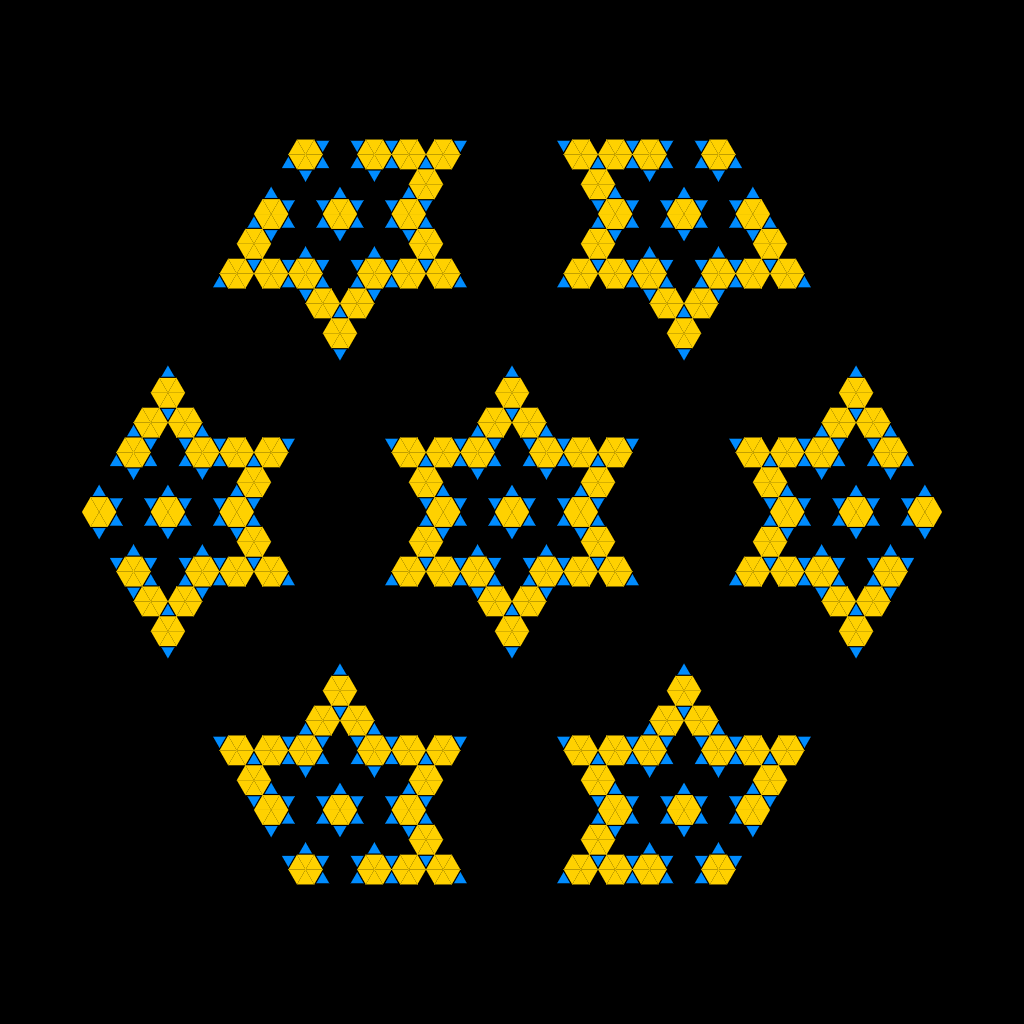
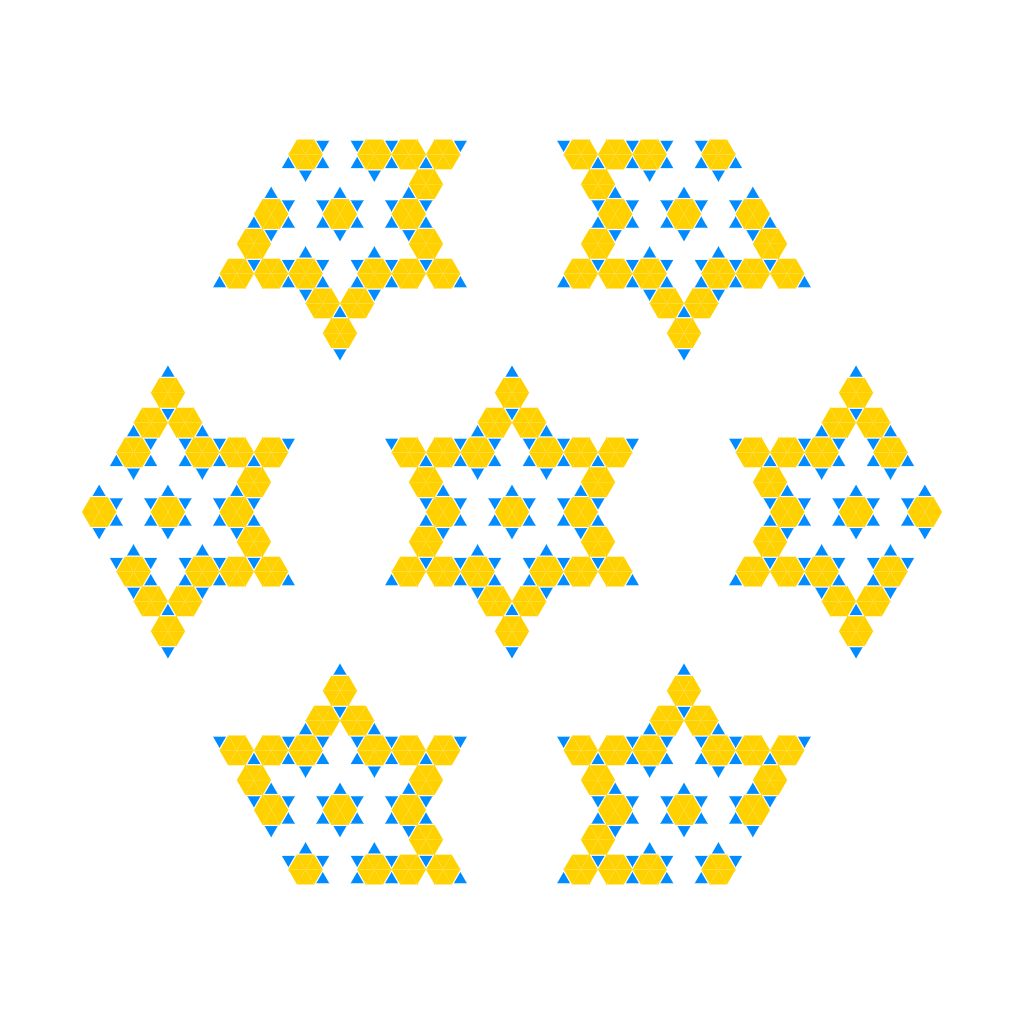
The diagonal slice of a cube fractal is a hexagon with a tile grammar. Everything published about that grammar stops at base 3; this page asks what happens at every other odd base.
- The base axis is the open thread. The dimension axis - the same
log(fill) / log(base) - 1comparison run alongdimat fixed base 3 - is settled and lives on the shelf. - The spectra demo draws the Laplacian of a design, its degenerate families and the slope that reads the spectral dimension.
- The modes demo lays a design's level-
Lmask over the torus, where every eigenvalue is a product ofLrescaled copies of the tile's own transform and the field of eigenvalues is a picture of the tile. - Every number on this page is regenerated by
lab/py/odd-base-slice-grammar, a raster-free digit recursion cross-checked against a direct layer census. What stays Conjecture is the grammar itself: a2x2map reproducing cell counts is weaker than a substitution acting on tiles, and only base 3 has the latter from a source.
WHAT IS KNOWN
Cited facts only.
- The cut is Perez-Duarte's. "Slice of Menger", showing "a very interesting pattern of stars and hexagons" (Flickr), credited directly by Abel.
- Hart popularised it in Mathematical Impressions, with a Scientific American mirror.
- Cook published working code, applying the base-3 digit predicate to a plane through the cube's centre (Cook 2011). Its prose says the normal runs to
(1, 1, 1)while the listing setsnormal = (1, 1, 0.5), so the published plane is not the centroid diagonal. - The substitution rule is Abel's, verbatim: "replace each hexagon with 6 hexagons and 6 triangles, and replace each triangle with 1 hexagon and 3 triangles". As a matrix on
(hexagons, triangles)that is[[6,1],[6,3]], trace 9, determinant 12. - The dimension is Abel's, and he states it as a computation rather than a proof: the slice dimension solves
3^x = (9+sqrt(33))/2, so it islog_3((9+sqrt(33))/2) = 1.8184, with the hedge "it takes a bit more work to turn the above computation into a full proof". - A299916 counts holes, not tiles. Its name is
a(n) = A299914(2n+1), offset 0, terms1, 6, 42, 306, 2250, 16578, 122202, signature(9,-12); the Menger reading is a comment on the entry, not the definition. That the two are the same object is Proved, by the hexagram bijection in cuts, and the index shift is load-bearing: the mesh-triangle census isA299916(n+1). - The two-tile move is published at base 3. Hocking's Bridges paper, resolved in REFS, treats the base-3 slice as a closed fractal family on a hexagon and a triangle, which is a directed-graph iterated function system under another name. What is unpublished is every other base.
- The nearest real theory looks elsewhere. Slice dimension is solved for almost every plane (Marstrand 1954, Mattila 1975); the centroid diagonal is a single maximally arithmetic plane, exactly the case those theorems exclude. So a plane landing off
log(fill) / log(base) - 1contradicts nothing and dodges no theorem. - The upstream is grey literature. A photograph, a video, three blog posts and an OEIS comment. Adjacent work does not close the gap: one generalisation runs along dimension, another changes the solid, and none touches base 5, 7 or 9.
THE CLAIM
- Conjecture. For every odd base, the centroid diagonal slice of the parity solid
bang dim 3, code 23is a graph-directed set on exactly two tiles, whose2x2integer substitution matrix is a fixed rational function ofbasewithin each class ofbase mod 4, and whose slice dimension sits abovelog(fill) / log(base) - 1whenbase = 3 mod 4and below it whenbase = 1 mod 4. - The method builds no raster. The plane
x + y + z = 3*base^level/2meets three diagonal layers and the coordinate sum splits assum_k base^k * sigma_kover independently chosen digit triples, so the tile census is a memoised digit recursion with nothing allocated. - The four rules. Verified by
lab/py/odd-base-slice-grammar; that they are tile grammars is the claim above. Two-term rulesx9 -12at base 3,x11 +62at 5,x42 -288at 7,x28 +693at 9, with dimensions1.8184 / 1.6869 / 1.8026 / 1.7204againstlog(fill) / log(base) - 1 = 1.7268 / 1.7304 / 1.7430 / 1.7544. - Their arithmetic is only self-consistent: each printed dimension is
log_baseof the dominant root of its own printed rule, so a wrong rule and its own wrong dimension agree by construction. - The base-3 rung is the one external target, and it passes. Verified. A cold census returns Abel's
[[6,1],[6,3]]and hexagons1, 6, 42, 306, 2250, 16578, 122202; the grammar cannot be fitted to that. - The matrices. Verified by
lab/py/odd-base-slice-grammar.[[7,3],[30,4]]at base 5,[[30,3],[24,12]]at 7,[[19,9],[96,9]]at 9, all non-negative, reproducing cell counts level after level. Counts obeying a fixed2x2map is weaker than a substitution acting on tiles, and only base 3 has the latter from a source. - The closed form. Verified at base 3..21 by
lab/py/odd-base-slice-grammar; every odd base is the claim above. On(hexagons, triangles):[[3(base+1)(3 base-1)/16, (base+1)(base+5)/32], [3(base+1)^2/8, 3(base+1)^2/16]]whenbase = 3 mod 4, and[[(3 base^2+6 base+7)/16, 3(base-1)(base+3)/32], [3(base-1)(3 base+5)/8, (base+3)^2/16]]whenbase = 1 mod 4. Both reproduce every census matrix at base 3..21. - What would falsify it. Any odd base whose slice needs a third tile symbol; any census breaking its own two-term recurrence past the fitted levels; any base where the mod-4 side is wrong.
- What a result would be worth. No candidate row returns an OEIS hit, and no paper treats the diagonal cross-section at any base but 3. A confirmed row at base 5 is new; an unconfirmed one is a number in a file.
OPEN QUESTIONS
- Which sponge is the sponge at a given base? Cook's predicate is "at most one coordinate in the middle third"; this page inherits "at most one odd coordinate" from
bang dim 3, code 23. The two agree at base 3 and nowhere else, and there is no canonical base-5 Menger sponge, so the whole generalisation rests on an unstated choice. - The choice is not cosmetic, and the two rules land on opposite sides. Verified. At base 5, dim 3 the middle-digit rule fills
112of125and its central diagonal slice sits ABOVElog(fill) / log(base) - 1, excess+2.888e-02, at slice dimension1.960651against1.931768; the odd-coordinate rule fills81of125and sits BELOW,1.6869against1.7304. No such claim at base 5 can be quoted without naming the rule. - Does the mod-4 split have a mechanism, or is it numerology? Conjecture. It holds at every odd base up to 401 by exact rational comparison in
lab/py/odd-base-slice-grammar, so it is not four data points. The candidate mechanism - the middle diagonal layer sits at coordinate sum3*(base-1)/2, odd exactly whenbase = 3 mod 4, forcing a different parity of cell into the middle layer in each class - is unwritten and unchecked. - The split is a property of the rule as well as the base. The mod-4 statement is about the odd-coordinate solid, and the middle-digit solid contradicts it at base 5. Any statement of it must pin base, dimension and digit rule before it means anything.
- Is the two-tile grammar geometric, or only arithmetic? Reproducing cell counts is weaker than a substitution acting on tiles, and no source supplies the latter past base 3.
- Does the base axis factor at all? cuts walks the dimension axis at fixed base 3 and has a theorem there: the order law, from a factorisation of the digit polynomial. The same three-step argument - digit polynomial, carry contraction, palindromic symmetry - is what the two-tile claim has never been given, and it is exactly the kind of statement that would decide the mod-4 split.
THE TENT IDENTITY
Law E's window length is a distance measured inside a slot, and that is an identity among Law E's own closed forms rather than a fact about the module. Every symbol below is lab/py/smith-window's and every number is regenerated there.
The objects
D = 2R + 1is odd withD >= 5, soR >= 2.Jis Jacobsthal:J(n) = 0forn < 0andJ(n) = (2^n - (-1)^n)/3otherwise, soJ(0) = 0,J(1) = J(2) = 1,J(3) = 3,J(4) = 5, withJ(n) = J(n-1) + 2 J(n-2)forn >= 2.bis the least integer with2^b >= 3R - 1, sob >= 3and2^(b-1) < 3R - 1 <= 2^b.g = |2R - 2^(b-1) - 1|is odd and at least1, ands = (g + 1)/2 >= 1is its half.e = min{e >= 1 : J(e) >= s}is the slot index andk = b - 1 - eits complement.- The window box is
i0 = max(2, 4R - 2^b)andhi = hi0 - (hi0 mod 2)withhi0 = floor((6R + 2 - 2^b)/3), andK = (hi - i0)/2is the top index of the familyX_0, ..., X_K, never its length. t = (J(k) - 1)/2, andc_tare theF_2Fibonacci polynomialsc_0 = 1,c_1 = 1 + y,c_t = y c_(t-1) + c_(t-2).N = J(e) - J(e-1)is the slot length,u = s - J(e-1) - 1the offset inside it, andp = uabove the octave centreR = 2^(b-2)whilep = N - 1 - uat or below it.C_D = K - 2 J(e-1)whenkis even andC_D = Kwhenkis odd is Law E's ceiling,W = C_D - t 2^eits offset,chi = 2 J(e-2) - 1fore >= 3andchi = 1otherwise,m = max(0, 2W - chi), andg_D = z^m c_t(z^(2^e))its generator.
The statement
- Proved. For every odd
D = 2R + 1 >= 5,min(p, N - 1 - p) = C_D - deg g_D. - The proof is exact arithmetic in
b, e, k, Rand uses no property ofV_2, only the formulas above.C_Dandg_Dare taken here as those closed forms and not as the measured ceiling and generator, so the theorem is an identity among Law E's formulas and says something aboutV_2only where Law E itself holds. - Law E is a swept law, Verified at 1199/1199 rows of odd
D = 5..2401bylab/py/smith-window, and the identity inherits that standing hypothesis. Against the formulas themselves it is a theorem, re-checked as a transcription at 999999/999999 rows of oddD = 5..2000001(lab/py/smith-window).
The proof
Throughout 3 J(n) = 2^n - (-1)^n, J(n) is odd for n >= 1, and J is nondecreasing on n >= 0.
- Lemma 1, no
e = 2.e = 2would needJ(1) < s <= J(2), that is1 < s <= 1, which is empty, soe = 1ore >= 3. - Lemma 2, the bracket.
J(e-1) < s <= J(e): the right inequality definese, the left is its minimality fore >= 2and reads0 < sate = 1. - Lemma 3, the box length.
K = J(b-2) - sin both octave halves: above centres = R - 2^(b-2)givesi0 = 4sandhi = 2s + J(b-1) + 1 - 2[b even], below or at centres = 2^(b-2) + 1 - Rgivesi0 = 2andhi = J(b-1) + 3 - 2s - 2[b even], both landing onK = (J(b-1) - (-1)^b)/2 - s, andJ(b-1) - (-1)^b = 2 J(b-2). - Lemma 4,
k >= 1. The defining bound3R - 1 <= 2^bgives3s <= 2^(b-2) + 1above centre and the minimality2^(b-1) < 3R - 1gives3s < 2^(b-2) + 2below, sos <= J(b-2)either way, henceK >= 0,e <= b - 2,k >= 1,J(k)odd andt >= 0an integer; Law E's standing hypothesisk >= 1is therefore a theorem. - Lemma 5, the collapse.
W = J(e) - swhetherkis even or odd: withb - 2 = k + e - 1andt 2^e = (J(k) - 1) 2^(e-1),3(J(b-2) - t 2^e) = (-1)^(k+e) + ((-1)^k + 3) 2^(e-1), which is3 J(e)forkodd, whereC_D = K, and3 J(e+1)forkeven, where the ceiling's-2 J(e-1)turnsJ(e+1) - 2 J(e-1)back intoJ(e); the ceiling deficit and the parity ofkcancel exactly. - Lemma 6, the slot. For
e >= 2,3(J(e) - J(e-1)) = 2^(e-1) - 2(-1)^e = 6 J(e-2), soN = 2 J(e-2)andchi = N - 1on the live rangee >= 3; ate = 1the slot isN = 1whilechi = 1, and that bridge fails. - Lemma 7, the reflection.
u + W = (s - J(e-1) - 1) + (J(e) - s) = N - 1with both terms nonnegative by Lemma 2, so{u, W} = {p, N - 1 - p}in both halves andmin(p, N - 1 - p) = min(W, N - 1 - W). - Lemma 8, parity.
p == R mod 2whenevere >= 3, since thenb >= 5makes2^(b-2)even andJ(e-1),J(e)are odd; it is sharp, failing exactly on thee = 1rows above centre,R = 2^(b-2) + 1, that is exactly onD = 2^j + 3forj >= 2. - The theorem.
deg c_t = t, becausey c_(t-1)has degreetagainstt - 2forc_(t-2), sodeg g_D = m + t 2^eandC_D - deg g_D = W - max(0, 2W - chi) = min(W, chi - W); by Lemma 1 three cases exhaust, ate >= 3Lemma 6 readschiasN - 1and Lemma 7 closes it, ate = 2there is nothing to prove, and ate = 1Lemma 2 forcess = 1, soW = u = p = 0andN = 1make both sides0.
What it buys
- Proved. The upper half of the layer-2 window law, that
z^(C_D - deg g_D + 1) g_Ddoes not lift, is free whereverC_D = K: every element ofV_2has coefficient degree at mostK, while that candidate has degreeC_D + 1whateverdeg g_Dis, so atC_D = Kit leaves the family outright. The tent identity is not used; the cut costs the ceiling law alone. - Proved. By the ceiling law
C_D = Kexactly whenkis odd ore = 1, andC_D < Kexactly whenkis even ande >= 3, where the deficit isK - C_D = 2 J(e-1) > 0. So the upper half is unconditional at every row withkodd ore = 1, and what stays open is the rows withkeven ande >= 3:448of the1199rows of oddD = 5..2401, and29116of99999over oddD = 5..200001(lab/py/smith-window). - Conjecture. At those open rows the family element of coefficient degree
C_D + 1has mod-4 obstruction outside the image of the mod-2 symbol on the same coefficient box, for a deficit of exactly2 J(e-1)steps. That is a rank statement about the corrector image, not arithmetic inb, e, k, R, and it is all that remains of the upper half. - Proved. Lemma 8's parity fails exactly on
D = 2^j + 3forj >= 2, rows carryingk = j - 1, so the reach law's escaping familyD = 4^m + 3is thekodd half of that set and nothing more:D = 11fails the parity and is not of that form. Why the reach law excepts that half and not thekeven rowsD = 11, 35, 131, ...is open.
WHERE THE REST LIVES
- The dimension axis at fixed base 3: the
ceil(dim/2)order law, the product formula over 3-adic angle towers, and the unconditional pinning|rho_dim - fill/3| <= 2(dim-1)/3are thecarlomitchener/research/slice-recurrence-orderlane. - The sign law in every even dimension at bases 3 and 5, the certificate machines, the transient constant
ln(R)/4, the tent rank law and the layer-2 window law are thecarlomitchener/research/slice-sign-even-halflane. - The layer-2 window itself - its generator
g_D, its ceilingC_D, the family shift law and the corrector law behind them - is regenerated bylab/py/smith-window. - So are the two statements that close the corrector law. The tent identity is proved above as arithmetic in
b, e, k, Ramong Law E's own closed forms, so only the reach lawreach = R - jmax = 3 min(p, N - 1 - p) + 2 [e even] + [k odd](1 + p mod 2)is still read off a sweep, with one row per odd octave escaping it atD = 4^m + 3. - Off those escaping rows
floor(reach/3) = C_D - deg g_D + [k odd and e even]; on them it reads1againstC_D - deg g_D = K - deg g_D = 0, somin(K - deg g_D, floor(reach/3)) = C_D - deg g_Dat every row and the corrector law's statement reads off(b, e, k, R)with no span test in it. The deduction behind it still carries one. - The carry matrix
M_evenis defined once, in cuts, and is not redefined here. - The hexagram bijection and the mesh census: cuts. The hexagon mesh itself: slices. The fill polynomial of
bang dim 3, code 23: method. - Every finding on a tagged line: DISCOVERIES. Every source resolved: REFS.