Menger Diagonal Slices: A Recurrence of Order ⌈D/2⌉
MrlyProd
First published 2026-08-23, revised 2026-09-08
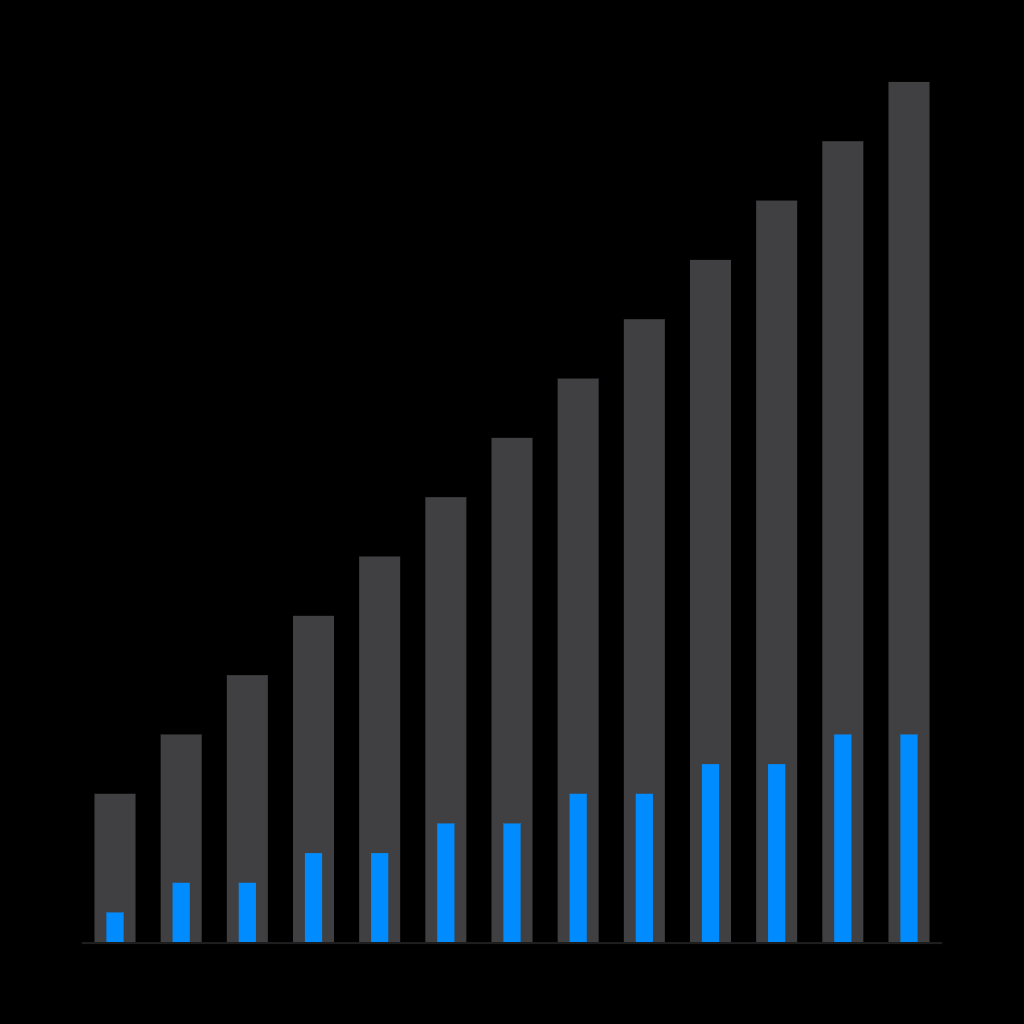
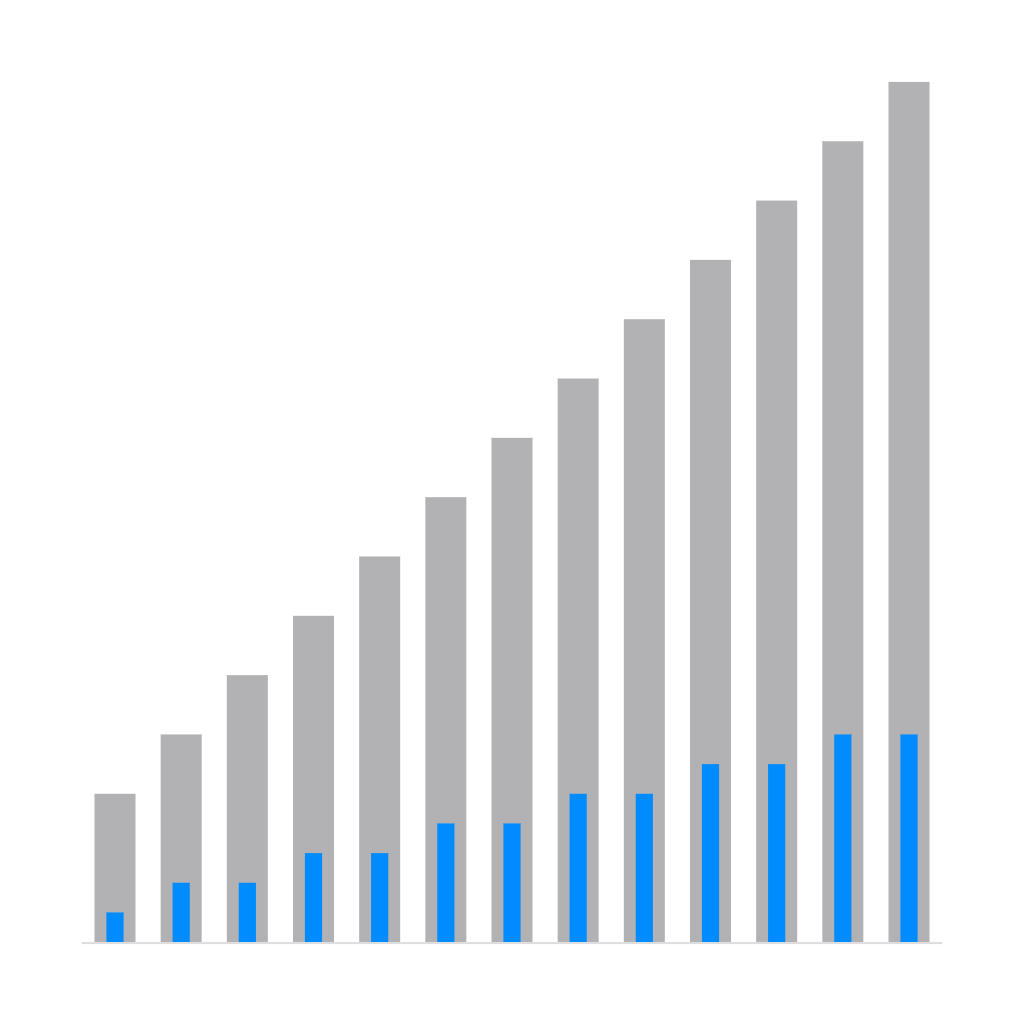
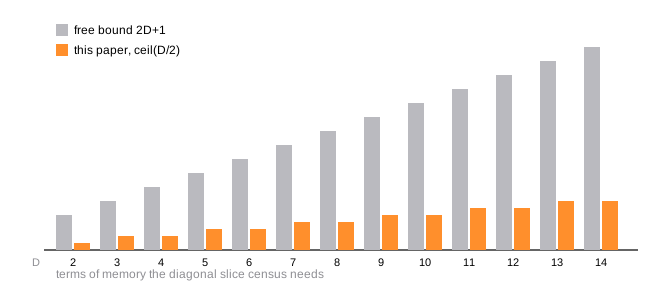
Slice a Menger sponge along its main diagonal, count the cubes the cut meets, and repeat in every dimension. The counts are not arbitrary: each one is decided by the few before it. A carry automaton with a contraction and a reflection shows that in dimension only previous terms are ever needed - about a quarter of the that the standard construction hands you for free. At the machine returns the published spectrum of the hexagon-triangle substitution without ever seeing a hexagon.
Keep the cells of the base-3 grid whose digit vector has at most one coordinate equal to the middle digit ; that is the -dimensional Menger analog. Let count the cells of its level- approximation that meet the central diagonal hyperplane .
Theorem. For every , satisfies a linear recurrence with constant integer coefficients of order at most , namely the one given by the characteristic polynomial of the carry matrix .
Theorem. At every odd with , the dominant root of that polynomial sits strictly above : the counting exponent of the slice exceeds the solid's dimension minus one. The engine is an exact product formula, over the 3-adic angle towers , whose every term ends in the parity factor ; at odd the integrand is pointwise nonnegative and the census cannot fall below . The even half of the sign law, and the residue class beyond , remained conjectural when this paper was written, and it records exactly why the even side is harder. The even half has since been proved, at base 3 and base 5, in slice-sign-even-half; the residue class is still open.
Theorem. Unconditionally, : the slice exponent converges to the generic Marstrand-Mattila value in every dimension, and only the side of the approach is still open. Exactly, with the Perron carry vector's mass on carries divisible by 3, so the entire sign law is the parity-free statement .
The proof is three moves: the digit polynomial factors as , the carry map contracts onto , and the palindromic symmetry halves that set. Exactness of the order is verified, not proved: the exact rational Hankel determinant is nonzero for , starting . The script re-derives the matrix , its polynomial , and the census - which is A299916 - along with the ladder and the traces and .