The Component Exponent of a Two-Letter Kronecker Word
MrlyProd
First published 2026-09-02, revised 2026-09-08
Nest one small black-and-white pattern inside another, then inside a third, and keep going forever, picking at each step one of two patterns according to an infinite word. Count the connected pieces after steps. The count depends on the order of the word, which is what the companion paper is about; this one asks whether the growth rate of the count does. It does not. We write down an exact formula for the piece count on every one of the two-letter alphabets over the fifteen nonempty two-by-two designs, and the rate falls out: whenever both letters occur with positive frequency it exists, sees nothing but the two frequencies, and on of the alphabets it is just the growth rate of the black-cell count, which never cared about the order in the first place. So the hoped-for payoff, an aperiodic word beating a periodic one, is not there, and the paper says so.
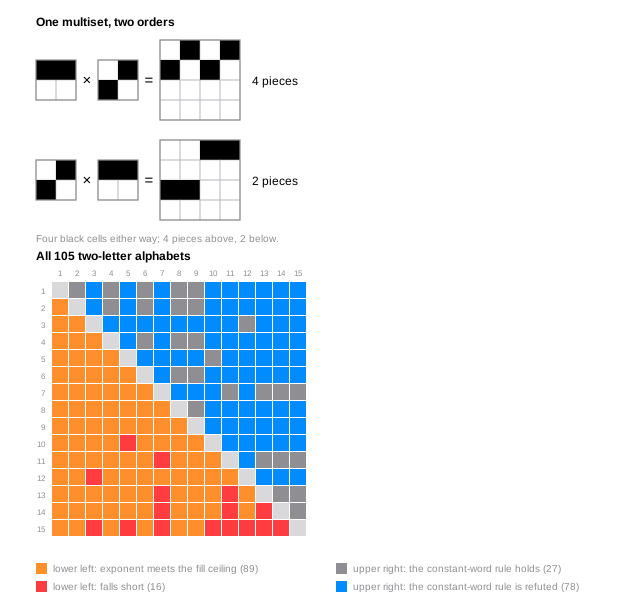
A design is a two-by-two square with some cells filled, coded to . A word gives the picture , outermost factor first, with black cells and four-connected pieces.
Theorem. Let be an infinite word over one of the alphabets whose letter frequencies exist and are strictly positive. Then exists and depends only on the frequency vector, so it is blind to the order. It equals the fill exponent on of the alphabets and falls short on ; the constant-word rule is refuted on and exact on ; and along the Thue-Morse word over any gasket-and-domino alphabet, exactly, with the two-sided certificate at every .
Five regimes close all alphabets and six geometric lemmas prove them: a contact-free letter cuts the word and turns the piece count into a prefix cell count ( alphabets), two letters that never break apart give one piece (), two dominoes at right angles give a power of two (), a row-block argument handles a domino against the full tile (), and a domino letter turns the count into a count of runs whose recursion telescopes (). The positive-frequency hypothesis is load-bearing and the paper proves it sharp: at a boundary frequency three words with the same letter frequencies have rates , , and no rate at all, the last one accumulating on a whole interval. python3 scripts/verify.py re-checks every number in about fifteen seconds: the closed forms against an independently drawn picture on all words of length at most over all alphabets, the four verdict counts re-derived alphabet by alphabet, the Thue-Morse certificate at every length up to in both readings, and the boundary and tripling words that mark the limits of the theorem.
- paper.pdf - the paper.
tectonic paper.texrebuilds it;python3 scripts/verify.pyre-checks every number;python3 scripts/figure.pyredraws both plates.