The stack is an RH-observable
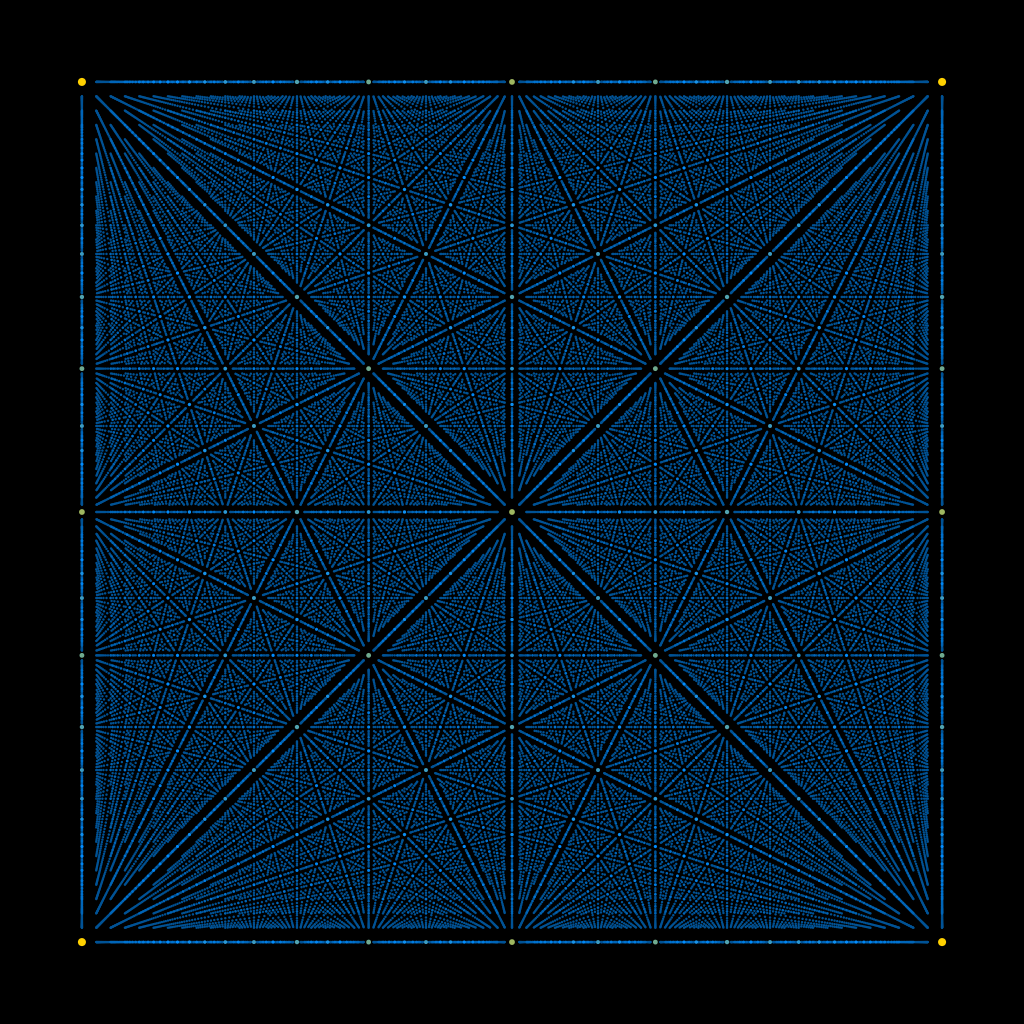
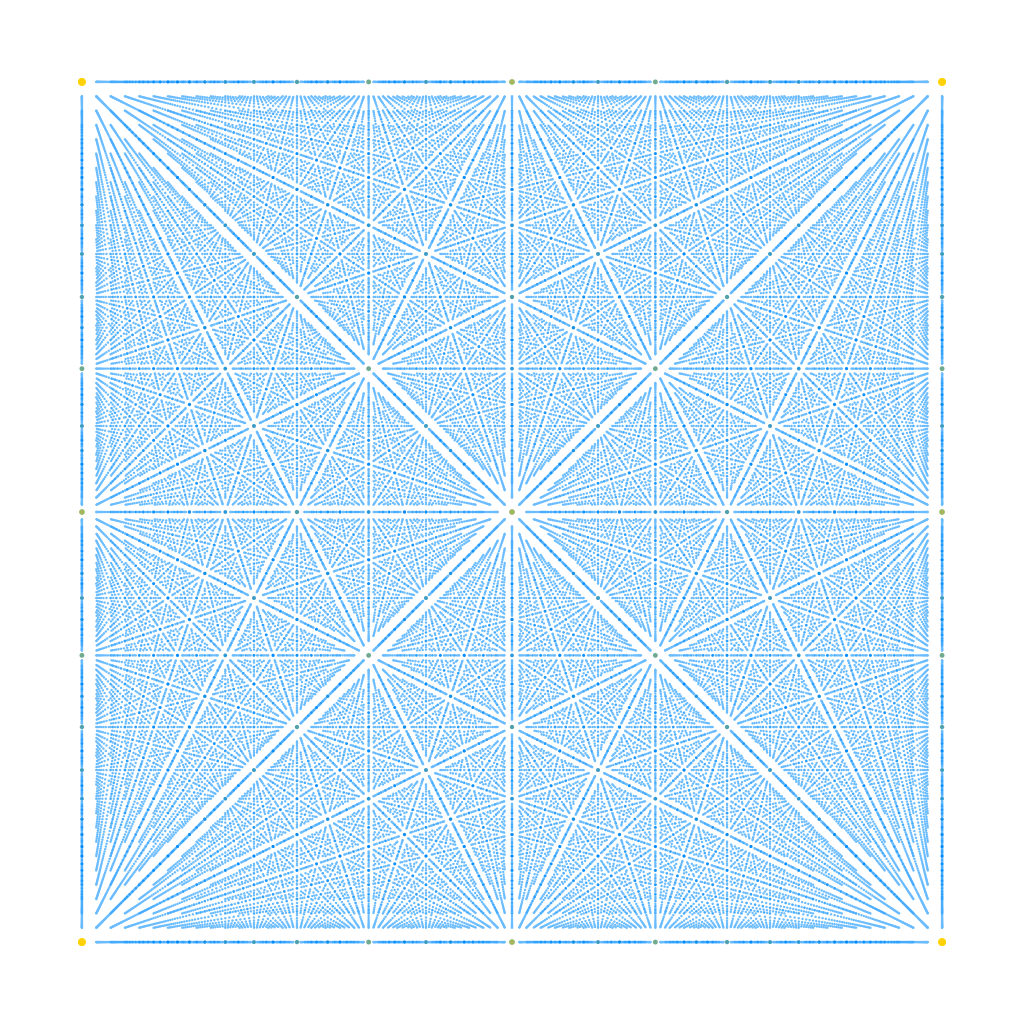
Lay the same fractal grid on the unit square at many scales at once - scale n puts its cell boundaries at x = k/n - drop the opacity and add the layers up. The result is a moire, and a bright point is one that many scales agree on. The question this page answers is what the bright points are, and the answer is not decorative: the lit nodes are the Farey fractions, the amount of new structure each scale contributes is Euler's totient phi(n), and how evenly those nodes spread is - by a pair of theorems from 1924 - literally equivalent to the Riemann hypothesis.
Every claim below carries a tag. Proved means derived here from definitions. Verified means recomputed from scratch, or checked against the published literature. Conjecture marks a reading the tables support and no proof reaches, Refuted a claim this page kills. The Farey sequence page builds the stack scale by scale, lights the Farey fractions, and shows phi(n) novelty peaking at the primes.
Where the lines land
Stack the scales n = 1..N. A point a/b in lowest terms receives a grid line from exactly the scales that are multiples of b, so over 1..N its brightness is floor(N/b). Proved, and Verified by direct simulation at N = 30: building the stack node by node and comparing every node's hit count against floor(30/b) gives no mismatch anywhere (lab/rs/farey-discrepancy).
Brightness therefore falls as one over the denominator, which is the Stern-Brocot ordering of the rationals. The top of the table at N = 30:
| node | brightness | floor(30/b) |
|---|---|---|
0, 1 | 30 | 30 |
1/2 | 15 | 15 |
1/3, 2/3 | 10 | 10 |
1/4, 3/4 | 7 | 7 |
1/5 ... | 6 | 6 |
The lit nodes are also exactly the lattice points visible from the origin, since a/b is in lowest terms precisely when gcd(a,b) = 1. That is the "lighthouse" reading of the picture. Proved. The density of visible points is 6/pi^2 - the same constant, and the same base-blindness, discussed in what base 3 hides, where it is measured as 0.608042 on a 3000 x 3000 grid. Verified, by recounting that grid.
Those same points draw two further pictures of the one node set. The sunburst is the visible lattice points themselves, the (a, b) with gcd(a, b) = 1 and abs a, abs b <= n, joined in angular order into a closed polygon, which reads the lit set as directions rather than as points of the line. The resonance diagram is the spike profile, a spike at the node a/b of height 1/b. The stack is that diagram up to the floor. Proved, from the brightness law: normalising gives the node a/b the height floor(Q/b)/Q, which lies in (1/b - 1/Q, 1/b] at every depth and equals 1/b exactly when b divides Q (lab/rs/farey-discrepancy).
Primes are the maximally novel scales
The nodes scale n introduces for the first time are the fractions a/n with gcd(a,n) = 1, since any a/n that reduces was already lit by the smaller scale it reduces to. There are exactly phi(n) of them. Proved, and Verified by set difference over the stack for n = 2..30:
n    2 3 4 5 6 7 8 9 10 11 12 13 14 15 16
new   1 2 2 4 2 6 4 6 4 10 4 12 6 8 8

n   17 18 19 20 21 22 23 24 25 26 27 28 29 30
new  16 6 18 8 12 10 22 8 20 12 18 12 28 8
Every count equals phi(n), and the running maxima 1, 2, 4, 6, 10, 12, 16, 18, 22, 28 occur at n = 2, 3, 5, 7, 11, 13, 17, 19, 23, 29. The reason is one line: phi(n) = n - 1 if and only if n is prime, because every one of 1..n-1 is coprime to n exactly when n has no smaller factor. Proved.
So primality is readable off the picture. Stack 1..n-1, then add scale n, and count what appeared: n - 1 new nodes means n is prime, fewer means composite. Proved (it is the previous claim restated). A composite scale mostly re-lights nodes its own divisors already drew - scale 30 adds only 8 new lines, the rest of its grid falling on lines from 1, 2, 3, 5, 6, 10 and 15.
Franel and Landau, 1924
Over scales 1..Q the stack lights exactly the reduced fractions of denominator at most Q: the Farey sequence F_Q. Its size in (0,1] is m = sum_{k<=Q} phi(k). Proved, and Verified by generating F_Q through the next-term recurrence and comparing its length with the totient sum at Q = 10, 30, 60 (lab/rs/farey-discrepancy, which runs the same comparison at Q = 10, 30, 60, 125).
Write rho_1 < ... < rho_m for those nodes and delta_j = rho_j - j/m for how far each one sits from perfect equidistribution. Then:
- Franel (1924) proved that
sum_j delta_j^2 = O(Q^(-1+eps))for everyeps > 0is equivalent to the Riemann hypothesis. - Landau (1924), in a note published immediately after Franel's, proved the same for
sum_j |delta_j| = O(Q^(1/2+eps)).
Verified against the literature: both statements, with the original 1924 citations to the Göttingen Nachrichten, are the standard Franel-Landau formulation, and are reproduced in Edwards, Riemann's Zeta Function, chapter 12.
Put the two halves together. The nodes whose discrepancy Franel and Landau are talking about are the nodes the stack draws - not an analogue of them, the same set. So the question "how evenly are the bright points spread?" is not related to the Riemann hypothesis; at this level of precision it is the Riemann hypothesis. Proved, given the identification above, which is what the first two sections establish.
The meter reads what RH predicts
Both sums are computable. Generating F_Q exactly and measuring, with S2 = sum delta_j^2 and S1 = sum |delta_j|:
Q | nodes | S2*Q | S1/sqrt(Q) | local exponent of S2 |
|---|---|---|---|---|
| 125 | 4796 | 0.5395 | 0.2040 | - |
| 250 | 19024 | 0.5848 | 0.1942 | -0.884 |
| 500 | 76116 | 0.6241 | 0.1852 | -0.906 |
| 1000 | 304192 | 0.6387 | 0.1634 | -0.967 |
| 2000 | 1216588 | 0.6560 | 0.1512 | -0.961 |
| 4000 | 4863602 | 0.6538 | 0.1314 | -1.005 |
| 8000 | 19455782 | 0.6564 | 0.1123 | -0.994 |
Verified by lab/rs/farey-discrepancy. S2*Q flattens near 0.656 and the local exponent walks to -1, which is the Franel condition; S1 stays under its Q^(1/2) envelope and its own local exponent runs between 0.27 and 0.43, under the Landau threshold of 0.5. The node count matches sum phi(k) exactly at every rung, which is the control that says the object being measured really is the stack's node set.
The meter on a digit design
A digit design S_F is the set of whole numbers whose every digit lies in a digit set F, of dimension alpha = log |F| / log base. Restricting the meter to one needs a convention, and the strict one is taken here: F_Q(S_F) is the set of reduced fractions a/b with 0 < a <= b <= Q and both a and b in S_F. The weaker denominator convention - b in S_F, a free - is measured beside it, and the unrestricted F_Q is the control. Neither is a set the stack produces: Farey order is the stack still holds and every design gives the same stack at fixed Q, so F_Q(S_F) is a filter laid over the stack's nodes by hand, and all that is at stake is what the Franel-Landau functional reads on it. No Mobius sum appears anywhere in this section, so nothing in it bears on the square-root conjecture of mobius, whose theta(F) is a Mertens exponent and belongs to that page alone; the exponents here are called e_2 and e_1 and are this section's own.
Each convention carries a count that never enumerates a fraction. The denominator convention has card = sum_{b in S_F, b <= Q} phi(b). The strict one has card = sum_{b in S_F, b <= Q} phi_F(b) with phi_F(b) = #{a in S_F : a <= b, gcd(a,b) = 1} = sum_{d | b} mu(d) * #{multiples of d in S_F up to b}, inclusion-exclusion over the divisors of b. Proved. Both are sieved independently of the enumeration and match it at every rung of every table below, which is the control that says the object measured is the object defined; the largest check is 9538759028 nodes on the base 3 control at Q = 3^11. Verified by lab/rs/farey-discrepancy design.
Rungs are powers of the base, so the design's set is self-similar at every rung. Every exponent below is one ratio between consecutive rungs, e_2 = ln(S2(Q')/S2(Q)) / ln(Q'/Q) and e_1 the same for S1, and nothing is fitted.
Write D_Q = #{b in S_F : b <= Q} ~ Q^alpha for the denominators the design supplies and card F_Q(S_F) ~ Q^e for the nodes. Square-root cancellation in the denominators is a node-count error of order sqrt(D_Q), which puts e_2 at alpha - e, and Cauchy-Schwarz on S1 <= sqrt(card * S2) then caps e_1 at alpha/2. Franel and Landau are this pair at alpha = 1, e = 2: e_2 <= -1 and e_1 <= 1/2, both under RH, both caps on a limsup and never values. The control misses them freely at a single rung - its e_2 wanders from -0.463 to -1.017 and its e_1 from +0.236 to +0.673 across the base 3 ladder - so a lane sitting off a cap at one rung shows nothing by itself. The ladders run to Q = 3^11 = 177147 and Q = 10^5, each with its own control, and the top rung reads:
| set | convention | alpha | e | exp card | alpha - e | e_2 | alpha/2 | e_1 |
|---|---|---|---|---|---|---|---|---|
base 3 {0,1} | strict | 0.631 | 1.262 | +1.263 | -0.631 | +1.259 | 0.315 | +1.262 |
base 3 {0,1} | denominator | 0.631 | 1.631 | +1.631 | -1.000 | -0.959 | 0.315 | +0.336 |
full set to 3^11 | control | 1.000 | 2.000 | +2.000 | -1.000 | -1.017 | 0.500 | +0.236 |
| base 10 without 9 | strict | 0.954 | 1.908 | +1.908 | -0.954 | +1.904 | 0.477 | +1.906 |
| base 10 without 9 | denominator | 0.954 | 1.954 | +1.954 | -1.000 | -0.899 | 0.477 | +0.585 |
full set to 10^5 | control | 1.000 | 2.000 | +2.000 | -1.000 | -1.000 | 0.500 | +0.347 |
The denominator lanes sit in the control's own band and the strict lanes sit on the mass. Verified. Both denominator rows put e_2 at -0.959 and -0.899 against alpha - e = -1.000 and e_1 at +0.336 and +0.585 against caps of 0.315 and 0.477, every one of the four inside the range the control walks. Both strict rows instead put e_2 and e_1 on exp card itself, agreeing with it to two decimals: +1.259 and +1.262 against +1.263, +1.904 and +1.906 against +1.908. Sums that ride the mass are sums with no cancellation at all, and the normalised readings settle:
| set | Q | card | S1/card | S2/card | widest gap |
|---|---|---|---|---|---|
base 3 {0,1} | 2187 | 4286 | 9.4258e-2 | 1.3307e-2 | 0.16720 |
base 3 {0,1} | 6561 | 17069 | 9.3888e-2 | 1.3100e-2 | 0.16684 |
base 3 {0,1} | 19683 | 67561 | 9.4171e-2 | 1.3170e-2 | 0.16673 |
base 3 {0,1} | 59049 | 269750 | 9.4171e-2 | 1.3147e-2 | 0.16669 |
base 3 {0,1} | 177147 | 1080458 | 9.4057e-2 | 1.3086e-2 | 0.16667 |
| base 10 without 9 | 1000 | 147096 | 5.6111e-3 | 4.1767e-5 | 0.00113 |
| base 10 without 9 | 10000 | 11890654 | 5.2424e-3 | 3.6501e-5 | 0.00011 |
| base 10 without 9 | 100000 | 963170938 | 5.2125e-3 | 3.6159e-5 | 0.00001 |
The strict lane holds those constants from Q = 2187 at base 3 {0,1}, card running 4286 to 1080458, and from Q = 10000 at base 10 without 9, card running 11890654 to 963170938: two figures of S1/card and of S2/card fixed across each span, and no more of either claimed, the base 10 rung below moving the first figure of S2/card from 4.1e-5. Verified.
At base 3 {0,1} the last column names an exact interval, a sixth of the line. Proved. If b has its leading base 3 digit at position level then 3^level <= b <= (3^(level+1) - 1)/2. A numerator whose own leading digit sits at level gives a/b >= 2 * 3^level/(3^(level+1) - 1) > 2/3; one whose leading digit sits at level - 1 or below gives a <= (3^level - 1)/2 < b/2, so a/b < 1/2. The closed interval [1/2, 2/3] is therefore empty in F_Q(S_F) at every Q, and a set that misses a fixed interval of positive length does not equidistribute. The widest gap the meter finds contains that interval at every finite Q and shrinks onto it from outside, reading 0.16827, 0.16720, 0.16684, 0.16673, 0.16669, 0.16667 at Q = 3^6 .. 3^11 and starting at 0.49931, 0.49977, 0.49992, 0.49997, 0.49999, 0.50000.
Base 10 without 9 has no gap to argue from. Conjecture. Its widest gap falls like 1/Q, reading 0.01136, 0.00113, 0.00011, 0.00001 at Q = 10^2 .. 10^5 against the control's 0.01000, 0.00100, 0.00010, 0.00001 on the same rungs, so the strict set there is as fine-grained as the full Farey sequence and the base 3 argument does not transfer. That it fails to equidistribute rests on the settled constants alone, which is a reading and not a proof.
The denominator convention keeps the transplanted shape. Conjecture. Restricting the denominator moves the mass from Q^2 to Q^(1+alpha) and the count error from sqrt(Q) to sqrt(D_Q) = Q^(alpha/2), and the two moves cancel in S2: S2*Q reads 0.8926 at base 3 {0,1} and 0.8536 at base 10 without 9 against the control's 0.6782 and 0.6684 at the same top rungs, a constant factor and not a rate. The transplanted Landau reading S1/Q^(alpha/2) is flat where the control's S1/sqrt(Q) is falling, at 0.243, 0.281, 0.267, 0.268, 0.274 for Q = 3^7 .. 3^11 and 0.213, 0.222, 0.207, 0.265 for Q = 10^2 .. 10^5. So the conjecture is S2 = O(Q^(-1+eps)) and S1 = O(Q^(alpha/2+eps)) on the thinner set. Normalising against the node count instead would demand e_2 = -(1+alpha)/2, which is the wrong yardstick: it agrees with alpha - e on the control only through the accident sqrt(Q) = card^(1/4) at e = 2, and the denominator lane is not beating a shape by missing it.
The honest cap below covers this section too. Nothing here reaches further than the meter above it. What it adds is negative and clean: digit restriction of the denominator is invisible to the shape, and digit restriction of both coordinates destroys equidistribution outright at base 3 {0,1} and appears to at base 10 without 9. The denominator lane's invisibility is measured here and priced in the section below, where its exponential sum turns out to have a closed form in Mobius sums.
The restricted Franel identity
The denominator convention has a Mobius face that the strict one does not, and writing it needs a second symbol: F_Q(S_F) stays the strict set of the section above, and F_Q^d(S_F) = {a/b reduced : b in S_F, b <= Q, 1 <= a <= b} is the denominator set throughout this section. Its node count is m_F(Q) = sum_{b in S_F, b <= Q} phi(b), its nodes ascending are rho_1 < ... < rho_m with delta_j = rho_j - j/m_F(Q) exactly as above, and its exponential sums are S_F(k, Q) = sum_{r in F_Q^d(S_F)} e(kr) with e(x) = exp(2 pi i x). What those sums produce is a family of Mobius sums the full set never separates: the dilated Mertens sums M_F(x; d) = sum_{c <= x, dc in S_F} mu(c), the Mertens function of the dilate d^(-1) S_F = {c : dc in S_F}. At d = 1 it is the design's own meter M_F(x) = sum_{n in S_F, n <= x} mu(n) from mobius; at d > 1 it is a new function and not a rescaling of the old one, since d^(-1) S_F is not S_F, is not a digit design and carries no digit test. On the full set every dilate is the whole of Z and all of them collapse to M.
At frequency m the denominator set's exponential sum is S_F(m, Q) = sum_{d | m} d M_F(Q/d; d), and at m = 1 it is exactly M_F(Q). Proved, in three steps. Partition by denominator, so S_F(m, Q) = sum_{b in S_F, b <= Q} c_b(m) with c_b(m) = sum_{a mod b, gcd(a,b) = 1} e(ma/b) Ramanujan's sum, which depends on b alone and knows nothing of the design; substitute Kluyver's formula c_b(m) = sum_{d | gcd(m,b)} d mu(b/d); exchange the two sums and write b = dc, which turns the inner one into M_F(Q/d; d). Frequency 1 needs no Ramanujan input at all, sum_{a mod b, gcd(a,b) = 1} e(a/b) = sum_{d | b} mu(d) sum_{c mod b/d} e(c/(b/d)) = mu(b), the complete inner sum vanishing unless b/d = 1. Verified: every denominator b in S_F up to Q = 10^5 at base 3 {0,1}, and up to Q = 10^4 at base 10 without 9 and on the control, has its literal sum of phi(b) roots of unity equal to mu(b), worst deviation 1.09e-11 at b = 86293 on the first design and 1.36e-12 at b = 7247 on the second, with 0 denominators rounding to the wrong integer anywhere; the Q = 10^5 rung at base 10 without 9 costs 2.6e9 roots of unity, past the machine budget, so it is not walked and nothing is claimed at it. The frequency-m formula is exact against the literal sum at m = 1, 2, 3, 4, 5, 6, 12 on both designs and the control (lab/py/restricted-franel).
Squaring that against the Franel weight gives the identity in two forms, both exact. Write G_F(Q) = sum_{d, e >= 1} (gcd(d,e)^2/(d e)) M_F(Q/d; d) M_F(Q/e; e), a finite sum of exact rationals, every term with d > Q or e > Q vanishing. The Fourier form is sum_{k != 0} |S_F(k, Q)|^2/k^2 = (pi^2/3) G_F(Q). Proved: substitute the frequency-m sum, expand the square and exchange, so for fixed d, e the inner sum is sum_{k != 0, lcm(d,e) | k} k^(-2) = 2 zeta(2)/lcm(d,e)^2, and d e/lcm(d,e)^2 = gcd(d,e)^2/(d e). The rank form is G_F(Q) - 1 = 12 m_F(Q) sum_j delta_j^2, under a top node of 1 and the mean value sum_r rho_r = (m_F(Q) + 1)/2. Proved, by Parseval on the sawtooth and piecewise integration of (A(v) - m_F(Q) v)^2 between consecutive nodes, the two boundary cubes vanishing because the top node is 1. That mean value is the whole surviving hypothesis, and closure under r -> 1 - r away from the node 1 is one sufficient condition for it: the denominator set has that closure, since a/b reduced with b in S_F gives (b-a)/b reduced with the same b and a = b only at the node 1, and every proper strict set fails it. The kernel gcd(d,e)^2/(d e) is the Smith gcd matrix that already carries the moire correlation law of the stack and the same identity one field up, so digit restriction moves the entries and never the kernel. Verified as an identity of exact rationals at base 3 {0,1} Q = 81 and Q = 243, base 10 without 9 Q = 40 and the control Q = 40, true at all four, the Fourier side truncated at |k| <= 200000 landing inside its printed tail bound 2 m_F(Q)^2/K at each; the control at Q = 40 regenerates Edwards section 12.2, m = 490 and sum_j delta_j^2 = 0.0104270117 giving G_F(40) = 62.310829 (lab/py/restricted-franel).
Dropping every term but k = 1 and k = -1 from a sum of nonnegative terms carries the meter back out: 2 M_F(Q)^2 <= (pi^2/3) G_F(Q) = 4 pi^2 m_F(Q) sum_j delta_j^2 + pi^2/3. Proved, and the factor pi^2/3 is load-bearing rather than decorative: the weaker-looking 2 M_F(Q)^2 <= G_F(Q) is false, 2 M(5)^2 = 8 standing against G(5) = 64/15 at the control Q = 5 and 18 against G_F(37) = 14.230517 at base 3 {0,1} Q = 37. Verified at every integer Q rather than at a sample, both sides stepping only at Q in S_F so that scanning S_F covers every Q below the bound: 0 violations over Q <= 2187 at base 3 {0,1} and Q <= 400 at base 10 without 9 and on the control. The ratio 2 M_F(Q)^2/((pi^2/3) G_F(Q)) peaks at 0.607927 at the trivial Q = 1 on all three, and over Q >= 100 its maximum is 0.340071 at Q = 253 on base 3 {0,1}, 0.137645 at Q = 221 on base 10 without 9 and 0.086385 at Q = 114 on the control (lab/py/restricted-franel).
What the inequality buys is a ceiling, and it is bought with the conjectured exponent and never the measured one. A_F(Q) = #{n in S_F : n <= Q} << Q^alpha is the block count |F|^level at Q = base^level, with a constant depending on the design alone, so m_F(Q) <= Q A_F(Q) << Q^(1+alpha); the denominator lane's conjecture sum_j delta_j^2 = O(Q^(-1+eps)) above then gives G_F(Q) = O(Q^(alpha+eps)) through the rank form, and the inequality gives |M_F(Q)| = O(Q^(alpha/2+eps)), the square-root ceiling for the design's Mertens meter on mobius, the constant pi^2/3 absorbed and no unproved input entering. Proved. The measured exponent does none of this: e_2 reads -0.959 and -0.899 at the top rungs of the table above with S2*Q still climbing there, and a proof of only S2 = O(Q^(-0.9)) would give |M_F(Q)| = O(Q^((alpha+0.1)/2)) and no ceiling at all. The converse needs the whole k sum controlled from Mertens bounds, hence the dilated sums M_F(x; d) at d > 1, and the three paragraphs below settle everything about those sums except cancellation. So digit restriction of the denominator is invisible to the shape and expensive to prove, and nothing here is evidence for the conjecture it runs from.
The dilates are regular languages, and their automaton is long multiplication. Read c in its base from the least significant digit; multiplying by d carries a value r that never reaches d, since floor((d(base-1) + d - 1)/base) = d - 1, so the d carries are the states of a deterministic automaton: from carry r the digit e writes the output digit (de + r) mod base, which must lie in F, and moves to the carry floor((de + r)/base). After level digits dc is the level output digits with the terminal carry r_level written above them, so the run accepts exactly when r_level lies in Acc_d = {0} union (S_F intersect [1, d)), a set of size A_F(d-1) + 1. Proved for a design carrying the digit 0, and it says the dilated Mertens sums run over regular sets rather than over digit designs. The hypothesis is load-bearing rather than cosmetic: without 0 in F the run tests every one of the level padded output digits, and a leading output digit 0 is not a digit of dc, so the automaton recognises the padded set of mobius instead. At base 3 with F = {1,2}, d = 1 and level = 3 it reads 8 where the true count is 14, which is what A_F(base^level) = (|F|^(level+1) - |F|)/(|F|-1) gives there, and over bases 3, 4 and 5, every F, every d <= 6 and every level <= 5 there are 0 mismatches in the 840 cases carrying 0 and 399 in the 750 without it. Its transfer matrix is T_d(r, r') = #{e < base : (de + r) mod base in F, floor((de + r)/base) = r'}, with #{c < base^level : dc in S_F} = e_0 T_d^level 1_(Acc_d) under the same hypothesis, and every column of T_d sums to exactly |F|, in every base, at every digit set and every d, with no hypothesis at all. Proved: the pairs (e, r) in [0, base) x [0, d) are in bijection with v = de + r in [0, d base) by the division algorithm, the column at r' counts the v with v - base r' in F, and the window [base r', base r' + base) lies inside [0, d base) for every r' < d. The all-ones vector is therefore a positive left eigenvector and the spectral radius of T_d is |F| for every d: a dilate carries the design's own mass exponent as its Perron root. The rows sum to g times #(F intersect (r + gZ)) with g = gcd(d, base), so they equal |F| whenever gcd(d, base) = 1, and there #{c < base^level : dc in S_F} <= |F|^level with constant 1, again for a design carrying 0. Verified: over d <= 64 on base 3 {0,1} and base 10 without 9 no column is off |F|, rows are off |F| at 21 and 38 of the 64 and every one of those d shares a factor with the base, and at base 3 {0,1} with d = 2 the matrix [[1,1],[1,1]] with both carries accepting counts 2^level - 1 against literal enumeration of {c : 2c in S_F} at every level <= 12, both reading 4095 at x = 3^12 = 531441 (lab/py/restricted-franel). One dilate is free: if 0 in F then M_F(x; base^j d) = M_F(x; d), since appending zero digits neither enters nor leaves S_F, so at base 3 {0,1} the d = 3 column is the d = 1 column, M_F(3^12; 3) = 56 with peak 61. Proved, and it is the lever that fixes the rate below.
What the matrix replaces is the digit symbol. The transform of a dilate is sum of e(ct) over c < base^level with dc in S_F, and decomposing over automaton paths gives e_0 M(t) M(base t) ... M(base^(level-1) t) 1_(Acc_d) with M(t)(r, r') = sum of e(et) over the digits e carrying r to r', and M(0) = T_d. Proved, for a design carrying 0, with the count identity above. That is the Mobius page's ladder prod_j g_F(base^j t) with the scalar symbol replaced by a matrix, and the replacement is what the route costs: an ordered product of non-commuting matrices does not factor, so the sup-over-shift l^1 exponent that carries a Type I estimate for a digit design has no scalar analogue on a dilate. The matrix form gives the exact count at t = 0, the exact mass constant, and exact evaluation at any t; it gives no cancellation in mu, and the Type II wall stands where it stands at d = 1. The mass constant it gives is the accepting set, and the exact hypothesis for that is a second coprimality. Write Delta_F for the gcd of the differences of the digits in F. For gcd(d, base) = 1 both sums make T_d/|F| doubly stochastic, so the stationary law is uniform on each closed class, and where the carry chain is irreducible A_d(base^level)/|F|^level converges to #Acc_d/d = (A_F(d-1) + 1)/d, which is O(d^(alpha-1)) and is exactly the saving a level of distribution for S_F at the modulus d would give. Conjecture under gcd(d, base Delta_F) = 1. Coprimality to the base alone is not enough: at base 3 with F = {0, 2} and Delta_F = 2 the dilate d = 2 has T_2 = [[2,0],[0,2]], carry 1 is unreachable from carry 0, the counts are 2, 4, 8, 16, 32, 64, 128, 256 at level = 1 to 8, exactly |F|^level, and the constant is 1 against #Acc_2/2 = 1/2. The split is clean where it is swept: over every base up to 7, every F carrying 0, every 2 <= d <= 24 coprime to the base, read at level = 400, there are 1747 agreements and 0 failures at gcd(d, Delta_F) = 1 and 0 agreements and 148 failures at gcd(d, Delta_F) > 1. Verified to three decimals at level = 24 at every coprime d metered, both designs having Delta_F = 1: base 3 {0,1} reads 1.0000, 1.0000, 0.7501, 0.8000, 0.5714, 0.5001, 0.5455, 0.5394, 0.5001, 0.3636, 0.3548 at d = 1, 2, 4, 5, 7, 8, 11, 13, 16, 22, 31 against 1, 1, 0.75, 0.8, 0.571429, 0.5, 0.545455, 0.538462, 0.5, 0.363636, 0.354839, and base 10 without 9 reads 1.0000, 1.0000, 1.0000, 0.9091, 0.9231, 0.8264, 0.8272, 0.8148 at d = 1, 3, 7, 11, 13, 121, 243, 729 against 1, 1, 1, 0.909091, 0.923077, 0.826446, 0.827160, 0.814815 (lab/py/restricted-franel). That saving is not uniform in d. Refuted, and the base-power ladder is what refutes it: 0 in F makes (base^j)^(-1) S_F equal to S_F, so the constant at d = base^j is 1 exactly at every j while the ceiling base^(j(alpha-1)) tends to 0, and A_d(x)/(d^(alpha-1) x^alpha) is at least q^(j(1-alpha)), unbounded. Off the ladder the base-smooth dilates are denser than the design in the same way: base 10 without 9 reads 1.1111, 1.1358, 1.1111, 1.1413, 1.0700, 1.0343 at d = 2, 4, 5, 8, 16, 32 against the ceilings 0.968781, 0.938537, 0.929003, 0.909237, 0.880851, 0.853352, and the accepting-set law fails there too, those d carrying #Acc_d/d = 1, 1, 1, 1, 0.9375, 0.90625. The last digit of an element of S_F is uniform on F and F is unbalanced modulo a prime dividing the base, so no equidistribution of S_F modulo d is available at base-smooth d. What survives is the constant on the base-smooth part alone: over the 29 base-smooth d <= 1000 at base 10 without 9 it lies in [0.9273, 1.1637] and over every d <= 200 the inflation of the constant over its value at the coprime part of d lies in [0.9375, 1.1413], bounded on the metered range and unmeasured past it.
The converse then closes on one hypothesis, and getting its dependence on d right is the whole difficulty. Write (U) for the uniform bound |M_F(x; d)| = O_eps(d^((alpha-1)/2) x^(alpha/2 + eps)), the one the accepting set suggests. It is Refuted for every design carrying both 0 and 1, which is both designs metered here. The free dilate above gives M_F(x; base^j) = M_F(x), so (U) at d = base^j demands |M_F(x)| <= C_eps base^(j(alpha-1)/2) x^(alpha/2+eps) for every j, and alpha < 1 drives the right side to 0 at fixed x, forcing M_F identically zero against M_F(1) = 1. At base 3 {0,1} and x = 3^12 the left side is 56 at every j = 0 to 12 while d^((alpha-1)/2) x^(alpha/2) falls 64.0000 to 5.6187 over d = 3^0 to 3^12 and the ratio climbs 0.875, 1.072, 1.313, 1.607, 1.969, 2.411, 2.953, 3.617, 4.430, 5.425, 6.645, 8.138, 9.967, unbounded. The cause is the refutation above: the exponent (alpha-1)/2 is the square root of the dilate's mass constant only where that constant is d^(alpha-1), and on the base-power ladder it is 1. Write (U') for |M_F(x; d)| = O_eps(d_co^((alpha-1)/2) x^(alpha/2 + eps)), uniform in d >= 1 and x >= 1, with d_co the part of d coprime to the base: square-root cancellation in each dilate's own mass with the mass read correctly, whose d = 1 case is exactly the square-root ceiling the implication above already delivers. (U') gives G_F(Q) = O_eps(Q^(alpha + eps)), hence sum_j delta_j^2 = O_eps(Q^(-1+eps)), the denominator lane's conjecture. Proved. Write d = a d_co and e = b e_co with a and b supported on the primes dividing the base; the two parts have disjoint prime support, so gcd(d,e) = gcd(a,b) gcd(d_co,e_co) and the kernel sum factors. Each term is at most gcd(d,e)^2 (d e)^(-1-alpha/2-eps) (d_co e_co)^((alpha-1)/2) Q^(alpha+2eps); the coprime factor carries exponent -3/2-eps, and writing d_co = g u and e_co = g v with gcd(u, v) = 1 it is at most zeta(1 + 2eps) zeta(3/2 + eps)^2; the base factor is prod over p | base of sum over i, j >= 0 of p^(2 min(i,j) - (i+j)s) with s = 1 + alpha/2 + eps, which sums to prod over p | base of (1 + p^(-s))/((1 - p^(-s))(1 - p^(-alpha-2eps))), finite because alpha > 0. Then m_F(Q) >> Q^(1+alpha)/log log Q, since the >> Q^alpha members of S_F in the top block below Q each exceed Q/q and phi(b) >> b/log log b, so the rank form divides that down to Q^(-1+3eps). At (alpha-1)/2 + delta with delta > 0 the coprime g sum becomes sum of g^(-1+2delta), of size Q^(2delta), and the conclusion weakens to G_F(Q) = O(Q^(alpha + 2delta + eps)) with no threshold; at delta = 0 it is the harmonic sum and only the eps closes it, and the base factor never sees the exponent, so the criticality is unaffected by the refutation above. That is one implication and not an equivalence. The reverse fails by the natural route: the threshold gives |S_F(k, Q)| <= k (pi^2 G_F(Q)/6)^(1/2) termwise, and Mobius inversion of the frequency-m formula gives d M_F(Q/d; d) = sum over c | d of mu(d/c) S_F(c, Q), hence only |M_F(Q/d; d)| <= (sigma(d)/d)(pi^2 G_F(Q)/6)^(1/2), which is << log log d times Q^(alpha/2+eps) and grows in d where (U') asks for d_co^(-1/2-eps) decay. The hypothesis has a Mobius-free surrogate, since M_F(Q/d; d) sums over exactly the m in S_F below Q divisible by d: square-root cancellation in that mass is |M_F(Q/d; d)| <= N_F(Q; d)^(1/2+eps) with N_F(Q; d) = #{m in S_F : m <= Q, d divides m}, and under that hypothesis the converse reduces to B(Q) = sum over d, e of (gcd(d,e)^2/(d e)) sqrt(N_F(Q; d) N_F(Q; e)) being O(Q^(alpha+eps)), a divisor statement with no mu in it. That form stays consistent where (U) does not, reading |M_F(Q/base^j)| <= A_F(Q/base^j)^(1/2+eps) at d = base^j, which is the d = 1 ceiling again. Conjecture, metered at base 3 {0,1}: B(Q)/Q^alpha reads 12.5146, 17.8640, 24.7369, 31.5935, 39.0671 at Q = 3^4 to 3^8, local exponents 0.955, 0.927, 0.854, 0.824 falling toward alpha = 0.630930 and B(Q)/(Q^alpha (ln Q)^2) falling 0.6480, 0.5920, 0.5693, 0.5342, 0.5058, consistent with Q^alpha times a power of a logarithm, no exponent claimed. Ten dilates on each design are metered against (U') itself, by the ratio max |M_F(y; d)| over y <= x divided by d_co^((alpha-1)/2) x^(alpha/2), which (U') asks to stay bounded in d. Verified: at base 3 {0,1} and x = 3^12 it reads 0.9531, 0.7991, 0.9531, 0.6054, 0.9883, 0.3580, 0.5504, 0.8269, 1.0535, 0.4431, 0.5528, 0.3828 at d = 1, 2, 3, 4, 5, 7, 8, 11, 13, 16, 22, 31, peak 1.0535 at d = 13; at base 10 without 9 and x = 10^7 it reads 1.1276, 0.9264, 0.5523, 0.6173, 0.8583, 1.2702, 0.4594 at d = 1, 2, 3, 4, 5, 7, 11, peak 1.2702 at d = 7. The exponent of (U) puts 1.1673 at d = 3 on base 3 against 1.0535 as the maximum over the coprime d, which is the ladder again. The raw readings log max |M_F(x;d)| over log x add nothing to this: 0.311823 at d = 1 and at most 0.292046 over d = 2, 4, 5, 7, 8, 11, 13, 16, 22, 31 at base 3, the d = 3 row being the d = 1 row by the free dilate rather than an independent reading, and 0.484570 at d = 1 against 0.489199 at d = 7 and 0.472377 at d = 2 at base 10, the crossing at x = 10^6 (0.495982 at d = 2 against 0.444731) reversing by x = 10^7; the local exponents between consecutive rungs swing over 0.24 to 0.845, so none of these readings is an exponent (lab/py/restricted-franel).
The strict set gets the same divisor identity and no Mertens face. Writing S_F^s(k, Q) for its exponential sums, S_F^s(1, Q) = sum_{b in S_F, b <= Q} sum_{d | b} mu(d) sum_{a <= b/d, da in S_F} e(a/(b/d)). Proved, by Mobius inversion of the coprimality condition followed by a -> da, and it is exact and inert: the inner sum is a digit-restricted exponential sum over an arithmetic progression, the Type II object mobius has no bound for. That sum is also not real, reading 1 + e(1/3) = 0.500000000 + 0.866025404 i already at base 3 {0,1} and Q = 3 and -1.809016994 + 0.587785252 i at base 10 without 9 and Q = 10, so no Mertens-type sum over S_F can equal it. Refuted, at once for M_F(Q), for the count-weighted sum_{b in S_F, b <= Q} mu(b) phi_F(b) and for the normalised sum_{b in S_F, b <= Q} mu(b) phi_F(b)/phi(b), all three real; the refutation rests on those two witnesses alone, and the observation beside them, that the strict set also fails the pairing a -> b - a which makes the denominator set's sum real, is not shown to force a non-real sum. Its modulus rides the node count instead, |S_F^s(1,Q)|/card reading 0.335693, 0.343837, 0.345905, 0.346338 at Q = 3^5, 3^7, 3^9, 3^11 and 0.015138, 0.012250, 0.011561 at Q = 10^2, 10^3, 10^4, and reaching modulus 374203.231 at Q = 3^11 against M_F(3^11) = -10. Verified (lab/py/restricted-franel). That is the section above's mass reading seen at frequency 1: a set whose frequency-1 sum is proportional to its own count has no cancellation there and does not equidistribute.
Two statements stay open, and neither carries an exponent of its own. The denominator lane's conjecture above is now readable on the kernel, G_F(Q) = O(Q^(alpha+eps)) saying exactly what sum_j delta_j^2 = O(Q^(-1+eps)) says once the rank form is in hand, which is the Franel threshold one design over, and it follows from (U'); what stays open under (U') is cancellation in mu, uniformly in d, the whole d-dependence of the hypothesis being fixed by the automaton and none of its d > 1 content following from its d = 1 content. Conjecture. And S_F^s(1,Q)/card converges to the first Fourier coefficient of a limit measure of the strict set, nonzero; that measure is not uniform at base 3 {0,1}, where the interval [1/2, 2/3] is empty at every Q by the section above, and until it is named there is no Franel-type equivalence to state on the strict set at all. Conjecture.
Weighting the stack by Mobius
Give scale n the weight mu(n) instead of weight one and the same stack renders a different arithmetic function: the node a/b collects mu over the scales that are multiples of b, so its brightness is Sum_{k <= N/b} mu(kb) = mu(b) * Sum_{k <= N/b, gcd(k,b) = 1} mu(k), a Mertens-type sum over the integers coprime to b. Proved, by the same divisor count that gives floor(N/b) in the unweighted stack. It is not M(floor(N/b)): the two agree at only 64 of 200 denominators at N = 200 (lab/py/mertens-meter), and coincide at b = 1, where the node reads M(N) exactly.
That makes the picture a Mertens meter rather than a Farey one, and the oscillations of M(x)/sqrt(x) are where the nontrivial zeta zeros live, by the explicit formula. Sampling M(x)/sqrt(x) in log-space and taking the power spectrum puts peaks at the first eight zeros:
known gamma | detected | error |
|---|---|---|
| 14.1347 | 13.94 | 0.20 |
| 21.0220 | 20.90 | 0.12 |
| 25.0109 | 24.97 | 0.04 |
| 30.4249 | 30.19 | 0.23 |
| 32.9351 | 32.52 | 0.42 |
| 37.5862 | 37.74 | 0.16 |
| 40.9187 | 40.64 | 0.27 |
| 43.3271 | 42.97 | 0.36 |
Verified by lab/py/mertens-meter, and weaker than everything above it on this page: M(x)/sqrt(x) for x = 1..50000 from a linear Mobius sieve, resampled uniformly in log x on 8192 points, Hann-windowed, the real FFT power spectrum read as gamma = 2 pi f, local maxima above three times the band median over 8 < gamma < 55. The bin width is 0.5806, so every error in the table sits inside one bin. The honest cap below covers this section too, and covers it harder: the zeros are known to far greater precision than a moire can reach, so what the picture buys is a rendering, not a measurement.
The honest cap
An observable is not a handle. What the last two sections establish is that this picture renders a genuinely RH-equivalent object, which is a real upgrade over the vaguer "fractals and zeta both have self-similar structure" gestures. What it does not do is supply any route to a proof. The Riemann hypothesis is already checked numerically far beyond any range this or any other meter can reach, so the table above can only ever illustrate the expected behaviour - it is consistent with RH, it is not evidence for it, and no amount of extra Q changes that. Scored here, the link quality is 6 out of 10 and the meter's tractability 0, and both numbers deserve to be stated together: the connection is exact, and no renderer reaches it - an attack must come through the equidistribution toolkit, never through a picture.
Two instructions this page hands the rest of the tree. First: the toolkit flows both ways. The window at dimension one in coprime is a discrepancy statement about a discrete arithmetic set and so is Franel-Landau, so the equidistribution methods that attack one are the methods the other needs - that kinship in technique is why an RH equivalence sits on a page of this tree, and it marks the one honest route: theorems, not renders. The verdict above is final for the meter alone; it caps what a picture can claim, never what a proof may attempt. Second: this page renders the Farey set without owning it. The rule whose ORBIT is the Farey set is the mediant, (a/b, c/d) -> (a+c)/(b+d), with the Gauss map x -> {1/x} as its continued-fraction twin - simple local rules with emergent complexity, exactly this project's own principle, and they carry the Stern-Brocot and GL_2(Z) symmetry that base digit restriction does not. Mayer's theorem lives there: the Selberg zeta function of the modular surface is the Fredholm determinant of the Gauss-Kuzmin-Wirsing transfer operator, a genuine fractal-dynamics-to-zeta bridge. Two cautions travel with it - that is Selberg zeta and not Riemann zeta, and its RH-analogue is known for unrelated reasons; and the alphabet is infinite, so every finite-state tool on this tree needs rebuilding there.
Farey order is the stack, not the design
- There is no design-specific Farey sequence, and there never was one to find. Refuted.
- The stack's lit set at maximum scale
Qis exactly{a/b : 1 <= a <= b <= Q, gcd(a,b) = 1}, because a boundary coordinatek/nreduces toa/band reappears at every scale divisible byb. - Farey order is therefore
Q, the maximum stacked grid scale. Fill count plays no part, and every design gives the same Farey sequence at fixedQ. Proved from the construction. - Brightness
hits(a/b) = floor(Q/b)is checked by literal stacking atQ = 30on all 278 lit fractions and up toQ = 125(lab/rs/farey-discrepancy). Verified. - Under the transparent convention
Q = 3^level, the geometric side length, the Landau discrepancyD_Q = sum_i |f_i - i/m|reads0.166667, 0.549206, 1.150760, 2.118500, 3.187070atQ = 3, 9, 27, 81, 243, withm = 4, 28, 230, 2020, 18056. Both generation routes agree exactly, a Farey next-term recurrence being the independent cross-check; the rows have no generator inlab/. Conjecture. D_Q/sqrt(Q)stays inside[0.0962, 0.2354]and reads0.2045atQ = 243. The adjacent log slope falls1.085, 0.673, 0.556, 0.372; the all-five log-log fit is0.660and the last-three fit0.464. Consistent withO(Q^{1/2+eps}), discriminating nothing: five nested deterministic points cannot test a statement quantified over every positive epsilon.- The
Q = 3^levelmap is a comparison convention chosen here, not a mapping the tree defines. MappingQto fill count would be arbitrary and was explicitly rejected.
The stack is an address, not a construction
Can a stack be created immediately, without stacking? The answer is yes, exactly, and the boundaries of the yes are theorems of their own; every number in this section is regenerated by lab/py/carpet-stack-address.
Everything layer n does at a rational point x = (a_1/q, a_2/q) depends only on r = n mod 2q: n is odd iff r is odd, and floor(n*a/q) is odd iff (r*a) mod 2q >= q, since n*a mod 2q = q*(floor(n*a/q) mod 2) + (n*a mod q). So the odd-carpet stack's brightness is a residue count with the N-dependence in closed form,
B_N(x) = ceil(N/2) - Sum_{r in S(x), r <= N} (floor((N-r)/2q) + 1)with S(x) the bad residues, and the per-point cost depends on q alone, never on N. Proved. The line-stack's own form is the floor(N/b) at the top of this page, O(1) per node. Verified by two generators sharing no code in lab/py/carpet-stack-address, one stacking literally and one forbidden to loop over layers: identical Farey digests at N = 55 (940 nodes, brightness sum 1540 = N(N+1)/2 landed by count), sha256-identical 512 x 512 renders by three routes, all 48 probes equal at N = 55 and 5555, the closed form against literal stacking at N in {1, 2, 55, 5555, 19945, 19946, 19947, 40001} with zero mismatches, and a stack of 5*10^17 layers - N = 10^18 - evaluated in a tenth of a second by both implementations, exactly, values agreeing digit for digit.
The scope is part of the result, each boundary proved. Per-point only: an R x R raster costs R^2 writes no matter what. Exact representations only: on a point supplied as a real oracle the value is undecidable at the discontinuity set {n*x integer}, while an irrational with a known continued fraction stays computable by the Ostrowski recursion - the obstruction is representation, not irrationality. Finite N only: membership in the infinite-depth limsup set is not decidable. And unweighted only: the Mobius-weighted node of this page carries the Mertens-type sum Sum_{k <= N/b} mu(kb), M(N) at b = 1, and no polynomial-time algorithm for the Mertens function at binary input is known, the best standing near x^(2/3) (Deleglise-Rivat 1996) - the one value on this page without an immediate form, an open computational status and explicitly not a hardness result.
What immediacy does not buy is the RH question, and the reason is sharp. The Franel-Landau functional needs each node's rank, and the rank's own closed form is A(x, Q) = Sum_{d <= Q} mu(d) Sum_{e <= Q/d} floor(x*e) - classical, Verified here at Q = 12, 25, 40 against brute-force enumeration - so the moment the picture is asked where its nodes sit, Mobius enters the formula. Brightness has a mu-free closed form; rank does not; only rank carries the difficulty. Franel's 1924 theorem is the symbolic all-Q reduction of the discrepancy to Mertens-type sums, so the route "generate every frame at once and read off structure" is not unexplored - it is the proof of the equivalence, and it terminates at Mertens. The Mertens meter's natural global readout collapses outright: Sum_{n <= N} M(floor(N/n)) = 1 identically (Proved, classical Mobius inversion; Verified at every N through 20000 with zero breaches, lab/py/mertens-meter), so the weighted picture aggregates to a constant and informs only where it presupposes M. One steelman deserves its named kill so it is closed: the stack's divisibility incidence array is the Redheffer matrix up to its first column, whose entries were always trivial and whose determinant is M(n), RH iff M(n) = O(n^(1/2+eps)). Immediate entries, untouchable determinant - the same wall this page's honest cap already describes, stated in the highest shape-adjacency object this tree carries.
The complexity frontier runs beside this page, not through it. Deciding a pixel's brightness with every input in binary is in P: the constraint set is a rational polytope in fixed dimension three (the both-even parity branch summed alongside the both-odd), and lattice-point counting in fixed dimension is polynomial (Barvinok 1994). Verified against the literature, with the caution that the tree's O(q) residue pass is polynomial in q and so exponential in bit-length - a unary-input algorithm, the honest name for what runs in lab/py/carpet-stack-address. The shared scales are the whole engine: moduli 1..N give the picture polynomially many faces and closed-form extrema, maximum brightness on the diagonal and floor(N/b) at b = 1. Destroy the sharing - arbitrary binary moduli, one darkened residue class per layer - and "does any point reach maximum brightness" is Simultaneous Incongruences, NP-complete (Garey and Johnson, SP3); make the ambient dimension part of the input and "is any layer lit at this fixed point" is NP-complete (Lagarias 1985), polynomial at every fixed dimension. Verified against the literature, both at source. Evaluation stays easy here exactly because the stack shares its scales; hardness begins where the sharing ends, one structural parameter away. A proved no-shortcut theorem for this stack could therefore never have separated P from NP: the problem it would bound is already in P, and what remains bindable there is fine-grained or expressibility only. Nor does the yes touch RH, for the reasons above - both halves of the question were category errors, and each points at the true theorem beside it.