Pairwise Coprimality in the Menger Sponge
MrlyProd
First published 2026-08-23, revised 2026-09-08
Cut a cube into twenty-seven, throw away the seven that touch the middle, repeat forever: that is the Menger sponge, and reading a surviving subcube's address in base three turns it into a triple of whole numbers. Ask an arithmetic question about that geometry - how often do the three coordinates share no prime factor, pairwise? On the full lattice the answer is a classical constant. On the sponge it is a different one, and the whole difference lives at the single prime 3: drilling the holes costs the coordinates exactly 12.25 percent of their odds.
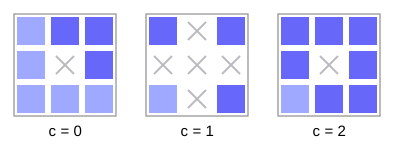
A level- sponge point is a triple whose base-three digit vectors each have at most one entry equal to ; there are of them, and is the fraction whose coordinates are pairwise coprime, with the convention .
Theorem. , where is the classical three-integer pairwise-coprimality constant.
Every prime but 3 behaves exactly as it does on the full lattice; at 3 the lattice factor is replaced by , because a coordinate is divisible by 3 exactly when its last digit is 0, and only 13 of the 20 digit vectors keep two zeros apart. The other primes need a character estimate and a counting bound fibred over a pair of coordinates - fibres of size 3, exponent , where the usual one-coordinate fibring gives 8 and and proves nothing. The same proof settles any base- digit design with on every coordinate pair. The scripts re-count all 64 million level-six points ( of them pairwise coprime, density ) and explain why the finite levels sit below the limit: the digits are biased mod 2, and the exact level- factor at 2 is at against its limit .