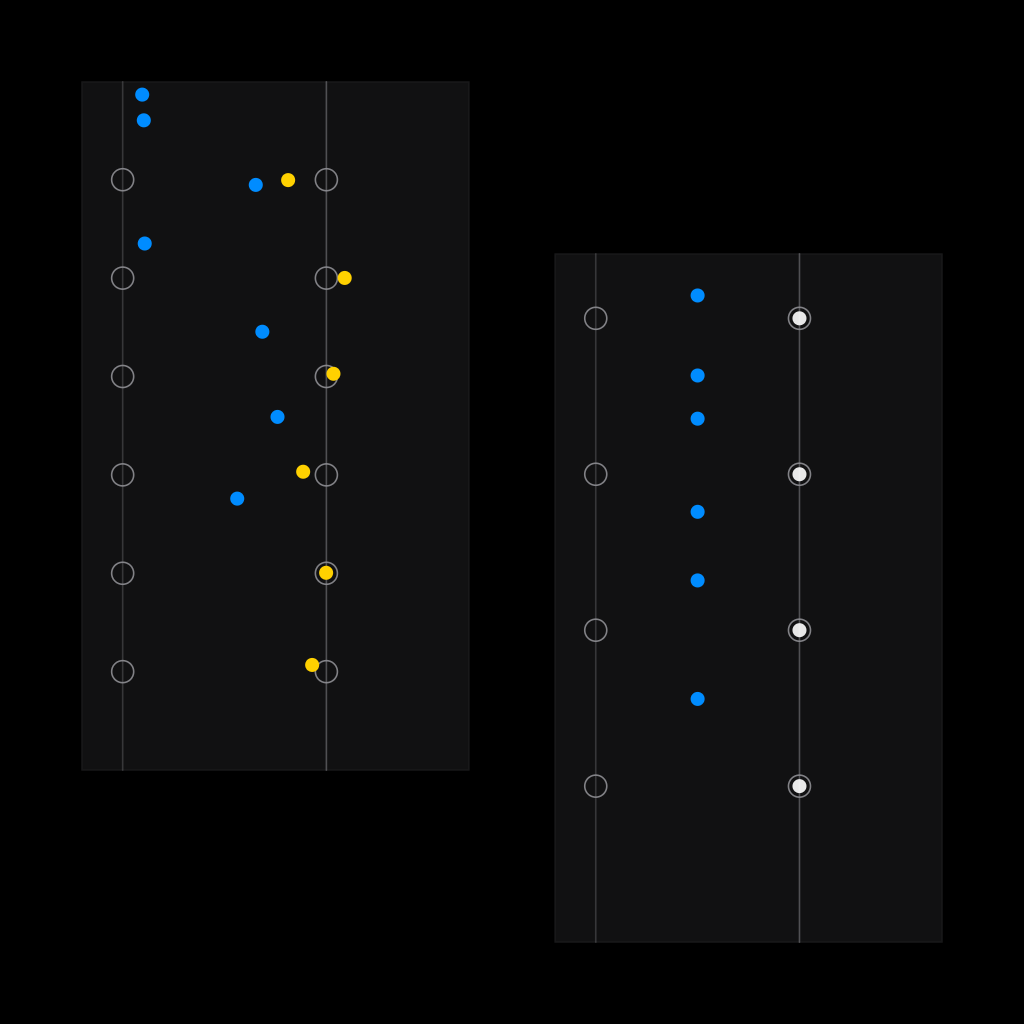
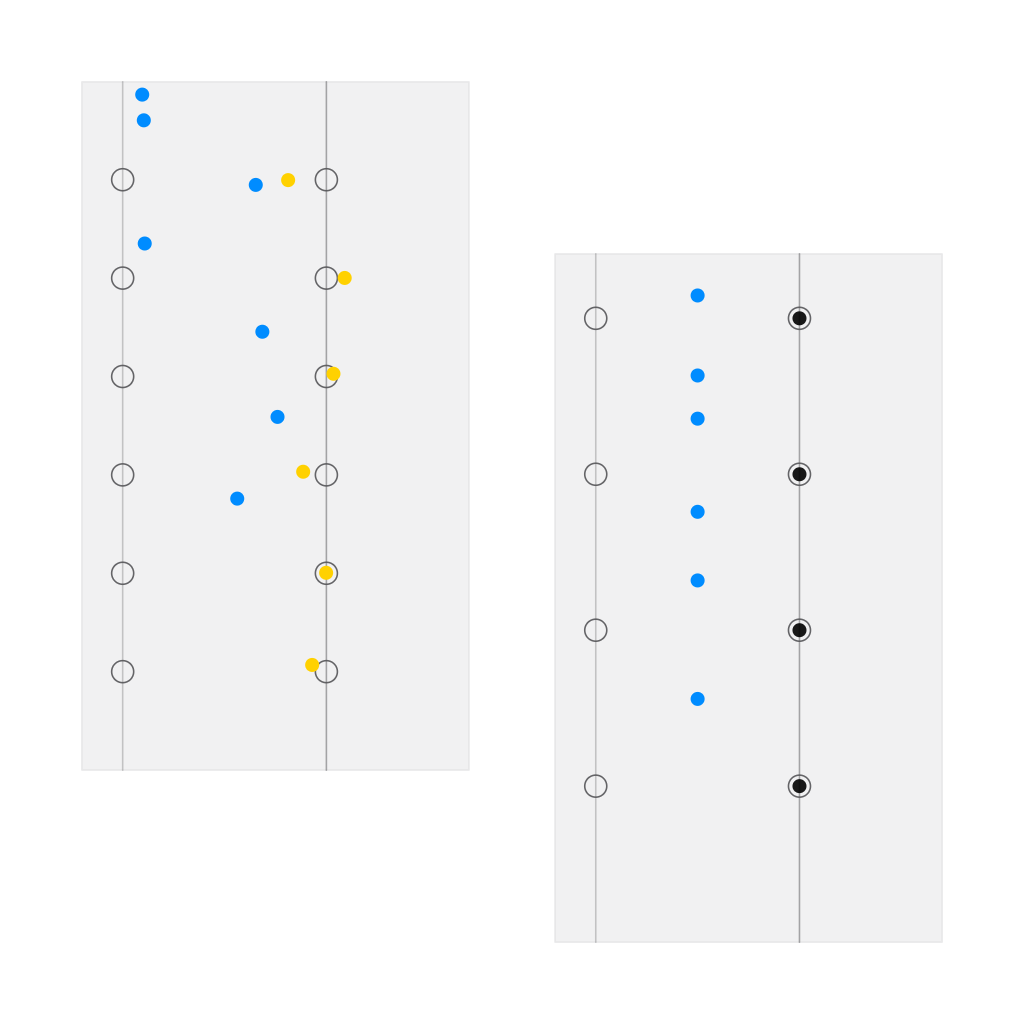
The zeta function of a digit design
Fix a base at least 2 and a digit set F inside {0..base-1} with fill = card F >= 2, and let S_F be the positive integers whose digits all lie in F. A design is a set of integers, so it has a Dirichlet series, zeta_F(s) = sum_(n in S_F) n^(-s), and that series is a zeta function with an abscissa, a meromorphic continuation and a lattice of poles. The full digit set gives Riemann's. Every other digit set gives an object carrying the same machinery and none of the same theorems. The critical line demo walks Riemann's own object at s = 1/2 + it, through the origin once per zero, and folds the zeros one at a time into the prime staircase. This page is the zeros of that object, and what the two faces of the Riemann hypothesis become on a design once the Euler product that glues them is taken away: the zeros of zeta_F on one side, the Mobius meter of mobius on the other, and no route running between them.
Tags as everywhere in this tree: Proved means derived here from definitions, Verified means recomputed exactly and checked against an independent path, Conjecture is labelled belief, Refuted means shown false.
THE SPINE
- The abscissa of absolute convergence is
alpha = log_base(fill), the design's own mass exponent, and the series continues meromorphically to the whole plane with simple poles confined to the lattices_(m,j) = alpha - m + 2 pi i j / log base. All of that is built territory: the abscissa is Kohler and Spilker 2009, with position-varying digit rules in Nathanson 2021; the continuation is the automatic-series mechanism of Allouche, Mendes France and Peyriere 2000, carried out for missing digits in Burnol 2026 and unified in Allouche, Shallit and Stipulanti 2025. The object of this page is Burnol'sK(s)and is not new. Verified against the sources in REFS. - The continuation is one digit recursion and nothing more. An element of more than one digit is
base m + awithm in S_Fanda in F, so expanding(base m + a)^(-s)binomially and summing the digit momentsgamma_l = sum_(a in F) a^lgives(1 - fill base^(-s)) zeta_F(s) = E_1(s) + sum_(l >= 1) binom(-s,l) base^(-s-l) gamma_l zeta_F(s+l)withE_1(s) = sum_(a in F, a != 0) a^(-s), the shift tos + lmoving the argument into faster convergence. That is Burnol's Proposition 4.1, and the peeled form of it that carries the small tailG_Pdirectly instead of as a difference of two large numbers is the engine of lab/py/design-zeta, where every printed value carries a propagated truncation bound. Verified against the source. - The pole lattice is the same object dimensions calls the complex dimensions of the design, one vertical line of period
2 pi / log baseperm >= 0, and it is what makes every counting function on a design log-periodic rather than asymptotic to a constant. The off-real poles atm = 0are genuine and not artefacts of the continuation: at base 3 withF = {0,1}the residue is enclosed in exact interval arithmetic and tied to the Fourier coefficients of the log-periodic profile ofA_F(x), certified in dimensions by lab/py/burnol-residue. Proved, computer-assisted. - One factor carries that whole lattice on its own, and dividing it out is what makes the zeros readable.
1/(1 - fill base^(-s))has poles exactly ats = alpha + 2 pi i m / log baseand no zeros, so the cofactorZ(s) = zeta_F(s) (1 - fill base^(-s))is analytic onRe s > alpha - 1: them = 0line is cancelled and no other, the poles ofZare thes_(m,j)withm >= 1at whichzeta_Fhas a nonvanishing residue, and on a full digit setZis entire, beingzeta(s)(1 - base^(1-s)). One peel level gives it in closed form,Z(s) = E_1(s) + sum_(l >= 1) binom(-s,l) base^(-s-l) gamma_l zeta_F(s+l), checked against brute-force digit summation to1.6e-14with and without0inF, andZ(s) a_min^s -> 1to the right,a_minthe least nonzero digit. The transfer runs one way without exception and the other way with one: a zero ofzeta_Fright ofalpha - 1is always a zero ofZ, and a zero ofZis a zero ofzeta_Fexcept at a poles_(0,j)whose residue vanishes, whereZvanishes andzeta_Fis regular. Ats_(0,j)one hasfill base^(-s_(0,j)) = 1exactly for everyj, so withu = s - s_(0,j)andlambda = log basethe periodic factor is1 - base^(-u)with nojdependence andzeta_F(s) = Z(s)(1/(lambda u) + 1/2 + lambda u/12 - lambda^3 u^3/720 + ...), which reads the residue, the regular part and its derivative off the Taylor coefficients ofZalone. Proved (lab/py/zeta-locus, lab/py/design-zeta, lab/py/burnol-residue). - What the spine buys is machinery and not a hypothesis. The abscissa, the continuation, the lattice, the positivity at
alphaand the residue formula are all cited above and none of them says wherezeta_Fvanishes. The rest of this page is the zero set, the products that do and do not stand where the Euler product stands on the integers, and what each of them decides about the design's own Mobius meter. The same spine over a memory rule, where the scalarfill base^(-s)becomes a transfer matrix and the one pole lattice becomes one comb per eigenvalue, is beneath,### The memory zeta.
THE ZEROS
- The census runs on the cofactor
Z, on one strip,alpha - 0.92 < Re s < alpha + 3.02and0.02 < Im s < 60, split atRe s = alphaexactly. Base 3 withF = {0,1},alpha = log_3 2, carries 3 zeros right of the abscissa and 20 left of it; base 10 with the digit9missing,alpha = log_10 9, carries 13 right and 25 left; base 3 withF = {0,2}carries 3 right, in the same three boxes as{0,1}. The largest surviving phase step on any census contour is0.9896and the largest propagated bound met at any census evaluation is9.99e-11, both printed beside every count. A count is resolved and not certified unless a Rouche margin backs it, and eleven of the comb's teeth now are. Verified (lab/py/design-zeta). - Three of those zeros sit inside the design's own half-plane of absolute convergence, where
zeta_Fis a convergent sum of positive terms and the census uses no continuation at all, the ladder only rearranging it. The integers forbid that: at the base 2 full digit set the same census reads0zeros inalpha + 0.02 < Re s < alpha + 3.02, computed and not quoted, and the Euler product is the reason. The claim is this object and not a principle, since absolute convergence of a positive-term series is no zero-free region in general either:1 + 2^(-s)has abscissa of absolute convergence-infinityand zeros at(2m+1) pi i / log 2. What the census shows is that an infinite design, whose series is the same shape as Riemann's and whose abscissa is a positive number, does the same thing. Verified (lab/py/design-zeta). - Scaled digit columns share a zero set exactly. For a positive integer
awitha max F <= base - 1, so thataFstays inside{0..base-1}, the carry-free bijectionm -> a mgiveszeta_(aF)(s) = a^(-s) zeta_F(s), an exponential factor with no zeros and no poles, so the two designs have the same zeros and residues in the ratioa^(-s_(m,j)), and the proof uses0 in Fnowhere. Base 3{0,2}against{0,1}agrees to5.6e-43at three points, and on what was censused the two agree box for box: winding one inIm [22.01, 24.01], inIm [28.01, 30.01]and inIm [56.00, 58.00]for both, and winding zero in every other box. Left of the abscissa{0,2}is not censused and is inferred from the theorem. On the meter side the same bijection twists by a sign (mobius), so the transfer is exact on both faces and trivial on one of them. Proved (lab/py/design-zeta). - Near the abscissa the zeros are a comb, one tooth per pole, and the residue puts each tooth where it is. A zero near
s_(0,j)solvesu(R_j + R'_j u + ...) = -r_jwithr_jthe residue andR_jthe regular part, first orderu_1 = -r_j/R_jand second order the near root ofR'_j u^2 + R_j u + r_j = 0, both built from Laurent data with nothing fitted. Over 20 designs toIm s = 40one radius0.45keeps the pole discs from overlapping, the smallest period in the sweep being2.2662, and it is not defended by the tooth law, which says nothing pastabs(u) = 0.3, so every count below is conditional on it: 164 poles carry one zero ofZ, 40 none and 8 two, of which 21 are the residue-null pole centres of the three full-set columns, leaving 143 poles with one zero ofzeta_F, 61 with none and 8 with two. Every located tooth is found by a polar grid and not by the prediction, so no tooth is selected by the law it tests. Comparing afterwards,miss2/miss1has median0.1637withmiss2 < miss1at 147 of the 151, and the accuracy is conditional on the tooth being close: the 43 teeth atabs(u) < 0.1have largest first-order miss0.01446and largest second-order miss0.00164, the 84 atabs(u) < 0.2have0.10815and0.01526, while the 31 atabs(u) >= 0.3reach1.64614and the prediction says nothing. The densest column is the sharpest: base 10 missing9atfill/base = 0.9locates 15 teeth to a largest first-order miss of0.013602and a median of0.000841. Verified (lab/py/zeta-locus). - The full digit set is the column where that comb is empty and what is left is the critical line.
zetahas one pole,s = 1 = alpha, so it is regular at everys_(0,j)withj != 0and the residue there vanishes as a one-line consequence rather than a measurement, the engine reading1e-26to1e-33there as its own control. The winding overalpha - 0.92 < Re s < alpha + 3.02,0.02 < Im s < 40then splits exactly as six zeros ofzetaplusfloor(40 log base/2 pi)cofactor-only teeth, those teeth being the zeros of1 - base^(1-s)onRe s = 1by exact arithmetic:10 = 6 + 4at base 2,12 = 6 + 6at base 3 and14 = 6 + 8at base 4. The six survivors readRe s = 0.5atIm s = 14.1347251417, 21.0220396388, 25.0108575801, 30.4248761259, 32.9350615877, 37.5861781588at all three bases, which share that zero set to1e-26because they are one arithmetic object. On a design the same split leaves a second family that is not a line atalpha/2: real parts run-0.273079611to0.391038600over the 7 zeros belowIm 40at base 3{0,1}againstalpha/2 = 0.3154648768,-0.30495894to0.28101268over 6 zeros at base 4{0,1}against0.25, and0.060261843to0.97363028over 5 zeros at base 16{0,1,2,3}against0.25. The spread is the witness and no per-design mean is claimed. Verified (lab/py/zeta-locus). - Which comb is stripped does not change what is left, and the next pole line's comb is forced by the first one's residues. For
m >= 1the cofactorZ_m(s) = zeta_F(s) prod_(i <= m)(1 - fill base^(-(s+i)))has exactly the zeros ofZinsidealpha - 1 < Re s < alpha + 3.02, since each extra factor vanishes only onRe s = alpha - iwithi >= 1, so the survivors are one set under every comb. WhatZ_madds is the level-icomb, and the level-one Laurent data is forced:Zis singular ats_(1,j) = alpha - 1 + 2 pi i j/log basethrough itsl = 1term alone, and withbase^(-s_(1,j)-1) = 1/filland1 - fill base^(-s_(1,j)) = 1 - basethe residue there isr_(1,j) = s_(1,j) gamma_1 r_(0,j)/(fill(base-1)), so the level-one comb is empty wherever the level-zero comb is, and at the full digit sets_(1,0) = alpha - 1 = 0kills it, which iszetahaving no pole ats = 0; the generator printsabs r_(1,0) = 0.0with its null flag set andabs r_(1,1) = 8.89623e-29at the base 2 full set. Proved (lab/py/zeta-family, lab/py/zeta-locus). - Stripping both combs at
rho = 0.45over twenty-two designs gives 377 zeros wound by the argument principle, 351 located, 171 teeth of which 9 are level-one teeth, 19 cofactor-only zeros at null-residue poles and 161 second-family zeros, each design censused to its own printed height,40except the four base 3 designs at42.894, base 9{0,1,2}at41.464and base 10 missing two at25.923. There is no gap atrhoon a design: the distance from a second-family zero to the nearest live pole has minimum0.45510938at base 4{2,3},0.45909168at base 3{0,1},0.48696667at base 4{0,1,2}and0.50481072at base 4{1,3}, with base 4{2,3}putting five of its eight inside0.45 < abs(u) < 0.6, so every count falls asrhorises,N_2reading8, 7, 13, 9, 14atrho = 0.45against7, 6, 12, 8, 7atrho = 0.6. The full digit set is where the gap exists: at base 2 the nearest live pole to a second-family zero is14.143566away and no radius below0.9moves any count. Where the located count falls short of the winding, base 4{2,3}at 12 of 18 being the worst,N_2is a lower bound. Verified (lab/py/zeta-family, verbtests). - The census needs no hand-chosen right edge, because a design zeta has an explicit zero-free half plane. With
a_minthe least nonzero digit, hence the least element ofS_F, any realsigma > alphawitha_min^sigma zeta_F(sigma) < 2puts no zero inRe s >= sigma: the coefficients are nonnegative, soabs(a_min^s zeta_F(s) - 1) <= a_min^sigma zeta_F(sigma) - 1 < 1for everyRe s >= sigma, and the hypothesissigma > alphais load bearing. On the gridalpha + 0.05 nthe edgesigma_1reads0.5at base 4{1}to1.75at the three full digit sets over twenty-four designs,a_min^sigma zeta_F(sigma)landing in[1.8635, 1.9995]with largestsigma_1 - alphaequal to0.95, so thealpha + 3.02strip of the locus sweep is three times wider than the zeros need. One real evaluation, carrying the ladder's own error bound. Proved (lab/py/transport-census, verbcensus). - Between the abscissa and that edge every proper design carries zeros and the full digit set carries none. On
alpha + 1e-6 < Re s < sigma_1the argument principle counts157zeros belowIm s = 40over twenty-three designs, all157located, plus2at base 50 missing one digit belowIm s = 4; twenty-one of the twenty-four designs carry one, and the three that do not are the base 2, 3 and 4 full digit sets, whose windings read-1.97e-33,1.73e-33and1.53e-33. The count is exact on the box and a lower bound for the half plane, the sliveralpha < Re s <= alpha + 1e-6, the band0 < Im s < 0.02, everything above the height and the conjugate half plane all uncounted. Each rightmost carries the height it is read below, since the level-zero teeth drift right with the pole index: base 20 missing one digit reads1.000285484146atIm s = 2.0988,1.000549674321at4.1971and1.002685494779at14.6920. BelowIm s = 40the rightmost real parts run0.441505537191at base 5{0,1}to1.002685494780at base 20 missing one digit, each certified by a winding1box of half width5e-5whose sampled contour minimum,1.2e-4to6.1e-3, beats the engine's bound by at least eight orders of magnitude and whose distance to the pole lattice is at least0.00517845, one hundred box half widths, base 20 missing one digit standing off at0.0223021and four hundred of them. Verified (lab/py/transport-census, verbcensus). - A positive Rouche margin turns a resolved tooth into a proved one, with every input bounded from the digit recursion itself. At a pole
s_0of nonvanishing residue writeZ(s_0+u) = P(u) + T(u),Pentire with Taylor coefficients the exact finite sumssum_n n^(-s_0)(-log n)^m/m!convolved against those of1 - e^(-lambda u), andTthel >= 1part of the ladder numerator, bounded onabs(u) <= R_2byB_T = sum_(l >= 1) binom(abs(s_0)+R_2+l-1, l) base^(-sigma-l) gamma_l G(sigma+l)atsigma = Re s_0 - R_2. Thatlsum is closed by a majorant ratio and not an observed one, the term ratio not being monotone:gamma_(l+1)/gamma_l <= a_maxandG(sigma+l+1)/G(sigma+l) <= base^(-(P-1))because every string in the pools is at leastbase^(P-1), so the term ratio is at mostR_l = ((abs(s_0)+R_2+l)/(l+1)) a_max base^(-P), decreasing inlonceabs(s_0)+R_2 >= 1and belowa_max base^(-P)otherwise, and stopping at the firstlwithR_l < 1and addingterm_l R_l/(1-R_l)is a proof. Then onabs(u) = rho, withtau = rho/R_2,abs(Z - (Z_0 + Z_1 u)) <= sum_(m >= 2) abs(P_m) rho^m + B_T tau^2/(1-tau)againstabs(Z_0 + Z_1 u) >= abs(Z_1) rho - abs(Z_0); strict inequality givesZthe linear model's zero count, and that count is one because the same inequality forcesabs(Z_0/Z_1) < rho. No step uses a differenced quantity,Z_1being the first Fourier mode ofTon a circle of radiusR < R_2with aliasing at most(B_T/R_2)(R/R_2)^N/(1-(R/R_2)^N). Proved (lab/py/zeta-locus, lab/py/design-zeta). - Run with the peel depth raised at each pole until the certificate fires or the string pool caps, that margin certifies exactly one zero at eleven poles of 106 at base 3, base 5, base 9, base 16 and base 10 missing
9toIm s = 40inside a fifteen minute budget: 11 certified, 60 failed, 7 residue-null and excluded because there the model's zero is the pole centre, and 28 skipped on budget. The eleven, with depth, margin and radius: base 3{0,1}j = 2atP = 7,0.13418242,rho = 0.205;j = 5atP = 7,0.028140545,0.16;j = 7atP = 9,0.00082974181,0.175; base 5{0,1}j = 4atP = 7,0.15035818,0.2775;j = 5atP = 7,0.12269904,0.295; base 9{0,1,2}j = 5atP = 5,0.038456894,0.26; and base 10 missing9atj = 1, 2, 3, 4, 7, all atP = 3, margins0.047105507,0.030062806,0.045802462,0.043508323,0.046292701at radii0.1275, 0.105, 0.1025, 0.09, 0.0725, each on 24 contour samples. Every certified disc agrees with the argument principle's count of one and none disagrees; of the 19 poles carrying zero or two zeros inabs(u) < 0.45that the budget reached, none certifies, the two double poles reached both failing. The lever is peeling and not a sharper majorant: at base 10 the automatic depthP = 2givesB_Tfrom1.08to38.1, andP = 3gives0.2096to1.2010. Proximity is no threshold, the certifiedabs(Z_0/Z_1)running0.0282669to0.149708while base 3{0,1}j = 7at0.104443fails atP = 7and certifies atP = 9. The margins are evaluated in high precision and not in ball arithmetic, which is the one step short of Proved. Verified (lab/py/zeta-locus, verbrouche). - The locus obeys no law in the design's coarse invariants. There is no curve
Re s = f(Im s)shared by designs of equalalpha: base 4{1,2}and base 16{0,1,2,3}, bothalpha = 1/2, hold zeros0.015058apart inIm snearIm s = 4.72and0.817047apart inRe s, and equality offill/baseas well fixes nothing, base 4{0,1}against{2,3}giving0.0136014against0.719693nearIm s = 17.64. Within one design the worst real-part gap between two zeros of equalfrac(Im s log q/2 pi)runs0.077591803at base 10 missing9to0.65632474at base 3{0,1}, so the fractional part fixes nothing either. The single exception isalpha = 1, where the full digit sets at bases 2, 3 and 4 are one arithmetic object and do share every zero. Refuted (lab/py/zeta-locus). - The pole lattice does not force the zeros either, so the vertical period of the poles is no symmetry of the function. At base 3
{0,1}the two polished zeros right of the abscissa sit at0.665639628004 + 23.0347504431 iand0.720787601477 + 28.6056765649 i, an ordinate gap of5.5709261against the pole period2 pi/log 3 = 5.7192017, short by0.148. The factor1 - fill base^(-s)is exactly2 pi i/log baseperiodic, and so isE_1at a design whose only nonzero digit is1, but the shifted termssum_(l >= 1) binom(-s,l) base^(-s-l) gamma_l zeta_F(s+l)are not, sozeta_Fis not periodic and its zeros carry what the lattice cannot. Refuted (lab/py/zeta-locus, verbcensus). - There is no counting law for the second family in
alphaor in the fill, at either radius. The four base 4 two-digit designs sharealpha = 1/2andfill/base = 1/2exactly and giveN_2(40) = 7, 13, 9, 14atrho = 0.45and6, 12, 8, 7atrho = 0.6, withN_2(80) = 20, 30, 22, 29and17, 26, 21, 20: a factor of two at onealphaand onefill/baseat both radii, so the refutation is radius-robust even though the integers are not. What spreads is comb occupancy and not the second family, base 4{0,1}and{2,3}differing by 29 percent in total winding, 14 against 18, and by a factor of two inN_2because 7 of 8 poles are occupied against 4 of 8. Read asN_2(T) = c_F T log T + d_F Tfrom the two heights,c_Fatalpha = 1/2is0.10820213, 0.072134752, 0.072134752, 0.018033688, spread0.09016844, against the base 3 and base 4 full-set controls0.15486803and0.16230319, the classical1/(2 pi) = 0.15915494and a control spread of0.0074351582. Every winding is the nearest integer to a numerically integrated phase whose largest surviving step runs0.9205to0.9998against a cap of1, so the counts are measured and not certified. Refuted (lab/py/zeta-family, verbstestsandcount). - The second family is not symmetric about any vertical line
Re s = c_Feither. Readingc_Fas the midpoint of the real parts of the two second-family zeros of leastIm sand testing the rest, no second-family zero in any design has a reflection partner: the reflection branch needs two zeros within the0.05test tolerance inIm sand the smallest ordinate gap inside a design is far above that, so the branch cannot fire. Every pair the sweep records is a self-pair, and self-pairs occur below the chance rate: over ten recensused designs the tally is 8 self-pairs and 0 reflection partners of 47 zeros tested, a rate of0.170213against the0.229904that drawing each real part uniformly from that design's own observed band predicts, and 22 of 117 over the full sweep. The three full-set controls pair 13 of 13 atc_F = 1/2to1e-22, where the functional equation makes every zero its own partner.c_Fis not a quantity either:c_F - alpha/2runs-0.28413232to+0.47788515andc_F - 1/2runs-0.78413232to+0.28664994, so it is notalpha/2, nottheta(F)and not1/2. Refuted (lab/py/zeta-family, verbsymmetry). - Nor do the real parts contract to
alpha/2as a design fills, so the critical line is not thealpha -> 1limit of this tree. Undivided,max abs(Re s - alpha/2)stays flat along the ladder carryingalphatoward 1, reading0.2275679549at base 5{0,1},0.5549589411at base 4{0,1},0.5885444877at base 3{0,1},0.4233198337at base 4{0,1,2},0.5365616661at base 5{0,1,2,3}and0.3151426744at base 10 missing two, then collapsing to1.43e-22,1.10e-21and1.76e-22at the base 2, 3 and 4 full sets. At base 10 missing9the second family reads0.216084781875to0.70401657869aboutalpha/2 = 0.477121255, a band of width0.488against1 - alpha = 0.0458. Divided by1 - alphathe statistic runs0.39971647to5.7047812with no monotone inalpha, falling from3.8699872to3.2519104on the last two rungs, so the refutation rests on the undivided spread and not on the ratio. Refuted (lab/py/zeta-family, verblimit). - One law does survive the fill, and it is about the heights rather than the real parts. Against the derived null of a quarter of the mean gap between consecutive
zetaordinates in the range, the exact expectation for an equally spaced ordinate set of the same density and conservative for one with gap variance, the mean distance from a second-family ordinate to the nearestzetaordinate divided by that null falls monotonically inalphaover seven rungs:2.0495374at base 5{0,1}withalpha = 0.430676558,1.8953371at base 4{0,1}with0.5,0.75419266at base 3{0,1}with0.630929754,0.51648744at base 4{0,1,2}with0.792481250,0.32356636at base 5{0,1,2,3}with0.861353116,0.090501352at base 10 missing two with0.903089987and1.0429899e-23at the base 2 full set. The base and fill confounds are dead: the fall is monotone at fixed base,2.0495374to0.32356636inside base 5 and1.8953371to0.51648744inside base 4, and at fixed fill 2 across bases; the nulls move only1.0425839to1.3595166across the ladder while the raw mean distance falls2.4032315to0.12303809, so the denominator does not drive it. Over the same designsmean abs(Re s - 1/2)reads0.36482392, 0.39426128, 0.3901396, 0.25540269, 0.31452367, 0.20473972and2.4065966e-23and does not fall monotonically: atalpha = 0.903the heights are pinned to2.3percent of the mean gap while the real parts are still0.20off1/2. A filling design findszeta's ordinates before its real parts find1/2.alphais a trend and not a function, the four base 4 two-digit designs at onealpha = 1/2spreading0.79050661to2.8404536, and the matching is nearest-ordinate and not injective, 3 distinct ordinates for 4 design zeros at base 10 missing two. Verified (lab/py/zeta-family, verblimit). - That shadow is a first-order perturbation and its constant-free form is a Newton step. The discrete position identity
1_(D_level)(n) = base^(-level) sum_(a mod base^level) G_level(a/base^level) e(-n a/base^level)on0 <= n < base^levelgiveszeta_(F,level)(s) = base^(-level) sum_(a mod base^level) G_level(a/base^level) S_level(s, a/base^level), reproduced from the transform to1.236e-37atlevel = 2over ten designs, and sinceG_level(0) = fill^levelthea = 0fibre carries the weight(fill/base)^levelexactly against the partial sum ofzetatobase^level, with no arc and no limit. That splits a polynomial at levellevelagainst a TRUNCATED zeta while the object is the continuedzeta_Fagainst the full one, and(fill/base)^levelfalls to0withlevelwhile both series tend to1on the right, so no level is forced andc = fill/baseis thelevel = 1reading and a definition. For anycthe splitzeta_F = c zeta + E_FgivesE_F(rho_0) = zeta_F(rho_0)at a zerorho_0ofzeta, an identity carrying nothing aboutc, and a first-order zero ofzeta_Fatrho_0 - zeta_F(rho_0)/(c zeta'(rho_0)); readingc zeta'(rho_0)aszeta_F'(rho_0)removes the constant and leavesrho_0 - zeta_F(rho_0)/zeta_F'(rho_0), Taylor at a simple zero. The continuous form, the mass ofG_levelonabs(t) < 1/(2 base^level), is the exact sinc sum1/base^level + sum_(n in D_level, n > 0) sin(pi n/base^level)/(pi n)and equalskappa_level(F) (fill/base)^levelwithkappa_levelrunning0.6015221to0.96774464atlevel = 1, 2, 3, so it adds no constant the fibre does not give. Proved (lab/py/zeta-shadow verbmass, lab/py/mrly-euler verbposition). - The constant-free step predicts the design zero attached to each zeta zero, and it sharpens as the offset shrinks. Over nine designs at twelve zeta zeros to
Im s = 56.4462476971, six toIm s = 37.5861781588at the two densest so the rungs do not share one height, both predictions come fromzeta_F(rho_0),zeta_F'(rho_0),zeta'(rho_0)and the digit density alone and the zero is located afterwards by Newton, accepted only atabs(zeta_F) < 1e-16, within1.5ofrho_0and0.02clear of the pole lattice, largest ladder bound9.001e-23. The step's median ratio reads1.3843088, 1.284225, 1.2481449, 1.2060106, 1.2042502, 0.89075541, 1.0195598, 1.005076, 0.99741809atalpha = 0.430676558up to0.994835739, largestabs(ratio - 1)being0.14041at base 20 missing one digit and0.01734at base 50 missing one digit, bands[0.94875, 1.14041]and[0.98266, 1.01144]; pooled, that largest deviation runs0.01734, 0.0508884, 0.193158, 0.83912, 3.32327over the bucketsabs off < 0.05, < 0.1, < 0.2, < 0.4and above, on7, 4, 14, 18, 44zeros. Thelevel = 1readingc = fill/baseis the looser column, median ratio1.4129353, 1.2842149, 1.0955991, 1.1806066, 1.1372453, 1.276577, 1.1347487, 1.0320127, 1.0507079, largestabs(ratio - 1)0.24964and0.0821168at the two dense rungs, five times looser at base 50, and the coupling does not select it either,median abs(coupling - fill/base)reading0.24057225and0.08291158againstmedian abs(coupling - 1)0.27619434and0.079335871, a flip between two rungs whose candidates differ by0.05and0.02. Nine zeros at the three sparsest designs have no located zero inside the trust region, predicted offsets0.95618855to3.0967393, so those medians are conditioned on Newton succeeding; the base 2 full set is the exact control,abs(zeta_F(rho_0))between1.85e-34and1.329e-25at all twelve zeros. Verified (lab/py/zeta-shadow, verbpredict). - The paired offset carries its exponent in the missing-digit density and not in
1 - alpha. The median paired offset overm/base = 1 - fill/base, withmthe number of missing digits, reads1.6463532, 1.2495026, 1.8345578, 1.5731321, 2.2102406, 1.6634381, 2.2424916, 1.8779239, 1.051349across the nine rungs and over1 - alphareads1.7350628, 1.2495026, 1.6569184, 1.8951686, 3.1883019, 3.432954, 4.9008186, 5.4839111, 4.0716338; a least squares in the logs, a fit and not a theorem, gives(m/base)^1.04544atR2 0.957842against(1-alpha)^0.71691atR2 0.944011, the first column spanning2.13297and the second4.38888, som/basecarries the exponent by a factor of2.05764inside the4.28797that(1-alpha)/(m/base)itself spans, which is the whole discrimination these two normalisations admit. The two new rungs are base 20 missing its top digit atalpha = 0.9828778777and base 50 missing its top digit at0.9948357391, all six zeros located at each, medianabs(E_F(rho_0))0.11830158and0.028066806and median offset0.093896196and0.021026979. Read in the family row's form the mean distance over a quarter of the mean gap gives0.81218635, 0.57141859, 0.50488757, 0.37447728, 0.20954319, 0.29197634, 0.14794812, 0.052888241, 0.011098646and0at the full set; the pairing is zeta-zero-first where the family row is design-zero-first, so this is a parallel ladder and not that row recomputed, it bounds no maximum over the second family and touches no jump clause. Verified (lab/py/zeta-shadow, verbrungs). - What it does not do is explain why the ordinates converge before the real parts, because at the zeros it pairs it separates neither. The first-order offset is one complex number, so a paired zero moves isotropically and the ordinate offset and the real-part offset are one quantity with no preferred phase: per zero
abs(Im off)/abs(Re off)spans0.137681to6.11895at base 20 missing its top digit and0.14167to18.7749at base 50, and rung by rungmedian abs(Im off)againstmedian abs(Re s - 1/2)reads0.55734029/0.43095421, 0.49670656/0.28603903, 0.48081533/0.22535435, 0.30633741/0.16748977, 0.12823995/0.36138728, 0.25093621/0.12181102, 0.11574693/0.19332005, 0.058239278/0.049215607, 0.011954894/0.010995712, the ordinate offset larger on seven rungs and smaller on two, at rungs 5 and 7, with both falling broadly and neither monotone. The law binds only the zeros Newton reaches from azetazero inside1.5of it and enumerates no design zero, so the ordinate shadow of the family row is what a PAIRED zero does and the unpartnered second family is the surplus; the two are consistent with a mixture that approaches in both coordinates on the partnered zeros and not at all on the rest, and that mixture has no witness until the unpartnered count is measured. Refuted (lab/py/zeta-shadow verbrungs, lab/py/zeta-family verblimit). - The one statistic the transport theorem reads obeys no law either: the gain of a design's rightmost zero over its abscissa is not a function of
alphaandfill/base. Four equal-key families, one base and one digit count each so both agree exactly and not to a rounding, read unequal gains: atalpha = 1/2,fill/base = 1/2the four base 4 two-digit designs give0.0853043873, 0.4400124317, 0.2706238545, 0.3439264581, a spread of0.35470804; base 5 atalpha = 0.4306766,fill/base = 0.4spreads0.37474232; base 3 two-digit atalpha = 0.6309298spreads0.17605693; base 4 three-digit atalpha = 0.7924813spreads0.060972003, still six hundred box widths. The two columns disagree in direction, the gain being largest at the sparsest designs,0.5291214025and0.4485242462atalpha = 0, where the rightmost real part itself is smallest. What rises withalphais the floor: the least rightmost real part per rung reads0.4485242462, 0.4415055372, 0.5853043873, 0.7207876015, 0.9126562295, 0.9897481059, 1.0015143877, 1.0015892753, 1.0026854948, 1.0000614750up ten rungs, rising at every step but the first and the last, the last being where the census height drops from40to4; one design per rung abovealpha = 0.86against six atalpha = 0.5, and no fit is taken. Refuted (lab/py/transport-census, verblaw).
THE WALL AND THE PRODUCTS
- The indicator of
S_Fis multiplicative exactly at the full digit set, and the wall is constructed rather than described.1 in Fis forced byf(1) = 1; if a digitc >= 2is missing take the least, andR_c R_(c+1)has no carry because itsbase^mcoefficient ismin(m+1, c, 2c-m) <= base-1, so its digit set is exactly{1..c}whilegcd(R_c, R_(c+1)) = R_1 = 1; if only0is missing then an odd base gives the coprime pair(2, (base^2+1)/2)and an even base the coprime odd pair(base^2-1, base^2+1), whose products leave the set. Over all 8177 sets with2 <= base <= 12the constructed witness is asserted at each of the 4083 sets that passf(1) = 1and are not full, and an independent search finds a minimal witness for every one, hardest base 12,F = {1}, pair(5, 377). No design outside the full set carries an Euler product over primes. Proved (lab/py/mrly-euler, verbwall). - The polynomial model does not transport Weil's theorem, and the wall's first case is exactly where it breaks. Evaluation
P -> P(base)carries the polynomials with coefficients in{0..base-1}, the modelF_base[t]at primebase, bijectively onto the nonnegative integers and adds correctly only where no carry occurs: a coefficient of the polynomial productP Rreaches(base-1)^2 (min(deg P, deg R) + 1), far above the digit capbase - 1, so the digit string of an integer product is the carry reduction of the polynomial product and not that product, andR_c R_(c+1)is that failure made minimal, the shortest coprime pair whose carry-free product shows the missing digitc. Multiplication inF_base[t]reduces its coefficients modbaseand never carries while the integer product does, so the Riemann hypothesis proved over a function field reacheszeta_Falong no evaluation bridge, and no other route is spoken to; the density side of the same substitution is coprime. Proved (lab/py/mrly-euler, verbwall). - What stands in its place is a product over digit positions rather than over primes. With
G_level(t) = prod_(i<level) sum_(d in F) e(d base^i t), one factor per position, uniqueness of the base expansion givesint_0^1 G_level(t) e(-nt) dt = 1_(D_level)(n)for every integern, hencesum_(n in D_level, n >= 1) a(n) n^(-s) = int_0^1 G_level(t) A(s,t) dtwithA(s,t) = sum_(n >= 1) a(n) e(-nt) n^(-s), for every absolutely convergent Dirichlet series at once. Takinga = 1returnszeta_Fagainst the periodic zeta of DLMF 25.13; takinga = mureturns the design's Mobius series against the Lerch-Mobius series. The set enters through the digit positions and the arithmetic sits entirely in the kernel; they meet only under the integral. Checked to1.95e-16and2.04e-16at base 10 missing9,level = 3, 4, and2.9e-16at base 3{0,1},level = 3, 4, 5. Proved (lab/py/mrly-euler, verbposition). - Read at
x = base^levelthe pairing is exact on a finite grid,M_F(base^level) = base^(-level) sum_(a mod base^level) G_level(a/base^level) S_level(a/base^level), both factors trigonometric polynomials of degree belowbase^level, and itsl^1mass decomposes level by level asC_level = sum_(j=0)^level fill^(level-j) c_j. The floorC_j >= base C_(j-1)forces the top-level sharec_level/C_level >= 1 - fill/baseat every base and digit set, measured0.485846, 0.602606, 0.687994, 0.510055against floors0.333333, 0.500000, 0.600000, 0.100000, with the levelsj >= level/2carrying0.995116, 0.996061, 0.997043, 0.942350of it. So weighting the Mobius input per denominator saves exactlylog_base(C_level/c_level)/level, a constant factor capped bybase/m, the numerator reading0.657068at base 3{0,1}identically at everylevel = 6..14: the mass is where the method cannot spend it. Proved (lab/py/mrly-pairing, verbsplit). - The large sieve does not rescue that split on the major arcs of any design below the full set, and the exact second moment prices it. Writing
a = base^v a'withbasenot dividinga'andj = level - v, thel^2mass of the grid pairing over the levelsj <= Jis exactlyfill^(2 level - J) base^J, sinceG_level(a/base^level) = fill^(level-j) G_j(a'/base^j)and Parseval onZ/base^Jgivessum_(a mod base^J) abs(G_J(a/base^J))^2 = base^J fill^J. Thosebase^Jpoints arebase^(-J)spaced, so the spacing form of Montgomery and Vaughan 1973 applies at every base, including the composite ones where ana'not divisible bybaseneed not be coprime to it and the coprime-residue form misses the point, and it givessum_(j <= J) sum_(a') abs(S_level)^2 << (base^level + base^J) base^level. Withx = base^levelthe levels belowJ = u levelthen costx^(alpha + u(1-alpha)/2), which under the hypothesisalpha < 1is strictly abovealphaat everyu > 0, equalsalphaonly atu = 0, and returns the whole-grid value(alpha + 1)/2atu = 1; atalpha = 1it isalphaat everyu, so the full digit sets witness nothing here. Proved (lab/py/mrly-pairing, verbsplit). - The principal fibre of that grid is the classical Mertens function and it is asymptotically too small. The
a = 0term isbase^(-level) fill^level M(base^level), of exponentalpha - 1/2under RH, andalpha - 1/2 < alpha/2for everyalpha < 1, so in the limitMcannot carry the conjectured size of the design meter. At finite depth it carries a great deal: shares-0.028961, 0.018555, -0.006583, 0.408208at base 3{0,1}atlevel = 14, base 4{0,1}atlevel = 11, base 5{0,1}atlevel = 9and base 10 missing9atlevel = 6, and exactly all of the meter on the two full-set controls. The exponent gap at base 10 missing9is0.454243against0.477121, and a factor of10between them needsx = 10^44. Proved (lab/py/mrly-pairing, verbsplit). - The design does carry an exact Euler product, and it is the one with nothing in it. On the free monoid over
Fwith normN(w) = base^(abs(w)),sum_w N(w)^(-s) = 1/(1 - fill base^(-s)) = prod_(level>=1) (1 - base^(-level s))^(-c_fill(level))withc_fill(level)the Lyndon count, by Chen-Fox-Lyndon: every word factors uniquely as a non-increasing product of Lyndon words, so the free monoid onFis equinumerous by norm with the free abelian monoid on Lyndon words and is not equal to it. Its primes are the Lyndon words, it is zero free, its Mobius is supported on the empty word and the letters so its Mertens is1 - fillbeyond norm1, and its poles are exactly the design pole lattice. All RH content ofzeta_Ftherefore sits in the cofactorZ, which is what the census reads. Expansion verified throughu^16atfill = 2, 3, 4, 9, 10,c_2(level)being A001037. Proved (lab/py/mrly-euler, verbword). - Inside the design there is a third product, genuinely over primes, and it lives on a different set: the free semigroup
N_Fon the primes that lie inS_F, a Beurling system with its own Mobius and its own RH-shaped question. It is blind to whole columns. Ifgcd(F) = a > 1then every element ofS_Fis a multiple ofa, so whenais prime the design's primes are{a},N_Fis the powers ofaandM_B(x) = 0forx >= a, and whenais composite the design holds no prime at all,N_F = {1}andM_Bis identically1, witness base 10,F = {0,4,8}. The eight scaled census families of mobius are exactly the columns the Beurling route cannot see and the scaling transfer reads exactly. Proved (lab/py/mrly-euler, verbbeurling). - The Beurling census to
x = 10^6says the same thing in numbers, and it reads a level rather than a trend. Base 3{0,2}has the single prime2andM_Bidentically zero past it; base 3{0,1}has525primes,N_F(920483) = 2198, runningmax abs(M_B) = 98and exponent0.3339againstalpha/2 = 0.3155; base 10 missing9has35139primes,N_F(10^6) = 488864againstx^alpha = 531441,M_B(10^6) = 1860, running max1866, andlog(running max)/log xreading0.4203, 0.4882, 0.5452at10^4, 10^5, 10^6againstalpha/2 = 0.4771, where full base 10 as control reads0.4084, 0.4241, 0.4276against its ownalpha/2 = 0.5. That is+0.068overalpha/2for the design against-0.072for the control, with a running maximum climbing in both: there is cancellation,0.545against the trivialalpha = 0.954, and it sits abovealpha/2, so the census supports cancellation onN_Fand does not support the design's own square-root shape.N_Fis notS_F. Full base 10 reproduces-23, -48, 212, A084237. Verified (lab/py/mrly-euler, verbbeurling).
THE IDENTITY
- One identity does survive the wall, and it is not
zeta M = 1. For every base andFwith1 in Fthe indicator ofS_Fhas a Dirichlet inversenu_F, given bynu_F(1) = 1andnu_F(n) = -sum_(d divides n, d > 1, d in S_F) nu_F(n/d), sozeta_F(s) N_F(s) = 1withN_F(s) = sum nu_F(n) n^(-s), andnu_Fismuexactly at the full digit set, where the classical identity is the special case. The support ofnu_Flies inside the multiplicative semigroup generated byS_Fand strictly inside it:9,27and36lie in the semigroup withnu_F = 0while16,48and52lie in the semigroup and outsideS_F. So a design carries four sets, not two:S_F, the Beurling integers on the primes of the design, the semigroup, and the support ofnu_F. Checked againstmuterm for term ton = 131072at base 2 andn = 177147at base 3. Proved (lab/py/mrly-pairing verbinverse, lab/py/design-zeta). - That identity is a one-way bridge from the zeros to the design's own Mertens function, and it runs the wrong way for the hypothesis. If
rhois a zero ofzeta_FwithRe rho > alphathensigma_c(N_F) >= Re rho, by the identity theorem on the connected pole-free half planeRe s > max(sigma_c(N_F), alpha), sosum_(n <= x) nu_F(n)is notO(x^(Re rho - eps))for anyeps > 0; the converse boundsigma_c(N_F) <= sup Re rhois not claimed. The partial sums ofN_F(sigma)meet1/zeta_F(sigma)to1.60e-3atsigma = 0.8008and1.96e-4atsigma = 0.9208at base 3{0,1}, and to1.72e-2atsigma = 1.0816and2.39e-3atsigma = 1.2016at base 10 missing9, both offsets sitting aboveRe rho. Proved (lab/py/mrly-pairing verbinverse). - Two of the censused zeros are certified by winding, and they turn that bridge into anti-cancellation. The argument principle gives winding
1onRe in [0.72074, 0.72084],Im in [28.60563, 28.60573]at base 3{0,1}, contour minimumabs(zeta_F) = 8.298e-4against the engine bound6.284e-30, and winding1onRe in [1.00150, 1.00168],Im in [2.73915, 2.73925]at base 10 missing9, contour minimum6.865e-4against2.798e-23, while the control rectangleRe in [0.99900, 1.00050],Im in [2.73810, 2.74030]there returns winding0. Both boxes lie strictly right ofalpha = 0.6309297536and0.9542425094, sosum_(n <= x) nu_F(n)is notO(x^(0.72074 - eps))and notO(x^(1.00150 - eps))respectively: the limsup of the design's own Mertens function exceeds the design's own mass, and at base 10 missing9exceedsxitself, the box lying right ofRe s = 1. Proved (lab/py/mrly-pairing verbsboxandinverse, lab/py/design-zeta). - The square-root shape is therefore false for
nu_F, and the census is far below both limsups at every depth reached, which is what a limsup statement allows:max/A_F = 0.0738at base 3,level = 16andmax/x = 0.0847at base 10,level = 7, the running maximum ofsum nu_F(n)growing by9.4474, 11.5000, 10.2220, 10.0354per level at base 10 missing9,level = 4..7, againstbase^(Re rho) = 10.036661and the trivial fill 9, only the last of the four landing on the predicted rate, withmax/A_F(base^level)rising0.1043, 0.1094, 0.1398, 0.1588, 0.1771; at base 3{0,1}the geometric mean of the four stepslevel = 12..16is2.059against2.207512and2while the arithmetic mean of the five printed level ratios is1.9972, a census too short to separate them. Proved (lab/py/mrly-pairing verbsboxandinverse). - One certified zero right of the abscissa refutes every square-root-shaped bound for the design's own Mobius, and the digit
1is the hypothesis that bites. Let1 in F, letrhobe a zero ofzeta_Fcertified by a winding1box with left edgex_0 > alphacontaining no pole. Transport givessigma_c(N_F) >= Re rho >= x_0 > alpha, sosum_(n <= x) nu_F(n)is notO(x^(x_0 - eps))for anyeps > 0; sinceA_F(x)has exponentalphathe conjectured exponent isalpha/2 <= alpha < x_0, sonu_Fmisses even the trivialO(x^(alpha - eps)), the first inequality failing to be strict only at the two designs withalpha = 0, whereA_F(x)grows likelog x. Nineteen of the twenty-four designs censused meet all three hypotheses and get a bound, seventeen of the twenty-two the locus and family sweeps carry, runningtheta(nu_F) >= 0.4414555at base 5{0,1}totheta(nu_F) >= 1.0026354at base 20 missing one digit. Four haveRe rho > 1, so their own Mobius outruns the count of ALL integers belowx: base 10 missing two digits, base 10 missing9, base 20 missing one digit and base 50 missing one digit, atfill/base = 0.8, 0.9, 0.95, 0.98, three censused toIm s = 40and base 50 toIm s = 4, and only the SIGN ofRe rho - 1is read and never its size. It is not ak/qeffect: base 5{0,1,2,3}at the samefill/base = 0.8has rightmost0.989748105861. Two designs carry a zero right ofalphaand no bound, base 4{2,3}and base 4{0,2,3}, which omit the digit1, so the indicator vanishes at1andnu_Fdoes not exist. Proved (lab/py/transport-census, verblaw). - So the design's own Mobius is not the object the hypothesis is about. The square-root shape on a design can only be carried by
murestricted toS_F, the meter of mobius, and the decoupling is what protects it:zeta M = 1on the full set,S_Fis not multiplicatively closed for any properF, andzeta_F M_Fis not1, so no known route runs from a zero ofzeta_Fto the meter's exponent and the zero census carries no bound on it. What survives is not the zeros but the position product, which pairsa = 1anda = mualike. Coons 2010 Theorem 2.3, thatmuis notk-automatic for anyk, rules out the automatic-continuation route to the Mobius series and nothing wider. Proved (mobius, lab/py/design-zeta, lab/py/mrly-euler). - The obvious repair, gluing the two series anyway and calling the remainder small, gains nothing: writing
zeta_F M_F = 1 + D_F, the abscissa ofD_Fis exactlyalpha. Absolute convergence ofzeta_F^2putssigma_a(D_F) <= alpha, and ifsigma_c(D_F)were belowalphathenM_F(sigma)would tend to0assigma -> alpha+, sincezeta_Fhas nonnegative coefficients and is singular at its abscissa by Landau; that half rests on a measurement, unconditional in shape sincesigma_c(D_F) < alphawould forceP(x) = o(x^alpha), andP(x)/x^alphareads0.493767, 0.699235, 0.758519, 0.587055at four sampling phases at base 3{0,1}, the four phases being needed because the ratio is log-periodic and sampling only atx = base^levelaliases every Fourier mode onto one number. SinceM_F = (1 + D_F) N_Fandsigma_c(N_F) > alpha, the glue is not neutral but lossy. Verified (lab/py/mrly-pairing, verbglue).
THE METER
- The design's Mobius meter does oscillate at the zeta ordinates, and not at the design's own pole lattice. Read
M_F(x)/x^(alpha/2)uniformly inlog x, Hann-windowed, against a local-median floor and a null of rigid shifts of each candidate list: at base 10 with the digit9missing all six strongest peaks sit within one bin of a nontrivial zeta zero, offsets0.068to0.216, with the full-set control at the same depth reading ten of ten, offsets0.018to0.196. Thirteen zeta ordinates are reachable in the band4 < gamma < 60, so a peak lands within one bin of one by chance with probability0.159and six of six isP = 1.6e-5. The pole lattice2 pi j / log basescores-0.592,-0.640,-0.734at base 3{0,1}, base 3{0,2}and base 5{0,1}, below its own null, while the counting function over the identical elements scores3.602,3.764and3.973: the pipeline would have seen a lattice and there is none. Verified (lab/py/design-meter, verbspectrum, and the echo demo). - The echo is a mean field and not a signature, and its size is a theorem.
M_F(x) = sum_(n <= x) mu(n) A_F(n)/n + R_F(x)definesR_Fat every base and digit set, and partial summation givessum_(n <= x) mu(n) A_F(n)/n = A_F(x) H(x) - sum_(m in S_F, m <= x) H(m-1)withH(y) = sum_(n <= y) mu(n)/n, which isO(y^(-1/2 + eps))under RH; so the echo isO(x^(alpha - 1/2 + eps))whenalpha > 1/2, while foralpha < 1/2the second sum converges absolutely and the echo tends to a nonzero constant, base 16{0,1}reading-0.0937, -0.1330, -0.1242, -0.1051, -0.1099at10^3to10^7againstx^(alpha - 1/2)falling0.1778to0.0178, and base 10{0,1}reading-0.0500at10^7against0.0405. Against the square-root barx^(alpha/2)the echo dies atx^(-min(alpha, 1 - alpha)/2), equal to1only atalpha = 1. Proved (lab/py/design-meter, mobius). - The split separates the two by hand and the frequencies follow the echo. At base 10 missing
9the echo carries six of six top peaks at zeta zeros and the residual none of the two it has, the echo being0.1342of the meter in root mean square against0.6476, and the echo's share of the meter falls0.356028, 0.242495, 0.207229there and0.208549, 0.099001, 0.047902at base 3{0,1}, share over prediction reading1.0000, 0.7387, 0.6846and1.0000, 0.9219, 0.8663, each design decaying at least as fast as its own rate. So the zeta zeros neither obstruct nor help the design's square-root shape, which is a statement aboutR_Falone. Proved (lab/py/design-meter, verbspectrum). - There is no family law behind the frequencies, and the obvious one is dead. The frequency set is not a function of
(q, alpha): base 3{0,1}and base 9{0,1,2,3}sharealpha = 0.630930, element count1048575and log range to within1.4%, and their meters split ten peaks against none, where support-matched random-sign meters reach0to4peaks on the first support and0to2on the second over eight draws each, so the ten sit above their own null and the none does not; base 9{0,1,2,3}and base 9{0,1,3,4}share base andalphaand split the same way, the second being base 3{0,1}element for element since its digits are the base-3 pairs00, 01, 10, 11. The scaled pair base 3{0,1}and{0,2}shares eight of ten peaks, so the scaling transfer carries into the spectrum where no(q, alpha)law does. Refuted (lab/py/design-meter, verbfamily, mobius). - The arcs are not a frequency family the meter carries. The primitive quadratic Dirichlet
L-zeros of conductor3,4or5, the quadratic conductor each base carries, separate from their shift null at no design over the eleven censused: the largest score is0.372against a null of0.341at base 4{0,1,2}and the widest gap over a null is0.371against0.290at base 3{1,2}, while the zeta ordinates on the same meters reach1.130against0.392at base 10 missing9and0.742against0.291at base 3{0,1}, so the pipeline would have seen an arc family and there is none. The wider prediction, over arcs of denominatorbase^j, is untestable by this spectrum rather than false, the generator carryingL-zeros at the three quadratic conductors alone, and it is not claimed here. Refuted (lab/py/design-meter, verbspectrum).
WHERE THE REST LIVES
- The other face of the Riemann hypothesis on a design is the Mobius meter
M_F, and it has its own page: the exact transfer between scaled columns, the 47-column cancellation census, the power saving under GRH at large base, the pair route with itsl^1threshold, and the open exponent are mobius. - The bar that route has to clear is arithmetic about the digit set rather than about
mu, and the certified bases that clear it, the least base below the quarter threshold at one and at two missing digits and where each family closes, are coprime. - The poles themselves, the certified residue at the off-real lattice points and what they say about Minkowski measurability are dimensions; the design's counting function, its log-periodic ripple and the checkpoint identities are mobius.
- The verbs of lab/py/mrly-euler this page does not print: the disjunction that replaces
zeta_F M_F = 1and the leastnwhere the product leaves1, the Holder reading of the position identity that recovers the pair route's exponent, the Lerch-Mobius fibres written as inverse Dirichlet L-functions of modulus dividing the denominator, and Hurwitz's formula rebuilt so that the reflection moves the kernel and not the design. - The per-design tables behind the census and the shadow, which this page reads only in aggregate, are lab/py/transport-census for
sigma_1, the strip, the winding and the certified box of every design, and lab/py/zeta-shadow for the remainder, the coupling and both predictions at every zeta zero of every rung. - The per-design cells of the family sweep live in lab/py/zeta-family: the counts, real parts and rightmost Mertens reading of every design at both assignment radii, the level-one residue table with its null flags, and the residue of each zero's ordinate against
2 pi/log base. - The verb of lab/py/mrly-pairing this page does not print: the one-step constant of the digit transform against its triangle-split bound, strict at every family measured beyond
level = 1. - Every finding on a tagged line: DISCOVERIES. Every source resolved: REFS.
GENERATORS
- lab/py/design-zeta is the ladder, the contour engine and the census:
uv run python research/lab/py/design-zeta/design_zeta.py, and--fullruns the census toIm s = 60and adds the base-10 columns. Every printed value carries a propagated truncation bound and the ladder raises rather than returns when the tolerance is not met. - lab/py/zeta-locus imports that engine and adds the cofactor, the Laurent data, the comb law and the falsification sweep:
uv run python research/lab/py/zeta-locus/zeta_locus.py shadow 40 allfor the law at every design andcensus 40 allfor the strip census,N_F(T)and one row per zero, androuche 40 roufor the certificate at every pole of the nine designs the census counts, with its margin, radii,B_Tand depth. - lab/py/transport-census prints the zero-free edge, the census right of the abscissa and the bound each design proves:
uv run python research/lab/py/transport-census/transport_census.py census 40 locus, and the verblaw; the third argument selectslocus,rungs,b20,b50,ctlorall, andallis the twenty-two of the two sweeps, base 20 and base 50 being their own runs. - lab/py/zeta-shadow prints the position identity, the fibre weight and the constant-free step against its
fill/baserival:uv run python research/lab/py/zeta-shadow/zeta_shadow.py mass ladder, and the verbspredictandrungs; the second argument selectsladder,oldornew. - lab/py/zeta-family splits the second family from the combs and runs the three derived tests:
uv run python research/lab/py/zeta-family/zeta_family.py family 40 all, and the verbssymmetry,count,limitandtests, the second argument the height and the third a design family. - lab/py/mrly-euler prints the wall, the position identity and the three products:
uv run python research/lab/py/mrly-euler/euler.py wall, and the verbspair,position,dual,fibre,wordandbeurling. - lab/py/mrly-pairing prints the identity, the winding boxes, the glue and the grid split:
uv run python research/lab/py/mrly-pairing/pairing.py split, and the verbsglue,inverseandbox. - lab/py/design-meter prints the meter's spectrum, its echo and the equal-
alphacomparison:uv run python research/lab/py/design-meter/design_meter.py spectrum, and the verbssieveandfamily. - lab/py/burnol-residue certifies the residues at the off-real poles in interval arithmetic:
uv run python research/lab/py/burnol-residue/burnol_residue.py.