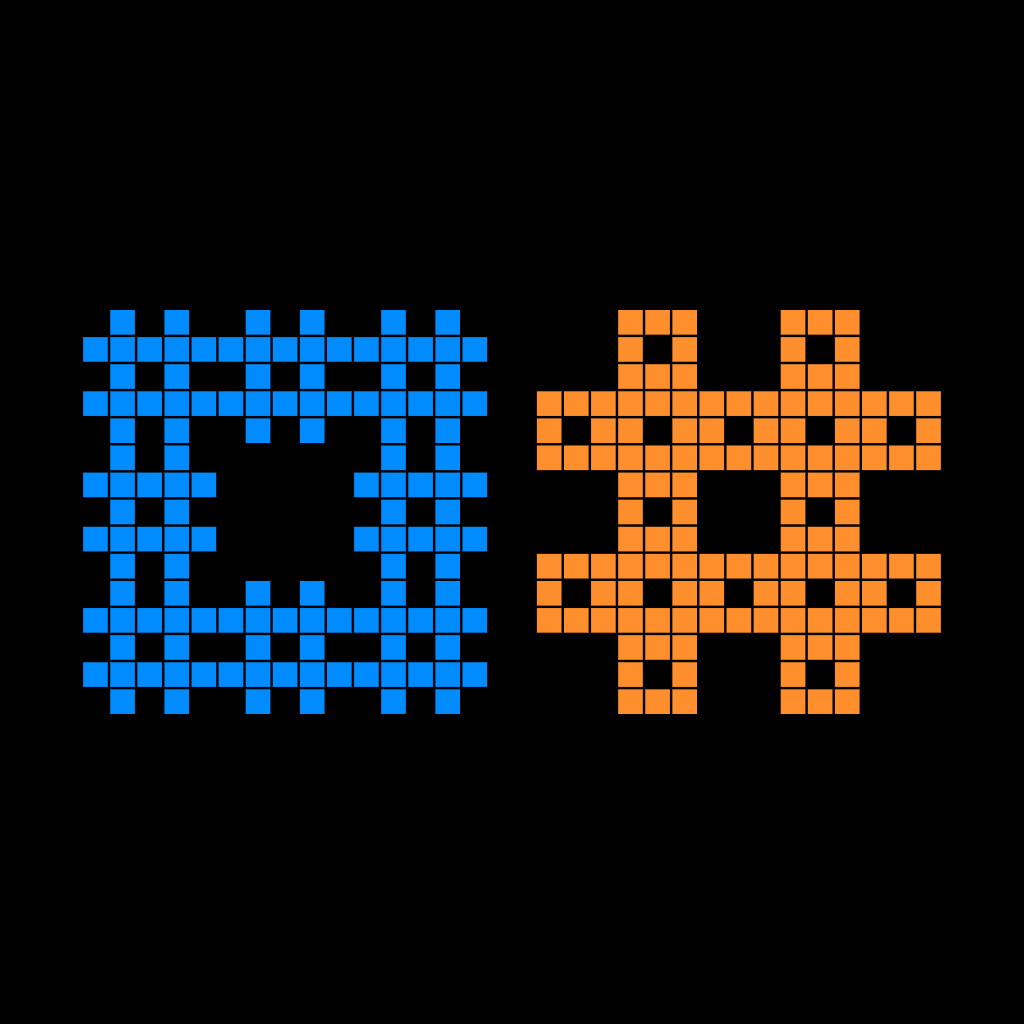
Magic words
A design's fractal is one rule substituted into itself by the Kronecker product. A magic word lets the rule change with the scale: an ordered list of letters, one per level, folded with the first letter outermost, A_w = A_(c_1) (x) ... (x) A_(c_level). The constructor is mrlymath::bang::magic in the crates, and this page fixes the grammar of the word, sorts the families that collapse back into the ordinary self-similar theory from the ones that do not, and says plainly which of the survivors are already published outside this tree.
The short answer is that most of the space collapses. A constant word is a fractal under another name, a periodic word is one composite tile, and over a finite alphabet every word whose letter frequencies exist has a scale dimension equal to a frequency average. What survives is not dimension at all: it is the observables that see the order of the letters, and the arithmetic of the composite codes the catalog cannot otherwise name, where the monoid of composites is now measured and its factorisation is not unique. Even there the collapse reaches further than expected, since the component count is now solved on every one of the 105 letter pairs and its growth rate at any interior frequency is a function of the letter frequencies too, so only the finite-length counts and the boundary of the simplex keep the order.
Proved means a proof is given here; Verified means recomputed by a crate test or a lab study; Conjecture means neither. The staircase numbers below are printed by lab/py/slice-ladder-controls, the base-15 composition by lab/py/complex-dimensions, and every factorisation and collision count by lab/rs/code-factorisation; every quantity on this page that has no generator is written as a question, never as a number. The words demo builds a word letter by letter and reads its census, its block reduction, its order swap, its code collision and its component exponent out of the same crates.
The grammar
A letter is a design, a residue base and a rendered side, written design[.base<base>](<side>), as in carpet(3), net(5), c495.base3(9). The design part is an alias or c<code>: a code is a cell bitmask over the base^dim grid, which at base 2 is the corner bitmask of the core page, and the aliases name tile-source codes, in the plane carpet 7, net 14, htree 3, vtree 5, void 9 with the rest listed in the crate name tables. An alias names a code, not a symmetry class: carpet and net collapse into one class at base 2 (core) and stay distinct letters here because the two codes render distinct tiles inside a word. A code at a base past 2 whose digit set is not a parity rule is a perfectly good tile but not a mrly design, and inherits nothing from the design census (dimensions).
A word is a comma list of letters, first letter outermost, written carpet(3), net(5), void(7), with the call form magic(carpet(3), net(5), void(7)) when a verb is wanted. The numbers-only form magic(3,5) is sugar for the all-carpet word and is the spelling dimensions already uses; the letter carpet_3 there is carpet(3) here. Dimension is a property of the word, since the constructor rejects mixed dimension, and is prefixed once as d3: when it is not the plane. Base is a property of the letter, and mixed-base words are legal. Hex is a view rather than a dimension, suffixed | iso, | pro or | cut on a solid word, because a hexagon here is always the diagonal slice of a cube. A word of letters of sides n_1 .. n_level and fills k_1 .. k_level has side prod n_i, fill prod k_i, density prod (k_i / n_i^dim) and scale dimension sum log k_i / sum log n_i, every one of them a product or a ratio of sums over the letters, which is why the four are blind to the order and everything interesting on this page is not.
A letter is native when its rendered side equals its residue base, and .base2 is never written, exactly as base 2 never appears in a design name. Only a fully native word has filled points of mixed-radix digit form, and a letter rendered at a side unrelated to its base is a tile product that inherits no digit theorem for free (dimensions). Printing both numbers is what keeps that distinction visible in the notation itself.
A decoration on a letter folds into a code. Proved. A letter may carry a quarter turn and a fill swap, written .turn<k> and .anti after the side as in net(5).turn1, following the turn and anti slots of the crate name tables. The swap renders the complementary code at every base and every side, since a render is decided cell by cell by the residue of the coordinate. A turn is a code again whenever the render commutes with it, which at base 2 is every odd side: side - 1 is even, so side - 1 - x and x share a residue, which makes the half turn of the rendered tile the identity and a quarter turn the render of the transposed corner rule. A decoration is therefore a spelling and not an object, and the ladder below folds every one of them away before anything reads the word.
The compact token for links, file names and URLs is the word kind's file view, word_dim=<dim>_magic=[<codes>]_side=[<sides>], with base=[<bases>] when a letter sits past base 2 and nothing else, because the word kind carries exactly the dimension, the ordered codes, the side of each letter and the base of each letter (crate name tables). It holds at every dimension and every base, and mrlymath::name::Word refuses a word of fewer than two letters or a letter of code 0, so the annihilating letter of the ladder below cannot be named. The prose form, the file form and the parse back are one round trip, magic_name, magic_key and magic_parse of mrlydemo::magic, and the file form is what the w= tail of a word link carries. What still has no canonical name is a drawn word: the tile kind is plane-only and caps codes at the corner range, so a solid word or one past base 2 renders without a tile name, and a letter's turn and fill swap are spelled on the letter here and carried by no name kind at all.
Order is part of the object and the notation is ordered. Side, fill, density and the main-diagonal count are functions of the letter multiset alone (Proved, DISCOVERIES), and contact counts are exactly multiplicative (Verified, same ledger), so a sorted letter list is a legitimate index; components, Euler characteristic, holes, boundary and the anti-diagonal profile are order-sensitive (connectivity), so a sorted list is never the word. The hyperoctahedral group acts diagonally through the Kronecker product. Proved. For g in B_dim, g . (A (x) B) = (g . A) (x) (g . B), because reflecting a mixed-radix coordinate reflects every digit at once, (nm - 1) - x = (n - 1 - i) m + (m - 1 - j); so a word canonicalises under one shared g applied to all letters, never letter by letter in independent orbits.
One word has one canonical form, and the steps that reach it run in this order, because folding and naming do not commute.
- Expand the sugar. A schedule prefix and the run notation
X^mbecome a flat ordered letter list, andmrlymath::bang::magicnever sees either. - The empty letter annihilates. Code
0anywhere empties the word, which is why the word name kind refuses a letter of code 0 rather than folding it. - Only a trailing solid letter is a magnification. Proved.
A (x) full(n)replaces every filled cell ofAby a solidn x nblock, which isAmagnified, whilefull(n) (x) Alaysn^dimcopies ofAin a grid, soc15(2), carpet(3)andcarpet(3), c15(2)differ cell for cell at equal side and equal fill; a solid letter is absorbed at the end of a word and nowhere else. - Fold the decorations, by the law above, and a half turn at odd side folds away entirely.
- Fold the runs. Adjacent equal letters contract to
X^m. - Print the block reduction, never hide it. A run
u^mprints beside its one-period composite, of side the product of the sides and fill the product of the fills, and of residue base the product of the bases when every letter is native. - Name a fractal a fractal. If the fold leaves one letter under an exponent, the word was self-similar all along and is written
fractal(X, m). - Never sort and never commute. Order is the object, and the monoid is not a trace monoid, so no rewriting by letter exchange is sound even where a particular pair does commute.
- Take the class representative under one shared symmetry. The diagonal action above acts letterwise, and the representative is the least word of its orbit in the letter order.
- Stop at the name. The name is the composite with its ordered side profile, and the sorted letter multiset underneath it is an index fixing side, fill, density, the main-diagonal count, the contact counts and the scale dimension, never an identity.
A family of words is named by its generator and never by its members. row runs one design over ascending sides, carpet(3,5,7); col runs one side over designs, [carpet, void, net](3); dia zips lists of equal length; free is any letter list at all. Sides come from odd, even, all or an arithmetic run arith(a, d, k), designs from the source catalog of mrlymath::bang::catalog, and an infinite schedule reaches a word only through its length-n prefix S|n. The schedules with a generator behind them are the constant, the periodic and the Thue-Morse word over an ordered pair, and the staircase, all four in mrlymath::bang::word; an arithmetic or random schedule is grammar and nothing more. A family token is a recipe, so any name that has to identify one object spells its letters out.
The four words
Four constructors lay the same picture: a mask of side f, a palette of cells of side n, one block of the palette at each mask site, and a result of side f n. A fractal takes the mask c and the palette [empty, c] and iterates it, mrlycore::Tensor::fractal. A magic word takes the prefix word as its mask and [empty, last letter] as its palette, mrlymath::bang::magic. A special takes a mask of quarter turns and the turn orbit of one design as its palette, mrlymath::two::geometry::special. A mosaic takes a base-k mask and any k designs as its palette, mrlycore::cell::mosaic. They nest by what the palette may hold: fractal inside magic inside mosaic, and special inside mosaic. Magic meets special at a plain tiling and nowhere else. Proved. Every mask site of a special carries a block, so a special is a magic pair exactly when all its blocks agree, which is full(f) (x) c at a constant mask or at a design c fixed by the quarter turn; anywhere else a special leaves no empty block for a word's mask to be read off.
A mosaic whose palette is empty and one design is a magic pair. Proved. The block at mask site x is the palette cell the mask value indexes, so at the palette [empty, c] the block is c exactly where the mask is filled, which is the definition of M (x) c; a census over both families counts such a mosaic once, on the word side.
Fill is linear in the mask histogram, not multiplicative. Proved. Writing h_i(M) for the number of mask sites of value i, the blocks are disjoint and fill = sum_i h_i(M) fill(P_i), which collapses to the product law of a word only when the palette holds one design beside the empty cell. The multiplicative laws of a word, side, fill, density and the scale dimension, are a property of the two-cell palette and not of block substitution, and the Kronecker law goes with them: block reduction is one line of associativity for a word and is given up on purpose the moment a palette holds two designs. A mosaic is a substitution rather than a product, since the Kronecker product multiplies cell values and so composes two-valued tiles alone, while a mask indexes its palette and stays a digit rule at every base.
A special is fill-invariant, fill = f^dim fill(c) at a mask of side f. Proved. An orientation permutes the entries of a cell, so every palette copy carries the fill of c, and the mask lays f^dim disjoint blocks; the crate spot-checks it at both dimensions, special_rotations_preserve_sum in mrlymath::two::geometry on one plane mask and orientations_preserve_sum_and_shape in mrlymath::three::geometry over all 24 orientations of the cube. A special therefore moves no fill and its census is topology alone; its palette is the orbit of one design under the ambient rotation group, which is why it sits inside mosaic with no axis of its own, and why the mask carries four turn values in the plane and 24 in the cube while the palette itself is smaller whenever the design is fixed by one of them.
The tile rollers are narrower than the constructors, and their choices are art rather than object: mrlymath::two::tile draws a special by turning a fixed vertical tree under the one chosen source read as a two-valued mask, and a mosaic from three sources under one fixed three-valued tree mask. Neither shape is inherited by anything counted here.
What a periodic word is
A periodic word is not a word, it is a letter. Proved. By associativity of the Kronecker product, a word repeated any number of times is the ordinary self-similar theory of its one-period composite tile, at side the product of the sides and fill the product of the fills; the statement is on dimensions and in the ledger. When every letter is native the composite is one residue rule at base the product of the bases, in general not itself a parity design: the alternating base-3 and base-5 word is exactly one base-15 tile on the residue set {0, 4, 10, 14}, checked both as integer arithmetic and as geometry (Verified, lab/py/complex-dimensions), and dimensions states plainly that this composite is not a parity design.
This is the law the rest of the page obeys. Any claim of novelty for a periodic schedule is a claim about a self-similar tile in disguise, and the control for any schedule experiment is the frequency-average value defined below - a proved answer for the scale dimension, and for anything else a prediction that has to be checked, since the component exponent is proved to break it. In the outside vocabulary a periodic word is a cycle in a graph-directed construction, where the collapse is not stated but follows from the cycle case of the dimension theorem (Mauldin and Williams 1988).
The composite is where periodic words stay interesting, and the catalogue question is now settled in the negative. Every number in the rest of this section is printed by lab/rs/code-factorisation, whose universes are named before they are counted and de-duplicated once.
Factorisation is unique once the ordered side profile is named. Proved, and cited rather than claimed. If A (x) B = A' (x) B' with A, A' of side m and B, B' of side n, all non-empty, then A = A' and B = B': cut the composite into an m x m array of n x n blocks, and since every non-zero block equals B and B is not the zero tile, A is read off as the 0/1 indicator of the non-zero blocks and B as any one of them. The 0/1 hypothesis is load-bearing, since over the rationals A (x) B = (kA) (x) (k^-1 B), and the block reading is the 0/1 shadow of the Van Loan and Pitsianis rearrangement. So the non-empty tiles under the Kronecker product form a monoid graded by side, cancellative and atomic, whose block test decides factorability at a named shape in O(N^2) of exact integer comparison and names both factors; a word is recoverable from its composite the moment its profile is named. All of that is published, for binary matrices under equality, in Voet and De Novellis 2025; the tree rediscovered it and cites it rather than claiming it.
The profile is not recoverable, and the axis-separable escape is refuted. Proved. The side-6 tile [6]{(0,0),(2,2)} is c1 (x) c257.base3 and also c17.base3 (x) c1; all four letters have prime side, hence are irreducible, and the two letter multisets differ; that shape-distinct factorisations exist is Example 2.5 of Voet and De Novellis 2025, and what is new here is the rest of this paragraph. It is not a rectangle, so the hope that every shape-distinct factorisation is axis-separable, which would have settled the question with one lemma, is false: separability accounts for 121 of the 171 side-6 cross-shape tiles and for none of the diagonal family. The mechanism is not a side-6 accident. I_m (x) I_n = I_mn = I_n (x) I_m, and the same for the antidiagonal E, at every pair of sides, because (nm - 1) - x = (n - 1 - i) m + (m - 1 - j) is symmetric in m and n: the digit identity the diagonal action above already carries manufactures the collision. Taking m and n distinct primes makes all four letters irreducible, so the failure lives at every side with two distinct prime factors.
Length is not an invariant either, first at side 12, and that is exactly where the word alphabet stops covering the monoid. Proved. The side-12 tile [12]{(0,0),(3,3)} reads as three irreducible letters of sides 2, 2, 3 and as two of sides 3, 4, the side-4 letter [4]{(0,0),(3,3)} being irreducible because its one candidate cut has two unequal blocks; a factorisation whose sizes are not all prime is Example 2.6 of Voet and De Novellis 2025, and what is new here is the minimality and the alphabet gap. Twelve is the smallest side where this can happen, since below it every side is a prime power, where factorisation is unique, or a product of two distinct primes, where every letter has prime side. The short reading needs a letter of composite side, and no plane code is one. So inside the magic-word submonoid, generated by letters of prime side 2 and 3, length and the side multiset are invariants for free and the phenomenon is invisible, while in the full monoid both fail. The alphabet of the words is not the alphabet of the monoid, and the two questions are printed apart from here on: 65310 of the 65535 non-empty side-4 tiles are already irreducible, and irreducibility is generic, the reducible share falling from 0.343328% at side 4 to 0.0000221% at side 6.
Two factorisations reconcile exactly when their cut chains do. Proved. Write L(C) for the divisors of the side at which C cuts. If d' | d and both lie in L(C) then the side-d left factor itself factors through the side-d' one, so two factorisations admit a common refinement if and only if the union of their cut chains is totally ordered by divisibility. Unique factorisation therefore holds at every prime-power side, where the divisors are a chain, and fails exactly when L(C) holds two incomparable divisors. L(C) is not closed under lcm, since L([12]{(0,0),(3,3)}) = {1,2,3,4,12} holds 2 and 3 and not 6, which is why the naive reading that any two factorisations refine is false.
The monoid is not a trace monoid. Proved. [2]{(0,0)} (x) [3]{(1,1)} = [6]{(1,1)} = [3]{(0,0)} (x) [2]{(1,1)} uses four pairwise distinct irreducible letters, so the relation is no commutation of a letter pair, and only 11 of the 171 side-6 cross-shape tiles are honest commutations against 160 rewritings. No canonicalisation may proceed by sorting or commuting letters, which is a third and negative rule the ladder owes.
Two letters render one tile at one side only at side 3, and the fold never manufactures such a collision. Proved. If a base-2 code and a base-3 code render one tile at one side by the residue rule, then row r equals row r' whenever r = r' mod 2 or mod 3; from side 4 up those two partitions join the whole row range, so every row and every column agrees and a non-empty constant tile is the full tile. The census is 480 pairs at side 2, 15 at side 3, one base-3 partner per non-empty base-2 code, and the full tile alone from side 4 up, checked at sides 4, 5, 6, 7, 8, 9, 12 and 18. The carpet's partner is c495 and it is unique; at side 9 the readings separate, the carpet residue filling 65 by the odd-carpet law below, c495.base3 filling 72 and the self-power of the side-3 letter filling 64, three pairwise distinct tiles. Read as level-2 fractals of that side-3 letter the two do not diverge at all, because at side 3 they are literally one tile, so the divergence is a statement about the residue rule and not about the fractal. This is a property of the alphabet alone: fixed-shape uniqueness proves the fold never creates such a collision, so they tabulate once per base and side, independently of any word.
The composite code alone is not a name. Proved. The name is the composite together with its ordered side profile, spelled c<code>(side_1 x side_2 x ... x side_level); uniqueness at a fixed profile supplies the recovery and the diagonal family supplies the failure without it. Profiles of different length occur, so the tie-break orders profiles by length first, finest before coarsest, then lexicographically, and only then does the diagonal-action class rep break what is left. The two non-injectivities are different and are disambiguated in order: the render collision belongs to the letters, so base and side are printed first, and the fold collision belongs to the profile.
The side-6 census. Verified, lab/rs/code-factorisation. The two shape images are injective and hold 7665 tiles each, 171 lie in both, so 15159 of the 2^36 - 1 side-6 tiles are reducible once the overlap is removed. Of the 171, 121 are axis-separable and 50 are not, 11 are commutations and 160 rewritings, and the 48 that are neither separable nor commuting are exactly the 48 carrying a one-cell letter in at least one reading and exactly the 48 carrying a one-cell outer factor in at least one reading: three different statistics on one set, and the study checks the sets rather than the counts. The 121 are exactly the products R x C of the 11 lines that factor in both radix orders, checked as set equality, so 121 = 11 x 11 is arithmetic with a bijection behind it rather than a numeric coincidence. Nothing new happens at a prime-power side, where no order of the sides can change: at side 8 the two shape images meet in 3375 tiles, which are exactly the triple products of base-2 codes, pure associativity, and 3375 never stands beside 171.
What is known elsewhere
Words are not a new object outside this tree, and the honest position is that the tree owns the alphabet, not the construction. Stated once: a magic word is a non-autonomous iterated function system in the sense of Rempe-Gillen and Urbanski 2016, restricted to a parity-rule alphabet, and in the plane its members are generalised Sierpinski carpets in the sense of Cristea and Steinsky 2010.
- A word at similarity maps is a Moran construction (Moran 1946), and the dimension formulas for varying-ratio constructions (Feng, Wen and Wu 1997), specialised to a common base, give the scale-dimension formula. It is cited, not claimed, and the same literature treats the lower and upper limits separately because they can differ.
- Connectedness of level-varying plane carpets has published necessary and sufficient conditions (Cristea and Steinsky 2010), so the order-sensitivity results on connectivity are positioned against that literature rather than stated cold.
- Mixed labyrinth fractals already own the word mixed, with box-counting dimension and arc structure of level-varying patterns studied there (Cristea and Steinsky 2017).
- A randomised schedule is a V-variable fractal at
V = 1(Barnsley, Hutchinson and Stenflo 2008), whose dimension theory runs through products of random matrices and lives in the companion the 2008 paper only announces (Barnsley, Hutchinson and Stenflo 2012). - Several ratios inside one level, which no move on this tree can express, is the multiscale substitution programme (Smilansky and Solomon 2021).
- A word is an S-adic directive sequence in symbolic dynamics (Berthe and Delecroix 2014), where the question of which aperiodic words behave well is a mature subject. Every one of these identifications is read at source except the Feng, Wen and Wu article, which is unreachable and is carried from verbatim restatements in citing papers, as REFS records per row; this page uses them as aliases and prior art, never as an argument.
- Kronecker factorisation of binary matrices under equality, not up to isomorphism, is a solved problem: Voet and De Novellis 2025 give uniqueness at fixed factor sizes, prime matrices, the decomposition graph that enumerates every factorisation of a given matrix, and both of the facts the section above rediscovers, that a matrix can factor at shapes of different length and that the factor sizes need not be prime. The monoid statements here are cited, never claimed. What is this tree's own is the census over the plane-code alphabet, the render collision, and what both do to the word grammar.
- False friend: the graph-product literature. Every unique-prime-factorisation theorem for the tensor product of graphs works up to isomorphism, where the product is commutative by fiat, and its load-bearing hypotheses are connectedness and non-bipartiteness; tiles forbid the permutation, demand equality on the nose, are generally not symmetric and are routinely disconnected. The gap is real but it is not where the reachable literature sits, and an earlier reading here, that no matrix literature reaches the question at all, is withdrawn.
- False friend: inhomogeneous self-similar sets are a fixed condensation set unioned in at every step (Fraser 2012) and have nothing to do with level-varying rules.
What is genuinely this tree's is narrower and firmer. The alphabet is finite, enumerated and classified by symmetry, 2^(2^dim) designs in A000616 classes (core), where the outside literature takes each level's rule as an arbitrary given subset. The composition law is the Kronecker product, which turns block reduction into one line of associativity rather than a graph-directed computation. The arithmetic side, filled points as digit strings in a non-stationary radix, is essentially absent from a metric-geometric literature. And order as a control experiment, holding side, fill, density and dimension fixed while only the letter order moves, is an experimental design the varying-ratio literature has no reason to run.
What collapses
- A constant word is a fractal. Proved. Repeating one letter is repeated self-Kronecker, which is what the level parameter already means, and the recipe layer refuses to draw such a word as magic at all.
- A periodic word is one composite tile. Proved. As above.
- Over a finite alphabet, the scale dimension is a frequency functional. Proved. The log side and log fill of a prefix of length
levelare sums of per-letter values drawn from a finite set, so if each letter's frequencyf_cexists both averages converge, the denominator average is at leastlog 2, anddimension(level) = sum log fill_i / sum log side_iconverges to(sum_c f_c log fill_c) / (sum_c f_c log side_c). Thue-Morse, period-doubling and Fibonacci words are uniquely ergodic (Berthe and Delecroix 2014), so their letter frequencies exist, so their scale dimension exists and is the frequency average: the famous aperiodic words cannot witness non-stationary behaviour in dimension. What remains of the existence question on dimensions is words over a finite alphabet with no letter frequencies, and every word over an unbounded alphabet, where frequencies can all exist while the dimension still oscillates and where the staircase itself lives. - Every value in
[0, log 8 / log 3]is a scale dimension. Proved. Over the two base-2 letterscarpet(3)andc8(3), a word wherecarpet(3)has frequencyfhas scale dimensionf log 8 / log 3; constant and periodic words realise every rationalfwith the endpoints, and Sturmian words, whose letter frequencies exist at every irrational slope (Berthe and Delecroix 2014), realise every irrationalf. The open question is not which values occur but which trajectorieslevel -> dimension(level)do. - A unit letter is a property of the code and the side together, not of the code. Proved. At odd side
2k - 1a base-2 letter fillssum over its corners of k^(zeros) (k - 1)^(ones)(mrlymath::formulas::counting, as sequences records the polygonal readings), so fill 1 forces a single corner with every coordinate odd andk = 2: at side 3 the one letter of fill 1 isc8and at side 5 the smallest fill is 4, so no letter there carries a word's dimension to zero. There is no idempotent letter either, since every letter multiplies the side, and the only absorbing letter is the empty code the grammar refuses. - One even letter removes the hex reading. Proved. Slice geometry is defined at odd side only (slices), and a product with an even factor is even, so a single even letter anywhere makes the composite side even and puts the whole hex and slice apparatus out of scope. A constraint on the construction, not a research question.
- Reversal comparisons are empty on palindromes. Proved. A palindrome equals its own reversal by definition; no further property is claimed for them.
What order does
Order sensitivity is where the content actually is, and this page owns no number of it. Connectivity records which observables separate two orderings of the same letters, with the minimal witness, and lab/rs/magic-words is the generator that prints every count of that section; they are cited there and not restated here.
The mechanism is now printed alongside the counts. Components, Euler characteristic, boundary and holes are linear-representation functions of the word, a fixed vector times a product of integer matrices, one matrix per letter (Verified, lab/rs/magic-words, as connectivity records it). Most matrix pairs fail to commute, so the word acts as a genuine matrix cocycle, and that is the only structure on this tree an aperiodic schedule can still reach once the dimension collapses to a frequency average.
The component exponent at any interior letter frequency is order-blind on the whole alphabet, and it is not the constant-word frequency average. Proved. Every one of the 105 letter pairs now carries an exact closed form, so along any word over a pair in which both letters have strictly positive frequency the growth rate exists, is a function of the letter frequencies alone, and is written down; connectivity carries the forms, their proofs and the comparison, and lab/rs/magic-words prints every number. The prediction Phi(f) = (f_6 + f_9) log 2, the one linear functional exact on constant words, then fails on 78 of the 105 pairs and holds on 27.
Two things fall with it. The payoff this page conjectured is refuted: a difference is not a non-stationary result. The exponent is frequency-only at interior frequency, so Thue-Morse returns what a periodic word of the same frequencies and almost every Bernoulli word return, and the tree's own stationary controls miss the prediction by the same amount; what a difference refutes is the frequency functional, not stationarity. And most of the difference is cheap: on 89 of the 105 pairs the exponent merely saturates the fill ceiling, which was already order-blind, leaving the domino against the full tile as the one class pair whose rate sits strictly between the constant-word values and that ceiling. The positive-frequency hypothesis is not decoration either - three words at one frequency vector give rates 0, log 2 and no limit at all - so any rate stated without it is refuted outright. The control is read with care at an irrational frequency: a word of period p has every letter frequency in (1/p)Z, so no periodic word carries the frequencies of a Sturmian word, and the comparison there is against the value of the frequency functional rather than against a word.
Existence along a named word is earned from the closed form, never from an engine. Proved, and the negative half is the more useful one. Along Thue-Morse over a gasket-and-domino pair the exponent is exactly (1/2) log 6, with a two-sided certificate rather than a fit. No ergodic theorem is used to get it and none could be: the observable is not subadditive and not a norm, and along 3^inf the matrix-norm exponent is log 2 while the component exponent is 0, so the top Lyapunov and joint-spectral-radius invariants (Furstenberg and Kesten 1960, Jungers 2009) answer a different question. Growth rates over an ergodic measure exist at almost every word, not at a named one, and unique ergodicity by itself gives nothing here; connectivity names the ruled-out class in full and carries the invariant cone that does exist and still does not help. The Thue-Morse demo builds that word twice from one digit rule and lifts it to four plane grids, three of them Kronecker powers of a plus-minus tile and one not, with its runs and its boundary word.
What stays open is elsewhere. Conjecture. Nothing above speaks about three-or-more-letter alphabets, a base past 2, dim 3, or the other order-sensitive observables, whose representations have ranks 4, 8 and 11. Nor about words whose letter frequencies fail to exist: over (3, 7) a word keeping both letters at lower density 1/4 has a prefix rate that ranges over an interval with no narrowing to level 4096, which is evidence that positive lower density is the wrong hypothesis and not a proof that the limit fails.
The staircase
The staircase word stacks prefixes, magic(3), then magic(3,5), then magic(3,5,7) (dimensions), so the letter in position j occurs n - j + 1 times in the first n blocks, side and fill are the matching products of letter powers, and dimension(n) = sum_j (n-j+1) log fill_j / sum_j (n-j+1) log base_j (Proved, read off the occurrence count). It is aperiodic and not eventually periodic, so block reduction does not apply to it; it is the cheapest concrete non-stationary schedule on the tree.
The odd-carpet fill law. Proved. The carpet code rendered at odd side side fills the cells whose coordinates are not both odd: with E = (side+1)/2 even positions and O = (side-1)/2 odd positions per axis, the fill is E^2 + 2EO = (3*side^2 + 2*side - 1)/4 = side^2 - ((side-1)/2)^2, the octagonal number 3k^2 - 2k at side 2k - 1 already identified for this rule on sequences. This discharges the fill assumption lab/py/slice-ladder-controls states before printing, so its five staircase dimensions 1.892789261, 1.892315261, 1.893034267, 1.894190425, 1.895495742 stand (Verified, lab/py/slice-ladder-controls, under the fill law proved here). The sequence is not monotone: it dips at the second term, because the base-5 carpet is less dense than the base-3 carpet, before climbing.
The staircase dimension tends to the ambient dimension. Proved. The per-letter dimension log fill_j / log base_j tends to 2 as base_j grows, and dimension(n) is the weighted average of the per-letter dimensions under the weights (n-j+1) log base_j, where the first J letters carry weight O(n) of a total that grows like n^2 log n, so the average inherits the tail limit. The staircase is dimensionally boring in the limit, full dimension and zero measure, and its only content is the rate of approach, which is unmeasured here. The tower demo holds the tile to one axis with the word rising a letter per block, where a block's fill fraction falls geometrically while its exposed count climbs, so the volume converges and the surface does not.
Not claimed
- No word on this tree is nonlattice. Every move chooses cells of a fixed grid, so every level has one ratio; nonlattice needs incommensurable ratios inside one level, which the multiscale substitution literature has and this construction does not.
- Nothing here is adjacent to the Riemann hypothesis. The inverse spectral problem is vacuous for lattice designs, and no schedule of lattice designs restores it.
- The scale-dimension formula is not a discovery of this tree, and neither is the fact that the limit can fail to exist. Both are cited above.
- No count of order sensitivity is asserted on this page:
lab/rs/magic-wordsprints them and connectivity records them. The factorisation counts that are asserted are exactly the oneslab/rs/code-factorisationprints, and each names its universe. The component growth rates that are asserted are exactly the oneslab/rs/magic-wordsprints, they cover all 105 letter pairs, and each carries its positive-frequency hypothesis inside the statement. - No factorisation count on this page is a design count. Every composite here is a residue rule at the product base, generally not a parity design (dimensions), so none of these numbers may be fed the design census of core, and 15 and 511 are code universes rather than symmetry classes.
- The monoid results are not a discovery of this tree. Fixed-shape uniqueness, the prime vocabulary and the shape-distinct factorisation are prior art, cited above; what is asserted as new is the census, the render-collision theorem and the consequences for the grammar.
- A count along a periodic word is never arithmetic. The order-sensitive observables are a fixed vector times a product of one integer matrix per letter, so along a periodic word a count is that vector times the powers of one matrix and satisfies a linear recurrence; a match in a table of sequences is then a linear recurrence and never a fact about the numbers.
- No dimension of a mosaic is claimed. Iterating a mosaic, one mask per palette slot, is a graph-directed construction, whose dimension is the spectral radius of a substitution matrix (Mauldin and Williams 1988) rather than a product of sides, and no generator on this tree computes it.
- One anti-diagonal profile coefficient is never quoted alone: the total is order-blind and the profile is not (DISCOVERIES), so the whole profile is the observable or nothing is.
OPEN QUESTIONS
- Which words make the scale dimension exist, now reduced to finite alphabets without letter frequencies and to unbounded alphabets; a word-combinatorics question, not a dimension-theory one.
- Which trajectories
level -> dimension(level)are realisable by a schedule over a finite alphabet: monotone, bounded oscillation, prescribed rate. - Which words with no letter frequencies have a component exponent at all, now that every letter pair has a closed form and interior frequency settles the rate; positive lower density is not enough, and the accumulation set of
comp/fillalong Thue-Morse is unidentified. - Whether an alphabet of three or more letters, or another order-sensitive observable, makes the exponent depend on more than the letter frequencies, which is what a genuinely non-stationary result would need; at interior frequency on two letters it provably does not, on any of the 105 pairs.
- Whether the same suffix recursion that closes the 46 reproduces the 59 already-known forms, which would collapse the whole table to one lemma, and whether the Euler, boundary and holes series of ranks 4, 8 and 11 answer to it as well.
- Whether
L(C)is closed under gcd, the one missing structural fact: with it the cut set is a meet-subsemilattice of the divisor lattice and the canonical name closes. Zero failures over every non-empty subset of a line toN = 20and over all 339795 side-12 plane-code composites, and no proof. - An intrinsic description of which tiles are Kronecker products, rather than the block test's algorithm and the published decomposition graph, and a counting theorem at non-prime-power side, where 171 and 15159 are enumeration and not formula; the gcd question above is the obstruction to the second.
- Which pairs of letters commute in general. One-cell letters commute exactly when
a(n - 1) = b(m - 1)at sidesnandmand cellsaandb, which givesgcd(m - 1, n - 1) + 1singleton pairs per axis; the earlier reading of the side-6 list as four corner cells plus scale-free families is refuted at sides(3,5), and whether the diagonal and the antidiagonal are the only permutation tiles factoring in both radix orders at every coprime split is open. - What the irreducible letters of composite side do, now that they are known to exist and to be generic. This is the question the word census could not see, since every plane code has prime side, and it replaces the question of a fourth mechanism above side 6.
- Does applying a different symmetry to each letter move any order-sensitive observable, given the representation already separates codes the square's symmetry group identifies (connectivity).
- What a mixed-base word does to the base-specific arithmetic of bases, whose structures exist at some bases and provably not at others, since a word may cross bases from letter to letter.
- Is the rate at which the staircase approaches the ambient dimension a clean expression in the letters.
Where the numbers live
The five staircase dimensions come from lab/py/slice-ladder-controls, which states its fill assumption before printing; the assumption is proved above. The base-15 composition comes from lab/py/complex-dimensions. The design and class counts come from the mrlymath census on the core page. The order-sensitivity counts, the cocycle matrices and the component growth families come from lab/rs/magic-words, recorded on connectivity and in the ledger. The factorisation census, the cut-set sweeps, the two witnesses and the render collisions come from lab/rs/code-factorisation, which cross-checks both of its renderers against the crate. Everything else on this page is a proof restated in place or a question.
The word is ordered, the dimension is not, and everything interesting lives in the gap.