Coprimality Density Above Dimension One
MrlyProd
First published 2026-08-23, revised 2026-09-08
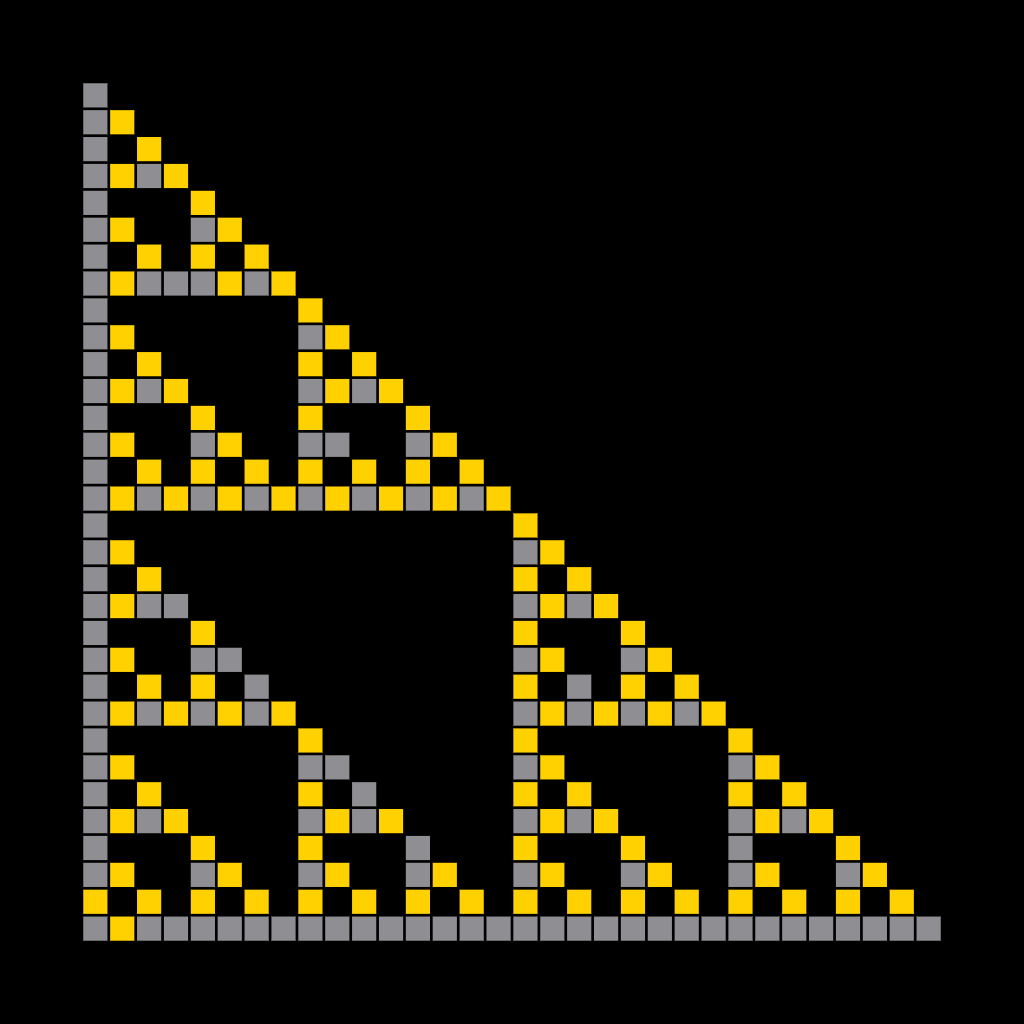
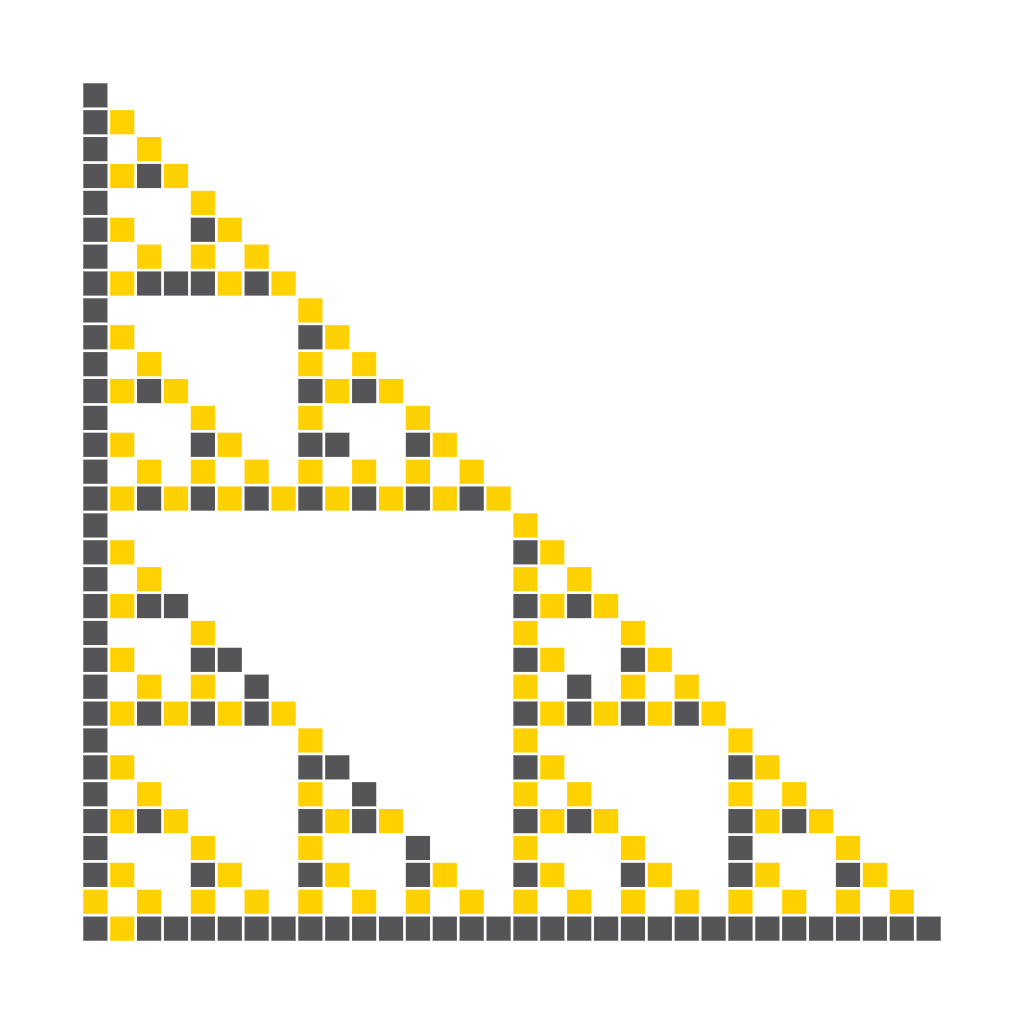
Stand at the origin of a square grid and look out: you can see a lattice point exactly when its coordinates share no common factor, and of all lattice points are visible. Now do the same on a fractal - the Sierpinski gasket, say, built by keeping the points of whose binary digit pairs all avoid . The answer changes to , and this paper proves why, for every fractal of this kind whose dimension exceeds one. Every prime away from the base keeps its classical factor; every prime dividing the base is deleted and replaced, collectively and exactly, by a single rational number read straight off the digit set.
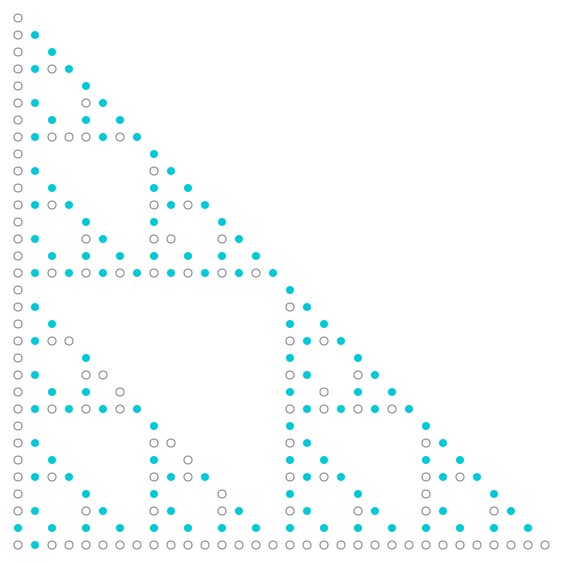
Fix a base , a dimension , and a set of admissible digit vectors, . The level- set holds the points of all of whose base- digit vectors lie in , and counts those with coordinate gcd . The design is spanning when the differences generate , and its attractor has dimension . The bracket is , where counts the corners all of whose coordinates are divisible by .
Theorem. If the design is spanning and - equivalently, the dimension exceeds - then
The proof is an elementary sieve. A digit-box bound gives ; summed against the von Mangoldt weight it converges precisely when , which is where the hypothesis lives and the only place it is used. Spanning enters once, in a character contraction that equidistributes modulo every coprime to . The hypothesis cannot stand alone: at , has yet forever - though one shear by restores the constant . For the gasket the theorem settles the convergence conjecture recorded in OEIS A396934, that . The scripts re-check the finite claims: ten designs enumerated exhaustively over 67 level rows and 1,352,989 points, the gasket to ; the base-6 identity that points have gcd coprime to while the naive product of per-prime marginals predicts ; the box bound in 1062 exact cases; and the exhaustive base-2, census - all 65536 designs closing into 402 orbits, 336 of them inside the theorem.