Two bases
Every page of this tree reads one base at a time, and that is a law rather than a habit. Two bases in one dependence class are one base and belong to bases; this page is about the other case. Cobham's theorem says a set recognized by a finite automaton in two multiplicatively independent bases is already periodic, so at dim 1 a proper design has exactly one base and the joint object of two bases is not a design, not an automaton and not a transfer matrix. This page states the law at its source, makes the dim 1 consequence exact, prices dim >= 2 where the law is weaker than folklore says, lists which of this tree's instruments survive contact with a second base and which do not, turns to the smallest honest two-base object, a base-2 gasket meeting a base-3 gasket, whose census refutes the naive planar budget, then to a three-base object on the line whose budget is negative and whose census finds five members and no sixth below a height of 38170 decimal digits, reads a two-base cell on the line for the two lattice frequencies its bases would each impose and finds the verdict unstable in height, and closes on the transcendence wall that stands between every instrument of this tree and any two-base exponent.
Every claim carries a tag. Proved means a proof is given or restated here; Verified means recomputed from scratch by a lab study; Conjecture means neither; Refuted means shown false. lab/py/two-base-gasket, lab/rs/three-base-thin and lab/py/two-base-instrument are the three generators behind every number below, the last of them behind the periodogram section alone.
Independence is a partition of the bases
- Two reals
alpha, beta > 1are multiplicatively independent whenalpha^m = beta^nwithm, ninNforcesm = n = 0(Durand and Rigo, Definition 1.1, read at source); for two integer basesp, q >= 2this readsp^i != q^jfor every pair of positive integersi, j. - Equivalently
log p / log qis irrational, and equivalentlypandqare not both powers of one integer; coprime integers are always independent, and6and18are independent without being coprime (same source). - Multiplicative dependence is an equivalence relation on the integers
>= 2, and each class is the set of powers of its least member, the first classes being[2], [3], [5], [6], [7], [10], [11], [12](same source, Remark 1.2). - Proved. Independence is never emergent in a triple. Dependence is transitive, so three bases that are pairwise dependent are jointly dependent, and one independent pair inside any family already makes the family carry an independent pair. A third base adds no hypothesis that a pair does not already carry, and the dependence-class partition, not the tuple, is the invariant.
- Base
1is not a base:k-recognizability, recognition in a basek, is defined fork >= 2only, so a pair holding base 1 has no content. - Bases
2and4are one base: they lie in the class[2], andk-recognizability andl-recognizability coincide on a dependent pair (Bes, attributing it to Buchi, read at source), so Cobham's hypothesis fails there. - Proved. The conclusion fails with it, so the hypothesis is load-bearing and not decoration: the base-4 design
{0, 1}is4-recognizable, hence2-recognizable, and it is infinite of density(1/2)^level, hence not ultimately periodic.
The law, at its source
- Theorem (Cobham 1969). "Let
k, l >= 2be multiplicatively independent integers. Every subsetXofNwhich isk- andl-recognizable is ultimately periodic. Therefore such aXism-recognizable for anym >= 2." (Bes, Theorem 24, read at source; Durand and Rigo state the same as Theorem 1.1 with "if and only if".) - Theorem (Cobham-Semenov, Semenov 1977). "For any
n >= 1, and all multiplicatively independent integersk, l >= 2, every subset ofN^nwhich isk- andl-recognizable is definable in<N; =, +>." (Bes, Theorem 25, read at source; the same statement is Durand and Rigo Theorem 4.7.) - Definable in
<N; =, +>is semilinear, a finite union of setsv + N c_1 + ... + N c_rwithvand thec_iinN^n(Bes, Theorem 4, after Ginsburg and Spanier); atn = 1semilinear is exactly ultimately periodic. - The law splits the subsets of
Ninto three classes and not two (Bes, read at source): the ultimately periodic sets, recognizable in every base; the sets recognizable in one dependence class and no other, where every proper design of this tree sits; and the sets recognizable in no base at all, the primes and the squares among them.
The dim 1 consequence is exact
- Proved. Let the filled digits
Flie inside{0, ..., base-1}with0 in Fand1 < card F < base, and letS_Fbe the integers whose digits all lie inF. ThenS_Fis recognizable in no base multiplicatively independent of that one. Proof:S_Fis infinite, sinced base^jlies in it for every nonzerodinFand everyj;card(S_F cap [0, base^level)) = (card F)^level, so the density is(card F / base)^level, which tends to0; an infinite ultimately periodic set has positive density; soS_Fis not ultimately periodic, and Cobham's theorem forbids a second independent base. - The two hypotheses are exactly the two exclusions:
card F > 1removesF = {0}andcard F < baseremoves the full digit set, and those two are the only semilinear designs at dim 1. Every other one-dimensional design is base-locked.
Which designs are semilinear
- Refuted. The sentence "no proper design is recognizable in two independent bases, at any
dim" is false. At dim 2 and base 2 the designF = {(0,0), (1,1)}hasS_F = {(n, n)}over the integersn, the diagonal, which is definable in<N; =, +>and so recognizable in every base. Proper designs recognizable in two independent bases exist as soon asdim >= 2, and the dim 1 statement above does not generalize by itself. - Proved (the necessary condition). If
S_Fis semilinear thencard F = base^dfor an integer0 <= d <= dim, andS_Flies in a finite union ofd-dimensional affine subspaces. A linear setv + N c_1 + ... + N c_rwhose generators span a subspace of dimensionemeets[0, N)^diminTheta(N^e)points, so a semilinear set's count in the box isTheta(N^d)withdthe largest span dimension among its constituents; the design's own count iscard(S_F cap [0, base^level)^dim) = (card F)^levelexactly, so(card F)^level = Theta(base^(d level))andcard F = base^d. - Proved (the sufficient condition). Call
Fa block design when thedimcoordinates split into a zero setZanddblocks, andF = {v in {0,...,base-1}^dim : v_i = 0 on Z, and v_i = v_j whenever i and j share a block}. Thencard F = base^dandS_F = N c_1 + ... + N c_dwithc_tthe0/1indicator vector of blockt, which is one linear set, hence semilinear, hence recognizable in every base. - Proved at base 2, dim 2. The two conditions agree there: of the eight designs containing
0, the five of cardinality1, 2, 2, 2, 4are exactly the block designs and are semilinear, and the three of cardinality3are excluded by the count. - Conjecture. Block designs are the only semilinear ones, at every base and every
dim. - Proved (the count alone is not enough). The base-3 gasket
F = {(0,0), (0,1), (1,0)}hascard F = 3 = 3^1and is not semilinear. Its box count is3^levelat side3^level, sod = 1and a semilinearS_Fwould lie in finitely many lines; butS_FcontainsP_t = (3^t, 3^(t^2))for everyt >= 2, whose consecutive slopes ares_t = 3^(t^2 - t) (3^(2t+1) - 1)/2, strictly increasing int, so theP_tare in strictly convex position, no three are collinear, and coveringnof them costs at leastn/2lines. Hence the base-3 gasket is not2-recognizable, and no automaton reading base-2 digits enforces its digit rule. - Proved. The base-2 gasket
F = {(0,0), (0,1), (1,0)}is not semilinear either, and needs no geometry:card F = 3is not a power of2. It is therefore not3-recognizable.
What the second base does to this tree's instruments
- Proved. When
pandqare independent and a base-qdesign is not semilinear, no finite automaton reading base-pdigits accepts it, so no transfer matrix over the digits of one base reads the constraint the other base imposes. What dies is the method and not the object: an intersection can still be recognizable by accident, a finite set being recognizable in every base, so nothing here says the joint object is complicated, only that neither base's machine sees it. - Survives: the box bound of the coprimality sieve. coprime proves
N*_level(m) <= (base+1)^dim fill^level m^(-alpha)withalpha = log_base(fill), and that is pure counting onS_level, so it passes to every subset by monotonicity, the joint object included, and the Chebyshev sum built on it still converges whenalpha > 1. That is one line of the sieve and it was never the hard part. - Dies: the fill law. method carries
fill(F, 2k-1) = sum_(c in F) k^(dim - w(c)) (k-1)^w(c)at odd side2k - 1and the level rulefill(level) = fill^level, both identities on a Kronecker power in one base. A joint object of two independent bases has no product structure at any scale, so there is no level at which a fill count multiplies. - Dies: the transfer matrix and its Perron root. beneath reads a window rule as a vertex shift and prints
log_2 rhowithrhothe Perron eigenvalue of a nonnegative integer matrix; cuts reads the central slice through the even transfer matrixM_even; crop certifies its own Perron brackets by Collatz-Wielandt. Each is a finite automaton over the digits of one base, and each falls to the previous bullet. - Dies: the carry automaton of cuts. Its states are the integers
cwithabs(c) <= floor((dim-1)/2)and its transition isc' = (c + dim - s)/3; it is finite becausex -> (x + dim)/3contracts on integer carries inside one base. A machine reading base-2 digits while tracking base-3 digits is base conversion, which is not finite state. - Dies: the character contraction. coprime's Lemma A splits the one-digit character sum at a position where the orbit is far from an integer and gives
abs(Sum) <= fill - 2 + 2 cos(pi/(2 base)); the equidistribution half of the sieve consumes one such factor per orbit cycle, and one per window ofm_ddigit positions under Lemma A'. The contraction is exactly the statement that the transform at one level factors over digit positions in one base, and the joint set factors in neither. A sieve needs an upper bound and an equidistribution; two bases hand over the first and destroy the second.
The budget on the line
- Theorem (Corso and Shmerkin 2024, Corollary 1.17, read at source). "Let
p_1, ..., p_d,A_1, ..., A_dandsbe as in Theorem 1.15. Then, for all affine mapsg_1, ..., g_d : R -> R,dim-upper_B(g_1(A_1) cap ... cap g_d(A_d)) <= max{s - (d-1), 0}." Theorem 1.15 carries the hypotheses:p_1, ..., p_d >= 2pairwise multiplicatively independent,A_1, ..., A_dclosed subsets of the circleTinvariant underT_(p_1), ..., T_(p_d), ands = sum_j dim_H A_j. - At
d = 2that is Furstenberg's intersection conjecture, stated by Shmerkin 2019 as his Conjecture 1.1 after Furstenberg 1970 and proved as his Theorem 1.2, read at source: "Letp, q in N_(>=2)be multiplicatively independent. Then for any closed setsA, Bof the circle[0, 1)invariant underT_p, T_qrespectively, and for any invertible affine mapg : R -> R,dim-B(A cap g(B)) <= max(dim_H(A) + dim_H(B) - 1, 0)." Wu 2019 proves the same independently. - Proved. The two-set theorem does not iterate, and the reason is elementary:
A cap Bneed not be invariant under either map, so it is not a legal input to the theorem against a third base. TakeAthe middle-thirds set, which isT_3-invariant, andB = [0, 1), which isT_2-invariant; thenA cap B = A, which is notT_2-invariant, since1/4 = 0.020202..._3lies in it andT_2(1/4) = 1/2 = 0.1111..._3does not. Them-fold bound is proved instead by rewriting the intersection as one slice of the productA_1 x ... x A_dinsideT^d, which is what the hypothesis on the slicing subspace in Theorem 1.15 protects. - Before that route existed the
m >= 3bound was known only under aQ-linear independence hypothesis on the ratioslog p_1 / log p_j(Yu 2021b), a transcendence condition unproved for(2, 3, 5). - The integer side of the same statement at
m = 2is Glasscock, Moreira and Richter 2024, whose main results include "integer analogues of two of Furstenberg's transversality conjectures pertaining to the dimensions of the intersectionA cap Band the sumsetA+Bofxr- andxs-invariant setsAandBwhenrandsare multiplicatively independent" (abstract read at source). A one-base design's integer set isxq-invariant in that sense at dim 1. - First of its kind, and what was searched. Read at source for this page: Shmerkin 2019, Wu 2019, Yu 2021b, Corso and Shmerkin 2024, Glasscock Moreira and Richter 2024, Burrell and Yu, Erdos Graham Ruzsa and Straus 1975 through Burrell and Yu, Senge and Straus 1973 and Stewart 1980 through the survey of Bugeaud, Cipu and Mignotte. Every dimension statement read there is an upper bound; none of them carries an asymptotic or an exact constant for any named independent pair; the only lower bound read is an infinitude statement and the only finiteness result read lives where every dimension is already zero. This card names what was searched and does not claim what does not exist.
The budget in the plane is false
- A design lives in
T^dimand uses one base on alldimcoordinates, while Theorem 1.15 asks for one set per coordinate in pairwise independent bases. The hypothesis therefore fails atdim >= 2, and the conclusion fails with it. - Refuted. The global planar budget
dim_H(A cap B) <= max(0, dim_H A + dim_H B - dim)is false at dim 2, in one line. The base-2 designF_A = {(0,0), (0,1)}givesA = {0} x Twithdim_H A = 1; the base-3 designF_B = {(0,0), (0,1)}givesB = {0} x CwithCthe base-3 digit set{0, 1}anddim_H B = log_3 2;Bsits insideA, sodim_H(A cap B) = log_3 2against a budget of1 + log_3 2 - 2 < 0. Both sets lie in the line{0} x T, which is invariant under both maps, and that is where the two codimensions refuse to add. - Proved (what product designs do give, one budget per axis). If every
F_iis a productG_i^(1) x ... x G_i^(dim)across thedimaxes in pairwise independent basesp_1, ..., p_m, then eachA_iis the product of its axis sets, the intersection is the coordinatewise intersection, upper box dimension is subadditive on products, and Corollary 1.17 applies on each axis, sodim-upper_B(cap_i A_i) <= sum_(j=1)^dim max(0, sum_i dim_H A_i^(j) - (m-1)), upper box on the left and Hausdorff on the right, as the corollary states it. - Refuted. The global budget is not a corollary of that per-axis bound, and the step that fails is
sum_j max(0, x_j) >= max(0, sum_j x_j), which runs the wrong way. The witness above is where it runs strictly wrong: the per-axis bound reads0 + log_3 2and is sharp, while the global budget reads0. - So at
dim >= 2the two-base budget is a theorem per axis for product designs and open for compounds, and core proves almost every design is a compound asdimgrows.
Budget zero is dimension zero, not finiteness
- Proved. The set
{2^n}has counting exponent zero,card({2^n} cap [0, N)) <= log_2 N + 1, and is infinite. A budget of zero says the dimension is zero and says nothing about finiteness, so a transversality bound of zero never closes a question that asks for a finite list. - Finiteness arrives only at the corner where every digit sum is bounded. Senge and Straus 1973 prove "the number of integers, the sum of whose digits in each of the bases
aandblies below a fixed bound, is finite if, and only if,aandbare multiplicatively independent", by Thue-Siegel-Roth and so ineffectively; Stewart 1980 makes it effective with Baker's theory of linear forms in logarithms, showing that for independenta, b, everyc >= 1and everym > 25whose digit sums in both bases are at mostc,log log m / (log log log m + c_1) < 2c + 1withc_1effectively computable inaandbalone. Both statements are read at source in the survey of Bugeaud, Cipu and Mignotte; the two originals are paywalled and are cited through it. - That corner is not a design. A bounded-digit-sum set is not closed under changing one digit, its count below
b^kisO(k^c), and its exponent is0; there Baker's theory beats the whole transversality machinery outright, and a third base buys nothing because two already give a finite list. - The one lower bound in that literature runs the other way. Burrell and Yu quote it as their Theorem 1.8, read at source, from Erdos, Graham, Ruzsa and Straus 1975: "Let
p, qbe integers greater than1. IfA, Bare two positive integers satisfyingA/(p-1) + B/(q-1) >= 1, then there exist infinitely many integers whose basepexpansion contains only digits<= Aand baseqexpansion contains only digits<= B."
Object Y: a base-2 gasket meets a base-3 gasket
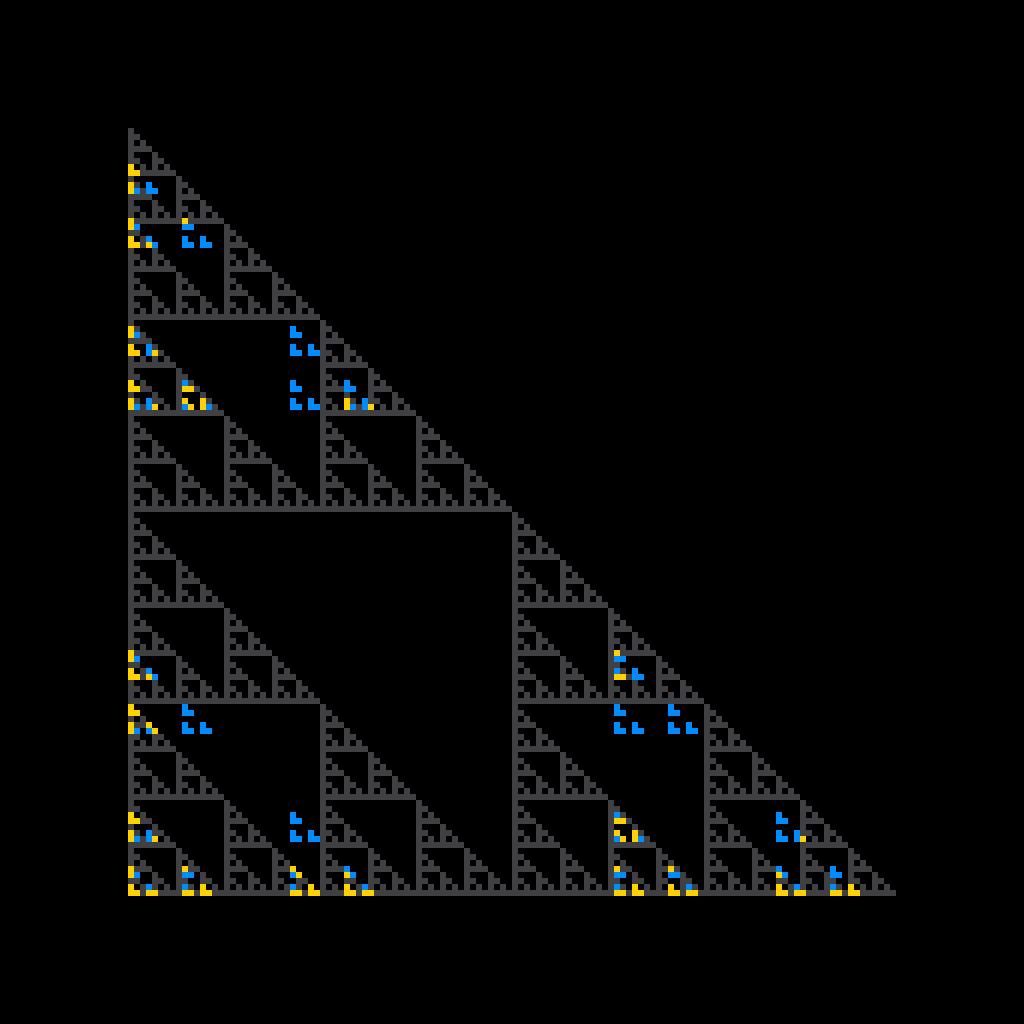
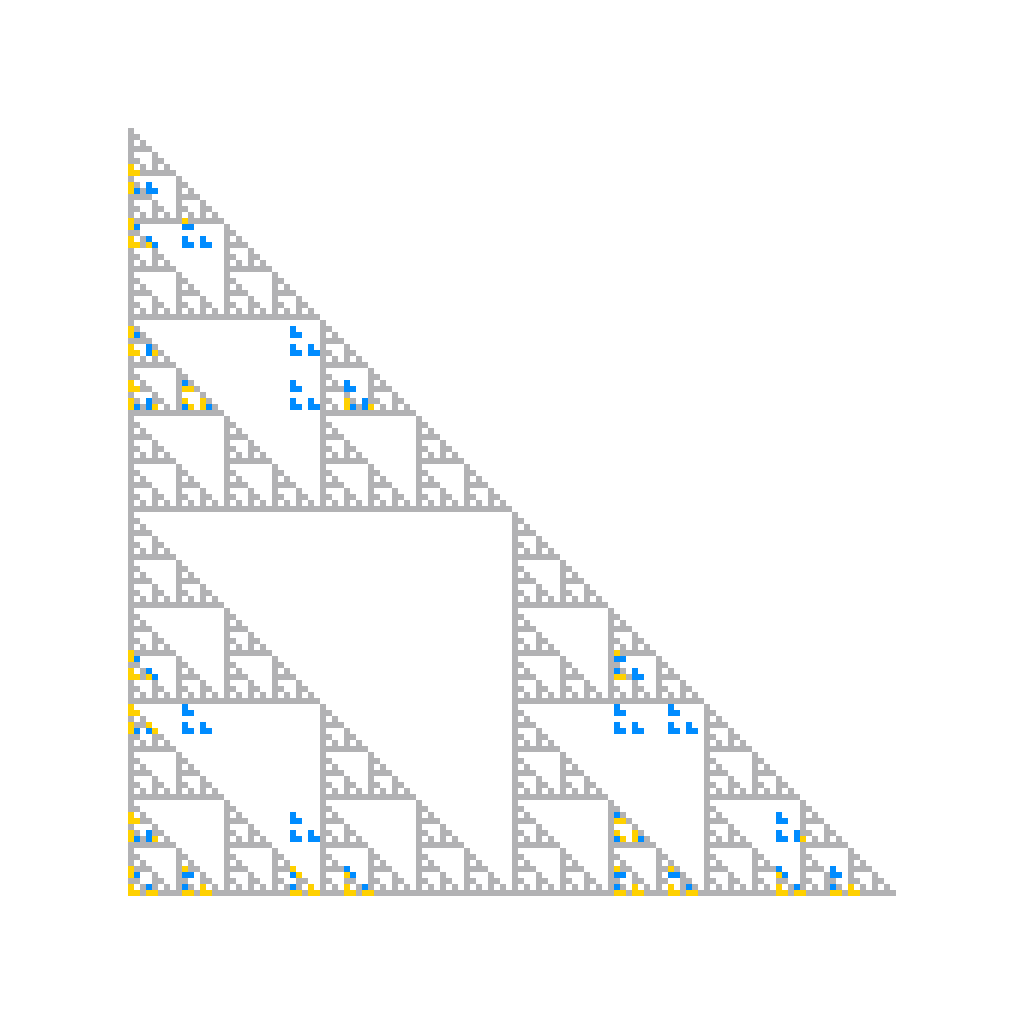
A = {(x, y) in Z^2 : every base-2 digit pair lies in {(0,0), (0,1), (1,0)}}, which is{(x, y) : x AND y = 0}, of counting exponentlog_2 3 = 1.584963.B = {(x, y) in Z^2 : every base-3 digit pair lies in {(0,0), (0,1), (1,0)}}, of counting exponentlog_3 3 = 1.C(N) = card(A cap B cap [0, N)^2)is the joint census, and the naive planar budget for it readslog_2 3 + 1 - 2 <= 0.584963(lab/py/two-base-gasket, verbbudget).- Verified (
lab/py/two-base-gasket, verbterms,3min13s form = 0..24on one core):C(3^m) = 1, 3, 7, 19, 45, 111, 241, 467, 1175, 2443, 5285, 11939, 25281, 53477, 109001, 231737, 498083, 1077727, 2179165, 4372741, 9051805, 18107943, 37126191, 75050077, 151133095atm = 0..24. The verbcontrolrebuilds the same counts form <= 6by testing every pair in the box against both digit rules directly, and agrees at every level. - Proved.
C(3^m) >= 2^(m+1) - 1. On the axisx = 0membership inAis automatic, and membership inBasks the base-3 digits ofyto lie in{0, 1}, which2^mvalues ofybelow3^msatisfy; the axisy = 0gives another2^m; the origin is the only overlap. The lab prints both sides at every level and the inequality holds at each. - Proved.
log_3 2 >= 0.630929 > 0.584963, the lower bound truncated down and the budget rounded up bylab/py/two-base-gasketverbbudget, so the counting exponent ofA cap Bexceeds the naive planar budget. The real gaskets carry the same excess: the left edge{0} x [0, 1]lies in the real base-2 gasket, and the real base-3 gasket meets that edge in{0} x CwithCthe base-3 digit Cantor set of dimensionlog_3 2, sodim_Hof the real intersection is at leastlog_3 2while the budget reads0.584963. - What Object Y adds to the one-line witness of the section above, and what it does not. Neither gasket lies in a proper closed subtorus: such a subtorus lies in the kernel of a primitive character,
{(x, y) : u x + v y = 0 mod 1}withgcd(u, v) = 1, and the real base-2 gasket contains(1/2, 0)and(0, 1/2), which force2 | uand2 | v, while the real base-3 gasket contains(1/3, 0)and(0, 1/3), which force3 | uand3 | v. The proved excess is nonetheless carried by the coordinate axes, which are invariant under both maps, so the mechanism is the same as the one-line witness, and Object Y is not a smaller counterexample; what it is, is a counterexample in which both sets are compounds rather than degenerate products, of counting exponents1.584963and1, and neither side is covered by any theorem in print. - Not converged, and said so.
log_3 C(3^m) / mreads0.754141, 0.749634, 0.746312, 0.743739, 0.738025, 0.732546, 0.729032, 0.724371, 0.721151, 0.717651, 0.714298atm = 14..24(lab/py/two-base-gasket, verbterms), falling by about0.004a level on the mean of those ten steps and still0.129above the budget at the last level. Twenty-five levels separate nothing. The true exponent ofA cap Bis Conjecture, andlog_3 2is the only proved number in this section. - Verified (
lab/py/two-base-gasket, verbhankel,3min15s atHI = 24, its two solvers checked against answers known in advance by the verbselftest):C(3^m)satisfies no linear recurrence with constant coefficients of order at most12. The Hankel determinant of size13on the twenty-five terms is-148892102950447887517893509783802772470337536, nonzero, which a recurrence of order at most12would force to vanish; independently the rational system for each orderr = 1..12, taken over all25 - requations the terms supply, is inconsistent by Gauss-Jordan overQ. Order12is the ceiling twenty-five terms carry and not a choice, orderrwanting2r + 1terms to leave its system one spare equation, so what stops the test is the term count and not the method. - Conjecture.
C(3^m)satisfies no such recurrence at any order. Were one to appear the growth rate would be an algebraic integer, its characteristic polynomial monic overZby Fatou, which would put Object Y back inside reach of this tree's own machinery; an algebraic integer need not be the Perron root of a nonnegative integer matrix, so even that would not by itself refute the Schanuel wall below. What the test returns is a negative and nothing more: no recurrence fits at order at most12, which is no evidence for the wall. The falsifier is order13, which wants the two further levelsm = 25andm = 26, about11min of census (lab/py/two-base-gasket, verbterms).
Object T: three bases on the line, where no two of them suffice
- Object T is the triple of digit rules
(3, <= 1),(5, <= 2),(7, <= 2). Its integer set isE = {n in N : every base-3 digit of n is <= 1, every base-5 digit is <= 2, every base-7 digit is <= 2}, and its real sets are the three closed subsetsA_3, A_5, A_7of the circle cut by those same digit rules,A_pinvariant under multiplication byp. - The three dimensions are
dim_H A_3 = log_3 2 = 0.630930,dim_H A_5 = log_5 3 = 0.682606anddim_H A_7 = log_7 3 = 0.564575, to six places (lab/rs/three-base-thin, verbbudget). - The three pair budgets
dim_i + dim_j - 1read0.313536at(3, 5),0.195505at(3, 7)and0.247182at(5, 7), each rounded up, and all three are positive, so the two-set bound of the section above returns nothing on any pair (same verb). - The triple budget
sum_i dim_i - 2reads-0.121889, rounded up (same verb), and that sign is the whole of the object. - Proved.
dim-upper_B(A_3 cap A_5 cap A_7) = 0. Corollary 1.17 as quoted above asks forp_1, ..., p_d >= 2pairwise multiplicatively independent, closed setsA_1, ..., A_din the circle invariant underT_(p_1), ..., T_(p_d), and affineg_1, ..., g_d, and concludesdim-upper_B(g_1(A_1) cap ... cap g_d(A_d)) <= max{s - (d-1), 0}withs = sum_j dim_H A_j. Hered = 3, the bases are distinct primes and so pairwise multiplicatively independent, eachA_jis closed andT_(p_j)-invariant by its digit rule, theg_jare the identity, ands - 2 = -0.121889 < 0, so the bound is0and upper box dimension is nonnegative. The conclusion is about the three real sets and about upper box dimension, and nothing here transfers it toE. - Proved. The third base is not redundant, and the redundancy has a sharp answer in both directions. Upward no two-set bound gives
0, since all three pair budgets are positive. Downward the pair(3, 5)alone is infinite: Erdos, Graham, Ruzsa and Straus 1975, quoted as Theorem 1.8 of Burrell and Yu in the section above, give infinitely many integers with base-pdigits<= Aand base-qdigits<= BwheneverA/(p-1) + B/(q-1) >= 1, and1/(3-1) + 2/(5-1) = 1.000000exactly (lab/rs/three-base-thin, verbbudget). Two of the three digit rules therefore admit infinitely many integers, and whatever finitenessEhas is bought by the third rule alone. - The other two pairs miss that criterion by one digit each,
(3, 7)reading1/2 + 2/6 = 0.833333and(5, 7)reading2/4 + 2/6 = 0.833333, and raising the base-7 bound from2to3takes both to1.000000(same verb). The criterion is sufficient and not necessary, so those two pairs are not known finite either, and nothing here says they are. - The census enumerates the base-3 side, whose members are exactly the subset sums of distinct powers of
3, from the top power down, and cuts a branch by a proved bound. Once the powers3^kand above are chosen, the remaining addition is at most(3^k - 1)/2, so withjleast such that5^j > (3^k - 1)/2the high partfloor(n / 5^j)of everynin the branch is one of two consecutive integers, and the branch dies when neither of them has all its base-5 digits<= 2; base7cuts the same way. Membership inA_3holds by construction and is never tested. - Verified (
lab/rs/three-base-thin, verbseven 17,333nodes, under0.01s): the members ofEbelow7^17 = 232630513987207are0, 1, 3186, 3187, 20007and nothing else. - Verified (
lab/rs/three-base-thin, verbreach 80000,1710789nodes,61.48s, about3GB): below3^80000, a height of38170decimal digits, the members ofEare the same five. The memory is the wall and not the clock, the stored powers costingTheta(level^2)bits at height3^level. - Verified (
lab/rs/three-base-thin, verbcontrol): the pruned walk and a direct scan of every integer below10^8against all three digit rules return the same five members, and the two agree again with the base-7 bound raised to3. - Raising that base-7 bound from
2to3lands on a set already in print, and the budget changes sign across the step. By Lucas's theorembinomial(2k, k)is prime topexactly when every base-pdigit ofkis belowp/2, which reads<= 1atp = 3,<= 2atp = 5and<= 3atp = 7, so the wider set is{k : binomial(2k, k) is prime to 105}, A030979, read at source. Its budget islog_3 2 + log_5 3 + log_7 4 - 2 = 0.025951, rounded up, withdim_Hof the base-7 side risen tolog_7 4 = 0.712414, against-0.121889forE(lab/rs/three-base-thin, verbbudget), soEis one digit in one base away from a named open problem, on the other side of the sign of the budget. - A030979, read at source, records a prize for settling whether that wider set is finite, names it as Erdos problem
376, and quotes a heuristic of Pomerance giving aboutx^0.02595...terms up tox; the Pomerance article is not opened here. That exponent is the budget0.025951of the line above, so on the wider set the transversality budget and the heuristic in print are the same number, and onEthe same budget is negative. - Verified (
lab/rs/three-base-thin, verbscontrol,ten 70andten 140,0.09s and39.32s): the same walk with the base-7 bound at3rebuilds all23terms A030979 publishes, counts1374members below10^70, which is the length of the table that entry calls complete to10^70, and counts216020below10^140. The effective exponentslog(count)/log(height)read0.044828and0.038103, truncated down, both above0.025951and falling. - That contrast is the control that matters for
E: one walk, one digit bound apart, finds1374members of the wider set below10^70and five members ofEbelow a height of38170decimal digits. - Conjecture.
E = {0, 1, 3186, 3187, 20007}. - Finiteness is open and no theorem on this page gives it. The dimension bound above is
0, and the section above on budget zero proves that a budget of0says nothing about finiteness. The finiteness results in print bound digit sums rather than digits: applying Senge and Straus 1973 or Stewart 1980 toEwould need a bound on the base-3 digit sum of a member ofE, which is the finiteness in question. The falsifier is a sixth member, and the census above is where it would have shown.
Reading a two-base count for two frequencies
- A one-base count oscillates in
ln Nat the single frequency2 pi / ln base, and dimensions owns the mechanics that read it: detrendln C(e^u)inu, window it, take the periodogram. If a two-base cell carried two lattice structures at once its count would have to show both2 pi / ln pand2 pi / ln q, and that is the prediction tested here. The decision rule islab/py/two-base-instrument's own and is weaker than the one that page states: a prediction counts met when the nearest local maximum lies within1%of it and carries at least10xthe median power of the band[0.5, 14], because a two-base count has to be read at frequencies that are not its loudest. - The count is not a smooth staircase. A member of the base-3 design
{0, 1}withk+1digits lies in[3^k, (3^(k+1)-1)/2]and a member of the base-5 design{0, 1, 2}withi+1digits in[5^i, (5^(i+1)-1)/2], so the two designs occupyln(3/2)/ln 3 = 0.369070andln(5/2)/ln 5 = 0.569323of their own decades and the joint count is exactly constant wherever the two bands miss. Verified (lab/py/two-base-instrument, verbsblocks 47andladder 38 47): ten of the47decades[3^j, 3^(j+1))below3^47carry no member at all, atj = 1, 4, 17, 20, 23, 26, 36, 39, 42, 45. - Verified (
lab/py/two-base-instrument, verbscell 44,collapse 28andblocks 47). Three one-base controls and one block model calibrate the rule, and neither pure control is clean. The base-3 design puts a maximum at5.719220against2 pi / ln 3 = 5.719202, error0.000%, at1.7e7times the median; the base-5 design puts one at3.903959against2 pi / ln 5 = 3.903963, error0.000%, at4.0e6. A multiplicatively dependent pair is one base by the collapse theorem of bases, whose zero-digit hypothesis holds here: base 3{0, 1}against base 9{0, 1, 3}is exactly the one-base designF(9, {0, 1, 3}), its count at3^28 = 9^14exactly3^14 - 1 = 4782968, and it shows2 pi / ln 9 = 2.859601at error0.010%and886times the median. The block modelC3(N) C5(N) / N, the two band structures multiplied with no joint arithmetic, shows both frequencies at1.33e6and9.79e5times the median, so the two-frequency prediction is exactly what block structure alone predicts. The base-3 count under the cubic detrend meanwhile passes the rule at2 pi / ln 5, error0.966%at39.2times the median, a frequency absent by construction, on a window of span38.05carrying11loud maxima against the cell's27.41and4; that pass does not recur at3^47, where the same control reads error2.791%at2.6times the median. - Verified (
lab/py/two-base-instrument, verbladder 38 47). The cell is dim 1, base 3{0, 1}against base 5{0, 1, 2}, of budgetlog_3 2 + log_5 3 - 1 <= 0.313536rounded up; it carries5667470members below3^44and19042219below3^47, and the rule's verdict on it depends on the height read. Atlevel = 38, 39, 40, 41both frequencies are met under both detrends; fromlevel = 42up2 pi / ln 3is not, its nearest maximum sitting at errors1.034%to1.574%at22to25times the median, and2 pi / ln 5is met at every one of the ten heights. That error rises monotonically fromlevel = 39tolevel = 46under both detrends, which is a maximum drifting away from the prediction as the window lengthens rather than an estimate converging on it, and a prediction whose verdict moves with the height is settled by neither verdict. - Verified (
lab/py/two-base-instrument, verbscell 44,cell 47andblocks 47). No small combination of the two frequencies explains what the cell does carry. Its strongest maximum sits at1.702087at3^44and1.697925at3^47, at57and68times the median, and the nearestm 2 pi / ln 3 + n 2 pi / ln 5withabs(m), abs(n) <= 8is the difference frequency1.815239,6.233%and6.463%away. Block structure puts nothing loud where the cell's strongest maximum sits: the block model's nearest maximum to1.815239carries0.588times the median at3^44and1.58at3^47. - Conjecture. The joint digit constraint destroys the oscillation either design carries alone, so the intersection is not the product of its two band structures at the level the spectrum reads: the block model carries both frequencies at
10^5to10^6times the median while at3^47the cell carries2 pi / ln 5at15.7times the median and puts nothing nearer to2 pi / ln 3than a maximum1.488%away. A nonlattice Moran system has its complex dimensions off any arithmetic progression and its detrended count carries no sharp frequency, which is consistent with that reading and is not separated from it at these heights. A positive test has to read the spread of the complex dimensions rather than a comb, which wants a zeta function for the joint object, which wants a gap structure, which is what this page denies.
The Schanuel wall
- Every growth exponent this tree prints has the shape
log(algebraic)/log(base): the Perron root of a nonnegative integer matrix read in its own base (beneath). That is what a finite census, a fill law and a Collatz-Wielandt certificate produce, and it is the only thing they produce. - Every two-base budget has the shape
sum_i log(fill_i)/log(p_i) - (m-1) dim, aQ-linear combination of1and the ratioslog k_i / log p_i, which is the shape Burrell and Yu's independence hypothesis below is stated in. The wall assumes a realized two-base exponent has that shape too, and nothing here proves it: Object Y reads0.714298atm = 24against a budget of0.584963and its true exponent stays Conjecture. - Conjecture (the Schanuel wall). Those two families of numbers meet only where one side degenerates, and under Schanuel's conjecture they meet nowhere nontrivial, so no instrument of this tree outputs a two-base exponent, for a reason that is transcendence rather than difficulty. This is strictly stronger than Cobham: Cobham forbids the set from being automatic, and the wall forbids the number from being a Perron root.
- The precedent is in print. Burrell and Yu state their Theorem 1.6 under "Assume Schanuel's conjecture", and their Theorem 1.11, "The triple
1, log 3/ log 5, log 3/ log nisQ-linearly independent for at least onen in {7, 11, 13}", is how far the unconditional route reaches; both read at source. - The two conjectures are not the same wall and neither implies the other: Cobham is a theorem about languages and holds unconditionally, while the wall is an arithmetic statement about a number that a two-base census would have to output, and it is open.