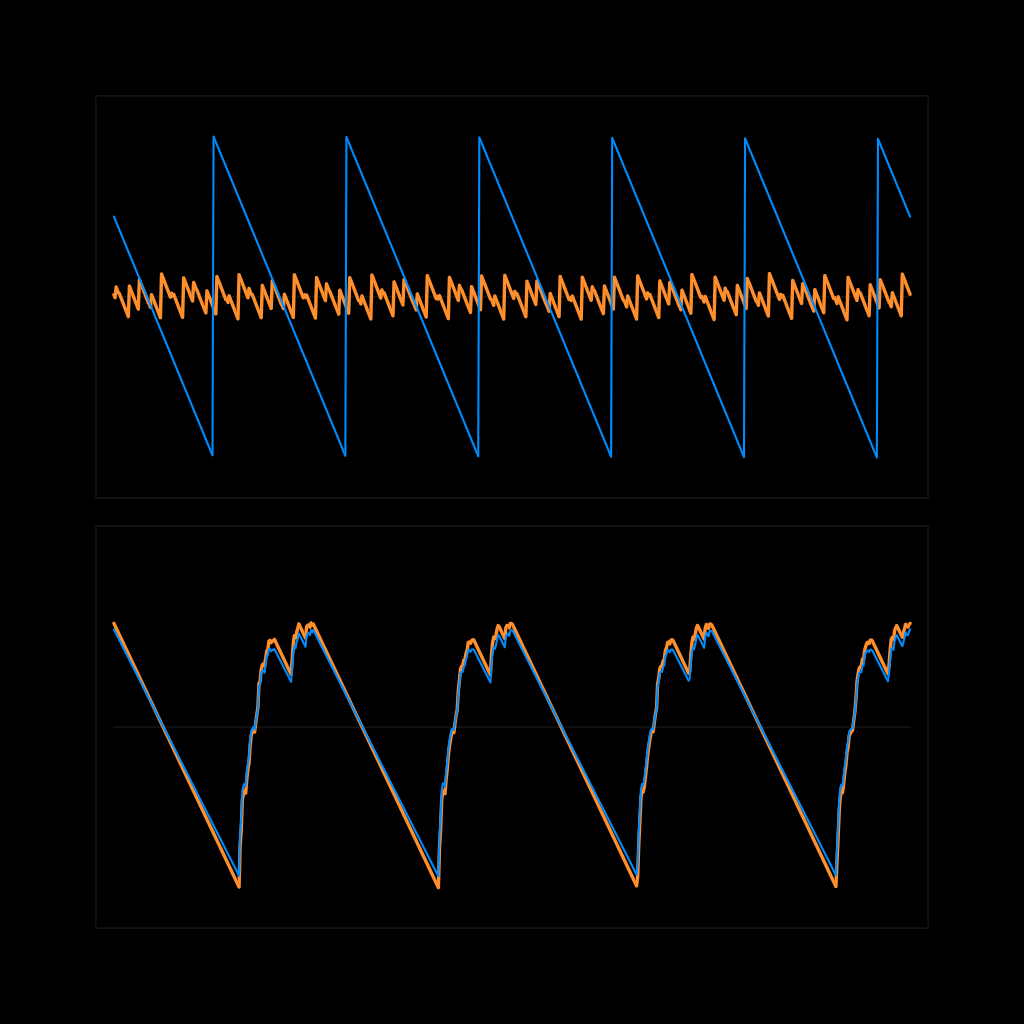
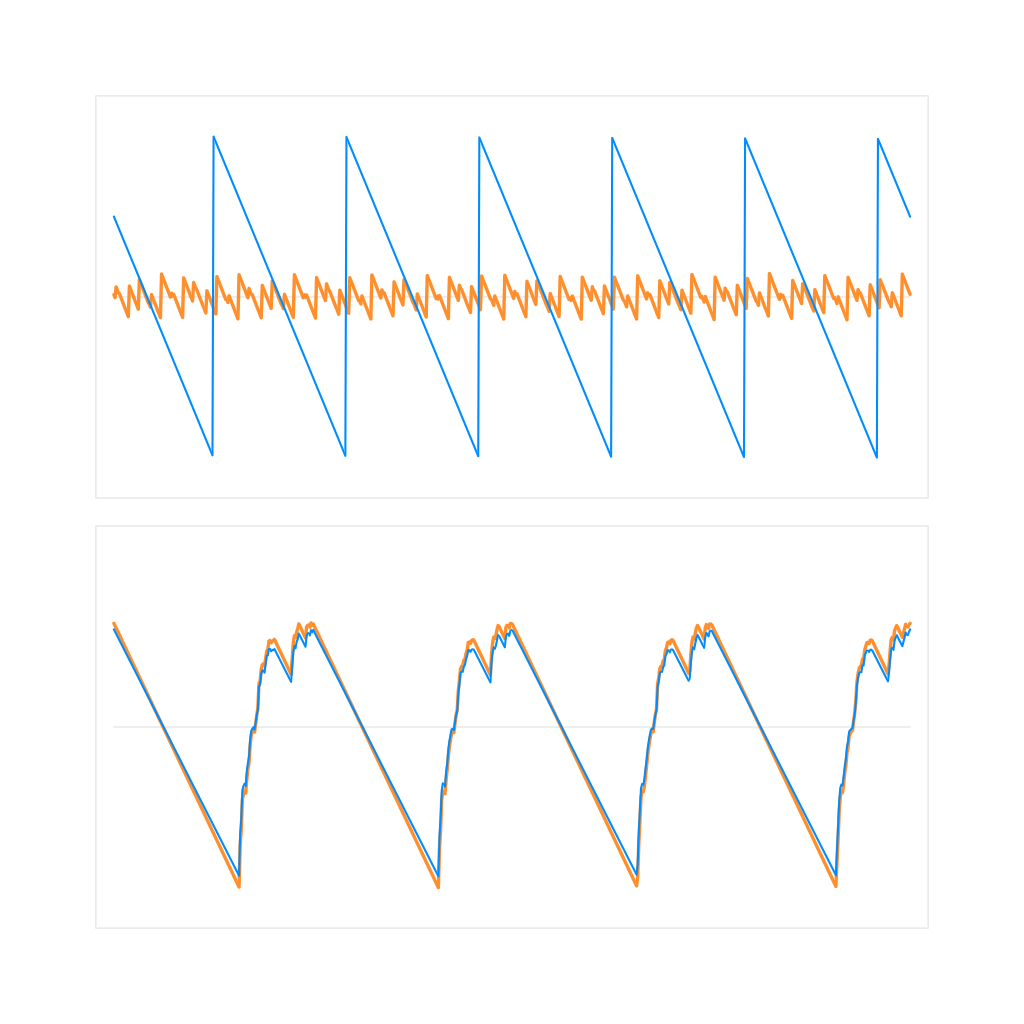
Weighted designs
A design is a set of cells; a weighted design is the same cells carrying a probability vector, and that is a refinement equation on the base grid. Weights move the mass side of the object and only the mass side: the contraction ratios stay 1/base, so every length-indexed observable keeps its log base ripple at every weight, while the mass-stopping count - the first mass-indexed observable this tree has - is log-periodic or smooth according to the arithmetic of the log w_f alone. The multifractal pressure of the same object closes in one line, tau(s) = log_base sum_f w_f^s.
Every claim carries a tag. Proved means a proof is given or restated here; Verified means recomputed from scratch by a lab study; Refuted means shown false. lab/py/weighted-designs is the one generator behind every number below: exact rationals in, safe-rounded floats out, every number asserted before it prints. The lattice and nonlattice vocabulary is the dimensions page's and is used here rather than restated.
The object
- A weighted design is the refinement equation
phi(x) = sum_(f in F) c_f phi(base x - f),xinR^dim,Fthe design's filled digits, inside{0,...,base-1}^dim,c_f = base^dim w_f. - The measure form is the same object:
mu = sum_f w_f mu . S_f^(-1)withS_f(x) = (x + f)/baseandsum_f w_f = 1.phiis the density thatmudoes not have. - Equal weights
w_f = 1/|F|is the 0/1 design: the support is the design itself, the geometry is untouched, and it stays lattice (dimensions). - Daubechies 1988 is the same equation at base 2, dim 1, digits
{0,...,N}: her scaling functions are weighted digit sets that overlap,N >= base, which no design has, and her remark after (4.29) is the reason regularity is bought only by widening the mask past one residue box. - Values are exact rationals over a common denominator,
w_f = n_f/dwithsum_f n_f = d, so every mass at levellevelis an integer overd^leveland floats appear only at display. The generator's object is base 3, dim 2, cells(0,0) (2,0) (0,2), weights3/8, 3/8, 1/4, integer masses[3, 3, 2]over8, level 10. - A symmetry of the cells acts on a weighted design by permuting the
(f, w_f)pairs, so two weighted designs are one object exactly when one symmetry matches cell and weight together: the unweighted equivalence of core with the weight vector carried along.
What weights never move
The contraction ratios are 1/base at every weight, so the geometry is the unweighted design's own and every length-indexed observable keeps its log base ripple forever.
The corner identity (Proved). At a filled corner digit of weight w_0, a ball of radius r < min_(f != 0) |f|/base about that digit's fixed point meets its own sub-block and no other, so mu(B(r)) = w_0 mu(B(base r)), and ln mu(B(r)) - alpha ln r with alpha = -log_base w_0 is exactly log base-periodic at every weight. The range is not decoration: at base 3, dim 1, F = {0,1,2} and w = (1/2, 1/4, 1/4) the radius r = 1/2 is past min_(f != 0) |f|/base = 1/3, and X = mu(B(1/2)) satisfies X = 1/2 + X/4, so X = 2/3 against w_0 mu(B(3/2)) = 1/2 and the identity fails. On the generator's object min_(f != 0) |f|/base = 2/3.
The ripple survives every weight (Verified). M(r), the mass within radius r of the corner fixed point, is read as an exact integer shell histogram, detrended by alpha and folded into 24 bins of log_3 r over whole periods of R in 3^4..3^8. Every set keeps the ripple, and the cross-level identity M_level(r) = n_0 M_(level-1)(r) for r < 2 base^(level-1) - the identity above, checked - is exact integer equality for all four. M(r) is the spin mass of spin read at weight, and being a length observable it is the wrong detector for the arithmetic class of the log w_f: it cannot smooth.
| weights | alpha | swing | drift bar | whole-period bar | gap against equal weights |
|---|---|---|---|---|---|
1/3,1/3,1/3 | 1.000000000 | 0.652441 | 0.022937 | 0.005857 | 0.000000 |
2/5,2/5,1/5 | 0.834043767 | 0.536956 | 0.019130 | 0.004779 | 0.066973 |
3/8,3/8,1/4 | 0.892789261 | 0.580858 | 0.020478 | 0.005133 | 0.044604 |
1/2,1/4,1/4 | 0.630929754 | 0.427372 | 0.014471 | 0.003019 | 0.153880 |
Equal weights give every cell mass 1, so M(r) is the cell count and its gap against the 0/1 ripple is 0.000000 by identity; the other three differ from it by 0.066973, 0.044604 and 0.153880 on drift bars of 0.014471 to 0.020478, so weights reshape the ripple and never remove it. The log 3 periodicity residual falls by decade of R - 0.0208, 0.0094, 0.0047, 0.0021 at equal weights, worst 0.0299 down to 0.0039 - which is discretisation, not drift.
Non-Rajchman at every weight (Proved). hat mu(base t) = P_w(t) hat mu(t) with P_w(t) = sum_f w_f e(-f . t), and P_w = 1 at every integer t because sum_f w_f = 1, so hat mu(base^m t) = hat mu(t) on Z^dim and the Fourier dimension is zero whatever the weights. Weights do not rescue the Mobius door (mobius).
What weights move
The Dirichlet root is not a weight observable (Refuted). That delta, the root of sum_f w_f^s = 1, reads the weighting is false: s = 1 solves that equation for every probability vector, and the generator prints delta = 1.0000000000 at all four of them. What weights own on the mass side is therefore the arithmetic class of the log w_f, never the root.
The mass-stopping count (Proved). N(t) = #{words of mass >= t}, written N(a) at t = e^(-a), is the tree's first mass-indexed observable: it is log-periodic exactly when the group generated by the log w_f is cyclic, and smooth otherwise. The mechanism is Lalley 1989, whose dichotomy is a property of the renewal function alone, fed here the mass variable f = -log w: Proposition 2.1 gives the unique delta > 0, Theorem 1 the nonlattice N(a) ~ C e^(a delta), Theorem 2 the integer-valued N(a) ~ C e^([a] delta). The class is decided exactly and never fitted: each w_f becomes its vector of prime exponents, and the group is cyclic exactly when that integer matrix has rank 1. This holds for positive rational weights only: there a weight carries a prime-exponent vector, and the Q-linear independence of the logs of the primes gives the exponent lattice and the group generated by the log w_f the same rank.
Four of the seven sets below sum to one and so are weighted designs proper - 1/3,1/3,1/3 is the equal-weight case, the 0/1 design itself, and 1/2,1/4,1/4, 2/5,2/5,1/5 and 3/8,3/8,1/4 are the three proper weightings; the other three are renewal weight sets, admissible because the dichotomy reads -log w and never asks it to normalise. (Verified, the rank and the oscillation alike.)
| weights | primes | rank | class | delta | oscillation of ln N(a) - delta a over a window of ln 3 at a = 20, 40, 60, 80, 100 |
|---|---|---|---|---|---|
1/2,1/2,1/2 | 2 | 1 | lattice, span ln 2 | 1.5849625007 | 1.09812 1.09852 1.09812 1.09812 1.09803 flat |
1/2,1/2,1/4 | 2 | 1 | lattice, span ln 2 | 1.2715533032 | 0.88098 0.88130 0.88098 0.88098 0.88091 flat |
1/3,1/3,1/3 | 3 | 1 | lattice, span ln 3 | 1.0000000000 | 1.09825 1.09825 1.09825 1.09825 1.09825 flat |
1/2,1/4,1/4 | 2 | 1 | lattice, span ln 2 | 1.0000000000 | 0.69284 0.69309 0.69284 0.69284 0.69278 flat |
1/2,1/2,1/3 | 2, 3 | 2 | nonlattice | 1.3646005647 | 0.20259 0.14175 0.11707 0.10183 0.09030 decaying |
3/8,3/8,1/4 | 2, 3 | 2 | nonlattice | 1.0000000000 | 0.23133 0.16019 0.13671 0.11972 0.10734 decaying |
2/5,2/5,1/5 | 2, 5 | 2 | nonlattice | 1.0000000000 | 0.23297 0.19792 0.18623 0.17623 0.16776 decaying |
Normalisation changes the class. 1/2, 1/2, 1/4 has rank 1 and is lattice at span ln 2; the same weights normalised, 2/5, 2/5, 1/5, have rank 2 and are nonlattice. Fix the probability vector before the word lattice means anything. The length side does not see the difference, since unnormalised weights differ from their normalisation by one constant per level and the detrending absorbs it; the mass side does, which is the whole trap.
The controls, pre-registered (Verified). Equal weights must reproduce the 0/1 design exactly, log-commensurable weights must keep every ripple, and only an irrational log ratio may move a mass observable. 1/3,1/3,1/3 lattice, length kept and mass flat; 1/2,1/4,1/4 lattice, length kept and mass flat; 3/8,3/8,1/4 nonlattice, length kept and mass moved. The length observable moves under none of the three and the mass observable under exactly one, which is the sign the controls predicted; a mass observable moving under all three would have failed here.
The pressure
Verified. At equal contraction 1/base under the open set condition the pressure equation sum_f w_f^s (1/base)^tau(s) = 1 closes, so tau(s) = log_base sum_f w_f^s and f(alpha) = inf_s (alpha s + tau(s)) is explicit, with tau(0) = log_base |F| = 1.000000000 and tau(1) = 0.000000000. This is the multifractal formalism for self-similar measures under the open set condition, Cawley and Mauldin 1992, read in Olsen's restatement, Section 3, the original being behind a publisher wall and not opened here.
s | sum_f w_f^s | tau(s) | alpha(s) | f(alpha(s)) |
|---|---|---|---|---|
| -2 | 272/9 | 3.102620937 | 1.088179391 | 0.926262155 |
| -1 | 28/3 | 2.033103256 | 1.050962223 | 0.982141033 |
| 0 | 3 | 1.000000000 | 1.015812676 | 1.000000000 |
| 1 | 1 | 0.000000000 | 0.985056822 | 0.985056822 |
| 2 | 11/32 | -0.971990429 | 0.959892942 | 0.947795455 |
| 3 | 31/256 | -1.921688171 | 0.940411228 | 0.899545513 |
The box partition at level level carries the moments exactly, sum_i mu_i^s = (sum_f w_f^s)^level as a rational identity at s = -2..3 over 7, 9 and 11 distinct box masses in 729, 6561 and 59049 boxes at levels 6, 8, 10. The coarse-grained band f_level(alpha) = log_base N(alpha)/level sits under the transform at every level and every achievable alpha, in one line from N_i mu_i^s <= base^(level tau(s)). At the band's middle alpha = 1.077324384 the readings are 0.769937048, 0.798858255, 0.818775202 against f = 0.946394630, deficits 0.176458, 0.147536, 0.127619 at levels 6, 8, 10; the gap is the Stirling volume term of the multinomial count, matched to 0.000077, 0.000058, 0.000046, and it falls with the level. Both endpoints are exact at every level, f_level(0.892789261) = f = 0.630929754 = log_3 2 and f_level(1.261859507) = f = 0, and the band's top at level 10 is 0.877427106 rising to tau(0) = 1. The weights demo puts the weights on sliders: the support never moves while the mass does, and tau(s) with its Legendre transform redraws as a closed form in the weights alone.
The ladder
Rung 0 is closed form (Verified). F inside {0,...,base-1}^dim puts supp phi inside the unit cell, so exactly one integer translate meets it, the Daubechies and Lagarias 1992 matrices are 1 x 1 with T_f = [base^dim w_f], and the joint spectral radius - norm-independent by Rota and Strang 1960 - is base^dim max_f w_f. Hence alpha_Holder(phi) = -dim - log_base(max_f w_f) = alpha_min(mu) - dim, negative for every proper design: the tree's objects are measures, never functions, and digit independence is exactly what empties the regularity question. The same word solver, run on rung 0, collapses onto the closed form.
| weights | T_f | JSR | solver | alpha_min(mu) | alpha_max(mu) | alpha_Holder(phi) |
|---|---|---|---|---|---|---|
1/3,1/3,1/3 | [3, 3, 3] | 3 | [3.0000000, 3.0000000] | 1.000000000 | 1.000000000 | -1.000000000 |
2/5,2/5,1/5 | [18/5, 18/5, 9/5] | 18/5 | [3.6000000, 3.6000000] | 0.834043767 | 1.464973521 | -1.165956233 |
3/8,3/8,1/4 | [27/8, 27/8, 9/4] | 27/8 | [3.3750000, 3.3750000] | 0.892789261 | 1.261859507 | -1.107210739 |
1/2,1/4,1/4 | [9/2, 9/4, 9/4] | 9/2 | [4.5000000, 4.5000000] | 0.630929754 | 1.261859507 | -1.369070246 |
Rung 1 is the first overlap (Verified). At base 2, mask with sum c_even = sum c_odd = 1, the same solver runs T_0 = (c_(2i-j-1)) and T_1 = (c_(2i-j)), 1 <= i, j <= N, on {v : sum_i v_i = 0}, and alpha = -log_2 JSR. The hat mask (1/2, 1, 1/2) returns JSR in [0.5000000, 0.5000000] and alpha in [1.0000000, 1.0000000], exactly. D4 returns Gripenberg lower 0.6830127 and norm upper 0.7105812 at length 14, so alpha lies in [0.4929285, 0.5500157], which contains the closed form 2 - log_2(1 + sqrt 3) = 0.5500157.
The caveat travels with the bracket. D4's lower end is attained at the one-letter word T_0, whose spectral radius is (1 + sqrt 3)/4, so alpha's upper end is that closed form by construction and its agreement is an identity rather than a test. The hat mask, where the bracket collapses to a single point, is the real validation of the solver, and D4's live content is the norm upper end 0.7105812. Refuted: that a norm upper bound may print truncated. The bracket is a certificate - all matrix arithmetic in Q(sqrt m), spectral radii and norms enclosed through trace and determinant, Gripenberg words to length 8 truncating down and norm upper bounds to length 14 rounding up - so the safe print of alpha's upper end at four digits is 0.5501, and 0.5500 would sit strictly below the closed form it is supposed to contain.
Where the numbers live
lab/py/weighted-designs is the one pass behind this page: one exact generator taking (base, dim, F, w) and printing the arithmetic class, delta, the mass-stopping count, the M(r) ripple, the local-dimension range, the multifractal band and the JSR bracket at both rungs, over the pre-registered controls. It runs in about four seconds, prints only, writes nothing, holds one level-10 cell list at a time, asserts every number before it prints and exits nonzero on any failure; the regression is the object of the first section. The lattice geometry these weights leave alone is dimensions, the Fourier door they do not open is mobius, and the unweighted object underneath is core.