Famous formulas
Eight elementary rules run out to infinity. Five close on a constant, one counts the primes, one refuses to reach zero and one refuses to settle down at all.
Each of the eight is a rule a schoolchild can carry out by hand. Multiply these fractions. Add these terms with alternating signs. Count the ways this number splits into two primes. Do the rule n times and you have a number. Let n grow and that number goes somewhere, and the three things worth asking are always the same: what is the rule, where does it go, and how fast does it get there.
The third question is the one the page is really about. Two rules can land on the same constant and take a thousand times longer to do it. Speed is the property that separates a formula you would actually compute with from a formula you would only admire.
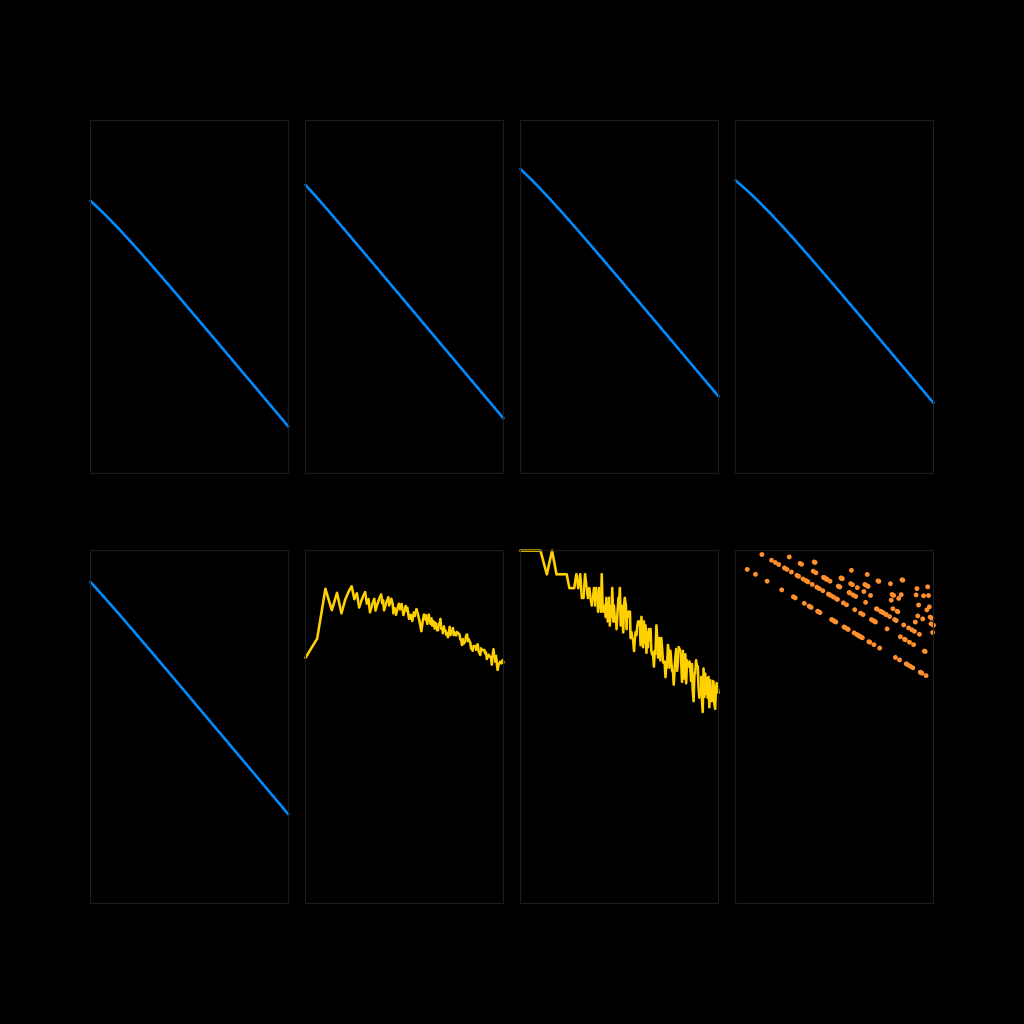
The figure puts all eight speeds side by side. It is a board of eight small panels, four across and two down, in the order of the list below. Each panel plots the gap, how far the rule stands from its target, against how far you have run the rule, with both scales logarithmic and four and a half decades of shrinking from the top of the panel to the bottom. A straight fall means the gap shrinks like a fixed power of n, and the steeper the line the faster the rule pays.
Read the board and the family sorts itself out. The five blue panels fall as straight parallel lines, five different constants paid at much the same rate. The prime count humps up before it starts falling, because the curve it is measured against overtakes it early. The Goldbach panel falls raggedly, shrinking only because the count it inverts is growing. The last panel is not a fall at all but a flat scatter, which is the whole point of it.
Not every panel has a target in the same sense. Five of them chase a number and the gap is an honest distance. The prime count is measured against a curve rather than a constant. Goldbach's panel shows one divided by the count of prime pairs, so it is a picture of a count refusing to be small. The Mertens panel shows a running total divided by the square root, and what it demonstrates is that the ratio stays put.
- The Wallis product: an endless product of fractions just above and just below one, closing on pi over two.
- The Leibniz series: one minus a third plus a fifth minus a seventh and on, closing on pi over four.
- The Basel problem: the reciprocals of the squares added up, closing on pi squared over six.
- Euler's number: one plus one over n, raised to the power n, closing on e.
- The Euler-Mascheroni constant: the harmonic sum less the logarithm, closing on gamma.
- The prime counting function: the staircase of primes, chased by two smooth curves that are only eventually right.
- Goldbach's conjecture: every even number as a sum of two primes, with a count that has never reached zero.
- The Mertens function: the Mobius marks added up, wandering against the square root of n.
Six of the eight are classical and settled. Two are not. Goldbach's is a conjecture, so its panel is a record of what has been checked and nothing else. The Mertens panel carries no claim either: the bound that its flatness suggests is the Riemann hypothesis, and nobody has it. Those two sit on the same board as the other six on purpose, because from close up an open question and a theorem look identical.
In the tree
The figure above draws all eight gaps closing on one set of axes, and each page opens on a figure of its own. The pi note counts pi out of the lattice by a ninth route of the same family, slow and honestly noisy, and says so.