Structure against noise
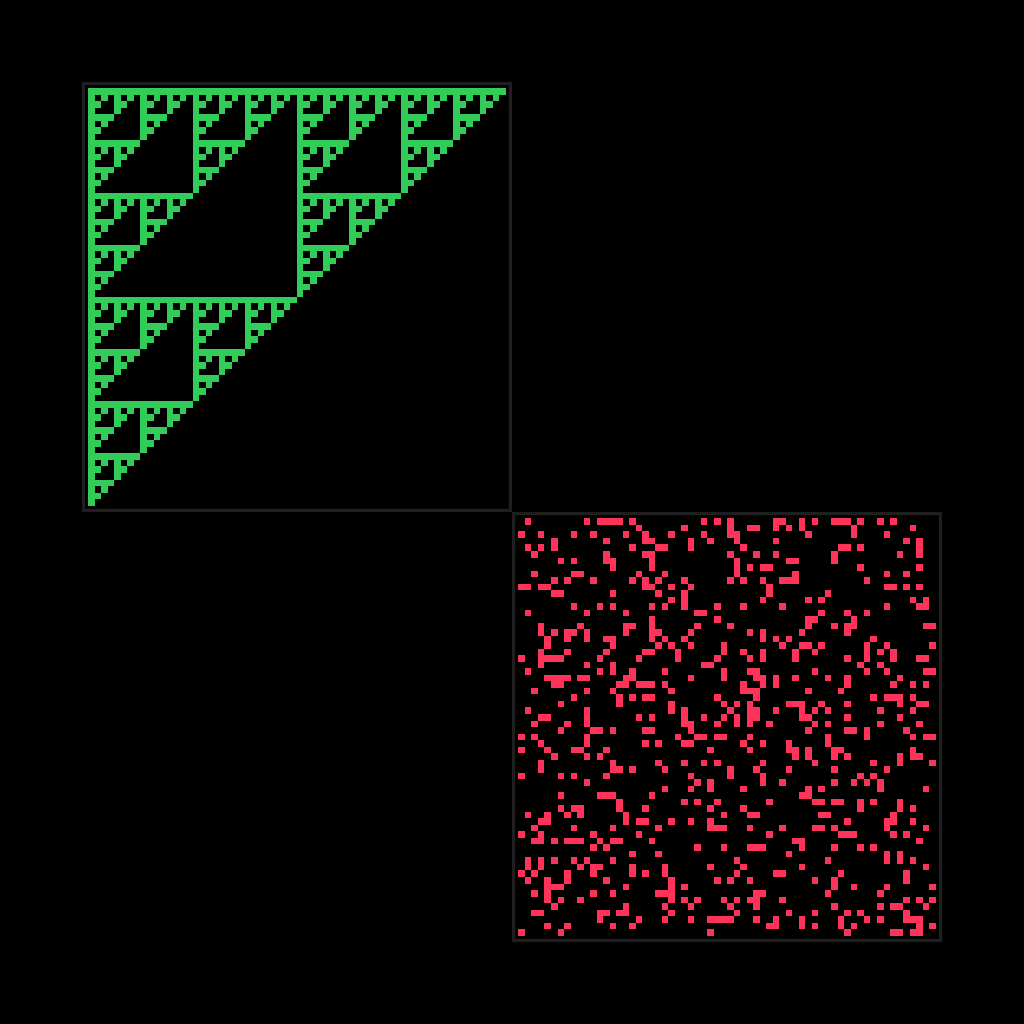
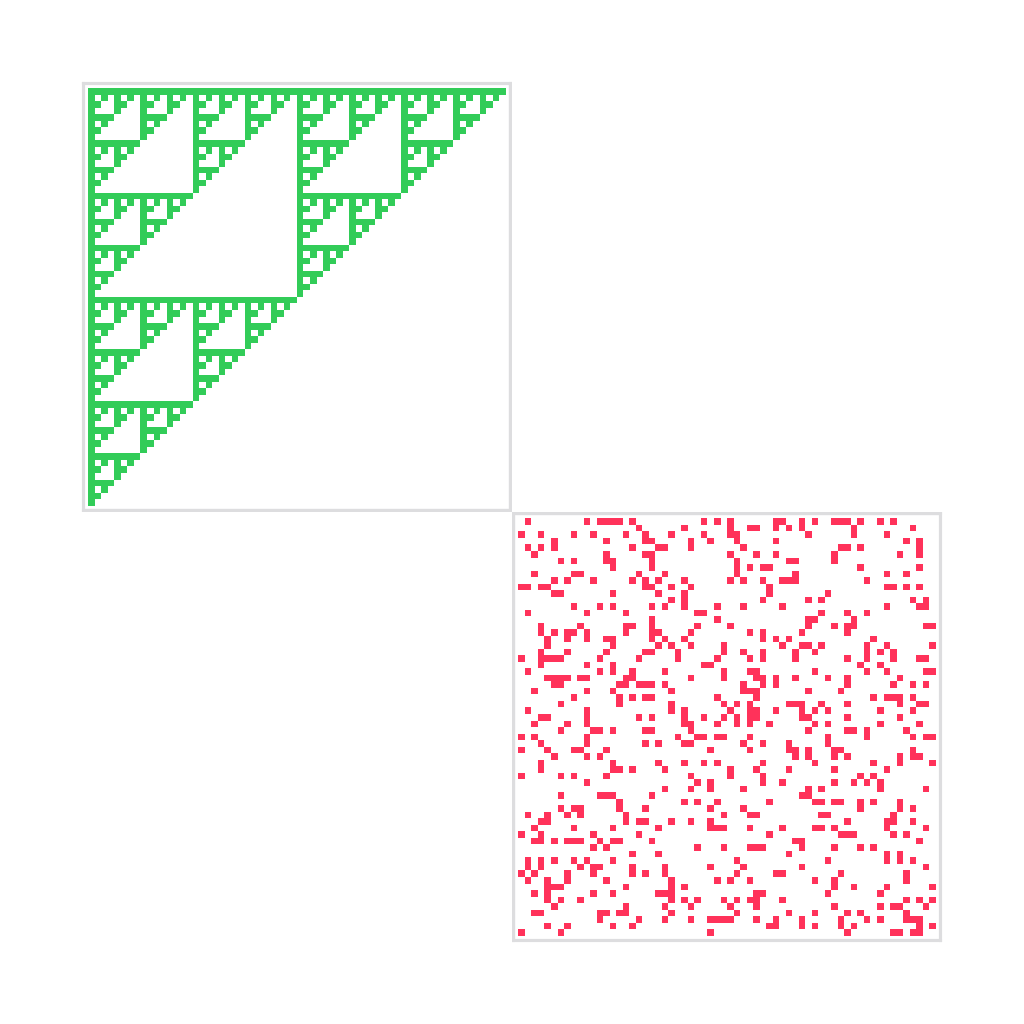
A design's fractal occupies some number of cells of a grid. A random set can occupy exactly the same number of cells of the same grid. Race the two on measurable geometry - how many connected pieces, how much boundary per cell - and the question of what the parity rule buys gets a number instead of an adjective.
Every claim below carries a tag. Proved means a proof is given or restated here; Verified means recomputed from scratch by a lab study; Conjecture means neither. Everything on this page is measurement at finite sizes; the one Proved line of the race is flagged where it occurs. The graphs demo draws the cell network of any design live, flat, in the cube and on the diagonal slice, with its tips, junctions, pieces and length beside it.
The race
Five designs, each built by substituting its level-1 tile into itself and cross-checked against the digit rule that defines it - codes and corner order as in the core:
| design | base | dim | rule |
|---|---|---|---|
| gasket | 2 | 2 | code 7, corners (0,0), (0,1), (1,0) |
| diagonal | 2 | 2 | code 9, corners (0,0), (1,1) |
| seven-of-eight | 2 | 3 | every corner but one |
| carpet | 3 | 2 | 8 of 9 cells - bang dim 2, code 7 read at base 3 |
| sponge | 3 | 3 | the Menger sponge, 20 of 27 cells |
The control is matched exactly, not approximately: a uniform sample of exactly N distinct cells, the occupied count asserted equal to the design's on every draw - not a Bernoulli field with matching probability. Components are face-connected, 4-neighbour in 2D and 6-neighbour in 3D. Boundary per cell is (2*dim*N - 2*E)/N with E the number of face-adjacent occupied pairs and the grid exterior counting as void, so an isolated cell contributes the full 2*dim. Every random figure below is a mean and a sample standard deviation: 400 seeds up to 729 cells, 200 at the 2187-cell 128 x 128 gasket, the 2401-cell 16^3 seven-of-eight and the 128-cell 128 x 128 diagonal, 100 at 6561 cells and at the 27^3 sponge, 20 at the 81^3 sponge (lab/py/percolation-race).
Two independently written passes race the designs inside one program, lab/py/percolation-race - Kronecker powers with union-find and a PCG64 control, and substitution over coordinate sets with breadth-first search and a Mersenne Twister control - and agree on every comparison to within a standard deviation; the widest gap printed is 0.2061 standard deviations. The numbers printed here are the second pass.
Connectivity
Every self-similar design above except the diagonal - built to scatter, and raced on boundary instead - is a single component at every size tested. The matched random set is not close, and the gap widens with size in every family. (Verified, lab/py/percolation-race.)
| design | grid | cells | density | design comps | random comps |
|---|---|---|---|---|---|
| gasket | 32 x 32 | 243 | 0.2373 | 1 | 134.39 +/- 7.34 |
| gasket | 64 x 64 | 729 | 0.1780 | 1 | 478.09 +/- 12.62 |
| gasket | 128 x 128 | 2187 | 0.1335 | 1 | 1613.61 +/- 21.96 |
| gasket | 256 x 256 | 6561 | 0.1001 | 1 | 5257.23 +/- 32.94 |
| seven-of-eight | 8^3 | 343 | 0.6699 | 1 | 2.80 +/- 1.43 |
| seven-of-eight | 16^3 | 2401 | 0.5862 | 1 | 23.77 +/- 4.85 |
| carpet | 27 x 27 | 512 | 0.7023 | 1 | 9.43 +/- 2.89 |
| carpet | 81 x 81 | 4096 | 0.6243 | 1 | 146.58 +/- 12.52 |
| sponge | 27^3 | 8000 | 0.4064 | 1 | 560.80 +/- 22.75 |
| sponge | 81^3 | 160000 | 0.3011 | 1 | 31576.40 +/- 152.71 |
The largest-component fraction says the same thing from the other side: the design holds 1.0000 of its cells in one piece in every row, while random holds 0.0411 +/- 0.0098 at the 32 x 32 gasket, 0.0011 at 256 x 256, and 0.0169 at the 81^3 sponge. (Verified, lab/py/percolation-race.) The result holds at base 2 and base 3, in two dimensions and three, and no gap narrows as the grid grows, which rules out a small-size artifact at the sizes reached.
Boundary
At the same matched cell counts, the connected designs also expose less surface than random, and one design - built to scatter - exposes the most surface possible. (Verified, lab/py/percolation-race, except the one Proved line.)
| design | grid | design boundary | random boundary | maximum |
|---|---|---|---|---|
| gasket | 32 x 32 | 2.0082 | 3.0814 +/- 0.0639 | 4 |
| gasket | 256 x 256 | 2.0003 | 3.6006 +/- 0.0103 | 4 |
| diagonal | 32 x 32 | 4.0000 | 3.8808 +/- 0.0897 | 4 |
| diagonal | 128 x 128 | 4.0000 | 3.9677 +/- 0.0232 | 4 |
| seven-of-eight | 8^3 | 1.8542 | 2.4941 +/- 0.0589 | 6 |
| carpet | 81 x 81 | 0.8633 | 1.5330 +/- 0.0124 | 4 |
| sponge | 27^3 | 2.2560 | 3.6535 +/- 0.0141 | 6 |
The diagonal at level level is 2^level isolated cells on a 2^level x 2^level grid - no two cells of the pattern are ever face-adjacent - so its boundary per cell is exactly 2*dim = 4, the theoretical maximum, at every level. (Proved, by construction; the exact 4.0000 is the measured confirmation.) The random set at the same density falls short of the maximum at every size tested.
One number in this table deserves its own flag: the gasket's 2.0082 is a level-5 figure, not a constant. It drifts 2.0082, 2.0027, 2.0009, 2.0003 at sides 32, 64, 128, 256, approaching 2. (Verified, lab/py/percolation-race.)
How decisive, honestly
Means hide ties, so the per-draw counts are part of the result (lab/py/percolation-race).
- Gasket,
32 x 32: 0 of 400 random draws reach one component, and 0 of 100 at256 x 256. Decisive at every size. - Seven-of-eight,
8^3: 73 of 400 random draws are also a single component, and random's largest fraction is already 0.9937 - at density 0.67 a random set percolates too, so the 3D win at that size is a win in the mean, not per draw. One level up, at16^3, it is 0 of 200 and decisive. - Diagonal,
32 x 32: 61 of 400 random draws also hit boundary 4.0000, because at density 0.031 a random set is often already an independent set. The design wins the mean by 0.119, about 1.3 standard deviations; at128 x 128the ties are 27 of 200. A real edge, and a small one.
And one scope line the summary sentence invites getting wrong: at the dispersing extreme, random has fewer components than the design - 30.10 against 32 at 32 x 32, 125.93 against 128 at 128 x 128 - because the diagonal is N isolated cells by construction. "Random wins at neither extreme" is true only of the metric named at each extreme: connectivity at the percolating one, boundary at the dispersing one. (Verified, lab/py/percolation-race.)
Where the honest line falls
What is reached: grids to 256 x 256 in 2D and 81^3 - 160000 occupied cells - in 3D, with the seed count thinning from 400 to 20 at the largest size; one control ensemble, uniform over cell sets of the exact matched size. Nothing here is a limit theorem. The claim this page supports is finite and plain: at matched grid and matched cell count, over the five designs and the sizes tested, self-similar structure holds together where noise shatters, and the one design built to scatter, scatters perfectly. One program, lab/py/percolation-race, runs both passes, prints every figure above in about nine seconds and exits nonzero on any failed check; no log is kept.
Order in the mixed product
A design's fractal is one tile substituted into itself. Replace the repeated tile by an ordered word of different tiles - A_w = A_(c_1) (x) ... (x) A_(c_level), first factor outermost - and every observable on this page can be asked a new question: does it depend on the order of the word, or only on the multiset of factors? An observable is order-blind if only the multiset matters, order-sensitive if two orderings of one multiset can differ. Base 2, dim 2, the 15 non-empty codes, corner order as in the core. Every count in this section is printed by lab/rs/magic-words, which draws each word twice, once inside the study and once through mrlymath::bang::magic, and gets the same cells both ways.
| observable | length 2, of 105 multisets | length 3, of 210 multisets | status |
|---|---|---|---|
| fill, side, density | 0 sensitive | 0 sensitive | Proved order-blind |
| main-diagonal count | 0 sensitive | 0 sensitive | Proved order-blind |
| boundary | 0 sensitive | 36 sensitive | Proved order-blind at length 2 |
| connected components | 74 sensitive | 188 sensitive | Proved order-sensitive |
| Euler characteristic | 78 sensitive | 188 sensitive | Verified |
| holes | 10 sensitive | 100 sensitive | Verified |
The status column tags the law; every count in the table is Verified, lab/rs/magic-words. Components are 4-connected as everywhere above, holes are the bounded 4-connected components of the complement, and the Euler characteristic is N - A + Q over filled cells, face-adjacent filled pairs and full 2 x 2 blocks.
Denominators are the multisets admitting two or more distinct orderings; a constant word cannot exhibit order sensitivity and is excluded. Length 2 is 225 words over 15 codes and C(16,2) = 120 multisets, 105 of them with two or more orderings once the 15 constant words are set aside. Length 3 is 1000 words over the 10-code library of every code of fill 2 or 3, the 15 less the four one-cell codes and the full tile, and C(12,3) = 220 multisets, 210 with two or more by the same subtraction; it is the only 10-code subset of the 15, out of 3003, whose length-3 column is the one printed above (Verified, lab/rs/magic-words).
- Fill, side and density are products of per-factor quantities, so they commute. (Proved.)
- The main diagonal factors,
diag(A (x) B) = diag(A) (x) diag(B), so its count is a product too. (Proved; the sweep of all15^3words of length 3 has zero violations, Verified,lab/rs/magic-words.) - Scope guard: that is the diagonal count, not the diagonal profile. The full anti-diagonal profile is order-sensitive on 99 of 105 multisets at length 2, minimal witness the one-cell codes 1 and 2. Take the whole profile, never one coefficient. (Verified,
lab/rs/magic-words, for the count of 99.) - Boundary at length 2 is order-blind because interior is: on the
4 x 4grid only the four central cells can be interior, and their requirements pair up under the swap,(S_1, S_4)against(S_4, S_1)and(S_2, S_3)against(S_3, S_2), which is symmetric in the two factors. (Proved; the sweep of all 256 ordered code pairs, the 15 non-empty codes with the empty one, has zero violations, Verified,lab/rs/magic-words.) It fails from length 3. - Scope guard: boundary in that table counts the filled cells with a void or exterior neighbour, which is what the interior argument controls. The race's exposed faces per cell,
(2*dim*N - 2*E)/N, is a second reading of the same word, and that one is order-sensitive already at length 2, on 78 of 105 multisets and 188 of 210 at length 3. (Verified,lab/rs/magic-words.) - Components are order-sensitive, minimal witness the multiset
{3, 6}, both factors of fill 2:comp(A_3 (x) A_6) = 4andcomp(A_6 (x) A_3) = 2. The inner tile's contacts decide whether adjacent outer copies merge. (Proved by the witness, which is a4 x 4array checked by hand.) - Among the fill-2 designs, adjacent (codes 3, 5, 10, 12) times adjacent commutes, diagonal (codes 6, 9) times diagonal commutes at 4, and adjacent times diagonal never commutes, always 4 against 2. Two observations settle all three. Copies of the inner tile sitting in two cells of the outer tile can merge only when those cells are face-adjacent, and then exactly when the inner tile has a contact in that direction. A diagonal pair
diaghas no face-adjacent cells and no contact in either direction, so as the inner letter it leaves every filled cell isolated,comp(X (x) diag) = 2 fill(X), and as the outer letter its two copies never merge,comp(diag (x) Y) = 2 comp(Y). Adjacent times diagonal is then2 * 2 = 4and diagonal times adjacent is2 * 1 = 2, and diagonal times diagonal is 4 in both orders. Two dominoes merge exactly when they share an orientation, a condition symmetric in the pair, so they commute, at 1 when the orientations agree and at 2 when they do not. (Proved; Verified,lab/rs/magic-words, on all 15 pairs.) - Every tile of fill at least 3 at base 2, dim 2 is connected and carries both a vertical and a horizontal contact, so any two of them give one component in either order. (Proved; all 10 pairs among codes 7, 11, 13, 14, 15.) This is the mixed-word form of the single-component result above.
Contact is order-blind, and decided factor by factor
Write h(X) for the number of rows at which two side-by-side copies of X touch, and v(X) for the columns at which two stacked copies touch. Then h(A_w) = prod_i h(A_(c_i)) and v(A_w) = prod_i v(A_(c_i)), because the outer columns of a Kronecker product are the Kronecker products of the outer columns and the inner product of Kronecker products is the product of the inner products. (Proved; the sweep of all 15^3 words has zero mismatches, Verified, lab/rs/magic-words.) So whether adjacent copies touch at all is order-blind even where the component count is not - the order-blind part of the boundary story is the contact law, not the interior count.
The race's one Proved line is the h = v = 0 case: code 9, the diagonal, has no contact in either direction, so no two cells of its fractal are ever face-adjacent at any level and boundary per cell is exactly 2*dim.
The observables are rational series
Each observable in the table is a rational series in the word: there are a row vector lambda, a column vector gamma and one square matrix M_c per code with phi(A_w) = lambda M_(c_1) ... M_(c_level) gamma.
| observable | Hankel rank | distinct matrices | basis words |
|---|---|---|---|
| components | 4 | 6 | e, 3, 5, 15 |
| Euler characteristic | 4 | 6 | e, 3, 5, 15 |
| boundary | 8 | 9 | e, 3, 5, 7, 11, 13, 14, (7,14) |
| holes | 11 | 10 | e, 3, 5, 7, 11, 13, 14, 15, (7,6), (7,7), (11,11) |
Verified, lab/rs/magic-words: the construction is exhaustive on all 54240 words of lengths 1 to 4 over the 15 non-empty codes, plus 120 seeded words of length 5 to 7, zero mismatches, by Hankel-basis elimination in exact rational arithmetic, with the basis words, the matrices, lambda and gamma all outputs of the elimination rather than inputs to it. For components lambda = (1,0,0,0) and gamma = (1,1,1,1)^T.
- The component matrix depends only on the class of the factor and there are six classes; 14 of the 15 class pairs do not commute, and that noncommutation is the algebraic source of every order-sensitive count in the table above.
- The one commuting pair is the two zero-contact classes, fill 1 and the diagonal pairs, whose matrices have rank 1 with
M_(6,9) = 2 M_(1,2,4,8). - The vertical and horizontal domino classes carry different matrices, so the representation is not blind to the full square symmetry group, only to the reflection fixing each axis.
- The tension is the whole interest. The number of components still able to merge with a neighbouring copy is
2^(level-1)on(15^(level-1), 3), whose product is2^(level-1)full-width rows and so carries exactly2^(level-1)components as well; that is the largest merge count found over all words of length 1 to 4, and the family attains it at every length checked. The component count itself reaches2 * 4^(level-1)on(15^(level-1), 6), where the outer full tiles move a cell by even offsets and the innermost letter fills only its two cells of oddi + j, so the product is the checkerboard and no two filled cells are face-adjacent - yet the Hankel rank stays 4, because rank is the dimension of a span of functions and not the size of any geometric bookkeeping. (Proved for both growths, the row family from the contact law and the checkerboard from the parity of the innermost letter; Verified,lab/rs/magic-words, at level 2..10, with the merge count maximised exhaustively to length 4.) 2 * 4^(level-1)is not merely reached, it is the ceiling: one cell taken from each component is an independent set, and the2^levelgrid has a perfect matching, so no independent set in it exceeds half the cells and no subset of it has more than2 * 4^(level-1)components. The checkerboard family attains the ceiling at every length. (Proved; attained exhaustively over all words of length 2 to 4 and through the representation at length 5, Verified,lab/rs/magic-words.)- The intermediate rate
2 * 3^(level-1)belongs to(7^(level-1), 6), the same construction with the gasket in place of the full tile: a zero-contact inner tile keeps adjacent outer copies apart and its own two cells are not adjacent either, so every filled cell is isolated and the count is the fill. (Proved; Verified,lab/rs/magic-words, at level 2..10.)
The component exponent along a word
Every count above sits at a fixed length. Since the word is a matrix cocycle the next question is a rate: along an infinite word w, does (1/level) log comp(A_(w_1 ... w_level)) converge, and if it does, is the limit a function of the letter frequencies alone? Base 2, dim 2, two letters at a time, and lab/rs/magic-words prints every number below.
The constant-word functional. Proved. comp(A_(c^level)) = comp(A_c)^level at every code, by the splits already above: the one-cell codes have fill 1, a domino word of one orientation is a full line, the five codes of fill at least 3 are connected and carry both contacts so every level is one piece, and the diagonal class has no contact in either direction so nothing ever merges and its count is its fill. So comp(A_c) = 2 exactly on the diagonal class {6, 9} and 1 on the other thirteen. The per-letter rate is therefore log 2 on the diagonal class and 0 elsewhere, and the one linear functional reproducing every constant word is Phi(f) = (f_6 + f_9) log 2. It is the component analogue of the scale-dimension frequency average of magic, built the same way out of per-letter data, but a plain average rather than a ratio of two averages, because the observable is a count and not a dimension. It is a value on the frequency simplex, defined at irrational frequencies, and reading it needs no word. (Verified, lab/rs/magic-words, all 15 codes at level 1..7.)
Fifty-nine of the 105 letter pairs carry an exact closed form. Proved. (Verified, lab/rs/magic-words, per pair on all 32766 words of length at most 14 against the representation and on all 254 words of length at most 7 against the drawn cells, zero mismatches.)
| pair | comp(A_w) | pairs |
|---|---|---|
| unit and domino | 2^(k - m), k the last unit place, m the unit count | 16 |
| unit and diagonal | 2^(number of diagonal letters) | 8 |
| two dominoes of unlike orientation | 2^(level - r), r the terminal run | 4 |
| domino and diagonal | 2^k, k the place of the last diagonal letter | 8 |
| domino and the full tile | 2^(n - j), n the number of full letters, j their terminal run | 4 |
| gasket class and the full tile | 1 | 4 |
| inside one class | 1, and 2^level inside the diagonal class | 15 |
That is 9 of the 15 pairs of distinct classes and all 6 pairs inside one class. The other 46 - the gasket class against the unit, domino and diagonal classes, and the full tile against the unit and diagonal classes - close too, by three suffix lemmas and two formulas, in the other forty-six below; the rest of this section is about the 59 and states nothing about them.
Three mechanisms cover the table, and two of them are geometry rather than algebra; the same-class row and the gasket-against-full row are the contact split and the fill-at-least-3 line already above.
- The rank-1 telescope. Proved. On
{3, 6}the last two columns of both matrices vanish andlambda = e_0, so the cocycle lives on the leading blockA = [[0,1],[-2,3]],B = [[2,0],[4,0]]withlambda = (1,0),gamma = (1,1)^T. HereA gamma = gamma,A p = 2 patp = (1,2)^T, andB = p q^Twithq^T = (2,0),q^T p = 2, soB A^n B = 2^(n+1) B. Writingw = 3^(a_0) 6 3^(a_1) ... 6 3^(a_m)and collapsing the interior gaps givescomp = 2^(level - a_m), the last-diagonal-place law. - The zero-contact cut. Proved. Contacts multiply, so a suffix has
h = v = 0as soon as it contains one letter withh = 0and one withv = 0;h = 0on codes 1, 2, 4, 5, 6, 8, 9, 10 andv = 0on codes 1, 2, 3, 4, 6, 8, 9, 12. Copies of such a suffix tile in adjacent cells of the outer tile can never merge, socomp(A_w) = fill(A_prefix) * comp(A_suffix)at the last suffix with both contacts zero. (Verified,lab/rs/magic-words: 49420 of all 54240 words of length 1 to 4 admit the cut, zero mismatches.) It proves four rows of the table outright, cutting at the last unit place for a unit against a domino, at the last letter for a unit against a diagonal, at the start of the terminal run for crossed dominoes, and at the last diagonal place for a domino against a diagonal, each leaving a suffix of one component or two. Its scope is the honest part: the other 4820 words have nonzero contact in one direction at every suffix, and every word over a domino and the full tile is among them. - The row-block law. Proved. On
{3, 15}the letter 3 forces the row digit to 0 and leaves the column digit free, and 15 forces neither, so the filled set is a productR x [0, 2^level)withRthe rows whose digit vanishes at every 3-place,|R| = 2^n. Each row ofRis a full horizontal line, so two merge exactly when they are vertically adjacent, andr,r + 1both lie inRexactly whenrsits inside a block of2^jconsecutive rows,jthe terminal run of 15s; the next row up flips the forced digit and leavesR, so the blocks are apart. Hencecomp = 2^(n - j). Transposing gives{5, 15}. This is the pair the cut law provably cannot reach.
Where both letters occur with positive frequency the exponent exists and is a function of the frequency vector alone. Proved, from the closed forms, one pair family at a time; the hypothesis is not decoration and the next claim is why. If f_diagonal > 0 then the last diagonal place k_level satisfies k_level / level -> 1, since the diagonal count is the same at k_level and at level; if both letters occur then the terminal run r(level)/level -> 0, since a terminal run of delta level equal letters would pin the other letter's density at (1 - delta) f; the unit count over level tends to f_unit and the terminal run of full letters over level tends to 0 by the same argument.
| pair | exponent at interior f | Phi(f) | fill exponent |
|---|---|---|---|
| unit and domino | f_domino log 2 | 0 | f_domino log 2 |
| unit and diagonal | f_diagonal log 2 | f_diagonal log 2 | f_diagonal log 2 |
| two dominoes of unlike orientation | log 2 | 0 | log 2 |
| domino and diagonal | log 2 | f_diagonal log 2 | log 2 |
| domino and the full tile | f_full log 2 | 0 | (1 + f_full) log 2 |
| gasket class and the full tile | 0 | 0 | f_gasket log 3 + f_full log 4 |
The constant word is a degenerate probe: Phi is refuted on 7 of the 9 named class pairs and exact on the other 2. Proved, by the table, at every interior f. Two scope lines travel with it and neither is optional. First, the interior formula extends to no vertex on any of the seven: it reads log 2 there while the constant word at that vertex has count 1 and rate 0, so no continuous frequency functional whatever reproduces the truth on the closed simplex, and the failure is a wrong shape rather than a wrong coefficient. Second, on five of the seven - 28 of the 32 letter pairs - the exponent equals the fill exponent, saturating the trivial ceiling comp <= fill, so the value carries nothing the order-blind fill law did not already give, and the whole content there is in the finite-length correction rather than the rate. Of the 59 named pairs only the domino against the full tile gives an exponent strictly between the per-letter values and the fill ceiling. Proved: at equal frequencies it is (log 2)/2 against per-letter values 0, 0 and a fill ceiling of (3/2) log 2.
Order-blindness on the named class. Proved. Since the exponent depends only on f at interior f, it is the same along Thue-Morse, along every periodic word with those frequencies, along every strictly ergodic word in which both letters occur - unique ergodicity gives the frequencies and minimality gives them full support - and at almost every Bernoulli word with 0 < p < 1. So a difference against Phi on this class is not evidence of non-stationary behaviour: the tree's own stationary controls, the periodic words, fail the prediction in exactly the same way and by exactly the same amount. What the difference refutes is the frequency functional, not stationarity.
Along Thue-Morse the reading is exact. Proved, and existence is earned from the closed form rather than assumed. The word has no three equal letters in a row, since t_(2n) = t_n and t_(2n+1) = 1 - t_n force a change at every even place, so every terminal run has length at most 2; pairing (t_(2k), t_(2k+1)), which always sums to 1, gives exactly level/2 of each letter at every even length, not merely in the limit. Hence the prefix exponent differs from its limit by at most 2/level in each family, and at level = 2^20 the exact prefix rates in log 2 units are 1/2 or 524287/1048576 in the families whose limit is (log 2)/2, 1 or 1048575/1048576 in the families whose limit is log 2, and 0 for the gasket class against the full tile, the alternative in each case being the other of the two letter readings. (Verified, lab/rs/magic-words, at every length to 2^20: letter counts exactly equal at even length, longest terminal run exactly 2 for either letter, the terminal run of one letter taking the value 0 on 524288 prefixes, 1 on 349526 and 2 on 174762, and the run-boundary word t_n xor t_(n+1) equal to the period-doubling word on all 1048575 terms.)
Without positive frequency for both letters the exponent is not a function of the frequency vector, and need not exist at all. Proved, over {3, 6} at f = (1, 0) by three words, checked against the closed form to length 14 (Verified, lab/rs/magic-words). The constant word 3^level has rate 0. The word carrying the diagonal letter at the square places has prefix rate 1 at every level = n^2 and n/(n + 2) at level = (n+1)^2 - 1, so its rate is log 2. The word carrying it at the powers of 2 has prefix rate 1 at every level = 2^k and 2^k/(2^(k+1) - 1) at level = 2^(k+1) - 1, printed exactly as 4/7, 8/15, ..., 8192/16383, so its upper rate is log 2, its lower rate is (log 2)/2 and the limit does not exist. Same frequency vector, three different answers. The scope this does not reach is the one worth naming: those two orbit closures are countable and uniquely ergodic but not minimal, their only invariant measure being the point mass at 3^inf, while along every minimal word over this pair carrying both letters the limit does exist and equals log 2, because minimality bounds the gaps between diagonal letters and so forces the last diagonal place over level to 1. A stated rate that drops the interior hypothesis is refuted by at least one of the three.
The other forty-six
The pairs the table above leaves open are the gasket class against the unit, domino and diagonal classes and the full tile against the unit and diagonal classes. All 46 close, and the mechanism is a suffix recursion rather than anything spectral. Three lemmas do the work, all three geometry, and lab/rs/magic-words checks every formula below against both the representation and the drawn cells.
- A heavy suffix letter does nothing. Proved. If
A_cis connected and carries both a horizontal and a vertical contact - exactly codes 7, 11, 13, 14, 15 - thencomp(A_wc) = comp(A_w)at everyw. InA_w (x) A_ceach filled cell becomes a block congruent toA_c, connected by hypothesis; two blocks at horizontally adjacent cells meet exactly when some row ofA_chas both end cells filled,h >= 1, two at vertically adjacent cells exactly whenv >= 1, and two at non-adjacent cells are disjoint and never touch, so the block graph is isomorphic to the cell graph. In the representation this isM_(7,11,13,14) gamma = M_15 gamma = gamma(Verified,lab/rs/magic-words). - A zero-contact suffix letter collapses the count to a fill. Proved.
A_1is one cell andA_6is two cells meeting only at a corner, soA_w (x) A_cis a set of isolated cells andcomp(A_wc) = fill(A_w)at a unit letter,2 fill(A_w) = fill(A_wc)at a diagonal letter. It is the zero-contact cut above read at one letter, and in the representation it isM_(1,2,4,8) gamma = phiandM_(6,9) gamma = 2 phiatphi = (1,2,2,4)^T. - A domino suffix letter counts runs. Proved.
comp(A_wp) = H(A_w), the number of maximal horizontal runs of filled cells, at a row dominop, and the transpose at a column domino. The run counts obeyH(e) = 1,H(A_wp) = H(A_w)andH(A_wq) = H(A_w) + fill(A_w)at a gasket letterq, read row by row, since each of 7, 11, 13, 14 has exactly one full row and one one-cell row while each of 3, 12 has one full row and one empty row.
The 46 closed forms. Proved. (Verified, lab/rs/magic-words, on all 753572 words of length at most 13 against the representation and on all 11684 words of length at most 7 against the drawn cells, zero mismatches.)
| pair | comp(A_w) | pairs |
|---|---|---|
| gasket and unit | 3^(g - j), g the gasket count, j its terminal run | 16 |
| gasket and diagonal | 2^d 3^(g - j), d the diagonal count | 8 |
| full and unit | 4^(F - j), F the full count, j its terminal run | 4 |
| full and diagonal | 2^d 4^(F - j) | 2 |
| gasket and domino | 1 + sum of fill(A_(w_1..i-1)) over the gasket places i <= m, m the last domino place | 16 |
The first four rows are one statement in four readings: at a zero-contact letter z against a heavy letter, comp(A_w) = fill(A_(w_1..p)) at p the last z place, and 1 when w carries no z at all, since the heavy lemma strips the terminal heavy run and the zero-contact lemma reads what is left. Its hypothesis is h(z) = v(z) = 0, which holds exactly on codes 1, 2, 4, 8, 6, 9. The fifth row iterates instead: the heavy lemma strips back to the last domino place m, the domino lemma turns the count into H(A_(w_1..m-1)), and the run recursion telescopes to the sum. Its hypothesis is that the domino carries exactly one contact direction and the gasket carries both; the eight pairs with a column domino are the transpose of the eight with a row domino, which is the domino lemma's own second half and not an extension of its first.
At interior frequency the exponent exists on all 46, is order-blind, and equals the fill exponent. Proved. Let w be an infinite word over any one of the 46 pairs and suppose both letter frequencies exist and are strictly positive. Then chi(w) = lim (1/level) log comp(A_(w_1..w_level)) exists, depends only on the frequency vector, and equals f_a log fill_a + f_b log fill_b at fill_c the fill of the letter. The interior hypothesis is used exactly once, on terminal runs: if the terminal run j(level) of the heavy letter were at least eps level along a subsequence, the light letter's count would be frozen on [level - j, level], giving f_light j = o(level) and hence j = o(level) because f_light > 0. That kills the exponent j in the first four forms outright. In the fifth the suffix past the last gasket place i* has the shape q p^a q^b, and freezing the gasket count on [i*, m] gives a = o(level) while freezing the domino count on [m, level] gives b = o(level), so log fill(A_(w_1..i*-1)) = n_p(level) log 2 + n_q(level) log 3 - o(level), which the sandwich below turns into the rate. Nothing whatever is claimed for a word whose letter frequencies fail to exist.
The sandwich. Proved. Over a gasket-and-domino pair write T = fill(A_(w_1..i*-1)) at i* the last gasket place at or before the last domino place. Then T < comp(A_w) <= 1 + (3/2) T. The lower bound is the i* term plus the leading 1; the upper is that consecutive gasket terms grow by a factor of at least 3, so the whole sum is at most (3/2) T. (Verified, lab/rs/magic-words, on six named words - Thue-Morse in both readings, both phases of the period-2 word, a fair coin at a fixed seed and 3^2000 7^2000 3^2000 - with comp/T measured in [1.0004, 2.0000] and no violation at any length.)
Every letter pair now carries an exponent at interior frequency. Proved, by the 46 forms here and the 59 forms above, one pair family at a time, on all 105.
The Thue-Morse value, exactly. Proved. Over each of the 16 gasket-and-domino pairs, (3, 7) and (5, 7) among them, the Thue-Morse word has chi = (1/2) log 6 under either letter reading, with the certificate |log comp(A_(w_1..level)) - (level/2) log 6| <= log 108 + (1/2) log(3/2) < 4.885 at every level >= 4. The word has no three equal letters in a row, so a <= 2 and b <= 2 in the sandwich's suffix and fill(A_(w_1..level))/T = 3 * 2^a 3^b lies in [6, 108]; it is balanced, |n_q(level) - level/2| <= 1/2, so |log fill(A_(w_1..level)) - (level/2) log 6| <= (1/2) log(3/2); adding gives the certificate and dividing by level gives the limit. The value is exact and not a fit: the study prints (1/2) log 6 as 0.895879734614027 nats and 1.292481250360578 in log 2 units, floats labelled as such. (Verified, lab/rs/magic-words: all 16 pairs and both readings to level = 2^14, largest deviation 4.273459 nats against the certificate constant 4.884864, and the prefix rate in log 2 units reading 1.291967463826 at level 4096 and 1.292352803727 at level = 2^14 in one reading, 1.291291597694 and 1.292183837194 in the other, all floats.)
- Scope guard, and it is the one this result is easiest to overstate: the exponents agree, the counts do not.
comp/fillis3^(-j)on a gasket-and-unit word and so is unbounded below, and nothing here says the component count is a bounded fraction of the cell count - only that the rate saturates the trivial ceilingcomp <= fill. Along Thue-Morse over(3, 7)that ratio oscillates and does not converge: over1 <= level <= 2^14its minimum is0.0113766545, above the proved floor1/108, its largest value atlevel >= 5is43397/186624in one reading and151/648in the other, and the0.2325367033it takes at level 4096 is one sampled term of the oscillation, never a limit and never a maximum. (Verified,lab/rs/magic-words, exact rationals where the value is exact and every float labelled.) - The hypothesis rides inside the sentence and not beside it. The window
comp/fillin(1/108, 5/12], which follows fromcomp <= (5/2) Tandfill >= 6 T, is a statement aboutlevel >= 4and is false at level 1, where the one-letter word 3 reads1/2; exactly one length in the whole sweep breaks it and it is that one.
Phi is refuted on 78 of the 105 letter pairs and exact on 27. Proved, at every interior frequency, against the value of Phi and never against a word. The 46 new pairs are refutations to a pair - f_gasket log 3 against 0 on gasket and unit, and so on down the table - and they join the 32 refutations of the 59. The same count carries the upgrade the 59 alone could not: the exponent saturates the fill ceiling on 89 of the 105 pairs and falls short on 16, so the domino against the full tile is the unique class pair on the whole alphabet, and not merely among the named 59, whose exponent sits strictly between the constant-word values and the fill ceiling. Proved. (Verified, lab/rs/magic-words, all four counts re-derived pair by pair from the closed forms rather than copied.)
The interior hypothesis is sharp on a pair carrying no diagonal letter. Proved, over (3, 7) at the boundary frequency f = (1, 0), by three named words and the fifth closed form. The constant word 3^level has rate 0. The word carrying the gasket at the square places has rate log 2. The word carrying it at the powers of 2 has upper rate log 2, lower rate (log 2)/2 and no limit - and more than that: comp is pinned to fill(A_(w_1..i*-1)) with i* = 2^k for every level in (2^k, 2^(k+1)], so the prefix rate is (i*/level) log 2 + O((log level)/level) and its accumulation set is the whole interval [(1/2) log 2, log 2], not the two endpoints. The {3, 6} witness of the same shape above needed a diagonal letter and this one does not, so the pathology is not a property of the diagonal class. (Verified, lab/rs/magic-words: the prefix rate at the powers of 2 reads 0.502367981 at level 2048, 1.002164269 at level 2049 and 0.500219405 at level 32768, and over the single block 4097 <= level <= 8192 it sweeps from 1.00123 down to 0.50073, all floats in log 2 units.)
- A by-product with a stationary control in it:
comp(A_((7,3)^k)) = (6^k + 4)/5, reading 2, 8, 44, 260, 1556, 9332, whose per-letter rate is(1/2) log 6again. Every closed form on the other 89 pairs gives a count of the form2^a 3^b, so the gasket against a domino is the only family whose counts are not smooth; the largest at level 8 over(3, 7)is1094 = 2 x 547. (Verified,lab/rs/magic-words, tok = 8against both the closed form and the representation.) - What stays open, named: words over these pairs whose letter frequencies do not exist. The tripling word
W_(k+1) = W_k 7^|W_k| 3^|W_k|over(3, 7)keeps both letters at density at least1/4and still has its prefix rate range over[0.4792, 1.4379]inlog 2units on1024 <= level <= 4096with no narrowing, so positive lower density is not enough. The closed form is exact there; the non-existence of that limit is numerics. (Verified,lab/rs/magic-words, and not proved.) The accumulation set ofcomp/fillalong Thue-Morse is unidentified, plausibly the attractor of the two affine maps read along the word (Conjecture).
What the cone buys, and what it does not
The route these rates were expected to come by was ergodic: find a common invariant cone, get a Hilbert-metric contraction along a uniquely ergodic driving word, read the limit off the contraction. Half of that is true, and the half that is true proves nothing here.
The cone exists and the gasket-and-domino pair is primitive in it. Proved, and no line of the section above uses it. phi = (1,2,2,4)^T is a common right eigenvector, M_c phi = fill_c phi at every code, so it normalises the row orbit lambda M_(c_1) ... M_(c_level) and that orbit only; the side matters, since phi is not a left eigenvector of anything. On {3, 7} the normalised orbit stays in the plane n_4 = 0, where comp/fill = 1 - b - c at (b, c) = (n_2, n_3) and the two letters act by N_gasket(b,c) = ((1+b)/3, (1+c)/3) and N_domino(b,c) = ((1+b)/2, 0). The set S = {0 <= b <= 1, 0 <= c <= 1/2, b + c <= 1} is invariant under both, and the length-3 word gasket-domino-gasket maps it strictly inside itself, vertex images (5/9,1/3), (11/18,1/3), (5/9,1/3), (7/12,1/3) with b + c at most 17/18; three is minimal, since domino-gasket sends (1,0) to (2/3,1/3) on the face. (Verified, lab/rs/magic-words, in exact rationals against the raw matrices along 7,3,7,7,3,3,7.) The stronger reading is refuted rather than proved: entrywise positivity in the standard basis is the wrong test and fails, neither M_3 nor M_7 being non-negative and none of the 8190 products of length at most 12 being entrywise positive.
And the route is dead anyway, for a reason no cone can fix. Proved, and the obstruction is named three times over. The observable is a forward orbit lambda P_level gamma, not the nested decreasing family of images a projective contraction argument compresses. gamma is a fixed vector of both heavy matrices, so the normalised gasket map multiplies comp/fill by exactly 1/3 and drives the observation functional into its own invariant face: gamma sits on the boundary of the dual cone and the orbit walks to it, which is why comp/fill has no uniform positive lower bound over all words. And the decisive one, the number a norm theorem returns is the wrong number. Along 3^inf the largest entry of M_3^level is exactly 2^(level+2) - 2, so the matrix-norm exponent is log 2, while comp(A_(3^level)) = 1 at every level and the component exponent is 0. (Verified, lab/rs/magic-words, at level 1, 2, 4, 8, 16, 32 reading 6, 14, 62, 1022, 262142, 17179869182.)
- The class this rules out, named: no argument bounding
(1/level) log lambda P_level gammathrough projective contraction of forward orbits, through the top Lyapunov or joint-spectral-radius exponent (Furstenberg and Kesten 1960, Jungers 2009), or through unique ergodicity of the driving word alone, can reachchi. What the cone does buy iscomp/fill >= (1/18) 3^(-N)for words in which gasket-domino-gasket recurs with gaps at mostN, a bounded-gap hypothesis strictly stronger than the one the theorem needs. - No ergodic engine is used above, and none is cited as one. The hypothesis in force is that both letter frequencies exist and are strictly positive, which is weaker than bounded gaps, weaker than linear recurrence and weaker than unique ergodicity (Berthe and Delecroix 2014).
log compis neither subadditive nor a norm, so the subadditive convergence theorems for uniquely ergodic driving do not apply to it, and by the witness above they would return a different number if they did. - A headline that does not exist, said out loud so it is not written later: Thue-Morse is not a named word along which the component exponent fails to exist. It converges, exactly, to
(1/2) log 6. The genuine non-existence witness is the gasket at the powers of 2 at the boundary frequency, whose orbit closure is countable and not minimal.
The joint spectral radius of the cocycle
The cone section asks for a rate along one word. The matrices themselves carry a rate over all words at once: a finite family F of square matrices has a joint spectral radius JSR(F) = lim_level max_(|w| = level) ||M_w||^(1/level), independent of the norm and equal to the infimum over norms of the largest member norm (Rota and Strang 1960, Jungers 2009), and a lower spectral radius LSR(F) with the maximum replaced by a minimum. The standard question is the finiteness property: is the supremum sup_w rho(M_w)^(1/|w|) attained by a periodic word. It fails in general, and the counterexample is a pair of 2 x 2 matrices with nonnegative coefficients such that (1/|w|) log rho(M_w) < lambda^+ at every nonempty word (Bousch and Mairesse 2002), made explicit later (Hare, Morris, Sidorov and Theys 2011). Base 2, dim 2, the six component-matrix classes above, and lab/py/jsr-schedules prints every number below.
Read on the basis words e, 3, 5, 15 each observable is a column vector, and in that frame the cocycle is a nonnegative integer matrix at every code whose columns are the transfer laws of the four observables. Proved. The vectors are gamma = (1,1,1,1)^T for the component count, h = (1,1,2,2)^T for H, the number of maximal horizontal runs, v = (1,2,1,2)^T for V, and phi = (1,2,2,4)^T for the fill; the last three are comp read at one appended letter, h = M_3 gamma, v = M_5 gamma and phi = M_1 gamma. Write fill_c for the fill of the tile, h(c) and v(c) for its row and column contact counts, r(c) and s(c) for its numbers of nonempty rows and columns.
| class | M_c gamma | M_c h | M_c v | M_c phi | column sums |
|---|---|---|---|---|---|
{1,2,4,8} | phi | phi | phi | phi | 1, 1, 1, 1 |
{3,12} | h | h | 2 phi | 2 phi | 1, 1, 2, 2 |
{5,10} | v | 2 phi | v | 2 phi | 1, 2, 1, 2 |
{6,9} | 2 phi | 2 phi | 2 phi | 2 phi | 2, 2, 2, 2 |
{7,11,13,14} | gamma | h + phi | v + phi | 3 phi | 1, 2, 2, 3 |
{15} | gamma | 2 h | 2 v | 4 phi | 1, 2, 2, 4 |
The gamma column is the three component lemmas above, heavy, zero-contact and domino. The phi column is the multiplicativity of the fill. The h column is one law, H(A_wc) = h(c) H(A_w) + (r(c) - h(c)) fill(A_w): in row 2i + s of A_w (x) A_c each filled cell of row i contributes the runs of row s of A_c, and two horizontally adjacent filled cells fuse exactly when row s of A_c has both end cells filled, so that row carries r_s fill_i - h_s (fill_i - H_i) runs; summing over s and i gives the law, and the v column is its transpose. Every coefficient is a nonnegative integer, and the column sums are (comp(A_c), r(c), s(c), fill_c), the letter's own tile read four ways. (Verified, lab/py/jsr-schedules, all 15 codes, with the column sums asserted against the drawn tile.)
The frame is a basis, and lambda M_w reads all four observables at every word. Proved. The frame matrix G = (gamma, h, v, phi) has determinant -1, so the four are a basis of the state space and the rank-4 representation is exactly the four of them. At the empty word lambda G is the first row of G, which is (1,1,1,1) = (comp, H, V, fill)(A_e); and lambda M_(wc) G = (lambda M_w G) T_c at T_c = G^(-1) M_c G the table above, so the transfer laws carry the identity from w to wc, and induction on the length gives lambda M_w gamma, lambda M_w h, lambda M_w v and lambda M_w phi equal to comp, H, V and fill of A_w at every word. The component rational series of the observables section, Verified there on a Hankel scan, is Proved here on all words. (Verified, lab/py/jsr-schedules, on all 3616 words of length at most 3 and 240 seeded words of length 4 to 7, zero mismatches.)
So the whole cocycle is simultaneously triangularizable over Z, and the spectral radius of a class matrix is its fill. Proved. In the order gamma, h, v, phi the table is lower triangular: M_c phi is a multiple of phi, M_c v uses only v and phi, M_c h only h and phi, and M_c gamma is a single frame vector. The diagonals are (0,0,0,1), (0,1,0,2), (0,0,1,2), (0,0,0,2), (1,1,1,3) and (1,2,2,4) on the six classes, so the characteristic polynomial of M_c splits over Z and rho(M_c) = fill_c at every code, the largest diagonal entry always sitting in the phi place. (Verified, lab/py/jsr-schedules, the characteristic polynomial computed as an integer determinant at five points and matched against the product over the diagonal.)
The cross-polytope on the frame is an extremal norm for every subfamily at once. Proved. Let P = conv{+/- gamma, +/- h, +/- v, +/- phi}. Its gauge is the frame l1 norm N(a gamma + b h + c v + d phi) = |a| + |b| + |c| + |d|, and the operator norm of M_c in it is the largest column sum, which the table gives as fill_c. Hence M_c P subset fill_c P at every code, with exact integer residuals fill_c - N(M_c u) reading [0,0,0,0], [1,1,0,0], [1,0,1,0], [0,0,0,0], [2,1,1,0] and [3,2,2,0] over the four frame vertices at codes 1, 3, 5, 6, 7 and 15. This is the inclusion an extremal polytope norm is asked for (Guglielmi and Protasov 2013, Definition 1 and the criterion A_j P subset rho_l P), obtained in closed form rather than by an algorithm.
The joint spectral radius of any subfamily is the largest fill, the lower spectral radius is the smallest, and the finiteness property holds with a one-letter word. Proved. For any F, max_c rho(M_c) <= JSR(F) <= max_c ||M_c|| in any norm, so the extremal norm pins JSR(F) = max_(c in F) fill_c exactly, attained by the constant word at any fullest letter, which is a spectrum maximizing product of length 1. For the lower one, the diagonal in the phi place gives rho(M_w) >= prod_t fill_(c_t) >= (min_c fill_c)^level, and ||M_w|| >= rho(M_w) in any submultiplicative norm, while the constant word at an emptiest letter attains it, so LSR(F) = min_(c in F) fill_c. Both values are integers, both are read off single letters, and the statement covers all 2^15 - 1 nonempty subfamilies at once.
| class pair | JSR | LSR | class pair | JSR | LSR | class pair | JSR | LSR |
|---|---|---|---|---|---|---|---|---|
1, 3 | 2 | 1 | 3, 5 | 2 | 2 | 5, 15 | 4 | 2 |
1, 5 | 2 | 1 | 3, 6 | 2 | 2 | 6, 7 | 3 | 2 |
1, 6 | 2 | 1 | 3, 7 | 3 | 2 | 6, 15 | 4 | 2 |
1, 7 | 3 | 1 | 3, 15 | 4 | 2 | 7, 15 | 4 | 3 |
1, 15 | 4 | 1 | 5, 6 | 2 | 2 | |||
5, 7 | 3 | 2 |
Of the 105 pairs of distinct letters, 78 carry two different fills and 27 carry one; the table is by class, one row per pair of distinct classes. (Verified, lab/py/jsr-schedules.)
The bracket closes at length 1 and never moves. Verified, lab/py/jsr-schedules, by an exhaustive scan of all 2^level words to level 16 on the two named pairs, the largest spectral radius and the largest frame 1-norm asserted at every one of the 16 lengths. That largest frame 1-norm is exactly (max_c fill_c)^level, since the phi column of T_c is fill_c at the phi place and zero elsewhere, so the phi column of T_w sums to the product of the fills, while ||T_w||_1 <= prod_t ||T_(c_t)||_1 is that same product at the fullest letter (Proved). On the rank-1 telescope pair {3, 6} every word ties, spectral radius exactly 2^level, so the scan's own bracket is [2.000000000, 2.000000000]; on the gasket-and-domino pair {3, 7} the best word is 7 at every length with spectral radius exactly 3^level, so the scan's own bracket is [3.000000000, 3.000000000]. The Kronecker-lifting bound of Blondel and Nesterov 2005 Theorem 3 applies because the frame matrices leave the nonnegative orthant invariant, and on two letters it carries a lower end 2^(-1/k) times its upper at Kronecker power k: at k = 2, 4, 6 the lifting alone reads 2.000000000, 2.000000000, 2.000000000 below and 2.828427125, 2.378414231, 2.244924097 above on {3, 6}, and 2.549509756, 2.638975964, 2.710444581 below and 3.605551276, 3.138288993, 3.042371177 above on {3, 7}. So at k = 6 a lifting alone reports [2.000000000, 2.244924097] on {3, 6} and [2.710444581, 3.042371177] on {3, 7}, both ends its own. The best word's rate does not improve with length: it is 2 and 3 at every length from 1 to 16.
The lifting has a closed form here and never closes at any finite k. Proved. A Kronecker power of a triangular matrix is triangular, so rho(M_a^(x)k + M_b^(x)k) is the largest sum of two diagonal products taken at the same index sequence, and the largest diagonal entry of both sits in the phi place, so the value is exactly fill_a^k + fill_b^k and the bound is (fill_a^k + fill_b^k)^(1/k). That is strictly above max(fill_a, fill_b) at every finite k and tends to it, so the method converges and terminates at no k, while the cross-polytope settles it at k = 1.
The telescope pair is reducible and every one of its words is extremal. Proved. On {3, 6} the last two columns of both matrices vanish, so the cocycle lives on the leading blocks A = [[0,1],[-2,3]] and B = [[2,0],[4,0]]; A p = 2 p at p = (1,2)^T and B = p q^T has range span(p), so span(p) is invariant under both and in the basis (gamma, p) the blocks are diag(1, 2) and [[0,0],[2,2]]. The p diagonal is 2 in both letters, so rho(M_w) = 2^level for every word of length level, not merely for the best one, and every nonempty word is a spectrum maximizing product. (Verified, lab/py/jsr-schedules, exhaustively at level 1, 2, 3, 6, 10.)
- Neither standard route settles this family. Proved. The polytope algorithm of Guglielmi and Protasov 2013 assumes an irreducible family, and no subfamily here is irreducible:
phiis a right eigenvector of everyM_cwith eigenvaluefill_c, sospan(phi)is a common invariant line. Its orbit from the leading eigenvector of the length-1 spectrum maximizing product spans dimension 1 of 4 under either normalisation: dividing each image by the letter fillfill_creturnsphiitself, and dividing by the family'srho_l = max_c fill_cgives(2/3)^n phion{3, 7}, insideconv(+/- phi)from the first round. (Verified,lab/py/jsr-schedules, the common eigenvector at all 15 codes and the orbit at thefill_cnormalisation.) The Kronecker lifting runs but by the closed form above cannot terminate. What settles the family is neither: it is a change of basis to the observables. - The joint spectral radius is blind to the component count. Proved. The cone section refutes the norm exponent along one word with
max |entry(M_3^level)| = 2^(level+2) - 2againstcomp(A_(3^level)) = 1. The frame gives the general form:JSR(F) = max_c fill_cdepends on the alphabet only through its largest fill, so it is order-blind and frequency-blind, whilechiis a function of the letter frequencies bounded above by the fill exponentsum_c f_c log fill_c, which is strictly belowlog max_c fill_cat every interior frequency whenever two fills differ. So on the 78 letter pairs carrying two different fills the joint spectral radius rate exceeds the component exponent at every interior frequency, and on those pairs no joint spectral radius, lower spectral radius or extremal norm of this cocycle can reachchi. On the 27 pairs of one fill the two agree:{3, 5},{3, 6},{6, 9}and{1, 2}all carrychi = log fillat the common fill and at every interior frequency, which islog JSRexactly. - What the finiteness property costs here. Proved. It holds by simultaneous triangularizability, so this cocycle carries no counterexample of the Bousch-Mairesse shape and no joint spectral radius content beyond the order-blind fill law.
- Open: does the same frame close at a base past 2 or at dim at least 3? The obstruction is not the run law, which stays the two-term recursion
H(A_wc) = h(c) H(A_w) + (r(c) - h(c)) fill(A_w)for the reason it is one here, that a row of the appended tile fuses with a filled cell ofwonly at its own end cells. It is the component law. Once a tile is larger its copies can merge along a cycle rather than a single contact, the four-corner tile being one such, and thencomp(wc)need not be linear in(comp, H, V, fill)(w), sogammahas no transfer column and the four observables are no longer a frame. What replacesgammais not known.
Positioned: connectedness of level-varying plane carpets has published necessary and sufficient conditions (Cristea and Steinsky 2010), which decide whether the count is 1; the closed forms above are counts and rates rather than a connectedness criterion, and no prior art for them was found in the literature searched, which is a report on a search and not a novelty claim.
Matched cell for cell, noise breaks into hundreds of pieces and the rule stays whole - and where the rule is built to scatter, it beats noise at scattering too.