Crop
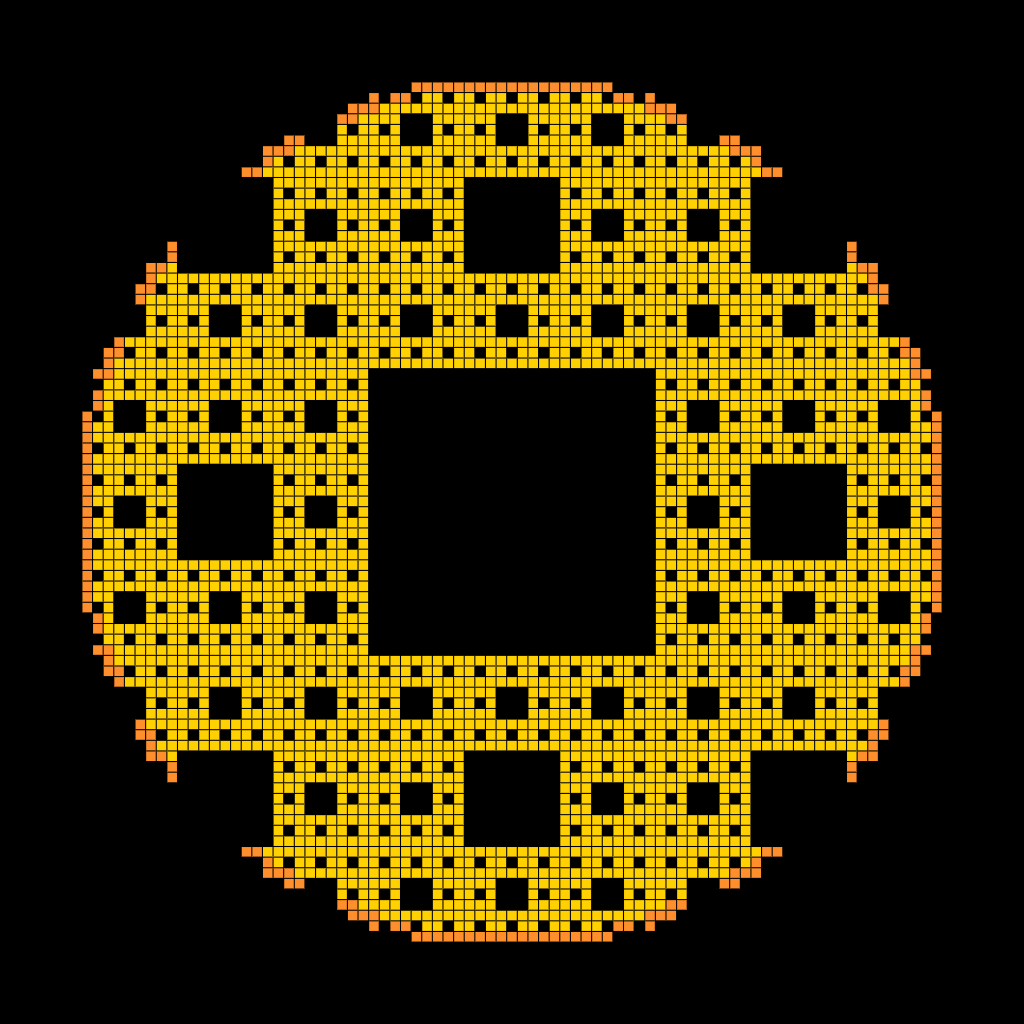
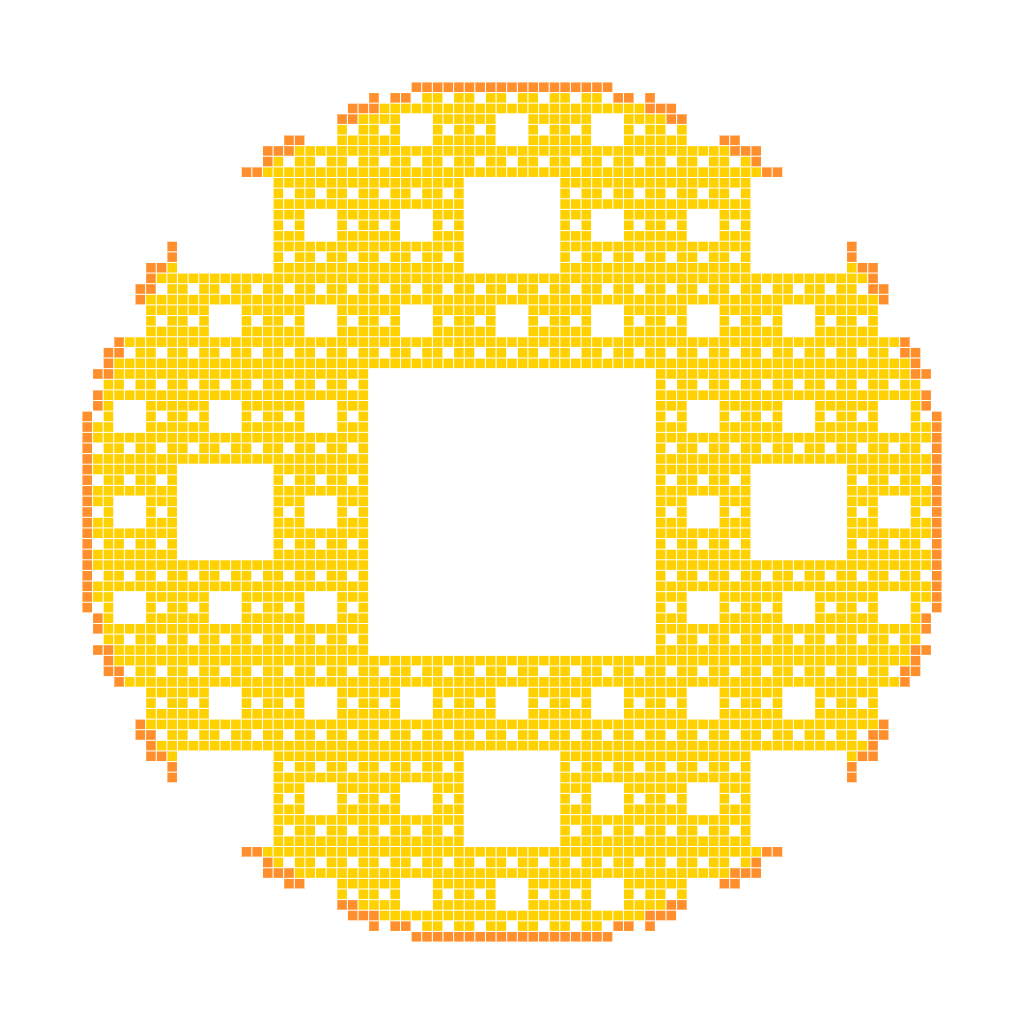
A crop lays an exact shape - a ball, a box, a diamond, any rational polytope - over a design's grid and classifies every cell as In, Cut or Out, in exact integer arithmetic with no floats: ball tests clear denominators and compare squared distances, half-space tests evaluate the linear form at two extreme corners. Cropping then zeroes the filled cells the shape rejects, keeping Cut cells on request, and Shape::Anti swaps In with Out while Cut stays. This page is the census of what a circle and a diamond keep of the carpet, what a sphere and an octahedron keep of the sponge, and the one open lane the Cut column points at: the dimension of a curved slice.
Every claim carries a tag. Proved means a proof is given or restated here; Verified means recomputed from scratch by a crate test or a lab study; Conjecture means neither. The generators are mrlymath::shape in ../crates - classify, regions, crop, refine, census - of which classify, crop, refine and census are each pinned by tests named for their claims, including an independent 2^dim-corner oracle, while regions carries no test of its own name and is exercised only through the others. lab/rs/crop-counts is the one pass that prints every number below. The crop demo draws a named shape over a design and counts the in, cut and out regions before anything is rendered.
Two identities, by construction
Partition (Proved). Every cell is exactly one of Out, Cut, In - classify returns one region, census tallies cells and filled cells per region, and the three filled tallies sum to the design's fill. crop(types, shape, true) keeps the filled cells of In and Cut, crop(types, shape, false) keeps In alone, so the two crops bracket the boundary from both sides.
Anti-crop complement (Proved). Shape::Anti flips In and Out and fixes Cut, so crop(types, Anti(shape), false) keeps exactly the filled Out cells and crop(types, Anti(shape), true) keeps Out and Cut: the crop and the anti-crop with the complementary cut rule partition the filled set exactly, whichever side gets the boundary. Both identities are read off the definition of classify and asserted, both ways, on all 118 configurations lab/rs/crop-counts prints, and independently by the mrlymath::shape partition tests. (Proved; Verified.)
The inscribed ball and diamond, level by level
Code 7 at dim = 2 is the carpet, code 23 at dim = 3 the sponge; the shape is centered at (1/2, ..., 1/2) with the inscribed radius 1/2, so the ball touches the four or six face midpoints and the diamond is the inscribed cross-polytope. filled_in and filled_cut are the filled cells fully inside and crossing the boundary; exposed_after counts the exposed unit faces of the keep-cut crop, a face being exposed when its neighbour is empty or off the grid. Level 0 is the single filled cell. (Verified, lab/rs/crop-counts, every row.)
Carpet, level = 0..5, side 3^level:
level | ball in | ball cut | ball exposed | diamond in | diamond cut | diamond exposed |
|---|---|---|---|---|---|---|
| 0 | 0 | 1 | 4 | 0 | 1 | 4 |
| 1 | 0 | 8 | 16 | 0 | 8 | 16 |
| 2 | 32 | 28 | 80 | 12 | 32 | 64 |
| 3 | 332 | 76 | 400 | 168 | 104 | 304 |
| 4 | 2908 | 204 | 2688 | 1596 | 320 | 1792 |
| 5 | 23900 | 580 | 20160 | 13560 | 968 | 12400 |
Sponge, level = 0..4, side 3^level:
level | ball in | ball cut | ball exposed | diamond in | diamond cut | diamond exposed |
|---|---|---|---|---|---|---|
| 0 | 0 | 1 | 6 | 0 | 1 | 6 |
| 1 | 0 | 20 | 72 | 0 | 20 | 72 |
| 2 | 44 | 216 | 792 | 0 | 116 | 504 |
| 3 | 2320 | 1224 | 8400 | 132 | 476 | 2016 |
| 4 | 54800 | 7968 | 134448 | 4320 | 2612 | 18456 |
Two structural readings, both exact. The inscribed sphere never enters the sponge at level 1: census reads cells [0, 26, 1] - the one In cell is the empty centre, all 20 filled cells are Cut - so the keep-cut crop keeps everything and the strict crop keeps nothing (Verified, mrlymath::shape test and the level = 1 row). And the inscribed octahedron holds no filled sponge cell fully inside through level 2: its deep interior is exactly where the sponge is empty. (Verified.)
The radius sweep
At carpet level 4 (side 81) and sponge level 3 (side 27), radii r = 1/24 .. 24/24. The digest; every number is a printed line of lab/rs/crop-counts. (Verified.)
- Dead zones: the carpet crop is empty - In and Cut both zero - for
r < 1/6under ball and diamond alike, the central hole's inradius in both norms, and the sponge diamond crop forr < 1/3; both radii are exact. The sponge ball's exact contact radius issqrt(2)/6 = 0.2357, off the sweep grid: the level-3 cell[13/27, 14/27] x [8/27, 9/27] x [8/27, 9/27]is filled - digit triples(1,0,0), (1,2,2), (1,2,2), each with at most one middle digit - and its nearest point to the centre is(1/2, 1/3, 1/3)at distancesqrt(2)/6, so the sweep reads empty atr = 5/24 = 0.208and first cuts atr = 6/24, the first grid radius past contact. (Proved by the witness cell; the sweep rows Verified.) - First contact on the sweep grid: carpet ball at
r = 1/6readsin = 0, cut = 4; sponge ball atr = 6/24readsin = 0, cut = 60; sponge diamond atr = 1/3readsin = 0, cut = 12. - At the inscribed
r = 1/2the sweep reproduces the level tables: carpet ball2908 / 204, carpet diamond1596 / 320, sponge ball2320 / 1224, sponge diamond132 / 476. - Saturation: the carpet ball crop holds all
4096filled cells with zero Cut fromr = 17/24, the first sweep radius past the circumradiussqrt(2)/2 = 0.7071; the sponge ball fromr = 7/8, pastsqrt(3)/2 = 0.8660. The sponge diamond never saturates in the sweep - atr = 1it readsin = 5356, cut = 1332of 8000, since the cube's corners sit atL1distance3/2. - The Cut column is not monotone in
r: the carpet ball's runs204, 184, 204, 144acrossr = 5/12 .. 13/24. How this count fluctuates alonglog ris the dimensions question below. (Verified for the values; nothing is claimed about the fluctuation.)
The circle count
The sweep above fixes the level and moves the radius across the unit box; this section fixes the radius in cells and lets it run, which is the Gauss circle question asked of a carpet. Cells are indexed x in [0, 3^level)^dim and a cell counts when its centre, x + 1/2 on every axis, lies in the closed Euclidean ball |y| <= r; two centres are run, the corner ball about the lattice corner 0 and the centre ball about the grid centre 3^level/2. lab/rs/circle-crop prints every number below across 22028 asserted rows, 6802 of them carrying a live error band, and checks its integer sweep against mrlymath::shape::census at 41 radii, the filled and the whole-grid columns alike; the whole-grid count itself stays within 0.310472 r of the quarter disc's area for r <= 242 and within 0.476401 r^2 of the octant's volume for r <= 26. (Verified.)
The count is one sequence, not one per level (Proved; Verified). Let S be the design's filled residue corners - {0,1,2}^2 without the middle (1,1) for the carpet, so m = 8, and the 20 vectors with at most one middle coordinate for the sponge - and let F be the points of Z_{>=0}^dim whose every base-3 digit vector lies in S. The zero digit vector lies in S in both designs, so F cut to [0, 3^level)^dim is exactly the design at level level, and every cell the corner ball of radius r <= 3^level - 1 counts sits inside that box. The corner count N(r) = #{x in F : |x + 1/2| <= r} therefore does not depend on level: the generator asserts each level against the one below over the whole range the lower level reaches, count, In and Cut columns alike - on the carpet level = 6 against level = 5 on r = 1..242, level = 7 against level = 6 on r = 1..728, level = 8 against level = 7 on r = 1..2186 and level = 9 against level = 8 on r = 1..6560, on the sponge level = 4 against level = 3 on r = 1..26, level = 5 against level = 4 on r = 1..80 and level = 6 against level = 5 on r = 1..242. Chaining those checks, all five carpet levels agree on r = 1..242 and all four sponge levels on r = 1..26, which are the ranges every level of a design reaches; the deepest pair is checked over r = 1..6560 and r = 1..242.
The main term is a periodic multiplier, not a constant (Proved). Write mu for the design's natural measure - the self-similar probability measure with equal weights 1/m on the maps x -> (x + s)/3, s in S, normalised by mu([0,1]^dim) = 1 and supported on the limit set - and dimension = log_3 m, so dimension = 1.8927892607 for the carpet and 2.7268330279 for the sponge. For s <= 1 the ball B_(s/3) lies in the corner sub-box [0, 1/3]^dim, which carries the s = 0 piece and meets the other pieces only in faces, and mu gives a face measure zero; on that piece mu is 1/m times the 1/3-scaled copy of itself and x -> x/3 pulls B_(s/3) back to B_s, so mu(B_(s/3)) = mu(B_s)/m and M(r) = m^k mu(B_(r/3^k)) is one number for every k with 3^k >= r. Writing k = ceil(log_3 r) gives M(r) = r^dimension G(log_3 r) with G positive and 1-periodic: the count's main term carries the lattice oscillation the dimensions page predicts, and no constant times r^dimension can replace it.
The circle theorem (Proved). For every r >= 1, |N(r) - M(r)| <= C(r), where C(r) is the number of filled unit cells the sphere |y| = r crosses, which is exactly the Cut column of the corner ball. At scale 3^-k a filled cell fully inside the ball contributes 1 to N and m^k mu(cell) = 1 to M, a cell fully outside contributes 0 to both, and a crossing cell contributes 1 or 0 to N and something in [0, 1] to M, so the two counts differ only over the crossing cells and by at most one each. Since the crossing cells of the whole grid number O(r^(dim-1)) in every dim - a cell meeting the sphere has diameter sqrt(dim), so it lies in the shell | |y| - r | <= sqrt(dim), and unit cells have disjoint interiors, so their number is at most that shell's volume in the positive orthant, 2^(-dim) omega_dim ((r + sqrt(dim))^dim - max(r - sqrt(dim), 0)^dim) with omega_dim = vol(B_1), which is pi sqrt(2) r at dim = 2 and pi sqrt(3) (r^2 + 1) < 5.4414 (r^2 + 1) at dim = 3 once r >= sqrt(dim), and less below; the telescoping column count sharpens the plane, where the crossing cells of a column form an interval of length at most sqrt(r^2 - i^2) - sqrt(r^2 - (i+1)^2) + 2 whose first part telescopes, and the generator asserts C_full(r) <= 3r + 5 at every r <= 19682 in dim = 2 and C_full(r) <= pi sqrt(3) (r^2 + 1) at every r <= 728 in dim = 3 - the theorem reads
N(r) = r^dimension G(log_3 r) + O(r^(dim-1)), an unconditional saving ofr^0.8927892607on the carpet andr^0.7268330279on the sponge over the count itself.
The defect is an exact integer (Proved). M(3r) = m M(r) by periodicity, so with E(r) = N(r) - M(r) and the defect delta(r) = N(3r) - m N(r) one gets E(3r) = m E(r) + delta(r), and since |E| <= C = O(r^(dim-1)) = o(r^dimension) the recursion inverts: E(r) = - sum_(j >= 0) m^(-j-1) delta(3^j r). The defect is an exact integer, printed at every radius; the error is printed as N(r) - N(3^j r)/m^j at the deepest j the grid allows, banded by C(3^j r)/m^j, which is the theorem applied at that radius. So |E(3)| lies in [0.989655, 0.995193], |E(9)| in [0.038459, 0.082757], |E(27)| in [0.337951, 0.692322], |E(81)| in [2.703613, 5.538575] on the carpet, and the exponent of |delta| bounds the exponent of |E|.
The measured exponents (Verified, with their windows). The running maximum's growth over one triadic step, read at every radius in the range, gives for the crossing count C on the carpet min 0.871371, mean 0.898741, max 0.969141, log-log fit 0.870673 and endpoints 0.898794 over r = 27..19682, and on the sponge 1.704391, 1.733764, 1.757218, 1.654302, 1.720961 over r = 27..728. Both bands contain dimension - 1, which is 0.8927892607 and 1.7268330279: the circle's trace on the carpet and the sphere's on the sponge measure about one less than the design's own dimension, over six and three triadic windows. For the defect the same estimators give 0.220478, 0.527490, 1.015046, 0.544749, 0.648815 over r = 27..6560 on the carpet and 0.645285, 1.056561, 1.730726, 1.001255, 1.273634 over r = 27..242 on the sponge: the three central estimators land in [0.527490, 0.648815] for the carpet and [1.001255, 1.273634] for the sponge, while the per-radius readings run over [0.220478, 1.015046] and [0.645285, 1.730726], and the range decides nothing sharper. All six central estimates sit above half the crossing exponent, 0.4494 and 0.8669, so square-root cancellation over the crossing cells - the Hardy-shaped guess - is not what these radii show, and all six sit below the crossing exponent itself, so the theorem's bound is not attained either. (Conjecture, either way.)
The window mean of the crossing count (Proved). The crossing count is a difference of two corner counts. With A(r) = #{x in F : |x| <= r} and B(r) = #{x in F : |x + 1| <= r}, a filled cell crosses the sphere exactly when |x| <= r < |x + 1|, so C(r) = A(r) - B(r) at every integer r, where B is the In column and A the In plus Cut column the generator prints. On the nonnegative orthant a cell's two corner radii are never closer than one apart: |x + 1|^2 - |x|^2 = 2 sum_i x_i + dim while |x + 1| + |x| <= 2 |x| + sqrt(dim) <= 2 sum_i x_i + sqrt(dim), since |x| <= sum_i x_i there and sqrt(dim) <= dim, so 1 <= |x + 1| - |x| <= sqrt(dim), the upper bound by the triangle inequality. The half-open interval [|x|, |x + 1|) therefore holds at least one integer and at most floor(sqrt(dim)) + 1, which is 2 for both designs. Summing C over a triadic window counts the pairs (x, r) with r in [|x|, |x + 1|) cap [R, 3R), and the two multiplicity bounds give the exact sandwich B(3R) - A(R) <= W(R) <= 2 (A(3R) - B(R)) for W(R) = sum_(r = R)^(3R - 1) C(r). The bracket lemma B(r) <= M(r) <= A(r) is the circle theorem's own cell argument, not a consequence of In <= N <= In + Cut with |N - M| <= C: a filled cell fully inside the ball contributes 1 to M, one fully outside 0, a crossing cell something in [0, 1], so M sits between the In column and the In plus Cut column at every radius. Feeding that in, with A = B + C and M(3R) = m M(R), turns the sandwich into (m - 1) M(R) - C(3R) - C(R) <= W(R) <= 2 ((m - 1) M(R) + C(3R) + C(R)), and since C = O(r^(dim-1)) with dimension > dim - 1, dividing by the window's 2R radii gives the theorem: the mean of C over r in [R, 3R) lies between ((m - 1)/2) G_min R^(dimension-1) and (m - 1) G_max R^(dimension-1) up to O(R^(dim-2)), with G_min >= mu(B_1)/m and G_max <= m mu(B_1) the positive bounds of the periodic multiplier. Averaged over a triadic window the crossing exponent is dimension - 1 exactly, with m - 1 = 7 on the carpet and 19 on the sponge; only the pointwise statement is open.
The constants, at every window (Verified). The generator prints a mean line for each triadic window with 3R <= 3^level - 1, eight on the carpet and five on the sponge, and asserts at every one both the exact sandwich and its closed form, the latter with M(R) bracketed by its own In and In plus Cut columns at the deepest depth the grid reaches. At r = 2187..6560 the carpet's window sum is 13758140, the sandwich reads [11019880, 22055720], the closed form [11013332.750000, 22068746.000000] and the mean 3145.436671; the window below has mean 1180.226337, so successive window means multiply by 2.665113 against m/3 = 8/3, which is 3^(dimension-1). Every printed bracket rounds outward at 1e-6. The multiplicity kappa = W(R) / ((m - 1) M(R)) sits in [1, 2] only asymptotically: the exact statement carries the slack (C(3R) + C(R)) / ((m - 1) M(R)) on both sides, and at r = 1..2 on the carpet that slack drives form_low to -4.744629, below zero. Measured, kappa brackets to [1.247746, 1.248322] at r = 2187..6560 and descends monotonically from [1.331356, 1.331971] at r = 1..2; on the sponge it climbs from [1.084118, 1.105871] to [1.417534, 1.445977] at r = 81..242 and is still climbing at the last window it reaches, so only the carpet's sequence has settled. On the carpet the sum sits near the theorem's lower constant and nowhere near its upper one: the factor two in the sandwich is the price of counting integers in [|x|, |x + 1|) instead of measuring that interval.
The pointwise question is one statement about digits (Proved reduction; Verified factor). Let C_full(r) be the whole grid's crossing count. It is Theta(r^(dim-1)): the shell bound above gives the upper half, and for the lower half fix a lattice point p >= 0 with |p| <= r in the first dim - 1 coordinates, put j = floor(sqrt(r^2 - |p|^2)) and take the cell x = (p, j): then |x|^2 = |p|^2 + j^2 <= r^2 and |x + 1|^2 >= |p|^2 + (j + 1)^2 > r^2, so it crosses, distinct p give distinct cells, and the orthant ball holding the cube of side r / sqrt(dim - 1) gives C_full(r) >= (r / sqrt(dim - 1))^(dim-1); the generator asserts that bound at every radius, and the measured C_full(r) / r^(dim-1) bands to [2.000152, 2.037038] on the carpet over r = 27..6560 and to [2.298611, 2.380000] on the sponge over r = 9..242. Let level be the least level with r < 3^level, so 3^(level-1) <= r < 3^level, and put Phi(r) = C(r) (3^dim/m)^level / C_full(r): the filled share of the crossing cells divided by (m/3^dim)^level, the share a cell at level level carries at random. Since (m/3^dim)^level = 3^(level(dimension - dim)), the pointwise C(r) = Theta(r^(dimension-1)) holds if and only if Phi is bounded above and below by positive constants, so the pointwise crossing exponent is exactly the statement that the sphere's crossing cells carry the design's digits at their ambient density up to a bounded factor, and nothing further about the circle enters. The generator prints a factor line per window with the minimum, mean and maximum of Phi, each mean asserted against a ground built from the window theorem's lower constant and the proved cap on C_full, which is 3r + 5 at dim = 2 and pi sqrt(3) (r^2 + 1) at dim = 3, so the check does not draw its expectation from the sweep it checks. On the carpet over eight windows, r = 1..6560, the mean reads 1.012500, 0.981078, 0.959982, 0.954469, 0.948442, 0.944582, 0.943419, 0.942790, the minimum stays inside [0.588115, 0.900000] and the maximum inside [1.125000, 1.518945]; on the sponge over five windows, r = 1..242, the mean reads 1.080000, 1.042535, 0.980332, 0.968704, 0.965114, the minimum inside [0.602555, 0.810000] and the maximum inside [1.350000, 1.673315]. Both ends widen, and the widening decelerates: the carpet's maximum rises at all seven steps by 0.140625, 0.090402, 0.074920, 0.033718, 0.033360, 0.020111, 0.000808 and its minimum falls at six of the seven, the sponge's maximum rises at all four by 0.176959, 0.086036, 0.054979, 0.005341. The increments shrink by an order over the range, so the reading is a factor whose spread is settling rather than one growing with r, and the pointwise exponent dimension - 1 survives the test that would refute it without being confirmed by it. (Conjecture past the measured range, in both directions.)
The crossing shell of the plane is exactly 2r + 1 cells (Proved). At dim = 2 the whole grid's crossing count is not merely Theta(r), it is an identity: C_full(r) = 2r + 1 at every integer r >= 1. Fix a column x_1 = i with 0 <= i <= r. The cell (i, x_2) crosses when i^2 + x_2^2 <= r^2 < (i+1)^2 + (x_2+1)^2, so x_2 runs over [lo_i, hi_i] with hi_i = floor(sqrt(r^2 - i^2)) and lo_i the least integer with (x_2 + 1)^2 > r^2 - (i+1)^2, which is floor(sqrt(r^2 - (i+1)^2)) = hi_(i+1) whenever (i+1)^2 <= r^2 and 0 at i = r, which is what setting hi_(r+1) := 0 records, since r^2 - (r+1)^2 < 0 leaves the root undefined there. The column counts therefore telescope, C_full(r) = sum_(i=0)^r (hi_i - hi_(i+1) + 1) = hi_0 - hi_(r+1) + (r + 1) = 2r + 1, using hi_0 = r. The same computation at a real radius R gives 2 floor(R) + 1, and if x crosses at radius r then its level-j box X = floor(x/3^j) satisfies |X| <= r/3^j < |X + 1|, since 3^j X <= x and x + 1 <= 3^j (X + 1) coordinatewise, so the level-j boxes carrying a crossing cell number at most 2 floor(r/3^j) + 1; clipping the same telescoping to one box gives at most 2 * 3^j crossing cells inside it. The generator asserts C_full(r) = 2r + 1 at every radius of every carpet level, out to r = 19682 at level = 9. The identity sharpens the proved cap C_full(r) <= 3r + 5, replaces the measured band [2.000152, 2.037038] for C_full(r)/r - which is exactly the range of (2r + 1)/r over r = 27..6560 - and makes the pointwise factor exact in its denominator, Phi(r) = C(r) (9/8)^level / (2r + 1). In dim = 3 the low corner of a column moves in two coordinates at once, nothing telescopes, and the sphere's band stays measured.
The digits of the crossing shell (Proved cap; Verified census). Write p_j(r) for the fraction of the C_full(r) crossing cells whose base-3 digit vector at position j is one the design omits - (1,1) on the carpet, one of the seven vectors with two or three middle coordinates on the sponge - so a crossing cell is filled exactly when no position carries an omitted vector and C(r)/C_full(r) is the survival of the crossing cells' digit vectors, against the null rate 1 - m/3^dim, which is 1/9 and 7/27. The pointwise question then splits into two exact factors, ind(r) = prod_(j < level) (1 - p_j(r)) (3^dim/m)^level, the independent model's survival times (3^dim/m)^level, and the dependence correction Psi(r) = (C(r)/C_full(r)) / prod_(j < level) (1 - p_j(r)), with Phi(r) = ind(r) Psi(r) by construction; since log ind(r) = sum_(j < level) (log(1 - p_j(r)) - log(m/3^dim)), ind bounded is exactly the statement that the average of log(1 - p_j) over the level positions equals log(m/3^dim) to O(1/level); ind and Psi both bounded above and below is sufficient for the pointwise exponent, and is not necessary, since Phi stays bounded along any pairing of ind -> 0 with Psi -> infinity. One cap is proved at dim = 2: a cell with the omitted vector at position j lies in the centre child of a level-(j+1) box, a level-(j+1) box has one centre child and carries a crossing cell only if it is one of the 2 floor(r/3^(j+1)) + 1 boxes counted above, and a level-j box holds at most 2 * 3^j crossing cells, so p_j(r) <= 2 * 3^j (2 floor(r/3^(j+1)) + 1) / (2r + 1) < 2/3 + 3^j/r, asserted in exact integers at every radius and position of the eight windows, and every position with 3^j <= r/30 is capped at 0.7 uniformly in r. On its own that buys nothing, because the sharpest bound the marginals alone support is the Frechet-Hoeffding lower bound C(r) >= C_full(r) (1 - sum_j p_j(r)), attained when the omission events are disjoint, also asserted exactly, and the generator prints sum_j p_j with window mean 0.941002 and maximum 1.349974 at level = 8 on the carpet and 1.321036 and 1.627693 at level = 5 on the sponge: the union bound is already empty at the sizes that matter, and grows emptier like level/9. What the census reads instead is equidistribution everywhere except the top of the scale. On the carpet at r = 2187..6560, level = 8, the window means run 0.111086, 0.111086, 0.111068, 0.111063, 0.111141, 0.109478, 0.109295, 0.166786 from the finest position to the coarsest: five of the eight agree with 1/9 to four decimals, and the whole departure lives in the top three, a profile locked to level - j rather than to r, ending at 0.166786 where the digit is the arc's place in the level-1 grid. Every fine position, every j with j + 4 <= level, has window mean inside [0.108363, 0.111141] across the five of the eight carpet windows deep enough to have one, and (p_j - 1/9) 3^k/3^j on the window r = 3^k..3^(k+1) - 1 stays inside [-0.111806, 0.063806] at every position of every window, which is the reading p_j(r) = 1/9 + O(3^j/r) in the window mean; per radius the band is wider and set by the shell's size, [0.102466, 0.121271] at the finest position and [0.000000, 0.447092] at the coarsest. The sponge reads the same shape against 7/27 = 0.2592592593, window means 0.259211, 0.259237, 0.259663, 0.256864, 0.286061 at r = 81..242, fine positions inside [0.259103, 0.259237] and the scaled drift inside [-0.108311, 0.026803] over five windows, with one difference: the sponge's fine band lies wholly below 7/27 where the carpet's straddles 1/9, a one-sided bias on the three readings its two deep-enough windows supply, too few to call. The pair dependence is bounded per pair: on the window's pooled counts the consecutive ratios p_(j,j+1)/(p_j p_(j+1)), where p_(j,j') is the fraction of crossing cells carrying an omitted digit vector at both positions, read 1.000165, 1.000219, 1.000521, 0.998543, 0.992613, 1.076698, 0.956158 on the carpet at level = 8 and 0.999847, 1.000927, 1.003308, 0.954574 on the sponge at level = 5, the gap-two ratios 1.000298, 1.000022, 1.000203, 1.000221, 1.003261, 1.005671 and 0.999497, 0.999197, 0.997414, and over every window the consecutive ratio stays in [0.939130, 1.714286] on the carpet - the high end is the two-position window r = 3..8 - and in [0.954573, 1.151415] on the sponge, the gap-two ratio in [0.988460, 1.126957] and [0.997413, 1.019127]. So neighbouring positions are dependent by a bounded factor and the dependence falls off with the gap, the finite-range shape a transfer operator would give. What that does not settle is Psi: its window means read 1.000000, 1.010516, 1.009082, 1.006311, 1.007708, 1.006371, 1.005977, 1.005714 on the carpet, settling near 1.0057, while its extremes widen with decelerating drift exactly as Phi's do, [0.793296, 1.374208] at the deepest window against [0.808810, 1.362428] at the one below. Over all eight windows the generator prints the global brackets [0.542697, 1.515753] for ind and [0.793296, 1.374208] for Psi, the second being the deepest window's bracket and the global one at once, the first not: ind's low end is read at r = 243..728, while its window means run 1.012500, 0.973637, 0.954993, 0.953180, 0.945805, 0.943289, 0.942499, 0.942104. The pointwise conjecture therefore survives its sharpest test - the fine positions carry no drift, the drift is three positions deep, and pair dependence is bounded - and what is missing is a bound on Psi, which bounded pair ratios do not supply: a product over pairs bounds a survival probability only under a Markov property proved rather than measured. (Proved for the cap and for the emptiness of the union bound; Verified for every rate, ratio and factor printed; Conjecture that Psi is bounded, hence that Phi is; ind bounded is proved two claims below.)
A bound on ind from a 1923 theorem (Proved). The crossing shell of the plane is a monotone lattice path: within a column its rows are an interval, and column x and column x + 1 share the row floor(y(x+1)) for y(x) = sqrt(r^2 - x^2), so consecutive cells are edge-adjacent while x never decreases and the row never increases. A monotone path meeting w columns and h rows has exactly w + h - 1 cells, and an axis-aligned box clips a contiguous sub-path, so a level-j box X carries leaves(X) = w(X) + h(X) - 1 crossing cells. The two marginals are exact and telescope: fine column x meets the box rows [beta(x+1), beta(x)] with beta(x) = floor(y(x)/3^j), so sum_(X in S_j) w(X) = sum_(X in S_j) h(X) = floor(r/3^j) + r + 1 and sum_(X in S_j) leaves(X) = 2r + 1, the shell's own size. Both the shell and the centre seat X = (1,1) mod 3 are invariant under swapping the coordinates, and the swap carries w to h, so the seat class Ctr_j has equal marginals and p_j(r) (2r + 1) = 2 sum_(X in Ctr_j) w(X) - |Ctr_j| with no error term. That identity is why the leaf weighting is load-bearing rather than decorative. Counting the seat's cells directly asks a congruence in the fine row as well as the fine column, 3^(2j) residue classes mod 3^(j+1), and beats the trivial bound only for 3^(4j) < r; counting w asks a congruence in the fine column and one in the box row, 3^j classes, and 3^j (3^(j+1))^(-2/3) r^(2/3) is 3^(-2/3) r R^(-1/3) at every level, R = r/3^j. With floor((floor(v) + k)/n) = floor((v + k)/n) both counts become sums of floor of one smooth arc over those classes, and floor(z) = z - 1/2 - psi(z) splits each into a main term and sawtooth sums.
The bound, its constant and its reach (Proved; Verified). The sawtooth sums are exactly the object van der Corput, Zahlentheoretische Abschätzungen mit Anwendung auf Gitterpunktprobleme, Math. Z. 17 (1923) 250-259 caps in Satz 5: for h in C^2[a, b] with h'' monotonic and nonzero, |sum_(a < n <= b) psi(h(n))| <= 6 int_a^b |h''|^(1/3) + 175 max |h''|^(-1/2) + 2, read at source in Laugesen and Liu, Optimal stretching for lattice points and eigenvalues, Appendix A, Theorem 18, which cites Satz 5 and Kraetzel's corollary and sharpens the +2 to +1; the +2 is what is used here. A progression is an affine substitution, so h(u) = (y(qu + c) - b)/q has h'' = q y''. The arc is never used closed, since y is not C^1 at x = r: the theorem is applied on [a, b] with q b + c < r, where h'' is monotonic and nonzero, min |h''| = q/r sits at x = 0 for every such b, and int_0^(qb+c) |y''|^(1/3) dx <= int_0^r |y''|^(1/3) dx = (pi/2) r^(2/3) converges, so both constants are uniform in b and no split at slope 1 is needed - one class costs 3 pi q^(-2/3) r^(2/3) + 175 q^(-1/2) r^(1/2) + 2. What the subinterval leaves outside is peeled at two points, not one: the term at x = r where y'' is undefined, and, in the sum whose argument is y(x+1), the term at x = r - 1 for the same reason and the term at x = r where y(r+1) := 0 is a convention and not the arc. Each carries |psi| <= 1/2, so the peel costs 1 in that sum and 1/2 in the other, which is exactly the +1 the assembly carries, with zero margin. The main term is not an Euler-Maclaurin error but a monotone sequence split by residue: y(x) - y(x+1) is nondecreasing by concavity, a residue class deviates from the block mean by at most the block spread, the spreads are disjoint increments and telescope, and only the largest single increment - sqrt(2r - 1) on the arc, sqrt(2R) at the shell - is paid at full size, so the main-term error is a square root and not a constant. Summed over the 3^j classes each of the two column sawtooth sums is at most 4.5310 r R^(-1/3) + 101.0364 r R^(-1/2) + 2 r R^(-1) + 1 and each of the two box sawtooth sums at most 4.5310 R^(2/3) + 101.0364 R^(1/2) + 3, since 3 pi 3^(-2/3) = 4.5309... and 175 * 3^(-1/2) = 101.0362..., both rounded up; the residue split costs (7/9) sqrt(2r) <= 1.1000 r^(1/2) on the column marginal and (10/3) sqrt R + (4/3) sqrt(2R) <= 5.2190 R^(1/2) on the box count, the two counting terms being exact to 2 * 3^j and to 2/3; the main terms cancel to (2r + 1)/9 plus the residue (R - floor(R))/9, itself below 1/9, and the errors add to 27.1860 r R^(-1/3) + 610.1581 r R^(-1/2) + 9.3334 r R^(-1) + 10.3334, which 2r + 1 >= 2r and R <= r fold into three constants. Assembling, |p_j(r) - 1/9| <= 13.60 R^(-1/3) + 305.08 R^(-1/2) + 9.84 R^(-1) at every level of every radius, every constant rounded up and every hypothesis inside the statement. Since R_j = r/3^j is geometric, sum_(j < level) R_j^(-delta) <= 3^delta/(3^delta - 1), which reads 3.2612, 2.3661 and 1.5 at delta = 1/3, 1/2, 1, so sum_(j < level) |p_j(r) - 1/9| <= 781 uniformly in r; a Huxley-type delta = 77/208 in place of van der Corput's 1/3 would move the first of those three to 2.9927 and nothing else, so the modern exponent is a luxury on this route and not a hinge. Box column 0 is never a seat and carries r - floor(sqrt(r^2 - 3^(2j))) + 3^j >= 3^j cells, so 1 - p_j(r) >= 3^j/(2r + 1) >= 1/(3 R_j) at every level and the product never degenerates. Where R_j clears the 23157375 at which the bound first falls under 1/9, the crossing sitting at 23157374.055, 1 - p_j >= 7/9 and the mean value theorem gives |log(1 - p_j) - log(8/9)| <= (9/7) |p_j - 1/9|, so that block costs at most (9/7) 781 <= 1004.15. At most 16 levels fall below it, since R_j < 23157375 asks j > log_3 r - 15.44 while log_3 r >= level - 1, and on them |log(1 - p_j) - log(8/9)| <= log(3 R_j) < (i + 1) log 3 at the i-th from the top, a tail of at most log 3 * n(n + 3)/2 over the top n levels and so at most 167.0 at n = 16. Hence |log ind(r)| <= 1191 for every r >= 1, and ind is bounded above and below by positive constants. What that is not: Psi is untouched, so Phi = ind Psi does not follow, and the frozen-slope refutation below still stands; the constant is a certificate and not a size, the measured ind living in [0.542697, 1.515753] inside an envelope of e^(+-1191), all of it driven by the 175; and the staircase is a plane fact, so the sponge has none of this. lab/rs/circle-crop asserts every identity above in exact integers at every level of r = 80, 242, 1000, 2186, 6560, 12345, 19682 - the leaf weighting box by box, both marginals, the transpose equality, the seat identity, both floor formulas, the away-from-one lemma - then the bound itself, the drift sum against 781 and |log ind| against 1191; the drift sums read 0.223603, 0.245132, 0.328170, 0.256778, 0.260804, 0.446659, 0.267260 and |log ind| reads 0.069975, 0.105310, 0.341219, 0.140802, 0.144928, 0.281717, 0.158483, with worst slack 0.001478 against the cap. Those seven radii check the identities and not the bound: 13.60 R^(-1/3) + 305.08 R^(-1/2) + 9.84 R^(-1) stays above the trivial 8/9 for every R < 212957, so at r <= 19682 no assertion on the bound can fail, and the pass prints live_levels=0 at each of them rather than claiming otherwise. The bound is asserted where it bites, at j = 0 and r = 212957, 531441 and 2000000, the first of them the least radius at which the cap clears 8/9 at all: caps 0.888888350, 0.586410834 and 0.323672329, measured gaps 0.000590, 0.000447 and 0.000192, ratios to the cap 0.000664, 0.000761 and 0.000592. (Proved for the staircase, the marginals, the seat identity, the arc cap, the residue split and all three bounds; Verified for every identity and every number the generator prints.)
The crossing shell is a tree, and the pointwise question is a growth rate on it (Proved). Fix r, write S_j for the level-j boxes carrying a crossing cell, and R_j = r/3^j. The box bound above gives |X| <= R_j < |X + 1| for every X in S_j, and the converse holds too: a monotone lattice path of unit cells from the box's near corner to its far corner starts inside the ball and ends outside it, and the first cell on it whose far corner is outside has near corner at most the previous cell's far corner coordinatewise, hence inside, so that cell crosses. S_j is therefore exactly the whole grid's crossing shell at the real radius R_j, and the real-radius form of the plane identity gives |S_j| = 2 floor(r/3^j) + 1 at every level, 2r + 1 at j = 0 and a single box at any j with 3^j > r. Since a cell's level-(j+1) box is floor(x/3) of its level-j box, the levels chain into a rooted tree of depth level with 2r + 1 leaves, and a leaf's base-3 digit vector at position j is exactly its seat in its level-(j+1) parent, so C(r) counts the leaves whose root-to-leaf path never takes the centre seat and the pointwise question is a growth rate on a pruned tree. Writing b(X) for the number of children of X in S_j, summing over S_(j+1) gives the exact branching identity sum_(X in S_(j+1)) b(X) = |S_j|, so with Q = floor(r/3^(j+1)) and floor(r/3^j) = 3Q + k, k in {0, 1, 2}, the mean branching is (6Q + 2k + 1)/(2Q + 1) = 3 + (2k - 2)/(2Q + 1): exactly 3 at every level where floor(r/3^j) is 1 mod 3, and 3 + O(1/Q) at the other two residues. Both identities are asserted at every level of every radius the transfer pass runs. Suppose the pruned tree had a growth rate lambda per level while the tree grows at 3: then Phi(r) = C(r) (9/8)^level / C_full(r) would be (3 lambda / 8)^level up to bounded factors, and Phi bounded would be exactly lambda = 8/3, the branching number 3 less the centre seat's share 1/3 - and 1/3 at the box is the same reading as p_j = 1/9 at the cell, since a level-j centre child is one of the three seats a level-(j+1) box fills on average and carries an average leaf load. Nothing here proves the pruned tree has a growth rate, so the equivalence is a restatement under a hypothesis and not a reduction of Phi to a number. The shell demo draws the shell as that tree at any radius, level by level, the surviving leaves lit against the pruned ones and every level's box count set beside 2 floor(r/3^j) + 1. (Conjecture that the rate exists.)
The transfer operator on the local pattern (Verified). Give a box the 9-bit pattern of its crossed children as its state, printed in octal with bit 4 the centre. The pass reads the boxes of levels 1..level-3 only, dropping the top three levels of each tree, and over those levels lab/rs/circle-crop finds the same alphabet of 30 patterns at r = 6560, 19682 and 12345, asserted equal across the three - 001, 003, 007, 011, 013, 017, 036, 070, 074, 111, 113, 132, 136, 170, 174, 222, 226, 264, 322, 326, 360, 364, 400, 440, 444, 600, 640, 644, 700, 740 - with no pattern taking more than 0.104824 of the boxes at any of them, and the branching means 3.003711, 3.001532, 3.000976 and centre rates 0.326994, 0.328381, 0.335367, which tripled read 0.980983, 0.985143, 1.006102 against 1. That alphabet belongs to the truncation and not to the tree. Reading every box of every level the count is 31 at all three radii, the extra state being the root's own pattern - 744 at r = 6560 and 19682, 032 at r = 12345 - and even under the truncation the alphabet is not closed: of the 16683 radii r = 3000..19682, 228 carry a state outside the thirty over levels 1..level-3 and 1966 carry one over levels 1..level-1, the extra reading 744 or 032 in every case and no radius ever reading fewer than thirty. The pinned witnesses are r = 15122, whose extra 744 appears at level 6 = level-3, r = 3182, which carries 032 at every truncation, and r = 1395, 1739 and 6570, which carry theirs at 1..level-1 alone, the last of them sitting ten above the pass's own 6560. What is Verified is that the thirty all occur and no thirty-first does at the three study radii over levels 1..level-3. The operator is the exact integer matrix M[s][t] of parent-child pairs over the printed levels and its mean offspring matrix is A[s][t] = M[s][t] / n_s; its Perron root is certified and never fitted, a positive integer test vector v giving the Collatz-Wielandt bracket min_s (sum_t M[s][t] v_t) / (n_s v_s) <= rho(A) <= max_s, an exact ratio of integers printed with the lower end truncated down and the upper rounded up. Against 3 the brackets read [3.000861, 3.000862], [3.000948, 3.000949] and [2.997616, 2.997617]: rho(A_r) differs from 3 at all three radii, certified, by at most 0.0024. That is a fact about three matrices and not a verdict on the process, and the same pass prints three reasons the Perron root is the wrong functional to try it with. The row sums of A are exactly popcount(s), asserted state by state, so from the true state census at any level the memory-one model returns the level below with zero error - 161, 485, 1457, 4373, 13121 against the tree's own |S_4| down to |S_0| at r = 6560 - and iterating the matrix four times from the level-5 census still lands within 8.694464 of 13121. The exact 3 the brackets miss is not a rate the tree realises: its pooled branching at r = 6560 reads 3.037736, 3.012422, 3.004124, 3.001373, 3.000457 from level 5 down, the exact 3 being the Q -> infinity limit of 3 + (2k - 2)/(2Q + 1) and no finite level. And the miss is finite-size: built from one level pair at a time the bracket's certified distance from 3 falls monotonically 0.323840, 0.002623, 0.002385, 0.000086 as the parent count rises 53, 161, 485, 1457. Over 18 radii the pass does not otherwise use, 3001 to 18301 at stride 900, every bracket excludes 3, 9 of them above and 9 below, at sizes 0.000336 to 0.005951 - the same sign flip that leaves the ratio drift below uninformative. So rho(A_r) != 3 at the three named radii is Verified, and whether the pattern process is Markov at memory one is untested here. Against 8/3 the pruned matrix - the same counts with the centre child dropped and the states that reach no survivor removed - brackets to [2.657742, 2.657743], [2.672261, 2.672262] and [2.668083, 2.668084], so the ratio rho(A_nc)/rho(A) brackets to [0.885659, 0.885661], [0.890471, 0.890473] and [0.890068, 0.890069] against 8/9, a per-level drift of Phi's exponent of [-0.003314, -0.003311], [0.001618, 0.001621] and [0.001206, 0.001208] in log_3. The sign flips with the radius, so nothing systematic survives, and a three-per-thousand error in the ratio is (1 +- 0.003)^level in Phi, which is precisely the error a bound may not carry: the memory-one operator neither confirms nor refutes lambda = 8/3. Enlarging the state to the pattern paired with the box's own seat in its parent - 263, 270 and 270 of the 270 possible - moves the bracket to [2.964909, 2.964910], [3.000989, 3.000990] and [2.998702, 2.998703] and the ratio to [0.893588, 0.893590], [0.891339, 0.891341] and [0.890199, 0.890201]: no closer, and one of the three worse. One step of memory does not converge the state, which is the obstruction the route was always going to meet - a box's pattern is fixed by the arc's slope and its offset in the box, the offset triples modulo one down a level while the slope is a continuous parameter, so the exact state is an interval map and not a finite set. What the finite matrix does deliver is a certified contraction: the one-step Dobrushin coefficient is exactly 1 at every radius, two patterns with disjoint seats having disjoint child seats, but the minorisation sum_t min_s P^n[s][t], computed in fixed point with every rounding taken down so the printed floor is a bound, reads 0.000000, 0.073937, 0.217716, 0.347398, 0.458035, 0.552167 at n = 1..6 and r = 6560, forcing a contraction per level of at most 0.874687, 0.874812 and 0.872736 at the three radii, a gap of at least 0.125188 for the printed matrix.
Psi is a product over scales, and its terms decay (Proved identity; Verified decay). Let T_k(r) count the crossing cells whose digit vectors at the top k positions j = level - 1, ..., level - k are all non-centre, so T_0 = C_full(r) and T_level = C(r), and put u_k = T_k / T_(k-1), the survival at the k-th position from the top given every coarser one. Indexing by the depth k = level - 1 - j from the top, the gain at rank k is g_k = u_(k+1) / (1 - p_(level-1-k)), that survival against its own marginal, which is what the generator computes. The u_k telescope to C(r)/C_full(r), so Psi(r) = prod_(k=0)^(level-1) g_k(r) exactly, with g_0 = u_1/(1 - p_(level-1)) = 1 identically - the top rank's conditional survival is its own marginal - and every g_k a ratio of two integer counts; the generator asserts the product against Psi computed directly to 1e-12 relative, and g_0 = 1 exactly, at every radius. Psi bounded is therefore exactly the convergence of sum_k log g_k uniformly in level, so the generator sweeps six triadic windows at an even stride - 54, 162, 98, 98, 98, 97 radii from r = 27..80 to r = 6561..19682 - and pools |log g_k| by the depth k from the top rather than by the position j. Two ranks carry no information. g_0 = 1 by construction, and g_1 = 1 exactly whenever the centre box at level level-1 or at level level-2 is uncrossed, which is the case at r = 80, 242, 1000, 2186, 6560, 19682 and 12345 alike, and at 18 of 54, 54 of 162, 35 of 98, 35 of 98, 35 of 98 and 32 of 97 sampled radii across the six windows. The ladder therefore carries at most level - 1 informative ranks and often level - 2. The profile is set by k and not by level: the rank-one window mean stays inside [35.902169, 36.207969] in units of 10^-3 across all six windows and the rank-two mean inside [33.540080, 34.280021] across the five past level = 4, and at r = 6561..19682 the full profile reads 0.000000, 36.111664, 34.280021, 24.412289, 14.937825, 11.086863, 6.332857, 3.731719, 2.371680. From rank 2 the rank-to-rank decay is geometric, at worst 0.752924, 0.704680, 0.772659, 0.785194, 0.784415, 0.742201 over the six windows; the rank-one to rank-two step sits outside that statistic and is far slower, 0.949278 at the deepest window, so the decay quoted is the decay of the tail and not of the whole profile. The window totals of the mean |log g_k| read 89.734824, 105.695558, 118.801020, 125.674943, 130.335999, 133.264920, increments 15.960734, 13.105462, 6.873923, 4.661056, 2.928921 falling by 0.821106, 0.524508, 0.678078, 0.628381, and extrapolating those increments geometrically gives 146.708428 and the band Psi in [0.863545, 1.158017] in the window mean. That band is a fit and neither a cap nor pointwise, and the generator prints both failures beside it. It is not pointwise: the sampled per-window extremes of Psi envelope to [0.824797, 1.321206], outside the band at both ends, printed on the same line with band_holds=false. And the extrapolation is not stable under the sampling that feeds it: resampling the three deepest windows at strides 24, 48 and 72 moves the last increment to 1.993070, 2.186657 and 4.336745 against 2.928921, the deepest total to 131.731144, 131.469841 and 131.968206 against 133.264920, and the extrapolated total to 120.468507, 141.506415 and 151.873506 against 146.708428 - and at stride 24 the increments do not decay at all, worst ratio 1.215013, so the geometric sum diverges and there is no cap to print. The increments the band rests on are smaller than the noise of the grid that reads them. The per-radius picture agrees: the deviation of log Psi reads 0.070520, 0.074837, 0.074889, 0.076942, 0.078042, 0.078954 across the six windows, a rise of one part in eight where sqrt(level) over the same span would be one part in two, and the sampled extremes of Psi read [0.881494, 1.276712], [0.824797, 1.321206], [0.842485, 1.281241], [0.836172, 1.283999], [0.837527, 1.290536] and [0.838220, 1.314879], flat over six windows. What the ladder delivers is the decay of the profile, which survives every resampling above; what it does not deliver is a rate, a cap or a band, all three of which move with the grid. (Proved for the tree, the branching identity, the ladder identity and g_0 = 1; Verified for every bracket, floor and rank profile printed; Conjecture for the band, for the geometric rate, and for Psi bounded, the six windows that read the decay being the same six that would have to bound it.)
The operator, derived from the geometry (Proved law; Verified alphabet). The pattern was read off the shell above; here it is derived, and the derivation is checked against the shell rather than the other way round. At level j the shell is the staircase of the circle of radius R_j = r/3^j: writing y_j(x) = sqrt(R_j^2 - x^2), column x holds the rows floor(y_j(x+1)) to floor(y_j(x)), and the level identity above is that telescoping. The scaling y_(j-1)(3x) = 3 y_j(x) is an identity of reals, so the offset a_j(i) = frac(y_j(i)) obeys a_(j-1)(3i) = frac(3 a_j(i)) at every level and every column: the offset at a box's leftmost child is exactly 3a mod 1, with no error term and no hypothesis. The slope sigma = -y_j'(i) = i/y_j(i) is scale-free, the same number in fine units and coarse, so along the other two child columns the frozen-slope reading gives the offsets 3a - sigma and 3a - 2 sigma. The state is therefore (sigma, a) and the level map is the x -> 3x mod 1 transfer operator on the offset at frozen slope, integrated over the circle's slope. The pattern falls out of the same coordinates: with u the box's offset in child units and the four floors v_k = floor(u - k sigma), k = 0..3, the box carries the child in column k and row t exactly when v_(k+1) <= t <= v_k, so the 9-bit pattern is the function mask(v_0, v_1, v_2, v_3) of four integers clipped to [0, 2]. That makes the alphabet a theorem about the map. A quadruple is realised by some (u, sigma) with sigma >= 0 exactly when max_(k<l) (v_k - v_l - 1)/(l - k) < min_(l<k) (v_l - v_k + 1)/(k - l) and that upper end is positive, an exact rational test; enumerating every quadruple returns exactly thirty masks, stable from search radius 12 to 15, and they are the shell's thirty character for character - 001, 003, 007, 011, 013, 017, 036, 070, 074, 111, 113, 132, 136, 170, 174, 222, 226, 264, 322, 326, 360, 364, 400, 440, 444, 600, 640, 644, 700, 740 - asserted equal at r = 6560, 19682 and 12345. The thirty-first state is not realisable by any line: 744 forces v = (>= 2, 2, 2, <= 0) and 032 forces v = (1, 1, <= -1, ...), each a zero step beside a step of at least two, while the floors of a line step by floor(sigma) or floor(sigma) + 1 and never by both. So the thirty is the frozen-slope alphabet, the extra state is a curvature state, and that is why it lives at the top of the tree alone. Where the turning bites is then measurable: taking the chord of the box, sigma = (y_j(3i) - y_j(3i+3))/3, the derived pattern reproduces the shell's on the shallow half of the arc, sigma <= 1, with 2 faults of 2188 boxes at level 0 and none at all at levels 1 to 5 at r = 6560; the shell is symmetric under swapping the coordinates, so the steep half is the transpose of the shallow half and the same law reads it in rows. Forcing the column parametrization on the steep end too, the chord's fault rate over all boxes reads 0.011434, 0.020590, 0.035052, 0.068323, 0.113208, 0.235294, 0.600000 at levels 0..6 for r = 6560 and 0.006631, 0.009604, 0.018531, 0.051546, 0.062112, 0.188679, 0.235294, 0.600000 at levels 0..7 for r = 19682, against the tangent's 0.023325, 0.040494, 0.101031, 0.161491, 0.415094, 0.411765, 0.600000 at the first: the law is exact where the parametrization is right and fails only where R_j = O(1) and the arc turns by O(1) inside one box. The centre seat comes out of the same coordinates at 1/3: the centre child is crossed exactly when u lies in [1 + sigma, 2 + 2 sigma), an interval of length 1 + sigma met by a progression of step 3, while the coarse column carries 1 + sigma + O(1) boxes, so with the offset equidistributed the centre rate is 1/3 at every slope and p_j = 1/9 follows from |S_(j+1)|/|S_j| -> 1/3; measured, r = 6560 reads 0.342099, 0.334248, 0.309278, 0.310559, 0.339623, 0.294118, 0.400000 at levels 0..6 and r = 19682 reads 0.340980, 0.329522, 0.330130, 0.317526, 0.310559, 0.339623, 0.294118, 0.400000 at levels 0..7. (Proved for the offset map, the pattern law and the feasibility test; Verified for the alphabet's equality with the shell, for the fault rates and for the centre rates.)
A frozen-slope gap cannot bound Psi (Refuted). The derivation says what Psi is. At frozen slope a leaf's digits are the symbolic itinerary of the offset under x -> 3x mod 1, the leaf dies when one of its boxes takes the centre seat, so C/C_full is the survivor measure of that map with the hole [1 + sigma, 2 + 2 sigma) and Psi is that survivor measure divided by the product of the hole's marginals. Psi bounded is therefore exactly the statement that the punctured operator's leading eigenvalue equals 1 - p rather than merely approximating it, and for an open system that is a coincidence, not a gap: the hole is a full triadic cylinder only at sigma = 0, where the digits are independent and Psi = 1 identically. It fails. Running the ladder on a straight line of slope 1/3 across 3^level columns, where the pattern law is exact, log Psi reads 0.039821, 0.063195, 0.087646, 0.111808, 0.136048, 0.160267, 0.184491, 0.208714, 0.232938 at level = 4..12, an increment of 0.024224 a level at each of the three line offsets 0, 0.411523 and 0.906094 alike, so Psi grows like 1.024520^level, and the per-level survival survival^(1/level) reads 0.910342 at level = 12 against the independent model's 8/9 = 0.888889 printed beside it; at slope 1/7 the same ladder has log Psi falling by 0.009633 a level, and at 1/2, sqrt(2) - 1, (sqrt(5) - 1)/2 and pi/4 it settles flat at -0.008195, 0.002837, 0.021450 and -0.009142. A spectral gap of the frozen operator therefore cannot bound Psi, at any slope-by-slope integration, since the frozen model's own Psi is unbounded at a set of slopes the circle meets. What kills the resonance is the turning that was the route's named obstruction. A leaf's slope drifts by (1 + sigma^2)^(3/2)/R_j across its level-j box, so an arc tracks a given slope only while 3^j/r stays inside the resonance's width; setting the line's slope to 1/3 + 3^-k the ladder follows the resonant log Psi through depth k - 2 and departs one depth later, so at k = 9 the four readings 0.039821, 0.063195, 0.087646, 0.111808 at depths 4 to 7 are shared with the resonant line before the split at 0.132569 against 0.136048. The circle visits every resonance and stays at none, which is why the shell's own Psi measures flat over eight windows while the frozen model's does not, and it is why the top three positions, where R_j = O(1) and the slope turns by O(1) in a single box, carry the whole departure of p_j from 1/9. So the route dies at its first move and leaves its successor named: a bound on Psi is not a gap of the frozen operator but a bound on how many levels a resonance can be tracked, O(log_3(eps r)) levels inside a window of width eps, which the two paragraphs below prove with the constant floor(log_3(2 eps r)) + 1 and show sharp. (Refuted for the frozen-slope gap as a route to Psi bounded; Verified for every ladder number and the tracking depth; Conjecture, still, that Psi is bounded.)
The resonance-tracking bound (Proved; Verified). Write y(u) = sqrt(r^2 - u^2) on [0, r) and t(u) = u/y(u) = -y'(u) for the arc's slope at fine column u, increasing from 0 to +infinity with t'(u) = r^2 (r^2 - u^2)^(-3/2) = (1 + t(u)^2)^(3/2)/r. The level-j COLUMN BLOCK in column i is the fine columns [3^j i, 3^j (i + 1)], and it TRACKS the window W(a/b, eps) = (a/b - eps, a/b + eps) when t carries that closed interval into W. A level-j BOX is a cell of the level-j grid and its content is the part of the shell inside it, w(X) fine columns and h(X) fine rows; only the boxes the arc crosses side to side have w(X) = 3^j, so a block statement is not a box statement and the difference is measured below. Two facts settle the question the refutation left. Tracking is inherited downwards: a level-(j-1) block inside a tracking level-j block tracks the same window, since t is increasing and the sub-interval is contained, so for one leaf and one window the tracked levels are a run {0, ..., J} from the bottom of the tree and never a gap. And t'(u) >= r^2 r^(-3) = 1/r on all of [0, r), so by the mean value theorem every level-j block's slope span is at least 3^j/r = 1/R_j, at every block whose right edge is at most r - the outermost block of a level runs past r, where t does not exist, and the sweep stops before it - with no shallow hypothesis and no curvature estimate. Tracking puts that span inside an interval of length 2 eps, so at dim = 2, for every integer r >= 1, every rational a/b and every eps > 0, a level-j column block of the crossing shell of radius r tracks W(a/b, eps) only if 3^j < 2 eps r, and the tracked run of any leaf is at most floor(log_3(2 eps r)) + 1 levels, uniformly in a, in b and in the leaf. At the Dirichlet width eps = 1/b^2, where the rationals of denominator at most b are separated, that reads floor(log_3(2r/b^2)) + 1, and no level-j block tracks a rational of denominator b >= sqrt(2 R_j); counting ranks from the top of the Psi ladder, k = level - 1 - j and R_j < 3^(k+1), so no block at rank k tracks a rational with b >= sqrt(6) 3^(k/2) - rank 0 sees only b <= 2, rank 1 only b <= 4, rank 2 only b <= 7, rank 3 only b <= 12, rank 4 only b <= 22. That budget is on the block and not on the box, and the gap is printed: the level-6 box (16, 20) at r = 19682 has content slope span 0.002487440, 6.7157% of its block's floor 3^6/r = 0.037038919, and its whole content sits inside the Dirichlet window of 17/21 while the rank-2 block budget stops at b <= 7. The cap is sharp for blocks and not merely true: if a >= 1 and ab + 1 <= b^2, so the window sits inside the shallow half t <= 1, and if 8 * 3^(2j) b^4 < r^2, then some level-j shell block does track W(a/b, 1/b^2), because (t^(-1))'(s) = r (1 + s^2)^(-3/2) >= r 2^(-3/2) on [0, 1] makes t^(-1)(W) longer than 2 * 3^j exactly then, an open interval that long holds a closed block [3^j i, 3^j (i + 1)], and that block ends below t^(-1)(1) = r/sqrt 2 so its column is a shell column. lab/rs/circle-crop sweeps all 279 fractions of F_30, every a/b in [0, 1] with b <= 30, at r = 3^level - 1 for level = 6, 7, 8, 9, reads the run on the shallow half by exact integer arithmetic - t(u) < p/q is u^2 (q^2 + p^2) < p^2 r^2, the cap is #{j : 3^j b^2 < 2r} and the floor is #{j : 8 * 3^(2j) b^4 < r^2} - and asserts the run inside those two integer counts on every one of the 1116 slope rows, a run past the cap being the witness that would kill the theorem. The cap bites at 276 of the 279 slopes at each radius, the run equals the cap at 102, 91, 93 and 98 of them and equals the floor at 26, 72, 66 and 63, and over the 277 slopes meeting the sharpness hypothesis a >= 1 and a b + 1 <= b^2, 1108 of the rows, cap less floor is never above 2 and attains it, so the two exact integer counts pin those runs to within two levels at every radius swept; at 0/1 and 1/1 the hypothesis fails, the floor reads 0, and the pair says nothing. At r = 19682 the run is 8 at slope 1/3 against cap 8 and floor 7, 7 at 1/5 against 7 and 6, 4 at 1/30 against 4 and 2, and 2 at 29/30 against 4 and 2. The Farey budget the sweep measures, the largest F_30 denominator tracked at a level, reads 30, 30, 30, 30, 19, 11, 6, 3, 1 at levels 0 to 8 for r = 19682 against the theorem's 22, 12, 7, 4, 2 at the last five, the first four levels being held by the sweep's own b <= 30 and not by the bound; every level's line prints b^2 3^j beside 2r. Residue classes ride with each row: the tracking columns at the deepest tracked level are censused mod 3, the seat classes p_j reads. The steep half is the transpose of the shallow half in rows and the seat class is transpose-invariant, so nothing is lost by reading columns only. (Proved for the down-set, the span floor, the block cap and its sharpness; Verified for every run, budget, residue census and box witness.)
No column block of the shell is a line past level/2 + O(1), and a box still can (Proved; Verified). Let U, U + m and U + 2m be integers in [0, r) and suppose the shell heights v(X) = floor(y(X)) agree at those three columns with floor(l(X)) for some affine l. For an affine l the second difference of floor(l) is -frac(l(U)) + 2 frac(l(U + m)) - frac(l(U + 2m)), an integer in (-2, 2) and hence at least -1; for the arc, y(U) - 2 y(U + m) + y(U + 2m) = m^2 y''(xi) for some xi in (U, U + 2m) with |y''| = r^2 (r^2 - u^2)^(-3/2) >= 1/r, so that second difference is at most -m^2/r, and v = y - frac(y) adds less than 2. Both readings of one integer give -1 <= 2 - m^2/r, so m^2 <= 3r. A level-j column block holds 3^j fine columns and therefore the triple with m = (3^j - 1)/2, so if the shell's staircase across the whole block is any line's staircase then (3^j - 1)^2 <= 12 r and j <= log_3(1 + 2 sqrt(3r)), which is level/2 + O(1) and reads 5.633 at r = 19682; the bound is left in that form because log_3(1 + 2 sqrt(3r)) runs 2.165784, 2.663880, 3.154190, 3.645789, 4.139992 at level = 2 to 6 and level/2 + 1.14 rounds the unsafe way below level = 6. Above that level no column block is a line and, by the coordinate swap, no row block either. A box is not a block, and the same triple says only what its extents allow: a box whose content is a line's staircase has w(X) <= 2 + 2 sqrt(3r) and h(X) <= 2 + 2 sqrt(3r), which above the block cap excludes nothing for a box the arc enters and leaves through the same side. It excludes nothing, and boxes take the room: at r = 19682 and level 6, above the block cap, the arc crosses only 12 of the 53 boxes side to side, 19 of the 53 have both extents inside the theorem's own reach, and exactly 3 boxes have their whole content equal to a line's staircase, (16, 20) on columns 12369..12392 with -y' in (0.8000000, 0.8125000), (19, 19) on 13851..13983 with -y' in (0.9924812, 1.0075188) and (20, 16) on 15290..15308 with -y' in (1.2307692, 1.2500000), each certified by the exact rational feasibility bracket for floor(s x + c) = v(x) over the whole content. The generator reads the necessary condition abs(v(U) - 2 v(U + m) + v(U + 2m)) <= 1 at m = (3^j - 1)/2 over every level and every shell column and prints the deepest level that passes, 4, 4, 5, 5 at r = 728, 2186, 6560, 19682 with witness column 0 at each, the flattest place on the arc; it then asserts both ((3^j - 1)/2)^2 <= 3r and ((3^(j+1) - 1)/2)^2 > 3r, so the block cap is met and not merely satisfied, 14641 <= 59046 < 132496 at r = 19682. What is attained there is the three-point condition and not a line: the condition is necessary, so the level it reaches is an upper bound for the line depth and not the line depth. The same coordinates say why the thirty-mask alphabet cannot see a resonance: the state is mask(v_0, v_1, v_2, v_3) with v_k = floor(u - k sigma), and moving sigma to sigma + eps moves u - k sigma by k eps, so v_k changes only on the offsets with frac(u - k sigma) < k eps, a set of measure k eps, and the two masks differ on at most 6 eps of the offset circle; the generator computes that set exactly at sigma = 1/3 and eps = 3^(-k) for k = 2 to 7 and finds it exactly 4 eps every time, the gap to 6 eps being the mask's clamp of its four floors to the rows 0 to 2, which lets a floor move without the state moving. What this gives Psi is exact and it is not a bound. Rank k of the ladder reads level j = level - 1 - k, so every rank with k < level - 1 - log_3(1 + 2 sqrt(3r)) carries no frozen-slope resonance across a whole block; that is level/2 - 2.14 ranks to leading order, always under half of them, and at level = 9 it frees ranks 0, 1 and 2, three of the nine, which carry 70.391685 of the deepest window's profile total 133.264920 in units of 10^-3, 52.82% of it. The frozen refutation's own divergence, 0.024224 a level at slope 1/3, therefore cannot run the depth of the tree on a circle block by block, only level/2 + O(1) levels of it, which halves the exponent the refuted route produced and bounds nothing. Psi bounded is the convergence of sum_k abs(log g_k) uniformly in level; the tracking bound caps the length of a resonant run and says nothing about the amplitude the run carries, g_k is a ratio of counts over all 2 floor(R_j) + 1 boxes of a level at once, and the caps are block statements while the counts are box counts. The mass of the measured profile sits at ranks 1 and 2, exactly the ranks with the smallest Farey budget, b <= 4 and b <= 7, the seven fractions of F_4 and the nineteen of F_7, and exactly the ranks freed of every block-wide line: the top of the profile is not a resonance effect but the R_j = O(1) effect that already carries the departure of p_j from 1/9. (Proved for the three-point bound, the block corollary, the box corollary and the alphabet's blindness; Verified for the line depths, the three line boxes, the exact blind measures and the rank arithmetic; Conjecture, still, that Psi is bounded.)
The measure of the corner disc (Verified). M(3^k) = m^k mu(B_1) and the In and Cut columns bracket it, so the printed rows certify mu(B_1) in [0.750767350, 0.751113415] for the carpet at r = 6561 and in [0.475928750, 0.485478125] for the sponge at r = 243. Lebesgue's values are pi/4 = 0.7853981634 and pi/6 = 0.5235987756, far outside; 3/4 is outside the carpet's bracket too, so the quarter disc's carpet mass is not that either. This is the one place the count reads a constant of the limit measure straight off exact integers.
There is no resonance at r = 3^n (Verified). The powers of the base are the natural place to expect the error, since the digit-product transform does not decay along 3^m t at integer t. The defect says otherwise: at r = 1, 3, 9, 27, 81, 243, 729, 2187 the carpet's |delta| ranks at 0.5000, 0.8333, 0.1111, 0.0185, 0.6605, 0.5514, 0.7167, 0.4390 inside its own triadic window, the rank of 3^n being the fraction of the window r = 3^n .. 3^(n+1) - 1 with |delta(r)| <= |delta(3^n)|, and the sponge's at 0.5000, 0.6667, 0.3333, 0.2963, 0.3395 - scattered, with no trend and no extreme high. delta(27) = 0 exactly, the minimum of |delta| over r = 27..80 at rank 0.0185, so N(81) = 8 N(27) on the nose, and N(3^(k+1))/N(3^k) reads 7, 6.857143, 8.020833, 8, 7.990260, 7.998618, 8.000467, 7.999949. What is periodic is the profile, not a spike: the crossing count's window maximum sits at 2.9671 times the window's start for k = 5, 6, 7, 8, the argument tripling exactly from r = 721 onward, and the defect's maximum sits at 2.3333, 2.7407, 2.8724, 2.8628, 2.7979 times the start for k = 3..7. The 3^n radii are quiet points of the crossing profile, which ranks them at 0.1296, 0.1235, 0.1296, 0.1200, 0.1253, 0.1283 for k = 3..8 on the carpet and 0.0185, 0.0062, 0.0021 for k = 3, 4, 5 on the sponge by the same statistic; they are not quiet points of the defect, whose eight carpet ranks average 0.4788 (derived from the ranks above) and reach 0.8333 at r = 3.
The centre is a hole, and the density main term dies there (Proved; Verified). The centre cell of the grid at level level is ((3^level - 1)/2, ...), whose base-3 digits are all 1, and the digit vector (1, ..., 1) is missing from S in both designs, so the entire middle block is empty and the centre count vanishes out to the block's inradius (3^(level-1) - 1)/2. There the error against the density main term is minus the whole main term: N - rho_level N_full has relative size exactly 1, at every level, over a range of radii of length 3^(level-1)/2. The first filled cell sits at r = 122 and r = 365 on the carpet at level = 6, 7, one past the inradius; on the sponge the empty region is larger, since every face neighbour of the middle block has two middle digits and is missing too, and the first hit is r = 20 and r = 58 at level = 4, 5, the first integer past sqrt(2) 3^(level-1)/2. Across the whole inscribed range the relative error falls only to 0.059636 on the carpet at level = 7 and 0.301915 on the sponge at level = 5. So rho_level * vol(B_r) is not an asymptotic for a centred design count at any level, and the corner convention above is the one that carries a theorem.
The transform route, and where it stops (open). For the centre ball, which lies inside one period box, the finite-level identity is exact: with f the design at level level read mod 3^level, hat f(a) = 3^(-dim level) sum_(y in F_level) e(-a.y/3^level) and S_r(t) = sum_(x in B_r cap Z^dim) e(t.x), Fourier inversion and one swap give N(r) - rho_level N_full(r) = sum_(a != 0) hat f(a) S_r(a/3^level) with no error term. The digit-product transform factors: in the unnormalised convention P(u) = sum_(d in S) e(-d . u), which is the one used here, |sum_(y in F_level) e(-a . y/3^level)| = m^k prod_(j = k+1)^level |P(a/3^j)| when 3^k exactly divides a, since P equals m at every integer argument; the same product written with the normalised P/m is off by m^(level-k). So the frequencies of high 3-adic valuation carry their full mass. In the limit the statement is the non-Rajchman tombstone hat mu(3t) = (P(t)/m) hat mu(t), true at every real t, with P(t)/m = 1 exactly on t in Z^dim because S contains 0 and every unit vector: the familiar hat mu(3^m t) = hat mu(t) therefore needs t in Z^dim and fails off the lattice, the carpet reading |hat mu(t)| = 0.59332804 against |hat mu(3t)| = 0.29666402 at t = (1/2, 0), where P(t)/m = 0.5, and 0.10072687 at both for t = (1, 0). Turning the identity into a bound needs S_r at those rationals, and the only decay in stock is Bessel, r^((dim-1)/2) |t|^(-(dim+1)/2) for the ball's continuous transform; passing from the lattice sum to that transform reintroduces the classical circle error the exact main term above was chosen to avoid, and the frequencies where |hat 1_F| is at full size are exactly the ones a term-by-term Bessel bound handles worst. No bound is carried through here, so none is claimed, and the price of the route is exact. Write phi_level(a) = m^(-level) sum_(y in F_level) e(-a . y/3^level), so phi_level(0) = 1 and hat f(a) = rho_level phi_level(a) with rho_level = (m/3^dim)^level, and the identity reads N(r) - rho_level N_full(r) = rho_level sum_(a != 0) phi_level(a) S_r(a/3^level). Take 3^(level-1) <= r < 3^level, so rho_level is r^(dimension-dim) up to a bounded factor, and landing this error at r^(dimension-1), the saving the corner count already carries, asks exactly sum_(a != 0) |phi_level(a)| |S_r(a/3^level)| = O(r^(dim-1)): the budget is the shell bound itself. The circle sum has a floor at the square root of that budget. By Poisson the lattice sum is the ball's continuous transform summed over integer shifts, of size r^((dim-1)/2) |t|^(-(dim+1)/2), so at a frequency whose distance to the lattice is of order 1 the sum is of order r^((dim-1)/2), which is r^(1/2) at dim = 2 and is attained; a van der Corput second-derivative bound on an arc of the circle gives the same r^(1/2), and no term-by-term estimate of any order goes below it. The route therefore needs the l^1 mass Lambda_level = sum_(a != 0) |phi_level(a)| to be O(3^(level/2)), at most sqrt(3) = 1.7320508076 per triadic step. Write one step as h(u) = m^(-1) sum_(e in {0,1,2}^dim) |P(u + e/3)|. At u in Z^dim on the carpet |P(u)| = m while the full digit box sums to zero off the lattice, so P(e/3) = -e(-(e_1 + e_2)/3) has modulus 1 at each of the 3^dim - 1 = 8 nonzero e and h(u) = (m + 3^dim - 1)/m = 2 exactly (Proved). That value is not the minimum: the generator evaluates h at the level-5 triadic point u = (155/243, 155/243), which the recursion visits, and gets 1.951261 < 2 (Refuted). So the mass is measured, not bounded from below by a step argument: Lambda_level reads 1.000000, 3.585973, 9.637999, 23.736907, 56.547512, 132.884543 at level = 1..6, the step falls 3.585973, 2.687694, 2.462846, 2.382261, 2.349963 toward the transfer operator's eigenvalue and stays above 2 at every step printed, and the step at level = 6 is log_3 2.349963 = 0.777708 per triadic level. The route is worse off for it: the term-by-term cost is r^1.277708 against the budget r^1, the error is no better than r^1.170497, and both exceed what the exact floor Lambda_level >= 2^level - 1 would give, r^1.1309297536 and r^1.0237190143, the -1 being the excluded a = 0 and the level-1 mass being 2. The exact saving that would close it is a uniform |S_r(a/3^level)| = O(r^(dim - 1 - log_3 step)) over the nonzero frequencies, O(r^0.3690702464) at the 2^level floor and O(r^0.222292) at the measured step, both strictly below the square-root floor 1/2, so no term-by-term bound closes it at any van der Corput order; what is left is cancellation in the a sum, or an l^2 large-values count of #{a : |phi_level(a)| >= X} in place of the mass. (Proved for the budget and for h(u) = 2 at u in Z^2; Refuted for 2 as the minimum of h; Verified for the mass values and their step over level = 1..6; the Bessel size is cited; Conjecture that the route can be made to beat r^(dim-1) at all.)
The yardstick, at source (cited, with this tree's own savings tagged in place). For the whole lattice the same question is the Gauss circle problem: #(Z^2 cap B_R) - pi R^2 = O(R^theta), conjectured by Hardy at theta = 1/2 + eps and forced above it by Hardy's Omega(R^(1/2) (log R)^(1/4)). The exponent to quote is theta = 131/208 = 0.6298076923, from Huxley, Exponential sums and lattice points III, Proc. LMS 87 (2003) 591-609, where K = 131/208 bounds the lattice-point discrepancy as O(R^K (log R)^Lambda) in the maximum radius of curvature R, improving 46/73 from the second paper of the series. The sharper 517/824 = 0.6274271845 should not be quoted: its source, Bourgain and Watt, Mean square of zeta function, circle problem and divisor problem revisited, stands withdrawn, the authors' own note recording a gap in the proofs of Propositions 2 and 3 and a further problem with Proposition 1', so that "Theorems 1, 2 and 3 lose their status as theorems". In three dimensions the count S(R) = #{x in Z^3 : |x| <= R} satisfies S(R) = (4/3) pi R^3 + O_eps(R^(21/16 + eps)) by Heath-Brown, Lattice points in the sphere, sharpening 29/22 of Chamizo and Iwaniec and the 4/3 of Chen and Vinogradov, against the known Omega(R (log R)^(1/2)) and the conjectured O_eps(R^(1 + eps)). Against all of this the savings line up as follows. For the lattice the saving is 2 - theta, so 1.3701923077 at Huxley's exponent and 3/2 at Hardy's conjecture, both cited above. For the carpet the proved saving is dimension - 1 = 0.8927892607 (Proved) and the measured one lies between 1.243974 and 1.365299, dimension less the defect's three central estimators (Conjecture). Each of the four is a lower bound on a saving, so they order what is proved and what is measured, not the two error terms; nothing here says which error decays faster.
What the search found, and what it did not. Searches for lattice points of self-similar sets in discs, for a fractal Gauss circle problem, for Sierpinski carpet lattice point counting, for log-periodic counting functions in balls and for missing-digit sets in balls returned the analytic number theory of digit-restricted integers - primes and Waring problems and the divisor function over missing-digit sets, all of them counting in intervals or under arithmetic constraints, never in a Euclidean ball - and the classical archetype for the periodic multiplier, Delange's summatory digit-sum fluctuation. No theorem counting a self-similar carpet's lattice points in a disc was found among what those searches reach, which is a statement about the search and not about the literature; nothing here is claimed as a first.
How to break it. Every measured number above is printed by lab/rs/circle-crop; every other number - the exponents dimension and dimension - 1, the halves and savings taken from printed estimators, and the classical constants - is derived or cited where it stands. Every row is asserted before it prints: In <= N <= In + Cut for the design and for the whole grid, the crossing bounds C_full(r) <= 3r + 5 in dim = 2 and C_full(r) <= pi sqrt(3) (r^2 + 1) in dim = 3, |delta(r)| <= C(3r) + m C(r), the theorem's own |E| - band <= C(r), the level-free identity level against level, and the census cross-check in exact Frac arithmetic at 41 radii. Of the 22028 rows the totals line counts, 6802 carry a live band - 6560 of the carpet's 19682 corner rows and 242 of the sponge's 728, by the two bands lines - and the rest sit at depth 0, where the assertion reads 0 <= C(r); every band quoted above comes from a row of depth 4 or more, 7, 6, 5, 4 at r = 3, 9, 27, 81. The exponents are windowed measurements and nothing more: the crossing exponent is pinned to [0.871, 0.970] on the carpet by 6534 readings and to [1.704, 1.758] on the sponge by 216, and any claim that it equals dimension - 1 needs a proof or a deeper level. The defect exponent is pinned only to [0.22, 1.02], and one more triadic window on the carpet needs level 10, a grid of 3.5 * 10^9 cells, so a smarter generator, not a bigger one, is what would settle it. The transfer pass asserts its own scaffolding before any of it prints: |S_j| = 2 floor(r/3^j) + 1 at every level, the children of one level exhausting the level below, the pattern alphabet equal across the three radii over levels 1..level-3, g_0 = 1 exactly, and prod_k g_k equal to Psi computed directly to 1e-12; its Perron brackets are exact ratios of integers and its minorisation floors round down at every step, so both are bounds and not readings, and the two claims that would break the lane are sharp - a certified bracket for rho(A_nc)/rho(A) that excludes 8/9 at every large radius kills Phi bounded, and a rank profile whose decay approaches 1 kills Psi bounded. The index pass asserts the proof itself rather than its conclusion: leaves(X) = w + h - 1 box by box, both marginals against floor(r/3^j) + r + 1, sum_X leaves = 2r + 1, the transpose equality of the seat marginals, the seat identity p_j (2r+1) = 2 sum_(seat) w - #seats, both floor formulas rebuilt from integer square roots, and (2r+1) - seats >= 3^j, all in exact integers at every level of seven radii, so an algebra slip in the derivation fails an assertion instead of shifting a decimal; the bound itself is asserted per level and its slack printed, and a single radius whose drift sum passes 781 or whose |log ind| passes 1191 kills the theorem outright. The derivation pass asserts its own scaffolding too: the line alphabet is asserted equal at search radius 12 and 15, equal to the shell's truncated alphabet at all three radii, and the every-level alphabet is asserted to hold exactly one state the line cannot realise. The crop demo draws the shape and the census; it does not yet draw N(r) against r^dimension G(log_3 r), which is the one picture this section wants.
The open lane: curved slices
The Cut column at fixed r = 1/2 is a box count: filled_cut at level level counts the 3^-level cells that meet both the circle and the pre-fractal at level level, so its growth exponent log_3 of the ratio measures the dimension of the circle's trace on the carpet - an upper bound for the trace on the limit set, since a surviving cell need not meet the intersection itself. The printed ratios give log_3(28/8) = 1.140, then 0.909, 0.899, 0.951 for the carpet circle, and 2.166, 1.579, 1.705 for the sponge sphere. (Verified for the ratios; any limit is Conjecture - five levels decide nothing.)
The yardstick is the straight case. Furstenberg's slice conjecture, proved independently by Shmerkin 2019 and Wu 2019, concerns the intersection of a xp-invariant and a xq-invariant closed subset of the line with p and q multiplicatively independent - equivalently, irrational-slope slices of the product A x B - and bounds its box dimension by max(dimension - 1, 0). That theorem is cited, not claimed, and the carpet is a single x3-invariant planar set, not such a product, so the theorem does not literally cover the carpet's straight lines either, let alone circles: for the carpet and the sponge, both the straight dimension - 1 bound and any curved analogue are yardsticks by analogy, not covered cases. The comparison values are dimension - 1 = 0.8928 for the carpet and 1.7268 for the sponge, and the printed exponents hover near both - suggestive and unproved. Whether the slice bound, or the generic-slice value from the Marstrand side, extends to curved slices - a circle on the carpet, a sphere on the sponge - appears uncharted for self-similar carpets: the arithmetic digit structure that drives the straight-line theory has no obvious action on a curve of no rational slope anywhere. That is the lane. (Conjecture, all of it.)
The neighbours
- slices and cuts section these solids with single planes, one offset at a time, and get exact meshes and digit-scheduled gaskets. A sphere crop of the sponge sweeps all plane sections at once: the Cut shell at radius
rmeets tangent planes of every orientation, and the sweep inrruns through every offset, so the sphere's cut census aggregates the whole two-parameter family of plane sections the plane pages take one by one. The price is exactness - the plane pages get closed forms, the shell so far only counts. - dimensions predicts that a lattice set's counts oscillate along
logof the scale with period2*pi/ln 3.filled_in(r)detrended byr^dimensionalonglog r, andfilled_cutalong the level, are the same observable for the crop; the 24-point sweep above is too coarse to fold, and nothing is measured yet. (Open.) - The trivial end, stated honestly: a grid-aligned polytope crop is digit counting, not geometry. A box whose walls sit on multiples of
3^-kkeeps exactly the cells whose coordinates lie in integer intervals at levelk, and counting a digit-product set over an integer box is the restricted-digit machinery ofmrlylab::press- the count factors along digit positions and the crop adds nothing. (Proved, read off the definitions.) The lane above starts precisely where this reduction stops: the ball is the simplest shape with no digit structure.
Where the numbers live
mrlymath::shape carries the machinery - Frac, classify, regions, named, crop, refine with its 20-million-cell guard, census - with the corner oracle, the partition identities, the diamond closed form 2m(m-1) and the sponge shell [0, 26, 1] pinned by its tests. lab/rs/crop-counts prints every table and sweep line above and asserts both identities on each; lab/rs/circle-crop prints every line of the circle count, its exponents and its bands, its transfer pass prints the shell's tree, the pattern operator with its certified Perron brackets and minorisation floors, and the gain ladder that turns Psi into a product over scales, and its derivation pass prints the frozen-slope alphabet, the fault rates of the derived pattern law against the shell, the centre rates against 1/3, and the straight-line gain ladder that refutes the frozen gap.