The Menger Sponge Is Not Minkowski Measurable
MrlyProd
First published 2026-09-21
Take the unit cube, cut it into 27 equal cubes, remove the seven that touch the centre, and repeat inside each of the 20 that remain. The limit is the Menger sponge F, of Minkowski dimension D = log 20 / log 3 = 2.726833. Thicken it by eps, take the volume, multiply by eps^(D-3): F is Minkowski measurable when that number has a limit as eps -> 0. On the line a set built from one contraction ratio never has that limit; in higher dimension the same is known under a pluriphase hypothesis on the set removed at the first step, and the sponge's removed set, a plus of seven cubes, is not pluriphase. This paper settles the sponge by the criterion of Kombrink, Pearse and Winter (2016), which needs no such hypothesis: with the open unit cube as feasible open set, F is Minkowski measurable if and only if a multiplicatively periodic function p is constant, and p is a series in the volumes T(delta) of the delta-neighbourhood of F inside the plus. Three lemmas on distances, read off the digit rule of the sponge, reduce every such distance to the 24 carpets on the walls of the plus and give T in closed form on (0, 1/6], a sum over the holes of those carpets of an arcsine integral plus one small term bounded exactly. An interval-arithmetic evaluation encloses p(1/12) in [2.122718, 2.122723] and p(1/6) in [2.135019, 2.136794], so p swings by at least 0.5792 % and F is not Minkowski measurable. The certificate is checked against an exact distance oracle on the level-4 prefractal, a Monte Carlo of the tube, and an independent recomputation of every band.
Introduction
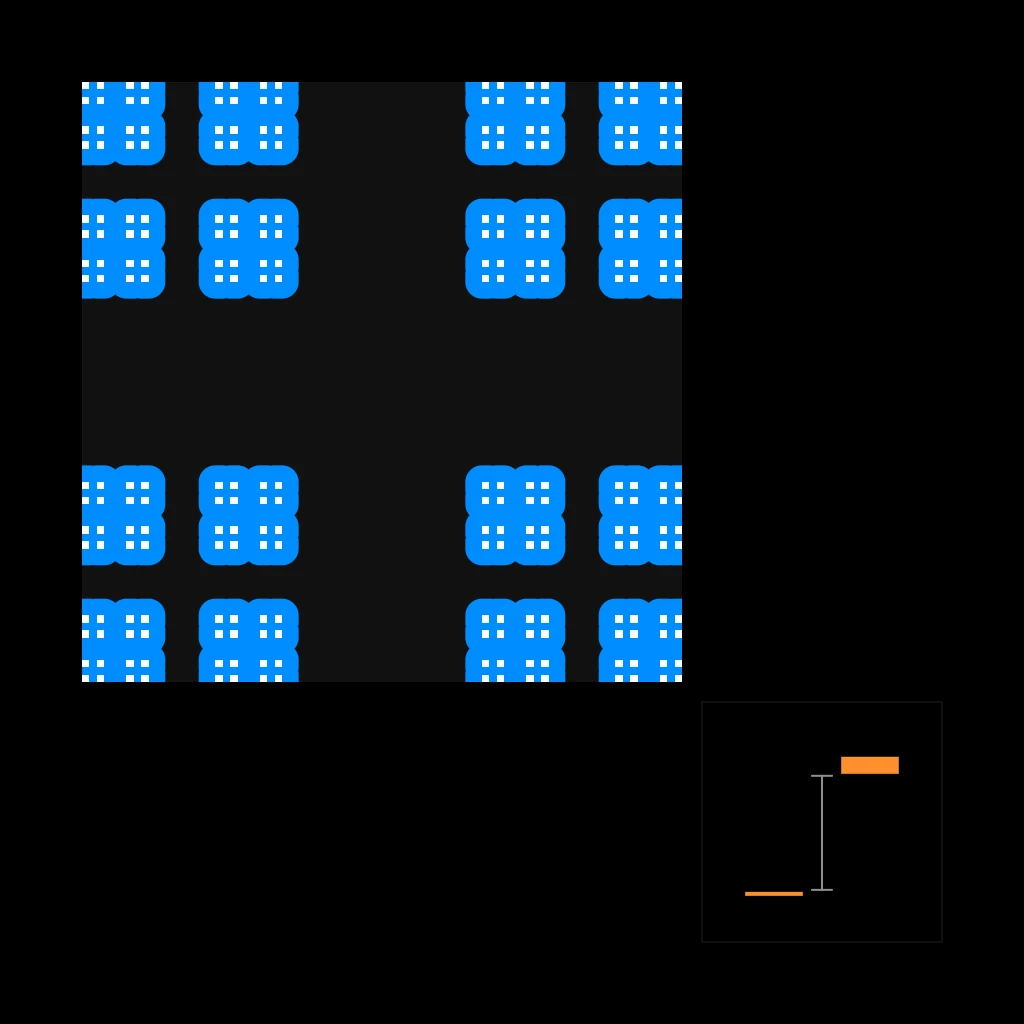
The figure is the sponge seen in its own middle. The plane z = 1/2 passes through the centre of the removed plus at every level, so what is left of F in it is Cantor dust, C x C for the middle-thirds Cantor set C, drawn as the 256 cells of the level-4 slice. Around the dust in blue is the set of points of the plane within 1/36 of the sponge, the three-dimensional distance rastered exactly from the lemmas of Section 3: rounded squares, one per level-2 cube, notched where a smaller arm opens through a face, and between them the crosses of the first two levels stay bare. At radius 1/108 the crosses of the third level would open too, at 1/12 the second level would close: the blue never settles into a fixed proportion of the picture, because the sponge repeats itself only at the ratio 1/3, and eps^(D-3) lambda_3(F_eps) inherits the repetition. It does not converge; it circles one profile, a function of eps that returns to itself whenever eps is divided by 3.
That the profile is not flat is the whole content of this paper, and it is not a foregone conclusion. Nonlattice self-similar sets, with two contraction ratios whose logarithms are incommensurable, are Minkowski measurable in every dimension (Gatzouras 2000). Lattice sets, whose ratios are all powers of one r, are never Minkowski measurable on the line, for a nontrivial set of non-integer dimension (Falconer 1995, completed by Kombrink and Winter 2020); in the plane and above this is a theorem only under a hypothesis: Kombrink, Pearse and Winter (2016), Theorem 1.1(ii), prove it when some strong feasible open set O satisfies their projection condition and the attractor is pluriphase with respect to Gamma(O), the volume of F_eps inside Gamma being piecewise polynomial in eps. For the Sierpinski carpet with the open square, Gamma is the middle square, that volume is 4 eps/3 - 4 eps^2 on (0, 1/6] and 1/9 beyond, and the carpet is not Minkowski measurable; the dimensions page of this tree carries the explicit profile, swing 0.3662 %, and its one-paragraph proof. For the sponge with the open cube, Gamma is the plus of seven cubes, and Lapidus, Pearse and Winter (2011), in the caption of their Figure 6.5, name its generator as neither convex nor pluriphase. The reason is visible in the figure: the walls of the plus are carpets, not squares, so the neighbourhood of F inside an arm is not the parallel volume of the arm, and its volume, Theorem 4.2 below, is a sum over holes of every size of an arcsine integral.
The same paper of Kombrink, Pearse and Winter carries, in its Theorem 3.1 and Corollary 3.2, a statement that needs no pluriphase hypothesis at all, and says so in words: for a nontrivial lattice self-similar set under the open set condition and any strong feasible open set with the projection condition, eps^(D-d) lambda_d(F_eps) is asymptotic to a constant times p(eps), with p the multiplicatively periodic function of Definition 2.5, and F is Minkowski measurable if and only if p is constant. The pluriphase hypothesis is what lets them prove p non-constant without computing it. Here p is computed, and that is what is new: the three lemmas of Section 3 on distances to the sponge, the tube formula of Section 4 with its arcsine integrals and the bound on its one uncomputed term, and the certificate of Section 5; Section 6 lists the checks run beside it, Section 7 what is left open, Section 8 how to reproduce every number. No claim is made about whether the sponge had been settled elsewhere by another route: of the three papers named above, read at source, the 2011 one lists the Menger tiling among the examples of its pointwise tube formula and says, in Remark 4.4 and Section 8.4, that its measurability results are for the monophase case, the 2013 one is that monophase case, and the 2016 one works two examples, a flat square in R^3 and the Sierpinski gasket; the wider literature was not surveyed.
Definitions and the criterion at source
Definition 2.1 (the sponge). For a in {0, 1, 2}^3 let S_a(x) = (x + a)/3. The Menger sponge F is the attractor of the 20 maps S_a with at most one coordinate of a equal to 1: the unique nonempty compact set with F = union_a S_a(F). Equivalently x in [0, 1]^3 lies in F if and only if its coordinates have base-3 expansions x_k = 0.x_(k,1) x_(k,2) ... in which every digit triple (x_(1,j), x_(2,j), x_(3,j)) holds at most one 1; a coordinate with two expansions may use either. Its Minkowski dimension is the similarity dimension D = log 20 / log 3, the solution of 20 * 3^(-D) = 1, as for every self-similar set under the open set condition. Throughout, O = (0, 1)^3 is the open unit cube, Q_a = S_a([0, 1]^3) the closed retained subcubes, H the closed plus, the union of the seven closed subcubes of side 1/3 with at least two coordinates of a equal to 1, C = [1/3, 2/3]^3 its centre cube, and an arm one of the six with exactly two coordinates equal to 1. A wall is a face of an arm shared with a retained subcube, 24 in all. The tube function is T(delta) = lambda_3(F_delta meet H), with lambda_3 Lebesgue measure.
Definition 2.2 (parallel set, content, measurability). For a compact A in R^d and eps >= 0 the parallel set is A_eps = {x in R^d : d(x, A) <= eps}, with d(x, A) the Euclidean distance to A. For 0 <= alpha <= d the alpha-dimensional Minkowski content is M^alpha(A) = lim_(eps -> 0+) eps^(alpha - d) lambda_d(A_eps) whenever the limit exists in [0, infinity], and A is Minkowski measurable of dimension alpha when M^alpha(A) exists and lies in (0, infinity). This is Definition 2.1 and equation (2.1) of Kombrink, Pearse and Winter (2016).
Definition 2.3 (feasible sets, the projection condition, the tiling set). A self-similar system S_1, ..., S_N satisfies the open set condition when some nonempty open O has S_i(O) inside O for every i and S_i(O) meet S_j(O) empty for i != j; such an O is a feasible open set, and strong feasible when moreover O meet F is nonempty. F is nontrivial when O is not contained in the closure of SO = union_i S_i(O), which by their Proposition 2.4 holds if and only if dim_M F < d. With pi_F the metric projection onto F, defined at the points with a unique nearest point of F, a feasible O satisfies the projection condition when S_i O lies in the closure of pi_F^(-1)(S_i F) for every i. The tiling set is Gamma = Gamma(O) = O minus SO, whose interior is the open generator G = O minus closure(SO), and g = sup {d(x, F) : x in Gamma}. The system is lattice with base r when every ratio r_i is an integer power of r, with r the largest such number. These are their Definitions 2.2, 2.3, 2.7 and 2.13 and equations (2.8) and (2.10).
Definition 2.4 (pluriphase). F is pluriphase with respect to Gamma(O) when for some finite partition 0 = a_0 < a_1 < ... < a_M = g the volume lambda_d(F_eps meet Gamma) is a polynomial in eps on each (a_(m-1), a_m] and equals lambda_d(Gamma) beyond g; their Definition 2.9, used nowhere below.
Definition 2.5 (the periodic function). For a lattice system with base r, p(eps) = eps^(D-d) sum_(l in Z) r^(l(D-d)) lambda_d(F_(r^l eps) meet Gamma) for eps > 0, their equation (3.2). Since lambda_d(F_(r^l eps) meet Gamma) = lambda_d(Gamma) once r^l eps >= g, for eps in (rg, g] the terms with l <= -1 sum to a geometric series and
p(eps) = eps^(D-d) ( lambda_d(Gamma) / (r^(D-d) - 1) + sum_(l >= 0) r^(l(D-d)) lambda_d(F_(r^l eps) meet Gamma) ) ,
their equation (3.3). The substitution l -> l + 1 in (3.2) gives p(r eps) = p(eps): p is multiplicatively periodic with period 1/r.
Theorem 2.6 (Kombrink, Pearse and Winter 2016, Theorem 3.1). Let F in R^d be the attractor of a self-similar system satisfying the open set condition, nontrivial, so that D = dim_M F < d, and let O be a strong feasible open set satisfying the projection condition, with Gamma = O minus SO and g as above. If the system is lattice with base r, then as eps -> 0,
eps^(D-d) lambda_d(F_eps) ~ ( ln r / sum_i r_i^D ln r_i ) p(eps) ,
meaning that the ratio of the two sides tends to 1.
Corollary 2.7 (their Corollary 3.2). Under the hypotheses of Theorem 2.6, F is Minkowski measurable if and only if p is constant, p(eps) = C for some C > 0 and all eps > 0, in which case M^D(F) = (ln r / sum_i r_i^D ln r_i) C.
The text after the corollary says that Theorem 3.1 and Corollary 3.2 apply to all nontrivial self-similar sets satisfying the open set condition, that there is no monophase or pluriphase condition present and the projection condition on its own does not impose any restrictions, a strong feasible set satisfying it, the central open set, always existing. Their proof uses strong feasibility for one estimate, their (3.5), and the projection condition for one identity, their (2.15): F_eps meet S_i O = (S_i F)_eps meet S_i O. Pluriphase enters that paper only in Theorem 3.4, the proof of Theorem 1.1(ii).
For the sponge with O the open unit cube: the 20 maps have ratio 1/3, so the system is lattice with base r = 1/3, and sum_i r_i^D ln r_i = 20 * 3^(-D) ln(1/3) = ln(1/3), so the prefactor is 1. SO is the union of the 20 open retained subcubes, so Gamma = O minus SO is the plus H without its six outer windows on the boundary of O, plus the faces shared by two retained cubes; both are null sets, so lambda_3(Gamma) = 7/27 and lambda_3(F_eps meet Gamma) = T(eps); and r^(D-3) = 3^(3-D) = 27/20, whence lambda_3(Gamma) / (r^(D-3) - 1) = (7/27) / (7/20) = 20/27 and r^(l(D-3)) = (27/20)^l. What remains is that O is strong feasible with the projection condition, that g = sqrt(2)/6, and what T is.
Three lemmas about distances
Everything here is read off the digit rule of Definition 2.1, which is invariant under two operations on one coordinate's expansion: the complement x_(k,j) -> 2 - x_(k,j) of every digit from some position on, which fixes 1 and swaps 0 and 2, so changes no count of 1s in any triple; and the replacement of the digits from some position on by a constant string of 0s or of 2s, which can only lower the counts.
Lemma 3.1 (folding). Let x lie in a closed retained subcube Q_a and y in F. Define y' coordinatewise: y'_k = y_k when y_k lies in the closed third [a_k/3, (a_k+1)/3]; y'_k is the reflection of y_k across the plane separating that third from the adjacent one when y_k lies in an adjacent third; and y'_k = y_k -+ 2/3 when y_k lies in the third two steps away. Then y' lies in F meet Q_a and |x - y'| <= |x - y|. Consequently d(x, F) = d(x, S_a F) for every x in Q_a.
Proof. Read the three cases in order, so a coordinate on the boundary of the third of a_k is unchanged. Expand y obeying the rule with every coordinate that is a multiple of 1/3 written with a constant tail and a first digit other than 1 (0.000..., 0.0222..., 0.2000..., 0.222...), so that it contributes no 1 to any triple; every other coordinate lies in one third only, indexed by its first digit b_k. A coordinate with b_k = a_k is unchanged. One with |b_k - a_k| = 1 is reflected across the shared face plane, which replaces b_k by a_k and complements the tail, since 0.1 d_2 d_3 ... = 2/3 - 0.0 (2-d_2)(2-d_3) ...; one with |b_k - a_k| = 2 is translated by 2/3, which swaps the first digit 0 with 2 and keeps the tail; a multiple of 1/3 goes to a multiple of 1/3, again written with no 1. So the first triple of y' holds a 1 only where a does, at most once since Q_a is retained, every later triple holds at most as many 1s as that of y, and each coordinate lies in the third of a_k: y' lies in F meet Q_a. Reflecting a point across a plane onto the side of x_k never increases |x_k - y_k|, and translating from two thirds away into the third of x_k leaves a distance at most 1/3, which was at most the old one. Finally F meet Q_a = S_a F: a point of F meet Q_a lies in some S_b F; if b != a it lies on a face of Q_a shared with Q_b, is a multiple of 1/3 in every coordinate where a and b differ, and there admits the expansion with first digit a_k and a constant tail, so it lies in S_a F too. Hence d(x, F) <= d(x, S_a F) = d(x, F meet Q_a) <= d(x, F). □
Corollary 3.2 (the open cube is admissible). The open unit cube O is a strong feasible open set for the sponge's system and satisfies the projection condition; the sponge is nontrivial and lattice with base 1/3.
Proof. The 20 open subcubes S_a(O) are pairwise disjoint and lie in O, so the open set condition holds; (1/2, 1/4, 1/4), with expansions 0.111..., 0.0202..., 0.0202... and triples (1, 0, 0), (1, 2, 2), lies in F meet O, so O is strong feasible; D < 3 gives nontriviality. For the projection condition take x in S_a O; if x lies in F it is its own unique nearest point and lies in S_a F, so suppose not, and let y' in S_a F be a nearest point of x in F, which exists by Lemma 3.1 and compactness. For z on the open segment from x to y', y' is the unique nearest point of F: for w in F, |z - w| >= |x - w| - |x - z| >= |x - y'| - |x - z| = |z - y'|, with equality only if w lies on the ray from x through z at distance |z - y'| from z, that is w = y'. Points z near x lie in the open set S_a O and in pi_F^(-1)(S_a F), and z -> x. □
Lemma 3.3 (clamping). Let y lie in F, let k be a coordinate and I = [a/3, (a+1)/3] a closed third. The point y' obtained by replacing y_k with its nearest point in I and keeping the other two coordinates lies in F, and |x - y'| <= |x - y| for every x with x_k in I.
Proof. If y_k lies in I nothing changes. Otherwise y'_k is an endpoint of I, a multiple of 1/3, which has an expansion with no digit 1 at all (0.000..., 0.0222..., 0.2000..., 0.222...); with it the coordinate k contributes no 1 to any triple of y', so every triple of y' holds at most as many 1s as the corresponding triple of a rule-obeying expansion of y, and y' lies in F. Moving y_k to its nearest point of I does not increase its distance to any point of I. □
Lemma 3.4 (locality). Let A be an arm of H, with its four walls carrying the carpets W_A = F meet (union of the walls of A). Then d(x, F) = d(x, W_A) for every x in A. Let E be the union of the twelve edges of the centre cube C. Then E lies in F and d(x, F) = d(x, E) for every x in C. In particular d(x, F) = d(x, W) on H, with W the union of the 24 wall carpets.
Proof. Take x in A and y in F, and clamp each coordinate of y into the third A occupies there (Lemma 3.3, three times): the result lies in F meet A and is no farther from x, so d(x, F) = d(x, F meet A). The interior of A lies in the interior of H, which meets no retained cube and so no point of F. The boundary of A is its four walls, its outer window on the boundary of the unit cube, and its inner face shared with C. For A = [0, 1/3] x [1/3, 2/3]^2, a point (1/3, y, z) of the inner face with y, z in (1/3, 2/3) has first digits 1 in y and z in every expansion, and 1/3 reads 0.1000... or 0.0222..., so its first triple holds at least two 1s either way and it is not in F; likewise the outer window (0, y, z), with first triple (0, 1, 1). So F meets the inner face and the window only on their boundary squares, which are edges of the walls, and F meet A = W_A, the carpets on the walls containing their boundaries. For C, clamp all three coordinates into [1/3, 2/3]; F meet C lies on the boundary of C, whose six faces are inner faces of arms, met by F only along their edges. A point of an edge, say (1/3, 1/3, z), reads 0.0222..., 0.0222..., 0.1 z_2 z_3 ..., with triples (0, 0, 1) and (2, 2, z_j), so E lies in F and F meet C = E; and the edges of C are edges of walls, so E lies in W. □
Lemma 3.5 (the walls are carpets, and their holes). Let K be the Sierpinski carpet, the set of (u, v) in [0, 1]^2 with expansions in which no digit pair (u_j, v_j) is (1, 1). Each wall carries F as a copy of K scaled by 1/3: on the wall {(x, 1/3, z) : x in [0, 1/3], z in [1/3, 2/3]} of the arm above, (x, 1/3, z) lies in F if and only if (3x, 3z - 1) lies in K. Moreover K contains the boundary of the unit square; its complement in the open square is the disjoint union, over m >= 1, of 8^(m-1) open squares of side 3^(-m), the level-m holes, each the middle ninth of a retained square of level m - 1; the boundary of every hole lies in K; and for w in a hole, d(w, K) is the distance from w to the boundary of that hole.
Proof. With y = 1/3 = 0.0222..., the triples of (x, 1/3, z) are (0, 0, 1) at the first position, x <= 1/3 and z >= 1/3 expanding with first digits 0 and 1, and (x_j, 2, z_j) after, which hold at most one 1 exactly when (x_j, z_j) is never (1, 1); the expansion y = 0.1000... gives (0, 1, 1) and is never better. The facts about K are proved on the dimensions page: a coordinate 0 or 1 reads 0.000... or 0.222..., so the boundary of the unit square and of every retained square lies in K; a point outside K leaves the retained squares at a first level m, so lies in the open middle ninth of a retained square of level m - 1, whose boundary consists of edges of the eight surrounding retained squares; and every point of K lies outside the open hole, so the segment from w to it crosses the hole's boundary first. □
Corollary 3.6 (the covering radius). g = sup {d(x, F) : x in Gamma} = sqrt(2)/6, attained at the centre (1/2, 1/2, 1/2), and T(delta) = 7/27 for delta >= sqrt(2)/6.
Proof. On C the distance to the twelve edges is largest at the centre, sqrt((1/6)^2 + (1/6)^2) = sqrt(2)/6. On an arm with coordinates u, v across and z along, the distance to the wall u = 0 is sqrt(u^2 + d_0(v, z)^2) with d_0 the distance to the wall's carpet in its plane, by Pythagoras, and d_0 <= 1/18, half the side of the largest hole of a carpet of side 1/3, by Lemma 3.5; so the four walls put every point of the arm within sqrt((1/6)^2 + (1/18)^2) = sqrt(10)/18 < sqrt(2)/6 of W. Hence d(x, F) <= sqrt(2)/6 on H, with equality at the centre, and F_delta contains H for delta >= sqrt(2)/6. The points of Gamma outside H lie on faces shared by two retained cubes, where by Lemma 3.1 the distance to F is a third of a distance inside the unit cube, hence at most a third of the maximum sqrt(2)/6 over H and the retained cubes together. □
The tube inside the plus
Fix delta in (0, 1/6], and in an arm use coordinates u, v in [0, 1/3] across and z in [0, 1/3] along, so that its walls are u = 0, u = 1/3, v = 0 and v = 1/3. Write d_0(v, z) for the distance from (v, z) to the carpet on the wall u = 0 within that wall's plane, and d_1(u, z) likewise for the wall v = 0. The holes of a wall's carpet at level m are 8^(m-1) open squares of side s_m = 3^(-m-1), and the strip of the wall u = 0 is {(v, z) : 0 <= v <= delta}, within delta of the edge it shares with the wall v = 0.
Definition 4.1 (the hole integrals). For s > 0 let
J(s, delta) = int_0^(min(delta, s/2)) 4 (s - 2t) sqrt(delta^2 - t^2) dt ,
the integral of sqrt(delta^2 - d^2) over the points of an open square of side s at distance d < delta from its boundary, the points at distance t forming a square ring of length 4(s - 2t). With a_0(t) = int_0^t sqrt(delta^2 - tau^2) dtau = (t/2) sqrt(delta^2 - t^2) + (delta^2/2) arcsin(t/delta) and a_1(t) = int_0^t tau sqrt(delta^2 - tau^2) dtau = (delta^3 - (delta^2 - t^2)^(3/2))/3, J(s, delta) = 4 (s a_0(t_1) - 2 a_1(t_1)) at t_1 = min(delta, s/2): the polynomial pi s delta^2 - (8/3) delta^3 for s/2 >= delta, and arcsin(s/(2 delta)) with sqrt(delta^2 - s^2/4) below. Let
V1 = (1/2) sum_(m >= 1) 8^(m-1) J(s_m, delta) , A1 = int_0^delta int_0^(1/3) sqrt(delta^2 - d_0(v, z)^2)_+ dz dv ,
with (.)_+ the positive part; A1 is a sum over the holes meeting the strip, J(s_m, delta) for each hole inside it and, for the one column of holes per level that the line v = delta cuts, the same integrand over the part of the hole with v <= delta, again a combination of a_0 and a_1 over the four pieces of the hole nearest its four edges. Finally Deep is the volume of the points (u, v, z) of the column [0, delta]^2 x [0, 1/3] beyond both wall tubes, u > sqrt(delta^2 - d_0(v, z)^2)_+ and v > sqrt(delta^2 - d_1(u, z)^2)_+.
Theorem 4.2 (the tube formula). For 0 < delta <= 1/6,
T(delta) = (pi + 8) delta^2 - 8 sqrt(2) delta^3 + 48 (V1 - A1) - 24 Deep ,
with 0 <= V1 <= delta/18, 0 <= A1 <= delta^2/3 and Deep >= 0; and Deep lies in the union, over pairs of a level-m hole h of the wall u = 0 and a level-n hole h' of the wall v = 0, of the boxes {u in [delta - s_m^2/(4 delta), delta] meet u(h'), v in [delta - s_n^2/(4 delta), delta] meet v(h), z in z(h) meet z(h')}, with u(h'), v(h), z(h), z(h') the coordinate ranges of the holes and the lower end of the u or v interval replaced by 0 when s_m > 2 delta or s_n > 2 delta.
Proof. By Lemma 3.4, T(delta) is the volume of {x in C : d(x, E) <= delta} plus six times the volume of {x in A : d(x, W_A) <= delta} for one arm A.
The centre cube. The points of C within delta of an edge form a quarter cylinder of radius delta and length 1/3, twelve of them, of total volume 12 (pi delta^2/4)(1/3) = pi delta^2. Since delta <= 1/6, two quarter cylinders overlap only where their edges meet at a corner, and the overlaps at different corners are disjoint. At a corner, with C in the positive octant, the three quarter cylinders are {v^2 + w^2 <= delta^2}, {u^2 + w^2 <= delta^2} and {u^2 + v^2 <= delta^2} cut to the octant; two of them meet in one eighth of a Steinmetz bicylinder of volume 16 delta^3/3, so 2 delta^3/3, and all three in one eighth of the tricylinder of volume 8 (2 - sqrt(2)) delta^3, so (2 - sqrt(2)) delta^3. Inclusion and exclusion at each of the eight corners subtracts 3 (2/3) delta^3 and adds back (2 - sqrt(2)) delta^3, a net -sqrt(2) delta^3, and the centre cube's tube is pi delta^2 - 8 sqrt(2) delta^3.
The arm. The distance from (u, v, z) to the wall u = 0 is sqrt(u^2 + d_0(v, z)^2), as in Corollary 3.6, and likewise for the other walls. The carpet on a wall is symmetric under the reflections of its square, so the arm's tube is invariant under u -> 1/3 - u and v -> 1/3 - v, and its volume is four times its volume in the quarter Q = [0, 1/6]^2 x [0, 1/3]. In Q the walls u = 1/3 and v = 1/3 are at distance at least 1/6 >= delta, so up to a null set the tube in Q is (T_u union T_v) meet Q with T_u = {u <= sqrt(delta^2 - d_0(v, z)^2)_+} and T_v = {v <= sqrt(delta^2 - d_1(u, z)^2)_+}. The volume of T_u meet Q is the integral over v in [0, 1/6] and z in [0, 1/3] of the u-extent sqrt(delta^2 - d_0^2)_+, at most delta <= 1/6; by the reflection v -> 1/3 - v this is half the integral over the whole wall, and since the carpet has measure zero and d_0 on a hole is the distance to its boundary (Lemma 3.5), that integral is sum_m 8^(m-1) J(s_m, delta). So T_u meet Q and T_v meet Q have volume V1 each, and the arm's tube is 4 (2 V1 - V2) with V2 the volume of T_u meet T_v meet Q. That intersection lies in the column B = [0, delta]^2 x [0, 1/3], of volume delta^2/3, and inclusion and exclusion in B gives V2 = lambda_3(B) - lambda_3(B minus T_u) - lambda_3(B minus T_v) + lambda_3(B minus (T_u union T_v)): the second term is the integral over the strip of delta - sqrt(delta^2 - d_0^2)_+, which is delta^2/3 - A1, the third the same by symmetry, the fourth Deep. So V2 = 2 A1 - delta^2/3 + Deep, the arm's tube is 8 V1 - 8 A1 + 4 delta^2/3 - 4 Deep, six arms give 48 (V1 - A1) + 8 delta^2 - 24 Deep, and with the centre cube the display follows. The bounds: the integrand of V1 is at most delta over a wall of area 1/9, that of A1 at most delta over a strip of area delta/3.
Confinement of Deep. A point (u, v, z) of B beyond T_u has d_0(v, z) > sqrt(delta^2 - u^2) >= 0, so (v, z) lies in a hole h of the wall u = 0, of some level m, at depth at most s_m/2 by Lemma 3.5; hence s_m/2 > sqrt(delta^2 - u^2), which for s_m <= 2 delta reads u > sqrt(delta^2 - s_m^2/4) >= delta - s_m^2/(4 delta), the last step because (delta - s_m^2/(4 delta))^2 = delta^2 - s_m^2/2 + s_m^4/(16 delta^2) <= delta^2 - s_m^2/4 when s_m <= 2 delta. Likewise (u, z) lies in a hole h' of the wall v = 0, of some level n, with v > delta - s_n^2/(4 delta) when s_n <= 2 delta, and the point lies in the box of the pair (h, h'). □
The generator of Section 8 evaluates V1 and A1 by these sums to 400 levels, counting the level-m holes inside the strip by a recursion on the base-3 digits of the number of full columns (a column indexed by the m - 1 digits of its position holds the product over those digits of 3 for a digit other than 1 and 2 for a 1), and bounds Deep by the volume of the boxes over all pairs of holes to level 7 plus a count of the pairs beyond, every box an exact rational.
Corollary 4.3 (the phase 1/6). A1 = V1 at delta = 1/6, so T(1/6) = (pi + 8)/36 - sqrt(2)/27 - 24 Deep, with Deep at most 3.84e-5.
Proof. At delta = 1/6 the strip 0 <= v <= 1/6 is half the wall, and the integral of sqrt(delta^2 - d_0^2)_+ over it is half the integral over the wall by the reflection v -> 1/3 - v. The value of Deep is the bound of Theorem 4.2 summed by the generator. □
Fact 4.4 (the tube read). The generator encloses T(1/12) in [0.180947086, 0.180947093], T(1/8) in [0.234186414, 0.234701259] and T(1/6) in [0.256188319, 0.257110405], the widths being the bound on 24 Deep plus the outward rounding to nine decimals, the bound on Deep itself reading 2.42e-10, 2.15e-5 and 3.84e-5. A raster of the distances of Lemma 3.4 at the centres of 120^3 cells per cube of the plus, counting the cells within delta minus the half diagonal of a cell for a lower bound and within delta plus it for an upper one, brackets T(1/8) in [0.23229, 0.23708] and T(1/12) in [0.17665, 0.18531], both containing the closed form. Domain: the three radii named. Generator: lab/py/sponge-tube, section TUBE.
The certificate
Theorem 5.1 (the periodic function on a window). For eps in (sqrt(2)/18, 1/6],
p(eps) = eps^(D-3) ( 20/27 + sum_(l >= 0) (27/20)^l T(eps/3^l) ) ,
every radius eps/3^l in the sum lying in (0, 1/6], where Theorem 4.2 applies.
Proof. By Corollary 3.6, g = sqrt(2)/6 and rg = sqrt(2)/18, so (sqrt(2)/18, 1/6] lies in (rg, g] and the alternative form of Definition 2.5 holds, with the constants computed at the end of Section 2 and lambda_3(F_(eps/3^l) meet Gamma) = T(eps/3^l). □
Lemma 5.2 (a dominating tube that contracts). Let T_up(delta) = pi delta^2 + 24 sum_(m >= 1) 8^(m-1) s_m delta min(s_m, 4 delta). Then T(delta) <= T_up(delta) and T_up(delta/3) <= (11/27) T_up(delta) for every delta > 0.
Proof. The centre cube's tube lies in the twelve quarter cylinders, of volume pi delta^2. A point of an arm within delta of the wall u = 0 has u <= delta and d_0(v, z) <= delta, so the arm's tube lies in the union over its four walls of [0, delta] times the set of wall points within delta of the carpet; that set has measure sum_m 8^(m-1) min(s_m^2, 4 s_m delta), since a hole of side s has area s^2 and its points within delta of its boundary have area s^2 - (s - 2 delta)^2 <= 4 s delta when 2 delta < s. Six arms and four walls give the factor 24. For the contraction, pi (delta/3)^2 = (1/9) pi delta^2, and since s_m = 3 s_(m+1) the level-m term at delta/3 is 8^(m-1) s_(m+1) delta min(3 s_(m+1), 4 delta/3) <= 3 * 8^(m-1) s_(m+1) delta min(s_(m+1), 4 delta), which is 3/8 of the level-(m+1) term at delta; so the hole sum contracts by at most 3/8, and both 1/9 and 3/8 are below 11/27. □
The evaluation. The generator sums Theorem 5.1 to l = 40 and bounds the rest: since (27/20)^l T(eps/3^l) <= (27/20)^l (11/27)^(l-41) T_up(eps/3^41) for l >= 41, the tail is at most (27/20)^41 T_up(eps/3^41) sum_(k >= 0) (11/20)^k = (27/20)^41 T_up(eps/3^41) (20/9). Every arithmetic step runs in the interval arithmetic of mpmath at 133 bits: each T(eps/3^l) is an interval whose lower end subtracts the tail delta (8/9)^400 / 8 of the A1 sum and the bound on 24 Deep, both exact rationals, and whose upper end adds the tail delta (8/9)^400 / 16 of the V1 sum, an exact rational above the true delta (8/9)^400 / 18; the series tail is an interval added to the upper end; eps^(D-3) is exp((D - 3) log eps) with D an interval; and the printed bands round the endpoints outward to six decimals with exact integer floor and ceiling. Two facts about the tool are part of the record. Its interval + - * /, sqrt and integer powers are exactly directed, while pi, atan2, exp and log are computed with guard bits and rounded outward, not certified directed roundings; a wrong-side endpoint is off by at most 2^(-137) relative, and over the run's order of a million such calls the possible drift is below 1e-30, absorbed by the printed rounding, which lies at least 5.6e-9 outside every 133-bit endpoint. And a_1 is evaluated as t^2 (3 delta^4 - 3 delta^2 t^2 + t^4) / (3 (delta^3 + (delta^2 - t^2)^(3/2))), the same number without the subtraction, which at the deep levels would cancel at any fixed precision; the bounds V1 <= delta/18 and A1 <= delta^2/3 of Theorem 4.2 are asserted at every radius.
Fact 5.3 (the bands). The generator encloses
p(1/12) in [2.122718, 2.122723] , p(1/8) in [2.134668, 2.135742] , p(1/6) in [2.135019, 2.136794] ,
so p(1/6) - p(1/12) >= 2.135019 - 2.122723 = 0.012296, p(1/8) - p(1/12) >= 0.011945, and (p(1/6) - p(1/12)) / p(1/12) >= 0.5792 %. Domain: the three phases named, the series to l = 40 with its tail bounded. Generator: lab/py/sponge-tube, section PERIODIC.
Theorem 5.4. The Menger sponge is not Minkowski measurable. As eps -> 0, lambda_3(F_eps) = eps^(3-D) p(eps) (1 + o(1)) with p positive, multiplicatively periodic of period 3, given on (sqrt(2)/18, 1/6] by Theorem 5.1, and p(1/6) - p(1/12) >= 0.012296.
Proof. By Corollary 3.2 the open unit cube is a strong feasible open set with the projection condition for the sponge's system, which is lattice with base 1/3, satisfies the open set condition and is nontrivial. Theorem 2.6 therefore gives eps^(D-3) lambda_3(F_eps) ~ p(eps), the prefactor being 1, and Corollary 2.7 says F is Minkowski measurable if and only if p is constant. By Fact 5.3, p(1/6) > p(1/12). □
The proof is computer-assisted at exactly one point, Fact 5.3. The criterion is the literature's; Lemmas 3.1 to 3.5, the decompositions of Theorem 4.2 and the confinement of Deep are proofs on the page; the hole sums, the tails, the bound on Deep and the series are computed, in interval arithmetic with the two caveats above, so the bands are enclosures and not estimates; the raster of Fact 4.4 is a floating-point check that carries nothing. Unlike the carpet, where non-constancy follows from a polynomial being unequal to a power on an interval, no argument free of digits is known here: T is a sum of arcsines over holes of every size, and the two evaluated phases are the proof. The swing of 0.5792 %, a lower bound read at two phases, sits between the carpet's 0.3662 % and the Cantor set's 3.53 % on the dimensions page.
The checks
Four checks were run beside the certificate, each a sub-verb of lab/py/sponge-tube/checks.py, and none is part of it: the certificate stands on Section 5 alone. They are the evidence that the lemmas and the formula describe the sponge.
First, an exact distance oracle (checks.py oracle, 4 seconds). The level-4 prefractal F_4, the 160000 closed cubes of side 1/81 the construction keeps, contains F, and the distance to F_4 is an exact minimum over cubes, the candidate set tested complete for every point. On 22844 points of the plus, 2844 within about 1e-3 of a face, the distance to F_4 equalled the distance to the 12288 cube faces on the 24 walls with largest difference 0, and the reduction of Lemma 3.4 at level 4, own four walls or twelve edges, with largest difference 2.8e-17; the reduced distance to F itself exceeds the distance to F_4 by between -9.5e-17 and 1.48e-3, under the 1.75e-2 a level-4 cube allows. The centre's distance to F_4 is sqrt(2)/6 to 8.3e-17.
Second, Monte Carlo (checks.py montecarlo, 82 seconds, seed 7). With the reduced distance of Lemma 3.4 at 4e7 points of the plus, T(1/12) = 0.180952 +- 0.000056, T(1/8) = 0.234691 +- 0.000036 and T(1/6) = 0.257060 +- 0.000011 at three standard deviations, against the enclosures of Fact 4.4; without any lemma, at 1e6 points against F_4, T(1/12) lies in about [0.17601, 0.18090] and T(1/8) in about [0.23190, 0.23467], the upper count an upper bound since F lies in F_4, the lower count taken within delta - sqrt(2)/486, the covering radius of a kept cube; and on 2e7 points of the column, V2(1/12) = 0.00231180 +- 5.6e-8 against 2 A1 - delta^2/3 = 0.00231178.
Third, Deep itself (checks.py seeded, 29 seconds, seed 20260921), sampled on the box [delta - w, delta]^2 x [0, 1/3] with w = (1/81)/(4 delta) that Theorem 4.2 confines it to: 1.8882e-6 +- 1.4e-8 at delta = 1/6 against the bound 3.8420e-5, a factor 20 under it, and 4.7432e-8 +- 2.9e-9 at 1/8 against 2.1452e-5; with it, on 1e7 points of the column, V2 = 0.0092395 +- 4.1e-7 at 1/6 against 2 A1 - delta^2/3 + Deep = 0.0092398 and V2 = 0.0052056 +- 1.1e-7 at 1/8 against 0.0052056. The slack of the bound on Deep is the width of the bands at 1/8 and 1/6.
Fourth, an independent recomputation (checks.py recompute, 9 seconds) at 60 decimal digits from the text of Section 4 alone: own closed forms for a_0 and a_1, the cut hole integrated by level sets as int (s + 2c - 4t) sqrt(delta^2 - t^2) dt, column counts by a recursion on the top digit checked against brute force to level 6, J and the cut-hole integral checked against quadrature to 1e-24 or better, 200 levels with the tails delta (8/9)^200 / 18 and delta (8/9)^200 / 9, and the bound on Deep by hole indicator tables on the 3^7 cells of the z axis. It gives T(1/12) in [0.180947086642, 0.180947092489], T(1/8) in [0.23418641434, 0.234701258885], T(1/6) in [0.25618831932, 0.25711040476], p(1/12) in [2.12271839047, 2.12272278536], p(1/8) in [2.13466808303, 2.13574147037] and p(1/6) in [2.13501900545, 2.13679371243], the printed bands of Facts 4.4 and 5.3 outward of every one, and 2.4199e-10, 2.1452e-5 and 3.8420e-5 for the bound on Deep, against the generator's 2.42e-10, 2.15e-5 and 3.84e-5; the series tail at l = 41 is 6.09e-17 at eps = 1/6. The same verb evaluates V1(1/12) = 0.00460751034373681 and A1(1/12) = 0.00231329771288259 twice more: at 200 digits with a_1 in the subtractive form (delta^3 - (delta^2 - t^2)^(3/2))/3, where that precision leaves nothing to cancellation, to every printed digit, and on a 3000^2 midpoint grid of the exact carpet distance on the wall, as 0.004607510 and 0.002313298.
Open problems
Four things are left undone, stated plainly. First, T on (1/6, sqrt(2)/6]: above delta = 1/6 the walls u = 1/3 and v = 1/3 reach into the quarter, the edge cylinders of the centre cube overlap along their lengths, and the arcs about the reentrant edges of the plus meet, so the decomposition of Theorem 4.2 stops; p is explicit on the phases (sqrt(2)/18, 1/6], a fraction 1 - log_3(2)/2 = 0.6845 of its logarithmic period, and unknown on the rest, and its extrema, its full swing and its logarithmic mean over a period, the average Minkowski content of Gatzouras (2000), are not computed. Second, a proof of non-constancy without numbers: the carpet's argument, a polynomial against a power, has no known analogue here. Third, the same method on other cube designs: clamping needs only that replacing a coordinate's tail by a constant string keeps the digit rule, true for every design defined by a bound on the number of 1s in a triple, and locality needs the removed set to be a union of cubes whose faces shared with retained cubes carry carpets with the hole property of Lemma 3.5; which designs of base 3 and higher bases satisfy both, with a tube formula that stays a sum of one arcsine integral, is not worked out. Fourth, the general statement, that every nontrivial lattice self-similar set of non-integer dimension in R^d, d >= 2, fails to be Minkowski measurable, remains open; this paper settles one set.
Reproducibility
One study, lab/py/sponge-tube, with two verbs, prints every number of this paper beyond the closed forms. uv run python research/lab/py/sponge-tube/sponge_tube.py from the repository root, one core, about 46 to 50 seconds, needing mpmath and numpy, taking no arguments, reading and writing no file, prints every enclosure of Facts 4.4 and 5.3 and the bounds on Deep, and stops on a failed assertion of the raster brackets, the bounds V1 <= delta/18 and A1 <= delta^2/3 at every radius, or the positivity of the gaps. uv run python research/lab/py/sponge-tube/checks.py prints every number of Section 6, about 125 seconds for its four sub-verbs oracle, montecarlo, seeded and recompute, any one of which runs alone by name; it needs scipy as well, and its Monte Carlo is seeded. The study's README names the witness of every printed line. The figure is bash scripts/figures.sh paper-sponge-measurability, under half a second a theme: it builds the level-4 sponge from mrlymath::three::carpet and its midplane slice from mrlymath::three::slice, asserting 160000 cubes and 256 dust cells; rasters the distance of Lemma 3.4 through the digit descent of the sponge; and recomputes T and p in double precision with the cancellation-free a_1, 200 hole levels, the series to l = 40 and Deep set to 0, asserting T(1/6) = (pi + 8)/36 - sqrt(2)/27 to 1e-9, which is Corollary 4.3 and tests the strip sum against the wall sum, T(1/12) and T(1/8) inside their enclosures, the three p values inside their bands, the difference of its own values at 1/6 and 1/12 above the certified 0.012296, and the centre's distance sqrt(2)/6 to 1e-15, so a wrong hole sum, column count or distance stops the press.
References
- Kombrink, Pearse and Winter 2016, Lattice-type self-similar sets with pluriphase generators fail to be Minkowski measurable, Math. Z. 283, no. 3, 1049-1070, doi 10.1007/s00209-016-1633-x; read at source in arXiv:1501.03764v1: Definitions 2.1, 2.2, 2.3, 2.7, 2.9, 2.13, Proposition 2.4, Theorem 3.1, Corollary 3.2, Theorem 1.1(ii) and Theorem 3.4. arxiv.org/abs/1501.03764
- Lapidus, Pearse and Winter 2011, Pointwise tube formulas for fractal sprays and self-similar tilings with arbitrary generators, Adv. Math. 227, 1349-1398, read at source in arXiv:1006.3807, Figure 6.5 and its caption, Remark 4.4 and Section 8.4. arxiv.org/abs/1006.3807
- Lapidus, Pearse and Winter 2013, Minkowski measurability results for self-similar tilings and fractals with monophase generators, Contemp. Math. 600, 185-204, the monophase case; cited as on the dimensions page, not reread for this paper. arxiv.org/abs/1104.1641
- Gatzouras 2000, Lacunarity of self-similar and stochastically self-similar sets, Trans. Amer. Math. Soc. 352, no. 5, 1953-1983; cited as on the dimensions page and in Kombrink, Pearse and Winter 2016, not read at source for this paper. doi.org/10.1090/S0002-9947-99-02539-8
- Falconer 1995, On the Minkowski measurability of fractals, Proc. Amer. Math. Soc. 123, no. 4, 1115-1124; cited as on the dimensions page, not read at source for this paper. doi.org/10.1090/S0002-9939-1995-1224615-4
- Kombrink and Winter 2020, Lattice self-similar sets on the real line are not Minkowski measurable, Ergodic Theory Dynam. Systems 40, no. 1, 221-232; cited as on the dimensions page, not read at source for this paper. doi.org/10.1017/etds.2018.26