The divisor function
d(n) counts the ways to split n into a product, 2 at every prime and 12 at 60; it never grows as fast as any power of n, and on average it is log n.
Write down every number that divides n. For 12 the list is 1, 2, 3, 4, 6, 12, six of them, so d(12) = 6. For a prime it is 1 and the prime itself, so d(p) = 2, the smallest value any n > 1 can have. The count is the divisor function d(n). Its sibling sigma(n) adds the divisors instead of counting them: sigma(12) = 28.
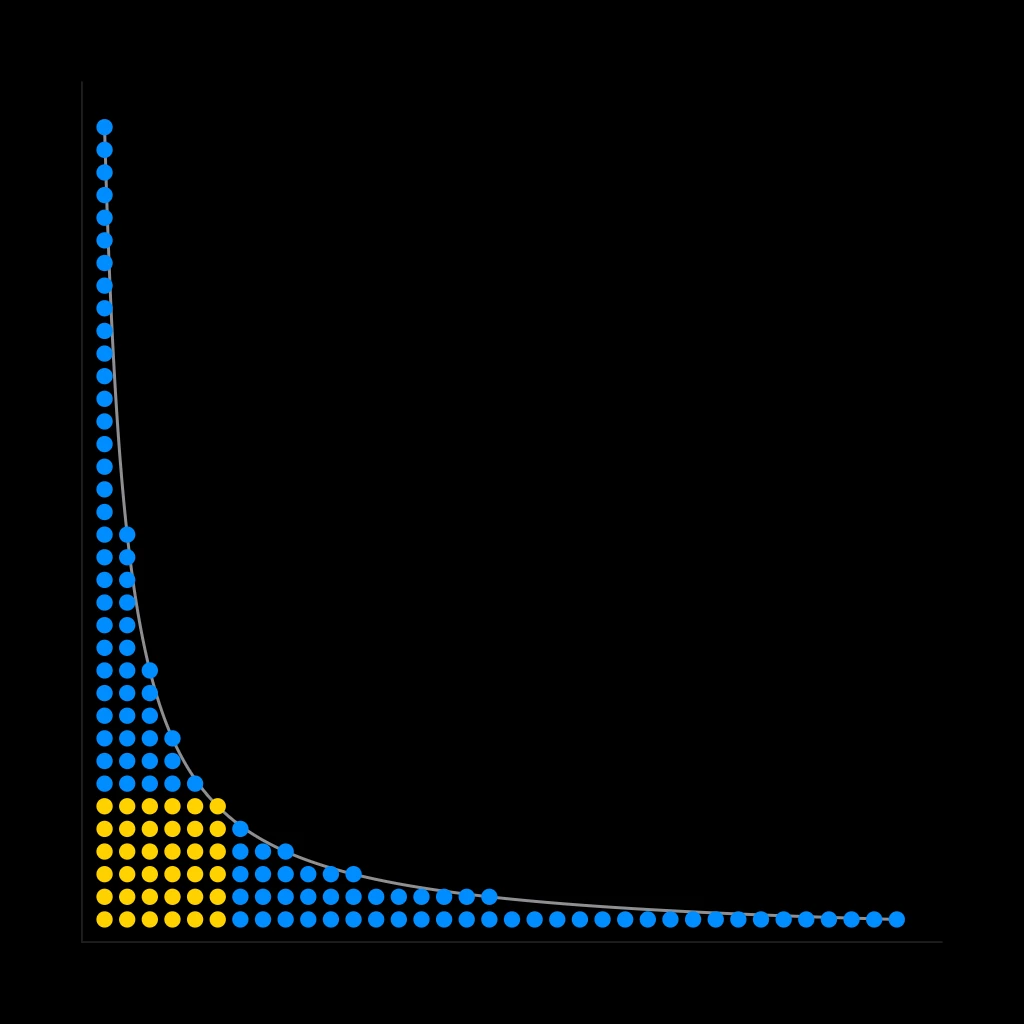
The figure is another way to count. A pair (a, b) with ab = n is a divisor a of n with its partner b, so d(n) is the number of lattice points on the hyperbola ab = n. The dots are every lattice point on or under the hyperbola ab = 36, 140 of them, and 140 is d(1) + d(2) + ... + d(36). Nearly all of them hug the axes: a product lands under the curve only when one factor is small.
Both read off the prime factorisation. A prime power p^a has divisors 1, p, ..., p^a, so d(p^a) = a + 1 and sigma(p^a) = (p^(a+1) - 1) / (p - 1). Two numbers with no common factor multiply cleanly, d(m n) = d(m) d(n) and the same for sigma, since a divisor of m n is a divisor of m times a divisor of n. So for n = p_1^a_1 ... p_r^a_r,
At 60 = 2^2 3 5 that is 3 * 2 * 2 = 12.
The function is jumpy: 2 at every prime, 12 at 60, 24 at 360, 64 at 7560, records set by numbers built from many small primes. The divisor bound says the jumps never reach a power: d(n) <= C n^eps for every eps > 0, and more sharply d(n) <= n^(O(1 / log log n)), as a post of Tao states. Wigert found the exact exponent: the lim sup of log d(n) log log n / log n is log 2, so d(n) climbs no faster than n^((log 2 + o(1)) / log log n) and infinitely often as fast.
On average it is tame. Dirichlet proved that
with gamma the Euler-Mascheroni constant, so the average of d(n) over n <= x is about log x. The proof is the figure. Column a holds floor(x / a) dots; the points with a <= sqrt x are one arm plus the square, those with b <= sqrt x the other arm plus the same square, so the total is 2 (floor(x / 1) + ... + floor(x / sqrt x)) - floor(sqrt x)^2, which at x = 36 is 2 (36 + 18 + 12 + 9 + 7 + 6) - 36 = 140. The reciprocals 1 + 1/2 + ... + 1 / sqrt x add to log sqrt x + gamma + O(1 / sqrt x) and each floor loses less than 1, so the main terms fall out. This is the hyperbola method; at x = 36 it gives 134.6 against 140.
The true size of the error is Dirichlet's divisor problem, still open: Huxley proved O(x^(131/416 + eps)), 131/416 = 0.3149..., Hardy showed the exponent cannot go below 1/4, and 1/4 is the conjectured truth. The sources are the Wikipedia articles on the divisor function and the divisor summatory function; Huxley's paper is in Proceedings of the London Mathematical Society 87.
In the tree
The integers note reads the cell count of the sponge rule at odd side 2n + 1 as d(x^n), the divisor count of a power of one fixed x.