A Moving Target for Erdos Problem 125
MrlyProd
First published 2026-09-23
Add a number written in base 3 with the digits 0 and 1 only to a number written in base 4 with the same two digits. Erdos problem 125 asks whether the sums fill a positive proportion of the integers. In the lower sense they do not: an argument found by DeepMind and checked in Lean shows that the proportion below x falls under any eps > 0 for arbitrarily large x. Whether it rises above one fixed c > 0 for arbitrarily large x, positive upper density, is open, and it is the variant the formal statement of the problem leaves as answer(sorry). This paper does not settle it; it changes its shape. An exact identity carries the sums below 3^k + 4^m onto a continuous object, the sumset of two Cantor sets at the scaling tau = 4^m/3^k, read on cells of side 3^(-k). Across that bridge the energy ratio that bounds the count from below is subpolynomial, by Shmerkin's theorem on L^q dimensions, and unbounded along infinitely many pairs, by the resonances of Nazarov, Peres and Shmerkin; its average over the scaling is at most 190; and the upper density is at least 6/(11 liminf_k h_k(tau_k)), where h_k is the normalized cell energy and the scalings tau_k walk the circle [1, 4) by an irrational rotation. So the upper density is positive unless that one orbit lands, at every late step, in a target of measure at most 190/M, for every M. Almost every rotated orbit misses such targets infinitely often, and the census of the energy ratio along the orbit to k = 29 keeps it between 1.63 and 2.01; the orbit that matters is a single one, and neither fact reaches it.
Introduction
Let A be the integers whose base-3 digits are all 0 or 1, 0, 1, 3, 4, 9, 10, 12, 13, 27, ..., and B those whose base-4 digits are, 0, 1, 4, 5, 16, 17, 20, 21, 64, .... Each is thin: A has about x^0.631 members below x and B about x^(1/2). Their sumset S = A + B is not. Every integer up to 61 lies in it, the first two it misses are 62 and 63, and below 3^22 it holds 26666749554 integers, 85 percent of them (Fact 11.1). Erdos problem 125 asks whether S has positive lower density; Burr, Erdos, Graham and Li had asked for positive density and for positive upper density. The lower density is 0, and the formal statement of the problem keeps the other half open:
theorem erdos_125.variants.positive_upper_density :
    answer(sorry) <-> 0 < (A + B).upperDensity
This paper is about that statement: with D(x) = card(S meet [1, x])/x, is limsup_(x -> infinity) D(x) > 0?
The first gap is typical. A sum a + b with a < 81 and b < 64 is at most 40 + 21 = 61, and a sum with a >= 81 or b >= 64 is at least 64, so nothing lands on 62 or 63. The same happens at every pair of levels: S misses every integer strictly between d(k, m) = (3^k - 1)/2 + (4^m - 1)/3, the largest sum of the lower levels, and min(3^k, 4^m). Where a power of 3 and a power of 4 nearly coincide, that gap swallows about a sixth of the range and the density dips: its lowest reading below 3^22, 0.763391, sits just below 3^15, where 4^12/3^15 = 1.169234. Compounding the dip along ever closer coincidences drives the lower density to 0, and that is the known answer. For the upper density the question is whether, between the coincidences, the density recovers to one fixed positive level infinitely often.
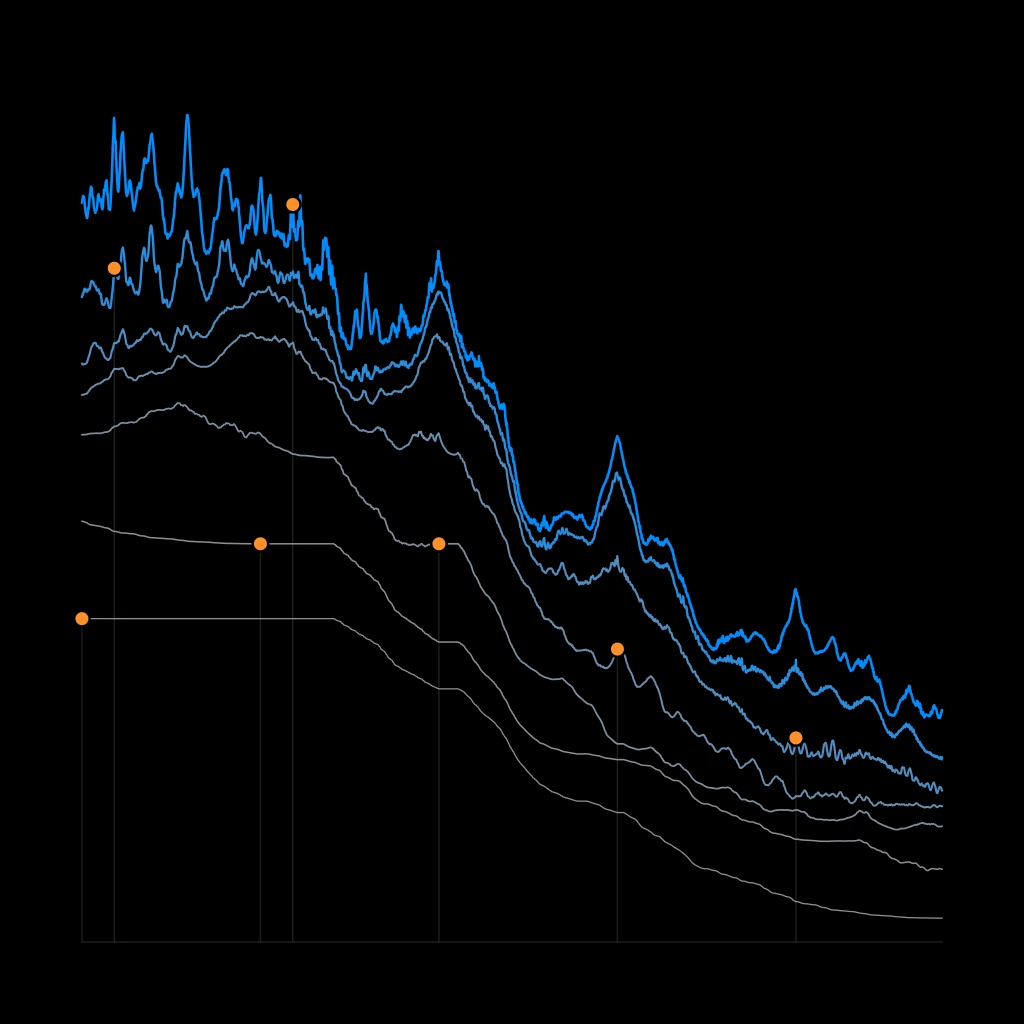
Counting a sumset from below goes through collisions. If the 2^(k+m) pairs (a, b) of the two lower levels rarely share a sum, their sums are many: Cauchy-Schwarz gives card(A_k + B_m) >= (d + 1)/Q(k, m), where the energy ratio Q counts the quadruples with a + b = a' + b' against the count a flat distribution on [0, d] would give. So a bound on Q along infinitely many pairs gives positive upper density. The first observation here is that Q is exactly a continuum quantity: A_k + B_m is the sumset C_3 + tau C_4 of two Cantor sets at the one scaling tau = 4^m/3^k, read on cells of side 3^(-k), and Q is the energy of the natural measure on it at that resolution (Theorem 3.1). The figure draws that energy.
The horizontal axis is the circle of scalings tau in [1, 4), drawn on a logarithmic scale so that multiplying by 4 goes once around. Each curve is the normalized cell energy h_k(tau) = 3^k sum_x rho_tau(c_x)^2 of Definition 3.1 at one resolution, k = 0 dim at the bottom to k = 6 blue at the top; a flat measure on the support would read 1/(1/2 + tau/3), and a larger value means more collisions and fewer sums. The curves nest, because refining a cell never lowers the energy (move (iv) of Theorem 3.4), and their peaks sit near ratios 4^m/3^j of small exponents, where the two bases coincide early. The orange dots are the chain. At level k the pair that decides the density is (k, m_k), with m_k the least exponent such that 4^(m_k) >= 3^k; its scaling tau_k = 4^(m_k)/3^k lies in [1, 4), and the dot sits at (tau_k, h_k(tau_k)) on the curve of its own level. From one level to the next tau_k turns by -log_4 3 around the circle, an irrational rotation, so the dots walk the circle without repeating. At every dot the value is exact, h_k(tau_k) = 3^k E(k, m_k)/4^(k + m_k) with E the integer energy of mrlyrs::num::sumset::Pair::energy, and the binary that draws the figure asserts it.
Theorem 3.6 makes the dots decisive: the upper density of S is at least 6/(11 liminf_k h_k(tau_k)), so it is positive unless the dots climb to infinity. Theorem 3.5 makes the high ground small: h_k integrates to at most 190 over [1, 4] at every level, so the scalings with h_k > M fill a set of measure at most 190/M. Zero upper density would therefore force one orbit of an irrational rotation into shrinking targets at every late step. Almost every rotated copy of the orbit escapes infinitely often (Theorem 3.7), and along the orbit itself the census keeps Q(k, m_k) inside [1.638124, 2.004783] for every 6 <= k <= 29 (Fact 11.2); but the orbit that matters is one orbit, and no statement about almost every orbit reaches it. The question stays open.
What is in print
Throughout, A_k = A meet [0, 3^k) and B_m = B meet [0, 4^m) are the two levels, of 2^k and 2^m integers, and d(k, m) = (3^k - 1)/2 + (4^m - 1)/3 is the largest element of A_k + B_m. Every source below is listed in the references. The problem page and its comment thread, the formal statement, Shmerkin (2019), Nazarov, Peres and Shmerkin (2012) and Glasscock, Moreira and Richter (2024) are read at source; Hasler and Melfi (2024) is read in its abstract and through the problem page; Burr, Erdos, Graham and Li (1996) is not read at source.
The problem. The problem page states the question for positive lower density, attributes it to Burr, Erdos, Graham and Li, who ask "positive density? positive upper density?", and marks it disproved, with the proof verified in Lean. It credits an argument found by DeepMind that first shows the upper density to be at least 6/5 times the lower density, so that S has no positive density, and then the lower density to be 0: for every eps > 0 there are infinitely many x with card(S meet [1, x]) < eps x. The formal statement in the formal-conjectures repository lists the four possible patterns of the two densities, records the lower-density question as solved and keeps erdos_125.variants.positive_upper_density open with answer(sorry); the comment thread on the problem page calls it the likely harder half.
The gap and the injection. The argument, as the comment thread reads the Lean proof, rests on one elementary fact.
Lemma 2.1 (the gap). For all k, m >= 0, S misses the open interval (d(k, m), min(3^k, 4^m)).
Proof. A sum a + b with a < 3^k and b < 4^m has a in A_k and b in B_m, so it is at most d(k, m). A sum with a >= 3^k or b >= 4^m is at least min(3^k, 4^m). □
Take a scale L with 3^k and 4^m both in [L, (1 + eps) L]. Then S meet [0, L) lies in [0, d(k, m)], inside [0, (5/6)(1 + eps) L]. Split each x < L N of S along one chosen representation x = a + b, as a = 3^k a_1 + a_0 and b = 4^m b_1 + b_0 with a_0 in A_k, b_0 in B_m, a_1 in A and b_1 in B, and put y = a_1 + b_1, a member of S below N. Then x - L y = a_1 (3^k - L) + b_1 (4^m - L) + a_0 + b_0 lies in [0, eps y L + (5/6)(1 + eps) L], inside [0, (5/6 + delta) L) once eps <= delta/(N + 5/6), and x -> (y, x - L y) is injective. So card(S meet [0, L N)) <= card(S meet [0, N)) ((5/6 + delta) L + 1), and D(L N) is at most about (5/6 + delta) D(N) once L is large. Since log 4/log 3 is irrational, such scales exist for every eps, and iterating along them drives D to 0 on a sequence. The iteration needs very close coincidences, abs(m log 4 - k log 3) < delta/N, and no k <= 22 supplies one close enough to show in the census of Section 11, which sees the single gaps and nothing compounding.
Growth. Hasler and Melfi (2024) prove card(S meet [1, x]) >> x^0.97777, improving an older estimate of Melfi; the problem page also quotes from them the bound 1015/1458 = 0.69616 from above on the lower density, now superseded by 0. Glasscock, Moreira and Richter (2024), Theorem C, prove from Shmerkin's uniform L^q bounds that A' + B' has mass dimension min(1, dim A' + dim B') for every x3-invariant set of integers A' and every x4-invariant B', dim being the limit of log card(A' meet [0, N))/log N. At this pair that is card(S meet [1, x]) = x^(1 - o(1)), past x^0.97777. Their question on positive density for sumsets of full dimension asks for positive upper density in that generality, and S is a case of it.
The continuum. Write mu and nu for the laws of sum_(l >= 1) X_l 3^(-l) and sum_(l >= 1) Y_l 4^(-l), the digits X_l, Y_l independent and uniform on {0, 1}, and C_3 in [0, 1/2] and C_4 in [0, 1/3] for their supports, Cantor sets of dimension log_3 2 = 0.630930 and 1/2. Shmerkin (2019), Theorem 1.11, proves that for a pleasant model with exponential separation, whose finitely supported driving measures depend continuously on the point outside a null set and have a bounded number of atoms, the L^q dimension of every measure of the model exists, the limit uniform over the model, and equals an explicit min(D_q, 1). His Lemma 7.1 and the proof of his Theorem 7.2 make the convolutions of two homogeneous self-similar measures, with an irrational ratio of the logarithms of the contractions and a separation hypothesis on each, such a model over a circle that covers one full period of the scaling, the driving measure there having at most four atoms and one discontinuity; at this pair D_2 = log_3 2 + 1/2 > 1. Nazarov, Peres and Shmerkin (2012), Theorem 1.1, had proved the correlation dimension min(d_a + d_b, 1), d_a = log 2/log(1/a), for the natural measures of the central Cantor sets of ratios a and b convolved at every nonzero scaling when log b/log a is irrational. Their Theorem 4.1 makes such a convolution singular on a dense G_delta set of scalings whenever 1/a and 1/b are Pisot numbers, names a = 1/4, b = 1/3, this pair, as the example, and its proof finds the Fourier transform away from 0 at each resonance abs(lambda 4^n - 3^m) < 1/4 of their scaling lambda, in their symmetric coordinates. The projection theorem of Marstrand (1954), applied to the product C_3 x C_4 of dimension log_3 2 + 1/2 > 1, gives leb(C_3 + tau C_4) > 0 for almost every tau. Glasscock, Moreira and Richter state a question of Hochman on the Lebesgue measure of X + Y for xr- and xs-invariant closed sets X, Y whose dimensions add past 1; it is read here in their paraphrase and not in the original. None of Shmerkin, Nazarov, Peres and Shmerkin, or Glasscock, Moreira and Richter is cited on the problem page or in its thread as read here.
The complement. OEIS A367090 lists the integers outside S, 62, 63, 143, 144, ..., and records the reflection x -> d - x of S meet [0, d] as a proposition on the window 1 < 4^m/3^k <= 4/3; Lemma 4.1 below carries it to every clean pair.
Definitions and results
Definition 3.1. Fix levels k, m >= 0 and write d = d(k, m).
r(x) = card{(a, b) in A_k x B_m : a + b = x},E(k, m) = sum_x r(x)^2the additive energy, andQ(k, m) = E(k, m) (d + 1)/4^(k+m)the energy ratio, the energy against its value4^(k+m)/(d + 1)for a flatron[0, d].- The pair
(k, m)is clean when3^k > dand4^m > d, and a gap copy when2 4^m < 3^k + 5or3^(k+1) < 4^m + 5. rho_tauis the law ofa + tau b,afrommuandbfromnuindependent, for a scalingtau > 0; its support isC_3 + tau C_4, inside[0, 1/2 + tau/3].- The cells of level
karec_x = [x 3^(-k), (x + 1) 3^(-k)),xan integer, andh_k(tau) = 3^k sum_x rho_tau(c_x)^2is the cell energy;G_k(M)is the set oftau in [1, 4]withh_k(tau) > M. - The chain:
m_kis the least integer with4^(m_k) >= 3^k,tau_k = 4^(m_k)/3^k, which lies in[1, 4), andd_k = d(k, m_k). D(x) = card(S meet [1, x])/x; the upper density ofSislimsup_(x -> infinity) D(x).
Theorem 3.1 (the bridge). At tau = 4^m/3^k, rho_tau(c_x) = r(x)/2^(k+m) for every integer x. Hence Q(k, m) = (d + 1) sum_x rho_tau(c_x)^2 = (d + 1) 3^(-k) h_k(tau), card(A_k + B_m) is exactly the number of cells c_x that meet C_3 + tau C_4, and leb(C_3 + tau C_4) <= (5/6) 3^(-k) card(A_k + B_m). Because the lower density of S is 0, the infimum of leb(C_3 + tau C_4) over tau in [1, 4) is 0, approached along the chain.
Theorem 3.2 (the energy ratio is subpolynomial). For every eps > 0 there is k_0 with Q(k, m) <= 3^(eps k) for all k >= k_0 and all m with 1/3 <= 4^m/3^k < 4, a window holding every clean pair. Hence card(S meet [1, x]) >= x^(1 - eps) for all large x.
Theorem 3.3 (the energy ratio is unbounded). There is an infinite family of clean pairs along which Q(k, m) -> infinity. So no bound on Q holds over the clean pairs, although Q <= 3^(eps k) holds over all of them from some k on.
Theorem 3.4 (the four moves). For every k >= 0 and every tau > 0:
- (i)
h_k(tau') <= 2 h_k(tau)whenevertau' > 0andabs(tau' - tau) <= 3^(1-k), and the factor2is sharp:h_0(1) = 1andh_0(4) = 1/2; - (ii)
(3/2) h_k(3 tau) <= h_(k+1)(tau) <= 3 h_k(3 tau); - (iii)
(3/8) h_k(tau) <= h_k(4 tau) <= (3/2) h_k(tau); - (iv)
h_(k+1)(tau) >= h_k(tau).
Along the chain, h_(k+1)(tau_(k+1))/h_k(tau_k) lies in [9/16, 9/2].
Theorem 3.5 (the average over the scaling). For every k >= 0, int_1^4 h_k(tau) dtau <= 190. Hence leb(G_k(M)) <= 190/M for every M > 0.
Theorem 3.6 (the moving target). The upper density of S is at least 6/(11 liminf_k h_k(tau_k)), read as 0 when the liminf is infinite; so it is positive as soon as liminf_k h_k(tau_k) < infinity, and no mean over k is needed. Contrapositively, if the upper density of S is 0, then for every M the chain point tau_k lies in G_k(M) for all large k, where G_k(M) has measure at most 190/M and contains the part in [1, 4] of the 3^(1-k)-neighbourhood of G_k(2M), and where log_4 tau_(k+1) = log_4 tau_k - log_4 3 modulo 1.
Theorem 3.7 (Marstrand at this pair, the lattice identity, almost every phase).
- (i) At every
tau > 0,h_k(tau)increases withkto a limith(tau)in(0, infinity],int_1^4 h(tau) dtau <= 190, andleb(C_3 + tau C_4) >= 1/h(tau); soleb(C_3 + tau C_4) > 0for almost everytau in [1, 4]. - (ii) At every
tau = 4^m/3^k,leb(C_3 + tau C_4) = 3^(-k) card(A_k + B_m) leb(C_3 + C_4). - (iii) For a phase
psi in [1, 4), lettau_k(psi)bepsi tau_kbrought into[1, 4)by a power of4, sotau_k(1) = tau_k. Thenint_1^4 liminf_k h_k(tau_k(psi)) dpsi <= 760: for almost every phase the rotated orbit misses the target infinitely often, and the phases withliminf_k h_k(tau_k(psi)) > Mhave measure at most760/M.
Conjecture 3.8. liminf_k h_k(tau_k) < infinity, so the upper density of S is positive, at least 6/(11 liminf_k h_k(tau_k)). The stronger form, a bounded mean of Q(k, m_k) over k <= K, is what the census suggests: over the 24 chain levels 6 <= k <= 29, Q(k, m_k) lies in [1.638124, 2.004783] with mean 1.861840 (Fact 11.2). Its evidence and failure modes close Section 11.
What is new and what is not. Lemma 2.1 and the injection are the thread's reading of the Lean proof, and the reflection of Lemma 4.1 is on A367090 on a narrower window. Theorem 3.2 is Theorem C of Glasscock, Moreira and Richter at this pair, restated for the energy rather than the count; its one input is Shmerkin's uniform limit, and the step here is the bridge. The singular scalings behind Theorem 3.3 and the resonance that produces them are those of Nazarov, Peres and Shmerkin, who name this pair. The almost-everywhere half of Theorem 3.7(i) is Marstrand's projection theorem, and the proof of Theorem 3.5 is the energy argument of its potential-theoretic proof, written out for this pair. New here, as far as the sources read here show: the exact bridge of Theorem 3.1; the use of the resonances to make Q unbounded on the clean pairs, which closes the route through a uniform bound on Q; the four moves; the constants 190, 760 and 6/11; the reduction of Theorem 3.6 to a single orbit; the lattice identity of Theorem 3.7(ii); and the census of Section 11.
The integers
Three facts about the levels come before the continuum: where the sumset is exactly the sum of two levels, how its energy is a correlation of digit counts, and when a pair is only a copy of a smaller one.
Lemma 4.1 (the clean centres). The pair (k, m) is clean exactly when 3^(k+1) + 5 > 2 4^m and 4^(m+1) + 5 > 3^(k+1), which up to the two 5s is the window 3/4 < 4^m/3^k < 3/2. At a clean pair S meet [0, d] = A_k + B_m, and x -> d - x maps S meet [0, d] onto itself. The clean pairs occur at a set of k of density 1/2.
Proof. 3^k > (3^k - 1)/2 + (4^m - 1)/3 rearranges to 3^(k+1) + 5 > 2 4^m, and 4^m > d to 4^(m+1) + 5 > 3^(k+1). At a clean pair a sum a + b <= d has a < 3^k and b < 4^m, since otherwise it would be at least min(3^k, 4^m) > d; so S meet [0, d] = A_k + B_m. Complementing every digit, a -> (3^k - 1)/2 - a maps A_k onto itself and b -> (4^m - 1)/3 - b maps B_m onto itself, and together they send a + b to d - (a + b). The window has length log_4 2 = 1/2 in the variable m - k log_4 3, which is equidistributed modulo 1 because log_4 3 is irrational. □
Lemma 4.2 (the energy). card(A_k + B_m) >= 4^(k+m)/E(k, m) = (d + 1)/Q(k, m), and Q(k, m) >= 1. Moreover E(k, m) = sum_t R_A(t) R_B(t), where R_A(t) = 2^(z_3(t)) with z_3(t) the number of zero digits of the k-digit balanced ternary expansion of t, and R_A(t) = 0 when abs(t) > (3^k - 1)/2; and R_B(t) = 2^(z_4(t)) when t has an m-digit base-4 expansion with digits in {-1, 0, 1}, z_4(t) its zero digits, and R_B(t) = 0 otherwise. Consequently D(d) >= ((d + 1)/Q(k, m) - 1)/d, and the upper density of S is at least limsup 1/Q(k, m) along any infinite family of pairs.
Proof. sum_x r(x) = 2^(k+m) over the card(A_k + B_m) values of x with r(x) > 0, so Cauchy-Schwarz gives 4^(k+m) <= card(A_k + B_m) E(k, m); with A_k + B_m inside [0, d] the same inequality gives Q >= 1. The energy counts the quadruples with a - a' = b' - b, so E = sum_t R_A(t) R_B(t), with R_A(t) the number of pairs in A_k^2 with difference t and R_B likewise, which is even in t. A difference of two digit strings from {0, 1} is a digit string from {-1, 0, 1}, and such a string determines t uniquely in base 3, being the balanced ternary expansion, and in base 4, the digits {-1, 0, 1} being distinct modulo 4; a nonzero digit of the difference fixes both digits, and a zero digit arises twice. So R_A(t) = 2^(z_3(t)) and R_B(t) = 2^(z_4(t)) where the strings exist. Finally card(S meet [1, d]) >= card(A_k + B_m) - 1. □
This is the sumset form of the two-base transversality: Q bounded says the law of a - a' in base 3 and the law of b - b' in base 4, two digit-count weights 2^(z_3) and 2^(z_4), collide no more often than two flat laws on the same range. The two weights are read in multiplicatively independent bases, and Section 12 returns to that obstruction.
Lemma 4.3 (the gap copies). When 2 4^m < 3^k + 5, A_k + B_m is the disjoint union of A_(k-1) + B_m and its translate by 3^(k-1), and E(k, m) = 2 E(k - 1, m). When 3^(k+1) < 4^m + 5, it is the disjoint union of A_k + B_(m-1) and its translate by 4^(m-1), and E(k, m) = 2 E(k, m - 1).
Proof. A_k is A_(k-1) together with its translate by 3^(k-1), so r is the sum of the representation function of the smaller pair and its translate. The two supports are disjoint when d(k - 1, m) < 3^(k-1), which rearranges to 2 4^m < 3^k + 5, and then the sum of squares doubles. The base-4 case is the same with B_m = B_(m-1) + {0, 4^(m-1)} and the condition d(k, m - 1) < 4^(m-1), which is 3^(k+1) < 4^m + 5. □
At a gap copy Q is the smaller pair's value inflated by the gap, Q(k, m) = Q(k - 1, m) (d(k, m) + 1)/(2 (d(k - 1, m) + 1)) in the first case, so the census of Section 11 reads the copies but keeps them out of its extremes and fits.
The bridge
Proof of Theorem 3.1. Split the first k digits off a and the first m off b: a = 3^(-k) (a_0 + u) with a_0 = sum_(l <= k) X_l 3^(k-l) uniform on A_k and u = sum_(l > k) X_l 3^(k-l) an independent variable of law mu, and b = 4^(-m) (b_0 + v) with b_0 uniform on B_m and v of law nu. Since tau 4^(-m) = 3^(-k), a + tau b = 3^(-k) (x + w) with x = a_0 + b_0 and w = u + v in [0, 1/2 + 1/3] = [0, 5/6]. So the point lies in the cell c_x, and x takes the value x with probability r(x)/2^(k+m); that is rho_tau(c_x) = r(x)/2^(k+m), whence sum_x rho_tau(c_x)^2 = E(k, m)/4^(k+m) and the formula for Q. The support C_3 + tau C_4 is the union over x in A_k + B_m of the pieces 3^(-k) (x + C_3 + C_4), each nonempty and inside c_x, so the cells it meets are exactly the card(A_k + B_m) cells c_x, and each piece has measure at most (5/6) 3^(-k). For the last claim fix eps > 0 and a large x with card(S meet [1, x]) < eps x, and take the chain level k with 3^k <= 6x/11 < 3^(k+1). Then d_k < 3^k (1/2 + 4/3) <= x, so A_k + B_(m_k) lies in S meet [0, x] and has fewer than 1 + eps x members, and since 3^(-k) < 11/(2x), leb(C_3 + tau_k C_4) < (5/6)(11/(2x))(1 + eps x) < 5 (eps + 1/x). As eps -> 0 along such x, k -> infinity and the measure tends to 0. □
So the fill card(A_k + B_m)/(d + 1) is the box count of the continuum sumset C_3 + tau C_4 at the scale tied to tau, and Q is its L^2 sum there. Everything below reads the integer problem through this identity, and the identity pins the scaling: the integers see C_3 + tau C_4 only at the lattice scalings 4^m/3^k, and only at the one resolution 3^(-k) that the scaling fixes. The theorems in print about C_3 + tau C_4 hold for every scaling or for almost every one, and neither kind singles out the lattice.
The energy ratio is subpolynomial
Proof of Theorem 3.2. First let tau = 4^m/3^k lie in [1, 4). The image of rho_tau under y -> 3y is the measure of Shmerkin's Lemma 7.1 at the point theta of his circle with e^theta = 3 tau/4 or 3 tau. The separation hypothesis of his Theorem 7.2 holds for both factors with R = 2: a nonzero polynomial P of degree n with coefficients in {-1, 0, 1} has abs(P(1/3)) >= 3^(-n), because 3^n P(1/3) is a nonzero integer by the uniqueness of balanced ternary expansions, and abs(P(1/4)) >= 4^(-n) >= 3^(-2n) in the same way in base 4. Since D_2 = log_3 2 + 1/2 > 1, his Theorem 1.11 at q = 2, whose limit is uniform over the circle, gives for every eps > 0 an n_0 such that the sum of squares of that image over the intervals [j 2^(-n), (j + 1) 2^(-n)) is at most 2^(-n (1 - eps)) at every n >= n_0 and every point of the circle. Pulled back by y -> y/3, the intervals of length 2^(-n)/3 carry the same sum of squares of rho_tau. Choose n with 2^(-n)/3 in [3^(-k), 2 3^(-k)). A cell meets at most two of these intervals, so its mass squared is at most twice the sum of their squared masses, and each interval meets at most three cells; hence sum_x rho_tau(c_x)^2 <= 6 2^(-n (1 - eps)) <= 6 (6 3^(-k))^(1 - eps). With d + 1 <= 2 3^k for k >= 2, Theorem 3.1 gives Q(k, m) <= 72 3^(eps k), and running the argument at eps/2 absorbs the 72 for large k.
Now let tau lie in [1/3, 1). Split the first digit off a: a = (a_1 + u)/3 with a_1 uniform on {0, 1} and u a fresh variable of law mu. So rho_tau is the average of rho' and its translate by 1/3, where rho' is the image of rho_(3 tau) under y -> y/3. At level k the translate moves by exactly 3^(k-1) cells, and the average of two measures with the same sum of squares over a common cell grid has at most that sum of squares; and rho' on the cells of level k is rho_(3 tau) on the cells of level k - 1. So E(k, m)/4^(k+m) <= E(k - 1, m)/4^(k-1+m), that is E(k, m) <= 4 E(k - 1, m), and since d(k, m) + 1 <= 3 (d(k - 1, m) + 1), Q(k, m) <= 3 Q(k - 1, m) with 4^m/3^(k-1) = 3 tau in [1, 3). The first case bounds that.
For the count, given a large x take the chain level k with d_k <= x < d_(k+1); the d_k increase, since d_(k+1) + 5/6 = 3^(k+1) (1/2 + tau_(k+1)/3) >= (5/2) 3^k > (11/6) 3^k > d_k + 5/6. Then x < 6 3^k and d_k + 1 >= (5/6) 3^k > x/8, so card(S meet [1, x]) >= (d_k + 1)/Q(k, m_k) - 1 >= x^(1 - 2 eps) for large x. □
This is Theorem C of Glasscock, Moreira and Richter at this pair, whose proof also runs through Shmerkin's uniformity; the form here bounds the energy and not only the count, and it is sharp in the only sense available, by the next section.
The energy ratio is unbounded
Proof of Theorem 3.3. In the symmetric coordinates of Nazarov, Peres and Shmerkin their Cantor measures of ratios 1/3 and 1/4 are affine images of mu and nu, and their convolution at scaling lambda is an affine image of rho_tau with tau = 4/(3 lambda). Their resonance abs(lambda 4^n - 3^m) < 1/4, multiplied by 3 tau, reads abs(tau 3^k - 4^(m')) < 3 tau/4 at (k, m') = (m + 1, n + 1). The proof of their Theorem 4.1 finds the Fourier transform away from 0 at every resonance, so at a tau with infinitely many resonances the Fourier transform of rho_tau does not tend to 0 and, by the Riemann-Lebesgue lemma, rho_tau has no density; their theorem makes these tau a dense G_delta and rho_tau singular there. Only the absence of an L^2 density is used. Fix such a tau in (1, 5/4). If 3^k sum_x rho(c_x)^2 stayed bounded along a sequence of k for a probability measure rho, the cell averages 3^k sum_x rho(c_x) 1_(c_x) would be bounded in L^2, a subsequence would converge weakly to some f in L^2, and since the cells shrink, rho = f dx; so h_k(tau) -> infinity, monotonically by move (iv). At a resonant pair (k, m), tau_(k,m) = 4^m/3^k is within 3 tau 3^(-k)/4 < 3^(-k) of tau. Replacing a + tau b by a + tau_(k,m) b moves every point by at most 3^(-k)/3, as b <= 1/3, and all in one direction, so the mass of each cell of rho_(tau_(k,m)) stays in its cell or moves to the next one, and by the split of move (i), proved in Section 8, sum_x rho_tau(c_x)^2 <= 2 sum_x rho_(tau_(k,m))(c_x)^2. With d + 1 >= 3^k/2, Theorem 3.1 gives Q(k, m) >= h_k(tau)/4 -> infinity. As tau_(k,m) -> tau inside (1, 5/4), which lies in the clean window (3/4, 3/2) with room for the two 5s, these pairs are clean from some k on. □
Proposition 7.1 (the set route). If some tau in [1, 4) has abs(tau 3^k - 4^m) < 3 tau/4 for infinitely many pairs (k, m) and leb(C_3 + tau C_4) > 0, then S has positive upper density. At every such tau the measure rho_tau is singular.
Proof. At a resonant pair abs(tau - tau_(k,m)) < 3 tau 3^(-k)/4 < 3^(1-k), and b <= 1/3, so every point a + tau b of C_3 + tau C_4 sits less than one cell from a + tau_(k,m) b, on one fixed side, and that point lies in one of the card(A_k + B_m) cells of Theorem 3.1, at most 5/6 of a cell from its left end. So every cell meeting C_3 + tau C_4 is one of those cells or its neighbour on that side, and card(A_k + B_m) is at least half the number N_k of cells meeting C_3 + tau C_4. The union of those cells covers the set, so N_k 3^(-k) >= leb(C_3 + tau C_4), and D(d) >= (card(A_k + B_m) - 1)/d >= leb(C_3 + tau C_4)/4 - 1/d with d + 1 <= 2 3^k. Singularity is Nazarov, Peres and Shmerkin's Theorem 4.1 again, since tau has infinitely many resonances. □
So the resonant scalings are the ones whose energy blows up, and a set route through them needs a singular measure with a support of positive length, which nothing here rules out or supplies.
The four moves
Each move compares two cell energies by one elementary inequality on sums of squares. Two are used repeatedly: moving mass by less than a cell, and averaging two copies.
Proof of Theorem 3.4. (i) Since b <= 1/3, replacing tau by tau' with abs(tau' - tau) <= 3^(1-k) moves every point a + tau b by at most 3^(-k), one cell, and all in one direction, say up. The mass rho_tau(c_x) then splits into a part s_x that stays in c_x and a part v_x that moves to c_(x+1), so rho_(tau')(c_x) = s_x + v_(x-1) and sum_x (s_x + v_(x-1))^2 <= 2 sum_x (s_x^2 + v_(x-1)^2) <= 2 sum_x rho_tau(c_x)^2, as s_x^2 + v_x^2 <= (s_x + v_x)^2. For sharpness, at k = 0 and tau = 1 the whole support [0, 5/6] lies in c_0, so h_0(1) = 1, while at tau = 4, 4 b = Y_1 + b' with b' in [0, 1/3], so the mass splits evenly between c_0 and c_1 and h_0(4) = 1/2; the scalings are 3 = 3^(1-0) apart.
(ii) Split the first digit off a, as in the proof of Theorem 3.2: rho_tau is the average of rho' and its translate by 1/3, where rho', the image of rho_(3 tau) under y -> y/3, carries on the cells of level k + 1 exactly the masses of rho_(3 tau) on the cells of level k, and the translate moves by 3^k whole cells of level k + 1. For nonnegative p and q, ((p + q)/2)^2 lies between (p^2 + q^2)/4 and (p^2 + q^2)/2; summing, 3^(-k-1) h_(k+1)(tau) lies between 3^(-k) h_k(3 tau)/2 and 3^(-k) h_k(3 tau).
(iii) Split the first digit off b: b = (b_1 + v)/4 with b_1 uniform on {0, 1} and v of law nu, so rho_(4 tau) is the average of rho_tau and its translate by tau. A translate by any amount changes the sum of squares over the cells by a factor in [1/2, 2]: a whole number of cells changes nothing, and the fractional part is a move of less than one cell, handled by the split of (i) in both directions. With p the masses of rho_tau and q those of the translate, sum ((p + q)/2)^2 <= (sum p^2 + sum q^2)/2 <= (3/2) sum p^2 and >= (sum p^2 + sum q^2)/4 >= (3/8) sum p^2.
(iv) A cell of level k is the union of three cells of level k + 1, and (p_1 + p_2 + p_3)^2 <= 3 (p_1^2 + p_2^2 + p_3^2), so 3^(-k) h_k(tau) <= 3 3^(-k-1) h_(k+1)(tau).
For the chain, 3 tau_(k+1) = 4^(m_(k+1))/3^k and tau_k = 4^(m_k)/3^k differ by a power of 4, and with 3 tau_(k+1) in [3, 12) and tau_k in [1, 4) that power is 1 or 4. By (ii), h_(k+1)(tau_(k+1)) lies between (3/2) h_k(3 tau_(k+1)) and 3 h_k(3 tau_(k+1)); when 3 tau_(k+1) = tau_k the ratio lies in [3/2, 3], and when 3 tau_(k+1) = 4 tau_k, (iii) puts it in [(3/2)(3/8), 3 (3/2)] = [9/16, 9/2]. □
So one step of the chain changes the orbit value by a bounded factor, and the chain cannot jump from low ground to arbitrarily high ground in one step; what it can do is climb slowly, and that is what the conjecture denies.
The average over the scaling
The bound 190 is the energy argument of the potential-theoretic proof of Marstrand's projection theorem, written out with the digit tails of this pair.
Lemma 9.1 (the digit tails). With a, a' independent of law mu, b, b' independent of law nu, and alpha = log_3 2, P(abs(a - a') < s) <= (6s)^alpha and P(abs(b - b') < s) <= (6s)^(1/2) for every s > 0.
Proof. If the first digit where a and a' differ is at place j, then abs(a - a') >= 3^(-j) - sum_(l > j) 3^(-l) = 3^(-j)/2, and that first difference is at place j or later with probability 2^(1-j). So abs(a - a') < s forces 3^(-j) < 2s at the first differing place, and with j_0 the least j with 3^(-j) < 2s the probability is at most 2^(1 - j_0) = 2 (3^(-j_0))^alpha < 2 (2s)^alpha = (6s)^alpha, as 2^(1/alpha) = 3. In base 4 a first difference at place j gives abs(b - b') >= 4^(-j) - sum_(l > j) 4^(-l) = (2/3) 4^(-j), and the same count gives 2 (3s/2)^(1/2) = (6s)^(1/2). □
Proof of Theorem 3.5. Write ell = 3^(-k). Two independent points of rho_tau in one cell are less than ell apart, so sum_x rho_tau(c_x)^2 <= P(abs(a - a' + tau (b - b')) < ell), with a, a', b, b' as in Lemma 9.1. Integrate over tau in [1, 4] and exchange: for fixed b != b' the tau in [1, 4] with abs(a - a' + tau (b - b')) < ell form an interval of length at most min(3, 2 ell/abs(b - b')), empty unless abs(a - a') < 4 abs(b - b') + ell, and b = b' has probability 0. By independence and Lemma 9.1,
int_1^4 sum_x rho_tau(c_x)^2 dtau <= E[ min(3, 2 ell/abs(b - b')) (6 (4 abs(b - b') + ell))^alpha ] .
Where abs(b - b') >= ell, 4 abs(b - b') + ell <= 5 abs(b - b') and the integrand is at most 2 30^alpha ell abs(b - b')^(alpha - 1). Where abs(b - b') < ell it is at most 3 (30 ell)^alpha, on an event of probability at most (6 ell)^(1/2). So the integral is at most 2 30^alpha ell E(abs(b - b')^(alpha - 1)) + 3 30^alpha 6^(1/2) ell^(alpha + 1/2). Put gamma = 1/(2 - 2 alpha); Lemma 9.1 gives P(abs(b - b')^(alpha - 1) > t) <= min(1, 6^(1/2) t^(-gamma)), and integrating in t, E(abs(b - b')^(alpha - 1)) <= 6^(1/(2 gamma)) gamma/(gamma - 1), finite exactly because gamma > 1, which is alpha + 1/2 > 1, the dimensions adding past 1. The constants are E(abs(b - b')^(alpha - 1)) <= 7.398167 and 30^alpha <= 8.549875, and with ell^(alpha + 1/2) <= ell the total is at most 189.34 ell (Fact 11.4). Multiplying by 3^k = 1/ell, int_1^4 h_k <= 190, and Chebyshev's inequality gives leb(G_k(M)) <= 190/M. □
The constant sits far above the readings: the curves of the figure, h_k computed with the tail of nu replaced by its mean and integrated by the trapezoid rule, integrate to between 2 and 4 at every k <= 6, which its binary asserts, and the proxy of Fact 11.3 reads between 3.93 and 4.58 at k = 8..17. What matters here is that it is a constant, the same at every level.
The moving target
Proof of Theorem 3.6. On the chain d_k + 1 = 3^k (1/2 + tau_k/3) + 1/6, so Theorem 3.1 gives Q(k, m_k) = (d_k + 1) 3^(-k) h_k(tau_k) <= (11/6 + 3^(-k)/6) h_k(tau_k), as tau_k < 4. The chain is an infinite family of pairs, so by Lemma 4.2 the upper density of S is at least limsup_k 1/Q(k, m_k) >= limsup_k 6/((11 + 3^(-k)) h_k(tau_k)) = 6/(11 liminf_k h_k(tau_k)). If the upper density is 0, the liminf is infinite, so for every M the value h_k(tau_k) exceeds M for all large k, which is tau_k in G_k(M); Theorem 3.5 bounds its measure. If tau in [1, 4] lies within 3^(1-k) of some tau' in G_k(2M), move (i) gives 2M < h_k(tau') <= 2 h_k(tau), so tau lies in G_k(M). The rotation is the chain step of Theorem 3.4: tau_(k+1) = 4^j tau_k/3 with j in {0, 1}. □
So zero upper density is a shrinking-target statement about one orbit: the rotation by -log_4 3 on the circle [1, 4), started at 1, would have to lie in G_k(M) at every late step k, for every M, while G_k(M) has measure at most 190/M and holds an interval of radius 3^(1-k) around every point where h_k > 2M, so the orbit cannot slip through a thin spike. The orbit does enter such targets infinitely often: the unbounded family of Theorem 3.3 has its scalings tau_(k,m) converging to a tau in (1, 5/4), inside [1, 4), so its pairs are chain pairs and limsup_k h_k(tau_k) = infinity. Whether it also leaves them infinitely often is the question.
Proof of Theorem 3.7. (i) By move (iv), h_k(tau) is nondecreasing in k, and h_0(tau) > 0; monotone convergence and Theorem 3.5 give int_1^4 h <= 190. Let N_k be the number of cells of level k that meet C_3 + tau C_4 and U_k their union. Those cells carry all the mass, so Cauchy-Schwarz gives 1 <= N_k sum_x rho_tau(c_x)^2, that is leb(U_k) = N_k 3^(-k) >= 1/h_k(tau) >= 1/h(tau). A cell of level k + 1 that meets the set lies in a cell of level k that meets it, so the U_k decrease, and their intersection lies within 3^(-k) of the compact set C_3 + tau C_4 for every k, hence in it. So leb(C_3 + tau C_4) >= lim_k leb(U_k) >= 1/h(tau), positive wherever h is finite, which is almost everywhere on [1, 4]. (ii) At tau = 4^m/3^k the pieces 3^(-k) (x + C_3 + C_4), x in A_k + B_m, lie in distinct cells by Theorem 3.1, and each has measure 3^(-k) leb(C_3 + C_4). (iii) For fixed k, psi -> tau_k(psi) is a rotation of the circle [1, 4) in the coordinate log_4, piecewise tau = 4^(-j) psi tau_k, with dpsi/dtau = psi/tau <= 4. So int_1^4 h_k(tau_k(psi)) dpsi <= 4 int_1^4 h_k(tau) dtau <= 760, and Fatou's lemma gives int_1^4 liminf_k h_k(tau_k(psi)) dpsi <= 760; Chebyshev's inequality gives the last claim. □
Part (i) is Marstrand's theorem for this pair, with an explicit density: leb(C_3 + tau C_4) >= 1/h(tau) and int h <= 190. Part (ii) puts the one number leb(C_3 + C_4) in front of every lattice scaling, so the continuum sumset at the scalings the integers see is the integer sumset times a fixed factor; whether that factor is positive is the case r = 3, s = 4, X = C_3, Y = C_4 of Hochman's question. Part (iii) is the moving target at a random phase, and the phase of S is psi = 1, a single point, which no almost-every statement reaches.
The census
Every number below is printed by lab/rs/sumset-density, one verb per fact, and the integer objects are those of mrlyrs::num::sumset. Densities are truncated to six places, energy ratios rounded up, and the ends of an interval of ratios printed truncated below and rounded up above.
Fact 11.1 (the density to 3^22). card(S meet [1, 3^22]) = 26666749554 and D(3^22) = 0.849772. Table 1 gives D(3^k) and the extremes of D over each window [3^k, 3^(k+1)). D(4^m) at m = 3..17 reads 0.968750, 0.843750, 0.860351, 0.897460, 0.859313, 0.791305, 0.837238, 0.868845, 0.806823, 0.783585, 0.838184, 0.875988, 0.785523, 0.793552, 0.845272. Over all of [1, 3^22] the minimum of D is 0.763391, at x = 3^15 - 1, and the maximum is 1, at every x <= 61; the least of the dyadic maxima over [2^j, 2^(j+1)), j = 8..33, is 0.841760. The deepest readings sit where 4^m/3^k is nearest 1, at 3^k when the ratio is above 1 and at 4^m when it is below: 0.778472 at 3^10 with 4^8/3^10 = 1.109858, 0.763392 at 3^15 with 4^12/3^15 = 1.169234, 0.767893 at 3^20 with 4^16/3^20 = 1.231785, and 0.785523 at 4^15 with 4^15/3^19 = 0.923839, the ratios rounded up; that is the gap of Lemma 2.1 at each near coincidence, and nothing deeper. The falsifier set in advance, window maxima decaying like a power, does not appear: the maximum reads 0.913419 at k = 5, 0.910650 at k = 18 and 0.872186 at k = 21, and the proved zero lower density is invisible at this height. Controls: the bit array matches a double loop over A x B to 3^13 and the other shift order to 3^17, its first 58 non-members are the first 58 terms of A367090, and the reflection x -> d - x fixes S meet [0, d] at every clean centre below 3^17 and at no mixed centre with d >= 449. Generator: lab/rs/sumset-density, verbs density 22 and control.
k | D(3^k) | max on [3^k, 3^(k+1)) | min on [3^k, 3^(k+1)) |
|---|---|---|---|
5 | 0.835390 | 0.913419 | 0.835390 |
6 | 0.858710 | 0.903768 | 0.852729 |
7 | 0.887517 | 0.912038 | 0.887517 |
8 | 0.908855 | 0.931596 | 0.858945 |
9 | 0.864959 | 0.913781 | 0.778468 |
10 | 0.778472 | 0.875566 | 0.778472 |
11 | 0.837186 | 0.875469 | 0.822506 |
12 | 0.858264 | 0.881621 | 0.858264 |
13 | 0.874244 | 0.908274 | 0.806430 |
14 | 0.814704 | 0.885045 | 0.763391 |
15 | 0.763392 | 0.865671 | 0.763392 |
16 | 0.831183 | 0.882855 | 0.815887 |
17 | 0.858962 | 0.886340 | 0.858962 |
18 | 0.881342 | 0.910650 | 0.785230 |
19 | 0.792352 | 0.874408 | 0.767893 |
20 | 0.767893 | 0.865858 | 0.767875 |
21 | 0.831191 | 0.872186 | 0.818358 |
Table 1. The density of S at the powers of 3 and its extremes over the windows between them. The least window maximum is 0.865671, at k = 15.
Fact 11.2 (the energy ladder to k = 29). Over the 43 pairs with 6 <= k <= 29 and 1/3 < 4^m/3^k < 4, twelve are gap copies in the sense of Lemma 4.3: (6, 4), (7, 5), (11, 8), (12, 9), (16, 12), (21, 16), (26, 20) and the chain levels (9, 8), (14, 12), (19, 16), (24, 20), (28, 23). Over the 31 others Q lies in [1.638124, 2.004783], least at (6, 5), where Q = 858849/524288, and largest at (26, 21); so no Q passes 2.07 to k = 29, and the largest reading of all, 2.060586 at (16, 12), is a copy. The whole chain, 24 levels with its copies, lies in the same interval with mean 1.861840 (Table 2). Least squares of log_3 Q on k give eta = 0.003915 with standard error 0.001243 over the 31, and eta = -0.001109 with standard error 0.001254 over the 25 with k >= 11: past k = 11 the slope is zero within one standard error. Scored in units of Q on those 25, the power model 3^(eta k) has eta = -0.001093 and rms 0.065794, and the model a + b 3^(-s k), s = log_3 2 - 1/2 = 0.130930, has rms 0.065127 with a = 1.869317 and b = 0.282604, a slow decline rather than a rise to a limit; over all 31 the same model has b = -0.606850, so the sign depends on the window and the census separates neither model. On the 27 pairs with 6 <= k <= 22, 4^m within a factor 3 of 3^k and d <= 3^22, the Cauchy-Schwarz bound 1/Q alone puts D(d) at or above 0.485298, against fills card(S meet [0, d])/(d + 1) between 0.834213 and 0.928391. Generator: lab/rs/sumset-density, verbs ladder 29 and energy 22.
k | m_k | tau_k | pair | Q(k, m_k) |
|---|---|---|---|---|
6 | 5 | 1.404664 | clean | 1.638125 |
7 | 6 | 1.872886 | mixed | 1.724517 |
8 | 7 | 2.497181 | mixed | 1.646953 |
9 | 8 | 3.329574 | copy | 1.700067 |
10 | 8 | 1.109858 | clean | 1.761631 |
11 | 9 | 1.479811 | clean | 1.941866 |
12 | 10 | 1.973081 | mixed | 1.965842 |
13 | 11 | 2.630775 | mixed | 1.878861 |
14 | 12 | 3.507700 | copy | 1.954950 |
15 | 12 | 1.169234 | clean | 1.940363 |
16 | 13 | 1.558978 | mixed | 1.987226 |
17 | 14 | 2.078637 | mixed | 1.860206 |
18 | 15 | 2.771516 | mixed | 1.803557 |
19 | 16 | 3.695354 | copy | 1.906659 |
20 | 16 | 1.231785 | clean | 1.895327 |
21 | 17 | 1.642380 | mixed | 1.959133 |
22 | 18 | 2.189840 | mixed | 1.861153 |
23 | 19 | 2.919786 | mixed | 1.822641 |
24 | 20 | 3.893048 | copy | 1.942757 |
25 | 20 | 1.297683 | clean | 1.925912 |
26 | 21 | 1.730244 | mixed | 2.004783 |
27 | 22 | 2.306992 | mixed | 1.911416 |
28 | 23 | 3.075989 | copy | 1.832435 |
29 | 23 | 1.025330 | clean | 1.817784 |
Table 2. The chain: at each level k the one pair (k, m_k) with tau_k = 4^(m_k)/3^k in [1, 4), whether it is clean, mixed or a gap copy, and its energy ratio, rounded up. By Theorem 3.1, h_k(tau_k) = Q(k, m_k) 3^k/(d_k + 1).
Fact 11.3 (where the orbit sits, a proxy). For each k = 8..17 on the chain, the energy of the atoms a + sigma b, a in A_k and b in B_(m_k), is read at 4096 scalings tau = sigma tau_k spread evenly in log tau over [1, 4), once with a nearest-integer window and once with the tent (1 - abs(Delta))_+, Delta the difference of two atoms. Both equal E(k, m_k) at sigma = 1 and are a proxy for h_k elsewhere, not h_k itself, so every rank and ratio here is the proxy's. The integral of the window reading over [1, 4] is 3.937434, 4.318193 and 4.572550 at k = 8, 12, 17, far under the 190 proved for h_k. Its maximum over the period sits at the grid point 1.053504, next to the lattice point 4^4/3^5, at k = 8 and every k >= 11, and at 1.404673, next to 4^5/3^6, at k = 9, 10: the large values sit at the low lattice points, where the two bases coincide early. Among the grid points within 1/50 of tau_k in log_4 tau, the share below the orbit value averages 0.8110 over the ten levels under both kernels, between 0.7055 and 0.9202 under the window, and the orbit value exceeds their mean by a factor between 1.0090 and 1.0525 under the window, largest at k = 12 and 1.0180 at k = 17, and between 1.0063 and 1.0512 under the tent. The orbit sits a few percent above its neighbourhood, and the excess does not grow over this range. Generator: lab/rs/sumset-density, verb phases 17 4096.
Fact 11.4 (the constants of Theorem 3.5). E(abs(b - b')^(alpha - 1)) <= 7.398167 and 30^alpha <= 8.549875, each the exact value rounded up, and the exact total 30^alpha (2 6^(1/(2 gamma)) gamma/(gamma - 1) + 3 6^(1/2)) rounded up is 189.335292; from the two rounded constants the total is below 189.34. Generator: lab/rs/sumset-density, verb constants.
Conjecture 3.8, weighed. For it: past k = 11 the chain readings are flat within one standard error; the orbit value sits only a few percent above its neighbourhood, with no growth over k = 8..17; and a scaling with infinitely many resonances meets the chain at only O(log K) of the levels k <= K, because two resonances (k_1, m_1) and (k_2, m_2) of one tau make abs(4^(m_2 - m_1)/3^(k_2 - k_1) - 1) smaller than about 3^(-k_1), while abs(4^j - 3^i) >= 1 keeps it at least 3^(-i), so k_2 >= 2 k_1 up to a bounded shift. Against it: the orbit does climb, limsup_k h_k(tau_k) = infinity by Section 10, and a factor 3^(eta k) in Q with eta below 0.01 is invisible to k = 29. It fails if the local excess of h_k(tau_k) over its neighbourhood keeps growing with k, or if the chain readings pass 2.1 and keep climbing.
Open problems
The upper density of S stays open, and this paper leaves it at one orbit: whether liminf_k h_k(tau_k) < infinity at the single phase psi = 1, Conjecture 3.8. Every bound here averages, over the scaling in Theorem 3.5 or over the phase in Theorem 3.7, the resonances of Theorem 3.3 show that no bound holds uniformly, and so a proof has to use the arithmetic of the one orbit tau_k = 4^(m_k)/3^k, where Q is the correlation of the digit weights 2^(z_3) and 2^(z_4), read in two independent bases. The second problem is whether leb(C_3 + C_4) > 0, the case r = 3, s = 4 of Hochman's question: by Theorem 3.7(ii) that one number scales the continuum sumset at every lattice scaling, and by Proposition 7.1 a resonant scaling whose sumset has positive length would give positive upper density, but whether any resonant scaling has one is open, the measure on it being singular. The rest is size: the constant 190 sits far above the integrals near 4 that the readings show, 6/11 is not optimized, the census stops at k = 29 for the energies and at 3^22 for the density, and the proved zero lower density never shows below 3^22, where the density stays above 0.76.
Reproducibility
Every computed number of Sections 1 and 11, and the census reading cited in Section 2, is printed by the study research/lab/rs/sumset-density, a crate of the root workspace, run from the repository root as CARGO_BUILD_JOBS=4 cargo run --release -p sumset-density -- <verb>. density 22 prints Fact 11.1, Table 1 and the counts of the introduction in 13 seconds on a 4 GB bit array, and density 17 a smaller run in 0.09 seconds; control prints the controls of Fact 11.1 in 0.08 seconds; energy 22 prints the 27 pairs with d <= 3^22, their fills and their Cauchy-Schwarz bounds, in 39 seconds; ladder 29 energies.tsv prints Fact 11.2 and Table 2, the energies computed once in 139 to 178 seconds on 8 threads and cached in the named file, and in under a second from a full cache; phases 17 4096 prints Fact 11.3 in 47 seconds on 8 threads; constants prints Fact 11.4 at once. cargo test --release -p sumset-density runs 11 tests, which check the energy against the histogram of the representation function, the chunked energy of the ladder against the digit-string energy at every k <= 11, m <= 14, the gap copies of Lemma 4.3, and both phase kernels against E(k, m) at the lattice. The integer objects live in mrlyrs::num::sumset: Sumset holds S as one bit per integer to 3^20, and Pair carries a pair's largest, gap, clean, copy, scale, energy and ratio, the energy summed over the 3^m digit strings of Lemma 4.2. The demo three plus four runs the same crate in the browser to 3^16: S below x as a zoomable strip, D(x) dipping at every gap, and Q along the pairs. The figure is bash scripts/figures.sh paper-erdos-125-upper-density, under a second a theme. Its binary computes h_k(tau) for k <= 6 at 3073 scalings from the distribution function of mu and the atoms of nu on ceil(log_4(tau 3^k)) + 7 digits, the rest of nu replaced by its mean, which is exact at the lattice scalings; it asserts the integral of each curve over [1, 4] between 2 and 4, and h_k(tau_k) = 3^k E(k, m_k)/4^(k + m_k) against Pair::energy at every chain level k <= 6, an independent check of Theorem 3.1 from the continuum side; it also asserts move (iv) at every sample, the chain steps inside [9/16, 9/2], h_0(1) = 1, h_0(4) = 1/2, and Q(6, 5) = 858849/524288 from Pair::ratio.
References
- Erdos problem 125, the problem page with its comment thread, read at source. erdosproblems.com/125
- Formal Conjectures,
FormalConjectures/ErdosProblems/125.lean, read at source. github.com/google-deepmind/formal-conjectures - Burr, Erdos, Graham and Li 1996, Complete sequences of sets of integer powers, Acta Arith. 77(2), 133-138, not read at source. doi.org/10.4064/aa-77-2-133-138
- Hasler and Melfi 2024, On sums of distinct powers of 3 and 4, Combinatorics and Number Theory 13(2), read in its abstract. msp.org
- Glasscock, Moreira and Richter 2024, Additive and geometric transversality of fractal sets in the integers, J. London Math. Soc. 109, e12902. arxiv.org/abs/2007.05480
- Shmerkin 2019, On Furstenberg's intersection conjecture, self-similar measures, and the
L^qnorms of convolutions, Ann. of Math. 189(2), 319-391. arxiv.org/abs/1609.07802 - Nazarov, Peres and Shmerkin 2012, Convolutions of Cantor measures without resonance, Israel J. Math. 187, 93-116. arxiv.org/abs/0905.3850
- Marstrand 1954, Some fundamental geometrical properties of plane sets of fractional dimensions, Proc. London Math. Soc. (3) 4, 257-302. doi.org/10.1112/plms/s3-4.1.257
- OEIS A367090, Numbers that cannot be written as a sum of distinct powers of 3 and distinct powers of 4. oeis.org/A367090