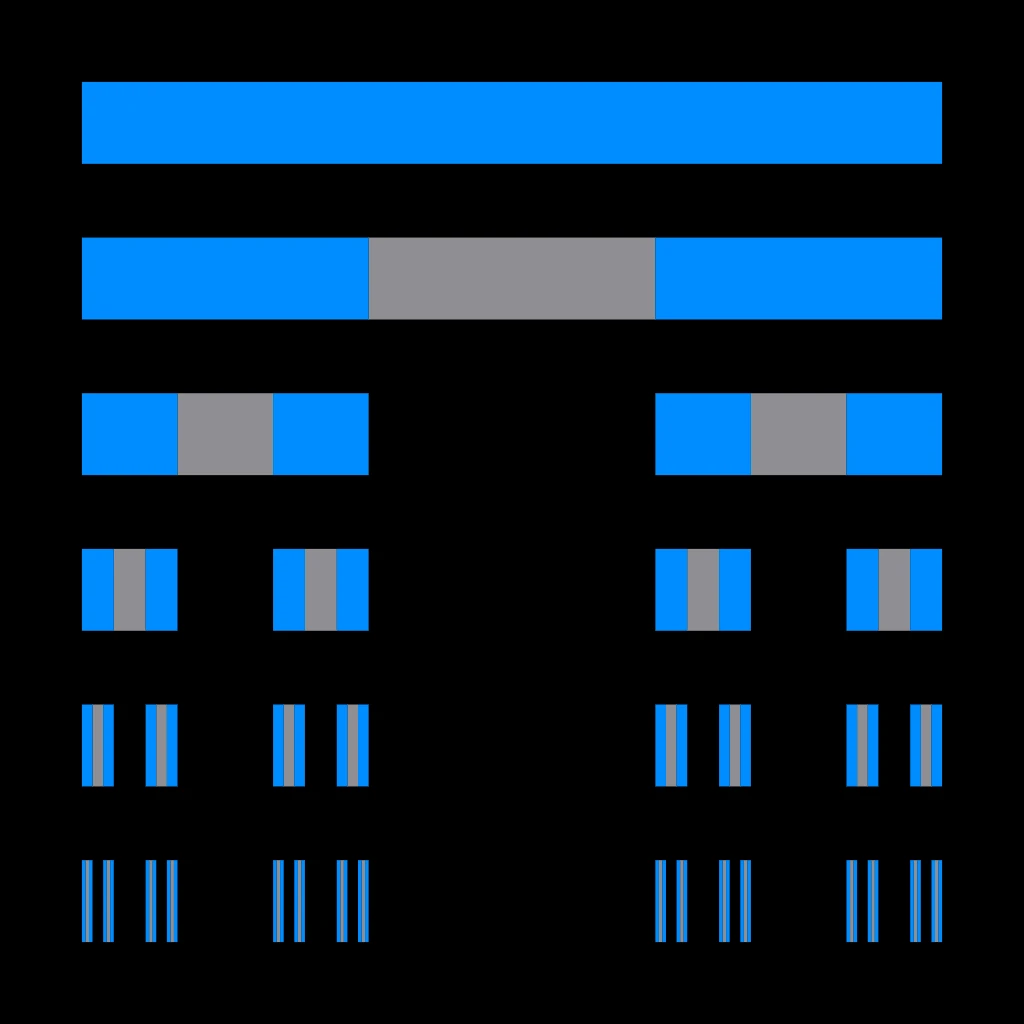
The Cantor set
Cut the middle third out of a line, then the middle third of every piece left, for ever. What survives has no length, as many points as the line, and added to itself fills an interval.
Start with the interval from 0 to 1. Cut out its open middle third, every point strictly between 1/3 and 2/3, and two closed pieces of length 1/3 are left. Cut the middle third out of each of those, and four pieces of length 1/9 are left. Keep going. At stage k there are 2^k pieces, each of length 3^-k. The Cantor set is what is never cut: the points that survive every stage.
The figure draws stages 0 to 5, one row each, from the whole interval at the top to 32 pieces of length 1/243 at the foot. In every row the middles cut at that stage are left faint, so each row is the row above with a hole punched in every piece.
Length drains away. Each stage keeps two thirds of what was there, so after k stages the pieces add up to (2/3)^k, which goes to zero. The cut middles add up to 1/3 + 2/9 + 4/27 + ... = 1, the whole interval. Yet a great deal is left. The end points 0, 1/3, 2/3, 1, 1/9 and so on are never cut, and there are far more points than those.
Digits say exactly which. Write a number between 0 and 1 in base 3, with digits 0, 1 and 2. The first cut removes the numbers whose first digit has to be 1, the second cut those whose second digit has to be 1, and so on. So a number is in the Cantor set exactly when it has a base-3 expansion with no digit 1. 1/4 is 0.020202... in base 3, so it is in the set, though it is never the end of any piece. 1/3 is 0.1, but it is also 0.0222..., so it is in too.
That reading shows how big the set is. Take a point of the set, change every digit 2 into a 1, and read the string in base 2. Every string of 0s and 1s turns up, so every number between 0 and 1 turns up: the Cantor set has as many points as the whole interval while having no length at all. That map, filled in flat across each cut middle, is the Cantor function, a staircase that climbs from 0 to 1 though it is level on every middle that was cut.
The set is two copies of itself, each shrunk by 3. A shape made of N copies of itself shrunk by s has dimension log N / log s, so the Cantor set has dimension log 2 / log 3, about 0.631: more than a scatter of points, less than a line. That is the fractal dimension in its simplest case.
A set with no length still carries a natural way to spread one unit of mass over it: give each of the 2^k pieces of stage k the mass 2^-k. That is the Cantor measure, and its running total from the left is the Cantor function. It is also the law of a random number: choose each base-3 digit to be 0 or 2 by the toss of a fair coin. Measures built this way, by splitting mass among shrunken copies with fixed weights, are the self-similar measures, and each system of shrinking maps and weights has exactly one (Hutchinson 1981). The Fourier transform of the Cantor measure is an infinite product of cosines (Morrison 1995), and it never dies away, which is the subject of Rajchman measures.
Now add. Take one point of the set, add another, and ask which sums you can reach. All of them: every number from 0 to 2 is the sum of two points of the Cantor set (Wikipedia). Halve everything and the proof is one line of digits. Half a point of the set has base-3 digits 0 and 1 only. Two such numbers add place by place with no carrying, and 0 or 1 plus 0 or 1 is any of 0, 1 and 2. So every number from 0 to 1 is a sum of two halves, and doubling gives every number from 0 to 2.
Picture it as a shadow. The pairs of points of the set form a dust in the unit square, the Cantor set times itself. The sum x + y is constant along each line that falls at 45 degrees, and the claim is that every such line crossing the square hits the dust. Two sets with no length make a sum with full length.
Newhouse turned this into a test. Build a Cantor set by cutting gaps out of an interval, largest first. Each time a gap is cut, compare it with the two pieces beside it, called its bridges. The thickness of the set is the worst ratio of bridge to gap over the whole construction. The middle-thirds set has every bridge as long as its gap, so its thickness is 1. Newhouse's gap lemma says two Cantor sets whose spans overlap must meet when neither lies inside a gap of the other and their thicknesses multiply to at least 1 (Yavicoli's survey). A number x is a sum a + b exactly when the first set meets x minus the second, which is exactly as thick as the second, so two sets whose thicknesses multiply to at least 1, neither with a gap wider than the other set, add to a whole interval. For the middle-thirds set with itself, 1 times 1 is 1, and the sum from 0 to 2 comes back.
Thickness is enough but not needed. Dimension gives the other side: for the regular Cantor sets that dynamics produces, two dimensions adding to less than 1 force a sum of length zero. Palis conjectured that for typical pairs there is nothing in between, the sum either has length zero or contains an interval. Moreira and Yoccoz proved the hard half: for generic pairs of regular Cantor sets whose dimensions add to more than 1, the difference set contains an interval, and keeps containing one when the pair is nudged (Moreira and Yoccoz 2001).
Particular pairs are another matter, and Erdos asked about one in the integers. Let A be the whole numbers written in base 3 with digits 0 and 1 only, and B the whole numbers written in base 4 with digits 0 and 1 only. Shrunk into the unit interval, A becomes a Cantor set of dimension log 2 / log 3, about 0.631, and B one of dimension log 2 / log 4 = 1/2. The dimensions add to about 1.131, more than 1, so size alone does not stop A + B from filling a fixed share of the integers. Erdos problem 125 asks whether it does, whether A + B has positive lower density. The answer recorded there is no: for every eps > 0 there are arbitrarily large x below which A + B holds fewer than eps x numbers, with the proof checked in Lean. Hasler and Melfi 2024 had shown that it holds at least a constant times x^0.9777 of them.
The pair is the integer shadow of a question of Furstenberg. A stays put when multiplied by 3, which shifts its digits, and B when multiplied by 4. No power of 3 is a power of 4, and Furstenberg's conjectures say that sets fixed by two such bases are as independent as their dimensions allow.
In the tree
Two bases takes the sum of the base-3 and base-4 sets as its Object S: the gap the sum leaves at every scale, the clean scales where it is symmetric, and its density read against the sum of the two Cantor sets in the continuum, and the three plus four demo lights those sums and the dark runs where a power of 3 nearly meets a power of 4. Complex dimensions treats the Cantor design {0,2} at base 3 as a fractal string and shows why its tube never settles, which is Minkowski content. The set is the base-3 case of missing-digit numbers, and its square and cube cousins are the Sierpinski carpet and the Menger sponge.